Ignite Seattle, an evening of fast presentations, runs like clockwork. We think of the evening as a show, and each of the 16 speakers we have at each events are the stars. We do all that we can to set the stage, the audience and the format to make it as easy as possible for them to do a great job. One key role is the host or emcee (MC). They are the first and last person on stage, tying all the pieces together for the audience. I’ve hosted many Ignite events and here’s my advice on how to do it well.
Before the event
Go watch someone else host. You will watch events differently if you are deliberately paying attention to the host. There are many little things good ones do that normally you won’t notice. Go watch your local Ignite and pay attention: what seems to help the audience and speakers? What doesn’t? How are they helping the audience stay engaged?
Point speakers at good advice for how to prepare. The speakers are the talent – you’re a fool if you don’t do everything you can to help them prepare well and to be comfortable and relaxed when they arrive. There are many good posts and books about public speaking: find advice you like on common mistakes and how to avoid them and share it. Here is the checklist I give to speakers, as well as a list of common mistakes I see speakers make. Ignite Seattle now even does live coaching with speakers a week before the event where we give them feedback on practice runs.
Get a slide wrangler. Since the event is a series of talks, you need to have all the slides on one machine, in one deck, with one person who runs them during the show. This eliminates the need to switch slide decks, or computers, which kills audience energy and wastes time. If you have 10 speakers, that’s 10 transitions, and even if each one takes 60 seconds, that’s two Ignite talks worth of dead time.
Confirm the speaker order with the Slide Wrangler. Since the slide order wins any debates with you as the MC, you don’t want a speaker up there when someone else’s slides are showing.
Know the seating plan. Speakers need to be lined up, in order, near the stage. This speeds transitions between talks. Make sure whoever controls the layout of the room is reserving enough chairs for all the speakers.
At the event
Get there early and say HI to all volunteers. Often Ignite’s have volunteers who help run the event. Be friendly to them. If anything goes wrong they’re the ones who will know about it first and respond, and you want to know who and where they are. As the host, you will be the person who has to explain, or respond to, anything that goes wrong in front of the crowd.
Speakers are depending on you. Most of them will be nervous. They need someone to tell them where to be and what to do. That is your job as host. You are not just host for the audience, you are also the host for the performers. Make sure they have what they need. A nice touch is to have a box of bottled water in the speaker waiting area – it’s a common pre-speaking request.
30 minutes before start, assemble all the speakers. Use the PA to ask all speakers to come to the stage. Introduce yourself and have a short meeting that covers: a) the order they’ll be speaking b) where they are supposed to sit c) letting them walk on stage to get their bodies comfortable with what it feels like d) a reminder of how awesome they are and how supportive the audience will be (lie if necessary).
Make sure you ask speakers how to pronounce their names. Have a pad of paper listing the speaker order, and when you ask them how to pronounce, write it down. You won’t remember otherwise. Plan to take that paper with you up on stage.
Make sure to give them a tour of the stage. By letting them walk on the stage you calm their nerves. Their bodies get to see what it will actually be like when they speak. if you don’t do this, they have to deal with the sensory surprise of what the lights, audience, etc. feel like. You don’t want to surprise your speakers.
If there are special instructions for where to stand, tell them. If the event is videotaped, wise videographers put a X, or other marker on the stage to let speakers know where to be. Speakers won’t know what it’s for if you don’t tell them.
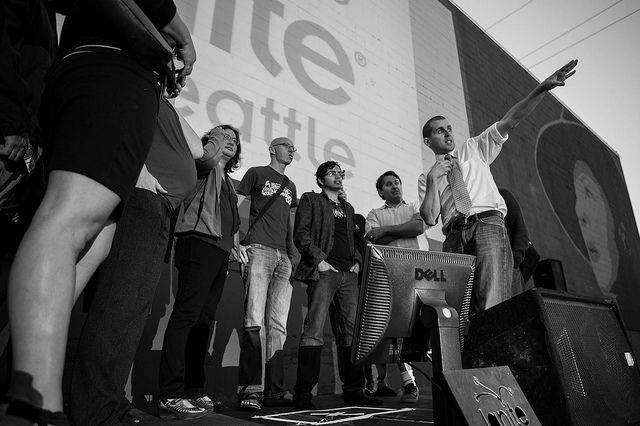
If there is a confidence monitor for them to use, tell them what it is. It helps speakers if they can see their own slides as they are talking. Most speakers will never have seen a confidence monitor before, so you’ll need to explain that it will indicate the current slide the audience sees, but will be too small to read (see image).
During the event
Have intro slides that explain the format. Many people will never have been to an Ignite before. Have an opening talk (preferably done as an ignite talk) that covers the basics. Here’s the slide deck I used at Seattle Ignite #17.
Your job is similiar to being a game show host. Your primary function is to add positive consistency to the event. You don’t need to do much, other than be happy, energetic, and enthusiastic for the speakers.
Make the transitions as smooth as possible. The reason for having speakers sit in order, near the stage, is to accelerate the transitions. Ask for a round of applause before, and after, each speaker. The audience will almost always oblige, and the speakers will perform better.
Be prepared to introduce people’s names and topics. On your host sheet that you bring on stage, list their name, pronunciation guide, and their topic. You should be able to say something brief and positive about each speaker. Have some variety of intros prepared as they can get repetitive: “I’m so excited”, “This should be a great talk on”, “this might be my favorite”, etc.
Milk the audience for applause. It’s fair for each speaker to get some applause as they take the stage and when they leave. Some audiences are lazy – it’s up to you to remind them.
If there is a break, let people know how long. It’s wise to break the event into two parts, with half the speakers in each part. If you do break, remind people how much time they have, where the restrooms or snacks are, etc. If you break, you should repeat the call for speakers 15 minutes before the 2nd half, to make sure they are all there and seated in the right place.
After the event
Thank your speakers. Ignite events often create community and you can help this by emailing your speakers to thank them for participating. Remind them if any videos or slides will be posted online so they can help spread the word. Create a ignite-speakers mailing list, so alumni can stay in touch. This can be helpful in finding future speakers or doing other events.
Have a debrief dinner with the other volunteers. Get together a few days later to review what went well and what could have gone better. Use this info in planning your next ignite.
Come back here and add your own tips. What other tricks do you learn that other hosts should know? Come back here and leave a comment.
America is one of the greatest countries the world and is often heralded as the best example of democracy (or republic if you want to be a stickler) in the world. Yet there are issues with how voting works in the U.S. worthy of examination. There are better ways to handle some of the details.
Voting is not in the constitution. Of the hundreds of democratic countries in the world, only a handful fail to mention voting rights in their Constitution. Even Iran and Lybia at least promise all citizens voting rights. The U.S.Constitution does not. Voting rights have been touched on in 15th, 19th and 26th amendments (race, gender and age) but many core elements of voting rights are left to the states to decide. States of course deserve their own rights, but national elections are worthy of consideration for national rules.
Our ballots are hard to use. Every state controls it’s own ballots. In the 2000 election the butterfy ballot was so poorly designed that many people voted for the wrong person. Some of our current ballots are not much better. Well written guides do exist for designing easy to use ballots, but every state has to choose to follow them (as opposed to Canada, where there is one voting ballot design for national elections).
The Electoral College is unnecessary. Few Americans understand how it works or why it exists. It mostly comes up in close elections where the popular vote won’t decide the winner. The electoral college was created in the 1800s as a compromise between two factions, one wanting the popular vote to decide, and the other wanting Congress to decide. The rules for how electoral representatives are chosen and if they can vote for someone other than who their state’s citizens voted for vary state to state.
It’s hard for some citizens to vote. People who have the hardest lives, including those working multiple jobs, the disabled, and single parents, struggle to make it to voting booths before they close. Many states allow absentee ballots to help citizens participate, but many do not. While we don’t want to make it too easy to do something this important, some efforts should be made to simplify the process (see lines in Florida and Ohio). Why not move a vague federal holiday like President’s day to be on election day, so citizens can honor past president’s by voting for the next one.
Presidential debates are privately organized. Question: Who decides who gets to participate in presidential debates and what the format is? The public? The Senate? U.S. Citizens? The answer is none of these. It’s a group of unelected officials, chosen largely by the Republican and Democratic parties called the the Commission on Presidential Debates. The debates themselves are sponsored by corporations (though what this sponsorship means is unclear). The debates are the only public discorse between candidates and should be protected from partisan and other influences.
It’s impossible for most citizens to run for office. Obama and Romney spent $933 million and $841 million respectively in their 2012 campaigns. While never an option for most citizens, the costs of running for office, including senate races, have increased, narrowing the demographics for who can participate. The test of who runs and wins increasingly has more to do with their bank account rather than their merits as a political leader.
While I don’t have specific proposals for solving these problems, and do recognize attempting to solve them might create more problems, you have to notice the problems before you can do anything about them.
What other problems do you see? What solutions do you have? Leave a comment.
Over the past two years I have written a light-hearted fitness blog specific to running. I am going to start turning it into a book. I am beginning the process of going back through my posts and searching in a “Table of Contents” type of manner, seeing what would fit…what won’t. My question is: How do you do to fill holes? I assume a book can’t just be post after post…but rather expand upon these posts as ideas and write and fill in around them?
Writing a book is one thing, writing a good book is something else. There’s no easy answer to your question as it’s very subjective.
It turns out you can just have the book be post after post. There are no laws against it. The Diary of Anne Frank, is effectively just post and after post and it’s one of the most popular books in the world. Montaigne, the dude who invented the essay, wrote a book on intentionally unrelated topics, yet he’s quite popular.Then again, many books from blogs are heavily criticized for having the exact same format as Frank or Montaigne. The difference then is:
The quality of the writing in the posts
The order you put them in
How interested a reader is in subject you’ve written about
The best advice then is to go look at other books made from blogs and see how they deal with the problem. Some examples:
Another wise approach is to make a draft version of your book and ask friends or readers of your blog to read the draft. Ask specifically for feedback on discontinuity between sections, and suggestions for other topics they expected to see to help close the gaps.
When you find a gap, you have four choices:
Add a new post/chapter to fill the gap
Change the order of posts in the book
Remove a post from the book
Rewrite one or more of the posts to better fit together
Good books apply these four choices better than the bad ones. But with books there are no rules to follow. You as the author have to decide for yourself what you want your book to be. Good luck.
Growing up in NYC in the 1970s, with a mere 4 TV stations, any show in regular rotation on PBS was seen by millions. One show on PBS was called The Joy of Painting, staring Bob Ross, who was born 70 years ago today (and died in 1995 at 53).
I had no interest in painting or the arts, yet I’d seen his show many times. There was something about his goofy looks and quiet voice that made him easy to make fun of as a kid, and we did. But watching him now there was always an intensity about him. As silly as he seemed to me then, beneath the soft exterior he was deeply serious about the power of painting. He believed what he was doing had meaning and could be learned by others.
I see him now as an unexpected inspiration (Rick Steves is another one). Ross was the first person I’d ever seen paint. Few working artists let cameras watch them over their shoulder as they work. And although Ross’s work was often rote and predictable, he was open about his methods. He believed in what he did enough to share what he knew and to teach as many people as he could. I don’t know many people who do or have done that.
Today as someone who writes about creativity I spend time studying how creatives do their work – until now I didn’t realize I’d seen countless examples of it as a child, thanks to Bob Ross, well before I’d even started looking.
One of his most popular sayings was ‘Beat the devil’ and here you can see him gleefully, and with just a hint of joyful madness, prep to do some work:
http://youtu.be/Pen4SXm0B98
Later on I’d discover and be inspired by Picasso’s film, The Mystery of Picasso, where he lets the camera watch him work. Few artists have ever done anything like this:
“It used to be said that the facts speak for themselves. This is, of course, untrue. The facts speak only when the historian calls on them: it is he who decides to which facts to give the floor, and in what order or context… a fact is like a sack – it won’t stand up until you put something in it.”
Among the most annoying platitudes we have is the saying “Always trust your gut”, a reference to your deepest instincts. This is mostly bad advice and I will explain why.
Our instincts (‘guts’) can say contradictory things. We often feel fear just before we do something we deeply desire, such as getting married, or interviewing for a job we really want. We can also feel great attraction to things that are bad for us (e.g. cheeseburgers and milkshakes). There is often no singular ‘instinct’ but a multitude of feelings that must be actively sorted out. Biologically there is little difference between fear and excitement, meaning it’s our psychology and attitude that has to sort out what our instincts trying to tell us. To be able to say “I’ve sorted through my instincts and here’s what I’ve decided” is a far better path towards good decisions.
We don’t know ourselves that well. Why do you like your favorite food but not the same ones your friends do? Why are you attracted to certain people but not others? Why do you make the same mistakes again and again? Most people are not aware of their instincts, or even why they make most of the decisions they do. You can’t trust your instincts if you don’t know what your instincts are trying to tell you. Some people know themselves better than others and have better reasons for trusting their instincts.
Instincts are situation dependent. Depending on what happened to you yesterday, the way your instincts respond to what happens today will change. Instincts are not static. We are heavily biased by recent events. The way we perceive threats and rewards changes. We are also prone to influence from people around us, and their behavior changes what our instincts tell us. We all have better and worse instincts for different types of situations, which means different instincts can help or hurt you depending on many factors.
Some of our instincts are better trained than others. If you are a trained artist your eye has been coached through hours of practice to see things most people do not. Your instincts for composition, form, balance and style may be finely tuned, better than many of your other instincts. To trust your well trained instincts is one thing, to trust your untrained ones is another. The advice ‘trust your gut’ assumes all of your instincts are well trained, when the opposite is true.
Good judgement comes from mistakes which comes from bad judgement (paraphrasing Will Rogers). To develop your instincts requires practice, which means making mistakes so you can learn from them. You need to experiment with trusting your judgement, but also not trusting your judgement, to get the experience needed for good judgement to grow. You need metainstincts – instincts about how to interpret your own instincts.
Data trumps memory. We have poor retroactive memories. When we pick X, and we’re wrong, we’ll say “Damn! I knew I should have picked Y”. Really? Are you sure? If you didn’t write it down and capture your thinking before you made the decision, you are going to be biased in how you think about your thinking afterwards. For tough decisions we often change our minds many times, which makes retroactive doubt useless. Sure, at some point you were leaning towards Y, but that doesn’t teach you anything since tough decisions require exploring multiple options. Simply because the outcome wasn’t what you wanted doesn’t mean you made ‘a mistake’.
You can succeed for the wrong reasons, and fail for the right ones. You can be correct in trusting your instincts, but due to forces out of your control, still fail. It’s also possible to ignore your instincts, and have everything work out great. A single trial is a shallow basis for evaluating anything. We have big egos and assume the outcomes for important things are entirely on our shoulders but that’s rarely true. Even worse, success hides more data than failure does. There are many very successful people who have no idea why they were successful, but don’t know that either and possibly never will.
[Updated] – Our instincts are easy to manipulate. Advertisers, marketers and salesman play on specific instincts and try to convince us to use them to override our own good judgement.
Sometimes you should trust your instincts, but even when you do, that trust should be earned, and trusted differently based on your experience with the situation you are in.
What do your instincts say about this post? Leave a comment.
(This post inspired by a conversation with Paolo Malabuyo)
#5. Braden Kowitz, Google Ventures, Pianos, Battleships, and Sneakers: Stories about Design and Failure.
He gave an excellent talk, with many real examples of failures he’s had in design. Best talk I’ve seen so far today.
He told a story from early at Google where he spent 3 months trying to make a perfect design, not showing his sketches to anyone. He finally showed it, and it was so overdesigned no one could figure it out. Waiting to unveil design is a mistake – it’s not art, it’s something that’s supposed to do something.
Reading books has limited value at skills. He learned tech skills by reading books, and gaining confidence, but this doesn’t work for skill development. You have to practice piano, not read books about it.
Design is learning through doing. Many young designers believe they are their work, and if their design fails, they fail.
Best suggestion is to dive into project and find a ‘piano’ tutor. Someone who knows more about design than they do and show them the way.
Google chat: they had a design for chat they’d developed, but in the first user test it completely failed. They tried again, failed again. The Designers often feel horrible at this point – in fact Braden is on a current project where this is happening.
Design is subtle – no one could have predicted which final design would work.
Why is there so much failure? He compares design to the game of Battleship. You are forced to continually guess at what a good design is, and people are moving targets. Example: the pull-down metaphor on iPhones. Apple didn’t invent it, but in just a few years people’s expectations have changed. People are a moving target.
Design then is really about dealing with failure.
One day sprint: Schedule user study for end of the day, forced to test something fast. Was working so fast he was afraid it would fail.
“Even if you are good at design, even at something specific like button placement, you can be wrong many times.”
When you run away from failure as a designer, you get less and less feedback. Instead you should lean in to failure, because it makes the intervals of ignorance smaller.
Have a running buddy – someone who helps set you pace for feedback, and helps get you out there in the real world.
#6. Mike Arsenault, Grasshopper, How Not to manage your product
Finally a solid case study structured talk about one specific startup, with specifics on key decisions, results and lessons. Bravo. Honest, smart and real. Well done. A model for future failcon talks.
Linear fallacy – most stories about sucess tell a linear story about how they became so successful. He showed a graph of his product trajectory, which was chaotic and far from a ‘hockey-stick’ [hockey sticks are incredibly abnormal and rare despite how much they are talked about]
Service was to help entrepreneurs find other entrepreneurs. Referral rates – earned $100k of referral revenue based on a referral form.
‘How can we productized this?’ That was the goal for the spin off product: Spreadables.
Staffed team of 12 experienced people, 40k customers from original business, and $100k of income… which was all done smartly. WE STILL FAILED.
They launched in summer 2010 and shut down in spring 2011.
They benchmarked: customer lifeitme value, cost per acquisition, avg revenue per user, Churn. And more.
Why did it fail?
Churn was 3X (Not enough matching between customers they got, and the ones they wanted).
CPA was 3x higher than Grasshopper.
Organic search was very low (compared to Grasshopper). This meant customer acquisition
Customers needed high touch
Lessons
Wasted beta list. Let it sit dormant and cold. Should have kept it ‘warm’ so it was active and ready to be useful when launched.
Team was too big (Mythical Man Month). Bigger team made more politics and lower velocity. Big team encouraged wrong behavior (build more!) instead of (build the right thing!). He would have kept team smaller.
Didn’t charge for 6 months. This was a product for businesses, not consumers and who would pay would have been a useful forcing function, and better data on responses to change (If you do something dumb with a free service, they stay anyway).
When people are paying you, their feedback is more pointed and engaged.
Product > Marketing. We focused on marketing too much too early.
“If you are doing more than writing code and talking to users, you are probably wasting your time”
It’s hard to make an event about failure work as most people most of the time feel shame about failure, even though it’s an unavoidable part of success and learning. It’s a fantastic idea for an event and I’m glad it exists. I’m sure it’s much harder to get speakers to speak here than other events, despite the payoff for everyone being much higher. The event went well, although the quality and the nature of the talks varied widely.
#1. Chip Conley, former CEO of Joie De Vivre Hotels, spoke about the role of emotions in failure and success. He didn’t linger much on the many failures of his life, as dramatic as they were, and moved on to suggestions for what he has learned.
Survived 2000 downturn and the great receision
Decided to reinterpret Maslow’s hiearchy into something simpler: Survive / Succeed / Transform
Which led to Money / Recognition / Sense of meaning, as the basis for their compensation model
Two useful equations:
Despair = suffering – meaining
Anxiety = Uncertainty x Powerlessness
Late in his career he felt like a prisoner in his own company. “I didn’t want to be CEO anymore”. He offered that personal crisis follows business crisis. Some of his friends that are entrepreneurs committed suicide, his son was put in prison, and he fainted on stage during a talk. He wrote his new book as a CEO who didn’t understand emotions and failure forced him to reevaluate.
#2: Suneel Gupta (GroupOn): The Case Against Someday.
I really wish he didn’t use Prezi. It didn’t help him at all. Some of his slides were unreadable too (low contrast text over background image = readability fail). He’s a fine speaker technically, but his material was a collection of tips and stories that needed more structure for me to follow. I had a hard time capturing his talk for that reason.
He told a story about working for Clinton. He was asked, as an intern, to close the door, by Rahm Imanuel, after Clinton entered the room. Gupta was so distracted by being in front of Clinton he completely forgot.
The second act is the scariest and unsexiest act of a startup.
He showed a video clip of Brian Glazer on the Charlie Rose show, who thought he could jump from being a law clerk to being a producer. He was told what ‘do you have? money? power? No, you have nothing.’ He was told to grab a piece of paper and start writing, and that was something he could own.
Parkinsons law is critical in the first act, because it helps you get to the second act, which many startups struggle to get to.
He showed a study of books written by Republicans and Democrats, and how narrow and separate the sources were (Was the point confirmation bias? I wasn’t sure. He went fast here so I couldn’t catch a name to look up online for more details.)
Interaction > Opinion – watching users gives a better perspective than people talking about what they think users will do (nod to basic user research methods).
Then he showed an embarrassing video of GroupOn employees doing a Gangam Style video. I really don’t know why he showed this. I think he was making a point about treating people well, but I’m not sure.
He finished by offering it’s amazing to work on the web, and in 2012, because we can fail very quickly and learn, unlike entrepreneurs in other fields and eras
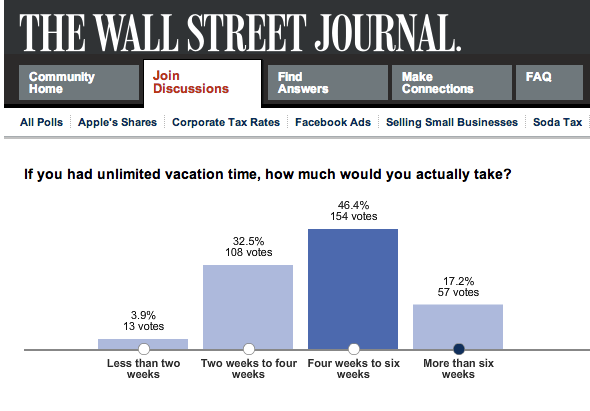
Of the 341 people not currently working from home:
63% of you said you’d work from home if you could
37% said you wouldn’t
Of the total 524 respondents:
33% already work from home
Since many of my readers work in tech fields, this is likely much higher than average
And some of you have magical powers:
14 people voted “my work transcends space and time”
I can use your help the next time I have a book to promote
Observations from the comments:
Many talked about hybrids (Reffel, Archer, Duff ), suggesting if the question was worded “work from home some of the time” more people might have said yes
Several commenters flagged the culture as critical. Some work cultures would make this easier than others.
It’s job dependent: some jobs are much harder to do remotely.
A top concern was perception of performance – the fear that if you worked from home, it’d be harder to prove you were working hard/effectively
Thanks everyone.
The Brooklyn Bridge is one of my favorite buildings. I’ve studied its history and the story of how it was built is also a favorite.
Here’s a great quote from one of the bridge’s engineers:
Man is after all a finite being in capacities and powers of doing actual work. but when it comes to planning, one mind can in a few hours think out enough work to keep a thousand men employed for years. -Washington Roebling
Assuming you could keep your same job and pay, would you work from home instead of working in an office?
Leave a comment about why you chose your answer.
[polldaddy poll=6610306]
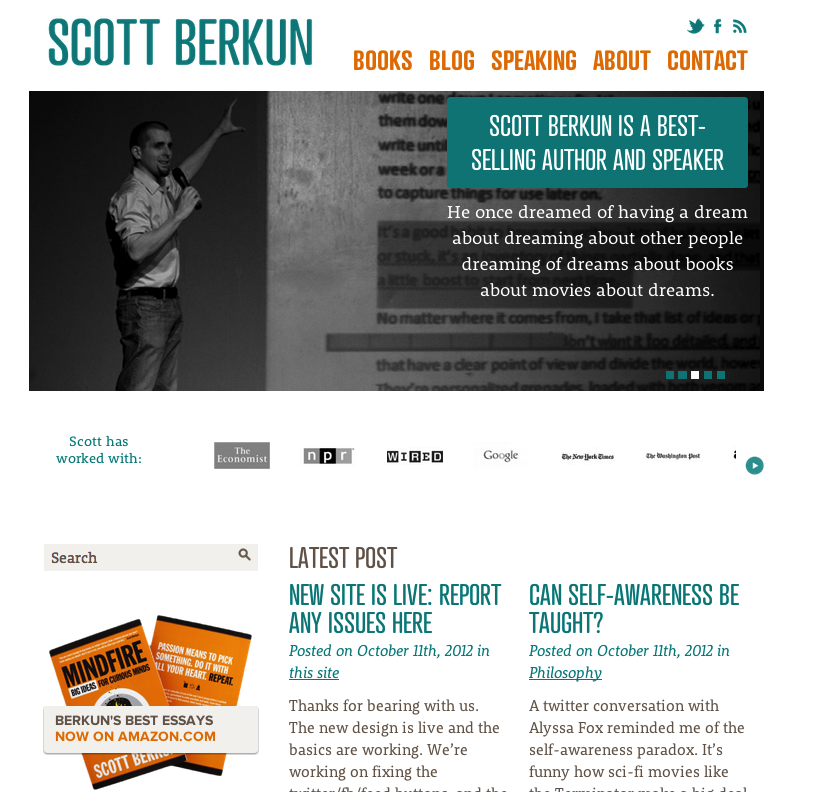
Thanks for bearing with us. The new design is live and the basics are working.
It should look like this:
We’re working on fixing the twitter/fb/feed buttons, and the mailing list signup form.
If you find other issues, from broken links or things on fire (that shouldn’t be) please report them here. Thanks.
Known issues:
We’re still dealing with some permalink issues. This should be fixed now. If you find broken links, please report them below.
There is a self-awareness paradox. To become more self-aware you have to be self-aware enough to realize how self-aware you are not. It’s a bootstrapping problem. Unless something happens that forces you to realize how inaccurate your view of yourself is, you can go through life never even knowing who you are. A twitter conversation with Alyssa Fox reminded me of this challenge.
It’s funny how sci-fi movies like the Terminator center on the fear of computers becoming self-aware. It’d be bigger news if most people became self-aware. Most of us aren’t aware of ourselves at all. Just ask our neighbors, coworkers and spouses. We laugh at other people who seem unaware of their own nature yet magically believe we are immune.
We all tend to reject negative things we hear in favor of positive ones, even if the negative ones are more accurate. Learning about our blind spots, weaknesses or insecurities is emotionally difficult. For some people even reading about cognitive bias, which effects all of us, is shocking and demoralizing. Discovering limitations is in most people’s psychology a kind of failure rather than the beginning of greater awareness.
As children we develop ways to avoid uncomfortable situations and information, and it’s part of how we’re able to survive. But those patterns often grow too strong. It’s easy to blame other people, at least in our own minds, for many disappointments we experience in life that are our own fault. Anyone who offers the complete and difficult truth is easy to avoid in favor of those who tell us what we want to hear, even if it’s limited or untrue.
Of course some elements of self-awareness are positive. We all have the potential to do things we don’t think we can. Discovery requires risk and life provides chances for everyone to make their own positive discoveries. There are natural rewards for seeking those kinds of self awareness. It’s easier for people in our lives to reach out and tell us the good things about us we don’t notice, rather than the weak spots they bet we’re sensitive to and are therefore afraid to try and help us see.
There are many methods that can help an interested person in learning more about themselves:
Meditation
Keeping a journal (and reading it periodically)
Traveling alone
Trying new experiences that challenge you
Seeing a therapist (a safe person you can be completely honest with about yourself)
Asking close friends ‘What am I not aware of about myself?’
Many of these are scary and for good reason as more self-awareness, for better and worse, awaits on the other side.
But for any of these to work requires you to want to be more self-aware. A teacher can only provide the opportunity, not the commitment. It’s easy to do any of these things without conviction. “Yes, I tried meditation. Didn’t work.” But why didn’t it work? That’s the question someone serious would ask. Or what does the teacher suggest might work? What if the thing you need to become aware of is that you give up too easily? How can you ever learn that if you don’t know it?
Even with persistence, it’s convenient to wait until the hard parts of an experience arises, right where a discovery is available to us, and reject it before we risk getting hurt. We’re great at inventing logical reasons to cover for the things we’re scared of. Fear is twice as powerful when we call it by other names.
Having spent many years in teaching roles I’ve experienced enough students who simply did not want to learn that I can’t put the burden on the teacher. Or perhaps I simply wasn’t a good enough teacher for them to want to learn? I have no doubt that’s true. But no teacher can reach every student.
Self-awareness, the trickiest thing to develop, is a paradox: to become more self-aware, you have to be aware enough about yourself to know you need to know yourself better. How can anyone possibly teach this to anyone else?
Do you think you are self-aware? Do you think self-awareness can be taught? How?
There are only 4 steps:
Do it
Get feedback on how you suck
Study how to improve at where you suck
Repeat
People tell me this is obvious. But it’s ok to be obvious. Knowing and doing are different. Many people know many obvious things they fail to try or do, despite their knowledge.
I’m often asked for advice about writing. My first question is always “how much do you write now?” If they say, “I don’t really,” I say “Go write something. Anything. Then get feedback on it from someone who knows more than you.” There’s often a look of surprise or fear as if to say “I have to actually do the thing?” They’re afraid to even try. Their ego has made doing even a small task very expensive, when it should be very cheap. Their expectations for their own work should naturally be low and useful feedback is easy to find. It’s their ego that’s in the way more than anything else.
If they tell me they’ve written, I ask them how they think they need to improve. If they don’t know, I tell them to get feedback from someone who sucks less than they do. None of this is complicated. It’s not even expensive. The problem is everyone wants to skip steps 1 through 4. No one in history has ever become good at something by skipping these steps, yet everyone wants to try.
For most skills you can do #2 and #3 on your own. Read your own writing. Watch a video of yourself speaking or playing basketball or whatever it is you want to get good at. If you have read good writing, and watched good speakers, you can easily identify your bad habits. A coach or a teacher can help you move through these steps faster, but you can do them on your own, for free, with enough courage and persistence, two things everyone knows about, but few people have.
We’re all going to die, all of us. What a circus! That alone should make us love each other but it doesn’t. We are terrorized and flattened by trivialities, we are eaten up by nothing.
– Charles Bukowski
I have a fascination with religious history. It’s a fantastic lens on the history of civilization. I’ve never had much faith, but the history of it, and the details of various scriptures have held me fascinated for years. The way the roots of all religions wind together mythology, history, culture, selfishness, compassion, wisdom and ignorance is an amazing way to understand our species.
A few weeks ago I visited Israel. I spent three amazing days in Jerusalem. On returning, my passion for history was rekindled and many books I’ve read since I returned were about religion and religious history.
The prize gem of this research has been one book: Jerusalem: One City, Three Faiths by Karen Armstrong. It focuses on religions that trace back to Abraham, so there is no coverage of Hinduism, Buddhism, or other beliefs, but many of the lessons I learned from Armstrong have clear applications to any system of belief. The book is short, powerful and well written.
The book uses the city of Jerusalem, a central place in Judaism, Christianity and Islam, as the focal point for history of all three faiths. From the shift from paganism to early Judiasm of the Old testament, to the birth of Christ and the diaspora of the Jews, to the rise of Islam, and the centuries of fights over a very small piece of land, many of the questions you’ve had are answered here.
Armstrong focuses on history, not faith. She clearly has knowledge of all three religions, as those are discussed, but her intent is to provide a balanced view not dependent on a particular belief. The book has been criticized by some for it’s lack of balance, but I found her view, as someone with little at stake, impressively fair . Her main bias seems to be towards compassion and against violence, as she critiques everyone when they fall short of their own scripture in this regard.
Some of the facts I enjoyed most were:
Early Christians used the fish as their sign (a symbol of peace and miracles). After the Roman’s codified the religion, the cross became the sign, a sign Constantine associated with war (Hey, he was a Roman.)
The Christian focus on the cross, and crucifixion, began only around 400 A.D with the ‘discovery’ of the true cross. This returned the focus of the religion back to Jerusalem, and began the waves of pilgrims that would eventually lead to the Crusades.
Jerusalem has been destroyed over 40 times, and has changed hands as many times.
There were many other gospels. The Romans and church leaders decided which to include and reject under Constantine in 325 A.D.
There have been periods of peace and tolerance by each faith somewhere in the history of Jerusalem, including between Jews and Muslims (tolerance of other faiths is supported by all three scriptures).
Powerful leaders in all the faiths have been incredibly petty at times, sometimes horribly cruel, contradicting the compassion in their faith.
The core tenets of all three faiths are incredibly similar, a reflection of the derivation from the same source stories.
I’ve always wished every citizen of the world had to take a short course in comparative religion. It would stop a lot of violence. This book would make a fantastic start. If you have any curiosity about the links between faiths, I highly recommend this book.
Recently my friend Jared Spool posted on twitter about why it’s wrong to give interview candidates design exercises:
Asking a candidate to perform a design exercise so you can “see how they handle the pressure” is unethical. #DanceMonkeyDance@jmspool(#)
This split me right down the line.
First, I think most interviews are bullshit. There’s little evidence interviewing identifies better candidates than other methods do, it’s just one we are all familiar with, and it’s easy, so we do it. Any questioning of job interview practices makes me happy, since we put great faith in something we’ve never examined that is filled with bias. Some interviewers are sadists who never have to justify their cruelty since it’s never questioned.
The ideal way to hire is to use referrals and references of people you trust in your line of work to arrive at candidates. And then, to hire a candidate to do a small project for you where they can demonstrate their ability. That is the best interview in the universe since it is based on what they can actually do for you on real work, rather than an absurdly artificial interview loop of mostly cliche conversations. To do this requires more work and is less efficient, but I’m convinced the results are dramatically better.
However, assuming I’m required to interview candidates, there’s value in asking people to show their ability to do tasks I’m going to hire them to do. If they were a painter, I’d ask them to give their opinion of the paintings in my office. If they were a carpenter, I’d ask them to evaluate the furniture in the room. I’d pick something real, in the present, where their abilities and knowledge should apply, and get out of their way. “How would you make this better?” and hand them a whiteboard pen and step back. I’d want to see what questions they ask and what they know about what they need to know before they can design something. I can do this in a friendly way, and at natural points politely disagree with them, just as I would if we worked together.
The idea of “see how they handle the pressure” is a tricky one. Most work environments are not designed around designers. To be successful a designer needs to be willing and able to persuade, convince and persist in selling or defending ideas. While I’m not certain there is a reliable way to test if a person is capable of doing this during an interview, it’s my job as an interviewer to try. I have to find places to challenge and ask tough, but fair, questions, to let them demonstrate their conviction in their ideas. As well as their ability to change their minds and learn from new information.
Or put another way, if I were hiring an Air Traffic Controller, I’d need to know they can handle the stress of being an Air Traffic Controller. It wouldn’t be unethical for me to expect them to demonstrate something of what I need to see to know they are credible. While the means I use to get this information could be unethical, my interest in getting that data isn’t – it can’t be. It’d be unethical to all the passengers of all those airplanes if I hired someone without even attempting to learn about their abilities for a key part of the job.
All of this is obviously more abstract and collaborative than having them build a chair, or paint or a portrait, while I yelled at them through a megaphone while timing them with a stopwatch. That’s a game show, not a job interview. But if done right a design exercise is a chance for them to lead the conversation through a problem. And if leading the way through a problem is something expected of them in the job, it’s reasonable to provide an opportunity for them to do it during the interview process.