Remote work expert David Tate wrote that when fearful CEOs talk about workplace culture, they’re really talking about workplace control. Their insecurities demand that the way work is done by employees is always visible, highly regulated and uses the methods executives prefer, rather than what’s best for everyone’s productivity. Remote work is seen as a threat to many CEOs simply because of their fear of change and resistance to progress. That fear leads to an irrational rejection of remote work, instead of a thoughtful examination of where it has succeeded and what can be learned.
In her May 6th Washington Post opinion article, I worry about the erosion of office culture with more remote work, CEO Cathy Merill makes two fundamental mistakes common among fearful executives. First, it shows an ignorance of alternatives, as many organizations have worked remotely for years before the pandemic and have solved problems she considers unsolvable. She may not prefer these approaches, but her lack of awareness of them is incompetence. Second, she is infantilizing her employees by presuming they are not capable of and motivated to be productive and collaborate even when the CEO can’t see them down the hallway.
We are over a year into a pandemic and an era of great social unrest and uncertainty, yet Merill has chosen remote work, and not other likely psychological or cultural factors, as the singular reason why workplace performance has declined. And if this wasn’t enough of an oversight, her evidence against remote work consists mostly of examples from executive friends of their self-described management incompetence.
She offered the story of an anonymous CEO with a new but struggling employee. Yet none of the leadership team did anything about it:
A friend at a Fortune 500 company tells of a colleague who was hired just as the pandemic hit. He struggled. He wasn’t getting the job done. It was very hard for the leadership team to tell what the problem was. Was it because he was new? Was he not up to the work? What was the specific issue? Worse, no one wanted to give him feedback over Zoom when they hadn’t even met him. Professional development is hard to do remotely.
This is simply a management failure. Does this company not have telephones? Or email? Have they never worked with a vendor or client that wasn’t in the same building? They are responsible for helping this employee regardless of what technologies are available or not. This is inept management hiding behind technological fear.
Merill estimates that 20% of work is helping a colleague or mentoring more junior people, extra work that she feels is impossible to do remotely. This is despite dozens of popular collaboration tools and mentoring programs that work entirely online. It also denies the dozens of remote corporations like Automattic and Citrix that have vibrant work cultures where these “extra” activities are successfully done remotely.
Merill and her peers might not like these alternatives, but she never explains why. She even goes so far as to suggest that remote workers should be paid less and lose their benefits, since in her estimation they will never be able to contribute in these extra ways. She effectively threatened her own staff through the article (she apologized later after her staff revolted).
If the employee is rarely around to participate in those extras, management has a strong incentive to change their status to “contractor.” Instead of receiving a set salary, contractors are paid only for the work they do, either hourly or by appropriate output metrics. That would also mean not having to pay for health care, a 401(k) match and our share of FICA and Medicare taxes
One quality of a great CEO is the ability to look into the future and show their organization the way forward. Instead of blaming employees, they take responsibility for solving problems. For every serious issue that arises they ask themselves what can I do or change in my own behavior that can lead my staff to a better place? They diversify their network to ask “who has solved the problem my organization is facing somewhere else and what can we learn?” Or perhaps most critical of all, they invite their own employees to participate in both defining the problem and exploring ways to solve it, instead of drawing lines in the sand and assuming the only way forward is the one that makes them the most comfortable.
Technology is often seen as a silver bullet, oversold as the magic solution that can solve hard problems. This overestimates what a technology can do, as often it’s the management culture that is the real cause. But in the case of Merill, her CEO peers and remote work, technology is being used as a scapegoat. It’s the safe target to blame as it requires no introspection or accountability. Leaders that do this become fear-driven, allowing their competitors an advantage simply by exercising curiosity and seeking new knowledge. Smart CEOs chose to invest in their work culture and grow it for the future instead of hoping for the past to return.
[UPDATE: the book is no longer free! Sorry if you missed it. We gave it away to all for over a month and more than 15k people downloaded the popular book. Hope it helps people figure out our new working world. You can of course still buy the book in various formats].
I worked with Wiley, the publisher of The Year Without Pants: WordPress.com and The Future of Work, to make the digital editions of the book free to all. We’re doing this to help anyone who is adjusting to remote work acclimate to what the next few weeks or months will be like.
[On Tuesdays I write about the top voted question on Ask Berkun (see the archive). This week’s question is from Regina [330 votes]: What gaps in communication exist in global virtual teams? Which I have simplified for your reading pleasure to why remote workers fail.]
The best argument about the viability of remote work is that it’s about results: any boss should let their good employees work remotely on a trial basis and see how it goes. If they can perform just as well, and their coworkers have no complaints, what’s the problem? You lose nothing and have a happier employee. Sadly many managers are afraid to try new ideas of any kind, which suggests they’re not all that great at being the boss anyway, but that’s a topic for another post.
Even when a remote experiment is done, and it fails, often it’s the remote worker, or the very idea of remote work, that gets scapegoated. This is sad. It’s far wiser to start by blaming the manager instead. Why? Well the Leffert’s Law of Management states that the starting assumption for managers should be that whatever is going wrong is their fault, and this rule applies to remote work too. A good boss realizes it’s their job to create an environment their staff can perform well in and remote work is just another scenario they should be taking responsibility for.
This sets the stage for the five most common reasons why remote workers fail:
No ally in the main office. If there is a primary physical office, it’s hard for remote workers to know what they’re missing. Someone has to look out on their behalf in meetings, hallway discussions or post work happy-hour chats. No one likes having their time wasted, but without an ally decisions are often made that are not communicated to remote workers, even when those decisions directly impact them. It’s not hard to learn the habits of being an ally, but someone has to lead the way. Some workplaces adopt a remote-first culture, where as many discussions, meetings and processes are done online, and with tools that can be used from anywhere and at anytime (which often benefits “non-remote” workers too, as all conversations are archived and searchable, people can be more productive when traveling, etc.). The boss is the most obvious ally for a remote worker, making sure their perspective and needs are represented.
Cultural bias towards caution. Amazon and other companies talk about bias towards action as a key part of their culture. This means the default posture every employee is expected to have is to be aggressive in making decisions and taking action, rather than waiting to be told what to do or taking endless precautions before acting. Remote workers are more likely to do well in these cultures, as their autonomy becomes an advantage, rather than a source of frustration. Bias towards action also tends to create more resilient employees who are comfortable identifying and solving problems (including perhaps diagnosing co-ordination frustrations involving remote workers). The more overhead and coordination required by a culture, the more pressure that’s put on remote communication tools and the team’s ability to communicate well (see #4).
Poorly defined role. Remote workers benefit from clearly defined roles where they have more freedom to decide on their own how best to use their time and resources. Even if their role requires high collaboration with other people, explicitly stating what’s expected, what powers they have and how their performance will be measured is essential to their success. Of course poorly defined roles are a problem in any organization, but the negative impact is amplified with remote workers. A role likely needs to be reevaluated, and possibly modified, when it’s transitioned to a remote position.
Poor culture of communication. When you work remotely you depend heavily on written communication: email, chat rooms, and more. Organizations that have cultivated excellent communication skills make it much easier for people to work remotely, as it’s built into the culture to ask clarifying questions, to be helpful to coworkers and to document processes and decisions in a way that other people can easily comprehend. One of the great discoveries I made when I worked for WordPress.com (Automattic Inc. is 100% remote) was how thoughtfully everyone wrote and read, and at every level of the organization. It’s taken for granted that most organizations in the world consistently hire people with good communication skills, but in reality good/mature communication skills are uncommon, and the price paid for poor communicators is amplified for remote workers.
The wrong person was hired. Hiring good people is hard enough, but to hire someone for remote work demands extra care. Remote work isn’t for everyone. Some people depend on the energy they get from being physically near their coworkers, or the psychological value of going to a physical place to “do work” and leaving to go home. Remote workers often need above average organization skills and self-awareness of their working habits. Being proactive as a remote worker is a major asset, as even in an organization with allies and a bias towards action, remote workers by definition must take more responsibility for themselves than other employees do. Automattic wisely hires by remote trial, which makes a candidate’s remote working skills part of how they are evaluated.
Despite the suggestion of the image shown below, it’s uncommon for remote workers to fail because they abused their privileges. Many people who choose to work remotely greatly appreciate not having to commute in traffic, value the ability to easily take care of their family (if they work from home) and the superior control they have over their lifestyle when compared to more conventional employment. It’s for these reasons I advocate workplaces give it a try and for people to ask for it. There’s much to gain and little to lose.
Have you seen other reasons why remote workers fail? Have a theory? Leave a comment.
As a general rule the slowest thing to change about civilization is human nature. It’s easier to upgrade technology, but when it comes to people’s habits and beliefs change takes time.
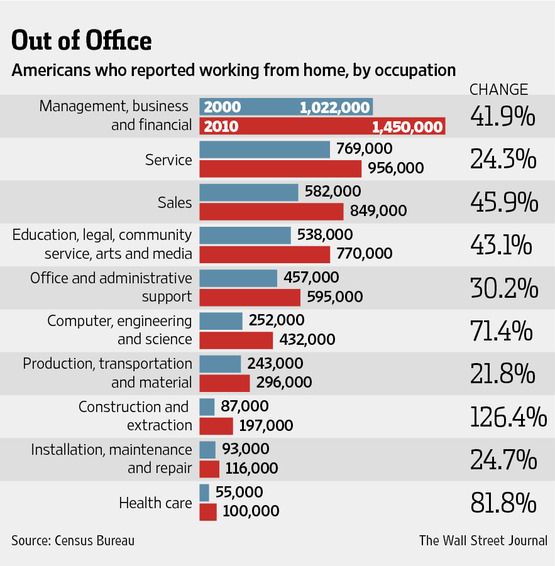
1. Remote work is more popular than you think
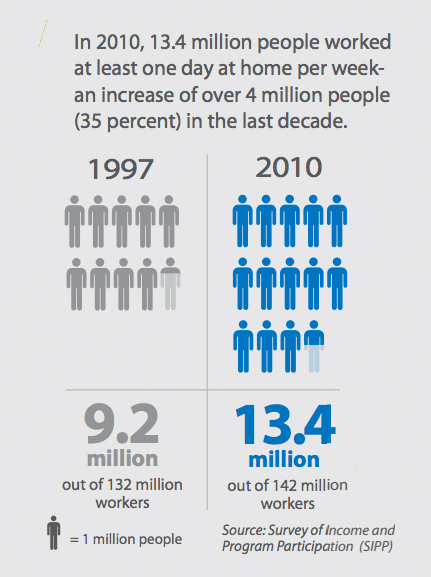
We have poor conceptions of wider trends: our basis for opinions is anecdotal and prone to many kinds of hidden bias.
And the data across all working people in American (about 142 million) shows an increase in 4.2 million people who work from home part of the time:
2. You do remote work every day without realizing it
How much of your daily work is done through a computer screen? 30%? 50%? At any moment you are working through a screen, you could be anywhere in the world while you’re doing it. Whatever benefits there are of being in the same office, when working strictly through a screen those benefits are neutralized.
Every mobile device and laptop is by definition a remote working tool. Pay attention to how much time you actually spend each day in the same room talking in real time to other people – it’s far less today than ever in history (I don’t have data for this, but I’ve rarely heard counterarguments). Even in companies that do not allow “remote work”, remote work is encouraged implicitly by the equipment used and the daily working habits we’ve adopted across our culture. The resistance to the concept of remote work is strange, given the reality of most office work.
3. It’s often smaller companies that are willing to try new ideas
Most companies on the list I’ve compiled of 100% distributed/remote organizations are small, young, and technology centric. Some, about half, started as distributed companies with one or more of the founders living in a different city than the others. 50 years ago it’d would very hard to start a company that depended on remote work, but the technology of the last 10 years has made it easier, and in some cases preferable, to base a company on remote work. These are new times and the assumptions we have about work need to change.
Managing remote workers requires different skills from managers and employees. The skills are not hard to learn, but they are real. I wrote The Year Without Pants: WordPress.com & The Future of Work to document my own experience as a traditional manager forced to learn this new way of thinking and to show what it was really like.
Even in large companies, it’s often younger managers, on younger projects, that are willing to experiment and try new ideas. Remote work is one of many new ideas about work and productivity. See How To Convince Your Boss To Try New Things and How To Change A Company for specific advice for your organization if you’re looking to push your company forward, on remote work or anything. The book Remote by 37Signals is a great companion to the Year Without Pants for advocacy of remote work policies.
4. Many companies are dysfunctional
We have a paradox about progress: many people complain about how stuck in the past their organizations are, yet point to the lack of adoption of remote work as an indicator of it’s uselessnesses, rather than a reflection of their organization’s fearful grip on the status quo. The people with the most power in any organization can be the most afraid of change. Remote work forces managers to reevaluate what good work is, and how to measure it, a reevaluation many managers don’t want to do (See: Work vs. Progress).
Remote work, like many progressive ideas, depends on company culture. A company that is truly progressive, trusting, collaborative and communicates well will fare better with remote work than one that is hierarchical, political and territorial. I wrote Why Culture Always Wins to capture why WordPress.com (and WordPress itself) are able to use remote work to its fullest advantage: remote work fits their philosophy of empowering talented people and keeping management out of the way of progress as much as possible. Organizations that see middle-management as the most important talent in the organization often struggle to see how remote work can function well at all.
5. Remote work, like commuting, is not for everyone
We have widely diverse preferences for how we work. Some people commute one hour each way, every day. That’s ten hours a week in a car or bus. Some people would find this unacceptable, others like the tradeoff. Generally we have many work traditions that don’t make much sense anymore in the abstract (e.g. 9 to 5 working hours, strict dress codes, etc.) but changing traditions takes time. More importantly, each person decides for themselves what the preferred combination of variables are and tries to get them for themselves. Remote work is another variable in the conversation between employers and employees and how they define what work is.
6. Remote work requires skills workers and organizations might not have (added 1/8/15)
If digital media is the only way workers communicate, it means everyone’s collective habits about email, Skype and other communication tools are critical. How well people write and how thoughtful they are about giving their coworkers what they need to be successful becomes more important. Remote work often means working with people in different time zones, which requires an extra level of awareness on everyone’s part for scheduling and planning. Most of these are soft skills, which are sometimes easier to hire for than to train. Soft skills can be far harder to teach, or find people with, than hard skills.
Often when a company experiments with remote work and it fails it’s because they didn’t notice or anticipate the shifts required in their assumptions. They chalk up the failure to “remote work doesn’t work” rather than “we’d have to adjust our assumptions and habits to benefit from remote work and we’re not willing to do that now.”
Remote work should be a benefit workers can choose to use
My hope is more managers realize it’s in their self interest to give good employees the choice to work remotely. It’s in any manager’s benefit to encourage workers to find ways to be more productive. If you hire a talented professional they will know best how to be most productive and do their best work. And of course some companies will default to remote work, like Automattic and others have, and this is great too. Having more kinds of companies is a good thing.
Many workplaces offer benefits to employees that go unused (discounted gym memberships, etc.) – it reflects choice, not a failure of the benefit. Some workers will always prefer to be in a physical office, and that’s fine. But if they’ve never worked remotely when will they get a chance to see if it benefits them? The option to work from home when needed, or to try a different lifestyle without having to change jobs, is a win for everyone.
I’d like to measure how many companies offer remote work to their employees, rather than only how many use it. On its own it’s a good indicator of the health of an organization in demonstrating their interest in attracting and retaining talented people.
Four years ago, on August 4th 2010, I was hired at Automattic, makers of WordPress.com, as the first leader of Team Social. It was the beginning of a journalistic writing project that would become The Year Without Pants, an Amazon.com best book of 2013.
There were many crazy things about the idea which is why I was so excited to do the project and why I’m proud of it now. I look back fondly on the entire experience, including all of the mistakes I made along the way. I still think often about the 20 months I worked on WordPress.com with my team and those memories stay with me today. If my biggest dream wasn’t to keep writing books, I’d probably still be there.
Thanks to Matt Mullenweg Toni Schneider, Mike Adams, Beau Lebens, Andy Peatling, all the great folks I worked with, and everyone who has supported the book since its release last year.
A great fallacy born from the failure to study culture is the assumption that you can take a practice from one culture and simply jam it into another and expect similar results. Much of what bad managers do is assume their job is simply to find new things to jam and new places to jam them into, without ever believing they need to understand how the system—the system of people known as culture—works. Much like the frustrated moron who slaps the side of a TV when it stops working, taking action without understanding the system rarely helps.
A favorite example of this tragic management habit is how in 1999 the famous design firm IDEO was featured on ABC’s popular Nightline TV show. They demonstrated an idea development technique they used called a “deep dive” to redesign a shopping cart in just five days. Soon hundreds of companies were doing their own half-baked versions of deep dives, and, surprise, the results were disappointing. Somehow, despite how dedicated some were to following all the steps and all the rules, an element was missing, and they couldn’t match the results they’d seen on the show. The missing ingredient was, of course, the primary one: the people involved. Watchers of Nightline worked at places with employees who were not as talented in design as IDEO’s. But beyond their talent, IDEO employees shared values and attitudes that were not explicitly captured in the deep dive method despite how essential those things were for the method to work. In anthropology terms this superficial mimicry is called a cargo cult, a reference to the misguided worship of abandoned airplane landing strips among tribes hoping for the goods airplanes had delivered to return.
Every year new trends in work become popular in spite of their futility for most organizations that try them. These trends are often touted as revolutions and frequently are identified with a high-profile company of the day. Concepts like casual Fridays, brainstorming sessions, Lean, Six Sigma, Agile, matrixed organizations, or even 20 percent time (Google’s policy of supporting pet projects) are management ideas that became popular in huge waves, heralded as silver bullets for workplaces. The promise of a trend is grand, but the result never is. Rarely do the consultants championing, and profiting from, these ideas disclose how superficial the results will be unless they’re placed in a culture healthy enough to support them. No technique, no matter how good, can turn stupid coworkers into smart ones. And no method can magically make employees trust each other or their boss if they have good reason not to.
The best approach, perhaps the only approach, is an honest examination of culture. But culture is harder to understand than a meeting technique or a creativity method. And culture is scary because unlike techniques, which are all about logic, culture is based on emotion. Few people have the skills to evaluate, much less change, a culture, even if they have the courage to try. It’s far safer to simply wait for the next trend to come along and rally behind it, hoping the excitement for the new method distracts everyone from noticing how little impact the previous method had.
In my story so far at WordPress.com, every employee I met was smart, funny, and helpful. They’d invested heavily in tools and systems but put the onus on employees, even new ones like me, to decide how, when, and where to do their work. These attributes of culture didn’t arrive by some technique sprinkled around the company years after it started. How did it happen, then?
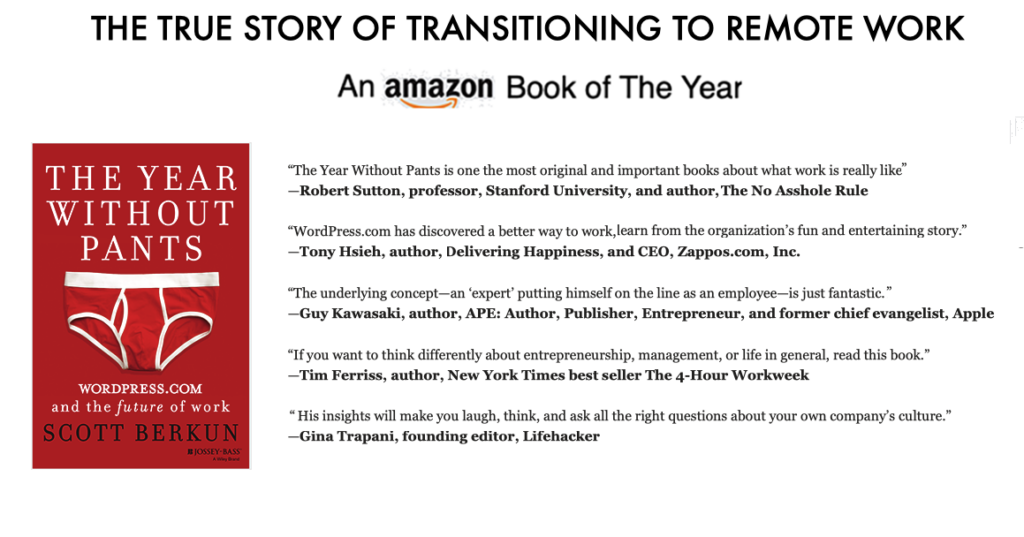
Praise for The Year Without Pants, an Amazon.com best book of 2013, includes:
“The Year Without Pants is one the most original and important books about what work is really like, and what it takes to do it well, that has ever been written.”
—Robert Sutton, professor, Stanford University, and author, New York Times bestsellers The No Asshole Rule and Good Boss, Bad Boss
“The underlying concept—an ‘expert’ putting himself on the line as an employee— is just fantastic. And then the book gets better from there! I wish I had the balls to do this.”
—Guy Kawaski, author, APE: Author, Publisher, Entrepreneur, and former chief evangelist, Apple
“If you want to think differently about entrepreneurship, management, or life in general, read this book.”
—Tim Ferriss, author, New York Times bestseller The 4-Hour Workweek
Powerful people often become conservative. Once they’re in charge, it’s easy to feel that the knowledge that helped them rise into power is all they will ever need. This means that despite the platitudes about wanting new ideas, many bosses are hard to convince to try new things. They have more to lose now, so their preference for the status quo increases.
We read books, take courses and go to events, often with the support of our bosses, under the pretense change is possible. But often they find ways to kill ideas, gently or passively, and not much happens. It often takes a different way of approaching the problem to get a powerful person to do something new.
Here’s a quick guide for how to convince your boss:
Have a great reputation. The best leverage you have with any boss is your performance. They’re more likely to consider suggestions from the highest performing person on the team than the lowest. Before you present the grand revolutions you want them to lead, make sure you’re in good standing. Be patient. Match the size of your suggestion to the quality of your reputation.
Consider what problems your boss needs to solve. Don’t start with your problems or what things you want to try. Instead think about the world from the perspective of your boss. What are their goals? What do they need to do to succeed? What achievements are they striving for? What will get them promoted? A good pitch is based on the catcher.
Match what you want to try to their goals. Frame anything you want to try in terms of how it might help your boss. Will it have a chance of helping reach their sales quota? Will it help them get better clients? Will it save them budget? At minimum, think about your own productivity and morale: why should your boss care about improving these things? Consider that and make it part of your pitch. You may discover that there are far better things to suggest than the idea you originally had.
Get support from respected coworkers. If your idea is good you should be able to get a coworker or two to also want to try it. Provided the boss respects their opinion, their interest helps support you. In some cases it might even be better if someone other than you makes the pitch. If you have a good relationship with the peers of your boss, especially peers they respect, consider trying to get them involved.
Look for books and respected organizations that support the thing you want to try. Find companies your boss respects that already use the practice you have in mind. There are often books and papers that can help support your case. Of course getting your boss to read them is another matter, but your consumption of them will better inform you of answers to questions your boss is likely to have, and most importantly, refine your own thinking about the realities of the thing you want to try. Maybe it’s not such a good idea. Or perhaps there is a different way of thinking about the problem that’s more useful.
Plan for a trial. Minimize their sense of risk by suggesting you try the new thing on a trial basis: a week or a month. Also propose a list of criteria for how to evaluate if the new thing was successful after the trial is over. If you’ve never pitched your boss on anything before, pick the smallest simplest version of the thing you want to try. Minimize the risks and earn some trust for the next time you have something you want them to try. Pick a safe and small project that has the fewest risks, or that is only of moderate importance.
Make the pitch. Remember that most people in power respond differently to pitches when they are in front of a group vs. when they are by themselves. Find a situation that provides the best opportunity, based on when your boss is most responsive to suggestions (email? in your performance discussions? at coffee?) Define the problem (in terms the boss relates to), offer the solution, define the (trial) terms, and reference what other companies already participate. Observe how other people pitch your boss and what tactics work best (See: How To Pitch An Idea).
Work very hard to make the trial work. Your future reputation is on the line in the trial. If the trial goes well, and they agree to the change, you’ll be in higher standing for the next recommendation you make and convincing them again will be far easier. If you fail, and fail badly, it will be harder to earn their trust next time. Do everything in your power to make sure that failing all else some useful lessons are learned, enabling the argument that doing trials, even if they fail, have minimal risk and provide new lessons for the organization. Including the discovery of new trials to do that might have better results.
In the end, it shouldn’t be all that hard to convince a smart, wise, progressive boss to try new things on a trial basis. If you realize that your boss is impossible to convince, the thing you might need to try is looking for a new boss to work for.
I was wondering how you think Automattic’s model would work for a more diverse workforce. The culture you describe in the book is very much centered on young, male, tech-savvy, western-socialised software developers. I was envisioning myself (female, a generation older, and while working in the tech world, not a technical person myself) in that specific culture and imagined I’d probably be rather miserable. 🙂
Do you think this kind of approach can still be effective with teams from many diverse backgrounds, different ages, cultures, languages, etc.? What would have to be tweaked?
One tradeoff of the book’s intimacy into the team I lead is you learn more about my team than others in the company. Automattic is in fact pretty diverse, at least for a tech company. Perhaps what you learned is you really don’t want to work with me? 🙂 Which is fine of course.
Putting Automattic aside for the moment, remote work has many benefits regarding diversity:
People see only your output. Most of what I knew of my coworkers was the designs they made, the code they wrote, the blog posts they drafted, and the things they typed or said in conversation. If I had a bias against someone’s age, gender or height, those elements were invisible to me most of the time. Or more powerfully, it was very hard to hold onto bias in the face of unignorable productivity.
No one hears your accent when you type.Remote work often hinges on written communication. No one can hear your accent when you are typing. While excellent communication skills become critically important in remote organizations, everyones typed words read the same.
You often discover people’s appearances only after you’ve worked with them. It’s common in remote organizations to spend weeks or months working with someone before you meet them in person. By the time you do, your opinion of them is based on their performance, unbiased by any biases you have.
Remote workers can be hired from anywhere. Since no relocation is required, anyone can be an employee. If people can work from home or a coffeeshop, they could also work in China or Portugal. Hiring employees from other countries doesn’t guarantee diversity, but it raises the odds significantly, certainly along geographic and cultural diversity lines.
Of course hiring remote workers doesn’t guarantee diversity unless the hiring process minimizes bias.
On gender diversity, When they were @ 180 employees, they had 39 female employees, ~21%. (They’re closer to 250 now).
On age: I was a generation older than most of my team and still not the oldest employee there
Because they hire by trial, a candidate’s performance is the primary criteria, minimizing the potential for discrimination
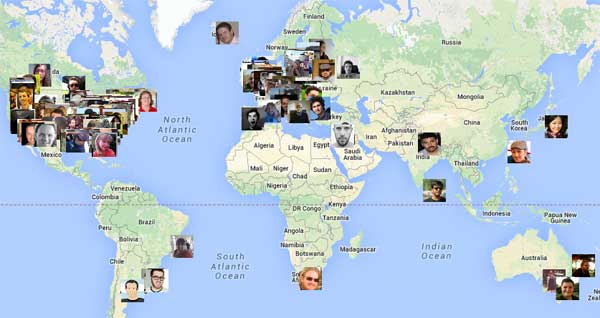
They have employees in over 120 cities, and 30 countries (you can see a map here)
In the section of The Year Without Pants on Results vs. Tradition I strongly make the case that superficials like how we dress, or who works late, are distractions, but I should have driven the point home harder that remote work helps reduce gender, age and other biases, since you see far more of a coworkers output than their outward appearances.
Next Thursday Citrix will be hosting me with a live webinar about remote work and The Year Without Pants. It’s completely free, and I promise it will be fun.
Hi folks. Its been a long time since I gave things away.
Some of you subscribe directly by email (“Get Posts Instantly” in the sidebar) or RSS to every single post. That’s swell of you.
As a small token of thanks you get the first shot at this. I won’t hit the social media thingies until later today.
The first 10 people (in North America, sorry rest of planet) to leave a comment will get a signed copy of The Year Without Pants, an Amazon.com best book of 2013.
Bonus: I’ll also pick another 5 additional commenters at random to get a book, so if you’re late, leave a comment anyway. You might still win!
As of March 17th I’ll be an ex-employee. It’s an amicable separation in the face of irreconcilable differences: I wouldn’t move to California and Google wouldn’t open a Vancouver office. I haven’t decided what to do next.
Seriously, about remote work? · Yep. Both before and after being hired, I had been asked to consider moving south. I didn’t want to and politely declined. Eventually, the group I’m in politely informed me that staying remote wasn’t an option. I talked to a couple of other groups but my heart wasn’t really in it, because I decided Google’s position was correct.
If a good employee asks to try remote work, or any choice about work habits they believe will help them perform well, why wouldn’t a manager let them do it on a trial basis? There’s very little risk. If it turns out to be disruptive to the team, or their performance is poor, that’s one thing as there would be an actual problem. But why not allow the employee to try? Allowing employees to try encourages them to look for better ways to work, an asset to any organization. Policies that are outright bans of anything rarely make sense as they prevents employees and managers from experimenting and evaluating actual results. Bans end thinking as people stop thinking for themselves and simply carry out a policy, the birth of bureaucracy.
Bray himself felt he would have performed better if he moved, which he was unwilling to do:
I would have been more effective in my job if I’d moved, and probably would have enjoyed the work more
Of course there is no singular answer to the question of remote work. Google has done an outstanding job of hiring and keeping talent. Yet by failing to frame the work policy restrictions around performance is a mistake against the philosophy at the core of any progressive company.
One of the many surprises from The Year Without Pants is that Automattic, makers of WordPress.com, doesn’t pay employees more when them become a team leader. They consider being a leader a role, not a job. One of the fun experiments this enabled for me while I worked there was to step down as lead and report to someone who used to report to me, something I’ve rarely seen done gracefully before.
If managers don’t get paid more, this dramatically changes several dynamics about management and leadership:
Money is removed as the motivation for becoming a leader
Instead only people who purely want to be leaders take the role
If they’re unhappy in the role, they have no reason to stay
In many organizations getting promoted into management is the only promotion path. The result is many people ill suited and even uninterested in leading groups take on those roles, with negative consequences across the organization. If you know of managers who clearly don’t like managing, you and they have been victimized by an organization that has misplaced how and why it rewards people.
During my 20 months working at WordPress.com the people in lead roles were mostly stable, and many people had been in a leadership role for two years or more. But the clarity around leadership being a role changed how leads behaved. It made leaders far less territorial, for they knew, much like being a Senator or a representative, that they were part of a larger system. Leadership as a role was one of many cultural attributes at Automattic that are unusual for corporations, and it’s their culture that allowed them do to so many things we’d all love in our own workplaces.
Of course management and leadership are not precisely the same things, and a manager in one organization has differently responsibilities than in others. But the question remains: would changing how managers are rewarded lead to people better suited for the task being interested and better performance in the position?
[Update 1/29/15] The concept of dual ladders is one way to officially support a path for increased rewards without having to become a manager.
Remote work and work from home are different. For working remotely, it’s figuring out habits that work for your psychology, shifting culture to be more autonomous and learning to be a better communicator. For work from home, it’s establishing new boundaries, since you don’t get them for free like you do when work is in a different physical space. It requires more self-awareness and better habits to do these things successfully. But the rewards of independence and work/life balance can be significant.
Improving work culture. Many workplaces are stuck in a command and control mindset. Remote work is best when employees are trusted and evaluated on their results more than what time of day they work or how they get things done (provided results are good). Meetings, or any synchronous activity that requires people doing the same thing at same time, become very expensive. The culture should shift to use other tools, documents + comments and chat rooms, so people have more freedom about when they get their work done.
Shifting to better tools. Email and meetings are the mainstays of most workplaces, but they have disadvantages that are overlooked. Documents and chat rooms can be searched and archived, so people can read/contribute on their own schedules and new employees can get up to speed faster. Most organizations that shift to remote replicate all the same habits and tools, they’re just online now. But they should be asking “what problem was this meeting created to solve?” and “what other tools can we use now that we’re remote to solve this?”
1: What were the biggest lessons you learned?
If I thought I could summarize 18 months of my life into a bulleted list I wouldn’t have written a book. But here goes (From 5 Ideas About The Future of Work, published on Copyblogger & @ FastCompany):
Workers should be treated like adults and be empowered to choose how and where they work. Many organizations pay people well, but treat them like children with far too many rules and processes. Only 13% of workers report that they feel engaged at work which suggests there is something wrong with the basic philosophy of management in most organizations.
Your location, clothes, and hours (should) matter less than your output. It’s common to reward people who come in early and stay late, but what does that have to do with their work performance? Not much. We all want to be judged fairly for our output, and this should include the possibility of being productive when remote.
You can escape from email and meeting hell. The banes of modern work are email and meetings but it doesn’t have to be this way. WordPress.com has proven it. (See Is There Life After Email? and Shut Down Your Office) There are better tools and cultures for communication.
Culture always wins over tools and technologies, but most of the business world is tone deaf to understanding culture.
Hire by trial. There is little scientific evidence that resumés and interview loops are effective methods for hiring staff. The job interview process itself is dubious, since few interviewers are truly skilled at doing it without bias. WordPress.com hires by trial – you audition for a job, allowing both parties real exposure to the talents and limitations of the other.
This is a lot to absorb or believe. Which is why I wrote a book about a place that has bet everything on these ideas.
The following themes were on my mind as I wrote the book:
There is no innovation without experimentation. Many people talk about wanting big ideas, but it’s rare that talk is matched with action.The grand frustration in the working world is stasis. Even if you don’t think what WordPress.com does can work for you, you must respect their willingness to experiment. The fact that WordPress.com hired me, a veteran big company manager, shows their willingness to mix things up and learn from the results. Isn’t that what our leaders are supposed to be paid to do? If we demand anything from managers, and perhaps from ourselves, it’s to take the first step, and learning from WordPress.com is an easy place to start.
Workplaces are buried in unquestioned and unproven traditions that should be tested and the story of WordPress.com raises those questions.
WordPress.com successfully defies conventional wisdom about hiring, offices, empowerment, incentives, management, intellectual property, hierarchy and more. They are the best case study I knew of for asking questions about work and what alternatives are on the horizon for the modern workplace.
The justification for the subtitle (The Future of Work) is that rather than prescribe 5 dubious commandments like many business books do, we need to explore an actual example and have an expert (me in this case) bring their expertise to bear in the reporting. This approach reveals different lessons depending on the reader’s own experiences. I didn’t know of a management book like this so I felt I should I write it. The Year Without Pants has been criticized for not being prescriptive enough, which was by design. If I’m mostly prescribing, I’m failing to capture what the reality of this kind of workplace was like.
2. Did WordPress.com know you were going to write a book when they hired you?
Yes. The book’s introduction explains this. Matt Mullenweg (WordPress founder) offered me a leadership role and I said I’d do it only if I could write about it. He agreed. My team knew about it early on, and much of the company knew about it before I left after working there 20 months. Since 2003 I’ve been primarily an author and I couldn’t imagine taking a conventional job unless I could frame it as research for a writing project. I was hired in August 2010 and left May 2012. The book released Sept 2013.
3. Most characters in the book are men – does this reflect Automattic accurately?
The book was focused on my team, which happened to be mostly men. WordPress.com’s staff is listed on their public list of employees. which at last count (in 2013) had 39 women in a company of ~180. This is in a typical range for a software company. However, I do regret not exploring issues of gender directly in some way.
The book does mention Hanni Ross, the woman who was the team lead for the Happiness team at the time, in chapters two and six but she’s far from a main character in the book. Although the fascinating way the Happiness (support) team works, with *all* new employees working there for their first three weeks, is the focus of chapters two through four.
I hoped the company photo in chapter 7, which shows exactly how diverse the company was, or, wasn’t, at the time (9 women to ~45 men if I count correctly) would help give a sense of the wider company. Today (2014) there are many women in development and some in leadership roles. I’m convinced remote work improves diversity since most of what you experience is people’s output – rather than superficial things that have little bearing on someone’s ability, but that are easier to form biases around in typical workplaces (height, race, age, physical attractiveness, questionable smells, abundant (or insufficient) piercings, etc.).
Another point that could have been made clearer was geographic diversity. It’s mentioned early on the company hires the best talent anywhere in the world since no relocation isn’t necessary, but the cultural diversity this offers isn’t emphasized. In the section on Results vs. Tradition I do strongly make the case that superficials are distractions, but I should have driven the point home harder that remote work, and as a result WordPress.com, helps reduce gender, age and other biases, since you see far more of a coworkers output than their outward appearances.
You can see a map of all of their employees by location and it’s impressive. They are extremely diverse geographically: http://automattic.com/map/
4. Did working remotely really work?
Yes, but I don’t advocate that it’s for everyone. I do advocate empowering employees to experiment for themselves in how best to be productive, including trying remote work.
But you should recognize that most of us already do significant work remotely today (See Why Isn’t Remote Work More Popular?). Consider this: what % of your working day is spent working with co-workers through a computer screen? I’d guess it’s 30-60%. In any of those moments you could be anywhere on the planet and do the same work. And the rest of the time is mostly in meetings we all complain about anyway. What is it we’re so afraid of to even give remote work a try? It’s an insane paradox. We hate things about work, but we defend those very same things whenever an alternative we haven’t even tried is proposed. About 20% of workers worldwide work remotely and that number will continue to climb as technologies improve.
A good, collaborative team that likes their work and has clear goals can do excellent work remotely. If a team is neither good, nor collaborative, it’s the fault of management, which has nothing to do with working remotely or not.
5. But what about Yahoo/HP/etc. banning remote work?
Yahoo has been a company in crisis for years: why are we using them as an example for emulation? Same for HP. Culture change, even in our supposed high tech high paced world, is slow. Many workplaces still require everyone to wear suits and skirts, and arrive at 9am, despite there being zero data this makes anyone happier or more productive.
This is a central question of the book: when was the last time you put your workplace traditions to the test? Is there really a rational basis for your assumptions about how work is best done?
6. How can I convince my boss to let me work remotely?
Two steps. 1. Do great work and get a great performance review. 2. Ask to try working remotely on a trial basis (perhaps one or two days a week). If in a month your performance is just as good, ask to continue. No good boss would refuse a request from a great worker than has no threat to worsen their performance.
If your boss is afraid to try, or can’t because of official policy, send them a copy of The Year Without Pants or Remote. Or look for a remote friendly company to work for, there’s a list of 100% remote companies here and hundreds more with liberal remote work policies.
7. Did working without email really work?
Yes, but I don’t advocate it’s for everyone. I do advocate it’s everyone’s job to look for and experiment with better ways of being productive, including communication tools other than email. If you try something and it fails, that’s one thing. But not to try at all? That’s shameful, especially if your organization claims to be progressive.
Since I left Automattic they switched from using IRC to using Slack and they’re not alone.
For within team interactions email has major limitations. Chapter 15 of the book, titled The Future of Work Part 2, documents exactly how we worked on a daily basis and how it compared to an e-mail centric culture. The modern workplace has pushed email too far and we know it. There are alternatives for within team communication that are better, but few have tried them.
Fundamentally the culture of most organizations is bureaucratic, forcing employees to seek permission and to cover their asses in email, confusing politics with productivity (See Is There Life After Email? @ FastCompany). In a healthy autonomous culture the pressure on email, and communication, is much lower. I’d fix the culture in an organization before I worried about the tools.
8. Did the experiment of having a non-programmer team leader work?
Yes. It’s not a new experiment really as plenty of important companies are led by people who aren’t a specialist in whatever the company does. Leadership and management are general, not specialized, skills. I think I can lead a team that does just about anything because of my ability to lead, and my interest in and ability to learn what I don’t know. Being an expert is not mandatory to be a leader, and is possibly a limitation in some cases. What matters is being able to make use of experts and synthesize their opinions into good decisions for projects.
9. The book mentions hiring by trial but never goes into the details. Can you elaborate?
Founder Matt Mullenweg explains the process in this Harvard Business article. I was involved with several trials and found the process straightforward and nearly magical. This commitment to working with people on real projects before hiring them explains why many of company policies work. People who would struggle with them are filtered out through hire-by-trial, which is exactly what a hiring process for an organization should do. It took more time to work with candidates than an interview loop would. But for that investment the candidates who asked better questions, were proactive about getting what they needed to complete their project and fit well into the communication tools and styles we were obvious. And those who struggled were obvious too. Instead of talking as a team about how a candidate answered questions, we could talk about what they had built, how they dealt with miscommunications, etc. a much better data set to use to evaluate who to add to your company.
10. What happened after you left WordPress.com?
Everything exploded!
No, that’s not true. Automattic and WordPress.com have been doing very well. WordPress.com is the 8th most popular website in the U.S. The book closes with my departure (May 2012) and the team structure with leads and all has continued to this day. Many of the folks who were on my team became leads on other teams which was nice to see. Automattic currently has more than 210 300 employees and expects to grow at a similar fast pace this year (they’re hiring btw).
11. Would the virtual, self deterministic org model work for a company that needs to market it’s products?
First, many organizations are dysfunctional. I don’t think the traditional ways organizations are structured set a high bar – you’re assuming that it ‘works.’ The Jetpack project (chapter 17, +) demonstrated my team’s ability to launch a specific product on a specific day. Our team worked well together and working on a deadline turned out not to be any more challenging than it would have been for a traditionally managed company, and perhaps it was easier to achieve since we had far less politics to put up with.
12. How can an existing company either accommodate or make the transition to being distributed?
For general advice see How To Change A Company. It’s the best advice for any kind of change to any organization. Change is hard because of culture, not technology. You have to start small, get it right, and repeat.
Chapter 15 of the book, titled The Future of Work Part 2, offers advice on the general way it happens: one person at a time. A worker has to say to their boss “hey, I can be just as, or more, productive if you let me work remotely. Let’s try it and see.” And then the boss has to say, “Yes”. If that experiment goes well, it will be repeated by others. This is the primary way change happens anywhere: two smart people agreeing to try something and then, when it works, agreeing to do it more and convincing others to follow. There’s no magic: just two open minded people.
Of course a team leader, or an executive, can accelerate change if they have control over policies. But typically people with control over policies are conservative: they’ll wait for the existence of a highly productive and vocal minority with enough influence before even considering changing policy. If YOU, reading this, want to work remotely, it starts with you pitching your boss to give it a try. If they see it as a win for you to win by working remotely, they’ll naturally promote the idea.
It already has. As mentioned above, most of the remote workers on the planet are at large corporations (Aetna, American Express, IBM, etc.). The U.S. space program in the 1960s employed 250,000 people in dozens of cities across the country. Every major armed force in history did most of it’s fighting in remote units. We have countless examples of large scale remote work. Think of the telegraph and the telephone, which allowed people hours apart to work together and collaborate. Remote work is old, but our fears cloud our memories. Microsoft, Google, and hundreds of companies have people working in different offices who magically are able to get work done without always sharing the same physical space.
Automattic is currently about 250 people. I could easily see the company reach 1000 people, with 5 product units each with about 200 people in them. Everything within those units would be much the same as it is now. Continuous deployment is part of how Automattic works and it helps with scale: since new ideas launch regularly you rarely have large dependencies between teams. The challenge with scale is for leaders of each unit, assuming they existed (and the units were not self-organizing collectives as some people theorize as ideal), to avoid the traps of middle-management, and maintain the same employee driven autonomy the company has now, while keeping the company lined up on strategy.
The history of work is useful here too. Read about the U.S. civil war or WWII or the Peloponnesian War. Armed forces in the grand wars of the past were intensely distributed, with thousands of soldiers working on what was supposed to be a singular strategy, separated by enormous distances. Messages were sent by runners and horses: ridiculously slow compared to Skype or SMS. My point is that there are plenty of examples of large scale distributed work if you look for them. My success and failures described in The Year Without Pants rarely hinged on my team being distributed or not.
Of course most companies fail. Most projects fail. We give a disproportionate amount of attention to absurdly successful things. If WordPress or Automattic fails in some significant way my first thought would not be to question the fact that they’re distributed, and the book does critique other elements of the company and the culture appropriately.
14. Results vs. Process seems to be a theme: are they really either/or ?
Only good processes keep politics at bay. Mediocre processes amplify politics by creating more turf and more restrictions. Any process should include a clause that defines when the process is no longer necessary. This almost never happens and the result is rules live on forever even after if their usefulness died years ago. Process should be a slave to results, but it rarely is. It’s often the other way around.
15. This is a really interesting observation: “Every manager is kind of a new experiment, and any experiment that goes wrong should change.” Do companies promoting someone to manager need to change what and how they evaluate success?
70% of all American employees are unengaged at work (Gallup 2013). All of those workers work for managers who are failing them. Management, as a discipline, is a failure: we are not, on average, good at it as a nation. We should be experimenting with the very notion of management itself: why not elect managers? Or promote them only on a trial basis? Or give the people who work for them the power to reverse a promotion? As wild as these ideas might sound I bet any of them would provide better results than that 70% number. The bar for management is that low.
As Americans it’s absurd how we never consider democratic principles for management. Instead we have a system modeled on what: monarchy? Oligarchy? I’m no radical, but I am open to other influences in structuring how the powerful are chosen at corporations.
16. It seems that storytelling, relationships, humor – ie the humanity of WordPress.com – is so consciously intented – and with great results. But didn’t they launch it with this in mind? How would a 200 year old company, say, with layers of tradition even begin to try to change its culture to get at a more meaningful workplace?
My story at Automattic is all about culture change: It was a suicide mission for me to introduce traditional management ideas into a company born of open source, independence and autonomy. I was an outsider with a radically different set of beliefs and experiences, which makes the core story of the book one about culture change: or at least my insane attempts to make culture change happen.
Any 200 year old company didn’t start that way. It was grown and you change a company the same way: you plant seeds and nurture them. One bright manager plants a small seed in their own team with some different rules. When they show better results than other teams, other managers follow. Soon there is a high performing minority and if the CEO has a clue they’ll invest in how to make that minority the majority. One way to read the The Year Without pants is “the year of attempting culture change.” How can an expert on management be useful in a place that doesn’t believe in management at all? That’s my story and that’s what the book is about.
17. It’s rare for a “business” book to involve the journalist taking a full time job. How did you approach this project?
I approached the project journalistically, inspired by NewJack and Down and Out In Paris and London. I wanted to report on a place from the inside, but from the first person, not third. I’m often disappointed by books about organizations where the writer never gets their hands dirty: how can you know the heart of a place if all you do is observe? I believe you have to participate to best capture an experience. To minimize betraying the trust of the team I lead, I chose to focus on my story and perspective, minimizing the need to report on private conversations or personal issues. Also working remotely made focusing on my story natural and fitting for the project.
Every journalist who is not too stupid or too full of himself to notice what is going on knows that what he does is morally indefensible. He is a kind of confidence man, preying on people’s vanity, ignorance or loneliness, gaining their trust and betraying them without remorse.
We forget that all the books we read about real people and real organizations required someone to get inside and report on it to the rest of us. I don’t agree with Malcolm that journalists are exclusively immoral, but they frequently must choose between giving the reader, or the subject, the benefit of the doubt. You should think carefully about the books or articles you read in this respect.
18. You say in this book “the bottleneck is never code or creativity; its clarity” Is this the biggest issue in the way for companies trying to move forward?
Any moderate sized corporation is a wasteland of indecisiveness: it’s all committees, review meetings and endless email chains. We all know too many people have veto powers. If you simply clarified who was the equivalent of a film director for a product, or a division, who was empowered to break ties, everyone would be freed to do better work: they’d spend more time actually working and less time fighting over turf. The Year Without Pants explores this in many ways, as the autonomy of the culture created bottlenecks of a kind all on their own.
“Confidence and faith in data grows in relation to your distance from the collection of it”
The Data Paradox. The more data you have, the larger the role intuition plays in deciding how to interpret, explain and apply the data. Intuition must be used to decide which data to focus on, how to collect or organize the data, and what samples to use and exclude. For example, in A/B testing, you use intuition to decide what B is. Underneath all of our rational intellect is intuition, which influences our “rational” behavior far more than we admit. Often data yields unavoidable tradeoffs where two or more options are equally viable and someone must make a judgment call beyond the data. In strict paradox form: the more data you have the less you know.
No team or organization is truly data-driven. Data is not conscious: it is merely a list of inert, dead numbers. Data doesn’t have a brain and therefore can’t drive or lead anything. At best you want to be data influenced, where (living) decision makers have good data available that they can use to help answer good questions about what they’re doing, how well it’s being done and what perhaps they should be doing in the future. All data has bias and blind-spots and a truly data-driven organization will drive itself into the ground chasing the illusion of purely objective truth.
Data is a flashlight. Data gives you specific information about a singular vector of information. Data, like a flashlight, is only as useful as the person wielding it and the person interpreting what it shows. It has no magical powers. To get good information you want multiple sources so you can triangulate information and compensate for the inherent biases each kind of data has. For example, A/B testing can tell you things customer interviews can’t and vice versa. Clickthrough data does not tell you what happened between clicks (Did they punch a wall or jump for joy?) One analytical model suggests one hypothesis but a different method can suggest another with the same data.
Ban the phrase “The data says.” Data can’t say anything for the same reason it can’t drive anything: data is inert. People, including data experts or growth hackers, can never speak singularly for the data. At best they are interpreters, offering one interpretation of what the useful narrative story derived from the data is (if there is one at all). Better experts yield better interpretations but never is their interpretation the only one available. If anyone utters “the data says” they are pretending data can have a singular interpretation which it never does, and this false faith prevents the asking of good questions, such as: is there an equally valid hypothesis based on this data that suggests a different conclusion than yours? (The answer is often yes).
Cognitive Bias pollutes our view of data. We know our brains are kludges, vulnerable to optical illusions. We also have blind spots in our cognition called cognitive biases. The most common one regarding data is confirmation bias, where we seek only to validate our preconceptions and stop doing analysis as soon as we have a singular hypothesis that supports our assumptions. Another dangerous bias is narrative bias, which is our attraction to stories. We love stories that are easy to understand, easy to say and that makes us feel good, and will prefer telling these stories over more complex ones even if the complex ones are truer.
Cui Bono -“who benefits?” Who paid for this data? What was their reason for paying for it? What ambitions do they have? Certain outcomes of data benefit the people asking for the data and the people who capture the data, biasing the results. In political elections it’s common to see competing campaigns find very different data for who is in the lead, each finding their own candidate in front. Another example is how company founders will select data that makes them sound the best when pitching for funding (And VC firms will listen for the kinds of data they want to hear). Generally in life when you’re confused about why a strange decision was made, or there is grand incompetence, or nothing is happening at all, ask cui bono?
The design of a book cover naturally follows the title of the book itself. The odds of a a strong cover rise when you have a strong title to work with (See The Truth About Book Titles for my approach to choosing book titles). Stronger titles are simple, clear, short and attract attention.
Most publishers, and not authors themselves, lead the the cover design process. It’s a surprise to most readers, but often authors have little say about the covers their books get. I’m always very involved and it’s something I’ve earned with four popular books and a design background: I always make sure the publisher knows, before I sign, that I’ll be centrally involved.
Title should be readable in online thumbnail / 10 feet away
Simplicity wins
Be bold: it’s better to have some people love it and some hate it than be bland and have no one care at all
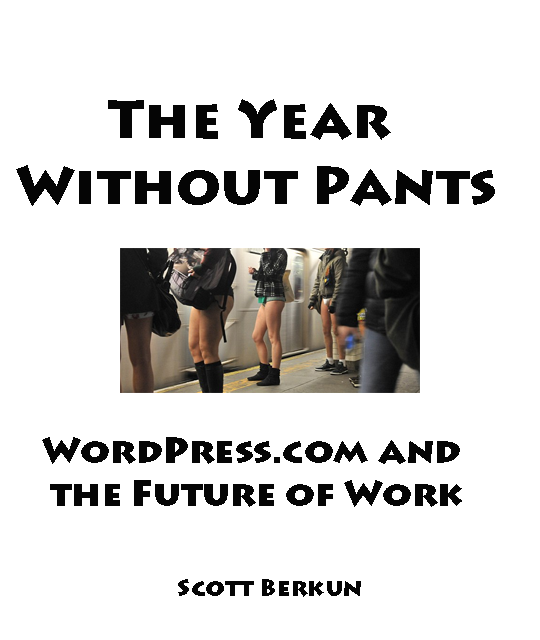
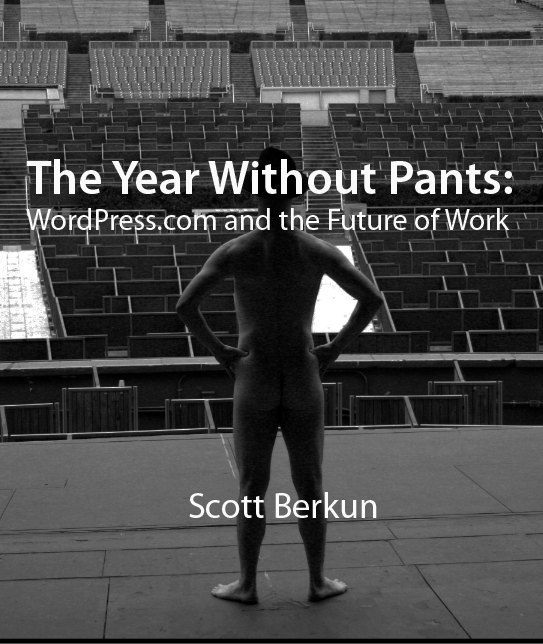
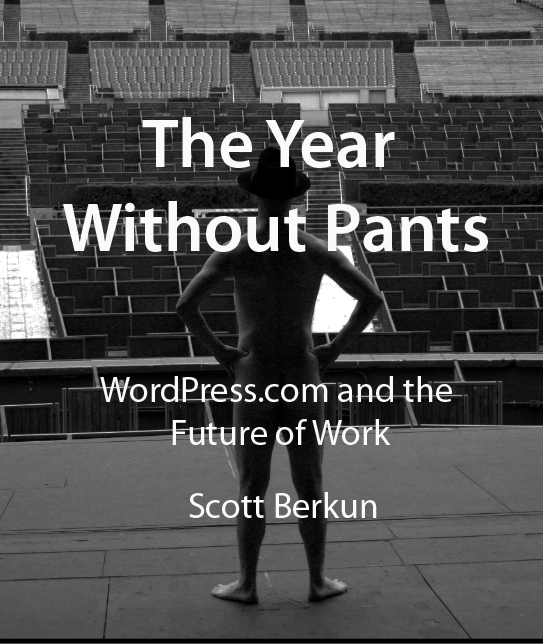
Once the title was chosen I made four quick and deliberately rough mock-ups to get the design conversation started.
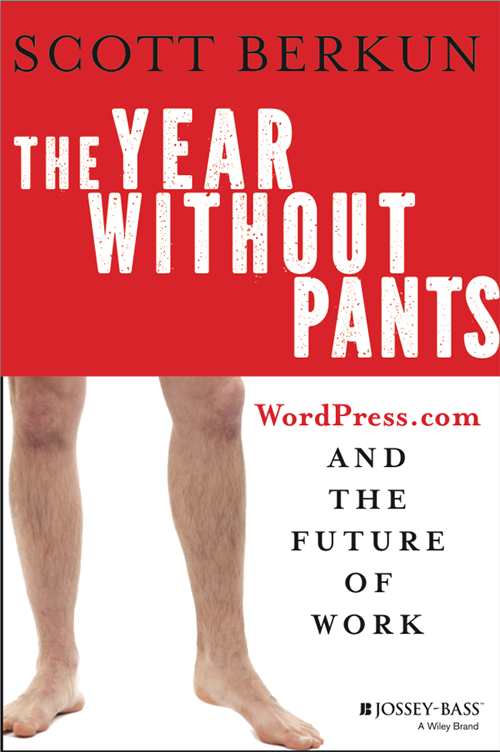
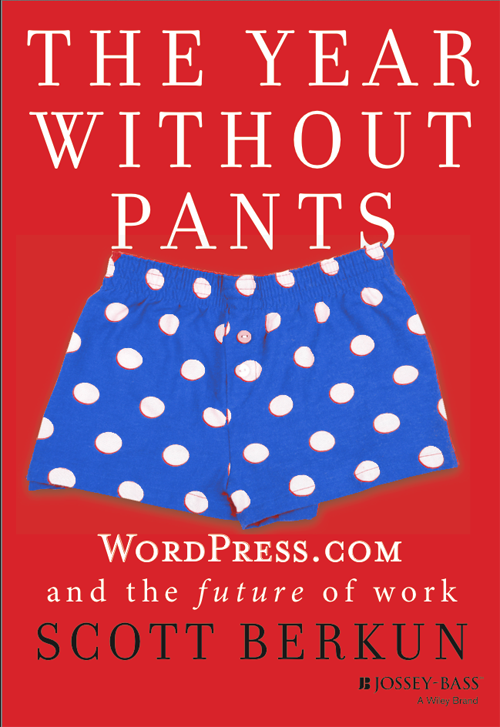
The first one has an image from No Pants Day, an annual event around the world. The last two use an amazing photo by Paul Zollo, who was kind enough to let me use it in chapter one of Confessions of a Public Speaker. I wanted a design that was playful and put nudity or the notion of being naked in a funny and social context, rather than in a sexual one.
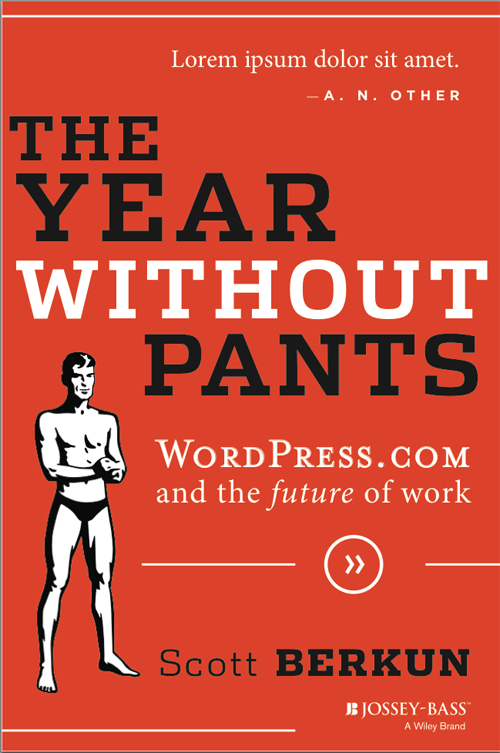
Round 2
Adrian Morgan was the lead designer from Jossey-Bass, and he generated most of these mockups and did the final version of the design. He did an excellent job of exploring widely different directions, which is the only way to arrive at something strong. The biggest mistake in the early rounds is only considering a narrow range of similar options.
One challenge the titled created was it was about the absence of something: The Year Without Pants. The challenge, as fun as it was, was to figure out how to show the absence of something. Here’s the first round of mockups with brief commentary from me.
This was good, until you notice where that left hand is.
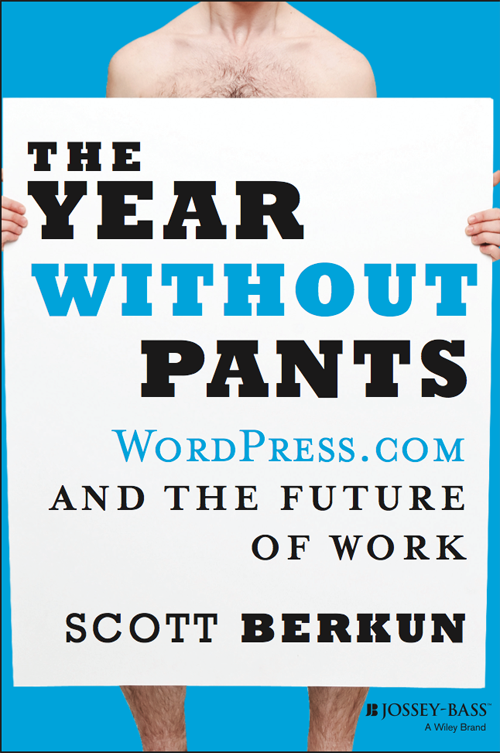
We liked this, and eventually made many variations of it, but there was always something creepy about the figure. We tried to do something more like the cover of Naked Statistics, going for cute rather than creepy, but it never quite worked.
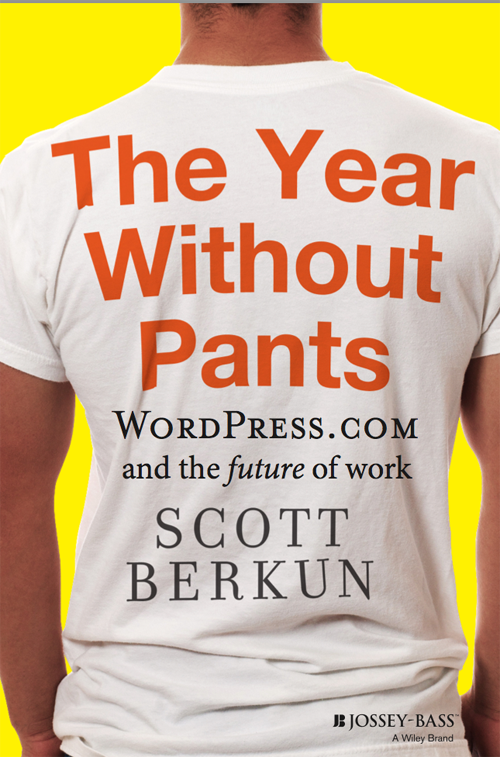
This was interesting, but had little to do with pants or any other concept really (why is this on the back of a shirt, other than it looks interesting?) It didn’t take enough advantage of the opportunities for fun or surprise that the title provided.
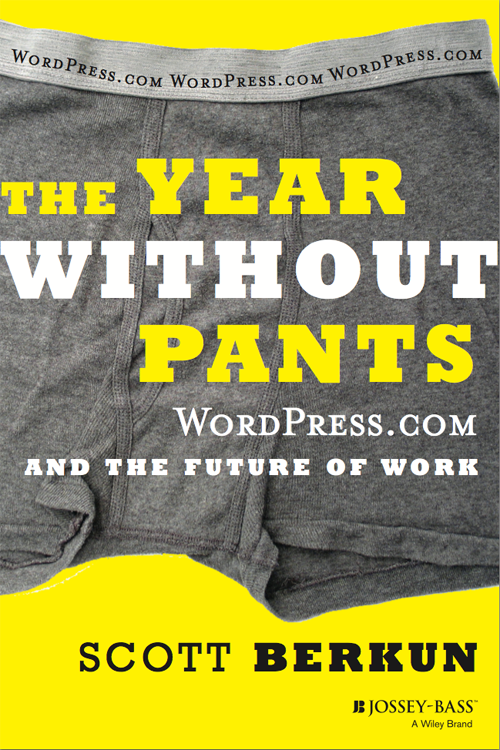
The grey, yellow, white palette is strong, and surprising in a positive way for a business book. This was a strong candidate. It did hint at the smell of old gym shorts, but since the underwear was a background element, rather than in the foreground, it worked.
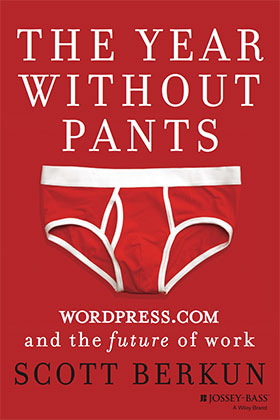
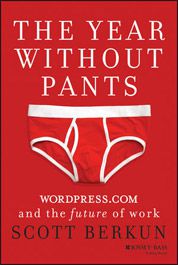
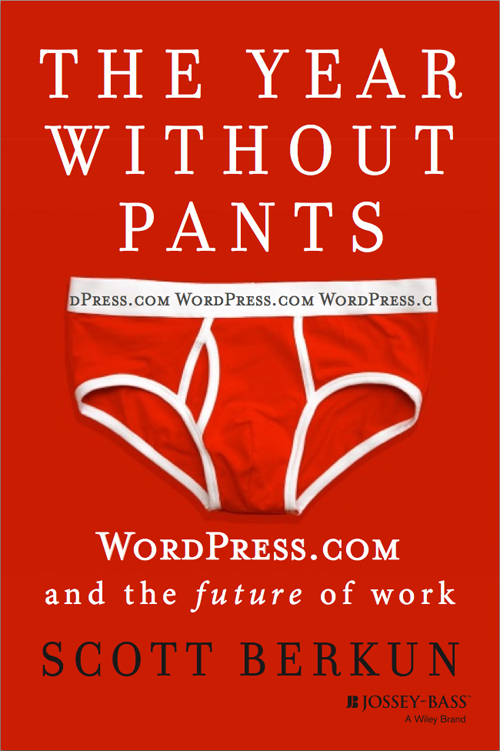
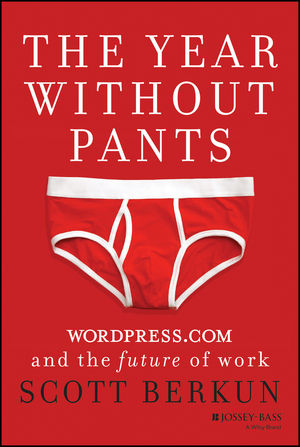
This one made me laugh the first time I saw it. And it still does. What kind of mad man wears bright red underwear? (I’d learn later you you can buy them here). It’s provocative, simple, bold, polarizing and raises questions, all things the book itself does.
Round 2 Voting
I often invite readers to vote on big decisions. It’s useful even if I don’t end up going with the most voted choice, as you folks always offer thoughtful comments and help me think about what I’m trying to do.
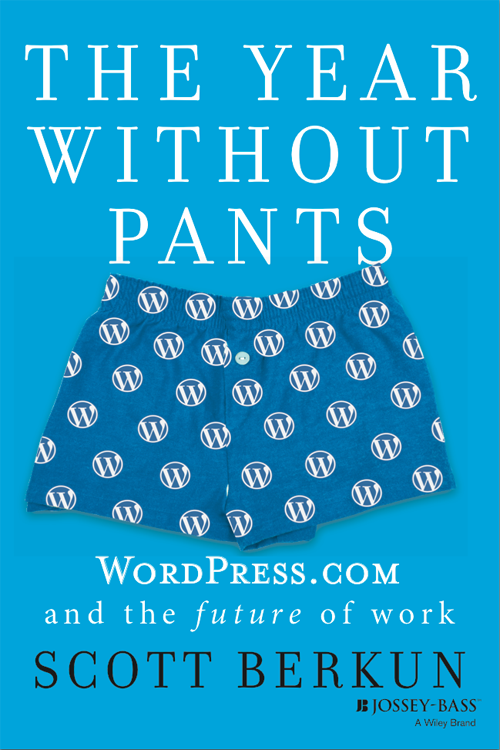
One direction we wanted to explore was incorporating the WordPress logo into the design. Since the book is about working at WordPress.com it was natural to try. We experimented with a few options, including swapping the red briefs, which I knew some people hated, for the safer option of blue boxers. I pitched it to Matt Mullenweg, but he made clear the logo was a trademark and basically impossible to use in a context like this.
Forgetting the book for a moment, I think WordPress boxers would be a big hit in the WordPress swag store, don’t you?
This last design was far too July 4th (red, white and blue) but it was a worthy experiment, and then very worthy of killing.
Round 4 (Refinement)
With the logo out of the running, we returned to the red briefs and refined the details.
We abandoned putting “WordPress.com” in the waistband as the design was cleaner and stronger without it: the white waistband almost underlines the title. We cleaned up various leading, kerning and spacing bits (Matt Thomas, Creative Director at Automattic at the time, gratefully lent me his eyes) and made the main title heavier, with tighter spacing.
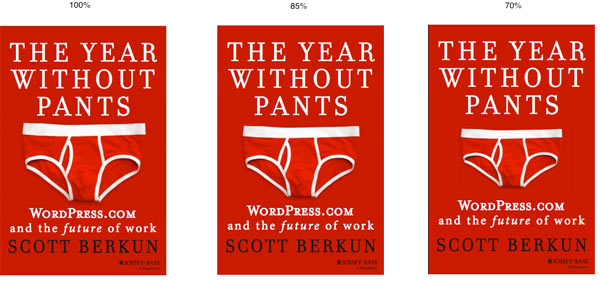
I also mocked up different sizes which made clear a smaller object in the center worked better (We went with the middle version).
Round 5 – Final
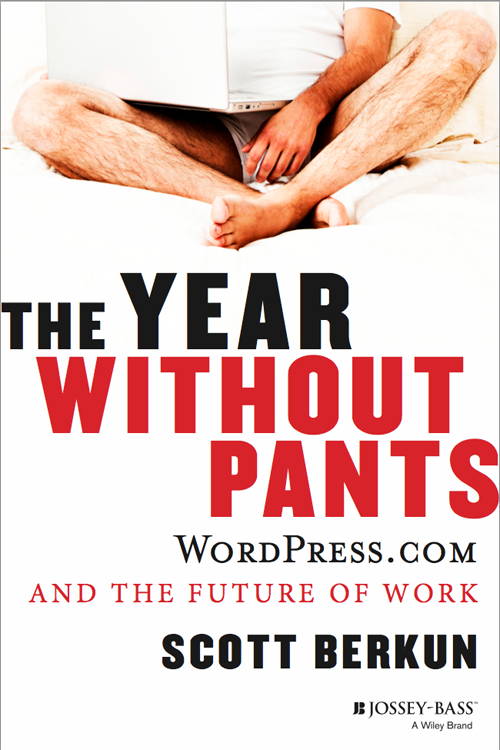
And here is the final design.
Impact: The cover contributed to the movie
I’d planned to do a movie trailer for the book and the cover design gave us plenty to work with (watch to the end):
If you have a theory of what a good cover is, you’ll be disappointed at how little impact covers seem to have on the success of books. Go look at the top selling books on Amazon.com – you won’t find any consistent cover design theory at work here. Many books with bad covers sell well, and many books with great covers don’t. We love to argue about cover designs, but in reality we buy books because of our trust in who recommended it to us more than anything else.
But of course I do think design matters. These behind the scenes posts take time to put together, and more importantly they illustrate how much effort I put into thinking about the book covers themselves. It’s a singular image that will be reused thousands of times to represent the book.
By using the design four principles:
Bet big on one visual concept
Title should be readable in online thumbnail / 10 feet away
Simplicity wins
Be bold: it’s better to have some love it and some hate it than be bland and have everyone not care at all
It has been much easier to have fun with branding and promoting this book than any of my others. Even at the book launch party it was easy to invite friends and fans to have some fun, and reuse the briefs, the colors and the ideas from the book in all sorts of crazy and entertaining ways and I expect that to continue.
I’ve had people tell me they’re afraid to read the book at work, or give it to coworkers, because of the cover, which is fascinating. It’s just a pair of ridiculous underwear! We are all wearing underwear right now (one hopes) in all workplaces across the globe. If your organization can’t handle a bright red book, or is terrified of the existence of undergarments, I doubt the challenging stories and ideas about management, work culture and creativity in the book itself will go over well either, which perhaps suggests the cover is doing its job of representing what the book is and who it might be for. But it’s hard to know: what do you think?
From this month’s book tour, the good folks at Google posted the video from my talk. Q&A begins at 31:27.
In writing The Year Without Pants, about my year working for the 100% remote organization at WordPress.com, I deliberately avoided exclusively writing a manifesto about remote work. I figured anyone could, and would, write a manifesto style book on the subject, but few would ever have the chance at a deep insider story of the trials and tribulations of a real team, with a real leader, on a real project of WordPress.com’s importance, where 100% remote workers and dozens of other new ideas about work, were in practice simultaneously. That’s the path I chose.
When I heard the founders of 37signals, Jason Fried and David Heinemeier Hansson, were writing a book called Remote: Office Not Required, I was relieved. I finally knew who was writing a manifesto style book on the subject and they’re good folks to do it. I like the spirit of their other books.
I finished Remote last week and I recommend it. I’m happy to say it’s a clear, short, solid book of arguments for using remote work to your advantage. It has a nice section of common excuses, with refutations, and sound arguments about how many opportunities there are to help your company by allowing remote workers. They discuss the unnecessary pain of commuting, the improved access to talent from other places and how the right kinds of employees benefit from greater flexibility. All things I observed at WordPress.com, and which I argue for at times in my own book.
Like their other books they focus heavily on stories from their own experience running 37signals, a very successful software company. There are references and mentions of other data and organizations, but they presume most organizations have the same attitudes, talents and businesses that they do, which I doubt is true. They’re an amazing and compact company, but I would have preferred the story of other companies to have had the central stage. From my recent book tour for The Year Without Pants I’ve learned much of convincing executives to try anything new depends on them seeing an example of a company like their own that has succeeded with the method you’re suggesting. Culture change of any kind is hard, and I’d recommend reading my post How To Change A Company for advice on starting with remote work, or any new idea, in your organization. Books open doors but someone has to lead the charge to open them all the way and keep them open.
It’s a common failing of manifesto type books to presume the world is uniform, and therefore uniformly malleable, but at least in 37signal’s case they are always practicing what they preach, which is commendable. I’d prefer to read what they have to say over “experts” who haven’t managed a team or a business in far too long.
I’m very pleased to say Remote: Office not Required and The Year Without Pants: WordPress.com & The Future of Work make excellent companions. They take complementary approaches (and even have the same colors). Remote has a broad, manifesto style list of proclamations, and The Year Without Pants captures a deep, specific examination of remote work from the perspective of a specific team and team manager in an important company in a fascinating work culture.
I’m sitting in Kevin Hoffman‘s session at UI18 on Running Better Meetings. He makes good arguments about facilitation and visual thinking and how they impact the quality of what happens during meetings.
But after my experience at WordPress.com, where meetings were rare, I now struggle to comprehend how many meetings most workplaces have. What evidence is there that we need these things? Many people complain about how much time they spend in meetings, yet the meetings go on.
Even back at Microsoft I had this rule about recurring meetings: at meeting birth, it should be planned that they will die. They will stop being useful at some point. But many of us suffer through zombie meetings, that live on in an undead state forever. Often there is one person who feels powerful in the meeting, and they will keep feeding the zombie with the coworker’s brains just to preserve that feeling.
The frequency and nature of meetings is an artifact of culture. An organization with long, or frequent, status meetings expresses the micromanagement in the culture. I once worked on a team that had 2 hour status meetings every friday. You could hear souls dying, or killing themselves, every fifteen minutes.
Creative meetings with 10 or 15 people in the room expresses a lack of trust of creatives. Too many cooks, rather than a lack of talent, expresses why so many organizations produce mediocre work. You can’t find or deliver on a vision if a dozen people all have equal say on defining it.
All leaders bring with them a culture of practice around meetings. In every bad meeting there is usually only one person with the power to end it, or redesign it. Often only that manager needs the meeting, even if just to stroke their own ego, and as long as they desire it the meeting will continue, whether it’s needed or not. Someone has to stand up and say: can we try working without this meeting for a week, and see what happens? Even if the meeting returns, everyone will see more clearly what the true value it has for getting real work done.