Creative abrasion is Jerry Hirshberg’s term for the kinds of friction that helps develop better ideas. Hirshberg, a former design manager at Nissan, realized that some kinds of resistance are useful in the creative process and should be deliberately created by the leader of a team. This could be a timely critique, a barrage of difficult questions or even a temporary reworking of team processes and roles.
This works against the romantic fantasy many have for an ideal creative workplace. Somehow we all have a latent desire for a workplace free of annoying meetings and frustrating bureaucratic processes, where we could just show up at the office, pronounce our epiphany, and have the entire organization immediately swirl around us in support. But Hirshberg suggests good ideas, and good people, need to be challenged to develop and grow. A good idea can withstand critique and hold up, or improve in quality, when compared against other good ideas, while weaker ones will be revealed and fade away.
In his book, The Creative Priority, Hirshberg documents various kinds of abrasions, including:
Hiring divergent pairs: teaming people who see the world differently to work together on the same project
Creative questions: thoughtful questions can reframe the problem that needs to be solved
Blurring discipline boundaries: our invented taxonomies for knowledge blind us from new ways to think about problems and solutions
He also noticed how his choices as manager would sometime generate dual responses from his team. It both made them uncomfortable and had effects that they appreciated, and this duality signified to him that his abrasions were having the desired effect. For example, when Hirshberg made his team’s prototyping process much faster:
Jim McJunkin, a meticulous designer from Texas, felt that “God is in the details and the nuances, and these take time to resolve.”… But McJunkin then countered himself with the observation, “I like the imposed haste. I’m a perfectionist, and it’s a nice counterbalance to my workstyle… there’s something provocative in the unfinished-ness of the models,” a statement that implicitly acknowledged the added value of the modelers’ creative instincts in these spontaneous interpretations. (p. 44)
Jim McJunkin noted that “it is the abrasion of tiny air molecules that creates the beauty of a shooting star, without which it would be just another rapidly moving, cold and anonymous piece of rock.”
However, too much friction, or friction of the wrong kind or at the wrong time, can be just as bad, or worse, as not having enough. Hirshberg is clear the goal isn’t to force heated debates or make people upset (although that may happen at times). Instead, it’s the deliberate use of energy to make a kind of forcing function, that pushes people to dig deeper, rethink harder and explore alternatives they would be unlikely to choose to otherwise.
Deciding the right kind of friction to apply is a subtle skill that many managers never master. It depends heavily on understanding the culture of the team, the personality of each individual, and the ability to make friction something interesting and that raises curiosity, rather than feeling like a penalty. It’s also heavily dependent on timing: much like working a campfire, you have to use different kinds of friction and fuel to start it, grow it, or to just keep it going.
The legendary research lab at Xerox Parc, where the GUI, Ethernet and the laser printer were invented, was led by Bob Taylor, and his approach to management might be one of the labs greatest creations. Alan Kay, who worked for him, said about Taylor: “His attitude kept it safe for others to put aside fears and ego and concentrate objectively on the problem at hand.”
Taylor encouraged open criticism and debate, in a weekly meeting in a room filled with beanbag chairs. The goal wasn’t to tear other people down, but to push, inspire, and challenge everyone to explore their ideas deeply. Taylor put the ideas, and ideas about ideas, at the center, and moved politics, posturing, and hierarchy to the perimeter. Taylor was likely an excellent facilitator of discussions, helping make sure there was just the right amount of friction.
All too often managers hear about a concept like creative abrasion and rush to apply it, without fully understanding how it works. Hirshberg shares this story:
After hearing about [creative abrasion] at a meeting at NDI, a group of executives from Salomon, the great French ski equipment manufacturer, attempted to apply it. When they returned to San Diego from France a few months later for a design review of the ski boot concepts we were developing for them, one of the vice presidents said, “Well, we have the abrasion part down pat!”
This reveals that the notion of friction applies to the manager’s own work as well. It’s inevitable that the use of friction as a tool will force questions about how a company or team are organized and the process that managers use. This is healthy and can lead to progress, but for insecure managers who fear change, it’s also terrifying. Creative abrasion can be seen as slowing things down or working inefficiently when it should instead be seen as one of the few ways to provoke better and more original thinking to happen.
But even if all the strategies suggested in this book were invoked and followed religiously, creativity would still sit uneasily within bureaucratic bounds… None of the procedures is designed to make it a comfortable, obeisant, timely, well-oiled cog in traditional or enlightened bureaucratic machinery. Instead, the strategies were conceived to help overcome the knee-jerk resistance that inevitably accompanies the creative process, and to recognize the unease as a sign of its probable health.
Hirshberg’s book is a worthy read, especially for design managers or R&D lab leaders, as many of the stories he uses to illustrate his ideas come directly from his management experience.
The great surprise for people with good ideas is the gap between how an idea feels in their mind and how it feels when they try to put the idea to work. When a good idea comes together it feels fantastic. Good ideas often come with a wave of euphoria, a dopamine high, and we’re joyously overwhelmed by it. It’s natural in that instant to overlook the dozens of questions that must be answered to bring the idea to life. We easily postpone those questioning thoughts, believing that if we can come up with the big idea surely we can conquer all the little problems too. An epiphany is a powerful experience, but the myth of epiphany is that it alone is all you need.[1]
The Effort Gap
When we do sit down to work on the details of an idea, the euphoria fades away. The act of thinking about how to bring the idea into the world is far less fun than the magical feeling of the idea’s arrival. It might take an hour or a day, but soon the tasks at hand feel surprisingly ordinary. While the 30-second summary of your science fiction screenplay is still fantastic, it doesn’t eliminate the effort required to write three, or more, complete drafts to flesh the idea out into its final form. Even if your idea was for your job, perhaps an inspiring new proposal you have for your boss, the work of drafting the required project plans and obtaining budget approvals just isn’t very interesting. This is the effort gap. No matter how great your idea is, there will be energy you have to spend, often on relatively ordinary work, to deliver it to the world.
The instinctive reaction to the realization that your amazing idea has led to ordinary work is to retreat. We feel we are doing something wrong if delivering on the idea isn’t as stimulating as finding the idea itself. Somehow we believe the feeling of euphoria should remain throughout the entire project, and when it doesn’t, and we have to choose to put effort in, we assume something is amiss. In the movies they often skip from the discovery of the idea to fame and fortune, but in real life we have to close that distance ourselves.[2] Or perhaps more honestly we simply don’t want to work that hard, preferring to return to the thrills of thinking up more ideas rather than doing anything about them. There is nothing wrong with this, as dreaming for dreams’ sake can be fun. The problem is when we torture ourselves by denying the fact that we have less ambition than we wish we had.
Many people suffer from creative cowardice and a fear of commitment. They are afraid of closing the effort gap. They want to be creative but without any risks. They know there is a chance they can put in weeks of work and have the project fail. So they prefer the shallow perfection of keeping the idea locked in their minds, taking it out only to stroke their ego and annoy their friends. When someone else produces something with a similar idea, perhaps a movie or an invention, they’ll claim false possession, exclaiming, “I thought of that years ago!” But the only way to possess an idea is by closing the effort gap and actually putting something out into the world. Coming up with the idea, it turns out, is often the easy part.
The Skill Gap
Sometimes the problem is the recognition that while the idea is excellent, and you’re willing to put the effort in, the skills you have aren’t good enough to deliver on it. The natural assumption is that the capacity to have the idea is the harder part, and if the idea is good it implies you have all the required abilities. Sadly, like many common assumptions of our silly little brains, the reality isn’t as kind. For example, while I can imagine
performing quadruple backflip dives and singing five-octave melodies, that imagination has no bearing on my body’s ability to do those things. This is the skill gap, the distance between the skills your idea requires and the ones you have. Often it’s only through putting effort into a project that we discover our skill gaps.
When we see work from our heroes, it’s easy to forget they once had skill gaps too. We imagine they were born with the abilities we know them for. The problem is our view of other creators is inverted. We know them after they became famous and after they learned their craft. The works we know best are rarely an artist’s early works but rather those considered masterpieces. When we see a Georgia O’Keeffe painting in a museum, or a J.R.R. Tolkien novel in the bookstore, we see the creators at their best and likely in their prime. We don’t see their many experiments, their
uncertain output during the long years they developed the skills they’d become famous for. As Steven Furtick said, “The reason we struggle with insecurity is because we compare our behind-the-scenes with everyone else’s highlight reel.” We have to go out of our way to find their behind-the-scenes work, and often we forget it even exists.
Ira Glass, host of This American Life, explained how these skill gaps work against us[3]:
“Nobody tells people who are beginners, and I really wish someone had told this to me… all of us who do creative work, we get into it because we have good taste.… there’s a gap… for the first couple years that you’re making stuff, what you’re making isn’t so good…. It’s not that great.… It’s trying to be good, it has ambition to be good, but it’s not quite that good.
But your taste, the thing that got you into the game, is still killer. And your taste is good enough that you can tell that what you’re making is kind of a disappointment to you…. A lot of people never get past this phase.… they quit.
And the thing I would say to you with all my heart is that most everybody I know who does interesting creative work, they went through a phase of years [of this]…. Everybody goes through that…. And the most important possible thing you can do is do a lot of work. Do a huge volume of work… it’s only by actually going through a volume of work that you are actually going to catch up and close that gap. And the work you’re making will be as good as your ambitions.”
Many talented people never develop their skills because they hate the feeling of this distance. They’re embarrassed and tortured by it. They expect to improve at a pace born only from wishful thinking, and when they fail to meet it they despair. They lack the commitment required to find out, through practice, exactly how much skill they might be capable of. Instead they want an easy and guaranteed path despite the fact that none of the heroes they compare themselves against ever had one. The tough news that Ira Glass hints at is that it’s easier for our ambitions to grow, as that happens simply by consuming good works, than it is for our skills to improve, something that requires dedicated effort.
One way to stay motivated in closing skill gaps is to study the history of masters you admire. The early works of Claude Monet and Jackson Pollock are drastically different from the styles they became most famous for. Brad Pitt’s first “acting role” was in a chicken costume for a Mexican fast food restaurant.[4] Michael Jordan, the basketball legend, was cut from his junior varsity basketball team. And who knows how many lousy plays young Shakespeare wrote that he burned, or poems Emily Dickinson tore apart and buried in the dust? Honest biographies of nearly every famous musician, writer or entrepreneur will share in painful detail how they worked to close the skill gaps in their careers.
The Quality Gap
Once you’ve developed your skills, how you choose to use them is a matter of style. Style, or quality, gaps are the most subjective of all. Unlike effort and skill gaps, a quality gap is a subjective opinion of the quality of what is made. When J.K. Rowling filled five pages of made-up Q words, it wasn’t because of a lack of skill. There was a specific quality, a feeling, a tone, an effect she wanted that she struggled to obtain. Each word still didn’t feel quite right, so she’d come up with another one (put another way, she solved a quality gap by creating and closing an effort gap).[5] Depending on what idea you have in your mind, even if you work hard and have the right skills, you will still experience quality gaps as you work on projects.
Some legendary creators struggled with their own opinion of their work, even after their public success. No matter how popular they became, they felt their work was flawed, inferior and immature, never reaching the standards set in their own minds. Woody Allen rarely watches his films once they’re finished, and thinks little of Manhattan and Annie Hall, two of his most famous works. Bruce Springsteen once called the Born To Run album “the worst piece of garbage” he’d ever heard, and didn’t want to release it.[6] Nabokov hated many of his novels, and had thrown the manuscript for Lolita into a fire.[7] Franz Kafka and Emily Dickinson both gave instructions to have all their work destroyed when they died. Artists are often victims in a way of their own perceived quality gaps. They struggle to match the ideas in their minds to what they can manifest in the world.
Some very successful creators never close the quality gap, at least not on every project, and you likely won’t either. This is fine, perhaps even good. If you want to keep growing it demands that when you finish a project you’ll see it differently than when you started. And in the very things you find lacking or wish you had done differently you find the motivation for the next project, and the one after that. To be perfectly satisfied with something you made likely means you didn’t learn anything along the way, and I’d rather be a little disappointed with projects now and then than experience the alternative of never learning anything at all.
These three gaps, effort, skill and quality, will be constant companions. Have patience in how you deal with them. Consider yourself part of a challenging trade where it takes time to develop your craft and that development never ends. If you truly believe in your ideas and potential, you should be willing to stay the course and commit to the long, and only realistic, path to fulfilling your ambitions.
If you can, take pleasure in making things for the sake of making them: what a gift to have the time to make at all! If you were born 200 years ago, or to different parents in a different country, you wouldn’t have the time to feel bad about your work, because you wouldn’t have the wealth and time required to try. If you feel love for your craft, honor it by showing up, even when it’s hard. Especially when it’s hard. Working when it’s hardest often teaches rare lessons that will earn you easy rides now and then. Take pleasure in small progressions when you see them, and know those hard-won gains are the only way anyone in history has ever achieved anything noteworthy—for themselves or for the world.
[5] The divisions between effort, skill and quality gaps break down eventually. In a way, all gaps are effort gaps, as work must be put in to fill gaps of any kind. But at times it can be useful to ask: do you need to put in more effort? Invest in skill development? Or simply have more patience to get to the quality you desire?
On Tuesdays I write about the top voted question on Ask Berkun (see the lovely archive). This week’s question is from Crysel [44 votes]:
What is the real motivation for creativity?
For most of history people did not use the word creativity very much. They just invented and discovered things in the course of their lives without applying special labels to them. But something strange happened to in modern times. We developed a romance around the notion of creativity. Most people today think of it as an extra layer of cognitive powers, that only special people have. This is untrue and there’s an easy way to prove it.
Imagine you are getting ready to work. You stop at your door to do your pre-airlock check for your phone, your wallet and your keys. You realize your keys aren’t in your pocket. Oh no! And at this moment an important sequence of cognitive events takes place.
Your brain instinctively tells you to look by the door in the place where you usually put your keys when you come home. So you go and look, perhaps at the basket on the shelf right by the door where they usually go. And they are not there!
Now your brain thinks a bit more. Maybe they fell? So you check on the floor and behind the basket. Not there!
And here is where the magic starts: your brain starts getting increasingly creative. You look under the basket. You look in the hallway outside. You look in clothes you haven’t worn in days, or weeks. Then you check the basket again (perhaps the keys magically reappeared since the last time you looked?).
You consider increasingly unusual explanations for where your keys are. Maybe you left them at the restaurant last night (which is unlikely since you got into your apartment)? Or someone broke into your place and stole them! (which also doesn’t make sense as if they broke in they don’t need your keys). And on and on your brain will go inventing and trying out solutions.
The lesson here is that when suitably motivated your brain will be creative all on its own. During step 3 above you did not have to engage in a brainstorming exercise or put on a magic hat of ideation. Your mind will, when motivated and presented with a hard problem, generate inventive, unusual and unorthodox ideas. This helps explain why our species has survived despite not being very strong or very fast. We are good at solving problems and when we are motivated can persist in trying to solve even very hard ones.
Now some people hear this and say that looking in strange places for keys isn’t really creative because most of those ideas are failures. But that’s just it. Creative work is very much like looking for keys. You have to do the work to explore many alternatives, many of them unsuccessful, until you arrive at a worthy idea. Even the most brilliant writers and artists write first drafts and draw early sketches that they eventually throw away. They learn much from those “failed” ideas and those lessons help make their second, third and final drafts better than the last. Working with ideas is never an efficient process. It’s messy and uncertain no matter how talented you are.
All this means that when we don’t feel creative often all that’s missing is a strong enough motivator. Sometimes we have demotivators in our own minds, like fear of being judged by others or fear of failure and it’s only by becoming more self-aware that our natural creativity can be free to surface. Other times we’re in cultures or teams that penalize creative thinking. But even in the best situations remember that creativity is a kind of work. You have to burn extra calories. And most of the time we, and our brains, prefer to be efficient and do the least amount of work necessary. But when we are suitably motivated, perhaps out of fear (losing your keys) or passion (solving a problem you care about deeply), our brains have most of the tools we need already built in.
You likely hear these terms often, but here is the background you need to use them to help you:
1. Where “Think outside the box” comes from: The implication of this popular phrase is that you should challenge assumptions and test constraints, but anyone who says this phrase is betraying their own advice. If they were helping to solve the problem at hand they’d offer a specific idea, or solution, that qualified as “out of the box” thinking, rather than simply saying the phrase and demanding that someone else do it. It’s like yelling at someone to “bake the cake” when you yourself don’t know how to bake a cake either.
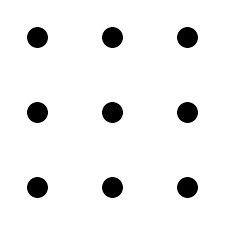
The phrase comes from the 9-dot puzzle that was used in a research study conducted by J.P. Guilford in the 1970s (although the puzzle itself dates back to at least 1914). The trick to the puzzle is to ignore a common, but unstated, constraint that puzzles like this usually have. The implication is that we invent false constraints all the time: and this is the one nugget of usefulness in the whole puzzle story. Challenging constraints is one approach to problem-solving.
However it turns out that being told to think outside the box doesn’t actually help much. Recently differentresearchers replicated the Guilford study, but gave one group the advice to, more or less, ‘think outside the box’. The result? It didn’t significantly change the results. This shouldn’t be a surprise. Simply telling someone to do something hard doesn’t make it any easier. Our brains like to be efficient and assuming rules and constraints is what our brains are largely designed to do (some optical illusions demonstrate this well).
More broadly, logic puzzles like the 9-dot example rarely teach us much. They often depend on a single trick or hidden assumption, which is a poor representation of the skills of problem solving and idea generation required to develop ideas in the real world. It’s far more useful as a leader to demonstrate good thinking, or create a healthy environment where interesting ideas are explored, than simply to demand other people engage in something simply because you say a phrase or post a sign.
The best intent of the phrase “think outside of the box” is to reevaluate the constraints you are assuming to be true. If you can find a false constraint, something you are assuming is required but isn’t, it often leads to more and better ideas. In the 9 dot puzzle the false constraint is the box, but on a project a false constraint could be you’re assuming a deadline that isn’t true, or a requirement from a customer that can be shifted or redefined. Making a list of all the constraints you are assuming to be true, and vetting them often yields one or more that can be modified to allow for other ideas to be explored.
2. The misnomer of Left brain / Right brain. Dan Pink unfortunately popularized this notion in his popular, but problematic, book A Whole New Mind – despite the left/right brain notion being mostly a misunderstanding of science. It is true that we do have two hemispheres in our brains, but the way they interact is complex and many areas on both sides contribute to what we describe as creativity.
The left/right brain concept goes back many years, but it was neuroscientist Michael S. Gazzaniga’s research in the 1960s that demonstrated how there are different functional centers in the brain. He performed tests where one part of the brain, in a patient with a head injury, clearly didn’t understand or know what the other part of the brain was doing. But the conclusion was not one of dominance – “you can’t be right brained any more than you can be right lunged or right kidneyed”.
Of course it is fair to label our personalities, as some people are more logical or free spirited than others, but it’s a mistake to confuse this with anything structural about how our brains work. As Jeffrey Anderson, a brain researcher, said: “It is certainly the case that some people have more methodical, logical cognitive styles, and others more uninhibited, spontaneous styles… this has nothing to do on any level with the different functions of the [brain’s] left and right hemisphere.”
3. Blue sky (constraint free) thinking. This phrase, most often used in product design and marketing, is a request to eliminate all constraints, and to work on a project free of any restrictions. The problem is that the benefits of working on a blue-sky project are often, but not always, more romance than reality. Constraints are very useful in finding new ideas. The request to ‘think blue sky’ can often lead people into the trap of ignoring seemingly smaller, or simpler ideas, that, if explored, could lead to the best solutions.
It can certainly be fun to think about solving bigger or more open problems. Imagining what you’d do with a 500% larger budget or an extra month of project schedule might yield an insight that transfers back to the actual constraints. But the desire to work ‘blue sky’ reflects a misunderstanding of how constraints often help, rather than hinder, the creative process.
A constraint, which can initially seem frustrating, is an important kind of information. It gives you something to start with, and work against in generating and testing ideas (and some research support this). For example, it’s much easier to write a poem that rhymes, than to write one in free verse. The structure of a rhyme provides information to work with and a structure, or shape, to try putting ideas into. Dr. Seuss famously wrote The Cat in The Hat based on a constraint from the publisher to use less than 250 different words.
There are many different kinds of constraints, and the way the constraint is defined can change how useful or not it is in solving a problem. Often it’s defining the problem thoughtfully, and working to examine and study the nuances of its constraints, that is where the real big insights are found. This is especially true when working on projects where you are designing something for other people.
Of course having too many constraints, or ones that conflict with each other, can render a problem unsolvable. Sometimes people are asked to do 1st rate work on a 3rd rate budget and it’d be unfair to tell them that if they were creative enough they could succeed.
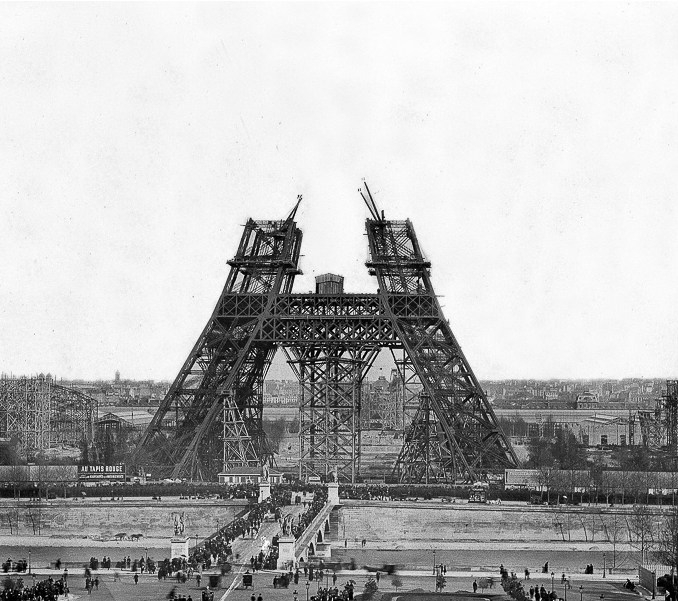
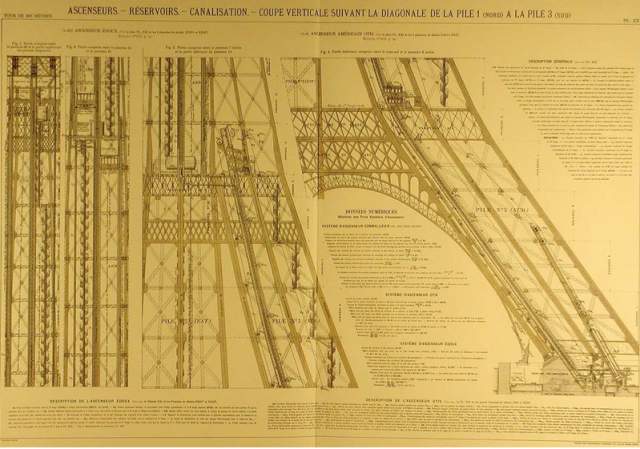
We take great works for granted. We forget, but the fate of even our most famous ideas and creations was far from certain at the time they were proposed. A powerful exercise anyone can do is to pick a famous creation and go back in history to the days before it was made. Only then can you see what the makers themselves truly experienced, and learn from the surprising challenges they faced and overcame. Here are some lessons we can all learn from the wonders of Eiffel’s Tower.
1. All Ideas Are Made From Other Ideas
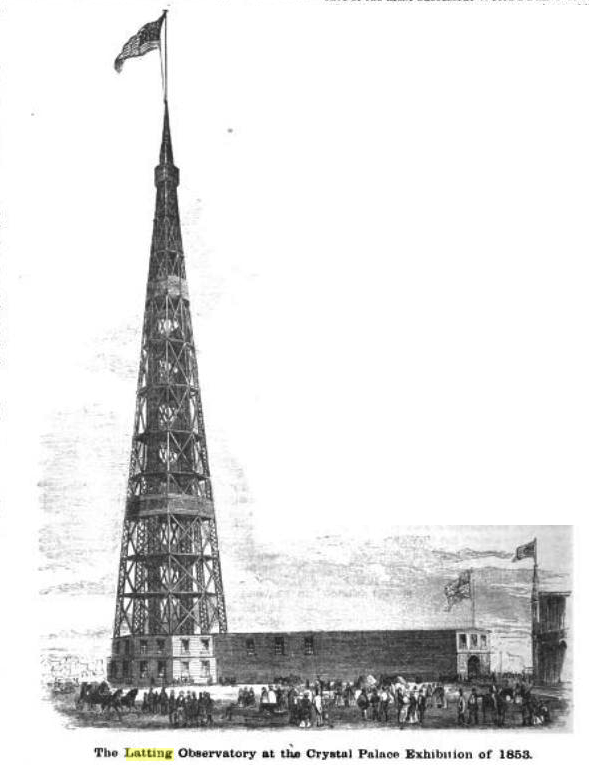
Eiffel was inspired by the Latting Observatory, among other works. This tower, built in 1853, was taller than any other building in NYC, that is, until it burned down in 1856 (wood was still the primary construction material at the time, a fact Eiffel wanted to change). Eiffel also used engineering techniques found in nature to reduce weight and retain strength, essential concepts for constructing the tallest building in the world at the time. If you’re struggling to come up with good ideas, dig deeper into the surprising history of the major ideas in your own field. You’ll learn how they borrowed, reused and found inspiration from existing ideas.
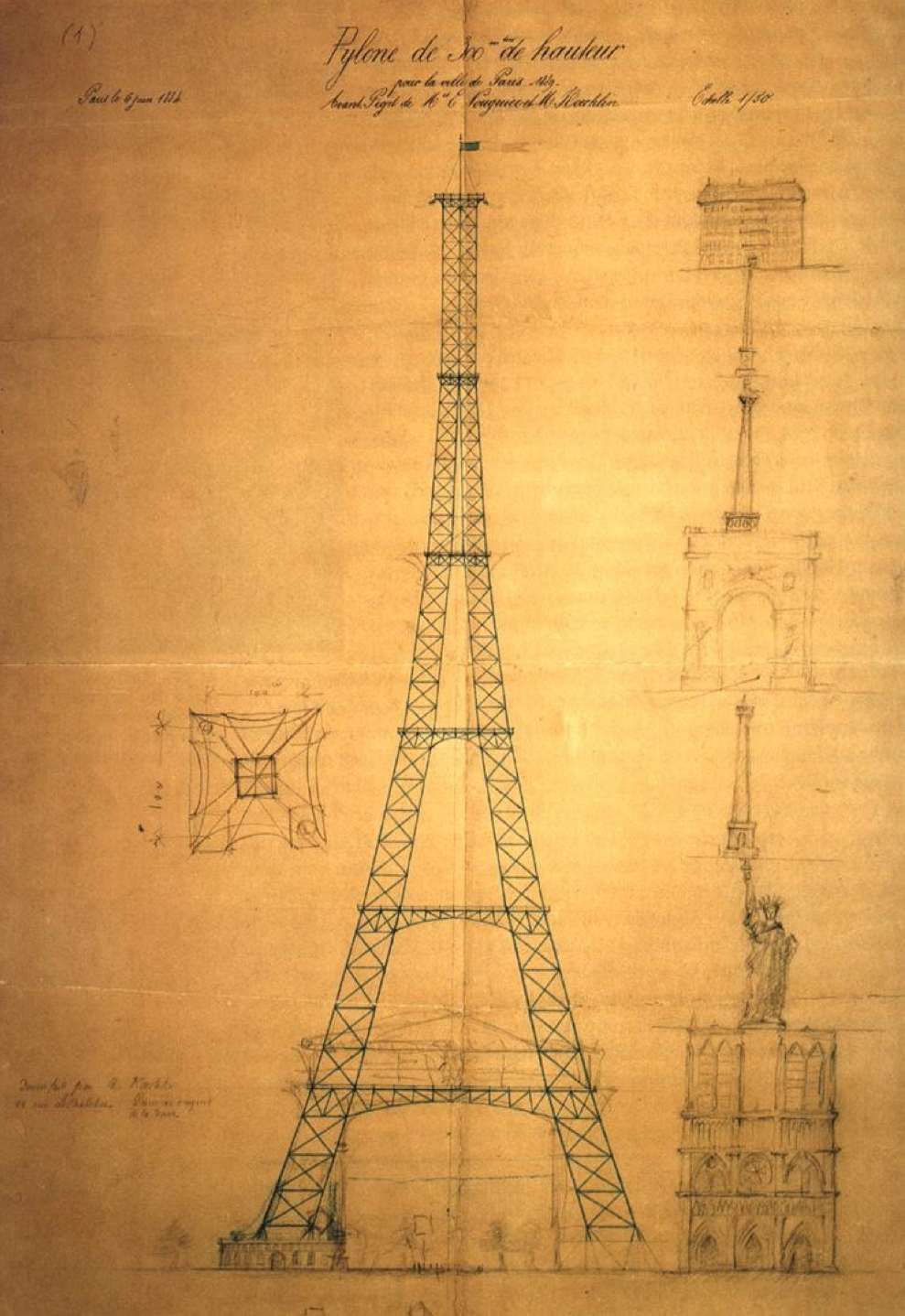
The design of the Eiffel tower was a wonderful combination of aesthetics and engineering (similar in this regard to the Brooklyn Bridge). But the plan for its style and construction evolved over time with contributions from at least four engineers. Maurice Koechlin and Émile Nouguier had the initial concept and drafted the first design (below), but it was rejected at first by Eiffel. They invited a third engineer, Stephen Sauvestre, who made several improvements, including the detailed latticework the tower would become famous for. Their revised design was finally accepted by Eiffel and proposed for the 1889 worlds fair (Exposition Universelle). Although the project bears his name, as only Eiffel had the reputation and finances to lead the project, the design of the tower had major contributions from others.
2. Conviction moves ideas forward
There were over 700 competing design submissions for the world’s fair tower (including this one from Bourdais, a major rival). Eiffel was fortunate to win, but the victory led to more challenges. The government surprised him by only offering $300k, a fraction of what his proposed budget required. Eiffel chose to put in the remaining $1.3 million (5 million francs) himself. In return, he asked for a 20-year lease and control over some of the pavilion area near the tower. This shrewd arrangement gave him the ability to advertise the other works his firm did, assuming of course that the tower itself was successful.
If your idea is turned down, what are you willing to put at stake as collateral (money or reputation) to make the project happen? If the person with the idea won’t stand behind it, why should they expect anyone else to?
Commitment to your own ideas is paramount. But also remember Franz Reichelt, as an example of conviction in an idea gone too far. He jumped from the Eiffel tower in 1912 to prove to the world that his parachute design worked, and fell to his death. You can even watch a film of his fatal attempt.
3. Even the best ideas meet resistance
Before the tower’s construction had begun, the French elite rejected its design. Soon 300 of the most well-known artists and poets of Paris joined together as “The Committee of Three Hundred” to write an open letter to Eiffel and the city, demanding the project be stopped:
We, writers, painters, sculptors, architects and passionate devotees of the hitherto untouched beauty of Paris, protest with all our strength, with all our indignation in the name of slighted French taste, against the erection […] of this useless and monstrous Eiffel Tower… imagine for a moment a giddy, ridiculous tower dominating Paris like a gigantic black smokestack, crushing under its barbaric bulk Notre Dame, the Tour Saint-Jacques, the Louvre, the Dome of les Invalides, the Arc de Triomphe, all of our humiliated monuments will disappear in this ghastly dream… we shall see stretching like a blot of ink the hateful shadow of the hateful column of bolted sheet metal.
Even our wisest and best people, by human nature, resist new ideas. We forget that some of the greatest ideas we’ve had as a species faced great doubt on their long road towards acceptance. This means anyone with big ideas needs to understand that the best ideas don’t always win. Merit is not enough. It’s wise to expect resistance, invest in skills of persuasion and try to learn from the feedback you hear before you dismiss it. The reason why Eiffel won is, in part, due to the relationships he built the society of civil engineers, and the investments he made in explaining to them why his design was superior to others.
4. Long-term commitments make history
The original agreement for the tower was that it would be torn down in 20 years. Part of the criteria for the design competition was that the tower must be engineered in a fashion that would make it easy to take apart. But Eiffel made careful investments in an attempt to prove the long-term value of the tower. He never wanted it simply to be a decorative delight. Instead, he imagined it as both a symbolic and practical embodiment of the future of science and technology.
He financed experiments in wireless telegraphy and radio, including the installation of one of the first antennas in France. This antenna proved sufficiently useful that it justified keeping the tower intact instead of destroying it, allowing it to remain the tallest building in the world for nearly 40 years. Eiffel even had a science laboratory installed not long after opening day, where experiments in meteorology, astronomy, and even aerodynamics were conducted. His commitment to the long-term vision of his idea is a major part of why the building still stands today and is loved by so many people for so many different reasons.
“Knowledge is a big subject. Ignorance is bigger. And it is more interesting.” – Stuart Firestein
It should be no surprise that creative thinking can be counter-intuitive. Often people use the framework of problem solving when talking about ideas, which is useful, but primarily logical. This means the problem itself (“how can I build a better mousetrap?”) and the desire to solve the problem (“mice keep stealing all of my cheese”) provides the fuel to do the work.
But a more powerful way to think about ideas is that it’s ignorance, the lack of knowledge, that can also be the motivating force. Curiosity is an interest in finding out what you don’t know and you can only be curious if you admit ignorance. When you think you know everything, you’re in the worst kind of creative trap. It explains in part why know-it-alls are so dull to be around. They never leave their safe turf of talking about what is already known.
Science is used as a metaphor for things we completely understand. The common saying “the art and science of…” uses the word science to represent formulas, facts and figures, things that are well understood. But how did we learn those formulas and facts? We forget there must have been a time when we were ignorant of those things, and someone, a scientist perhaps, was curious enough to try and figure them out.
Shoshin (初心) is a term from Buddhism that means beginners mind. The notion is that everything, even things we know best, can be reexamined with fresh eyes and that allows us to find new ways of looking. It’s always possible to ask why is it this way? What don’t I see? What other perspective can I explore? The trap is our culture pushes us to believe in the certainty of knowledge and to become bored with the basics. And this is why older generations often can’t see new ideas – their preconceptions and ego in feeling like a master block healthy kinds of ignorance.
In Stuart Firestein’s wonderfully compact book Ignorance: how it drives science, he explores the central role that ignorance, and curiosity, play in developing all of the knowledge that we take for granted today (He did a TED talk on this topic as well).
There are strong parallels in his book to any kind of creative work, such as projects where the goal is to do something new, solve an unsolved problem or to work on anything challenging at all. For many it’s a surprise to think of ignorance being central to science, much less creativity. But if science can be thought of in this way, then so can any field or profession, including the one you work in too.
Here are some favorite quotes from the book:
Questions are more relevant than answers. Questions are bigger than answers. One good question can give rise to several layers of answers, can inspire decades-long searches for solutions, can generate whole new fields of inquiry, and can prompt changes in entrenched thinking. Answers, on the other hand, often end the process.
When I sit down with colleagues over a beer at a meeting, we don’t go over the facts, we don’t talk about what’s known; we talk about what we’d like to figure out, about what needs to be done.
What if we cultivated ignorance instead of fearing it, what if we controlled neglect instead of feeling guilty about it, what if we understood the power of not knowing in a world dominated by information? As the first philosopher, Socrates, said, “I know one thing, that I know nothing.”
There is no surer way to screw up an experiment than to be certain of its outcome.
Here are some examples of what have turned out to be good questions in my class: Do you think things are unknowable in your field? What? What are the current technological limits in your work? Can you see solutions? Where are you currently stuck? How do you talk about what you don’t know? What was the main thrust of your last grant proposal? What will be the main thrust of your next grant proposal? Is there something you would like to work on knowing but can’t? Because of technical limitations? Money, manpower? What was the state of ignorance in your field 10, 15, or 25 years ago, and how has that changed? Are there data from other labs that don’t agree with yours? How often do you guess? Are you often surprised? When? Do things come undone? What questions are you generating? What ignorance are you generating?
Almost everyone believes that the tongue has regional sensitivities— sweet is sensed on the tip, bitter on the back, salt and sour on the sides. Pictures of “tongue maps” continue to appear not only in popular books on taste and cooking but in medical textbooks as well. The only problem is that it’s not true. The whole thing arose from the mistranslation of a German physiology textbook by a Professor D. P. Hanig,
So some things can never be known and, get this, it doesn’t matter. We cannot know the exact value of pi. That has little practical effect on doing geometry.
Thomas Huxley once bemoaned the great tragedy of science as the slaying of a beautiful hypothesis by an ugly fact.
Faraday, by the way, had no idea what electricity might be good for and responded to a question about the possible use of electromagnetic fields with the retort, “Of what use is a newborn baby?” This phrase he apparently borrowed from Benjamin Franklin, no less, who was the first to make the analogy in his response to someone asking him what good flight would ever be after witnessing the first demonstration of hot air balloons.
wrong. Great scientists, the pioneers that we admire, are not concerned with results but with the next questions. The eminent physicist Enrico Fermi told his students that an experiment that successfully proves a hypothesis is a measurement; one that doesn’t is a discovery. A discovery, an uncovering— of new ignorance.
George Box, noted that “All models are wrong, but some are useful.”
In 1946 Dr. Percy Spencer of Raytheon Corporation was working on radar experiments with a magnetron (a device used to produce radio waves). When he noticed the candy bar in his shirt pocket had melted, he had every reason to throw it away, except one: he felt no heat. Odds are good that other people in radar laboratories around the world experienced similar globs of chocolate and other foodstuffs in their various pockets, and did nothing about them, other than to clean up the mess and get back to work. And given that the rational, logical parts of most intelligent people’s brains would tell them to do the same, getting rid of the offending savory bits and forgetting about it as soon as possible, it’s entirely odd that Spencer chose something different. Remember, he essentially found a bit of warm trash in his pocket, and chose to spend the rest of the day playing with melted cocoa beans, ignoring the millions of dollars of super cool top secret defense equipment surrounding him in his lab.
Just imagine Spencer in that moment: standing alone in a lab, expensive lights blinking on and off all around him, his eyes staring down at two chocolaty fingers, his Hershey stained clothes and lab coat crying out for care. If you walked past him at that instant you’d think for certain he was insane: a chocolate fingered loon. But although he didn’t know it yet, this chance encounter, the moment that redlined his curiosity well past his logical mind’s ability to follow, would lead him to the invention of the microwave oven. Curious about the source of heat, he put some popcorn kernels, and then an egg, by the nearest radar tube. The pop-corn popped, and the egg exploded. He quickly found support for more experiments, and spent the next ten years developing this chance encounter into one of the most used appliances in the world.
How else will new knowledge appear to us, if not as strange, bizarre or incomprehensible experiences? We forget that the common sense we hold dear today was, years or centuries ago, discovered by a curious mind willing to ignore the common sense of their own time. Any sane person would throw away his mistakes without a second thought, but an open mind might just stop and ask “how can I explain this?” before throwing it in the trash.
In 1968 Spencer Silver, with a PhD in organic chemistry, worked for 3M as a senior chemist. Among 3M’s most popular products at the time were different kinds of adhesives, and Silver worked on a project to create a new kind of stronger glue. Unfortunately his prototype was a failure: the glue was weak, too weak to be useful for anything. It was more of a sticky substance than a bonding glue. (No one knew it yet, but this substance contained an important discovery called microspheres, which would lead to a patent years later).
For many years Silver tried to find uses for this substance, but despite many experiments couldn’t find any. Most people would have given up, but he kept trying. In 1973 he had a new boss, Geoff Nicholson, and Spencer pitched him on the idea of using his creation on bulletin boards and other surfaces to make them sticky (eliminating the need for pushpins). But the potential seemed limited.
Another 3M employee named Art Fry saw a lecture by Silver where he talked about this curious substance he’d created and his inability to find uses for it. Fry sang in his church choir and would make notes on little pieces of paper over his sheet music when he practiced, but they often fell off or got lost. Fry and Silver worked together to create new prototypes for a paper with the weak glue that could be put on almost any surface. Fry suggested that Spencer’s design had it backwards: instead of making a surface sticky, the glue should be on the paper itself.
“We have a saying at 3M,” Dr. Nicholson said. “Every great new product is killed at least three times by managers.” (source). It was because of the support of Nicholson, Fry’s boss Bob Molenda, and the persistence of Spencer and Fry themselves, that they had the time to develop improved prototypes. Two more scientists, Roger Merrill and Henry Courtney, worked on inventing a coating for the paper that would keep the glue attached to it, rather than it being left behind on objects after the note was removed. The yellow color was chosen for convenience, according to Nicholson: it was what the lab next door had available, so they used it.
Prototypes of their work were popular in the 3M office, enough so that in 1977 executives approved a test release of a “Press ‘n Peel” product, as it was first called. A test release was required, in part, because the manufacturing machines would have to be redesigned to make this new product in large quantities, which may have contributed to internal resistance to the product. It seemed a very expensive proposition to build new production machines for a product that didn’t have, in the opinion of company veterans, high odds of success.
The response to the test release wasn’t positive – few people were interested in the product. Nicholson and others felt that the product wasn’t marketed well in this release, and that free samples needed to be given away so people could understand the concept. Finally in 1978 a second product release took place in Boise, with free samples, and it was a success. Soon the product was launched to the world in 1980 and is now one of the most popular office supply products in history.
Lessons:
You can’t predict what uses an idea will have, even if the idea is yours (“We never throw an idea away because you never know when someone else may need it” – Art Fry)
Spencer had to pitch his idea many times, in lectures and to his bosses, to obtain the attention it deserved
It can take years to develop an idea or invention into a meaningful concept
An idea, even a great one, needs to overcome organizational resistance
Rarely is there a lone inventor – most often a multitude of contributors are involved
Timeline:
12 years from idea to successful product
1968 – Silver’s “failed” glue prototype
1973 – Silver pitched new boss Nicholson on spray/bulletin board concept
1977 – “Press ‘n Peel” memo pad product in limited release, mixed response
1978 – Rereleased in Boise, ID (called the “Boise Blitz”) with free samples – strong response
When the Wright brothers landed from their famous flight at Kitty Hawk on December 17, 1903 almost no one was there: just five people including a boy from the neighborhood. This is surprising to us in the present because in the nearly 114 years since that day airplanes have become central to modern life. But at the time airplanes were mostly a curiosity. Many other inventors over the centuries had attempted, and in some cases succeeded, at different variants of assisted and even powered flight. But the world shrugged at them all. “What problem does this solve?” was an excellent and largely unanswered question for these men and their machines.
Even the Wright brothers themselves weren’t entirely sure what powered flight could achieve. They passionately believed the invention would help end wars, as the power to see enemies from above would, in their thinking, eliminate the incentive to attack at all. Given the central role airplanes have played in modern warfare for decades this notion seems terribly naive, but inventors often are. The ability to create something doesn’t come with the ability to predict the future (although often often comes with enough hubris to make the inventor believe otherwise). Regardless, they faced a more pressing problem after their famous flight. Almost no one in the U.S. was interested in their creation for any purpose at all.
The Wright brothers had to go to Europe for a time to try and to sell their ideas, and it took many months before they found their first customers. They finally negotiated a contract with the U.S. government in 1907. It was the first military contract in aviation history. It took four years to get someone to pay for their airplane design.
What can we learn:
When you do something truly significant, the world may not understand or care (see Why The Best Idea Doesn’t Always Win). Selling an idea is often harder than coming up with one. (“Don’t worry about people stealing an idea. If it’s original, you will have to ram it down their throats.” – Howard Aiken)
It’s hard to predict how new ideas will be used, even for their inventors
Progress and change happens far slower than we think (and history helps remind us of this fact)
Asking “what problem does this solve?” is a powerful tool – but not having a clear answer does not mean the idea is useless (although it might be). It may just mean the use hasn’t been discovered yet. Working on new ideas is a dance with both the possible and the impossible.
The Dance of the Possible is a short book that captures my best advice from years of work as a creativity expert in one fun, easy to read volume.
This short, fast paced, irreverent guide to creativity is for everyone who wants better ideas and to finish projects they inspire. In 21 short chapters you’ll discover a fresh way to understand creative thinking, how ideas work, plus insights from decades of study on both how to be more productive and creative at the same time.
The book’s launched on Wed March 15th. Right now you can:
And if you’re on my mailing list before March 11th, you’ll get a digital copy of the book for free before the rest of the world.
Early praise for The Dance of the Possible:
“You’ll find a lot to steal from this short, inspiring guide to being creative. Made me want to get up and make stuff!” – Austin Kleon, author of How To Steal Like An Artist
“A fun, funny, no-BS guide to finding new ideas and finishing them. Instantly useful.” — Ramez Naam, author of the Nexus Trilogy
“Concisely debunks all kinds of misconceptions about the creative process in a book that’s no-nonsense, fun, and inspiring.” — Mason Currey, author of Daily Rituals: How Artists Work
“This book will undoubtedly increase your abilities to invent, innovate, inspire, and make things that matter. It’s fun, it’s funny, and it’s phenomenally effective.” – Jane McGonigal, author of the New York Times bestsellers Reality is Broken and SuperBetter
“Highly recommended for anyone whose employment just might depend on the quality of their next idea.” – Todd Henry, author of The Accidental Creative
“Creativity is the nature of the mind. It is our birthright and our gift. The Dance of the Possible, beautifully, reminds us of how to open it.” – Sunni Brown, author of Gamestorming and The Doodle Revolution
“A fun read and a helpful book! Berkun demystifies creativity in work and play with nuggets of truth and common sense.” – Dan Boyarksi, Professor, School of Design, Carnegie Mellon University
“This new nugget of genius from Scott is the best thing I’ve read about creativity in a long time.” – Dan Roam, author of The Back of The Napkin and Draw To Win
“This short, irreverent-yet-authoritative book from Scott will set you on the right path to get inspired and take action on what you create.” – Chris Guillebeau, NYT bestselling author of The $100 Startup and host of Side Hustle School
“…makes the font of creativity something that is right at your door, offering you a cup and inviting you to drink every day.” – Andrew McMasters, Founder and Artistic Director, Jet City Improv
“A spirited and tangibly useful guide to actually getting art done — memorably clear, mercifully artspeak-free, and filled with pithy nuggets of real-world wisdom.” — Ted Orland, co-author of Art & Fear.
“The best short book on creativity yet! Playful, irreverent, insightful, exciting! Full of good advice delivered by example rather than description. Get on with it, Berkun advises, and expeditiously gets you on your way!” – Bob Root-Bernstein, co-author of Sparks of Genius, Professor of Physiology, Michigan State University
“Decades of creative experience distilled into an efficient little book you can finish on a plane ride.” – Kirby Ferguson, filmmaker, Everything is a Remix
“…demystifies the creative process and makes it easily accessible to anyone. If you’re looking for the quickest route from stuck to creative spark, this is the book for you.” – Dave Gray, author of Liminal Thinking and The Connected Company
“Many ambitious young folks think all they need is a great idea – now I tell them what they need is to read The Dance of the Possible.” – David Edery, game designer and CEO of SpryFox Games
“Berkun brings practical bite-sized brilliance. My problem was every two pages I put it down, inspired to go make something.” – Steve Ball, Musician / Composer
“Scott is masterful at asking questions that turns us sideways, keeps us engaged with his light-hearted voice and clever format, while ironically inspiring us to jump up and DO. This book would’ve saved me almost two decades of bumping along, trying to figure this out for myself.” – Kyle Kesterson, Founder & Chief Storyteller – Campfire
There is a viral video making the rounds of several donkeys at an animal sanctuary trying to work their way out of a pen. Most people, including a writer at the Huffington Post, focus on the superior problem solving skills of the third donkey, named Oreste, who took a novel approach to finding his way out. Unlike Pedro and Domenico who choose to jump, he finds a more creative solution.
But there are three common mistakes of thinking about problem solving made here. Yes, I know it’s a cute video and it’s daft to read much into them. However these traps are common in daily life and how we think about problems and solutions.
Insight is defined as the capacity to discern the true nature of a situation. And we presume Oreste is the most insightful. But he benefited from the information gleaned by watching the first two donkeys (Pedro and Domenico). He was able to observe, and smell, the choices the other donkeys made. At first he tries to copy what they did, but then decides, for some reason, to do something different. But if he didn’t have the data he gleaned from the other donkeys he might have simply done what they did. Oreste appears to take the most time to study before he acts than any other donkey. This suggests more data + more time often leads to better solutions.
We ignore the behavior of the fourth and last donkey. He doesn’t even get mentioned in the sanctuary’s own report of the event. But he might be the wisest of all. By doing the least work, he enjoyed the best outcome of all three previous donkeys at no expense of effort or possible embarrassment. There is an evolutionary advantage in being cautious. Most of the time in life we are more like the fourth donkey than any of the others. We are evolutionarily motivated to wait and observe, conversing calories, until we’re forced to make choices or good choices become obvious.
The first donkey to leave gets no credit either. Arguably it’s Pedro who is the leader here, making the choice to be the first to leave. He takes the greatest initiative in deciding on this goal and acting on it by himself. But we are easily distracted away from his brave act by the novelty of Oreste’s solution, even though the outcome for all of the donkeys (leaving the pen) is mostly the same.
Our minds are biased towards simple narratives. We instinctively focus on the moment when something interesting happens, ignoring the sequence of events that led to that moment, and often ignoring the more interesting observations of what happens after the obviously interesting moment occurs.
Many of our popular stories of discovery are portrayed as accidents or matters of luck. We love these stories as they make creativity seem easy and fun, regardless of how misleading they are.
“A surprising number of the conveniences of modern life were invented when someone stumbled upon a discovery or capitalized on an accident: the microwave oven, safety glass, smoke detectors, artificial sweeteners, X-ray imaging. “
What’s overlooked is that these accidents were earned. Each of these professionals committed themselves to years of work chasing hard problems, and then, when an accident happened, they chose not to ignore it, as most of us would. They chose to study the accident. Who among us studies our accidents? We mostly run and hide from them. Being curious about our own mistakes is a far more interesting attitude for life than someone who merely chases serendipity. Capitalizing on ‘accidents’ is an excellent notion that Kennedy mentions, however briefly, and I wish it were the focus of the article.
A common pattern of the Myth of Epiphany is creativity by accident. The very idea of the Muse, forces that choose to grant ideas to us from above, externalizes creativity, and accidents have similar appeal. Since we’re all often victims of accidents, we’re compelled by stories that redeem accidents into breakthroughs. Newton watching an apple fall, an ordinary event anyone could observe, is perhaps the greatest example of this kind of misleading storytelling (it took him years of work to describe the mathematics of gravity regardless of the apple’s disputed epiphanistic potency).
Kennedy’s opening example continues the myth’s stereotype:
In 2008, an inventor named Steve Hollinger lobbed a digital camera across his studio toward a pile of pillows. “I wasn’t trying to make an invention,” he said. “I was just playing.” As his camera flew, it recorded what most of us would call a bad photo. But when Mr. Hollinger peered at that blurry image, he saw new possibilities. Soon, he was building a throwable videocamera in the shape of a baseball, equipped with gyroscopes and sensors.”
He worked over the course of a year on this project (which Kennedy refers to as ‘soon’)
He built elaborate rigs capable of hosting multiple cameras
Hollinger stated “I was just playing” and I agree that play is a fantastic use of time and helpful towards developing skills for invention and creation for everyone. But it’s important to note that Hollinger’s idea of play is likely different from ours. It’s serious play. As the New Yorker described in 2008, this is no ordinary person:
He had spent the previous month mostly locked in his apartment, furiously teaching himself the principles of aerodynamics, the physics of hydrology, and the basics of how to operate a Singer sewing machine, and he was at last testing what he had been working on—a reimagined, reinvented umbrella, with gutters and airfoils and the elegant drift of a bird’s wing.
But Kennedy continues to emphasize accidents and randomness:
A surprising number of the conveniences of modern life were invented when someone stumbled upon a discovery or capitalized on an accident: the microwave oven, safety glass, smoke detectors, artificial sweeteners, X-ray imaging. Many blockbuster drugs of the 20th century emerged because a lab worker picked up on the “wrong” information.
Care to guess about the context these stumbles and accidents arrived in?
Microwave oven: In 1945 Percy Spencer, an engineer at Raytheon, discovered a candy bar that melted in his pocket near radar equipment. He chose to do a series of experiments to isolate why this happened and discovered microwaves. It would take ~20 years before the technology developed sufficiently to reach consumers.
Safety Glass: In 1903 scientist Edouard Benedictus, while in his lab, did drop a flask by accident, and to his surprise it did not break. He discovered the flask held residual cellulose nitrate, creating a protective coating. It would be more than a decade before it was used commercially in gas masks.
Artificial Sweeteners: Constantine Fahlberg, a German scientist, discovered Saccharin, the first artificial sweetener, in 1879. After working in his lab he didn’t wash his hands, and at dinner discovered an exceptionally sweet taste. He returned to his lab, tasting his various experiments, until rediscovering the right one (literally risking his life in an attempt to understand his accident).
Smoke Detector: Walter Jaeger was trying to build a sensor to detect poison gas. It didn’t work, and as the story goes, he lit a cigarette and the sensor went off. It could detect smoke particles, but not gas. It took the work of other inventors to build on his discovery to make commercial smoke detectors.
X-Rays: Wilhelm Roentgen was already working on the effects of cathode rays during 1895, before he actually discovered X-rays. was a scientist working on cathode rays. On November 8, 1895, during an experiment, he noticed crystals glowing unexpectedly. On investigation he isolated a new type of light ray.
And how many accidents among similarly talented and motivated people were dead ends? We are victims of survivorship bias in our popularizing of breakthrough stories, giving attention only to successful outcomes from accidents, while ignoring the vast majority of accidents and mistakes that led absolutely nowhere.
To be more helpful, work is the essential element in all finished creative projects and inventions. No matter how brilliant the idea, or miraculous its discovery, work will be required to develop it to the point of consumption by the rest of the world. And it’s effort, even if in pursuit of pleasure, that provides the opportunity for serendipity to happen. Every writer, artist and inventor is chasing something, even if it turns out to be the wrong thing, on their way to their moments of insight. There is no way to pursue only the insights themselves, anymore than you could harvest a garden without planting seeds. The unknown can not be predictable, and if creativity is an act of discovery then uncertainty must come with the territory.
Curiosity is a far simpler concept than serendipity and far more useful. People who are curious are more likely to expend effort to answer a question on their mind. To be successful in creative pursuits requires an active curiosity and a desire to do experiments and make mistakes, having the sensibility that a mistake is a kind of insight, however small, waiting to be revealed.
The Myths of Innovation (the actual myths) will always be popular, which means for any inspiring story of a breakthrough, we must ask:
How much work did the creator do before the accident/breakthrough happened?
How much work did they do after the accident/breakthrough to understand it?
What did they sacrifice (time/money/reputation) to convince others of the value of the discovery?
It’s answering these 3 questions about any creativity story in the news, however accidental or deliberate, that reveals habits to emulate if we want to follow in their footsteps.
All the clichés about beginnings are true, at least in part. The history of innovation is large enough that all the sayings, from Plato’s famous “Necessity is the mother of invention” to Emerson’s “Build a better mouse- trap and the world will beat a path to your door” hold some truth. The trap, and the myth, is that evidence supporting one claim doesn’t mean there isn’t equally good evidence supporting another. Invention, and innovation, have many parents: the Taj Mahal was built out of sorrow, the Babylonian Gardens were designed out of love, the Empire State Building was constructed for ego, and the Brooklyn Bridge was motivated by pride. Name an emotion, motivation, or situation, and you’ll find an innovation somewhere that it seeded.
However, it’s simplifying and inspiring to categorize how things begin. In reading the stories behind hundreds of innovations, some patterns surface, and they’re captured here in six categories. I concede to the existence of reasonable arguments for seven or five, or different categorizations altogether. I offer this list to seed your thoughts on what paths to innovation are in front of you now.
1. Hard work in a specific direction
The majority of innovations come from dedicated people in a field working hard to solve a well-defined problem. It’s not sexy, and it won’t be in any major motion pictures anytime soon, but it’s the truth. Their starts are ordinary: in the cases of DNA (Watson and Crick), Google (Page and Brin), and the computer mouse (Englebart), the innovators spent time framing the problem, enumerating possible solutions, and then began experimenting. Similar tales can be found in the origins of the developments of television (Farnsworth) and cell phones (Cooper). Often, hard work extends for years. It took Carlson, the inventor of the photocopier, decades of concentrated effort before Xerox released its first copying machine.
2. Hard work with direction change (Pivot)
Many innovations start in the same way as mentioned previously, but an unexpected opportunity emerges and is pursued midway through the work. In the classic tale of Post-it Notes, Art Fry at 3M unintentionally created weak glue, but he didn’t just throw it away. Instead, he wondered: what might this be good for? For years he kept that glue around, periodically asking friends and colleagues whether it could be useful. Years later, he found a friend who desired sticky paper for his music notations, giving birth to Post-it Notes. Teflon (a mechanical lubricant), tea bags (first used as packaging for loose tea samples), and microwaves (unexpected discharge from a radar system) all have similar origination stories. What’s ignored is that the supposed “accident” was made possible by hard work and persistence, and it wouldn’t have otherwise happened by waiting around.
3. Curiosity
Many innovations begin with bright minds following their personal interests. The ambition is to pass time, learn something new, or have fun. At some point, the idea of a practical purpose arises, commitments are made, and the rest is history. George de Mestral invented Velcro in response to the burrs he found on his clothes after a hike. He was curious about how the burrs stuck, put them under a microscope, and did some experiments. Like da Vinci, he found inspiration in the natural world, and he designed Velcro based on the interlocking hooks and loops of the burrs and his clothing. Linus Torvalds began Linux as a hobby: a way to learn about software and explore making some of his own.10 Much like the direction-change scenario, at some point, a possible use is found for the product of curiosity, and a choice is made to pursue it or follow curiosity elsewhere.
4. Wealth and money
Many innovations are driven by the quest for cash. Peter Drucker believed Thomas Edison’s primary ambition was to be a captain of industry, not an innovator: “His real ambition…was to be a business builder and to become a tycoon.” Drucker also explains that Edison was a disaster in business matters, but that his profile was so prominent that—despite his entrepreneurial failures—his management methods are emulated today, particularly in Silicon Valley and venture capital firms.
With half an innovation in hand, ideas but no product, it’s natural to try to sell those ideas: let someone else take the risks of complete innovation. Instead of idealistic goals of revolution or changing the world, the focus is on reaping financial rewards without the uncertainties of bringing the ideas all the way to fruition. The Internet boom and bust of the 1990s was driven by start-up firms innovating, or pretending to innovate, just enough for established corporations to acquire them. In many cases, the start-ups imploded before acquisition or were acquired only for their ideas to be abandoned by the corporations’ larger and conservative business plans.
The founders of many great companies initially planned to sell their ideas to larger corporations but, unable to sell, reluctantly chose to go it alone. Google tried to sell to Yahoo! and AltaVista, Apple to HP and Atari, and Carlson (photocopier) to nearly every corporation he could find.
5. Necessity
Waves of innovation have come from individuals in need of something they couldn’t find. Craig Newmark, the founder of Craiglist.org, needed a way to keep in touch with friends about local events. The simple email list grew too popular to manage and evolved into the web site known today. Similarly, the founders of McDonald’s developed a system for fast food production to sim- plify the management of their local homespun hamburger stand (Ray Crok bought the company later and developed it into a multinational brand). Innovations that change the world often begin with humble aspirations.
6. Combination
Most innovations involve many factors, and it’s daft to isolate one above others. Imagine an innovation that starts with curiosity and leads to hard work, but then the innovator’s quest for wealth forces a direction change. Midway through, this direction change is interrupted by a stroke of good luck (say, winning the lottery), allowing the innovator to return to the initial direction with renewed perspective and motivation. The removal of any of those seeds from the story might end it—or might not. In many of the stories of innovation, we have to wonder: if the first “magical” event didn’t take place, might the innovator have found a different seed instead? No matter what seeds are involved, all ideas overcome similar challenges, and studying them reveals as much or more than the beginnings of innovation.
The challenges of innovation
Steve Jobs, founder of Apple and Pixar, was asked, “How do you systematize innovation?” (a common question among CEOs and the business community). His answer was, “You don’t.” This was not what readers of Business Week expected to hear, but foolish questions often receive disappointing answers. It’s as absurd a question as asking how to control weather or herd cats, because those approximate the lack of control and number of variables inherent in innovation. Jobs, or any CEO, might have a system for trying to manage innovation, or a strategy for managing the risks of new ideas, but that’s a far cry from systematizing something. I wouldn’t call anything with a 50% failure rate a system, would you? The Boeing 777 has jet engines engineered for guaranteed 99.99% reliability—now that’s a system and a methodology. It’s true that innovation is riskier than engineering, but that doesn’t mean we should use words like system, control, or process so casually.
To read more about the challenges of innovation, and how to overcome them, get a copy of The Myths Of Innovation.
I’m ten days into the worst burnout of my life. I’ve discovered, in times like these, it’s a challenge to answer the seemingly simple question: “how are you?” The polite lie is what most people want, and that’s fine, but when you say enough polite lies you soon lie to yourself too. Out of my own frustration I’ve started surprising people with honest answers. Perhaps I’m just bored with the lie, or maybe I’m hoping honest conversations with people I don’t know that well can help free something stuck inside me. I know that burnout, like its older and more dangerous cousin depression, is a serious thing. And most people, most of the time, are terrified of talking about serious things. I want to talk about mine. I’m not afraid and I don’t want you to be afraid either.
Eleven years ago I wrote How To Survive Creative Burnout, back before my first book was published. I reread the post this week and there’s valuable advice there. If I think of my creative motivation as a horse, it must be rested in a fair ratio to how hard I work it, especially if I expect the horse to work well for many years. But somehow we imagine our minds as transcendent, free from the natural balance of work and rest. We know crops must be rotated and seeds take time to grow. But in our work centric culture to admit to anyone, much less ourselves, that we’re past our limit comes with shame. It’s part of the cult of busy we live in. And as with all emotions it’s the feelings we have about our feelings that do more harm that the initial feelings themselves.
My past burnouts have lasted just days. Two or three times a year I’ll fall out of rhythm with myself. I’ve been there enough times that I even have a routine. I stop all work, and reschedule meetings, so I can have a day or two where I’m doing as little work as possible, possibly none at all. Free to do anything, or nothing, as I choose. My chosen career requires some significant sacrifices, but a major benefit is on most days I answer to no one. When I need time for myself it’s there for me to take it. Sometimes I’ll spend more time with friends and try to recharge from their energy. Often I go see a matinee film or two, or perhaps a long walk or a marathon of video games. My wife knows I’m in one of these phases when she comes home from work and finds me on the couch, a place I almost never visit during the day, in a position so deeply nested into the cushions it looks like I was absorbed into the furniture.
But as I write this I’m more than a few days in and my standard routine has only had limited effects. I’ve thought about it hard and there was no acute trigger. Nothing specifically bad has happened to me recently. And this is where talking about burnout, or depression, with people becomes frustrating for everyone. We want a singular reason, a primary cause. Most people want to help you find the thorn in your side and take it out, and when you express there is no singular thorn, the script they know is useless. Instead of a bad day or a major rejection I simply feel a slow grinding away of something important has taken place. Something big and heavy that I need has moved and there’s no quick way to move it back.
But I am successfully past the judgements of myself: I stopped feeling bad about feeling bad. It’s OK for a time to be very far from my imagined potential and to be far away on purpose. It’s OK to grant myself patience. It’s OK to vacate. I don’t have to like it completely, but I do need to do it. Reading through my journals I realize I’ve been on my own as a writer for a long time now, without the morale benefits of working on a team, or the security of a steady paycheck. Maybe I need a new circle of creative friends. Or I need to do collaborative projects where I have a partner or two to share everything with. Perhaps there’s a five year or ten year habit that I need, something like what Sagmiester calls a creative sabbatical. I don’t know yet. I doubt there’s one thing alone I need to do. Perhaps this new challenge will just work itself out or I’ll have to find some new habits, short and long term, to keep on working towards my life goal.
Over this week I’ve thought much about who I am and what I’m trying to do. It’s a pleasant surprise that when I shut things down and take more deliberate time to play, rest, wander and ponder, that I slowly make realizations I’d be unlikely to make any other way. I hate the phrase “things happen for a reason”, but I do believe when something happens I can put effort in to make meaning from it.
I know that for most of my my life I’ve found it natural to care about ideas enough to chase them. I’m often described as intense or passionate and I take those words as compliments. My motivation is not accidental. I believe certain things should be done before I die and that belief sustains me. This belief has been my preferred fuel for the hard work of writing a book, preparing for a lecture or doing anything interesting at all.
But that fuel hasn’t been consistent lately. It fades easily. I’m more prone to false starts. Apathy is friendlier now and familiar. It’s a frequent struggle to stay motivated. And unlike the burnouts I’ve experienced before I find myself asking the question: “so what?” Why is working so hard important? Many people who are continually productive are miserable, or worse, produce little of value. Maybe it’s better to live a life where you work only as much as you need to, so that there’s more time left for living? I love to work hard but that’s not all that I love. And given I have a fulfilling, fun and comfortable life, I must decide if what’s going on for me is a problem, a blessing, or some of both. I don’t know yet what it means or what I’m going to do about it, but wanted to share it with you anyway. Knowing how many of you read my work for the honesty I offer it seemed only fair that I share this with you while I’m in it.
Thanks for reading. Words of encouragement are welcome. Better would be to share a story of your own burnout experience. We all, legends included, have our times with too much fire and not enough. And maybe if we share those stories openly we can help each other along.
The more creative the project, the more subjective the answer is for when it’s finished. If the project was to eat an apple for lunch, you’d know you were done when only the core remained (unless you were very hungry and ate the core too). But if the project was to create a powerful dramatic film about a troubled marriage or a believable science fiction novel about a civilization powered by core-less apples, success is not objective. In fact what makes a work loved by some people are exactly the reasons why other people will hate it. Accepting a project as finished means, in part, seeing its flaws but accepting them as necessary to achieve its graces. A perfect work of art, if there is such a thing, would be perfectly boring.
Many people complained, and still complain, about the long, silent sequences in Stanley Kubrik’s 2001 A Space Odyssey. Yet it’s one of the most influential science fiction films of all time. Gauguin, and most of the art world, thought Van Gogh’s paintings were underworked and unrefined. And Gauguin was right in a way. But given what Van Gogh wanted to do they were fantastic. Who is right? No one is really. The value of art is decided by two people: the artist and the viewer. Critics and experts have their say, but if you look at something and appreciate it no one can get in your way. And if you hate it, the fact that it’s famous or won awards only makes you hate it more.
We’ve all read books or seen movies we didn’t think were finished, or good, or worth our time. Some are simply overdone and over the top, and perhaps too done (What Dreams May Come isn’t so much a bad film as it is a saccharine one). We forget that even the films and products we hate took years of effort by people who probably did think they were done. One my favorite books is The Old Man And The Sea, a novel I think is perfect, yet many find it childish and overly simple. There is no one singular answer. And much of the criticism and feedback artists hear is really about the wish of the critic to describe a different work, not necessarily a better one.
I have goals for each book when I start, but the goals shift. I’m learning about my ideas as I try to make them real. Even on a successful book it feels like a spiral going around the same core notions, stretching and tightening with each draft (and loop of the spiral). There are false starts. There are wrong directions. Sometimes the best choice is to pivot: this isn’t a drama, it’s a comedy! And with that single change waves of new energy ripple through the entire work. It’s scary to make big changes, but there are no rewards without risks (and that’s what the undo button is for). But with each draft I expect the scale of the problems to get smaller. Eventually the problems I see are about polish, in sentences or paragraphs, rather than chapters and themes. I believe in testing drafts of work by consuming it the way readers will. If I’m in doubt about a book being finished I’ll sit down and read the entire draft from the first page to the last. I’ll ask honest friends to do the same and listen to their opinions. That’s the only way to refresh in my mind what the draft really is, or isn’t.
Questions to ask if you’re not sure if it’s done:
What were you trying to do when you started?
What were you trying to do last time you felt you knew what you were doing?
How does what it is now compare to what you were trying to do?
Have you gotten feedback from someone who will be honest with you? (and not merely give you a pep talk)
What do the other key people on the project, or who the project is for, think?
Is it finished, but you just don’t like it anymore?
Do you not want to do the grunt work required now that the ideas are set?
Do you see ways to simplify? You may have 300 pages of a great 200 page book.
Put it away for a week or more. Then look at it with fresh eyes. How do you feel now?
Always remember creation requires risk. If you knew for certain what you were making when you started and that you had all the skills required to do it, why bother? If you are ambitious, not all of your projects are going to work out. Every novelist and entrepreneur has abandoned projects over their career (Michelangelo and Da Vinci were notorious for not finishing works). Or released mediocre work into the world (e.g. Bob Dylan). You may decide a project isn’t done, but it needs to be put away for awhile, while you work on something else. That’s fine. Abandoning works isn’t a crime provided that’s not what you do on every project. But all ideas demand grunt work that has to be done. If you’re not committed enough to do the grunt work for your own ideas, who will?
The more works you release into the world and say “it’s done!” the better your judgement will become about when something feels finished to you, the maker. And the less afraid you’ll feel about handling the feedback from the world. Charles Dickens released most of his books a chapter at a time: maybe you need to work in smaller chunks of doneness. Every time you say “it’s finished” you’ll get better at sensing if a project just needs another round of polish, or that it really does need to go back into the shop for an overhaul. Your intuition as a creator needs mileage to get improve and you can’t get it if you never finish anything. You want to be a creator who can look back to past finished projects to compare with the unfinished one you’re working on now. There’s only one way to get there.
Do you love stories about flashes of insight? Or wish you had more of them so you can be more creative? Most people do. But the reasons these stories are loved has little to do with how breakthroughs usually happen.
The surprise is if you scratch the surface of any epiphany story, you’ll find they are mostly fabrications and exaggerations. As fun and inspiring as they seem, their value fades in practice. I don’t say this to depress you: it is true that the thrill of an epiphany feels great. But if you’re serious about ideas you need to look deeper into what these stories are really about.
One of the best accountings of the mythology is from Tim Berners-Lee, describing how he invented the World Wide Web, one of the greatest inventions of the 20th century:
“Journalists have always asked me what the crucial idea was or what the singular event was that allowed the web to exist one day when it hadn’t before. They are frustrated when I tell them there was no Eureka moment. It was not like the legendary apple falling on Newton’s head to demonstrate the concept of gravity… it was a process of accretion [growth by gradual addition]”
We love these stories because they support our secret wish that creativity only requires a magic moment. That it’s like a lottery where we just need to be inspired enough, or have the Muses favor us. It feels safer to believe this, but it is dangerous because of how far removed it is from reality. Do you find the excitement of a flash of insight fades quickly? All of our creative heroes experience this too.
“Inspiration is for amateurs — the rest of us just show up and get to work.” – Chuck Close
We love stories of flashes of insight because we love dramatic stories. The notion of an epiphany ties back to religious and spiritual concepts like the Muses, where forces in the universe instantly grant things to people. Even if we don’t literally believe in these forces we love the notion that creativity works through some system, and that all we need is one brilliant moment that can change everything for us.
The smarter way to think of ideas is that a flash of insight is one part of the process. You can take any epiphany story and shift it into giving you useful advice for how to follow in a successful creators footsteps.
Ask three questions:
What was the person doing before the epiphany? In most cases, they were working in their field trying to solve a problem, or building a project, and the work led them to learn things that increased the odds of making a breakthrough. Creativity is best thought of as a kind of effort.
What did they need to do after the epiphany to bring the idea to the world? There is always significant work after the flash to develop the idea into a prototype, much less a working solution. A brilliant idea for a movie or a business still demands years of effort to realize the idea. An epiphany is rarely the end of the challenge, but typically the beginning of a new one. While epiphanies are common, people willing to commit years of work to see them to fruition are rare.
What can we learn about how to have an epiphany ourselves? Most epiphany stories have no substance. They focus on seemingly ordinary facts, like Archimedes in a bathtub or Newton by a tree, where the discovery is presented as a surprise. Epiphany stories rarely teach us anything to do differently in our own lives as there are no useful patterns or habits suggested in the story.
Even the Newton apple story isn’t true in the way it’s commonly told. Newton certainly wasn’t hit on the head, and it’s unlikely that the singular moment of watching an apple fall from a tree, even if it happened, carried particular significance to a man who made daily observations and ran frequent experiments testing his ideas about the things he saw.
The lesson about creativity from Newton we should learn is his daily habits: he frequently asked questions and ran experiments, constantly trying new approaches and making prototypes to explore his ideas. But that’s not nearly as exciting a story to tell as the apple tale, so it’s rarely told..
Gordon Gould, a primary inventor of the laser beam, had this to say:
“In the middle of one Saturday night… the whole thing suddenly popped into my head and I saw how to build the laser… but that flash of insight required the 20 years of work I had done in physics and optics to put all of the bricks of that invention in there”
Most legendary stories of flashes of insight are like Gould’s: the inventor rarely obsesses about the epiphany, but everyone else does. Flashes of insight are best understood as our subconscious minds working on our behalf. In professor of psychology Csikszentmihalyi’s book Creativity he defines epiphany as having three parts: early, insight, and after. The insight feels like a flash because until the moment our subconscious mind surfaces an idea, we’re not fully aware that our minds are still working on the problem for us. We get ideas in the shower because it’s a place where it’s easier for our subconscious minds to speak up.
One way to think about the experience of epiphany is that it’s the moment when all of the pieces fall into place. But this does not require that the last piece has any particular significance (the last piece might be the hardest, but it doesn’t have to be). Whichever piece of the puzzle is sorted out last becomes the epiphany piece and brings the satisfying epiphany experience. However, the last piece isn’t necessarily more magical than the others and has no magic without its connection to the other pieces. It feels magical for psychological reasons, fueling the legend and myths about where the insight happened and why it was at that particular moment and not another.
Americans are preoccupied by the size of things: big houses, big sandwiches, and big salaries. At leadership retreats, and in the bestselling books we buy, we seek grand thoughts. The basic logic we use is the bigger the idea, the bigger the value, but often that’s not true. There’s a myth at work here: the assumption that big results only come from radical changes. There’s good evidence for a counter-argument.
The problems that plague organizations, or hold them back from greatness, are often small things that happen to be consistently overlooked. The lack of progress or greatness isn’t because there’s a grand idea missing. Instead the cause is a simple idea prevented by bureaucracy, killed out of ignorance, or buried under incompetence. If those simpler, smaller, ideas were set free, the effect would be as potent as any grand theory. Somehow we discount simple ideas for being playthings, for being too small to be worthy, not recognizing the surprising power hidden in what seem to be our smallest decisions.
The McDonalds brothers had a very simple idea. They made hamburgers at a few stands in San Bernardino, California. And as any reasonable owners would do, they wanted to run those stands efficiently. How did they do that? They tried to make the process for making food repeatable, an assembly line for food construction. Any homemaker or line cook of the 1950s made the same discovery, as making school lunches, or eggs over easy, again and again motivates this kind of thinking.
Had you shown the McDonalds’ business plan to any of the great business minds of the day, they’d have thought you were insane: they’d have said the idea wasn’t big enough to warrant interest of any kind. Fifty years later, McDonalds has 30,000 locations and $22 billion in revenue. Certainly not all of that value can be attributed to the simple notion of creative efficiency, but dedication to the notion did enable their early domination of competitors. The point is simple: a small idea, applied consistently well, can have disproportionately large effects. Ray Kroc’s insight was not finding a big idea, but in seeing how a little idea, done right, could become big.
Put another way, what I’m describing is leverage. Rather than worrying about the size of an idea, which most people do, it’s more productive to think about the possible leverage an idea has. To do this requires thinking not only about the idea itself, but how it will be used. An idea can have a different amount of leverage depending on where, when and how carefully it is applied. One old idea from one team in your company, reused in the right way on another team unfamiliar with it, might just have transformative effects.
In Atul Gawande’s book The Checklist Manifesto, he explains how the simple idea of a task list, something used by aircraft pilots for decades, has improved patient safety in surgery by 30% or more. Hospitals didn’t need a breakthrough technology. There wasn’t a new theory or grand vision. A simple act, with a simple, old tool, had incredible, and surprising, leverage.
There are many dubious stories in the history of innovation, and some, despite their improbability, make valid points about the nature of ideas. Charles Steinmetz (or Edison, or Tesla, depending on the version of the legend you hear), holder of over 200 patents, retired from General Electric. A complex system had broken, and no one could fix it so they hired him back to consult. Steinmetz found the malfunctioning part and marked it with a piece of chalk. He submitted a bill for $10,000. The GE managers were stunned and asked for an itemized invoice. He sent back the following: Making the chalk mark $1, Knowing where to place the chalk mark $9,999. Ideas are like chalk marks: as simple as they seem, knowing where, when, and why to use even the smallest ones can make all the difference in the world.
We share a mass confusion about creativity – why are ideas are so fun in our minds but so frustrating when we work on them? Through my own stories, and tales from Picasso, Michelangelo and Yoko Ono, I explain how to close that gap. Recorded live in front of a great crowd of 2500 attendees of the World Domination Summit 2014.
This version of the talk contains the largest live game about cognitive bias that has ever been played (as far as I know). Jump to 18:31 if you want to start there.
Three magic words for people who create things are: don’t be precious.
Being precious means you’re behaving as if the draft, the sketch, the idea you’re working on is the most important thing in the history of the universe. It means you’ve lost perspective and can’t see the work objectively anymore. When you treat a work in progress too preciously, you trade your talents for fears. You become conservative, suppressing the courage required to make the tough choices that will resolve the work’s problems and let you finish. If you fear that your next decision will ruin the work, you are being precious.
When a young writer is struggling to finish a book, or a painter wrestling with an incomplete painting, wisdom would say “don’t be precious.” If you love your craft there are an infinity of projects in your future. There will be other chapters. There will be other canvases and other songs. Perfection is a prison and a self-made one. Whatever you’re making, it doesn’t have to be perfect. Perfection is an illusion.
Obsessing about every little choice is a sure fire way to prevent great work from happening. Try a bold choice. Put the beginning at the end, or the top at the bottom. Blow your work up into jagged pieces and put them back together. You might just find this opens doors you didn’t even know were there. If you’re too precious you miss the hundreds of big choices that might reveal the path to completion, or convince you the project is a puzzle that needs to be abandoned for a time. But if you spin your wheels faster and faster on smaller and smaller details, you’ll never move anywhere. You’ll never call anything finished, denying yourself the essential experience of looking back from a distance and learning from what you’ve already made.
Some Buddhist monks make mandalas, intricate paintings made from colored grains of sand. When completed the mandalas are destroyed. These monks make, and destroy, these wondrous works to remind themselves not to be too precious, and not only about their works of art, but about life itself. This isn’t an excuse not to work hard, or to not strive for greatness. Mandala’s take skill and patience to create. Instead it’s a recognition that while your work might mean everything to you in the moment, in the grand scheme of your career, your life, and the universe itself, it’s just another thing that will someday fade away.
Of course it is important to strive for greatness. You should care deeply about people and ideas that matter to you. To make good things requires intense effort and practice. There’s a long history of masters, from Michelangelo to Twyla Tharp to Kubrick (whose film 2001 is pictured above), who obsessed about the smallest details of their works and demanded the best from everyone who worked with them. In some ways they were very precious indeed. But they didn’t let those ambitions stop them from finishing their works: if they stayed stuck in their obsession for detail forever on a single project we wouldn’t know their names. Productive masters know how to be both intimate with and distant from their own work and we all need to learn the same flexibility.
Say “don’t be precious” to yourself when you’re stuck. Let your obsession go, or blow it up into fun sized pieces and let the chips fall where they may. Move on, learn, and repeat. You’re a creator, which means you can make nothing into something whenever you want. There are infinite possible projects ahead in your career, but only if you move past the one you are making far too precious now.
[I learned about not being precious from the artist, and my friend, Teresa Brazen]
I spoke at TEDXDepaul last month, on the invitation of Daniel Gurevich. He gave me free reign to decide what to talk about, a liberty I enjoy, so if you like this talk you can thank him too.
 [This is an excerpt from the book