A great innovation in business tech was announced on Sept. 16th in 1959 – The Xerox 914. It is one of the great breakthroughs in office technology and product design.
It was the first copy machine that resembles the ones we know and the inventions inside it led to the laser printers we use today. It’s hallmark was simplicity: unlike it’s complex competitors, you simply placed your paper on glass and pressed a button. How Chester Carlson invented it is a great story of risk and persistence and a better one to learn from than most.
Carlson worked at Bell Labs in the 1930s in the patent department. He had 100s of ideas for different inventions, but focused on copying because typing with carbon paper was messy and frustrating (You had to place a sheet of the carbon paper between two sheets of regular paper, and writing or typing would be copied to the second sheet). His patent department made hundreds of copies and he found the process frustrating. The “cc:” line in email applications today is a reference to the manual process of making a carbon copy,.
Carlson was fired in 1933 (Great Depression). By 1936 he had a new job and went to night school to study law. Too poor to buy books, he had to hand copy them from the library! Copying was his nemesis. To relax he read books on science, and there he learned about Pál Selényi’s work on electrostatic images and he saw a way for his idea to become real.
He did chemical experiments in his own home, to the annoyance of his family and neighbors. He made unavoidably smelly compounds, melting sulfur (!) over zinc plates in the kitchen smelling like rotten eggs, once even starting a fire. By 1938 his wife told him he had to do his work elsewhere..
Using Selényi’s ideas (roughly: use light to remove static charge, not create it) and his own, after many experiments he had a ‘breakthrough’ in 1938. But unlike the myth of epiphany, he realized that moment depended on many others:
“Things don’t come to mind readily, all of a sudden, like pulling things out of the air”
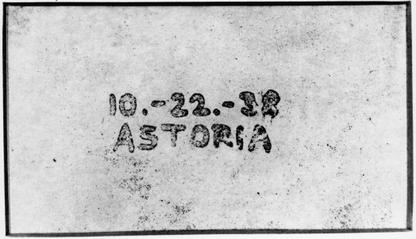
This is the first xerox copy in history.
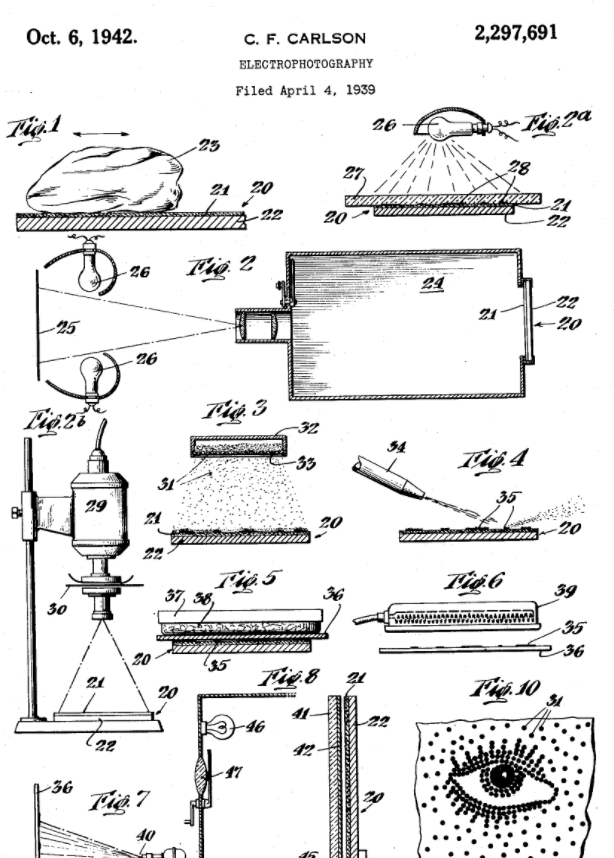
He soon had a patent but more rough times were ahead. Between 1939 and 1944 he was turned down by 20 companies, including IBM and the U.S. Navy.
He and his wife Elsa von Mallon soon divorced. He described the marriage as “an unhappy period interspersed with sporadic escapes.” Perhaps those kitchen fires and terrible smells made him a hard man to live with.
Carlson continued to work in patents at the P. R. Mallory Company. One day he was able to demo his work to an engineer from Battelle, who was only there his employer’s office to testify for a patent case. Battelle never took in outside ideas but were impressed and offered financial support. It only took 20 YEARS, but he finally had support for his idea.
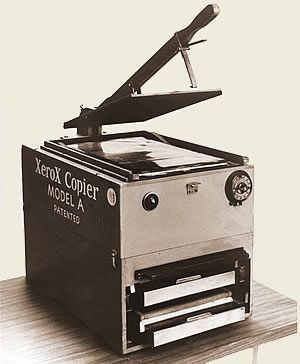
In 1946 they signed a deal with Haloid (later to be renamed Xerox), a competitor to Kodak. In 1948 they released the Xerox Model A Copier. It took 39 steps to make a single copy.
Another decade of development led to the Xerox 914 – named because it could copy paper up to 9″ x 14″. This model become popular quickly because it:
was simple to use
didn’t damage originals
could be rented
used regular paper
It took almost 30 years but Carlson’s dream was finally real. At the push of a button you could make a perfect copy.
As innovative as it was, as with most new tech it had some problems.
It tended to overheat (one demo model caught on fire on launch day), often enough that it came with a “scorch eliminator” – a sales friendly term for fire extinguisher. Ralph Nader’s machine caught fire 3 times in 4 months and he complained to the press about it.
unreliable, as paper jams (‘mispuff’) happened often
The machines often required a small team of people who maintained them and managed taking in copy requests and delivering them (the copy room). But relative to competitors it was a breakthrough in many ways and these issues were improved over time.
The story of Xerox and Carlson is a great example to learn from – it doesn’t suffer from any of the Myths of Innovation. The time from having an idea to making it a real product in the marketplace took decades, which is more often the case than most people realize.
His patents made him wealthy enough to retire. He gave most of his fortune away, anonymously, including support for Buddhism, NYCLU and the NAACP. He died in 1968.
In 1946 Dr. Percy Spencer of Raytheon Corporation was working on radar experiments with a magnetron (a device used to produce radio waves). When he noticed the candy bar in his shirt pocket had melted, he had every reason to throw it away, except one: he felt no heat. Odds are good that other people in radar laboratories around the world experienced similar globs of chocolate and other foodstuffs in their various pockets, and did nothing about them, other than to clean up the mess and get back to work. And given that the rational, logical parts of most intelligent people’s brains would tell them to do the same, getting rid of the offending savory bits and forgetting about it as soon as possible, it’s entirely odd that Spencer chose something different. Remember, he essentially found a bit of warm trash in his pocket, and chose to spend the rest of the day playing with melted cocoa beans, ignoring the millions of dollars of super cool top secret defense equipment surrounding him in his lab.
Just imagine Spencer in that moment: standing alone in a lab, expensive lights blinking on and off all around him, his eyes staring down at two chocolaty fingers, his Hershey stained clothes and lab coat crying out for care. If you walked past him at that instant you’d think for certain he was insane: a chocolate fingered loon. But although he didn’t know it yet, this chance encounter, the moment that redlined his curiosity well past his logical mind’s ability to follow, would lead him to the invention of the microwave oven. Curious about the source of heat, he put some popcorn kernels, and then an egg, by the nearest radar tube. The pop-corn popped, and the egg exploded. He quickly found support for more experiments, and spent the next ten years developing this chance encounter into one of the most used appliances in the world.
How else will new knowledge appear to us, if not as strange, bizarre or incomprehensible experiences? We forget that the common sense we hold dear today was, years or centuries ago, discovered by a curious mind willing to ignore the common sense of their own time. Any sane person would throw away his mistakes without a second thought, but an open mind might just stop and ask “how can I explain this?” before throwing it in the trash.
If you want to make progress happen, or be someone who brings good ideas into the world, this is for you. It’s the simplest, easiest, most straightforward way to convert your ambition into action. When I’m asked to give advice about managing creativity or how to make an organization “innovative” this is what I share.
Forget the word innovation: focus on solving a problem. Most products out in the world are not very good. You rarely need a breakthrough to improve things, to beat the competition, or to help people suffering from a problem. If you carefully study the problem you’re trying to solve, you will discover many clear ways, some forgotten or executed poorly, to make it better. That’s the best place to start. If you solve a problem for a customer that makes them happy enough to pay for it, do you really think they will care if it’s “innovative” or a “breakthrough”? They just want their problems solved. If you cured cancer conventionally, would the patients refuse, saying “but it’s not innovative.” Of course not. Often it’s the combination of many conventional solutions, the combination obscuring how old some of the ideas were, that is called an innovation afterwards by people ignorant of the history of those ideas. So don’t worry. Sometimes small ideas, applied well, matter more than big ideas. Try to use workmanlike language: problem, prototype, experiment, customer, design, and solution, instead of the jargon of breakthrough, radical, game-changing and innovative. This keeps you low to the ground, and prevents your ego from distracting you away from simply making good things.
If you work with others, you need leadership and trust. There’s no point worrying about which creativity or management method you’re using, or how much budget you’re going to spend, if people don’t trust each other. It’s the leader’s job to create an environment of trust so ideas move freely and can grow. Developing new ideas is scary and demands vulnerability and if people don’t trust each other their talents will never be revealed. It’s also the leader’s role to use their superior power to take risks, and protect the team from the dangers of those risks. This sounds obvious, but look around. It’s rare. Many people do not trust their teams, nor work for leaders who are willing to stake their reputations on the risks of a new idea. It’s uncommon to find someone in power who is willing to take the blame for problems, but also willing to give credit to subordinates as rewards for their efforts. If you’re a leader, the burden is on you. If you’re not, and you don’t work for someone who creates trust and is willing to take risks, good work will not happen where you are. Either move, find the courage to take a bet and force the issue, or accept the status quo.
If you work with others, and things are not going well, make the team smaller. There is a reason great things often happen in small organizations. With fewer people, there are fewer cooks and fewer egos. In many large organizations there are too many people involved for anything interesting to happen. The first advice I give teams when things are not going well is to make the team smaller. If you’re the boss, and the politics are too complex, volunteer yourself to leave. Do whatever is necessary to reduce the number of people involved in developing ideas, and/or making decisions. The dynamic of getting 3 people to agree to take a risk together is much simpler than getting 30 people to do the same. Three people can achieve an intellectual intimacy faster, and be fully invested and passionate about a decision in ways thirty people can’t be. Another solution is to pick one creative leader, and give them more power. A film director is the singular creative leader on a movie. Yet most corporate or academic projects divide up leadership across committees, diffusing authority, which always makes decisions more conservative, the opposite of what you want.
Be happy about interesting ‘mistakes’. If you are doing something new, it can not go well on the first, second, or possibly 50th time. This is OK. Your mindset has to be, ‘This did not go how I expected, but I expected that! What can I learn so the next attempt improves? (or teaches more interesting lessons)” The more interesting the lesson, the better. It’s the mind of an experimenter (see Chapter 3) that you want to cultivate, asking questions about everything you make, and using the answers to those questions to fuel the next attempt and the next. Many people quit on their 2nd or 3rd try at something, for reasons that have nothing to do with the history of innovation. There was not a story in this book where any of the brilliant minds mentioned succeeded on such a small number of tries. Perseverance, as simple a concept as it is, is rare. The more ambitious the problem you’re trying to solve, the more experiments and attempts you will need to get it right.
Pick a project and start doing something. It’s easy to fall into the trap of thinking big results always need big plans. Often big plans come only from what’s learned from small samples and prototypes. Write a draft. Draw a sketch. Make a prototype. Have a small ambition you can manifest quickly so the stakes are low, and the pace is fast. The temptation is to have a grand idea, but don’t wait too long to find one. That can come later. Think of drafts as scouting for ideas. Before you can build a city, you must thoughtfully scout and map the landscape. Having a thing, even a napkin drawing, to look at improves the quality of conversations about the possible ideas. And if you can’t find a way to start a project at work, do it on weekends – history is full of creative heroes who never had approval from anyone to do it. There is always a way to start, just pick something small enough you can do yourself in an afternoon, or with a friend, and get to work.
It’s easy to discount these 5 basic notions as they seem so simple, but that’s the trap. I’m convinced ones that don’t overlook these have the highest odds of producing good work, in a healthy culture, with results the team and the customers are proud of. The challenge is commitment as it’s natural to dream of an easier way, and hope for a trick or formula or magical method to avoid the work and the risks. You will find many consultants and experts who promise you things that do not exist based on stories not supported by history. But I hope that the true stories you read earlier in this book will anchor your confidence, defend you against the many myths, and help this simple view stay with you.
All the clichés about beginnings are true, at least in part. The history of innovation is large enough that all the sayings, from Plato’s famous “Necessity is the mother of invention” to Emerson’s “Build a better mouse- trap and the world will beat a path to your door” hold some truth. The trap, and the myth, is that evidence supporting one claim doesn’t mean there isn’t equally good evidence supporting another. Invention, and innovation, have many parents: the Taj Mahal was built out of sorrow, the Babylonian Gardens were designed out of love, the Empire State Building was constructed for ego, and the Brooklyn Bridge was motivated by pride. Name an emotion, motivation, or situation, and you’ll find an innovation somewhere that it seeded.
However, it’s simplifying and inspiring to categorize how things begin. In reading the stories behind hundreds of innovations, some patterns surface, and they’re captured here in six categories. I concede to the existence of reasonable arguments for seven or five, or different categorizations altogether. I offer this list to seed your thoughts on what paths to innovation are in front of you now.
1. Hard work in a specific direction
The majority of innovations come from dedicated people in a field working hard to solve a well-defined problem. It’s not sexy, and it won’t be in any major motion pictures anytime soon, but it’s the truth. Their starts are ordinary: in the cases of DNA (Watson and Crick), Google (Page and Brin), and the computer mouse (Englebart), the innovators spent time framing the problem, enumerating possible solutions, and then began experimenting. Similar tales can be found in the origins of the developments of television (Farnsworth) and cell phones (Cooper). Often, hard work extends for years. It took Carlson, the inventor of the photocopier, decades of concentrated effort before Xerox released its first copying machine.
2. Hard work with direction change (Pivot)
Many innovations start in the same way as mentioned previously, but an unexpected opportunity emerges and is pursued midway through the work. In the classic tale of Post-it Notes, Art Fry at 3M unintentionally created weak glue, but he didn’t just throw it away. Instead, he wondered: what might this be good for? For years he kept that glue around, periodically asking friends and colleagues whether it could be useful. Years later, he found a friend who desired sticky paper for his music notations, giving birth to Post-it Notes. Teflon (a mechanical lubricant), tea bags (first used as packaging for loose tea samples), and microwaves (unexpected discharge from a radar system) all have similar origination stories. What’s ignored is that the supposed “accident” was made possible by hard work and persistence, and it wouldn’t have otherwise happened by waiting around.
3. Curiosity
Many innovations begin with bright minds following their personal interests. The ambition is to pass time, learn something new, or have fun. At some point, the idea of a practical purpose arises, commitments are made, and the rest is history. George de Mestral invented Velcro in response to the burrs he found on his clothes after a hike. He was curious about how the burrs stuck, put them under a microscope, and did some experiments. Like da Vinci, he found inspiration in the natural world, and he designed Velcro based on the interlocking hooks and loops of the burrs and his clothing. Linus Torvalds began Linux as a hobby: a way to learn about software and explore making some of his own.10 Much like the direction-change scenario, at some point, a possible use is found for the product of curiosity, and a choice is made to pursue it or follow curiosity elsewhere.
4. Wealth and money
Many innovations are driven by the quest for cash. Peter Drucker believed Thomas Edison’s primary ambition was to be a captain of industry, not an innovator: “His real ambition…was to be a business builder and to become a tycoon.” Drucker also explains that Edison was a disaster in business matters, but that his profile was so prominent that—despite his entrepreneurial failures—his management methods are emulated today, particularly in Silicon Valley and venture capital firms.
With half an innovation in hand, ideas but no product, it’s natural to try to sell those ideas: let someone else take the risks of complete innovation. Instead of idealistic goals of revolution or changing the world, the focus is on reaping financial rewards without the uncertainties of bringing the ideas all the way to fruition. The Internet boom and bust of the 1990s was driven by start-up firms innovating, or pretending to innovate, just enough for established corporations to acquire them. In many cases, the start-ups imploded before acquisition or were acquired only for their ideas to be abandoned by the corporations’ larger and conservative business plans.
The founders of many great companies initially planned to sell their ideas to larger corporations but, unable to sell, reluctantly chose to go it alone. Google tried to sell to Yahoo! and AltaVista, Apple to HP and Atari, and Carlson (photocopier) to nearly every corporation he could find.
5. Necessity
Waves of innovation have come from individuals in need of something they couldn’t find. Craig Newmark, the founder of Craiglist.org, needed a way to keep in touch with friends about local events. The simple email list grew too popular to manage and evolved into the web site known today. Similarly, the founders of McDonald’s developed a system for fast food production to sim- plify the management of their local homespun hamburger stand (Ray Crok bought the company later and developed it into a multinational brand). Innovations that change the world often begin with humble aspirations.
6. Combination
Most innovations involve many factors, and it’s daft to isolate one above others. Imagine an innovation that starts with curiosity and leads to hard work, but then the innovator’s quest for wealth forces a direction change. Midway through, this direction change is interrupted by a stroke of good luck (say, winning the lottery), allowing the innovator to return to the initial direction with renewed perspective and motivation. The removal of any of those seeds from the story might end it—or might not. In many of the stories of innovation, we have to wonder: if the first “magical” event didn’t take place, might the innovator have found a different seed instead? No matter what seeds are involved, all ideas overcome similar challenges, and studying them reveals as much or more than the beginnings of innovation.
The challenges of innovation
Steve Jobs, founder of Apple and Pixar, was asked, “How do you systematize innovation?” (a common question among CEOs and the business community). His answer was, “You don’t.” This was not what readers of Business Week expected to hear, but foolish questions often receive disappointing answers. It’s as absurd a question as asking how to control weather or herd cats, because those approximate the lack of control and number of variables inherent in innovation. Jobs, or any CEO, might have a system for trying to manage innovation, or a strategy for managing the risks of new ideas, but that’s a far cry from systematizing something. I wouldn’t call anything with a 50% failure rate a system, would you? The Boeing 777 has jet engines engineered for guaranteed 99.99% reliability—now that’s a system and a methodology. It’s true that innovation is riskier than engineering, but that doesn’t mean we should use words like system, control, or process so casually.
To read more about the challenges of innovation, and how to overcome them, get a copy of The Myths Of Innovation.
This myth is best captured in the famous saying, “If you build a better mousetrap, the world will beat a path to your door.” Unfortunately, the quote is a misattribution to Ralph Waldo Emerson, a leading 19th-century intellectual. What he actually said was “If a man has good corn, or wood, or boards, or pigs to sell, you will find a broad, hard beaten road to his house.” I’m not sure when you last sold pigs or grew corn, but Emerson had something other in mind than rallying would-be entrepreneurs. The phrase was meant to be poetic, not instructional, and he’d be disappointed at how many people have taken his words literally.
The phrase has been used as the entrepreneur’s motto, misguiding millions into entertaining the notion that a sufficiently good idea will sell itself. As nice as it would be for good ideas to take responsibility for themselves, perhaps using their goodness ID cards to cut ahead of stupid ideas in the popularity line, it’s not going to happen. Even the (false) proverbial mousetrap, as historian John H. Lienhard notes, has about 400 patents for new designs filed annually in the U.S., and we can be certain that no one is beating down their doors. More than 4000 mousetrap patents exist, yet only around 20 ever became profitable products.
These days, the best equivalent to the metaphoric mousetrap is “to build a better web site” or mobile app, proven by the 30,000 software patents and 1 million web sites created annually. Certainly not all of these efforts are motivated by wealth or wishful thinking, but many inventors still hope that the “If you build it, they will come” sentiment is alive and strong.
Lienhard, based on his study of innovations throughout history, challenges that faith:
Rarely if ever are the networks that surround an innovation in its earliest stages given the credit they are due…a better mouse- trap, like anything else, will succeed only when those who envision the idea convince others to join in their new venture—as investors, suppliers, employees, retailers, customers, and even competitors.
The goodness or newness of an idea is only part of the system that determines which ideas win or lose. When we bemoan our favorite restaurant going out of business (“but they make the best cannelloni!”) or why our favorite band can’t sell albums (“they have the best lyrics!”), we’re focusing on the small part of the picture that effects us personally, which is only one factor in the environment determining its fate. These environmental, or secondary, factors have as much influence as the quality of the idea, the talent, or the innovation itself.
The secondary factors of progress
The history of innovation reveals many ideas that dominate a field yet are derided by insiders. Any hi-tech device today follows the QWERTY keyboard model, a system not designed for efficiency or ergonomics. The Phillips screw is inferior to the lesser-known Robertson screw, a clever gem of industrial design. The M-16, the most widely produced rifle in the world, had serious jamming and ease-of-use problems. Fireplaces, staples in American cabins and homes, are one of the least efficient heating systems known to man. And HTML and JavaScript are far from the best software development languages, yet they’re perhaps the most successful in history. The list goes on, despite the best wishes of all of the smart, goodness-motivated people throughout time. Even today, right now, ideas of all kinds that experts criticize—including those in your own fields of expertise—are gaining adoption.
In Chapter 4 of The Myths of Innovation, the psychology of innovations’ diffusion was explored, listing how individuals make choices that impact innovation adoption. Now, it’s time for a broader analysis of influen tial factors. Looking at history, here are seven factors that play major roles:
Culture. The Japanese invented firearms years before Europeans. But their culture saw the sword as a symbol of their values: craftsmanship, honor, and respect. Despite the advantages of using firearms, the innovation was ignored and seen as a disgraceful way to kill (a sentiment echoed by the Jedi in Star Wars films). The best technology is only one view of innovation—how the innovation fits in a culture’s values is often stronger. For example, imagine a device in the U.S. that gave you telepathy at work but required making lunch out of your neighbor’s dog or being naked in public, two taboos of American culture. Innovations do change societies, but they must first gain acceptance by aligning with existing values.
Dominant design. The QWERTY keyboard came along for the ride with the first typewriter. When Christopher Sholes created this layout, he didn’t imagine millions of people using it—he just needed a design that wouldn’t jam his mechanical keys. But once typewriters succeeded, the first computer designers wanted to ease people’s transitions to their creations, so they copied the typewriter design. Many dominant designs achieve popularity on the back of another innovation. Better designs might follow, but to gain acceptance, they must improve on that dominant idea by a sufficient margin to jus- tify the costs of the switch (e.g., re-learning how to type). The more dominant the design, the more expensive those costs are (e.g., try innovating, or unifying, the shape of electric plugs around the world).
Quality of the execution of the idea. Having a good idea doesn’t guarantee the way you manifest it in the world will be good. For a great idea for an automobile or a novel to be fully realized depends on the quality of hundreds of small decisions. Some good ideas, including ones labeled as “ahead of their time” lead to failed products. Some bad ideas, if executed in the right way, or marketed successfully for the climate of the times, can be successful in a marketplace, even if they are bad for consumers or the planet (e.g. unhealthy fast-food sold in styrofoam).
Inheritance and tradition. The U.S. rejection of the metric system is tied to tradition: America already knew the English system, so why learn another? (See “Space, metrics, and Thomas Jefferson,” later in this chapter.) Some people confuse their comfort for a belief with it actually being good; therefore, inherited ideas (including the evils of bigotry, ignorance, and urban legends) are often protected by the very people they hurt in the name of honoring the beliefs of their parents and the past. This is a specific cultural factor.
Politics: who benefits? There’s often little malice in political workings—people are simply acting in self-interest. In any situation, just ask: who benefits if we choose X, and who benefits if we choose Y? You can predict how people in power will respond to any new idea if you first calculate its impact on them. The interests of those in power influenced the adoption, or rejection, of every innovation in history. Hunger, war, and poverty are tough problems, but it’s in someone’s interest for those problems to continue. Any innovation aimed at solving those problems must consider politics for it to succeed.
Economics. Innovation is expensive: will the costs of changing to the new thing be worth it? Everyone might agree that an innovation is better in the abstract, but the financing required might be impossible or the risks unreasonable. Dominant designs (see above) are expensive to replace. Often there is only time or money for innovating in one area; other innovations are rejected, not on their merits, but on their value to the priorities of the moment.
Goodness is subjective. Get three people in a room and you’ll get five definitions of goodness (see Chapter 10). Fireplaces, mentioned earlier, are popular because of how they look more so than how they function. Consumer differences in values, tastes, and opinions are rarely explored until after an innovation has been proposed, or even built, leaving innovators with creations the public does not want. Smart innovators study their customers, mastering their needs early enough that those factors can be useful. The often-used Beta vs. VHS example fits: a key factor in the success of VHS was tape length (three hours, enough for a feature film, to Beta’s one hour), which was more important to consumers than Beta’s superior video quality.
Short-term vs. long-term thinking. One part of goodness is time: how long does this innovation need to be used for? Many superior ideas are rejected by societies interested in cheaper, shorter-term gains. In the 1930s, major cities in the U.S. had public transportation—trolleys and tram systems modeled on successful designs from Europe. But in the rush of the 1950s, and the thrill of automotive power, those street- cars were removed and replaced with new lanes for cars. Today, many cities regret these changes and approximate trolleys with new light-rail systems. The goodness of ideas changes depending on how far into the future their impact is considered.
The next time you witness a great idea rejected, or a bad idea accepted, this list will help reveal the true factors at work.
If you liked this you should pick up a copy of the very popular book, The Myths of Innovation.
The term Myths of Innovation has become popular on the web, but few articles on the subject link to each other. I wrote the bestselling book, The Myths of Innovation some time ago, but still new articles appear without a single reference to any sources at all. Somehow in all this “innovation” we’ve forgotten basic useful inventions like web searches, links and footnotes to credit what others have done.
On this page I’ve compiled the definitive list of Innovation Myths, referencing every use of the term I’ve been able to find. Many of these articles are broadly written: not based on research into specific legends and inventions. However my hope is providing one place to review and compare popular misconceptions about the subject will help all of us move forward in our thinking.
I came up with the term independently in April of 2002 for a lecture at Microsoft that eventually became the book. I hadn’t heard the term before but in compiling this post the earliest use I found was the 2001 post by Veitch, below.
Innovation can’t exist in a large established company
True Innovation comes from R&D
Innovation is driven from the top down
Innovation requires perfection
It can be impossible to overcome ‘thinkers cramp’
Innovation only happens in entrepreneurial organizations
How this list was compiled
I used a series of Google, Yahoo and Bing searches, focusing on different date ranges and permutations on “Myths of Innovation”. Search engines are better in some ways than when I wrote the book, as more data is now available on the web. I prioritized articles, posts or presentations that used the words Myth and Innovation somewhere in the title, including some that used the terms Myths and Creativity.
Many posts I found are cross-references of the same links, with interviews with authors of books/posts about myths they’d written about elsewhere and I only listed each list once. If you find other items I should add, please leave a comment.
The timeless patterns that explain how innovation happens, or more often doesn’t, are explained in the bestselling book I wrote called The Myths of Innovation. The way innovation is generally explained is flawed. We rely on legends and myths that sound inspiring but have little relation to the truth about how good ideas become real.
If you’re frustrated by how your organization kills good ideas, or relies on caution more than creativity despite the proclamations from leaders to innovate, this book will help you understand what’s really going on and why.
The stories and facts in the book are its greatest asset. You’ll gain the longest lasting tools for thinking clearly about innovation from the book itself.
To help as many people as possible get beyond the myths, they are summarized here. The book was heavily researched with 100s of footnotes and references, but here’s the tightest summation:
We overvalue the role of flashes of insight (The myth of epiphany). Flashes of insight feel great, but the way they’re reported distorts the well-documented history of how creativity and success happen. Epiphanies are a consequence of effort, not just the inspiration for it. And no idea is completely original, as all ideas are made from other ideas. When you hear a story about a flash of insight, the useful questions to ask are 1) how much time the creator spent working before the flash happened, 2) How many ideas from other people they reused and 3) how much work they did after the flash to make the idea successful. An epiphany doesn’t find investors, make prototypes, sacrifice free time or persist in the face of rejection: only you can do that and you’ll have to do it without a guarantee of success (More about epiphany myths).
Technological progress does not move in a straight line (The myth that we know history). We romanticize the past to fit the present, creating traps for creatives who don’t know the true history of their own field. Edison did not invent the lightbulb. Ford did not invent the assembly line. Inspiring lies are often more popular than complex truths. And history is heavily tainted by survivorship bias, which distracts us away from more useful historic lessons. History is not a straight line of progress: it wasn’t clear that B would follow A, until after they happened, which means the present isn’t a straight line of progress either (jetpacks and flying cars are not flukes, historically we’re wrong far more often than we think). (see Myth #8: the best idea wins).
Progress, and market success, are inherently unpredictable (The myth of a method). The challenge with creative work, especially in a marketplace, is the many factors beyond your control. You can do everything right and still fail. Most books on creativity make big promises based on history: they cherry pick examples from the past to support their “method”. Methods can be useful but they deny that the present is different from the past. There are too many variables in the present to have certainty. This is why terms like innovation system or innovation pipeline are absurd. The idea of an innovation portfolio, where a range of risk is assumed across multiple ideas, is more honest. Many books on creativity are surprisingly uncreative (lightbulbs should be banned from creativity book covers) and make impossible promises.
People resist change, including progress (The myth we love new ideas). We are a conservative species: try something as simple as standing, rather than sitting, in your next group meeting. How accepting were your peers? Conformity is deep in our biology. While talking about creativity is very popular, actually being creative puts your social status at risk. All great ideas were rejected, often for years or decades, yet we bury this in our history (see Myth #1 & #2). The history of breakthroughs is a tale of persistence against rejection. Much of what makes a successful innovator is their ability to persuade and convince conservative people of the merits of their ideas, a very different skill from creativity itself. Your problem is likely not your ideas, but your skills for pitching ideas to others. Ideas are rarely rejected on their merits; they’re rejected because of how they make people feel. The bigger the idea, the harder the persuasion challenge.
We overstate individual contributions and under-recognize teams (The myth of the lone inventor). It’s easier to worship a hero if they are portrayed as superhuman. But even people worthy of the title genius or prodigy like Mozart, Picasso and Einstein had family and teachers who taught them. Many of Edison’s patents are shared with co-workers, as despite his huge ego he knew collaboration was critical (His Menlo Park office was one of the first research labs). Stories of mad geniuses who worked completely alone are rare. Pick any master who you think worked alone and read some of their history: you’ll be surprised how many people influenced their work. Learning to collaborate, and give and receive feedback, may matter more than your brilliance.
Good ideas are everywhere, it’s courage that’s scarce (The myth that good ideas are rare). If you watch any 6 year old child they will invent dozens of things in an hour. We are built for creativity. The problem is the conventions of adult life demand conformity and we sacrifice our creative instincts in favor of social status. Unlike a child, adults are supremely and instantly judgmental, killing ideas before they’ve had even a moment to prove their worth. It’s easy to rediscover creativity, which is why brainstorming rarely helps much. We’re already creative. The challenge is ideas don’t come with the courage to invest in them. Good ideas are everywhere: what’s uncommon is people with the conviction to put their reputation behind ideas.
People in charge resist progress since change threatens the status quo that benefits them (The myth your boss knows more than you). A fallacy of workplaces is that senior staff are better at everything than the people who work for them. This is false in many ways, but creative intuition might be the most false. To rise in power demands good political judgement, yet innovation requires a willingness to defy convention. Convention-defiers are harder to promote in most organizations, yet essential for progress. To assume senior staff are the best at leading change is a mistake.
The world of ideas is not a meritocracy (The myth the best idea wins). We lionize winners and history blames losers for their fate, even if they did most of the same things the winners did (See survivorship bias). Marketing, politics and timing have tremendous influence on why one idea or its competitors wins, yet these details are more complex than we want to hear and fade from history. It’s satisfying to believe the best idea has won in the past, because it’s something we want to believe about the present too. But to be successful with ideas demands studying why some lousy ideas have triumphed (Why doesn’t the U.S. use the metric system?), and some great ones are still on the sidelines. The world of ideas is not a pure meritocracy and you need to act accordingly (See related chapter excerpt).
Defining problems well is as important as solving them (The myth that problems are less interesting than solutions). Einstein said “If I had 20 days to solve a problem I would take 19 to define it.” There are many creative ways to think about a problem, and different ways to look at a situation. The impatient run at full speed into solving things, speeding right past the insights needed to find a great solution. If you listen to how successful creators talk about their daily work, they spend more time thinking about the problem than the epiphany obsessed media would have us believe.
Unintended consequences are hard to avoid (The myth that innovation is always good). How would you feel about an invention that ends your profession? What impact will an idea have 1,5,10,100 years from now? All innovation is change and all change helps some people and hurts others. Many horrible inventions were created with the best intentions (and some horrible intentions led to some good consequences). Benz and Ford never imagined automobiles would kill 40k people annually in the U.S. And the Wright brothers never imagined Predator drones. Any successful idea has a multitude of consequences that are impossible to predict and difficult to even measure.
If you liked this summary, please get the book. Over 100,000 people already have and the book has earned hundreds of excellent reviews. You’ll get detailed lessons and dozens of entertaining and inspiring stories based on well researched facts. It includes 4 chapters about how to apply everything you learn with a simple plan for the common challenges innovators face.
[Updated 7/7/13 – added link to Myth #3]
[Updated 10/11/19 – restated myths as declarative statements]
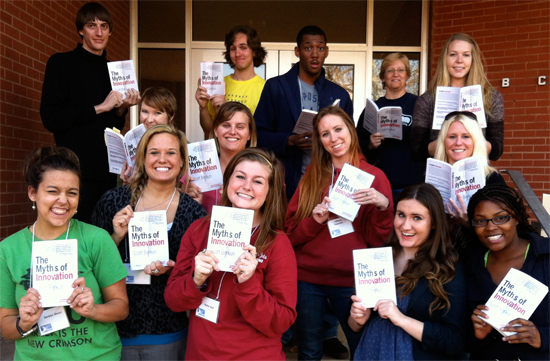
Many universities use The Myths of Innovation in courses on entrepreneurship or creativity, but David Burkus lined up his class for a photo, which I promised to post here.
Among other places he teaches at OSLEP, a program for top students across Oklahoma and they’re seen here.
If you use my book in a course, let me know. If you send in a photo I’ll post it here.
Before I share the list of the 5 best books on innovation, here’s a list of 5 things you need to know before reading that list. It’s worth it. I promise.
There are 100s of books on innovation and most are terrifyingly (and ironically) boring. They’re bought to be placed, unread, on office shelves so people can pretend they’re smart. These books are cliché in the worst way, cherry picking trendy examples and building worlds of junk theories around them, theories the heroes in the cherry picked examples didn’t even use. Innovation is a junk word, and there are many junk books.
It’s not clear why anyone should read a book about innovation. There’s little evidence people we’d call creative got that way by reading a particular book. Most skills in life are only acquired by work, and to be more creative means to create and learn, rather than merely read.
I carefully studied over 60 books, related to creativity, invention and managing creativity in others during research for my bestseller, The Myths of Innovation (research that included teaching a course on creativity at the University of Washington – syllabus). And I’ve read more books before and after that project. I even organized the books I studied in an innovative way for readers. I’ve been studying creativity in many forms for a long time and my list reflects wide and deep reading.
People looking for a book on innovation often make the mistake of compressing the many sloppy uses of the word into a single thing, and expect one book to excel at teaching people how to: 1) Generate ideas and invent things 2) Design and ship good products 3) Run a successful entrepreneurial business 4) navigate an organizational bureaucracy. These are very different skills, possibly even different subjects.
These four skills are rare. It’s insanely rare for one person to have two, much less three of them. It’s improbable any book could single-handedly give you one of these skills, much less all three. Any book claiming to do any of this is lying to you.
There. All done.
I can confidently say if you only read 5 books these are the ones to read and re-read:
Innovation and Entrepreneurship, by Peter Drucker. Drucker is profound, clear, concise and memorable. He puts modern business writers to shame with his clarity. This short books encapsulates all of the theory you need to think about starting a business, and what it will take to find, develop, launch and grow product ideas. (Also see, The Art of the Start, Guy Kawasaki, and if you work in the tech-sector, Founders at Work is a must-read)
Thinkertoys, Michael Michalko. There are many books with exhaustive lists of methods for generating ideas. This is one of them. The misconception is that idea generation is the hard part, which it rarely is. But for those looking for games, tactics and methods to generate ideas this is a great place to start. (Also see, Are your Lights on?, by Gause and Weinberg).
Dear Theo, By Vincent Van Gogh (& Irving Stone). Before you dismiss this one, consider this: what we call passion in the business world, is passion for profit. What if there was no profit motive? How much passion would our heroes, like Edison and Jobs, have had for the ideas alone? To learn about the deepest commitment to ideas you have to study artists. There are no better stories of passion than great artists pursuing their creative visions against all odds and Van Gogh’s letters are a fantastic encapsulation of commitment, vision, dedication, brilliance, work ethic and madness, all traits any creator or entrepreneur should understand. (Also see, The Agony and the Ecstasy, for a similar book about Michelangelo).
They all laughed, Ira Flatow. History is biased in that we retroactively inject purpose and narrative structure into stories of invention, so that they make more sense to us in the present. But the real history of invention and discovery is messy, weird, frustrating and surprising. This book documents how frustrating it usually is to have a great idea in a mediocre world. (Also see, Connections, by James Burke – all episodes of the documentary based on the book are free online).
Brain Rules, John Medina. I’ve read many books about intelligence and neuroscience – they’re mostly pseudo-fluff, filled with the latest theories and shocking claims, but lead to no tangible improvement in how you use what’s between your ears. Brain Rules is the book to read about how to use your brain to better use your brain. While it’s not strictly about creativity, show me a creative person who didn’t use their brain well (See my full review of Brain Rules here).
There. Have fun.
Most of these books are old. Well guess what? Innovation and creativity are old too. The best advice is not necessarily the newest, despite our compulsive neophilia. Just be glad I didn’t recommend Vitruvius’ ten books on architecture (which happens to be one of the only sources for the story of Archimedes and ‘Eureka‘).
But I implore you to do more than read. Like learning to play guitar, you can only learn so much from books. You must get to work yourself. It doesn’t matter what you make, but go make something. And when you finish, think about how to make it better and try again. This is the only thing that will make you more creative: the practice of making things. And only then can what you learn from books matter.
Timothy Meaney, CEO of Kindling, a collaboration tool used by Symantec, Motley Fool, Nordstrom and Credit Suisse, sent out copies of The Myths of Innovation to some of their favorite customers.
He kindly sent me a photo, which I promised to post here.
Should you be inspired to do something similar with one of my books for your clients, friends or armies of creatives under your employment, and give me an interesting picture, I’d be thrilled to post about it here too.
O’Reilly Media has started a new blogger review program – If you’re willing to write a review, both on your blog and on amazon.com, you can get free copies of many of their books.
And of course you are free to write positive or negative reviews.
The paperback edition of my bestseller, The Myths of Innovation is, for a limited time, part of the program (They change which books are in or out frequently)
If you want to participate, head here now. Look forward to your review!
You can be Don Draper and help pick an advertisement. I can’t offer you bourbon or a smoke, but you can weigh in and give judgment, which might be a fun break on a boring day.
Some books on amazon.com are allowed to put a video ad on the book’s page to help promote the book. Myths of Innovation is one of them. The current video is broken and was mediocre anyway.
To help promote the paperback edition of Myths, I hired Bryan Zug to make a new video to appear on amazon.com and on youtube. We edited two different versions and wanted your feedback: which is stronger? Which will get more people to watch all the way through and seek out the book?
If you have 3 minutes to opine, please do the following:
Watch both videos. They’re similiar but different.
If you were born on an even day (10, 12, etc.) please watch B first, then A (to help counterbalance order bias).
Vote below on which version is stronger
Version A: TJ
Version B: Spike
Vote
[polldaddy poll=4024420]
Thanks to O’Reilly Media, last week’s webcast on the new edition of Myths of Innovation is now available free online.
Bonus links:
There’s also an extended Q&A writeup (questions I didn’t have time to answer during the webcast).
If you have been waiting to buy 6,434 copies of the myths of innovation for your entire company, or have a coupon for a hour of advertising on all major networks burning a hole in your pocket, now is the best time ever in history to pull the trigger.
There are people who like my work, some who hate it, but most of the world has no idea who I am. PR helps reach that last group, and you know more people I don’t know than I do.
Today, if you can post on your blog, post to facebook or twitter, or buy the book today, it will help me and my future work more than you know.
The goal: We’re trying to see how high we can get the amazon rank to go. It started at 12,000. Can we break 5,000? The higher the ranking, the more exposure the book gets across all of amazon.com.
I’ll be posting cool stuff all day, with some more prizes, so stay tuned.
The Prize: A signed copy of the new paperback edition of Myths of Innovation.
Rules: anyone enters by leaving a comment – one winner will be chosen at random from correct entries. I’m the final arbiter of rules, including rulings about rules or rule like sub-rules, slide-rules, slides of all kinds, laws, by-laws, in-laws, laws about common law rules regarding the application of contest laws and sub-law rulings.
Ready? Here we go:
Some have complained the questions are to easy. Ok – try this one.
Question: Which of Rogers factors in Innovation diffusion is the hardest for an inventor to overcome? and why? (see chp 4 in the free sample)?
As part of Myths of Innovation day, I’ll be doing a free, live webcast on all things innovation, Wed Oct 13th 2010, at 10am PST.
I’ll be talking about new material – using stuff from previous talks as little as possible.So we’re calling it Remixed and Remastered.
Description: With the release of the new paperback edition of the classic bestseller, The Myths of Innovation, Berkun is back with new stories, advice and inspirations based on the true history and present of innovation. Scott will share lessons and insights he’s learned from 3 years of traveling the world speaking about innovation to universities, corporations and start-ups great and small. If you’re sick of hype and bogus trends, and want to be inspired, educated and entertained by true tales of greatness, this webcast is for you (and your boss, and your boss’s boss, and your entire organization if they’re busy chasing myths). Send in your toughest questions, and Scott will work them into his presentation or answer in the extended Q&A.
When: Wed, October 13, 2010 10am PT
Where: wherever you are
What: best free webcast on innovation ever (ok, at least this week)
Questions you want me to answer? Have an issue something related to ideas, invention, innovation foo you want me to answer? Even a tough, tricky, uber-hard question or situation? Fire away. If I use your question, you’ll get a free copy of the book.
The Prize: A signed copy of the new paperback edition of Myths of Innovation.
Rules: anyone can enter by leaving a comment – one winner will be chosen at random from correct entries. I am the final arbiter of all rules, including rulings about rules or rule like sub-rules, laws, by-laws, in-laws, laws about common law rules regarding the application of contest laws and sub-law rulings.
Ready? Here we go:
Question: In your own words, describe the innovators dilemma? (Most entertaining answer wins)
The Prize: A signed copy of the new paperback edition of Myths of Innovation.
Rules: anyone can enter by leaving a comment – one winner will be chosen at random from correct entries. I am the final arbiter of all rules, including rulings about rules or rule like sub-rules, laws, by-laws, in-laws, laws about common law rules regarding the application of contest laws and sub-law rulings.