The Myth of Epiphany
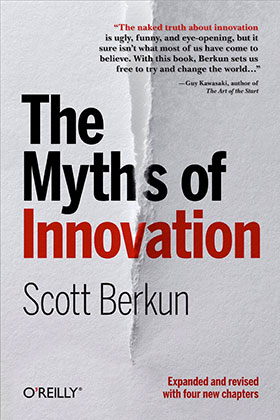 One of the most provocative chapters of The Myths of Innovation is The Myth of Epiphany.
Do you love stories about flashes of insight? Or wish you had more of them so you can be more creative? Most people do. But the reasons these stories are loved has little to do with how breakthroughs usually happen.
The surprise is if you scratch the surface of any epiphany story, you’ll find they are mostly fabrications and exaggerations. As fun and inspiring as they seem, their value fades in practice. I don’t say this to depress you: it is true that the thrill of an epiphany feels great. But if you’re serious about ideas you need to look deeper into what these stories are really about.
One of the best accountings of the mythology is from Tim Berners-Lee, describing how he invented the World Wide Web, one of the greatest inventions of the 20th century:
“Journalists have always asked me what the crucial idea was or what the singular event was that allowed the web to exist one day when it hadn’t before. They are frustrated when I tell them there was no Eureka moment. It was not like the legendary apple falling on Newton’s head to demonstrate the concept of gravity… it was a process of accretion [growth by gradual addition]”
Even Berners-Lee was a victim of the epiphany myth, as the apple falling on Newton’s head didn’t happen, and the entire story is problematic as it’s usually told
We love these stories because they support our secret wish that creativity only requires a magic moment. That it’s like a lottery where we just need to be inspired enough, or have the Muses favor us. It feels safer to believe this, but it is dangerous because of how far removed it is from reality. Do you find the excitement of a flash of insight fades quickly? All of our creative heroes experience this too.
“Inspiration is for amateurs — the rest of us just show up and get to work.” – Chuck Close
We love stories of flashes of insight because we love dramatic stories. The notion of an epiphany ties back to religious and spiritual concepts like the Muses, where forces in the universe instantly grant things to people. Even if we don’t literally believe in these forces we love the notion that creativity works through some system, and that all we need is one brilliant moment that can change everything for us.
The smarter way to think of ideas is that a flash of insight is one part of the process. You can take any epiphany story and shift it into giving you useful advice for how to follow in a successful creators footsteps.
Ask three questions:
- What was the person doing before the epiphany? In most cases, they were working in their field trying to solve a problem, or building a project, and the work led them to learn things that increased the odds of making a breakthrough. Creativity is best thought of as a kind of effort.
- What did they need to do after the epiphany to bring the idea to the world? There is always significant work after the flash to develop the idea into a prototype, much less a working solution. A brilliant idea for a movie or a business still demands years of effort to realize the idea. An epiphany is rarely the end of the challenge, but typically the beginning of a new one. While epiphanies are common, people willing to commit years of work to see them to fruition are rare.
- What can we learn about how to have an epiphany ourselves? Most epiphany stories have no substance. They focus on seemingly ordinary facts, like Archimedes in a bathtub or Newton by a tree, where the discovery is presented as a surprise. Epiphany stories rarely teach us anything to do differently in our own lives as there are no useful patterns or habits suggested in the story.
Even the Newton apple story isn’t true in the way it’s commonly told. Newton certainly wasn’t hit on the head, and it’s unlikely that the singular moment of watching an apple fall from a tree, even if it happened, carried particular significance to a man who made daily observations and ran frequent experiments testing his ideas about the things he saw.
The lesson about creativity from Newton we should learn is his daily habits: he frequently asked questions and ran experiments, constantly trying new approaches and making prototypes to explore his ideas. But that’s not nearly as exciting a story to tell as the apple tale, so it’s rarely told..
Gordon Gould, a primary inventor of the laser beam, had this to say:
“In the middle of one Saturday night… the whole thing suddenly popped into my head and I saw how to build the laser… but that flash of insight required the 20 years of work I had done in physics and optics to put all of the bricks of that invention in there”
Most legendary stories of flashes of insight are like Gould’s: the inventor rarely obsesses about the epiphany, but everyone else does. Flashes of insight are best understood as our subconscious minds working on our behalf. In professor of psychology Csikszentmihalyi’s book Creativity he defines epiphany as having three parts: early, insight, and after. The insight feels like a flash because until the moment our subconscious mind surfaces an idea, we’re not fully aware that our minds are still working on the problem for us. We get ideas in the shower because it’s a place where it’s easier for our subconscious minds to speak up.
One way to think about the experience of epiphany is that it’s the moment when all of the pieces fall into place. But this does not require that the last piece has any particular significance (the last piece might be the hardest, but it doesn’t have to be). Whichever piece of the puzzle is sorted out last becomes the epiphany piece and brings the satisfying epiphany experience. However, the last piece isn’t necessarily more magical than the others and has no magic without its connection to the other pieces. It feels magical for psychological reasons, fueling the legend and myths about where the insight happened and why it was at that particular moment and not another.

Related:
- Read about the other Myths of Innovation
- See Creativity Is Not An Accident
- Watch a lecture about the Myth of Epiphany (below), or buy the bestselling book
[youtube=https://www.youtube.com/watch?v=amt3ag2BaKc&feature=youtu.be&t=5m24s]