One of my most popular books is The Myths of Innovation. It was published years ago but I’m still regularly asked to talk about the core themes of tech-hype, survivorship bias, the flaws of tech-determinism and what true innovation looks and feels like.
Recently I was invited to give a talk called Beyond The Myths of Innovation as the opening keynote at Interface – Québec this year. I briefly explained the Myth of Epiphany, but then told stories that are not in the book. It was an excellent event and I felt honored to be there.
They kindly recorded my talk and you can watch it here for free.
Over the years it’s been rewarding to see how many courses use one of my books. I write to teach and it’s great to know I can help teachers do what they do.
If you’re someone who uses one of my books in a class, you should get in touch.
Now and then there are bonus materials I produce for my books (like this Speaking Checklist for Confessions of a Public Speaker). If I know you use my book, I can notify you when this happens.
How to get a video made for your class:
Tell me the name of the class
Include a link to the syllabus if you have one
Name a topic or question you want me to talk about
These are fun for me to do and it’s a way I can give something back. I’d like to thank you. These are fun to do and helps me learn and often gives me ideas for new things to write about. I appreciate what you do and honored you’re using something I made.
A great innovation in business tech was announced on Sept. 16th in 1959 – The Xerox 914. It is one of the great breakthroughs in office technology and product design.
It was the first copy machine that resembles the ones we know and the inventions inside it led to the laser printers we use today. It’s hallmark was simplicity: unlike it’s complex competitors, you simply placed your paper on glass and pressed a button. How Chester Carlson invented it is a great story of risk and persistence and a better one to learn from than most.
Carlson worked at Bell Labs in the 1930s in the patent department. He had 100s of ideas for different inventions, but focused on copying because typing with carbon paper was messy and frustrating (You had to place a sheet of the carbon paper between two sheets of regular paper, and writing or typing would be copied to the second sheet). His patent department made hundreds of copies and he found the process frustrating. The “cc:” line in email applications today is a reference to the manual process of making a carbon copy,.
Carlson was fired in 1933 (Great Depression). By 1936 he had a new job and went to night school to study law. Too poor to buy books, he had to hand copy them from the library! Copying was his nemesis. To relax he read books on science, and there he learned about Pál Selényi’s work on electrostatic images and he saw a way for his idea to become real.
He did chemical experiments in his own home, to the annoyance of his family and neighbors. He made unavoidably smelly compounds, melting sulfur (!) over zinc plates in the kitchen smelling like rotten eggs, once even starting a fire. By 1938 his wife told him he had to do his work elsewhere..
Using Selényi’s ideas (roughly: use light to remove static charge, not create it) and his own, after many experiments he had a ‘breakthrough’ in 1938. But unlike the myth of epiphany, he realized that moment depended on many others:
“Things don’t come to mind readily, all of a sudden, like pulling things out of the air”
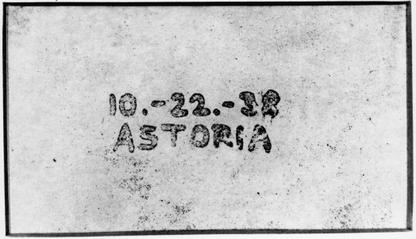
This is the first xerox copy in history.
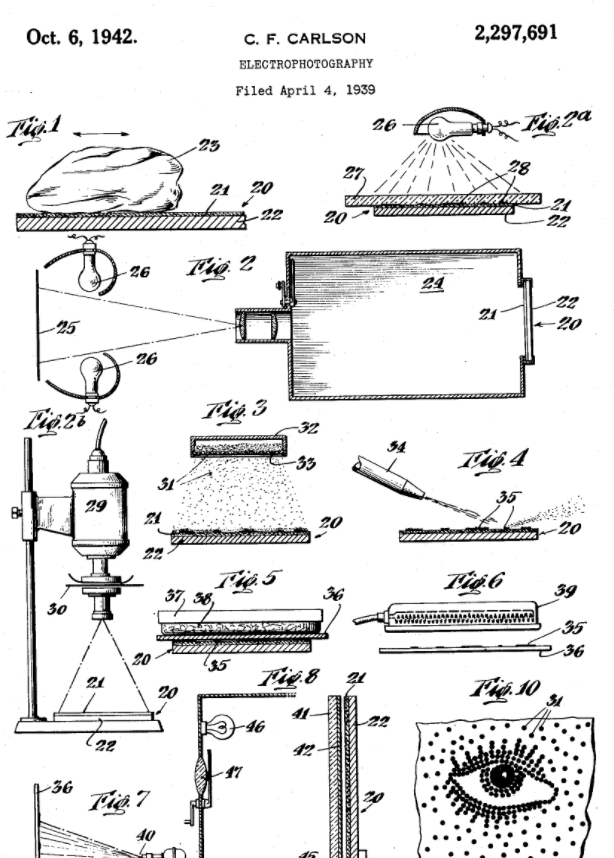
He soon had a patent but more rough times were ahead. Between 1939 and 1944 he was turned down by 20 companies, including IBM and the U.S. Navy.
He and his wife Elsa von Mallon soon divorced. He described the marriage as “an unhappy period interspersed with sporadic escapes.” Perhaps those kitchen fires and terrible smells made him a hard man to live with.
Carlson continued to work in patents at the P. R. Mallory Company. One day he was able to demo his work to an engineer from Battelle, who was only there his employer’s office to testify for a patent case. Battelle never took in outside ideas but were impressed and offered financial support. It only took 20 YEARS, but he finally had support for his idea.
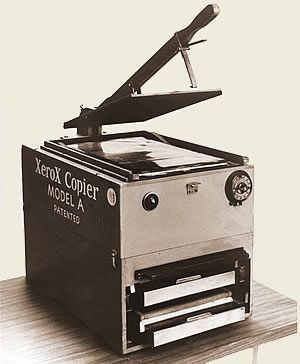
In 1946 they signed a deal with Haloid (later to be renamed Xerox), a competitor to Kodak. In 1948 they released the Xerox Model A Copier. It took 39 steps to make a single copy.
Another decade of development led to the Xerox 914 – named because it could copy paper up to 9″ x 14″. This model become popular quickly because it:
was simple to use
didn’t damage originals
could be rented
used regular paper
It took almost 30 years but Carlson’s dream was finally real. At the push of a button you could make a perfect copy.
As innovative as it was, as with most new tech it had some problems.
It tended to overheat (one demo model caught on fire on launch day), often enough that it came with a “scorch eliminator” – a sales friendly term for fire extinguisher. Ralph Nader’s machine caught fire 3 times in 4 months and he complained to the press about it.
unreliable, as paper jams (‘mispuff’) happened often
The machines often required a small team of people who maintained them and managed taking in copy requests and delivering them (the copy room). But relative to competitors it was a breakthrough in many ways and these issues were improved over time.
The story of Xerox and Carlson is a great example to learn from – it doesn’t suffer from any of the Myths of Innovation. The time from having an idea to making it a real product in the marketplace took decades, which is more often the case than most people realize.
His patents made him wealthy enough to retire. He gave most of his fortune away, anonymously, including support for Buddhism, NYCLU and the NAACP. He died in 1968.
If you could only pick one, would you rather have power in your home or a working iPhone?
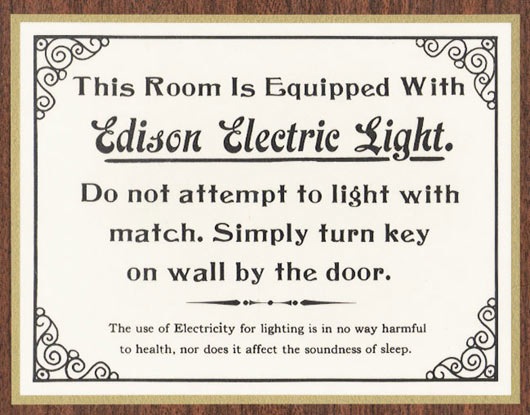
We tend to believe that the latest inventions are the most significant, but often the opposite is true. Running water, electricity, shelter, heat, safe sources of food, and good medical care are far more important for quality of life than nearly anything else. And as far as convenience, a reliable power source in our homes that we can activate with the flick of a switch (something 25% of the planet’s population still does not have) is more impressive than an invention than merely uses that power.
I admit comparing technologies across time is unfair in some ways, as domestic electricity was invented first. But in terms of how much we depend on particular inventions to live, comparisons are useful. The exercise exposes how much we take for granted. Or perhaps more importantly, improves our aim for new inventions that do more than attempt to add convenience, but that truly improve our lives.
Of 508 votes, 73% voted for electricity, and 27% for the cellphone (The poll didn’t let me explain, but my intention was the the cellphone could have unlimited power of its own and the internet worked fine on it. But if you chose electricity, you could not have a cellphone). Of course twitter polls have high bias (who are my followers? how do twitter audiences differ from the rest of the population) but it’s interesting nonetheless.
My belief is that for many among the 27%, if they actually experienced this choice for more than 24 hours, their answer would change. They underestimate how much they depend on electricity to do for them, from keeping their food cold, to heating their apartment, to washing their clothes and keeping the lights on (better go buy some Apple candles).
In a recent post comparing Tesla to Steve Jobs, writer Rajan suggests the light switch is at least as impressive an invention as the iPhone. And I agree. If for no other reason, the invention of domestic electricity had to be done without the benefit of electricity itself. In the 1880s, in the age of horse drawn buggies and hand (or steam) powered tools, they had to not only invent electric power generators, and neighborhood transformers, but also provide the installation of physical power lines across cities, streets and sidewalks. To upgrade a phone is easy, but how would you upgrade the entire power grid of a city? Far more challenging. The rate of technology change is faster today, but mostly with technologies that are far easier to upgrade.
The iPhone and the light switch are both tips of the innovation iceberg. They depend on a massive network of other technologies and inventions to function. With no internet or cell service, a cellphone has limited use, just as a light switch in a house that hasn’t paid its power bills, doesn’t do much at all. As consumers we only see the final interface, the last layer, but what makes an invention impressive or not might be best understood by studying the amazing things required to make that interface work, that in daily use we’d never even notice.
Electricity demanded the introduction of entirely new concepts to ordinary citizens. A transformation the iPhone did not have to force, as its very name reuses concepts well known by the average citizen when it was released in 2007 (its arguably an amazingly powerful wireless telephone). The technological and conceptual leap of in home electricity likely surpasses, in impact on daily (and night) life anything we’ve invented in the last two decades (facts supported by the excellent book, Empires of Light: Edison, Tesla, Westinghouse, and the Race to Electrify the World).
If you disagree, do this simple exercise: go for 48 hours without using electricity in your home (except the power required for your cellphone and internet access). Then report back and leave a comment.
All the clichés about beginnings are true, at least in part. The history of innovation is large enough that all the sayings, from Plato’s famous “Necessity is the mother of invention” to Emerson’s “Build a better mouse- trap and the world will beat a path to your door” hold some truth. The trap, and the myth, is that evidence supporting one claim doesn’t mean there isn’t equally good evidence supporting another. Invention, and innovation, have many parents: the Taj Mahal was built out of sorrow, the Babylonian Gardens were designed out of love, the Empire State Building was constructed for ego, and the Brooklyn Bridge was motivated by pride. Name an emotion, motivation, or situation, and you’ll find an innovation somewhere that it seeded.
However, it’s simplifying and inspiring to categorize how things begin. In reading the stories behind hundreds of innovations, some patterns surface, and they’re captured here in six categories. I concede to the existence of reasonable arguments for seven or five, or different categorizations altogether. I offer this list to seed your thoughts on what paths to innovation are in front of you now.
1. Hard work in a specific direction
The majority of innovations come from dedicated people in a field working hard to solve a well-defined problem. It’s not sexy, and it won’t be in any major motion pictures anytime soon, but it’s the truth. Their starts are ordinary: in the cases of DNA (Watson and Crick), Google (Page and Brin), and the computer mouse (Englebart), the innovators spent time framing the problem, enumerating possible solutions, and then began experimenting. Similar tales can be found in the origins of the developments of television (Farnsworth) and cell phones (Cooper). Often, hard work extends for years. It took Carlson, the inventor of the photocopier, decades of concentrated effort before Xerox released its first copying machine.
2. Hard work with direction change (Pivot)
Many innovations start in the same way as mentioned previously, but an unexpected opportunity emerges and is pursued midway through the work. In the classic tale of Post-it Notes, Art Fry at 3M unintentionally created weak glue, but he didn’t just throw it away. Instead, he wondered: what might this be good for? For years he kept that glue around, periodically asking friends and colleagues whether it could be useful. Years later, he found a friend who desired sticky paper for his music notations, giving birth to Post-it Notes. Teflon (a mechanical lubricant), tea bags (first used as packaging for loose tea samples), and microwaves (unexpected discharge from a radar system) all have similar origination stories. What’s ignored is that the supposed “accident” was made possible by hard work and persistence, and it wouldn’t have otherwise happened by waiting around.
3. Curiosity
Many innovations begin with bright minds following their personal interests. The ambition is to pass time, learn something new, or have fun. At some point, the idea of a practical purpose arises, commitments are made, and the rest is history. George de Mestral invented Velcro in response to the burrs he found on his clothes after a hike. He was curious about how the burrs stuck, put them under a microscope, and did some experiments. Like da Vinci, he found inspiration in the natural world, and he designed Velcro based on the interlocking hooks and loops of the burrs and his clothing. Linus Torvalds began Linux as a hobby: a way to learn about software and explore making some of his own.10 Much like the direction-change scenario, at some point, a possible use is found for the product of curiosity, and a choice is made to pursue it or follow curiosity elsewhere.
4. Wealth and money
Many innovations are driven by the quest for cash. Peter Drucker believed Thomas Edison’s primary ambition was to be a captain of industry, not an innovator: “His real ambition…was to be a business builder and to become a tycoon.” Drucker also explains that Edison was a disaster in business matters, but that his profile was so prominent that—despite his entrepreneurial failures—his management methods are emulated today, particularly in Silicon Valley and venture capital firms.
With half an innovation in hand, ideas but no product, it’s natural to try to sell those ideas: let someone else take the risks of complete innovation. Instead of idealistic goals of revolution or changing the world, the focus is on reaping financial rewards without the uncertainties of bringing the ideas all the way to fruition. The Internet boom and bust of the 1990s was driven by start-up firms innovating, or pretending to innovate, just enough for established corporations to acquire them. In many cases, the start-ups imploded before acquisition or were acquired only for their ideas to be abandoned by the corporations’ larger and conservative business plans.
The founders of many great companies initially planned to sell their ideas to larger corporations but, unable to sell, reluctantly chose to go it alone. Google tried to sell to Yahoo! and AltaVista, Apple to HP and Atari, and Carlson (photocopier) to nearly every corporation he could find.
5. Necessity
Waves of innovation have come from individuals in need of something they couldn’t find. Craig Newmark, the founder of Craiglist.org, needed a way to keep in touch with friends about local events. The simple email list grew too popular to manage and evolved into the web site known today. Similarly, the founders of McDonald’s developed a system for fast food production to sim- plify the management of their local homespun hamburger stand (Ray Crok bought the company later and developed it into a multinational brand). Innovations that change the world often begin with humble aspirations.
6. Combination
Most innovations involve many factors, and it’s daft to isolate one above others. Imagine an innovation that starts with curiosity and leads to hard work, but then the innovator’s quest for wealth forces a direction change. Midway through, this direction change is interrupted by a stroke of good luck (say, winning the lottery), allowing the innovator to return to the initial direction with renewed perspective and motivation. The removal of any of those seeds from the story might end it—or might not. In many of the stories of innovation, we have to wonder: if the first “magical” event didn’t take place, might the innovator have found a different seed instead? No matter what seeds are involved, all ideas overcome similar challenges, and studying them reveals as much or more than the beginnings of innovation.
The challenges of innovation
Steve Jobs, founder of Apple and Pixar, was asked, “How do you systematize innovation?” (a common question among CEOs and the business community). His answer was, “You don’t.” This was not what readers of Business Week expected to hear, but foolish questions often receive disappointing answers. It’s as absurd a question as asking how to control weather or herd cats, because those approximate the lack of control and number of variables inherent in innovation. Jobs, or any CEO, might have a system for trying to manage innovation, or a strategy for managing the risks of new ideas, but that’s a far cry from systematizing something. I wouldn’t call anything with a 50% failure rate a system, would you? The Boeing 777 has jet engines engineered for guaranteed 99.99% reliability—now that’s a system and a methodology. It’s true that innovation is riskier than engineering, but that doesn’t mean we should use words like system, control, or process so casually.
To read more about the challenges of innovation, and how to overcome them, get a copy of The Myths Of Innovation.
I do not like Maslow’s hierarchy of needs. My reason is that while it seems sensible, it’s largely made up. It’s mostly an invention. It’s an interesting invention but we’ve taken it to be definitive, which it isn’t. Maslow made observations, mostly about American culture and formed them into a framework we take as predictive for all people. Yet there are plenty of other frameworks, including ones that recognize needs are not hierarchical, an observation about your own life that’s easy to make when you stop to consider: do you organize your meals hierarchically? your day? your week? The worthy long and short term ambitions you have likely cut across the “hierarchy” in dozens of reasonable ways.
Recently Carr wrote about the arc of innovation, suggesting that there’s a hierarchy of innovation much like Maslow’s. Carr does point out some of the hierarchy’s flaws, but he still, maddeningly, uses a triangular hierarchy for his model for innovation. (It’s like the insanity of people making everything into periodic tables. What is wrong with you people?) It was always dumb that Maslow, if it was his choice, made it a pyramid. Why is the top level so small? is it really smaller in space? Does the smaller size suggest it’s easier to fulfill? What does it mean? It’s just bad design.
Anyway, the thrust of Carr’s post is about the diminishing returns of modern inventions, and here I agree with him. The common gripe is the rate of change today is faster than ever, but that’s perception. It feels that way certainly, but the amount of change is smaller than in the past.
The leap from steam power to electricity was larger than anything we experienced in modern times, bringing cheap power into workplaces and homes, granting nighttime lighting (which redefined sleep itself!) and thousands of things into the lives of ordinary people. The move from a telephone to a cellphone, as impressive as it is, is far less of a shift and it’s impact smaller on the important parts of our daily lives. This is an opinion of course as all comparisons of the value of two innovations always are. I love the internet, but when you break down how important it is compared to running water, electricity, a nearby market with food, stable democracy, reliable health care and hundreds of other older innovations it’s not even close.
Carr writes:
There has been no decline in innovation; there has just been a shift in its focus. We’re as creative as ever, but we’ve funneled our creativity into areas that produce smaller-scale, less far-reaching, less visible breakthroughs
Part of the problem is smaller breakthroughs, like a bigger screen for your phone, are made incredibly visible through billions in marketing dollars, whereas more substantial improvements that are less profitable are barely noticed (or would have to have the same financial support to become noticed).
There are plenty of holes to poke in Carr’s hierarchy. Healthcare, which would be at the bottom of the pile, constantly sees technological breakthroughs. It’s just that unless you are sick or know someone who is, these breakthroughs do not make the news and are never part of the consumer marketing machine. And of course many inventions slice through the hierarchy, as an app that lets you work with friends by playing games to watch your diet hits nearly every level in one fell swoop.
There are six important themes I see at work in the larger discussion we should have:
Innovation is relative, not universal. There is no universal index of progress. America is still struggling to provide universal health care, while many European countries already have it. Japan has fast trains, America does not. Progress and regress are always shifting around the world, and with countries, cities and neighborhoods. There is no universal constant. Even now America is divided on who has access to what innovations. From this perspective innovation in some third world countries is at an all time peak. This is why grand arguments about the pace of innovation are esoteric, and reflective of an overly academic perspective on reality.
Decline of research funding. The peak of U.S. Federal spending on science research and development was in the 1960s. Every major invention that makes up the internet was developed decades ago. It’s science where true breakthroughs happen, and by breakthrough I mean the acquisition of new knowledge. It takes years, decades, for that knowledge to be converted into products or solutions, and we may have ridden out the major wave from 50 years ago. Who is investing in the next wave for all of us? It won’t be a corporation (although what Tesla did is interesting).
There are only financial rewards for some breakthroughs. The marketplace will rarely invest in true discoveries since they are far too expensive to find. It’s possible that the most transformative technology advancements require government support as no corporation could ever afford to develop them.
Consumer culture has shifted our perceptions on innovation. Will the latest cell phone improve your contributions to social justice? Will an app upgrade save your marriage? Strengthen your community? America is more of a consumer culture than ever before, and that is part of Carr’s point: “We’re getting precisely the kind of innovation that we desire – and that we deserve.” But then the issues are philosophical, not technological. How did we become so shallow and lost? Were we always shallow and lost? The answers are not going to come from technologists and businesspeople.
Infrastructure is hard to replace. My point about the primacy of running water and electricity is really about infrastructure. You only get one chance to make certain choices about a city, or a nation. It’s extremely expensive to change these large decisions later, or even with the money on hand, it’s hard for a government to bet on a new approach. The 1950s was when America made its big bet about transportation, and we chose cars over everything else. Which suggests that American may be past it’s innovation prime. Our infrastructure was among the best in the world in 1965. But now, we’re in trouble. It’s a mature nation, with aging technology infrastructure, and bureaucracies and traditions that inhibit big changes. The U.S. is 10th in the world in providing broadband internet, something we basically invented. The future of big advancements might be shifting, or have already shifted, to countries with hungrier cultures. We need to reinvest, but do we have the will?
There are limits to progress. There are limits to innovation even if we’re not sure what they are. We have faith there are always ways to make things better, but that faith may be unfounded. We’re aware that the speed of light is the fastest possible thing in the universe: why can’t there be other maximums, like for computer power or algorithmic complexity? There is no way to know for sure that there are more discoveries to make, just as there is no way to know for sure that their aren’t.
Do you love stories about flashes of insight? Or wish you had more of them so you can be more creative? Most people do. But the reasons these stories are loved has little to do with how breakthroughs usually happen.
The surprise is if you scratch the surface of any epiphany story, you’ll find they are mostly fabrications and exaggerations. As fun and inspiring as they seem, their value fades in practice. I don’t say this to depress you: it is true that the thrill of an epiphany feels great. But if you’re serious about ideas you need to look deeper into what these stories are really about.
One of the best accountings of the mythology is from Tim Berners-Lee, describing how he invented the World Wide Web, one of the greatest inventions of the 20th century:
“Journalists have always asked me what the crucial idea was or what the singular event was that allowed the web to exist one day when it hadn’t before. They are frustrated when I tell them there was no Eureka moment. It was not like the legendary apple falling on Newton’s head to demonstrate the concept of gravity… it was a process of accretion [growth by gradual addition]”
We love these stories because they support our secret wish that creativity only requires a magic moment. That it’s like a lottery where we just need to be inspired enough, or have the Muses favor us. It feels safer to believe this, but it is dangerous because of how far removed it is from reality. Do you find the excitement of a flash of insight fades quickly? All of our creative heroes experience this too.
“Inspiration is for amateurs — the rest of us just show up and get to work.” – Chuck Close
We love stories of flashes of insight because we love dramatic stories. The notion of an epiphany ties back to religious and spiritual concepts like the Muses, where forces in the universe instantly grant things to people. Even if we don’t literally believe in these forces we love the notion that creativity works through some system, and that all we need is one brilliant moment that can change everything for us.
The smarter way to think of ideas is that a flash of insight is one part of the process. You can take any epiphany story and shift it into giving you useful advice for how to follow in a successful creators footsteps.
Ask three questions:
What was the person doing before the epiphany? In most cases, they were working in their field trying to solve a problem, or building a project, and the work led them to learn things that increased the odds of making a breakthrough. Creativity is best thought of as a kind of effort.
What did they need to do after the epiphany to bring the idea to the world? There is always significant work after the flash to develop the idea into a prototype, much less a working solution. A brilliant idea for a movie or a business still demands years of effort to realize the idea. An epiphany is rarely the end of the challenge, but typically the beginning of a new one. While epiphanies are common, people willing to commit years of work to see them to fruition are rare.
What can we learn about how to have an epiphany ourselves? Most epiphany stories have no substance. They focus on seemingly ordinary facts, like Archimedes in a bathtub or Newton by a tree, where the discovery is presented as a surprise. Epiphany stories rarely teach us anything to do differently in our own lives as there are no useful patterns or habits suggested in the story.
Even the Newton apple story isn’t true in the way it’s commonly told. Newton certainly wasn’t hit on the head, and it’s unlikely that the singular moment of watching an apple fall from a tree, even if it happened, carried particular significance to a man who made daily observations and ran frequent experiments testing his ideas about the things he saw.
The lesson about creativity from Newton we should learn is his daily habits: he frequently asked questions and ran experiments, constantly trying new approaches and making prototypes to explore his ideas. But that’s not nearly as exciting a story to tell as the apple tale, so it’s rarely told..
Gordon Gould, a primary inventor of the laser beam, had this to say:
“In the middle of one Saturday night… the whole thing suddenly popped into my head and I saw how to build the laser… but that flash of insight required the 20 years of work I had done in physics and optics to put all of the bricks of that invention in there”
Most legendary stories of flashes of insight are like Gould’s: the inventor rarely obsesses about the epiphany, but everyone else does. Flashes of insight are best understood as our subconscious minds working on our behalf. In professor of psychology Csikszentmihalyi’s book Creativity he defines epiphany as having three parts: early, insight, and after. The insight feels like a flash because until the moment our subconscious mind surfaces an idea, we’re not fully aware that our minds are still working on the problem for us. We get ideas in the shower because it’s a place where it’s easier for our subconscious minds to speak up.
One way to think about the experience of epiphany is that it’s the moment when all of the pieces fall into place. But this does not require that the last piece has any particular significance (the last piece might be the hardest, but it doesn’t have to be). Whichever piece of the puzzle is sorted out last becomes the epiphany piece and brings the satisfying epiphany experience. However, the last piece isn’t necessarily more magical than the others and has no magic without its connection to the other pieces. It feels magical for psychological reasons, fueling the legend and myths about where the insight happened and why it was at that particular moment and not another.
Americans are preoccupied by the size of things: big houses, big sandwiches, and big salaries. At leadership retreats, and in the bestselling books we buy, we seek grand thoughts. The basic logic we use is the bigger the idea, the bigger the value, but often that’s not true. There’s a myth at work here: the assumption that big results only come from radical changes. There’s good evidence for a counter-argument.
The problems that plague organizations, or hold them back from greatness, are often small things that happen to be consistently overlooked. The lack of progress or greatness isn’t because there’s a grand idea missing. Instead the cause is a simple idea prevented by bureaucracy, killed out of ignorance, or buried under incompetence. If those simpler, smaller, ideas were set free, the effect would be as potent as any grand theory. Somehow we discount simple ideas for being playthings, for being too small to be worthy, not recognizing the surprising power hidden in what seem to be our smallest decisions.
The McDonalds brothers had a very simple idea. They made hamburgers at a few stands in San Bernardino, California. And as any reasonable owners would do, they wanted to run those stands efficiently. How did they do that? They tried to make the process for making food repeatable, an assembly line for food construction. Any homemaker or line cook of the 1950s made the same discovery, as making school lunches, or eggs over easy, again and again motivates this kind of thinking.
Had you shown the McDonalds’ business plan to any of the great business minds of the day, they’d have thought you were insane: they’d have said the idea wasn’t big enough to warrant interest of any kind. Fifty years later, McDonalds has 30,000 locations and $22 billion in revenue. Certainly not all of that value can be attributed to the simple notion of creative efficiency, but dedication to the notion did enable their early domination of competitors. The point is simple: a small idea, applied consistently well, can have disproportionately large effects. Ray Kroc’s insight was not finding a big idea, but in seeing how a little idea, done right, could become big.
Put another way, what I’m describing is leverage. Rather than worrying about the size of an idea, which most people do, it’s more productive to think about the possible leverage an idea has. To do this requires thinking not only about the idea itself, but how it will be used. An idea can have a different amount of leverage depending on where, when and how carefully it is applied. One old idea from one team in your company, reused in the right way on another team unfamiliar with it, might just have transformative effects.
In Atul Gawande’s book The Checklist Manifesto, he explains how the simple idea of a task list, something used by aircraft pilots for decades, has improved patient safety in surgery by 30% or more. Hospitals didn’t need a breakthrough technology. There wasn’t a new theory or grand vision. A simple act, with a simple, old tool, had incredible, and surprising, leverage.
There are many dubious stories in the history of innovation, and some, despite their improbability, make valid points about the nature of ideas. Charles Steinmetz (or Edison, or Tesla, depending on the version of the legend you hear), holder of over 200 patents, retired from General Electric. A complex system had broken, and no one could fix it so they hired him back to consult. Steinmetz found the malfunctioning part and marked it with a piece of chalk. He submitted a bill for $10,000. The GE managers were stunned and asked for an itemized invoice. He sent back the following: Making the chalk mark $1, Knowing where to place the chalk mark $9,999. Ideas are like chalk marks: as simple as they seem, knowing where, when, and why to use even the smallest ones can make all the difference in the world.
Caveat: Democracy is not centered on change. The political system that allows change to happen fastest is a dictatorship. A dictator does not need to convince anyone, not even the citizens of his nation, and has the power to fire or kill anyone he likes (or, more precisely, doesn’t like). People forget a central motivation for modern democracies and republics is stability. Change is meant to be slow and require consensus, patience and cooperation (which was hard to come by even in 1783 when the U.S. Constitution defining the U.S. government was written). We like to pretend the U.S. President is a dictator and can do anything, but their power is kept tightly in check by design, unless there is truly enough of a problem to earn a consensus and a mandate, which is uncommon.
Push towards meritocracy in education. Germany recently made state university education free, while in America 2/3rds of graduates leave college in debt (totaling $1.2 trillion, more than our national credit card debt). Which nation is raising a new generation of ambitious creative risk takers? That’s not a fair question of course because culture isn’t defined by education alone, but you see my point. One country is investing as best it can in its next generation and the other is… I’m not even sure. I don’t believe making things free magically solves problems, but I do believe in meritocracy and the more expensive a good education is, the more wealth, and not merit, determines who gets it. Anyone who believes in meritocracy has to believe in quality public education available to as many citizens as possible, especially young ones.
Push towards meritocracy in immigration. I’ve never understood why we’d want to prevent the world’s brightest young talents from moving to the United States. The history of our growth hinges on the new ideas, hungry attitudes and different perspectives of immigrants. They take nothing of our wonderful country for granted, unlike many of our own offspring. Many of the most important innovations in U.S. History were made by people who were relatively new here. Right now it is very hard to get an H1-B visa, the primary work visitation visa used by technology companies, despite the talent shortages these companies have. If we believe in meritocracy we should have no fear of foreigners who enter the country based on merit as they will push us to be better in everything we do.
Reduce the reach of copyrights and patents. If you read the history of these laws it’s clear their utility has been stretched to protect the most powerful companies, as these are the companies with the most resources to invest in lawyers and legal services. It used to be that great ideas would pass into the public domain after 28 years, but we’ve recently extended the exclusive protections of copyright several times and now that protection is twice as much or longer. This protects the makers of the past, not the makers of the future.
Reform how campaign finance works. The episode of This American Life titled Take the Money and Run for Office documents how 60/70% of a senator’s time in office is spent fundraising for the next election. It’s shocking and it should be required listening for all Americans. It’s disturbing as it reveals how the modern system encourages the mortgaging of the present for the future by the very people we elect to invest in our future as a nation. Our Congress, as described in #1, is central to change in government. But the more focused Congress is on getting reelected, the more they must cater to the short term interests of corporations and wealthy people who are most interested in protecting their status quo, not the future of our nation. Any reduction in time Congressmen spend campaigning and raising funds is a win for the future of America.
What would be on your list? Leave a comment.
A reader took their favorite ideas from The Myths of Innovation and made them into fascinating, but rather hard to remember, acronyms.
NSMM-I-MSIAOT ~ No Singular Magic Moment – Instead – Many Smaller Insights Accumulated Over Time
TORTLPISIBOTOPYAPIP ~ The Only Reason That Last Piece Is Significant Is Because Of The Other Pieces You’d Already Put Into Place
UTIIA-IWBQR ~ Until The Innovation Is Accepted – It Will Be Questioned Relentlessly
PAUTBAIIYIAYA ~ People Are Unlikely To Be As Interested In Your Ideas As You Are
TMVCINTMS ~ The Most Visible Contribution Isn’t Necessarily The Most Significant
TGMILFFTS-SOTPAEATHOFNI ~ The Great Mistake Is Leaping From Facts To Solutions – Skipping Over The Play And Exploration At The Heart Of Finding New Ideas
IDDM-IWDWTTM ~ Ideas Don’t Do Much – It’s What’s Done With Them That Matters
PAI ~ Problems As Invitations
AICGABEROTIOTIOHWDTA ~ All Innovations Combine Good And Bad Effects Regardless Of The Intention Of The Inventor Or How Well Designed They Are
ARAIITAANISBTN-IESTAATSBTT ~ As Ridiculous As It Is To Accept All New Ideas Simply Because They’re New, It’s Equally Silly To Accept All Traditions Simply Because They’re Traditions
It’s always fascinating to see how readers digest what I had to offer. I’m just the writer, but if you want my take on the most important ideas, see my own easy to read summary of the book.
This essay in the NYTimes, Silicon Valley’s Youth Problem by Yiren Lu, is a kaleidoscopic essay on culture divide, and the angst of being smart, young and successful in Silicon Valley. It’s a well written but strange essay in that she seems unsure about where she lands on many of the issues she’s raising. It also suffers from her youth, which is fair given that that’s what the essay is about.
Why do these smart, quantitatively trained engineers, who could help cure cancer or fix healthcare.gov, want to work for a sexting app?
If Sean Parker, Mark Zuckerberg, and (young) Bill Gates are your heroes, your choices are obvious to you. But there are also plenty of social startups, ventures aimed at doing good as well as profiting, but Lu doesn’t mention them. And that’s her primary blindspot: she sees dichotomies on age and attitude, rather than spectrums.
He does answer her own question later – identity:
As an enterprise start-up, Meraki has been impeded by its distance from the web scene. It simply does not have the same recognition as a consumer company whose products users (and potential recruits) interact with every day. “You say, ‘I work at Pinterest,’ and people know what that is — they use Pinterest,” Biswas said. “You tell them you work at Meraki, and they’re a little more reserved. They’re like, ‘What’s that?’
The company you work for is an easy way to impress people and impress yourself. If you value this where you work hinges on how popular the company is, not what it does or what contribution you might be able to make there.
Before the web more bright engineers chose to stay in academia where they could work on problems that took a long time to solve, if they were solvable at all. The financial and cultural rewards today for leaving school and joining a startup has shifted that balance away from long term work (or for doing that work in academia, rather than a corporate research lab). Those pressures have always been there but they’ve intensified.
Scientists, including computer scientists, argue real innovations are fundamental developments like the laser, the satellite, the mouse, Ethernet, cellular networks, WiFi, even Object Oriented Programming. These are contributions that took years to develop and provided a breakthrough that enabled thousands of other inventions, including the web. And by developing these ideas in academia they become available to the world, not a corporation. What inventions does your average startup enable for the world? Usually none. Most startups die or are acquired and mothballed, their IP locked forever in a corporate cave.
Lu correctly mentions that the Web has made the barrier to entry for starting companies and releasing applications lower than ever in history. She writes:
“The sense that it is no longer necessary to have particularly deep domain knowledge before founding your own start-up is real.”
That alone explains the draw for anyone with ambition: for the first time in history you can launch a product to the entire planet in 6 months with the primary expense being your time. Many of these startups hope to become a fad, a viral trend, which means they are shallow by design. Many have the primary goal of simply learning what they are capable of and starting a company is a great way to do that.
But the typical startup is very high up on the tree of innovation, providing little for others to build on, and capitalizing on contributions from hundreds of forgotten people. There is little wrong with this, it’s just not interesting on the scale of the future if you are interested in more fundamental kinds of progress.
Dalrymple’s description makes sense, but its implied recommendation — that new and old need to embrace each other — is difficult to put into practice. Several of Cisco’s previous attempts to reach out to the new guard, like the Flip video camera and the Cius tablet, were busts. The phrase that’s constantly repeated in the valley is “innovate or die.” Innovation, everyone seems to agree, is the answer. The problem is that so many “innovations” — Intel’s “creative collaboration” with the rapper will.i.am, for instance — are just some stuffy vice president’s approximation of cool. That is to say, they’re hardly innovative at all.
Lu gets lost in the meaninglessness of the word innovation. The fact that a product was a bust doesn’t mean it necessarily failed at breaking new ground or developing new ideas, it merely means it failed in the marketplace. And celebrity collaboration is marketing, as it’s generally paid for by marketing and advertising budgets with the singular goal being attention.
These failures say nothing about the challenges of old and young. While the average age at Cisco, IBM and Microsoft are much higher than Google or Facebook, all of those older companies successfully hire thousands of top new graduates every year: they are simply graduates who have different ambitions and values. However I’d agree with Lu it’s less common to see older engineers join startups, but the reasons for this are multiple and she mentions some of them in her meandering way.
Many people crave opportunity. Many people crave stability. Some of this is linked to age, but not all of it.
The success of self-educated savants like Sean Parker, who founded Napster and became Facebook’s first president with no college education to speak of, set the template.
Lu desperately needs to read about survivorship bias and that a hero is not a template. A hero can be an inspiration but should never be used, without careful examination of others who did nearly everything the same as the hero did but failed, as part of a trend or a playbook.
In perhaps the most ignorant notion in the piece, Lu quotes a friend:
“Never before has the idea itself been powerful enough that one can get away with a lacking implementation,” she wrote. Her remark underscores a change wrought by the new guard that the old guard will have to adapt to. Tech is no longer primarily technology driven; it is idea driven.
This is hubris and youthful ignorance doing a blindfolded dance together. Lacking implementations is precisely what startups have shipped since the beginning of software startups (now approximated and acronymized as MVP). The web itself began with a shockingly limited feature set compared to desktop publishing tools at the time (or arguably, even now). The web had to reinvent table layout, only to abandon it years later in favor of an approximation of the kind of positioning system that had been around for years.
For the last 30 years everyone has bemoaned how Microsoft succeeded with third rate engineering. Or look at ShamWow or hundreds of other hyped ‘inventions’. The very notion of advertising can be cynically defined as ideas trumping implementation.
The lesson from innovation history is the best idea doesn’t necessarily win. Nor does the best implementation. You can do everything right and still fail, and do many things wrong and do very well. Marketplaces are chaotic and unfair. The personal lesson here is if you place meaning on success in the market, you will always be chasing meaning instead of making it for yourself.
I was a senior at CMU in ’93/’94 and for my computer science classes I spent many long hours in the computer labs, called clusters, working on programming projects or doing other schoolwork. Many of my friends hung out in clusters and it was common to see new software friends had found, or in some cases, made. I worked mostly in the Unix rooms, where all of the DEC and Sun workstations running X-Windows were, including their hockey puck shaped mice.
Late in ’93 or early in 1994 I remember being in Baker Hall, one of my favorite clusters, sitting in the back row (the photo above is from Ween Hall, a similar cluster, via CMU Archives, analysis). I wasn’t enjoying whatever I was doing so I looked around the room. Someone had a window open on their workstation with all sorts of images and text in it, and I asked him what it was. He told me it was Mosaic and he told me how to install it, which I did. I played with it for a few minutes, found it cute, and didn’t touch it again. There were only a few hundred websites and most of them were junk.
There were no search engines. There were no maps or guides. The joke was “There is nothing worthwhile on the web, and you will never find it anyway.”
What I can tell you is NO ONE thought much of the web at the time. I didn’t know a single person anywhere, in school, real life, or online, who thought this would ever become something mainstream, much less dominate the future, as the walled garden of AOL dominated how ordinary people interacted with each other online.
That year I read the first issues of Wired magazine, and even wrote for them, and they barely mentioned the web either. It just felt like yet another odd academic project, with few people using it. The Internet, meaning email, gopher, telnet and newsgroups, was something I’d been using in class for years (including The Andrew Project). I’d worked with Hypercard, Director, and studied different forms of hypertext tools in class. I knew about Project Xanadau. This “web” just seemed like yet another thing. And HTML, wasn’t even a proper “language” with barely any functionality other than crude text, links and images.
I was hired at Microsoft in 1994, and in early 1995 joined the Internet Explorer 1.0 team (where I’d work until version 5.0). Even then the web was far from mainstream. It was progressive for Windows to have a web browser at all, even though the first version shipped only in The Plus pack, along side screensavers and utility programs.
It wasn’t until the browser wars of 1996-1999 that the industry first shifted to focus on the web and the Internet, and only as society shifted from using dial-up modems to broadband, and eventually mobile devices, in the 2000s did it become central to most people’s lives. It wasn’t until 2001 that AOL saw it’s subscribers decline as direct access to the web became commonplace.
Lesson: The future often looks strange in the present. Any idea with the power to transform the world won’t make much sense at first. This is one of the best lessons from the history of innovation: if you want to be part of the future, keep weird stuff around.
When did you first see the web? Leave a comment, or write a blog post about it and I’ll link to it.
[Updated March 12, 2019]
I’m a fan of Atul Gawande’s books (here’s my review of Checklist Manifesto). His essay in the New Yorker, Slow Ideas, suggests most good ideas spread quickly.
I take the opposite position. The default state of a new idea is non-adoption. Most new ideas go nowhere. Most ideas travel slowly, if at all, and the examples of technological change we often site area tiny minority of the ones that were attempted: it’s selection bias. Consider how many posts on social media get ignored (it’s 71% of tweets). Are these all new ideas? No, but the sheer volume of information and ideas we are exposed to, and the limited channels of attention our brains can handle, should make clear most ideas in the world we never even hear about. We can’t adopt an idea we’ve never even heard.
And even if you knew about every good idea, there is a limit to how much change you can adopt. How many new diets can you try at one time? Modes of transportation? Techniques for getting your job done? Change, even to a clearly good idea, has what should be obvious costs that slow, or make improbable, the adoption of anything new.
Any good study of psychology and history shows that we are, by nature, conservative creatures when it comes to change. Most people, most of the time, defend the status quo, since they’re alive! It’s a valuable survival trait. Unless survival is at stake most of us, most of the time, resist change. Adoption of most knowledge, including social and philosophical beliefs, often shift only when the young age into being the dominate generation (or the old die) and the new ideas they bring with them enter the center of culture.
But of most importance to this post is Gawande’s misuse, or glancing over, of one of the pioneers in understanding how ideas spread: Everett Rogers. Gawande refers to his theories in an offhand way, overlooking how Rogers answered many of the questions Gawande is asking. Roger’s explained why most ideas don’t spread, rather than the opposite. Here’s all the Gawande has to say about Rogers:
“…incentive programs are not enough. “Diffusion is essentially a social process through which people talking to people spread an innovation,” wrote Everett Rogers, the great scholar of how new ideas are communicated and spread. Mass media can introduce a new idea to people.
But, Rogers showed, people follow the lead of other people they know and trust when they decide whether to take it up. Every change requires effort, and the decision to make that effort is a social process. This is something that salespeople understand well.”
But he never mentions the 5 major factors Rogers identified (in his book Diffusion of Innovation) for why some ideas gain traction and most do not:
Relative Advantage: this is perceived advantage. Marketing usually tries to tell you this explicitly (“save time”, “save money”, “double your income”)
Compatibility: How much effort is required? If the perceived cost of change is higher than the perceived relative advantage, most people won’t even try. Marketing typically attacks this too (“Free money back guarantee”, “Even a child could do it”)
Complexity: How much learning is required to apply the innovation? (“Easy to learn”, “5 of 6 people like you”)
Trial-ability: Is it easy to try out? Most clothing stores let you try things on, and many products have free trial offers.
Observability: How visible are the results of the innovation? Fashion fads are highly visible which helps them spread. Tech gadgets benefit from this too.
To Gawande’s central point, you need both leaders and salespeople to actively participate in pushing for adoption. Without the support of influencers in a culture, and a sustained effort to convince people of the 5 factors, ideas tend not to be adopted no matter how beneficial they are.
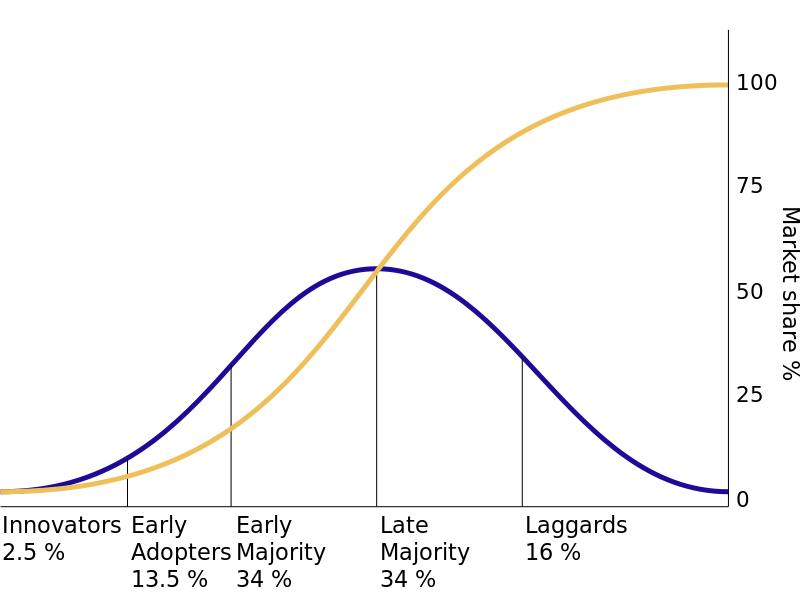
Rodger’s also coined the term Early Adopter, as part of his breakdown for the sub-groups that form around new ideas.
If you want more depth on Innovation adoption I have three recommendations:
Roger’s classic book, The Diffusion of Innovation, is more about anthropology than business. But if you like Gawande’s story, the book has many similar ones (including a story about convincing tribes to adopt the use of boiling water. Hey, everything was once an innovation).
I don’t care about Google Glass. When I say this I mean I’m neutral about the impact it will have on me or culture at large. Google Glass does not solve a single problem that bothers me. My life will not improve because I can more easily take photos or do web searches, as those things are almost too easy to do today given how often I see people doing them.
Every important attribute of my life will remain unaffected whether I have a Google Glass or not. I will not love my family more or less. I won’t have more or less friends. My dreams won’t be more or less likely to come true. And the amount of time I spend doing things I love, or being with people I care about will remain the same.
The consumer fallacy the tech-sector surrounds us with is that the progress we need comes in upgrades, upgrades made by corporations designed for profit. While I don’t regret the clean water that comes to my house or the WiFi I’m using to publish this missive, technological progress has diminishing returns for many dimensions of modern life. If you tripled the water pressure to my home or quadrupled the WiFi speed, as impressive as those leaps sound, it would have zero impact on my ability to drink water, or write and read posts. But technological progress is easier to measure than any other kind (spiritual, personal, social, metaphysical) so we measure it, and obsess about it, and allow it to distract us from more worthy improvements to modern life.
I enjoy doing one thing at a time. I become more efficient and proficient the more time I can spend doing one thing, not less (See Attention And Sex). I have little interest in machines and devices that compress more simultaneous activities and experiences into a single moment. My ability to enjoy life fades the more distracted I am. And it fades the more time I spend with people who are distracted. I like putting my phone in my pocket and having to choose to take it out, keeping myself aware of the personal and social interruptions it creates. I use my phone often, but I’m just as happy not to use it at all if I’m doing something important, or spending time with important people, two activities I want as much of as possible before I die.
I don’t care about Google Glass in the same way I don’t care about a pencil with stronger graphite, or a car with more powerful air conditioning. It’s a kind of progress that has almost no meaning for my quality of my life.
There are two different uses of the word myth:
A falsehood, as in “the weight loss myth”
A story with metaphorical truth even if not factually accurate
I spend time on this blog debunking factual myths like Newton’s Apple, even for things as boring as mythical numbers in schedule estimates, because I have expertise and believe people who read my blog want to know the truth. While complete ignorance is neutral, faith in a lie is dangerous. I don’t want the suspension bridge I drive across to be built on a pet theory. People with knowledge should be compelled to use what they know to question, poke and prod the darkness, especially the darkness snakes sell as light to fools.
But I do love the metaphorical truths found in mythological stories. The winged story of Icarus and Daedalus isn’t true in aerodynamic fact but contains powerful truths about ambition and trust. Few great works of literature are true in a factual sense, but their freedom from facts allows the expression of emotional or philosophical truths in ways factually based stories can’t. Picasso said “Art is the lie that tells the truth” and that’s what he meant. It’s not a justification for lying on your business plan.
Factual myths are very hard to kill. Simple lies are more popular than complex truths.And the most common factual myths have nuggets of truth in them, just enough to get past most people’s BS detection systems. Newton was never hit on the head by an apple. It’s one of the most popular stories in this history of science, yet it’s a fabrication. And science is a community of practice obsessed with factual certainty. How could this survive for so long?
The answer is the people most inspired by a story are the least interested in challenging it, and the most interested in spreading it. Apple Inc. chose its name after Newton’s apple, but never bothered to check the veracity of the tale. Why? Probably because they liked it and the popularity of the tale was part of the attraction. Popular lies grow into legends, and everyone wins in the spreading of a legend, everyone except the people who care about facts. I do like legends for their metaphorical truths, but it’s dangerous to confuse those with factual truths. Marketing and advertising live in the grey between what’s true and what’s a willful lie.
Does the true story of Newton, or anyone, matter? It depends. If you’re a fan and it you simply want to feel good about your fandom, then perhaps truth doesn’t matter. But if you are serious about achieving yourself, truth is essential. To achieve greatness the precise factual truth about what a hero did or didn’t do matters. I’m convinced these truths, if told well, always have more inspirational power than false legends. But not everyone agrees with me. I wrote The Myths of Innovation to sort out the history of ideas for people who want to stand on the true shoulders of giants, not the made up fantasy stories we’ve popularized. But as popular as the book has been, it will never be as popular as books that promise to teach you the magic secrets of geniuses in five minutes.
Falsehoods never go away completely. The ones that last are too fun, and too convenient, to kill. While Snopes.com will always be popular, it will never popular enough to eliminate the need for its existence. It’s too easy to bend legends to the needs of the teller and the listener. Few people are motivated to seek sources to verify what they see, hear or read. This is why legends grow in size with age: there are fewer and fewer people who witnessed the events around to question the tale. But I believe it’s progress to examine these stories anyway. It’s the duty of people with knowledge to use it to shine light on darkness. I know I will never eliminate the lies, but I must use what I know to help as many others find their way as I can.
History reveals itself to be a sloppy garden of truths, myths and lies, and it requires endless tending. Serious writers are the gardeners of ideas and must garden not just for the present, but for the future.
For years I’ve studied use and abuse of the word innovation. In the business world, it’s often used as a empty filler word, without meaningful intent. You can test this by simply asking someone using the word: what does innovation mean? Rarely will they have an answer, which is a good sign it has become a nonsense word. I’ve complained about this, which leads to people ask me to do more than complain, and to offer a definition.
I generally recommend people don’t use the word at all when working. Use more thoughtful words instead. Most importantly, simply dedicate yourself to solving problems. It’s solving problems that matters. Instead of saying “our goal is innovation”, which is vague, say “our goal is to solve THIS problem for THESE people”, or admit that your first aim is to decide which problems you’re going to solve and for whom.
If you must use the word, here is the best definition: Innovation is significant positive change. It’s a result. It’s an outcome. It’s something you work towards achieving on a project. If you are successful at solving important problems, peers you respect will call your work innovative and you an innovator. Let them choose the word.
This is a high bar, and it should be. To call every change you make in your work an innovation belittles the possible scale of progress. The act of creating something, even if it solves a problem, should perhaps still not be considered an innovation until it is adopted by other people (see Innovation vs. Invention). Until then, it’s just an invention with the potential to be an innovation. If you are an engineer, a designer or a start-up founder, inventing things is simply your job.
What does significant mean? I’d start with the invention of the light bulb, constitutional governments, wireless radio and the Internet. Perhaps you could say significant is a 30% or more improvement in something, like the speed of an engine or the power of a battery. If you know the history of your profession you know the big positive changes people made over the last 50 years, giving you perspective on the scale of brilliance you need to have to be worthy of that word.
But if you use word lightly, or frequently, you show hubris in the present and ignorance of the past. Sayings like “we innovate every day”, “chief innovator” or “innovation pipeline” are inflations. They’re popular, but misguided. Calling a thing an innovation doesn’t make it so. It’s just a word and words are free to be abused. If you think about it, it’s easy to separate mere improvements from something worthy of grander praise.
The best thing to ask anyone who uses the word innovation is: what do you mean when you say that?
Most of the time people have no idea what they mean (or realize they really just mean one of these). And once they admit this, that’s when you offer the definition above.
[Note: I can’t claim that I came up with this definition. I’ve read dozens of books on the history of invention and progress that influenced me before ever realizing an improved definition was necessary. Suggested sources are welcome.]
The term Myths of Innovation has become popular on the web, but few articles on the subject link to each other. I wrote the bestselling book, The Myths of Innovation some time ago, but still new articles appear without a single reference to any sources at all. Somehow in all this “innovation” we’ve forgotten basic useful inventions like web searches, links and footnotes to credit what others have done.
On this page I’ve compiled the definitive list of Innovation Myths, referencing every use of the term I’ve been able to find. Many of these articles are broadly written: not based on research into specific legends and inventions. However my hope is providing one place to review and compare popular misconceptions about the subject will help all of us move forward in our thinking.
I came up with the term independently in April of 2002 for a lecture at Microsoft that eventually became the book. I hadn’t heard the term before but in compiling this post the earliest use I found was the 2001 post by Veitch, below.
Innovation can’t exist in a large established company
True Innovation comes from R&D
Innovation is driven from the top down
Innovation requires perfection
It can be impossible to overcome ‘thinkers cramp’
Innovation only happens in entrepreneurial organizations
How this list was compiled
I used a series of Google, Yahoo and Bing searches, focusing on different date ranges and permutations on “Myths of Innovation”. Search engines are better in some ways than when I wrote the book, as more data is now available on the web. I prioritized articles, posts or presentations that used the words Myth and Innovation somewhere in the title, including some that used the terms Myths and Creativity.
Many posts I found are cross-references of the same links, with interviews with authors of books/posts about myths they’d written about elsewhere and I only listed each list once. If you find other items I should add, please leave a comment.
Historical note: a disturbing element of history is its unfairness to women. The majority of our most famous inventors and discoverers are men in large part because women were denied the education and opportunity required to make similar achievements or to get credit for them.
It’s hard to identify a singular cause but there’s evidence the shift to monotheism changed what had been a more balanced view of gender power, when there was still respect for male and female roles, into masculine centric cultures (see The Alphabet vs. The Goddess). Even by the time of the Western Enlightenment, women were still given few opportunities to study, work in pioneering fields or to receive acclaim for their work. This is a subject well beyond the scope of this post.
Even the ancient Greeks, who were progressive on many fronts, had few female philosophers and scholars, although there were some. Among the better known is Hypatia, but few works from the time survived and it’s hard to know how much influence she had.
Top women innovators of all time:
Much of my work is studying the true history of scientific, technological and artistic ideas (see The Myths of Innovation). From that research these are the women who had the most impressive careers and achievements. My criteria defined innovation as significant positive change, which led me to focus on women who made profound contributions to their fields (I list notable mentions and more about my process below). I’m an American, so there is unavoidable U.S. bias, although I attempted to explore as many different histories as possible.
Marie Curie – First person in history to win two Nobel Prizes (only other person to do it was Linus Pauling). She also defined the theory of radioactivity, a discovery she died for. Her life story of fleeing Poland for France, helping her family, and charitable works is awe inspiring. She discovered two elements and developed the first treatments using radioactive isotopes.
Georgia Okeefe Her creative work over a prolific lifetime is staggering. Most well known for her works in the Southwest, her career spanned different genres and context, comparable to Picasso’s in many ways. She was the first woman to have a solo show at The MOMA in NYC (1946).
Jane Austen – Helped define the style and structure of the modern novel and is one of the most popular writers in history.
Ada Lovelace – The first computer programmer in history. She is possibly an example of historic gender bias, as some of the work Babbage is credited with possibly should be attributed to her, although the history from the time leaves many questions about who did what, as the work they were doing was of interest to few at the time.
Susan B. Anthony – A relentless advocate for equal rights for women, she wrote, lectured and organized groups in the pursuit of voting and other rights. She was arrested, in an act of civil disobedience, for voting in the 1872 U.S. presidential election. She died 14 years before the 19th U.S. Amendment was passed, granting voting rights to women.
Empress Wu Zetian. The only female monarch in Chinese history, her amazing story of obtaining power and ruling, directly or indirectly, for decades. Her reign was one of the greatest periods of expansion for China.
Florence Nightingale – More than a nurse (although she was a progressive there too), she pioneered the use of statistics and visualizations (Nightingale Rose Diagram, diagram below) and was a prolific writer and teacher. Medicine has been a productive field for women, with Françoise Barré-Sinoussi (contributed to discovery of HIV), Gertrude B. Elion (pioneer in cancer medication, Nobel Prize in Medicine 1988) and Clara Barton (founded the Red Cross) and Elizabeth Blackwell – First woman to receive a medical degree (1849) and become a doctor in the U.S.
Grace Hopper invented not only the programming language COBOL, one of the first high level programming languages, but the very idea of a compiler, the critical engine that most programming languages depend on to function (1952). And if that weren’t enough she was an Admiral in the U.S. Navy.
Indira Gandhi became prime minister of India in 1966, second elected woman head of state in modern history, the first was Sirimavo Bandaranaike of Sri Lanka (1960). Indira had an enormous impact on the future of India, defining many policies and systems of government still in use today.
As my historical note suggested, I’m not surprised these women lived in the last few centuries. I acknowledge that best of / top lists of anything are at best subjective. If you emphasize politics, arts or engineering in a different balance than I did, you will end up with other equally notable people. My goal was to balance the impact and challenge of these people’s works independent of how famous they became, regardless of domain.
In the category of modern marvels:
Kevlar, used in bulletproof vests was invented by Stephanie Kwolek (1965). The car windshield wiper by Mary Anderson (1903). Patsy Sherman co-invented Scotchgard in 1956 (despite her high school aptitude test telling her she should be a housewife).
Many homemaking and clothing inventions were by women, likely because these were the first domains they were allowed access to. The wire bra was invented by Caresse Crosby (1914), Josephine Cochrane invented the dishwasher in 1886 and Bette Graham invented Liquid Paper in 1956. Chemistry, the rising science in the 1950s, created new opportunities that were open to women for the first time.
Notable Mentions:
Women from diverse cultures faced, and still face, additional discrimination and it’s hard to comprehend the suppressive effects this has had, and the cumulative disadvantage this creates. A very brief list from many great stories includes, Ethel Waters (First African American to star on own TV show in U.S. 1939), Ann Ann Tsukamoto (stem cell isolation, 1991), Katherine Johnson (NASA, programmer, 1953), Rebecca Lee Crumpler (first African American woman doctor in U.S.), Shirley Jackson (First African American woman to obtain PhD at MIT, 1973).
I did study Cleopatra, Mother Teresa, Amelia Earhart and many other famous historical women. The challenge is being famous and making contributions are different things. The history on Cleopatra isn’t great and Hollywood factors more in our perceptions than the thin historical record we have. Mother Teresa didn’t invent or pioneer much of anything as far as I could tell, and while her charity is impressive it didn’t warrant a place on this list. Earhart’s short life is inspiring of course, but I’d consider her more a pioneer (first to do something) than an innovator (progressing something in a way that has lasting impact).
Queen Elizabeth I had an astonishing autonomy, one of the first female heads of state, but her reign didn’t achieve much of lasting impact. Of course, she may have inspired many women of later generations, but it’s hard to measure that on a list like this. Margaret Thatcher and Hillary Clinton also surface in political history, but their works and visibility, while notable, were hard to stretch into innovations. Alison Bechdel came to mind for her Bechdel test which will blow your mind if you’ve never heard of it.
Lillian Moller Gilbreth (along with her husband Frank, until his death) was a pioneer in using time and motion studies to understand how people can work (and live) more effectively. Known as “a genius in the art of living.” She invented the kitchen triangle pattern, the foot pedal waste bin, shelving for refrigerators, and dozens of other inventions. She was a prolific speaker and writer about invention, engineering and other subjects.
Rosalyn Franklyn – a sad example of gender bias, she made major contributions to the discovery of DNA, widely credited exclusively to Crick and Watson. It wasn’t until much later, and after her death at 38, that the significance of her role in the process was accepted.
If you have a favorite female innovator I should study, leave a comment.
[edit note: minor updates and corrections, added Gilbreth and Franklyn to notable mentions – 12/9/2020]
[edit note: minor updates and corrections, added note about U.S. bias, diversity challenges in Notable mentions, added Empress Wu Zetian to primary list – 2/14/2021]
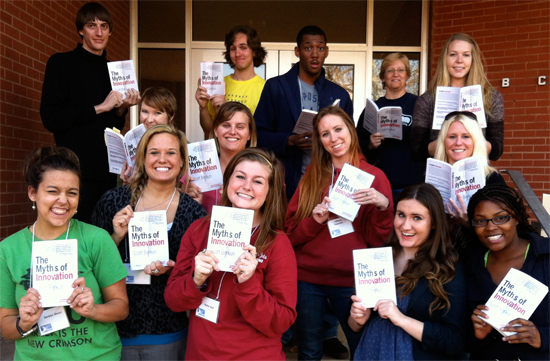
Many universities use The Myths of Innovation in courses on entrepreneurship or creativity, but David Burkus lined up his class for a photo, which I promised to post here.
Among other places he teaches at OSLEP, a program for top students across Oklahoma and they’re seen here.
If you use my book in a course, let me know. If you send in a photo I’ll post it here.