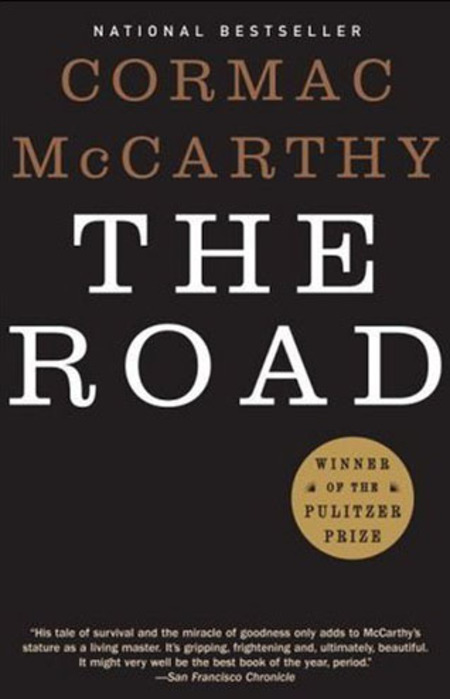
Book review: The Road, by Cormac McCarthy
The purpose of a story is to be an axe that breaks up the ice within us
-Franz Kafka
 I have a hard time reading fiction because often writers try way too hard to make their fiction seem real, or love their words so much they get in the way of telling the story.
I’m more of a Hemingway fan (particularly Old Man and The Sea) than, say, Updike. I prefer Beckett to Neil Simon. I find empowerment in dark tales, because when things are really dark, it’s easier to appreciate the little blessings of light in the world. The Seventh Seal is one of my favorite movies and it’s about the plague.
And when it comes to stories I’m with Kafka. Real literature shakes me up. And although sometimes I read to be entertained, often I want an experience that will make me see the world differently when I finish, and change something in me that can not be undone.
The Road would make Kafka proud. It shook me up more than any book I’ve read this decade.
The story (A spoiler free summary): At its heart, The Road is a simple story told well. It’s about a father and son who are trying to survive in tough times, possibly the end of the world. The book never explains what happened. it could be a nuclear war, an asteroid, an act of god (if there is one in the world of the book), its unclear and this is for the better. If you were starving, struggling to find food and safety, you’d think little about history or politics too. And that’s why the book works so well. In a sense we all believe we have important things to worry about or fear today, but that sense has been so far removed from real survival we understand much less of what it is to be alive.
In all survival stories I’ve read, and I’ve read many, from Shackleton’s Endurance, to McCandless in Into The Wild, the heroes are in exceptional circumstances that are much more dangerous than the rest of the world. In The Road, it’s the opposite, the danger has come to everyone. There is no safety, and this context changes everything. The father and son leave their home in search of survival because they know their chance for survival if they stay is zero. How long would I stay and wait? How would I decide when to take to the Road and bet there is something better elsewhere?
These are not adventurers. These are people just trying to live, just like us.The power of The Road is how, through the telling of a simple and captivating story (I read it in two sittings), I couldn’t help but ask myself deep questions about my identity. How unbearable would life have to be before I killed myself? Or my child? And by contrast, how far from that unbearable line of thinking has my entire life, and the life of everyone I’ve ever known, been? And why do we seem not to notice the wonder and good fortune of this gap?
The questions: Do I believe people are inherently good or bad, and how much of my own well being would I ever, or have I ever, put at stake in faith of that belief? What can I know about my beliefs if they have never been tested? And perhaps most of all, if I were stripped away from all of the distracting trappings of modern life, the gadgets, the entertainments, what would I have left? And if I don’t have much left, how do I feel about that? The list of things I felt are too long too list here.McCarthy achieves all this with subtlety and craft. Beyond the philosophical introspections the book provoked in me, it’s a surprising, horrific, surprising, dramatic and riveting tale. It compels you to keep reading which is the highest praise I can offer any book of any kind.
He writes simply and well and lets the narrative and situations lead you to your own conclusions, which is what the masters of writing throughout history have always done.Thanks to Bryan Zug (@BryanZug) for recommending the book to me: The Road, by Cormac McCarthy.