There are 4 points and 5 questions at the heart of the latest drama around Facebook and ethics, and the report of a recent experiment they did regarding emotions.
1. All media manipulates emotions by design
Newspapers editors have always chosen which news stories we see, choices made with emotional impact in mind. Television and print news have a long history of over-reporting stories of violent crime, far out of proportion to the rate they happen. One argument is the belief it’s easier to draw attention for negative stories. Another is that making people feel bad eases the challenge of selling them things in ads (See Do Emotions In Ads Drive Sales?). The news feed from any news source has always been editorialized, or in more cynical terms, manipulated. There has never been a news report that is purely objective, although some are more balanced than others.
Advertising by definition is “a form of marketing communication used to encourage, persuade, or manipulate an audience” (#). Television, print and web news generally depend on advertising for income. Any service you use that depends on advertising feels pressure on on all of their choices to help advertisers succeed in their goals.
2. Clickbait and headline crafting are emotion manipulations
News services choose which stories to cover and how to title them. There is a natural incentive to want stories to draw attention, and the writing of titles for articles is an important skill, a skill based on understanding reader’s emotions. Buzzfeed and Upworthy are notorious for their careful crafting of the title of the articles (The Atlantic reported on Upworthy’s successful headline style). The common use of puns (humor), tension (fear), and teases (curiosity) are all based on attempts to use the reader’s emotions to make them more or less likely to want to read the story. Headlines predate the web, and the history of newspapers documents yellow journalism, a practice still in use today.
3. Designers of most major websites experiment on their users
For more than a decade it has been standard practice for people who design websites to use A/B testing on unknowing users of a site. These experiments are done regularly and without any explicit user consent. A designer’s job is to learn about user behavior, and apply their knowledge of humor behavior to help their employer with their goals through redesigning things. Any website that depends on advertising for revenue is designed with the goal of selling ads. This includes most of the major news services that have been critical of Facebook’s behavior, including The Economist, The Atlantic, The Wall Street Journal, The Guardian and The New York Times. All of them have likely done research on unsuspecting users regarding how design changes impact user behavior.
Most major software companies employ user researchers and user experience designers, people who study human behavior for the corporation. Many of these people are hired for their expertise in experimental psychology. Most formal experiments are done in labs with explicit participant permission, but as software world has shifted to the web, the formality of online user experiments has changed.
4. The Facebook news feed has always been controlled by an algorithm
At any moment there are 1500 possible stories Facebook can show the average user. Much like Google or any search engine, Facebook has an algorithm for deciding which of many competing links (or stories) to share with any user at any time. That algorithm is not public, just as the algorithm in the minds of any news editor anywhere isn’t public either. That algorithm is perhaps the greatest piece of intellectual property Facebook has, and it is something they are likely developing, changing, and experimenting with all the time in the hopes of “improving” it. It’s no accident Facebook calls it the news feed.
Just like any media source, improvements from Facebook’s perspective and a particular user’s perspective may be very different. However all sources of media have some kind of algorithm. When you come home from work and tell your spouse about your day, you’re using a kind of algorithm to filter what to mention and what to ignore and have your own biases for why you share some news and not others.
Facebook is a social network that by its central design mediates how “friends” interact.
5. The 5 questions that decide if Facebook crossed the line
Outrage is emotional itself. When we get upset, based on a headline, we already have confirmation bias about the story. None of us heard about what Facebook did from a purely objective source. We all entered the story the same way we enter all stories, with preconceptions of our own and influences born from the editor and writer.
Ethics gets grey fast once you get past initial emotions and dig in to how one practice compares to others. There is never just one bright yellow line, instead it’s a series of many gray lines, where the details make a difference. There are 5 questions that probe at the entire issue and yield perspective on what’s right, what’s wrong and what’s somewhere in the middle.
Is it ethical to manipulate people’s behavior? Perhaps, but with media it’s a matter of degree. All communication has the implicit goal of effecting people in some way. All media organizations, which includes Facebook, have a combination of motivations, some shared by their users and some not, for the changes they make to their products. Advertising has strong motivations to explicitly manipulate people’s emotions and any organization that use ads are influenced by these motivations.
Is it ethical to use design and experimental psychology to serve corporate goals? Probably. This doesn’t mean all experiments are ethical, but using experiments of some kind has long been the standard for software and technology design, and similar methods have long been employed by advertising agencies. There may be nuances that should be adjusted, but in principle research on human responses to media is standard practice and has been for a long time. In the pursuit of making “better” products, research is an essential practice. I don’t think Facebook’s Terms of Service needs to state anything specific about experimentation if the terms of service for news and media outlets that do similar experiments don’t have to either.
Was there something wrong with explicit, rather than implicit, emotion research? The outrage may stem from this difference. Rather than they study being about increasing clicks, which has implied emotional factors, the stated goal was purely about influencing how people feel. This makes it feel categorically different, even if the methods and motivations are largely the same as much of the research done in most software and media companies. Plenty of magazines and websites have the primary goal of changing how you feel about a topic or issue (e.g. Adbusters). The results from the study were moderate at best – a tiny amount, about .1%, of influence was found. There are other possible issues with the study design, described here.
Was there something wrong in doing an experiment at this scale? Maybe. If the study had sampled 20 people I doubt there would have been much outrage. Something about the scale of the study upsets people. The rub is that when your service has 1 billion users, a small experiment involves thousands of people (the study involved 689k users, less than 1%).
Was it unethical to publish the results in a research journal? Possibly. On one hand research journals have specific protocols for participants in studies. But on the other hand, if it’s common for an an organization to do the experiment in private, why is it unethical to report on it? (I’m not saying it’s necessarily ethical, I’m just raising the question)
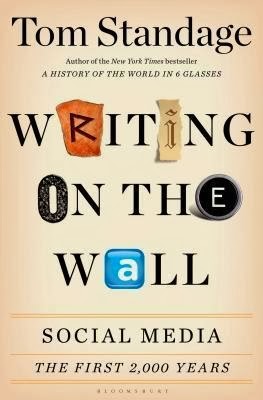
The big surprise of this excellent book is that the challenges around modern social media that we assume are new have largely been experienced before by different cultures at different times. Back when technologies like the printing press, pamphlets, newspapers, the telegraph and television were the newest innovations, societies struggled to sort out both how to use them and what the cultural implications would be. I found Writing on The Wall to be a palliative in this sense, showing that while Twitter, Facebook and blogging are new in some ways, the questions and opportunities they raise are fascinatingly old and we can benefit by comparing them the impact of inventions of the past.
Concepts like information overload, being distracted by media, trashy reporting and misinformation, and even questioning who should have the right to publish, and to read, come up continually in each era with each new wave of technology, sometimes repeating the patterns of the past (and predicting patterns for the future).
I strongly recommend the book for anyone professionally involved in social media, as to claim expertise without even a basic understanding of previous social medias is to fall into one of the greatest traps of innovation we have: chronocentrism, the blind faith that what it has happening now is unique in all history and that we have nothing to learn from the past (A term I believe Standage himself coined). Standage writes well and the book balances a focus on historical detail with insights into the present.
Here are some choice quotes from the book:
Gossip is an extraordinarily rich source of social intelligence, both about the person speaking and about whoever is being discussed. And because our brains are wired to process just this kind of information, we find exchanging it extraordinarily compelling.
Benjamin Franklin’s first foray into newspaper writing took the form of a series of fourteen letters, supposedly written by a widow named Silence Dogood, which he submitted anonymously to the New-England Courant’s office, and which were enthusiastically published by his unwitting brother. James was furious when sixteen-year-old Benjamin admitted to having written the letters. This tale does not simply illustrate Benjamin’s ingenuity and writing prowess; it also shows how newspapers at the time were open to submissions from anyone, provided they expressed an interesting opinion. Such newspapers consisted in large part of reprinted letters, speeches, and pamphlets, and thus provided a platform by which people could share and discuss their views with others.
The average number of titles published in print in England during the 1630s was 624 a year, but the figure jumped to more than two thousand in 1641 and more than four thousand in 1642. In all, some forty thousand different titles appeared between 1640 and 1660. Assuming an average print run of one thousand, that amounts to forty million copies, at a time when the population of England was about five million. This outbreak of printed material put even Luther’s campaign in the shade.
The social mixing that took place in coffee houses allowed ideas to leap over the boundaries of England’s class system, as the writer John Aubrey observed when he praised the “modern advantage of coffee houses … before which, men knew not how to be acquainted, but with their own relations, or societies.”
The bewildering variety of new voices and formats made it very difficult to work out what was going on. As one observer put it in November 1641, “ofttimes we have much more printed than is true.”
Newspapers also began to distance themselves from their readers in another way. Under the new penny-press model, advertisers were a more important source of revenue than readers. From a business point of view, the goal of a newspaper was now to gather as large a readership as possible in order to provide an audience for advertisements. Readers were no longer seen as participants in a conversation taking place within the newspaper’s pages; instead they had become purely consumers of information and, potentially, of the products and services offered by advertisers.
After a one-hundred-and-fifty-year hiatus during which the person-to-person aspect of media was overshadowed by centralized mass media operating on a broadcast model, the pendulum has swung back.
In many respects twenty-first-century Internet media has more in common with seventeenth-century pamphlets or eighteenth-century coffee houses than with nineteenth-century newspapers or twentieth-century radio and television.
One of my kickstarter supporters for Mindfire is a blogger and speaker in his own right: Luca Sartoni. He wrote a provocative article I read months ago about the dangerous implications of using follower counts as status, called Symbolic Violence and Social Media.
He points out how the application of a basic idea from Bourdieu suggests social mediums, which exagerate the value of symbolic capital, can be dangerous to culture:
He [Bourdieu] extended Marxist theory about capital, whereby people’s capital is split into four kinds: Economic, Social, Cultural and Symbolic.
Economic Capital is very easy to explain: money, time and production tools.
Social Capital is the number of people we know; our social circle.
Cultural Capital is what we know; our education and culture.
Symbolic Capital is the set of symbols recognized and legitimated by other people: job titles, study degrees, uniforms.
For example, having $20k is economic capital. Having studied money for 20k hours is cultural capital. But having 20k followers on twitter may just be symbolic capital. Some of it may be social capital, but its a kind that is easier to earn than non-virtual social capital, and its also a kind of capital we flaunt in front of others, questioning our motivations for getting it in the first place.
I think something much more complex and interesting is happening: The torrent of short-form thinking is actually a catalyst for more long-form meditation…
When something newsworthy happens today—Brett Favre losing to the Jets, news of a new iPhone, a Brazilian election runoff—you get a sudden blizzard of status updates. These are just short takes, and they’re often half-baked or gossipy and may not even be entirely true. But that’s OK; they’re not intended to be carefully constructed…
…It used to be that only traditional media, like magazines or documentaries or books, delivered the long take. But now, some of the most in-depth stuff I read comes from academics or businesspeople penning big blog essays…
Here’s my opinion:
Most people are still not on twitter, so twitter has had no effect on their reading behavior.
Facebook might be a better place to study, as status updates are the mainstream (can we call Facebook mainstream yet?) equivalent of tweets.
There will always be a wide variety of different writing forms and lengths that succeed simultaneously.
Media trends are not universal. For some people twitter has crushed interest in long form, but in others it’s helped them find long things to read. The broad stroke is too abstract to have a meaningful argument about.
Twitter has replaced newsreaders for many early-adopters (most people on earth don’t use newsreaders either) and it serves the same purpose. It’s how they find longer things to read.
Twitter doesn’t persist well. It’s very hard to link to a twitter conversation and have it be readable.
Email is still a huge source of reading material discovery and consumption, but is consistently glossed over, despite it being nearly 30 years old.
I agree with Thompson’s last point. The Kindle and iPad have improved long form reading, in our attention deficit culture. It’s a dedicated, read-only designed experience. I now read longer articles found online via Kindle, and find I’m reading more of them, but often days or weeks after they were published (Instapaper is the magic bridge, compiling and emailing articles I mark to my kindle).
If you use twitter, has twitter changed your reading habits? And if you don’t use twitter, has it’s existence changed how the people you read do their writing?
Thanks to the folks at SMC Seattle, the video from last month’s talk is now up.
Some background and disclaimers:
It was a rowdy venue, with an open bar at a circus themed hall (Hale’s Palladium room). I had a heckler of sorts at about the 8 minute mark, which I dealt with abruptly to prevent more of it from happening. Apologies if I come off as brash – the content is brash enough.
A drinking game for my talk was announced during my introduction by Brian, my SMC host, right before the video starts. It wasn’t my idea, and I found out about it when the audience did.
There is a some use of the word BS – very mildly NSFW.
There is a typo in the opening credit, I’ve already let the SMC Seattle folks who produced the video know
On Tuesday night May 25th I spoke at SMCSeattle, at Hale’s Brewery. They asked me to do a talk based on two posts: questioning gurus, and calling BS on social media. This was awesome. How many organizations invite outsiders to poke holes in the rhetoric of their field’s experts? Very courageous to do this and I wish more groups did. Kudos to SMCSeattle.
Video:
Slides:
Slightly edited to better reflect what i said without my voice talking over them.
26. The Strength of Weak ties (PDF) (wish I had a better link, sorry). This paper is often referred to as evidence of social media’s power, but the paper was published in 1983. If you want to claim “radical transformative fundamental shifting blah blah” then you should have recent research as the backbone to your claims. If you don’t, stop with the “radical shifting blah blah” talk.
31. Social Media Revolution (Refresh), Notion of Hobson’s choice. The video is fun to watch – however there are assumptions suggested by how some facts are presented. And if someone makes misleading claims about the past, I am unlike to trust their claims about the present and the future.
32. Industrial Revolution – My point is if you compare almost anything to the industrial revolution, and you actually look up what the industrial revolution meant to people’s lives, it sounds like hype. But the bet is most people won’t sit down and study the Industrial revolution, so your claim can get people excited, based on their ignorance. Advertising works on these principles, but wise viewers/readers should work to defuse them.
43. Twitter data analysis, and from mashable (General point is there is data twitter usage is much softer than many people assume).
44. Simple language gets shared more on Facebook – My use of this example is that it’s someone claiming science without giving sufficient information for someone else to repeat the study and support the claims. He might be doing science, but we can’t verify based on the limited data he provided. I’m criticizing any expert that reposts this and calls it science, without asking basic questions. I asked Dan myself and he responded quickly, and he deserve praise for this – he added more details to his posted methodology (See slide 51). But why was I (likely) the first to ask? An expert should both ask this of other experts, and expect them to ask him/her.
47. Empirical Research – My understanding is that science (in part) hinges on repeatability and sharing details – there can’t be secret sauce. If you want to claim secret sauce, don’t call it science.
I’ve been looking for choice examples of inflated claims and promises among people working in social media, for my talk next Tuesday, Calling BS on social media gurus.
If you’re someone who believes in the value of twitter, social media or even web 2.0m who do you think is giving you a bad name? Or making bad arguments?
I’m hoping if you know of a link, blog post or video I should see, you’ll leave a comment.
Disclaimer: I’m just getting started – so far not all of these are bad or even misleading, but they are interesting examples as points of reference. I’m trying to find a wide range to look at and examine.
1. Among other videos and papers I’ve been watching, this popular one is a highly produced, and often fascinating combination of statistics (his blog does list references – kudos) – but I’ll be looking at how they’re used in misleading ways.
Social Media Adoption By U.S. Small Businesses Doubles Since 2009
Small Businesses Mainly Use Social Media to Identify and Attract New Customers
And in his analysis, it appears they included email as social media in their categorization.
3. Brian Solis’s Unveiling the new Influencers, is a dazzling piece of writing, but has more hyperbole per paragraph than I’ve seen in some time. He’s completely entitled to his opinion, but writing like this is so speculative despite its bold claims, that it deserves attention.
4. This is more in the web 2.0 category, but it was one of the first. Its quite interesting and well done, and stays clear of misleading stats or other rhetorical tricks. But it still does take several positions and assumptions worth questioning:
What I’m looking for:
This list so far is pretty tame. Do you have other favorites, both honest and manipulative, you want to make sure I study and include in the talk? Videos, papers, blog posts, anything goes. Thanks for the help.
I wrote a post in June of 2009 called Calling Bullshit on Social Media. The goal of the post was to put twitter, and facebook, into an honest perspective, given all the hype and idiocy surrounding the phrase social media. It was picked up all over, as echo-chamber articles about social media often are, and has well over 100 comments and links to it.
In the six months since then my use of twitter has increased, warranting a follow up post.
I don’t retract what I said – but now I have more experience to explore similiar points.
Stats: I’ve been on twitter for 7 months. My follower count has doubled to 3000+ since the above post, while I’m still following about the same, ~350. Total tweet count is 1500+ over the 7 months I’ve been on twitter (@berkun). Which is an average of 7 tweets a day (although I’m not on every day).
Despite its problems, the fact is people who like spreading information use twitter. I’m an independent writer and need all the mediums I can find to spread my work. My blog has thousands of subscribers, my books have sold thousands of copies, but posting a link to new writings on twitter spreads faster and, seemingly, wider. Even if all the criticisms are true, the people currently on twitter are people who like to spread things. And they do. It’s heavily populated by people who like to forward, email, tweet, post, blog, telegraph and anything else. I’m sure my traffic and book sales have benefited from being active on twitter. And I’m grateful for readers on twitter, just as am for the blog and the books.
Twitter is fun in burstsand handy on the road. There is a breezy, sarcastic, side comment rich flavor to twitter, which makes it enjoyable if you’re on it enough. This seem possible only if you’re staring at a monitor most of the day, which many are. But if you’re not, twitter won’t make much sense. I doubt taxi cab drivers or anyone working retail will ever be a strong part of the mix. Twitter is fun as a break, as an aside, but if you show up expecting an event it doesn’t make much sense. If you travel often, a decent following guarantees someone can recommend something you need in that place, which is handy and life affirming in a good Samaritan kind of way. But is still something a concierge could do nearly as well.
It’s clear many people are free (or distracted) much of the time. It is amazing how quickly, during the work day, I see things retweeted, or get comments on my blog posts that originated from twitter. I’m grateful for this of course. It’s awesome and empowering. But what’s curious is the twitter crowd seems to have notifications for everything on all the time. Someone needs to do some ethnography on the daily work habits of twitter users, but by observation there are many who jump in in and out many times in a half hour, suggesting they’re jumping in and out of their actual work frequently.
Some of the positives are artifacts of the new. In the early days of email, it was amazing who you could get to answer you. This was, in part, because few were using it. Some of the thrill of twitter, where you can chat with various famous people, will decline as usage grows. It’s more an artifact of new media, than the medium of twitter itself. It’s still a new frontier and some if it’s charm will decline with each wave of mainstream users, in similiar fashion to how email and the web changed, and the small town frontier charm fades. It’s easy for megacorp to seem authentic on twitter, when there’s one guy online representing them. But when there is a team of 30 doing it, with the inevitable policies, and protocols, it will feel like something more familiar, and less interesting.
140 characters actually does prevent discourse. Twitter is great for snarky jokes, and for pointing people at things, but is a disaster for deep conversation. You haven’t had the full twitter experience until you’ve stumbled into an argument with someone who is incomprehensible and angry, and seems to find you equally incomprehensible and angry, even though, outside of twitter, you are neither. Direct messages are just as bad. I wish twitter was attached to a private chat feature free of the 140 limit, so attempts at deep conversation, or arguments where both sides don’t get the context of the other, can migrate and thrive, run their course, and then return people back to twitter.
You can easily spot people confusing life with a popularity contest. It doesn’t take long to realize many people with huge followings have nothing to say. There are some good reasons people follow others, but bad ones too. Mostly it’s easy to figure it out. Some of it is taste. Some of it is not. If the signal to noise ratio is off, look elsewhere. If someone feels slimy, they probably are. You often can tell if someone is being genuinely nice, or is just trying to manipulate you into some kind of reciprocation. I try to say hi to people who mention my work, simply because I’m sincerely grateful. But sorting out people’s intentions on twitter isn’t much different than the rest of life.
Twitter breaks often. It’s disturbing how often twitter acts strange, is broken in major ways, or doesn’t work at all. It’s understandable for something new, or experimental, but twitter is neither. The client apps are unreliable, and need major UI help. I’ve reverted to using the web page, which sounds primitive to twitter die-hards, but it’s the fastest and most reliable interface there is.
The elements needed most in this age are clear communication, patience, and wisdom, which are all in short supply. All media depends on the minds of the people who use it, and twitter is definitely a reminder than many folks either: a) don’t read what they link to b) don’t understand what they read c) don’t really care and just like pushing bits around. I don’t blame twitter for this. Twitter spreads misinformation just as quickly as real information, simply because people do. No technology can ever distinguish between a lie and the truth. However, twitter is faster and sloppier, which has advantages, but also has natural disadvantages. It doesn’t reward the patient and thoughtful. It’s definitely not a tool for encouraging thinking, questioning, or introspection (the innovation I am waiting for), as the spreading of links is not quite the same thing. It quite possible twitter makes those three things harder, given how tempting twitter makes it just to read the next link.
In summary I’m a reluctant, cautious fan. I don’t expect anything to radically change anything else, but its sensible for me to use any new media that helps spread my work.
I don’t believe the hype, but I do see results for some of the things I need to do to be successful. I do get pleasure now and then in connecting with new people I don’t know, or joking with folks I’ve met on the road.
If you use twitter, has your opinion of it changed over time? And if you haven’t tried it, what would it take to give it a serious spin?
Howard Rheingold wrote an interesting essay called Crap Detection 101, which provides both commentary on how to separate fact from fiction on the web as well as some practical advice. He wrote:
I got good strategy advice from John McManus, author of “Detecting Bull: How to Identify Bias and Junk Journalism in Print, Broadcast and on the Wild Web”, who told me “you have think like a detective.” Think of tools like search engines, the productivity index, hoax debunking sites like Snopes.com, and others I will mention later as forensic instruments, like Sherlock Holmes’ magnifying glass or the crime scene investigator’s fingerprint kit.
It’s a good essay and it made me realize one thing: the problem of how lazy we are. Most people know they should ask more questions, and take more time to verify sources, but that takes effort. And that effort, if spent well and results in the discovery of a unreliable source, it costs double. We’ve lost not only the time verifying something, but also the time spend finding that now unreliable source, and the kicker is you still don’t have a fact you can use. Fact checking is a double-whammy against seeming productive to others. We have natural reasons to not want to check that source, even though we know we should. Part of us doesn’t want to know.
When people find a fact that supports their argument, regardless of where it comes from, its incredibly tempting to grab it and run, assuming whoever reads what you write, or listens to what you say, will be as lazy as you were. You can bluff your way into credibility because there’s no one depending on what you say enough to openly challenge what you’re saying. Often online when people think you are full of shit, they’ll just click away. You have to care to take the time to challenge someone’s facts or sources. And even when people do criticize, they’re in such a rush to prove you wrong for something, it’s common to be criticized for things you didn’t actually say, or with claims that are not supported, sparking a dozen ratholes that have no possibility of convincing anyone of anything. Communication speed makes the downward spiral of miscommunication spin much faster.
I’ve written my own take on detecting bullshit, but the thing I don’t know how to tackle is what to do when our innate desire for efficiency works against us. Being “productive” online in writing blog posts or frequent tweets, demands spending little time verifying anything, much less seeking out evidence for the opposing view and vetting them against each other in what old school folks used to called thinking. If there is anything I want to promote it’s thinking. Honest, open, generous amounts of critical thinking where people are just as willing to admit when they are wrong as they are to prove they are right.
My gripes about social media, and the future of technology in general, comes around to how we’re increasingly rewarded for volume online, or believe we will be rewarded for volume, rather than quality. Which is strange given how successful the web has been at making volume of information moot. We have more to read, watch and listen to than we can consume in a thousand lifetimes. Volume isn’t the problem. It’s the search for quality and the shortage of critical thinking that we need to solve and this includes the promotion of the kinds of questions Rheingold suggests everyone asks of things they read online.
Critical thinking will always require effort – and if we’re overwhelmed and stressed by too much information, or feel we’re falling behind and running out of time, the feedback loop works against slowing down to ask good questions. That stress fuels making assumptions and jumping to misguided conclusions.
How do we fix this? Or is it even a problem at all? Let me know what you think.
While I like and use Facebook and Twitter, there’s enough hype and abuse of words like innovation, transformation and revolution around all things social media that a critique is warranted. I hope this post is used whenever someone feels they’re being sold something phony or that makes little sense and wants a skeptical opinion to calibrate where the truth is.
For starters: social media is a shallow term. Is there any anti-social media out there? Of course not. All media, by definition, is social in some way. The term interactive media, a more accurate term for what’s going on, lived out its own rise / hype / boom cycle years ago and was smartly ignored this time around – first rule of PR is never re-use a dead buzzword, even if all that you have left are stupid ones. I’ve participated in stupid terms, from push-technology to parental-controls, so I should know when I see one.
That said, here’s some points not made often enough:
We have always had social networks. Call them families, tribes, clubs, cliques or even towns, cities and nations. You could call throwing a party or telling stories by a fire “social media tools”. If anything has happened recently it’s not the birth of social networks, it’s the popularity of digital tools for social networks, which is something different. These tools may improve how we relate to each other, but at best it will improve upon something we as a species have always done. Never forget social networks are old. The best tools will come from people who recognize, and learn from, the rich 10,000+ year history of social networks. (Read the Excellent Writing On The Wall: The First 2000 Years of Social Media).
There has always been word of mouth, back-channel, “authentic” mediatools. In Gladatorial Rome, in Shakespearean England and in Revolutionary America, motivated individuals had ways to express their ideas and share them. Call it gossip, poems, paintings or pamphlets, there is a long history of individuals taking action to express opinions through non-official channels. The ease of using these channels changes over time, but they always exist because #1 always exists. Of note, IRC predates some, but certainly not all, of the features twitter is heralded for introducing to the world.
The new media does not necessarily destroy the old. TV was supposed to kill radio – this was wrong. TV forced radio to change and in some ways improve. The web forced TV, newspapers and magazines to change, and they will likely survive forever in some form, focusing on things the web can not do well. Its unusual for new thing to completely replace the old ones and when they do it takes years. Anyone who claims social media will eliminate standard PR or mass media is engaging in hype, as odds are better those things will change and learn, but never die. It’s wise to ask what each kind of media / marketing is good and bad for and work from there.
Social media consultants writing about social media have inherent biases. It’s difficult to take posts like this about social media seriously, as it’s written by someone from a social media consulting firm without an ounce of humility or perspective. It’s hard to come across as authentic if you promote a revolution that you personally stand to benefit the most from. Much writing about social media is PR people writing about the importance of PR – see a problem of authenticity here? When did PR, like advertisers, become a reliable source for what is authentic? How is SEO optimization, or similiar techniques for twitter, authentic? When a system becomes popular the greedy will game it and social media is no different. We should be worried when people with PR and advertising backgrounds or consulting firms are leading us in the ways of authenticity or integrity. The Twitter Book, from my publisher O’Reilly, takes a surprisingly reasonable, authentic and low-hype approach to social media I wish was more popular.
Signal to Noise is always the problem. I’m someone who would rather read 5 or 10 really good things every day, than skim through 50 or 100 mediocre ones. I find much of social media activity consists of people re-forwarding things they were forwarded that almost none of them appear to have read, as they believe they are rewarded for publishing frequently above all else. Using twitter, facebook or nearly any social media service I often feel I’m in the minority since what’s popular is rarely what’s good. If you are interested in quality, and not volume, then the size of your network matters less than the value of what or who is in it. I’m more fascinated by how kottke.org and metafilter.org have kept such high signal to noise ratios for years than I am about most media tools I see.
All technologies cut both ways and social media will be no different. For all the upsides of any invention there are downsides and it takes time to sort out what they all are. Blogs and Twitter have made self promotion, and self-aggrandizement, acceptable in ways I’ve never seen before, and I’m guilty myself. Is it possible to write or publish without self promotion? I don’t know anymore. I suspect digital tools for social media may have the negative effect of making authentic communication harder, not easier to find, as more people, and corporations, hover right on the gray dividing line between authentic and corporate, or selfish and generous.
Be suspicious of technologies claimed to change the world. The problem with the world is rarely the lack of technologies, the problem is us. Look, we have trouble following brain dead simple concepts like The Golden Rule. Millions starve to death not because we lack the food, but because of greed and lack of political will. We will largely behave like idiots on blogs and on twitter because we behave that way in real life. Every technological revolution must contend with the fact that we bring our stupidity, selfishness and arrogance along for the ride with our generosity, wisdom and love (12for12k.org being a great positive example). This is true for any new technology we use, and invariably it’s this fact that plays itself out and ruins the current technological wave, setting up the frustrated landscape for the next one. Democracy, steam power, electricity, telegraphs, telephones, televisions, the Internet, and the web have all been heralded as the arrival of Utopia, and although there has been progress in each wave, it seems there are things we want that technological change can not bring to us.
Always ask “What problem am I trying to solve?” The smartest thing to do with something new is to ask what is it you need it to do for you. Recognize good marketing will not make up for bad products or incompetent services. If your company is marketing itself well to customers, or your social life is fine, perhaps you don’t need a revolution and need something much simpler and more realistic from social media. Spend time figuring out what you need. If you want to experiment and see for yourself, that’s awesome, but know that’s what you’re doing. But above all use whatever media/communication tools or methods work for you, whether they are old or new, no matter what anyone says, including me.
Microsoft’s Outlook may be the world’s Rolodex, but they have not figured out how to link up all the latent connections that sit inside our Outlook address books. Put another way, they have the ends of the network, but don’t know how to tie them together!
In your email is a latent network of most of the people you know, and how often you talk with them. The Outlook add on – not made by Microsoft – called Xobni (pronounced ZOBNEE, and named for Inbox spelled backwards) looks through all the mail on your machine and figures out who knows whom by who is copied on which emails. In other words, your emails naturally contain your social network. It would be easy for Microsoft to simply ask your permission to contact the people in your email list, and Outlook contact database, and ask them if they were willing to join your Microsoft social network.
There is a ton of social network data in our cell phones (who do you call/text most often? Talk longest with?) and email applications, and a simple app could mine that data and build, or at least enhance, networks from it.
The problem is that for many people Outlook is no longer the primary contact list. Anyone using Linked-in or Facebook depends on those sources as virtual contact lists. Facebook wisely offers to import contacts from many sources when you create your account.
The surprising thing to me is that there isn’t a wikipedia, or craigslist, of social networks. A free, non-corporate, social network that protects it’s users by charter against the pressures of corporate raiding of personal social information.
Thanks to Brady Forrest and Jen Pahilka for giving me not one but two slots this week in a high caliber lineup. It was awesome to meet and talk to so many folks in just a few days (talking to people is always where the value is). (Photo credit: James Duncan Davidson).
Its been awhile since I’ve been to a big tech conference around a singular theme (web 2.0) during its rise. To see both the promise and the hype swirling around together made for a fun couple of days. Walking the expo floor, where vendors and companies demo and pitch for your pleasure, gave me flashbacks to Internet World in ’96 and ’97. Back then, there were a zillion “push technology” companies, services and products. Now it’s “social media” or “web 2.0”, with a zillion companies all throwing the same jargon around and mostly failing to distinguish themselves from one another.
There are certainly good ideas in the mix, and I think Tim O’Reilly and Clay Shirky‘s opening keynotes did more than any company I saw to speak for those ideas, or even attempt to describe what substance might surface from all the technology, energy and money bouncing around.
The problem for me is how infrequently people investing their lives making these things can describe how, at the end of the day, all of the potential described gets transfered into value. Or why the value provided is worth the risks and costs of using whatever they are selling (register for this, buy that, use this, etc.) It’s not a complex question, but it is the primary one I’m sure many attendees were asking: how much substance and takeaways can I fish out of the buzz?
I wasn’t surprised, but I didn’t hear anyone mention how many amazing things are made, in 2008, by organizations with little interest in web 2.0 concepts – namely Apple, Toyota, your favorite film director, or your favorite music band. Not to mention all of the great amazing things the world produced before 1994 (the year the web, even in 1.0 form, was born). That’s not to say this alone proves anything – my point is only this: it is possible to achieve amazing things, without -insert name of current trend here-. Thriving communities, tribes, and cultures have existed for ages. If its possible to do well without whatever the new secret sauce is, it suggests there’s an underlying element that’s not being talked about. I’m convinced there is a more refined explanation for what people might gain from buying what the expo vendors are selling, but very few people seemed capable of even suggestion one.
The unspoken nugget / explanation / marketing line that might get me jazzed is this:
We have always been collaborative. Always been social. It’s in our genes and it’s what we have evolved to do well. Good technologies enhance our natural abilities, give us useful artificial ones, and help us to get more of what we want from life. Web 2.0 and social media make the process of collaboration and developing relationships more fun, efficient, powerful and meaningful.
Ok. Now we’re talking. With a statement like this I can walk the halls of the expo, or converse with the greatest web 2.0 pundit, and have a straight conversation. Will this get me more of what I want from life? More of what my customers want from me, or vice-versa? I can make tangible arguments about what I want or my customers need and sort some decisions out. But note that the statement above is devoid of hyperbole like revolution, ground breaking, disruptive or transformative, things that are entirely subjective. If you identify a real problem well enough, you never need those words: the people who have those problems will naturally find what you do revolutionary if you really solve their problems.
Ok, enough industry talk. Here’s some shop talk for anyone that saw me speak: I’d give my performance at my innovation workshop a B and the keynote a C+. The keynote was mostly new material and, surprise, I never found my rhythm. I gave it my best but it wasn’t a great 10 minutes. The other funny thing is that the tech crew warned me the remote doesn’t go backwards – it’s kamikaze style – a warning I shrugged off as I couldn’t imagine in a ten minute talk needing to go backwards. Well, guess what, I did. I could have asked them to go back if I’d wanted but didn’t, it wouldn’t have saved my performance anyway 🙂
I don’t write about it often but I’m a huge film fan. For awhile now I’ve known about the works at Overcast Media, but they’ve been in stealth mode, under the radar.
Finally, with this coverage by the Seattle Times, I’m free to tell you: If you’ve ever wanted to create your own DVD commentary, or make commentaries for TV shows or other media, you’re in for a pleasant surprise.
Roger Ebert and others have talked about this idea for years, and finally it looks like someone is making it happen.
(Disclosure: Richard Stoakley, Overcast Media’s CEO, is an old friend. He had the office across the hall from mine at Microsoft on the Internet Explorer team, circa 1997)
FOO Camp saw the power combo of two different social software technologies: Crowdvine, a linked-in type system for pre & post conference connection making, and pathable (which I first saw at Bizjam) for guiding people in finding folks to meet.
Here’s a short review:
It works and its fun. Bravo! The premise is simple: weeks before the event log in, list some tags, and ping people you might know attending the event. It’s easy to find people who share your interests (via tags), read their bios, and ping them if you so desire. There’s a comment system so you can leave notes which was surprisingly active, and public: going to the home page for the site shows all activity, from blog posts made by an individual, to comments sent or received. Anyone can jump in on the threads which was interesting (and I wondered if it’d work for a 500 or 1000 person conference).
At a minimum crowdvine helped me match faces to names before the event which is a big deal for networking or meeting specific people. And it was voluntary – had I been annoyed or less social, I didn’t have to participate at all.
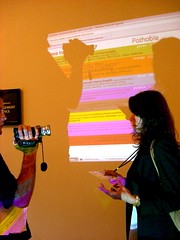
Pathable provided the event badges, fueled by their social matching system – based on tags and other magic they grouped individuals by interest (represented by the color of each badge and the color of the crowdvine profile, see photo above) and created the surprisingly popular matches/opposites lists for every person.
Much like at bizjam, the badges got people talking. It made introducing people to each other much easier as being someone’s opposite or match was an easy way to start a conversation.
Gripes:
Only problems were mild integration issues. There was a wiki for FOO that didn’t integrate with anything else, a photo wall, with tagish Q&A, at FOO that had different photos for people than crowdvine, little things like that that I’m not sure need to be fixed. Someone needs to do a user experience analysis on how many different places and systems ask for personal/social info and check that any redundancies are useful or fun in some way.
After the event I noticed it was possible for me to track what sessions I’d been to in Crowdvine, but wasn’t sure why it was worth the time – perhaps to follow up with people I’d met but didn’t grab their contact info? Not sure.
Summary:
Not sure how much these folks charge, but smart conference organizers should be hiring these folks. Conferences talk the talk about connecting people and building networks, but rarely do anything to facilitate it. Crowdvine and pathable are real tools to help make that stuff happen.
I experienced an innovation doubleheader last week. First, the inaugural Bizjam event in Seattle, where several hundred independents got together to learn and network, jam and mingle. First conference I’d ever seen aimed at this crowd and it went really well – Kudos to Dan, Lara and all the biznik folks.
But one particular bit of cleverness was their hiring of WaggleLabs to create custom conference badges using their Pathable system.
Now mind you, I hate conference badges. They make me feel like a 12 year old in a self-help group, and they’re often so big, ugly and annoying to wear that I often hide them in my pocket – Really, I can introduce myself and meet people without them. But this was new, fun, easy and it worked. Here’s the rundown:
Fill out a short form. Could do this online before or at the event. Took about 3 minutes.
Pick up the badge. This took another minute or so.
Talk to people about their badges. Each badge lists tags, and two groupings: people you have high affinity (Most similar), and low affinity with (Most opposite), based on your answers.
The effect was obvious: it gave everyone something easy to talk about, even if just to compare colors, or to ask people if they knew any of the people on your list.
They had a projector up in one hall listing all of the groupings the colors represented, and I had several conversations with people about that alone.
Well, here in this panel interview are the founders of all three: Kevin Kelly, Stewart Brand, and Howard Rheingold, talking about how it started, why they did what they did, and what they think of where we are today.
80 minutes long in Realvideo format. Skip to ~15 minutes in to bypass the various intros.
Rather than torture y’all with my first foray into liveblogging, I’m writing live comments, insights, and brlliant notes on each and every session.
 One of my kickstarter supporters for
  Thanks to



 Rather than torture y’all with my first foray into liveblogging, I’m writing live comments, insights, and brlliant notes on each and every session.