Yesterday I gave the closing talk, How To Champion Ideas, at An Event Apart Seattle (If you saw me at AEA Boston, those slides are here) . It was a new talk, requested by organizers Marci Eversole, Jeffrey Zeldman & Toby Malina. From their observations and attendee feedback they knew one big challenge for all events is how to help attendees bring ideas with them back to work. As an experiment, they asked me to do a talk on this as part of the event itself. I thought it was great that both they were thinking about this issue and they were willing to do an experiment. I wish more organizers were as thoughtful and as brave.
One primary observation: events should end with a happy hour. Or perhaps, like Webstock, with an after party at the venue. Most events end as soon as the last speaker finishes speaking. It’s a cliff of an experience: all of sudden there’s nothing. Why not invite people out for an informal social gathering, where they get one last chance to connect, share stories, and talk about highlights from the event, now that it’s over? As an experiment I invited everyone out to a drink after my talk, and the result was great. About 45 people joined me, and we took over most of Black Bottle.
I discovered that most people want this, but are afraid to take the social risk of trying to organize. It’s exactly the kind of thing an event, or the last speaker, can facilitate. Pick a place, a time, and announce it. Boom. Instant extension of the energy of an event, giving everyone more value for coming to the event at all. Thanks to everyone who came along and validated this little experiment. It would have been sad if I ended up drinking there alone.
Of course at a big event you can’t just invite 500 people to go to a bar together (But I basically did this, guessing 5 to 10% would come, which was about right. You might not be as crazy as I am though). If you’re worried about the logistics, simply make it an unofficial but encouraged activity. Offer signup sheets during the day, and find 5 or 6 volunteers willing to lead small groups out for a beer. Maybe ask each volunteer to call ahead a local bars to see who wouldn’t mind a nice rush. Events are often on weekdays which are slow nights for bars: they’ll be happy to hear from you. The key thing the event needs to do is announce it and provide the structure (time, place, etc).
Here are the slides from my closing talk, which offers a range of advice on how to get the most out of an event (as it’s ending). Thanks to everyone who commented on my related post.
Workshops are hopeful things. They’re sold on so much promise, but that promise is often dashed as students discover their expert instructor is far from an expert at teaching them how to learn anything.
For years I was a workshop guy: I taught them, I studied them, I even hired people to do them for other companies. I watched many instructors run them and I know the common mistakes. Here’s my best advice on how run a workshop people will love.
Rule #1: A 3 hour lecture is not a workshop
The word workshop implies that work will be done in a shop like atmosphere. This means the center of attention should be on the students doing work, not on the expert talking about their expertise. A cooking workshop means students cook things. A writing workshop means students write things. If most of your “workshop” is people not actually making anything, you should perhaps call it a class, a lecture, or a mistake.
Many experts are bad at teaching workshops because they are used to lecturing. A lecture has the spotlight on the speaker, but a workshop has the spotlight on each of the students.
The skills involved in designing workshops are very different for this reason. Instead of crafting a message for people to listen to, a good workshop is crafted to give students the opportunity for guided instruction in doing things. Many workshops are born from lectures, which explains why those workshops are so boring.
Rule #2: The more students you have, the less of a workshop it is
Better workshop instructors make larger groups feel more interactive, but beyond 20 or 25 people the instructor is spread thin. The common approach for large groups is to have people work in teams, as they at least get to be interactive with each other while the instructor is helping other students. In bad cases group work is a copout: the exercises aren’t interesting enough, or students struggle to work with annoying strangers who are too pushy or too passive. In better situations, when the students are motivated and the exercises well designed, it can work well (but likely not as potent as time spent being coached in a small group directly by the expert).
Designing exercises for groups of people to work together is hard. And also demands more testing to get right (see #5).
Rule #3: Work the triad: explain, exercise, debrief
The simplest way to construct a workshop is to think in units of 3.
Walkthrough: Show how to do something.
Exercise: Have everyone actually try to do that thing (while you wander around and help people one on one).
Debrief: lead a discussion of where people got stuck, what parts were fun/hard/frustrating, and what things people learned, or realized they want to learn. Show people’s individual work, rather than your own, to the class to help explain your insights and observations, and as way to invite them to share theirs. Lead a healthy critique session.
Repeat, with a more challenging thing.
These triads can be of different lengths 45 minutes (15/15/15 or 10/20/15) or longer. Its best to start with small things and build to a larger projects as the workshop goes on. It’s fine for the ratios to change. A more challenging exercise might be 1:3:1 (10 minutes, 30 minutes, 10 minutes).
Take breaks regularly. When people stand up and use their bodies for a minute or two their heart rate goes up, and they get energy back. It’s good for their bodies and minds to move around at least every hour or two. Gadget junkies can get their fix and people with biological needs can get that off their mind. Don’t see this as dead time: see it as taking a breather so everyone can bring more energy into the next exercise. Once every two hours is a good rule of thumb.
Rule #4: Stay out of the center
Workshop students come to learn and they can learn from other students often as much as they can from you. But they start as strangers to each other and you are the social link. Be friendly. Be conversational. Ask students who are good at something to help students who have questions on that thing. Do what you can to make everyone comfortable getting feedback from each other and not just from you (you can design exercises to make this happen naturally). The easy mistake is to center everything on you. This works for TV or lectures. This is a failure in a workshop.
Facilitation is the name of the game. It’s your job to create an environment where everyone is comfortable enough to take risks and learn some things. You should laugh, so they can laugh. You should be passionate so they can be passionate. At times you need to be a teacher, other times you’re game show host facilitating what’s going on, and other times you are quietly out of the way, helping people one on one.
Rule #5: Beta test your exercises
The top complaints workshop instructors hear is often “it was too easy” or “it was way too hard.” Using one exercise for 10 or 20 people guarantees a spectrum of experiences.
It takes a surprising amount of work to develop an idea for an exercise into something specific enough to be interesting, but flexible enough for different people. Since every student in a workshop will have different levels of skill, you want each exercise you use to have built in ways to make it harder or easier.
Great teachers let their students know it’s ok to raise their hand and say “Can you make this more/less challenging?” They’ve prepared wrinkles and twists to handle those cases.
It’s a great idea to beta test your exercises, if not the entire workshop. Do a dry run of half the workshop, for free, with the kind of people the workshop will be for. You’ll learn many little things to fix and adjust that will make a huge difference when you do it for the ‘first’ time.
There are tons of books with workshop exercises. If you poke around you can likely find a book for your discipline that will give you many ideas to start from. Many workshop exercises are horrifically lame, especially ice-breaker type games, but even those can inspire you to think of worthy ones.
Rule #6: Match promises to exercises
Each exercise should be about acquiring a skill, or at least having an experience that helps acquire a skill. List what you believe students will have learned, or experienced, by the time the workshop is over. Use that as your description for the workshop: it’s the promise you are making to students. If your workshop description has a promise than doesn’t map to a specific exercise, either change the description or change your exercises. You’ll find you need to limit your promises, which is good and realistic for everyone.
Rule #7: Always have a whiteboard or flipchart in the room
You never know when you, or a student, might need something big to write on to explain something. In corporate settings you’d be amazed how often the room you are supposed to teach in doesn’t have anything to write on. Digital whiteboards aren’t the same as they often break and take 5 minutes to figure out how to use. Flipcharts are cheap: always make sure there is one available.
Rule #8: The room should look like a workshop when you are done
If its been a true workshop there will be papers, drawings, diagrams, sketches, post-it notes and other made things all over the place. Tape the output of each exercise up on the walls so people can refer to them later. The room should look like a place where a real group of workers had been working on projects all day. Students should leave feeling like they’ve done work, and have some work they can take home with them if they choose.
Rule #9: Build a workshop checklist
There are many things to bring and remember. When you do your beta test of exercises, make notes on all of the equipment you need to bring (e.g. markers, pens, post-it notes, flip-charts, etc.), and what things students need to bring (of which you will have an extra set or two for forgetful students). You never want to have to waste time in the workshop searching or waiting for things. Build a checklist of all the things you need to bring, and put it all in briefcase or box so its ready to go.
Rule #10: Give students the next thing to do after they leave
Students didn’t come for the day: they came to keep learning. Have the next logical exercise or project available on your website, or in whatever materials you give them. Also include a small list of the best books or other resources they’re likely to need.
A secret project I did with O’Reilly Media is now available online.
For years I’ve taught full day workshops around the world on how to manage breakthrough projects. Beyond all the hype, it’s all the practical advice and time-tested wisdom I’ve learned from my own career and dedicated research into how others have made great things.
The fine folks at O’Reilly Media recorded one version of the course, with a live audience, and has now made it available online. They edited it down to a lean 3 hours and 55 minutes. No fluff. No nonsense.
The course includes chapters on:
Practical Creative Thinking
Leading Creative teams
Psychology of Innovation
The wonders of incubation
Project Management for Breakthroughs
The Business side of new ideas
Balance / Bringing it all together
Unlike the Myths of Innovation, which emphasized history and understanding, the course is focused on pragmatics – overcoming challenges leaders and managers face when working on projects with the goals of innovation and breakthroughs.
The course’s regular price is $99, but for today, it’s available at a sizable discount (60% off).
I was invited back to O’Reilly’s FOO (Friends Of O’Reilly) camp, an unconference weekend event held at O’Reilly Media’s HQ in Sebatapol, CA. It’s a privilege to go and every year I’ve written what I’ve learned to share some of the goodness, and force myself to review my Moleskine and digest.
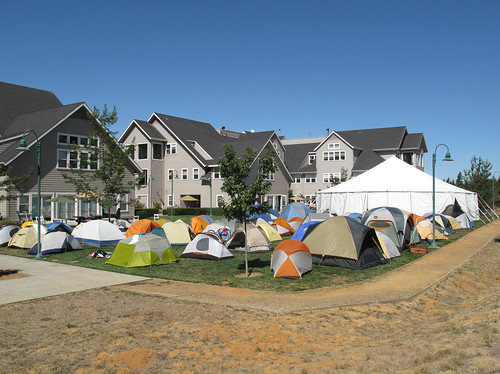
If you’re new to FOO: ~250 people are invited to camp on the lawn at O’Reilly Media HQ and spend a long weekend together. Most people camp in tents, a few stay in offices or hotels. Big schedule boards go up Friday, with room for 10 or 12 sessions to happen concurrently- anyone can organize one on anything. No restrictions. It’s that simple. It works amazingly well because of the openness of the event (see below) and the quality of folks who are invited to go. The weekend is endless series of entertainments, provocations, challenges and wonderments.
The range of sessions is entirely self generated and that’s part of the fun. There is a strong tech bias, but many of the folks here have non-profit or cultural ambitions, and that’s reflected in the sessions they choose to put on. And since the board has a huge number of slots, people come up with ideas for sessions late in the day, often as a result of a conversation that took place in a previous session.
I have a little ritual I do at the event: I get there early, go the picnic table and bring a few cases of beer. As people walk by, soon one or two ask for one, which I provide, and we chat. Soon others see this and come over, and join. And boom – by the time the event starts, there’s a nice crowd of happy people chatting with a positive vibe. It’s these sorts of little contributions that people are drawn to offer at FOO and often they’re unannounced. Thanks to Jeff Potter, Laurel Ruma and Brian Sawyer another O’Reilly friend whose name (but not face) I’ve totally forgotten, helped carry the beer and kick it off. (Mary Treseler, you were missed, my friend. And yes, I did have some lesbian beer).
Here’s what I wrote in my little Moleskine this year:
The Productive Geek: The irony of a session like this is the people there are amazingly productive, but feel unproductive, leading to the suggestion the problem is not technological but psychological (e.g. we need therapy, not technology). I heard a few people mention time off as a boon to productivity (first day back after a 3 day email/information fast is very productive). I suggested productivity is measured in quantity, rather than quality and that’s a large part of the problem.
The Secret forces of cities: Not sure this was the actual session title, as I dropped in late, but it was applied urban planning and an exploration of the many layers of ideas, mostly hidden, that define why a city block or a public park end up being designed the way they are. Favorite quote: “City as an invention is a force multiplier” . I ruffled feathers by claiming urban planning is more of a navigation of bureaucratic problem than a design problem, which few seemed to like. From what I’ve read, there is a huge gap from urban planning as theory (which is what most of the popular books are about), and urban planning in the real world . This begs for a session on “Design thinking vs. Bureaucracy” or something, which I didn’t think about until right now.
It was a mellower FOO. I chatted with some other folks who had been invited before, and we agreed things were more chill and laid back than past years, which was actually quite nice. Part of it was the move of the Make team upstairs – further away from the core hallway. Fewer folks built things or brought zany equipment (although there was the flaming keyboard, pictured at right. Which was awesome. And the Bloody Mary Foobar. Also awesome). I didn’t see, nor participate in, as many zany late night shenanigans as in the past.
Why Great Ideas Fail: I ran a session with this title and had a lively chat with ~20 people on different reasons, cases, stories and regrets about life experiences working with ideas. I will post notes from this eventually. Val Aurora kindly passed around a list for people to write down their own pet theories, which was cool (sadly, I don’t have everyone’s name. If you were there, drop me a ping). Memorable quote: “To be a great idea, it has to have a risk of failure”.
The Simple life FTW. I had a nice chat with Craig Mod about writing, living and the power of living simply. Somehow I assume most of the tech crowd has an ethos towards complexity (whether they acknowledge it or not) and it was refreshing to talk to someone who actively defended his time by simplifying other choices in his life. And like me, he has one foot in technology and the other in writing (Check out this beautiful book of his). We both missed the FOO session on sabbaticals, which I suspect we’d have resonated with.
Design of Religion: I didn’t stay long here, but did catch this gem: “If you stop mutation, you increase longevity, but reduce evolution”.
Innovation through Accessibility. Had a long chat with the awesome Wendy Chisolm about Universal design, and the idea that sometimes thinking about better design for special cases often creates opportunities for breakthroughs in general cases.
The Future of Email. I totally missed this one, and I’m looking for a writeup. I find it endlessly entertaining that despite all the things we’ve adopted, email still dominates the working life of most of us, and it’s often the bane of our existence.
Chats by the fire. It never fails that despite all the great stuff all day, I have the best time sitting by the fire late at night. It’s interesting to note how little technology is used by people throughout the weekend – very few sessions have slides or demos. Few people blog or tweet. It’s mostly tools centuries old that get used (if you shoehorn whiteboards as being version 2 of blackboards, this is quite true). Somehow the ancient bonds of sitting in a circle by a fire always wins for me. Especially if I get something potent to drink in my hand.
Randomly Interesting Quotes I heard
“You are a really bad person, and I approve”
“Fail harder” / “You are useless to me until you fail 3 times” (as told by Renny Gleason)
“I could patent that, but then I’d have to kill myself”
“To be a great idea, it has to have a risk of failure”
A) “What percent of people are assholes? B) What percent of people are awesome? (Was curious if these numbers tended to match for people. They never did).
Meta – Observations
Some people like to hear themselves talk. I found myself thinking about this in several sessions, and wondered if anyone else in the room had the same thought i did. I fantasized about tapping them on the shoulder and whispering, “Yes. You are very smart. Possibly the smartest person in the room. Now, can you please stop being so annoying?” It’s the downside of unconferences, in that some people will insist on dominating the floor, despite being in a room filled with 20 or 30 people, some of who are just as smart and notable on the subject as they are. Facilitation is still a lost art (I’ve written about facilitating unconference sessions). I myself had a hard time at times in my session on Great ideas. Maybe there needs to be a session or an article on “How to impress people (at FOO)” which explains that trying hard to impress people often has the opposite effect.
Split opinions on the round the room opening exercise: A tradition at FOO is after Tim O’Reilly and Sara Winge give opening comments, a microphone is passed around to everyone in the big tent and they get to say their name and three words. Some people love it, some hate it. It takes about 60 minutes to do the rounds with 250/300 people. As I’ve been to FOO several times, I tend to wander off and talk to other people who have wandered off (forming our own affinity group). Those that love it like the serendipity, and like matching names to faces (and the board in the main hall with pictures of every attendee, and their interests, affords this too). Overall, the event is packed with great people, and serendipity is, by definition, everywhere, so I’d easily trade 1 or 2 good 1-on-1 conversations, over doing a group exercise. It seemed women like the exercise more than men do, but that’s entirely anecdotal data.
The elimination of pretense always wins. I say this every year, but putting people in tents, and having no keynotes or plenaries, flattens the vibe in a great way. Everyone has something interesting to offer and because it’s so flat and friendly it’s up to you listen and be curious, rather than being a network jerk, looking for angles in every conversation. It’s amazing how after often at FOO, after talking to someone for 10 minutes, I realize “Oh my god, this is THAT guy”. Very humbling and empowering in many ways to spend a weekend in an environment like this.
I was invited back this year to O’Reilly’s FOO (Friends Of O’Reilly) camp, an unconference weekend event held at O’Reilly’s headquarters in Sebatapol, CA. What is FOO? About 250 people are invited to camp out on the lawn at O’Reilly Media HQ and spend a long weekend together. Big schedule boards go up Friday, with room for 10 or 12 sessions to happen concurrently- anyone can organize one on anything. No restrictions. It’s that simple.
By 1) creating a great environment, 2) inviting great people, and 3) getting out of the way, amazing things happen. This sounds obvious but experiences with all 3 elements are rare. How many times in your life have you been somewhere with all three? For an entire weekend? I’m amazed, inspired and exhausted every time I get to go for this reason.
Jane McGonigal ran a session on being time rich – This was one of my favorites, in part because she’s a fantastic facilitator (more on this bel0w). The session was about becoming time rich, overcoming hurry sickness and re-framing how we use time. I quit my job in 2003 largely with this goal, and it was great to be in a room full of people who were interested in the same thing. We talked about Rescue Time, and other tools to make us more self-aware of where our time goes. However most of the session was about attitude, self-awareness and things that transcend the tools. We agreed to hurt people who tell others “Looks like someone who has too much time on their hands” as it betrays the false belief that those who are busy deserve higher status than those who have free time (See the cult of busy). Watch the twitter tag #timerich for more.
Knowledge vs. Wisdom: I ran a session asking what wisdom was. I asked people to imagine the wisest person they knew (during a long moment of silence) and then report on what words they’d use to describe that person. Words included: calm, present, aware, joy, humble, available, listening and love. The idea that wisdom = context came up, which I liked very much. Whitney Hess told the story of the four sons from the Torah, and how admitting ignorance and asking questions are two big parts of being wise (echoed by Socrates core ideas). The irony of the session was that despite the interesting comments on self-awareness, being present, etc. some in the room weren’t listening much to what others were saying, which perhaps reflects the essential irony of talking about wisdom – talking is not doing. Can you be wise and have a big ego at the same time? I wish I had asked this question during the session – the results would have been fascinating.
How to get 1million views on YouTube. Tim Shey and June Cohen of TED talked about their lessons learned in popularizing video on the web. Some fundamentals were: build a community on youtube (it is its own huge and vibrant social network), make content your audience asks for, have great audio quality but don’t obsess about video, and make many videos. Most of the success stories Tim mentioned involved people who produce regular shows, rather than people who post one amazing video and have it work. And daisy-chaining, ending one video with links to related videos, or parts of a series, is an easy way to raise conversions from one view to two or more. As always, the way to get popularity involves work – sorry, no magic tricks.
The dictionary of theories: Sumana did a session on theories/frameworks, where we talked about different frameworks from different domains that try to frame or explain everything. We talked about Cargo Cults, Cognitive Bias, Metaphors we live by, Overton Window, and more. It reminded me of a book I picked up years ago called The Dictionary of Theories, which on any random page can set a curious mind off thinking about the world from a new point of view. It begged the question, is there a theory of theories?
The web and forgetting – Selena ran a session about privacy online and the right to have data of yours disappear. This was fascinating for many reasons, in part because of how wide the opinions were in the room. I found myself thinking about Technopoly – that the problems raised are real but they are non-solvable, as they’re the other edge of the sword of the potentials of the web and social networks (Making something digital means it absorbs all the good and bad of digital things). I also found it interesting how anecdote heavy the conversation was – Monika Lewinsky, The star wars kid, and a few other examples were often the primary arguments for why something was, or was not, problematic, but there was little discussion of how likely these experiences (e.g. not being able to get control of your identify back) are, if there is any evidence they will happen more often. We rarely choose how culture develops – and much of the conversation was in the spirit of cultural criticism, which I enjoyed.
Randomly Interesting Quotes I heard
Most people I like don’t like other people
Shit flips all the time (shit meaning “which things are winning, and which things are losing”)
ERBFDB – Emotionally Retarded Big Fat Douchebag
No one is ever going to really know about anyone
I will now disabuse you
The music of his personality
Meta – Observations
The elimination of pretense accelerates progress. A theory on why FOO works so well is that many who are invited are CEOs and alpha people in their worlds – they are used to being the center of attention. But by putting them in tents and in the camping vibe, where everything is shared, the default status becomes ‘we are equal’. And the quality of ideas and conversations rises with less ego in the way. There are no keynote sessions, no badges with ribbons, it’s all stripped away. If more executives, politicians and world leaders met this way, I think the results would be amazing.
Would FOO, or any great conference experience, be better if it were deliberately made less intense? Or paced based on learning theory? – The theory of retroactive interference, that suggests our brains learn best if they’re not crammed with an overloading of knowledge. What are the limits for knowledge absorption at an event like FOO? Would it better if there were fewer sessions? More designated breaks between sessions? A recommended (but not-enforced) default break/nap/meditate time for people to go off alone for a half hour to digest, as the learning theory literature suggests, what they’ve already experienced? Being overwhelmed with wonder is an emotionally positive experience that is inspiring and helps makes bonds form (sharing ‘an experience’) , but the brain science suggests its not the best way to learn.
There was more ego this year (maybe?) or We need Facilitators! I left more sessions frustrated than past years because either the moderator or participants, made poor use of the wisdom and experience in the room. There were folks who spoke too often, and about themselves, especially on the first day. In one case the 3 experts on the subject (whom I know where experts) in the room never spoke, but people who knew very little spoke quite often. Sometimes the speaker just gave a lecture, despite the conversation sized numbers of people there. I likely had a bad draw this year – there must be ~120 ‘sessions’ over the weekend, and I dropped in on perhaps 20 – but facilitation at FOO, and in the world, is still an undervalued talent. If I’m back next year it’d be great to see someone do “How to facilitate a FOO session” as the first slot on the schedule (There is how to run an unconference session, but it’s not nearly as good to read about facilitation than to learn about through experiencing someone doing it well)
The trajectory of social fatigue. This hadn’t happened before, but by Sunday I avoided anyone I hadn’t already met, and even most of those I did. Combined with the sad ‘end of summer camp’ feeling of watching everyone take down their tents, it took me until I got home late that night to start feeling like myself again. Perhaps there should have been a session on “How to deal with social fatigue” Sunday morning – but I suppose no one would show 🙂 If you introduced yourself to me and I was a jackass on Sunday, I’m sorry. Actually, if I was a jackass at any time, sorry for that too.
How do I keep my students off the internet during lecture? Today, in the class I TA – I had about 5 students on facebook, another 2 texting, a bunch checking their email, 1 playing tetris, 1 reading the sports, and another reading the nytimes. It drove me mad. One on facebook was even looking at pictures of girls in their bras.
After class, one student had the nerve to tell me he should be allowed to be on the internet in class because he takes good notes and has an A in the class (if he was in my section, trust me – he would no longer have an A).
All of this frustration (and I teach at an Ivy League school) – got me thinking, when I’m the head instructor – what can I do? Our university doesn’t have the option to turn off the internet. Do I just ban laptops? Is there anything else I can do?
A fascinating thread ensued (about 120 comments), where various professors and former college students chime in with a wide array of opinions, tactics and philosophies. It’s some thoroughly interesting reading if you have any opinion on this at all.
I offered the following as a post in the thread:
First, there is a strong academic argument that lectures are an inappropriate teaching method much of the time – it’s just that it’s the only method many professors know or are willing to try. Bligh’s What’s The Use of Lectures? clearly documents the research supporting this claim, and it’s bizarre so few people have ever heard of this book. It is a must-read for any TA or Professor or Academic department head, as it swiftly summarizes the limitations of lecturing and explores the alternatives, all based on well documented studies and research. It’s a well written but academic summation of lectures and their alternatives.
Second, most people who lecture are awful – the bar is low – and in the case of professors, they are lecturing to people who are captives. The feedback loop in most universities is weak regarding presentation skills, and sometimes regarding teaching skills altogether. Many professors in many universities have never been trained to teach, yet have an arrogance about how good they are, and faith in untested theories about how it is supposed to be done. Theories based heavily on their own experiences as students. People who lecture professionally are nowhere near as good at lecturing as they think they are, and never put themselves in a situation where it’s possible to discover that gap.
Third, before anyone makes claims about “this generation” the question remains: among the teachers in any school, in any era, some will do a better job of keeping students attention than others – how do these teachers do it? And can they teach those skills / attitudes / behaviors to the other teachers? Even if students have brain implants straight into the Matrix, some teachers will do better than others and that’s the framework any teacher should be starting from.
Fundamentally this problem is ageless. The web is not going away in the same way, despite teachers wishes, daydreamable windows, chewing gum, and passing notes, persisted. It has always been very hard to keep the attention of any group of people, at any age, at any time. And the people who have tended to be successful in overcoming these challenges are the ones who either 1) develop true teaching and persuasive skills, or 2) partner with their students in finding a mutually beneficial solution, rather than stumbling backwards into inflicting a fantasy of obedience on them.
The web failed to let me know about this one before it happened, but last week The first ever FAILCON event took place, where 400 people met to talk about and learn from failure (hat tip: Lynn). The only other thing like it I can think of is failcamp, which didn’t get the buzz it deserved.
From the nice writeup on Wired, it appears the event went well and hopefully there will be more events like this, or perhaps even other well known events will adopt a “Learning from failure” track. If you can get high profile folks like those who spoke at FAILCON to talk about failure, it makes it easier for everyone else to do it as well.
At FOO camp, most years Joshua Schachter runs a little session called ‘That Sucked’, where anyone who wants to can tell a story about something going horribly wrong, and it’s always a fun and popular session (I remember one year Paul Graham told a story of a bug in his code that caused an old plotter style printer to fling it’s printing head off it’s rails and fly across the room).
In many cases I bet people learn more from hearing people they respect talk about their mistakes, than hearing people tell perfectly fake, boring, takeaway free stories of things going perfectly well (e.g. lies).
For the fifth time I managed to get invited to O’Reilly’s FOO (Friends Of O’Reilly) camp, an unconference weekend event held at O’Reilly’s headquarters in Sebatapol, CA. ~250 people are invited to camp out on the lawn and spend a long weekend discussing anything anyone wants to talk about. Big schedule boards are put up Friday night, with room for 8 or 10 to happen concurrently, and anyone can organize a session on anything. No restrictions. It’s that simple.
There’s a reflexive beauty to how FOO works that matches how many of the people invited to FOO probably work in their lives and explains their success: Get smart motivated people together and get the hell out of the way.
I learned from Andy Baio that what makes analog things, like printed books or hand written letters, both great and bad is they don’t scale. And I realized why I prefer analog to digital is it’s easier for analog things to carry personal meaning (and I want a meaningful life) than digital things.
I love Jessica Hagy’s work even more after hanging out with her. She’s in possession of a most dangerous mind and will take over the world shortly if she has not already (she’s smart enough that you’ll never know it was her). Plus I learned she’s going to have a show here in Seattle sometime soon.
The most under-appreciated skill in the modern world is someone who can explain the complex in simple terms without trivializing it. I can divide all the people I’ve met (at FOO) into two piles: those that look to simplify and those that don’t. The problem is many in the second pile think they’re in the first pile.
I realized the creation of government policy is a design problem, yet politicians have even less awareness of design thinking and creative process than they do about new technologies.
I’m retroactively disappointed Dan Myer was not my teacher in high school. Can we clone this guy? Plus he backed up my arguments (in a session on education) for smaller class sizes by mentioning a study that showed teachers often rarely leave the front of the room, even when class sizes are small enough to allow this.
I learned ‘urban and discriminating’ can be a euphemism for being gay, or at least for a person who buys lesbian beer (which apparently I do).
My trick of ‘sit at picnic table offering free beer at start of event as way to build a crowd and meet people early’ has worked 3 for 3 now. We are simple creatures, even at FOO.
I got to meet Beth Goza and Beth Robson who I’d heard about for years but never really got to know until this weekend.
Brewster Kale explained why we need a PBS for the internet age, a Frontline quality dissection of current events but one built to allow the crowd to contribute, shape and respond. In the same session, everyone in the room was surprised to learn about CRS, great research funded by tax payers to help Senators make decisions that is not shared with the public.
The key word that separates great conferences from the rest is mastery of the many intangible factors that create vibe. (I think Sara Winge eluded to this at a session on great conferences)
I had my first attempt at drunken tweeting. If you had any doubts, this ensures I will never run for president.
I find it ironic that even the tech-elite stop using their gadgets when you get them around a fire at night. Fires and booze are the first and best social mediums.
Even at FOO there should be a blowhard gong in every discussion session that people can clang on anonymously when someone doesn’t realize they are not currently the smartest nor most important nor most interesting person in the room. It’s not entirely their fault as in their worlds they’re the CEO/founder/rock-star/center of attention, but at FOO some don’t realize nearly everyone in the room is the same kind of person in their world.
I was reminded again of the several thousand reasons I’m lucky Mary Treseler is my editor at O’Reilly.
The last and largest scribble in my notebook says only one word: TRANSCEND.
Going to FOO is a creative and inspirational highlight for me every year. Thanks to Tim, Sara, Marsee and everyone for preserving an amazing tradition and having me along for the ride.
Interactive lessons on creative thinking & management from the great innovators of all time
Covers material and exercises that go well beyond what’s in my books
Free consulting or Q&A with me over email after the course
A signed copy of the bestseller, The Myths of Innovation
If you’re in the SF area, or will be on Monday, and want a shot at a $600 ticket, leave a comment. I’ll pick one lucky winner for FREE entry to the course.
How to enter:
1. Leave a comment
2. Wait (and cross your fingers)
3. Winner chosen end of day Wednesday
Thanks to the kick-ass work of Kathy Gill, the first ever presentation camp in Seattle is scheduled to run all day Saturday April 4th at the University of Washington.
PresentationCamp is an ad-hoc gathering of passionate folks who want to share, interact and spread the love around the topic of presentation design and delivery. Come to learn, come to share: everyone walks away knowing a little bit more. (Not in seattle? Other camps are listed here )
Right now odds are good I’ll be doing a big talk to start the day, and will definitely run a session or two during the event.
If you’re interested, please asap, leave your name on the wiki to help us plan the day, or go ahead and register.
The longer I’m in the business of giving people advice, the more concerned I am about losing perspective. I see some experts who speak to their audiences as if they’re fools. While it’s true that we’re attracted to confidence and want to have faith, it’s all too easy to be distracted by superficials and forget to question the fundamentals.
Here’s an easy guide for testing if an “expert” is worthy of your respect:
Ask “have you done this yourself?” Many gurus have never successfully done the thing they are giving advice about. Some haven’t been practitioners in a long time. It’s easy to forget the difference between giving advice to do something and actually doing it. And the longer it has been since they’ve done it, whether it’s running a marathon or starting a successful business, the easier it will seem to be to them. Of course, just because an expert hasn’t done it themselves doesn’t mean they’re wrong, it just means they might need to ease up on the confidence they have in their own advice.
Ask “How do you know what you know?” Phrases like “studies say”, “I have seen”, “the leading theory is” are all possibly bogus phrases. They demand someone ask: What study? Where did you see this? Who says it’s the leading theory? Don’t even let an expert’s assumptions float past you. A true expert will encourage you to ask questions and challenge what they say. The word guru itself means “someone who dispels darkness and ignorance” and anyone who uses that label should welcome the light your questions bring.
Ask “When is the theory you are advocating wrong?” Nothing works all the time. A smart person is aware of the limitations of any idea or practice. Ask them to explain the alternative of their position, and when they might take it. In any field there are always smart and respected experts who disagree on important subjects. A true expert will be well versed in the alternative arguments and comfortable exploring them with you.
Look for admissions of mistakes and failures. Someone who never admits they are wrong is dangerous. If they’re so smart, and they’ve never failed, it just means they’re a coward and have never challenged themselves (despite the challenges they’re telling you to take) sufficiently to fail. But if they’ve failed and never talk about it, they project an unreal image of what is to be a human being. Ask for stories of mistakes and failures, their own or others. This will force any true guru into open and honest territory where they can be of greater use to you.
Ask “Why do so many people fail at this?” From starting companies to losing weight, to writing books, our most popular experts offer advice on things most people who try fail to achieve. A wise person will answer this question and acknowledge how hard the thing is to do. But there is an ego trap in this question: I once heard a famous consultant say, in response, “because not enough people follow my advice.”
Things to avoid so you don’t go too far:
When we’re looking for BS and find some we’re prone to going too far. Just because an expert has exaggerated their experience, or overstated the value of their advice doesn’t mean they have nothing of value to offer.
One factual error doesn’t dismiss a theory or a person. Factual errors are everywhere. Many good books contain them and it’s hard as a writer to sort through the origin of every fact. The existence of a mistake does not mean the premise of the author, or expert, is wrong and our tendency towards confirmation bias leads us to dismiss sound ideas that have simply chosen a poor source. It indicates a mistake in research, which all popular research has. Its maddening when someone finds I misquoted someone, or got a fact wrong, and assumes all my quotes and dates are wrong. You can criticize someone’s research but still buy the premise and theory, as some facts are less important than others. Instead look for experts who make changes to their work when they learn of mistakes and grow from it. (there’s a list of mistakes from the 1st edition of The Myths of Innovation in the 2nd, and all books should do this).
Use an expert as your negative stepping stone. This is what a heckler tries to do. They want to steal thunder and use someone else’s platform as a launching point for their own. In life you score more points for building on what people say, not tearing it down. If tearing something down is necessary to create a better theory, that’s fine, but people often forget that second part.
Demand instant satisfaction. Sometimes when I’m stumped, I say: “send me that question in email and I’ll blog about it, with a better answer”. This is not a cop-out if I follow through. I may have a good answer, or know a fact, but not be able to access it in real time (the older I get, the truer this will be). The goal is the truth, not how fast I can access it. Asking a guru to follow up on their blog about something is a totally reasonable request, and it’s one I love to hear.
What other advice do you have for authors and experts who want to avoid going too far? Leave a comment.
[Post updated 12-18-13, 9-5-14, and 3-31-16 with minor edits]
If the client and I do a good job on defining goals of the consultation before I visit, the answer is yes – a consultant can absolutely be of use in 8 hours, or even less. Sometimes an hour is enough – they’re paying for my experience and perspective, and if they have a clear problem they are facing and can describe it well, I’m a cost effective way to reach a quicker resolution.
But on occasion I find myself in an environment where there are too many cultural issues or nuances for me to be effective. This means I’ve failed to explore the needs beforehand. I hate this for many reasons, but sometimes it happens despite my efforts.
There are three situations in particular that makes one day consultations hard:
I’m hired for reasons other than I’m told. The person hiring me only grants me their perspective, and I only learn of the other perspectives when I arrive in a room and watch them get played out in my presence. To be extreme, the dude bringing me might be Darth Vader, but I think he’s Yoda until I’m an hour in the meeting and realize I don’t agree with him, or his reasons for bringing me in at all.
I’m hired by the wrong person. If the issues are truly with the VP of Products and his organization, but I’m hired by the VP of Marketing, and they don’t get along, my efficacy is likely limited to her sphere of influence. As an outsider I have no real power other than influence with whom I’m allowed to speak to. If I can’t talk to the VP of Products the best I can do is advise on how someone else can work with him or around him.
Consultants can not make change happen no matter what you pay them. Sometimes leaders know there is a tough decision to make, but as a group are struggling to make it, and thus want outside advice. No matter how good I am at what I do, I can’t make big decisions for any company that hires me. I can suggest, argue, prove, provide context, give insight, inspire, motivate, entertain and make recommendations, but I do not work at the company. When I leave they still have the same burdens of living with their choices as they did before I arrived. Consultants enable through insight, but they can’t do the actual thing. If they expect me to somehow make and live with the decision for them, or make a tough choice go away, it’s impossible for them not to be disappointed.
The difference between two days and one is enormous. A second day gives a night for observations to grow into better questions, and suspicions into hypotheses. There’s often a chance to get a drink or dinner off the record, and get the background you need that wasn’t provided officially or even by the person who hired you.
On the whole, writing, speaking and teaching are better deals for myself and my clients than consulting. There are fewer risks, and the transactions and expectations are clearer to everyone. It’s easier to see the value of what they are paying for. If I’m brought in to talk and it goes well, there is a natural sense of what else I can do for them in a consulting capacity. Then even if the consulting engagement is just for one day, we all have the benefit of what we’ve learned from the talk working to help each other get the most from each other.
At Adaptive Path’s MX event this week (my write up here), 5 teams were given an afternoon to attack a UX organizational challenge. The assignment was to come up with a plan, based on a design brief, for how to plan the future of design at a corporation. The center of our work was to pitch a plan to the CMO (Chief Marketing Officer).
The team I facilitated did 3 things:
Dissect the brief. We made a list of assets and liabilities from the brief, including questions we wanted answered that the brief did not tell us. (e.g. who made the personas? Were they BS or was there any data? etc.)
Tactics inventory from dangerous powerful people. We made a list of possible models to list, but settled on four: P.T. Barnum & ShamWow!, Genghis Khan, Machiavelli, and 007. For each we made a list of tactics or techniques they would use and put them up on the wall.
Divide and conquer. We split up the work into three piles: Work before the pitch, the pitch, and work after the pitch. And then split into three teams that came up with a plan for each one.
One of my favorite things at Adaptive Path’s MX event this week was how they had designers assigned to make large drawings based on the current talk, as the talk was happening. It was real time art/design/creation – super cool.
The cool thing is that as I watched other people’s talks during the day, if ever I got bored I could watch their drawing being made in real time and see what the designer was calling out as key points, or even how they interpreted what was being said. I found it was a great, non distracting way to add to what was being presented. I really hope more events do this kind of thing.
I was recently asked by a high school teacher about ideas for teaching leadership to teenagers (She heard about Making things happen, and is considering applying some of its content). They start in middle-school and the students are hand picked to continue throughout highschool:
The Middle School Leadership students are in seventh and eighth grade (12-14 years old). Every year they are hand picked or re-picked. If they demonstrate “leadership skills” they may apply to the High School Leadership class. These are the students who will primarily benefit from your perspectives on project management and leadership.
In an effort to stave off senioritis I would also like to incorporate some of the project management and leadership lessons in my twelfth grade honors and regular curriculum this year. Any suggestions?
I have my own ideas, but I’m hoping some of you will offer thoughts or experience. Anyone know of other programs like this? Or have experience running leadership programs for high school age students? Please leave a comment. Cheers.
The Personal MBA folks have released a update to their reading list, the core of their program for people who want an MBA style education without the formal program and bank-breaking costs.
Background: Foo Camp is the legendary annual social/tech event O’Reilly Media runs for Friends of O‘reilly. Two things make the event an amazing experience: 1) high quality invite list (except myself of course) and 2) Everyone camps out on tents on the lawn. This drops pretension to near zero, and combined with a self-defined agenda, people are set up to have their minds opened. Put 1 & 2 together and crazy, funny, wild, open, smart, thought-provoking, unexpected conversations happen all on their own. FOO Camp is a true highlight of my many travels – and it puts in relief how limited most conference experiences are, despite how easily replicable the lessons of unconference style formats can be.
High quality is good for the environment. One session by Make’s Arwen Oreilly was about luxury and nature, and how buying a $50 hairbrush that lasts 50 years isn’t a luxury, it’s actually better for the environment. Low price items often have low long term value (e.g. IKEA). Good quote “High-technology is what your parents did not use, and what your children will not use either” – Saul Griffith said it, but attributed it to someone else. How well designed can a cell-phone or laptop really be if it lasts 1/25th of a lifetime?
Zoe Keating is cool. Didn’t know who she was until after I’d chatted with her here and there, which is funny because had I known she was a musician I would have chatted with her about totally different things. Her stuff sounds amazing – from what I’ve heard so far it’s best described as kick-ass experimental, yet melodic, electronic chello – just downloaded from itunes. I wish someone had done a talk on “how composing music is like writing code”.
Why do adults stop making up games? As a kid in Queens we’d make up new games all the time, every day. A zillion variations of tag. Basketball with no traveling. On and on. Why not now? At FOO I played The lost game of Olympia, a crazy race game involving humming, blindfolds, mazes and lots of laughing. You can watch a video of my team playing at FOO here. Worked great to meet people, touch people, and focus on movement for awhile instead of thinking. If the world can be saved, I suspect gamemaster Jane McGonigal at AvantGame.com will have something to do with it.
Beekeeping is cool. Turns out there are quite few beekeepers in the tech elite, or at least people who have read The art and adventure of beekeeping which include two of my favorite people I’ve met at FOO – Brian Fitzpatrick and Nat Torkington (And Pathable’s Jordan Schwartz is a beekeeper too). I ordered a copy. The vibe of this session was the value of observation. How learning patience and skills of seeing leads to the insights people struggle to obtain.
Everyone has public speaking disaster stories. I ran a session where everyone told stories of their own public speaking horror stories. Turns out, everyone has a public speaking horror story. The only collection of public speaking disaster stories I know of is Mortification – I wish there were more collections like these.
I know the secret of happiness. I went to a session on happiness hacks (Run by HB Segel, Kim & Linda Stone), and the funny thing was how happy all the people who came seemed to be. Most of the advice are things I suspect most people know, and I found myself circling the same core idea over and over: to thine own self be true, and it must follow, as the night follows day, thou cant not then be false to another man”. No one can follow all of these hacks. Every person will sort out what to try on their own, and the better people know themselves, the better their odds of choosing well. As fun as the session was, I want the same people in the room again for a session titled “How to know yourself”.
Related quote “Being happy is separating the difference between what I care about, and what I think I care about” – I’d been drinking and can barely read my handwriting (so the quote itself might be wrong), and I suspect it was said to me by Lane Becker of Get Satisfaction.
Over the last month I’ve spent more time than usual with consultants and it is making me miserable. Is there a support group I can join? A ten step program? A nearby happy-hour? There are some great consultants out there, but damn, I wish there were more of them.
My passion for trying to get to the heart of things, to be clear and direct, makes it impossible for me to talk with most consultants for more than 5 minutes without wanting to punch them in the face. This might not be their fault – my spine shudders in revulsion when I’m faced with people who go out of their way to make things sound as complicated as possible. Consultants aren’t alone here – some academics, politicians and doctors are just as guilty, but I haven’t been dealing with those folks recently, and today, they get a free pass.
The inherent problem is this: I look at the English language as a good thing. Shakespeare did some good with it, didn’t he? Although he did invent some words here and there, I don’t think most of us need to create new words to get our points across – 200,000 is plenty to work with. In fact unless your new word enhances my understanding of what you’re trying to say instead of diminishing it, it’s hard not to see you as either a fool or a blowhard. You’re not making a new word or using obscure language to help me, you’re doing it to help you. If you look at how most consultant talk, you’d think they hated English, had a personal vendetta against it, as they seem to take such pride in burying clear thinking under layers of vacuous, disingenuous jargon.
My recent experiences have convinced me many consultants see jargon is an advantage – how, I’m not sure. Perhaps like the bait on a hook, it distracts potential clients into error, just long enough for them to open their wallets and bite on the hook. But for whatever reason I personally don’t know how to take the bait. And the result is many of my conversations with consultants (note I say many – there are exceptions) leave me feeling one of three things:
They are trying to deceive me. If they know what they are selling is advice on managing creative people, but they insist on calling it ‘ideation flow’, an ‘idea capitalization market’, or some corny trademarked term like ‘Ideaness(tm)’, I can’t help but feel deceived. If your advice is good, why all the camouflage? Why give me a chance to believe you have something to hide? Especially if this first conversation is one you hope will lead me to hire you.
They believe their own bullshit. Consultants do have to differentiate themselves and make claims – I get it. But some consultants have lost all ties to reality – they pathologically believe in their own hype and will die before confessing a simpler story of their work exists. If after a ten minute conversation I can’t get someone to stop using trademarked phrases, made up words with too many hyphens, or concede some of their clients get less value out of their efforts than they claim, I can only conclude they’re nuts.
They have no idea what they are talking about. Some consultants have never done the things they consult on. In innovation circles this means they’ve never managed a team of people making something, never prototyped an idea, never filled a patent, never taken creative risks, so instead of banking on their experience, or even their knowledge of the experience of others, they make stuff up. Often it’s a magic process or system they claim will transform your organization, described in frighteningly similar terms to the latest diet craze.
Certainly (bad) consultants aren’t entirely to blame for what they do – some clients want the made up stuff, they want to believe in things they don’t understand, or they want to rely on a outsider simply so they can blame the outsider later on.
So how do you separate the useful, well-meaning consultants from the less savory ones? What are your biggest gripes from past experiences working with consultants? I’d like to know.
The more I learn about creative thinking and about teaching, two subjects of great interest, the more depressing organized education in the U.S. becomes. I’m familiar with Montessori, Waldorf and various other well known private school brands, as well as public school programs here and there, but it’s all vaguely disappointing. I’m often left feeling there is no substitute for parents and extended family: they are the best hopes young minds have for learning what it means to think free. Perhaps that’s as it should be.
Two bright spots I’ve found are these two programs, aimed at giving kids exposure to creative problem solving in team environments. I’ve yet to see these things in action but I’d love to visit and maybe even help out with a local chapter.
Odyssey of the Mind – An international program that focuses on creative problem solving projects. It’s a world-wide competition with regional finals and programs.
If you know of other resources for parents who want to augment their kids exposure to creative thinking and problem solving skills, or have experience with either of the above programs, please leave a comment. I’d love to hear more.
Rube Goldberg was an engineering student who quickly realized he preferred making fun of engineers more than engineering things himself. His legendary cartoons of bizarre, over-engineered devices for trivial tasks have lived on well past his own lifetime.
So what do we make of people who actually try to make Rube Goldberg machines? Are they simply creative enthusiasts with a sense of humor or are they entirely missing Goldberg’s point? You decide.


 The range of sessions is entirely self generated and that’s part of the fun. There is a strong tech bias, but many of the folks here have non-profit or cultural ambitions, and that’s reflected in the sessions they choose to put on. And since the board has a huge number of slots, people come up with ideas for sessions late in the day, often as a result of a conversation that took place in a previous session.
 The Productive Geek: The irony of a session like this is the people there are amazingly productive, but feel unproductive, leading to the suggestion the problem is not technological but psychological (e.g. we need therapy, not technology). I heard a few people mention time off as a boon to productivity (first day back after a 3 day email/information fast is very productive). I suggested productivity is measured in quantity, rather than quality and that’s a large part of the problem.