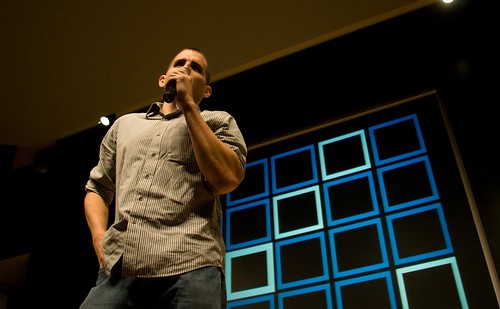
Recently on The Gist podcast novelist and storytelling coach Matthew Dicks offered his four useful lies of telling true stories. He believes that these careful manipulations of the truth work in the service of the audience. Dicks offered that “All the lies I tell on stage are never told for my benefit, or for the story’s benefit, but for the clarity of the audience”. But as I’ll explain this is a tricky line to hold for any storyteller.
First, here are as his four lies:
Lie of Omission. On the show Dicks tells a true story about running out of gas for his car and having to walk door to door pretending to be collecting for a children’s charity. What he doesn’t include is that the entire time he had a hitchhiker with him. To include this detail would, in Dicks’ opinion, complicate the story and take away its power (and in turn, I have omitted many details of his example story about the lie of omission).
Lie of Assumption. When you can’t remember a detail of the story, but you invent specifics to ground the story and help the audience share a vision for what is happening. As an example one of his stories involves a car, and even though he couldn’t recall what model it was, he took a reasonable guess (“brown Station wagon”) and used it in the story. He says “A lie of assumption is okay as long as it is a reasonable assumption… you assume details when you feel they are important but you have to make reasonable assumptions.”
Lie of Compression. When you want to shift time or space together for the sake of the audience. Whenever you skip an hour or a day of a story, you’re compressing it for the benefit of the audience. You can also have a lie of expansion, where you slow a moment down and spend far more time talking about it than it took to experience in real time.
Lie of Progression. When you switch the order of things for the benefit of the audience. The classic three act structure or any narrative arc is using progression to create suspense or keep the audience interested. Sometimes the most powerful segment of a true story happened at the half way mark, not at the end, when it was experienced in real life. For a more powerful story, the payoff needs to be placed carefully at or near the end.
There are many other manipulations that good storytellers use and I’ve used many of them in my books, even if I never called these techniques by these names. Dicks’ list is good but I don’t like referring to them as lies. A lie is defined as “a false statement made with deliberate intent to deceive” which isn’t generally the goal of storytelling. Instead a good story conveys something that feels real to the audience and careful manipulations like those in this list help a storyteller achieve a kind of truth, even if it’s only a metaphoric truth. To tell or write a story involves having a point of view and editing events, which means there is no purely true story. But the goal of a writer is to try and get at some kind of truth. I’d rather call the techniques of storytelling manipulations, or tactics, rather than lies.
The ethical danger is in Dicks assertion that “the audience does not want a story that declines”, which suggests that a good storyteller gives the audience what they want. This is the moral trap of storytelling. What about the important experiences in life that are messy, complex, ugly, and confusing? These experiences don’t conveniently fit the narrative bias that wires our brains. Messy and confusing stories that stay with us despite their lack of resolution, or clear heroes and villains, might be more important to us than the satisfying ones. We’re not well equipped to deal with ambivalence, ambiguity and existentialism despite how deeply effected we are by events in our lives that causes these feelings. Shouldn’t this be what our best storytellers help us explore?
“All the lies I tell on stage are never told for my benefit, or for the story’s benefit, but for the clarity of the audience”
There is a pocket lie here – all storytellers benefit from popularity. Telling satisfying stories makes any storyteller more popular, even if their stories stray from literal or metaphoric truths. To be exclusively in the service of an audience is a slippery slope (and to be clear I’m not familiar enough with Dicks’ work to accuse him of this). To want to entertain is a reasonable goal, but as important moments in life are not necessarily entertaining, it excludes many important kinds of stories central to the human experience. Storytelling is powerful which means people who are good at it have some responsibility for how they use that power.
Many talented storytellers slide towards the same selfish manipulations of advertising, marketing, and political propaganda. Simple lies travel faster and wider than complex truths. And someone who is a good storyteller can easily use the four lies, or any narrative system, to their own advantage. We all know that rationally there are no get rick quick schemes, or 7 day weight loss miracles, but our brains are wired to love these kinds of stories independent of their truth (see clickbait). Next time you hear a great story, ask yourself if it’s more than just the narrative machine in your brain that’s satisfied.
On Truth, Mike Daisy and This American Life (Mike Pesca pointed out in his podcast that the expectations of truth differ depending on the medium the story is in. A hollywood film provides one set of expectations, an Atlantic cover story another and a format like The Moth (“True stories told live”) or This American Life a third. But I doubt audiences pay as much attention to these nuances as storytellers and journalists hope they do).
One reason I rarely get excited about TED talks, although I do enjoy many of them, is I’m drawn towards the personal. For years I’ve been a bigger fan of the MOTH podcast, which is an evening of stories told without notes in from of live audiences. Although these talks are generally well presented, the agenda is different. They’re not as shinny. They have rough edges. They’re human and humble and honest in a way people pitching ideas can’t quite match.
A recent gem of a talk in every way is this one by Janna Levin, theoretical physicist and author of How the Universe Got Its Spots.
The talk moves from astrophysics, to misguided love, and the consequences of taking big risks.
Ignite is a presentation format that’s simpler than Pecha Kucha but longer than lightning talks. In Ignite each speakers gets 5 minutes, and must use 20 slides with each slide advancing automatically after 15 seconds, forcing speakers to get the point, fast. Having slides that automate seems mad, and in a way it is, but the surprise is that for most speakers it forces them to be far more concise and thoughtful than they would in any other format.
Even without the automation, my advice holds well for any kind of short talk. Why should anyone get the stage for 20 or 50 minutes if they can’t keep people’s attention for just 300 seconds? In many ways it takes more craft to make a short talk work well than a long one.
Often Ignite events have a dozen or more speakers, creating a fun evening with a wide range of advice, stories and entertainments.
I’ve spoken at many Ignite events and here’s what I’ve learned:
Pick strong storiesand big themes. What do you love? What do you hate? What is the best advice anyone ever gave you? Pick stories with big themes, since they require less introduction. What are the 4 most important things to know about X that no one talks about? The stronger the topic & title the easier the material is to create. Consider what one thing you want people to have learned when you’re done and make sure to drive that home at the end.
Outline 4 or 5 main points. You need a simple structure to make your message clear, and make sure people can follow along. Don’t assume you can just ramble your way through: the short format means you need to be more careful about how you use your time, not less. Ask yourself: what are the major lessons or points you want people to remember when you finish? That’s the structure of your presentation.
Figure out your points before you make slides. Talking about something for five minutes is easy – really, give it a shot once or twice before you make a single slide (practice with a timer) it will help you sort out what you want to say. You’ll quickly discover how unlikely it is to run out of things to say during an ignite talk. Once you know the 4 major points you want to make, only then work on finding images and slides to support what you’re going to say.
300 seconds is easy to practice. You can practice 10 times in an hour. Do it (The average Ignite speaker practices 5 times). 300 seconds equals 10 television commercials – you can make great points in a short time if you refine your thoughts. The entire sermon on the mount can be read in about 5 minutes and The Gettysburg address takes about 2 and a half minutes.
It is good to breathe and have pauses. There is no law that says you must fill every second with talking. When you practice, practice breathing. Give your audience a moment to digest the last thing you said. Take a moment between points. Like whitespace in visual design it’s the pauses that make what you do say stand out clearly. Give yourself a slide or two that’s for just for catching up and taking a breath.
Don’t get hung up on slides. What you say matters most. Good slides support what you’re saying, not the other way around. The last thing you want is to end up chasing your slides, a common problem at Ignite as you’ll never catch up. Pick simple images and if you must use text, be sparse (and use large 50+pt fonts). No bullet lists, just one or two points. Make the slides flexible enough that if you fall behind it’s easy to skip something to catch up.
Make your talk fault tolerant. Unlike normal presentations, if something goes wrong there’s no going back. You should build your talk into 4 or 5 pieces, where each piece could stand alone. Then if you fall behind, or something goes wrong, when the first slide for the next part comes up, you can easily recover.
You can hack the format. The idea of a ‘slide’ is vestigial – they’re not slides anymore. Put the same slide twice if you want to have more time to make a point. Or don’t use slides at all if you don’t want them. I’ve hacked the format a few times, including using a special time counter deck to give me more flexibility (see photo above). You can see this in action in my ignite talk on Attention and Sex or grab the deck here if you want to use or hack it further.
Plan to lose your first and last slide. Time will get eaten by getting on and off stage, the audience laughing and by any ad-libs you do. When you practice allow for some extra seconds, especially in the second half of your talk, when you might need to catch up. Plan and practice for about 4:30 instead of the full 5:00.
Keep your fonts large. Assume people don’t see well. Even if they did, people will be trying to listen to you. The more you try to cram text on the screen at the same time, the less likely any of it will be understood. Same goes for complex diagrams – there just isn’t time. Simple images or photographs work best. And again, you are not required to use slide at all.
You can find royalty free images to use. Search Google’s Creative Commons, flickr using the advanced options to show you creative commons images. Or try freeimages.com or istockphoto. Please attribute any photos you use with either the URL in small font on the bottom, or a last slide that simply lists all the URLs for photos that you used.