You will have fun. Yes, it’s true. Public Speaking can be fun. The exercises and games we play are designed to make you feel safe, comfortable and have fun while you learn.
Leave with confidence. Since you’ll spend much of the day speaking, or critiquing other speakers, when it’s over you’ll be a much better speaker than ever before. You will learn techniques to manage your fears, and how to prepare to give any presentation with confidence.
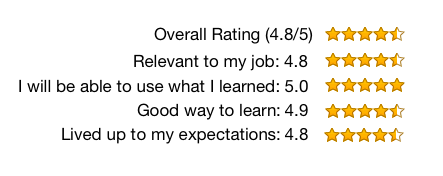
It has amazing reviews. Here are results from the last offering:
You will become a better storyteller. You’ll understand the common mistakes speakers make, how to avoid them, and how to use these skills to help you in your career.
The day is centered on YOU. This is a WORKshop. You will spend as much time as logistically possible practicing and getting constructive critique (there are other students of course, but you’ll be working at times in small groups, practicing and getting feedback).
Leave with helpful resources. You’ll get a signed copy of the bestseller, Confessions of A Public Speaker, the book that’s helped thousands of people become better speakers. Plus you’ll get a feedback and critique guide, useful for practice on your own.
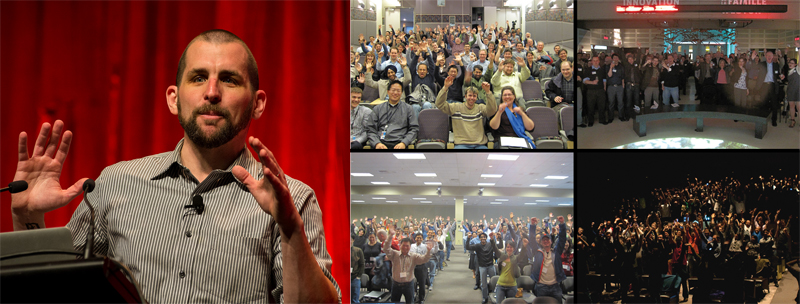
Learn from true expertise. I make much of my living as a professional speaker, and have given hundreds of lectures around the world. I’ve appeared on NPR, CNN, MSNBC and CNBC as an expert on various subjects, including public speaking. Over the last 20 years I’ve made every mistake imaginable, and teach from a place of invitation: I want you to improve and learn from my mistakes.
It’s Inexpensive. This is the final discount/beta offering of the course, at a very thrifty $350 (Early Bird) for a full day of first rate training.
Note: this is an intro to intermediate level workshop.
Last month I was invited by Dana Nunnelly to speak to some of her students in this year’s Microsoft Apprentice Program (in partnership with YouthForce). Every year they select a group of promising teens in tough situations (financial or otherwise) who pair up with project teams at Microsoft for internships while they’re still in high school. After talking with these young adults for an hour, and experiencing their intelligence and passion, I’m more hopeful about our collective future than ever. Can these kids take over the world soon please?
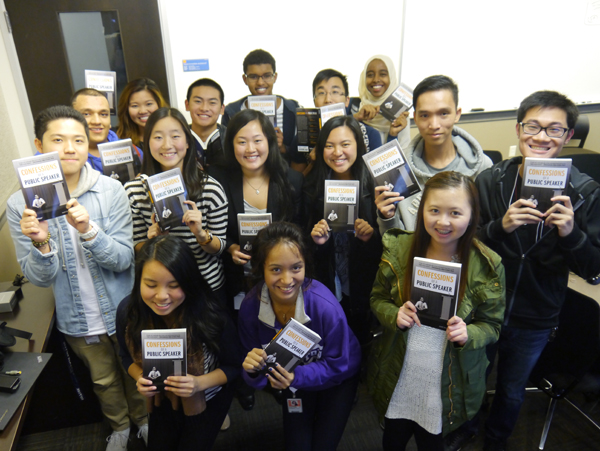
Dana explained they all have a major presentation as an upcoming assignment, so to help them out I sent them a box of my bestseller Confessions of A Public Speaker. And they were excited enough about it to take a photo and send it my way as thanks. Good luck!
Later this month I’ll be speaking at a community arts event at Umqua bank in South Lake Union. You’ll get to sample some great cider from the Seattle Cider Company, learn about robots from DXARTS PhD candidate / artist Meghan Trainor, and have a Q&A with me about creativity and writing. If you bring a copy of any of my books I’d be happy to sign it for you.
The Seattle Social Media Club is hosting me to speak next week about Free Speech and Social Media. They hosted me in 2010 to speak on Calling BS on Social Media Gurus (slides and notes) and it’s good to be back.
I’m very excited about this talk: the history of the collision of free speech and technology is a subject I’ve studied for a long time. I’m honored to get a chance to talk about these important issues. Here are the details:
Title: Can free speech survive the social media mob?
When: Wednesday January 1/22, 7pm
Where: Seattle City Hall, 600 4th Avenue, Seattle, WA 98104
Livestream? I don’t know but I’ll update when I do.
Description: The disturbing trend of online mob “justice” continues to grow. Has the unprecedented power of social media made us more or less free to express ourselves? What can we learn from how social media handled controversies and events like the Justine Sacco firing, The Boston Marathon bombing and the A&E Duck Dynasty debate? This entertaining and challenging talk explores these questions, providing clarity and advice on how media experts and ordinary citizens can make a difference.
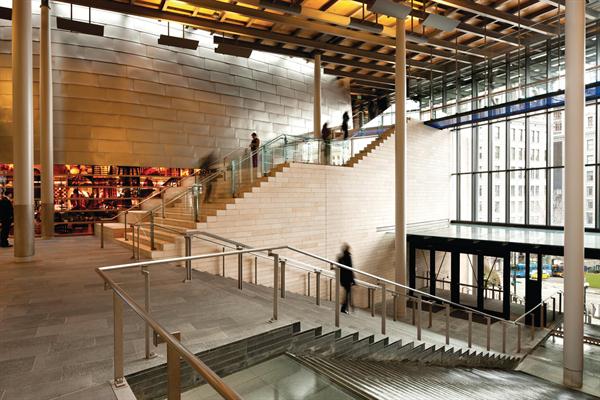
You can get tickets on eventbrite now. Hope to see you there. And you’ll earn that appetizer with a good pre-lecture workout by climbing the famous city hall stairs.
The best idea is to have a donation box for people to donate pairs of pants (and I’ll give them a free drink or a copy of the book).
Wanted: I’m hoping to find a volunteer from a local charity who can attend the party and man the donation box. It’d be nice exposure for your charity and of course you’re likely to leave with some nice pants to donate to your cause.
If you’re interested, or know someone who might be, leave a comment or contact me.
I’ve made my living as a writer in part because of of where I live. The city of Seattle has been an amazing place to be a maker of things, whether it’s books, software or just about anything. There are so many opportunities here and the culture is incredibly supportive of taking risks, making big gets and learning from each other.
It’s always been frustrating however that Seattle’s national reputation is dominated by two things: coffee and rain.
Other major cities like NYC, LA, and Portland have produced short films highlighting what they think makes them special. It’s time for Seattle to step up, and stand up, and express what makes th Emerald city such a great place for people with big ideas.
For the last few months I’ve been working with local filmmaker friends Bryan Zug and Dan McComb on We Make Seattle. As leaders in the creative community, they share my passion for the city, as well as the desire to use our abilities to craft something awesome as a gift back to Seattle itself.
Today we launched the kickstarter campaign for We Make Seattle. If you love Seattle I hope you’ll join in with your support and help us tell the story of our great creative city.
Next This week I’m moderating a panel on building online communities as part of WordCamp Seattle, at 1pm Saturday June 8th. I have four experts, either with vibrant communities or with wisdom about how to grow and maintain them. I’m looking for questions and challenges for them during the session.
The panelists are:
Michael Cyger, from isixsigma.com a B2B website that provides research and how-to knowledge for businesses
Most blogs struggle to get comments on posts, much less build an active user base that lead their own discussions. What insights would you want to hear from people who have made it work?
Even if you’re not attending WordCamp Seattle, what would questions would you ask? What situations have you experienced as a blogger that you want an expert’s opinion on? Please leave a comment. I’ll make sure there’s a writeup afterwards so you can read the answers even if you couldn’t attend.
Once again Seattle Ignite is venturing outside for a special family friendly event. If you’ve never been before, this is a great time to come. Each speaker has 5 minutes to talk about something important and interesting. If one of them is bad, don’t worry, by the time you notice they’ll be almost done. And if you love what one of them had to say, you can fiddle with your phone and learn more about them and their ideas. It’s fun, its fast, it’s friendly. And it will change how you think about how public speaking should be done.
Here’s the great roster of speakers. Many Seattle notables, speaking on fun and challenging topics:
Sol Villarreal, Engage Seattle (or, how I learned to stop worrying and love local government)
Steven Chau, My shirt does more than sparkle
Lisa Phillips, How to skate like a rollergirl
Charlotte Lee, Collecting Rubber Ducks and the Path to Mastery
Beth Goza, The Elegant Art of Waiting in Line
Rebecca Lovell, stop worrying and learn to love karaoke
Matt Jensen, From STEM to STICK: How to Raise Engineers
Donald DeSantis, Manufacturing Awesome: Going viral in a crowded market
Edward Jiang, Learning about Technology by Building Cool Stuff
Shalendra Chhabra, America from the eyes of a first generation immigrant
Lisha Sterling, Unschooling For School-Schooling Families
Richard Johnston, Changing the World With a New Business Idea
Viv Ilo Veith, Brain kNew Information on Knoggins
Brad Wilke, How I Made a Piranhaconda, Got Killed by Camel Spiders…And Lived to Tell About It
Tickets:$5 and sold online. Get them now. If available they’ll be sold at the door, but I wouldn’t wait.
Host: Brady is out of town, so I’ll be your guest host for the evening.
At the recent Ignite Seattle event I gave this carefully researched list of advice live in front of crowd of hundreds of Seattleites.
[youtube=http://youtu.be/7Fn34wfVfZk]
It’s common for everyone these days to bemoan how biased, superficial and misleading news reporting is. And the fall of major newspapers in the wake of the web is oddly seen an achievement. Yes, seeing old things fall can signify change, but it does not guarantee progress.
Are you a developer or designer who cares about news? Who believes quality reporting and information is key to a stable and long-lasting democracy? Do you wish there were better tools for finding, creating and verifying the information we share about the world?
If so, I invite you to sign up for Hacking Seattle News. An event next weekend (10/14-10/16), sponsored by King5 news:
JOIN US! We’re hosting a weekend hackathon with the goal of creating a social-savvy, aggregated news site for Seattle that YOU want to use.
The news industry is ready for a new idea and we’re coming together to build one. In a weekend. Want more social sharing built-in to the news process… or a better way of surfacing content you want to see? Let’s build it.
We’ll be brainstorming, creating, and coding a new news site for Seattle. The winning team will get a cash prize.
All used and created platforms will be open source. Registration is free. Designers and Developers wanted.
I was born and raised in NYC and despite living in Seattle for almost 15 years, I’ve still never gotten used to bad driving habits I see all the time. From the snowpocolypse, to four way stops where no one goes, to camping the left lane, it seems we struggle with the basics of urban driving.
If you live in Seattle, what do you think the biggest deficiencies are in how your fellow citizens drive? If you could get everyone to start, or stop, doing something on the road, what would it be? Leave a comment.
Update.2: I’m forced to postpone the lecture. Sorry to do this but unavoidable for personal reasons. The Town folks are cool and we’ll reschedule.
Updated: Only a few days to go – Hope to see you there. Leave a comment – I’ll be buying drinks for a pre-show party. Venue tbd.
For all you locals, I have some great news. It’s been hard to find big public venues to speak at here in Seattle, but I finally scored a big one.
On Wed March 9th, 7:30pm, I’ll be speaking at Town Hall Seattle on Creativity and Innovation. It’s going to be fun, and I’ll be working on new material for the talk. First 50 people who show up will get a free copy of the paperback edition of The Myths of Innovation.
Leave a comment if you’re a fan and you’re coming. I might set up a pre-show happy hour, with drinks on me.
How do you know if a new idea will succeed or fail? It’s easy (even for experts) to get it wrong, relying too much on wishful thinking and a romanticized understanding of history. Based on the new edition of his bestselling book, The Myths of Innovation, creativity expert Scott Berkun will dissect misguided notions of creativity and provide simple lessons from masters like Picasso, Da Vinci, and Edison, with crossover insights from the latest in art and technology. The first 50 people to attend will get a free copy of The Myths of Innovation. Presented by the Town Hall Center for Civic Life, with Elliott Bay Book Company. Series media sponsorship provided by PubliCola. Series supported by The Boeing Company Charitable Trust and the RealNetworks Foundation.
At Town Hall Seattle, 1119 8th Avenue, Seattle, WA (map), get tickets
To my initial disappointment, unlike the original Smell-O-Vision, or its arch-rival AromaRama, SIFF didn’t bother to install expensive ventilation systems to pump artificial scents into the theater. Instead they went with a low frills approach – each person received a paper bag filled with candy and smelly things. This turned out to be exceedingly clever and worked far better than those fancier systems ever did.
The pre-show instructions, delivered by our very own Oompa Lumpa, explained that on-screen prompts would tell us when to smell, eat, chew or open the various objects in our bags. He also told us that “tasting is just smelling with your tongue”.
Here you can see what the on-screen prompts look like. They also showed subtitles for all the lyrics to all the songs in the movie, making it a sing-a-long as well as a smell-a-long.
And it worked well. When 200 people all start eating chocolate at the same time, the room does smell like chocolate. When everyone eats cherry bubblegum, it smells like cherry. This simple approach to the problem was definitely more effective than Smell-O-Vision ever was.
A particularly fun moment is when Charlie and GrandPa Joe are in the Fizzy Lifting Drink room – in the theater we were instructed to blow bubbles, and blow we did, filling the the theater with the same bubbles that were on the screen.
The theater was 60% children, which usually means a nightmare of film annoyances. But this event was so fun, creative and entertaining, and the grand silliness of the movie, combined with all the activities everyone is supposed to do, made it great fun. I’m a fan of the film (70s satire at its finest) and this might have been the best experience I’ve had watching it.
Last night was the 12th Seattle Ignite and they celebrated their 4 year anniversary. How awesome. I had the honor of speaking at the first Ignite in 2006, and it’s amazing how far this thing has come (Photo credit: Eugene Hsu).
When it started it was a crazy format that few understood (20 slides per speaker, 15 seconds per slide, automated = 5 minutes per talk. 10-15 talks per night, inspired by Pecha Kucha). Half the fun was watching smart people struggle live on stage with their own slides. Since the bar for entry was low, it was safe for people to take a chance, and the audiences were super supportive as a result. But people have seen this enough they’re gaming the format – some people are exceptional at optimizing for this kind of speaking.
Which makes me think its time to change the format, or at least encourage more curveballs and cheats, like I recommend in the Ignite talk I gave about how to speak at Ignite. This isn’t the Olympics. There’s no score and no prizes. If you have a great idea that requires hacking the format, do it. What is a “slide” really anyway?
As long as something happens every 15 seconds, the goal of more interesting presentations has been served. You could pick 20 pretty backgrounds that have nothing to do with what you’re saying and show those (juxtaposition can be cool). Or have 20 blank slides. Or have a jigsaw puzzle made from one slide that fills in piece by piece every 15 seconds. There’s plenty of room for innovation here.
I hacked the format last night, showing a time-lapsed video of me writing this essay as my 5 minutes (I had permission from the organizers – thanks Brady and Randy). Some people said to me after “but you’re cheating” and I said “Absolutely. But was it interesting?” Rules are the means, not the ends.
Here’s my actual recap:
I didn’t catch all the speakers, but here were my notes.
Karen Cheng gave one of the best Ignite talks I’ve ever seen (How to solve a song). It was interesting, clever, informative, funny, involved live performance, and exposed the basic mathematics of pop music. Her closing medley of about 12 pop song choruses based on the same 3 chords was brilliant. When this is online as a video, it will be hugely popular. Very impressive.
Mandy Sorensen talked about parasites. Watching this made me think how cowardly I am for picking topics easy to find interesting. Not sure I can make parasites fun, but she did. She managed to make this entertaining and oddly, if grossly, captivating. She did cheat by showing a picture of puppies though, but as I said, cheats are ok.
Gregory Heller. SCRUM Project Management For Wedding Planning is a great title, and he delivered. The concept of Invested/Committed applied to weddings was apt. He also wins a prize for showing a diagram and immediately saying “Don’t try to understand this diagram”. Awesome.
Justin Martenstein – He runs the 400 person game at the beginning of the evening, and every time I’m thinking “there’s no way people will participate” and yet every time he gets 80% of the crowd up on stage, in groups of mostly strangers, to work happily together on some crazy team project. Proof our species does not (always) suck. Amazing. He warms up the crowd for all the speakers.
As a testament to how cool the Seattle Ignite crowd is, Emily Chen’s talk on owning fewer things (Have less, live more) had technical issues. But when she let the crowd know, they gave her a rally of cheers and encouragement. And she made the right call: abandoning her slides, and just speaking directly to the crowd.
Sadly I didn’t catch James Callan talk about grammar Nazis or Joel Grus talk about how to be funny. Hoping to catch these and the other talks I missed online.
About once a year Seattle gets snow, and invariably we do not handle it well. The shock is how, year after year, an entire city seems stunned by how fragile our transportation system is. And then, during the failure, some people complain that the city didn’t do enough to fix or prevent the problem.
Here’s a postmortem on what happened:
Our geography sucks. We have hills. It doesn’t take much ice to make hills dangerous. There isn’t much a plow or salt can do in a large city with lots of hills, with once a season snow. And many Seattle-ites have limited first hand experience with cars losing control on hills: they becomes unguided missiles (see videos below).
All our transportation is surface level. Due to our geography, we have no true subway. Buses run on surface roads and are not immune to surface level problems. I didn’t hear any reports of light-rail issues yesterday, likely because it’s an independent system.
We have inexperienced drivers. Since it snows once a year, whatever lessons people learn about how ineffective ABS brakes and fancy cars are in bad conditions, they’re forgotten 8 to 10 months later. And as driving home is a (understandably) selfish activity on normal days, people don’t realize the risks they’re taking in aggressively trying to beat the weather to get home.
Issues have compounding effects. Traffic is comprised of non-linear relationships, meaning it can accelerate faster through the traffic system than people expect. An accident here, can lead to a backed up exit there, and soon there is the equivalent of gridlock on arterials or even highways.
Plows, police and emergency crews can’t magically teleport through traffic. Once nothing is moving, there is no magic way for buses, tow trucks, or ambulances to get anywhere. We so rarely have bad weather it doesn’t make budgetary sense to maintain a large staff of plows and salt trucks that will sit dormant 95% of the season.
Thanksgiving/Holiday week’s amplify issues. More people are out and rushing to get things done.
The net lesson is it’s not the amount of snow that matters. It’s recognition of how:
Easily traffic flow can fall apart
The prime danger isn’t the roads but the other drivers on the road
Using a vacation day to avoid the whole thing might be a brilliant move
Yes, many people had no choice yesterday and I empathize. But many of you reading this probably did.
It’s interesting to read through this list of stories shared to the Seattle times – there’s a persistent sense of shock and surprise. I’d love to know how long these people have lived here. And what, if anything, they’ll do differently next time they hear a report of snow in the winter in Seattle.
Here are two videos from last night:
There’s barely a half-inch on the ground and look at the highways at 9:15am.
I’ll be at the lovely new bookstore, Ada’s, on Capital Hill, from 4-6pm. They have Myths for sale, as well as a selection of my favorite sci-fi & science books, but happy to chat with anyone about anything. So come on down. Possibility of going our for some beers afterward.
If you live in Seattle and like fun you owe it to yourself to check out Smash Putt: a unique arts/sports/golf experience, open for its last weekend of the year (perhaps all time!).
The basic idea: what if you take crazy artists and engineers and let them rethink miniature golf?
You get:
A full service bar (It’s a 21+ experience, with exceptions on one day)
Holes that include catapults, power drills and guns
We went last weekend and had a great time. It’s crowded and chaotic, but totally worth it. For extra fun, it’s in the old Immigration building in downtown Seattle, making for a bizarre, but ultimately fun experience.
Part of why I quit was I wanted to work on things I could get my entire hands around (e.g. books), even if I made less money than I would for continuing to play a small role in the making of big things. I bet I’d get more pride and pleasure from making things I loved, even if they are only used by a few people, than I would for the thousands of compromises that come with making things used by millions of people.
One of my former bosses at Microsoft, Hillel Cooperman, has not only gone on his own with Jackson Fish, a company that makes hand crafted software (you read that right), but he’s started up a little event for people who share the small and special philosophy.
What: Small and Special – a tiny conference for entrepreneurs and hopefuls
If you’re a small business owner or have thought about starting one, this is a great way to meet many locals who are a few steps ahead of you. Check it out.

 Once again Seattle Ignite is venturing outside for a special family friendly event. If you’ve never been before, this is a great time to come. Each speaker has 5 minutes to talk about something important and interesting. If one of them is bad, don’t worry, by the time you notice they’ll be almost done. And if you love what one of them had to say, you can fiddle with your phone and learn more about them and their ideas. It’s fun, its fast, it’s friendly. And it will change how you think about how public speaking should be done.


