On Tuesdays I write about the top voted question on Ask Berkun (see the lovely archive). This week’s question came from J.R. [via email]:
What is a favorite theory that you wish more people understood?
A favorite theory I wish was more well known is the Satir Change Model. It’s popular in some circles, but often when I mention it in talks at events few have seen it before. Virginia Satir was a family therapist who studied how families behave, and in particular, how they respond to change. Her ideas have been successfully applied to organizations and groups of people.
We like to believe change and progress are predictable, especially if we’re applying an idea we’ve used before or that is widely accepted. But according to her research (based on family behavior), and her model, even when we’re making the right change, at the right time, confusion and fear are likely.
The Satir Change Model is simple and has 5 parts (image by Jurgen Appello):

- Late Status Quo – this is the present, where things are stable, at least in the sense that they’ve been the same way for some time.
- Foreign element – This is Satir’s term for any change that is introduced, which could be something deliberate (a new healthy diet) or something surprising (new neighbors move in next door). It could be a new idea, process, team member or anything. Often people resist foreign elements, even if they come with the promise of solving a problem. People often prefer to keep doing what they have been doing (status quo), even if there are things they don’t like about the status quo, especially if they don’t have much trust in their leader or their coworkers.
- Chaos – (IMO this is the central idea of the model). Even if you are doing everything right, and the change is the right one, volatility will rise for a time. Average performance will drop as people experiment with adjustments to incorporate the new idea. Hidden assumptions, and emotions, will be revealed, which can be painful at first. A new idea may require new conversations, redistribution of responsibilities and more. What makes this phase challenging is it’s hard to predict how long it will take or if the path is the right one (e.g. “do we need to keep going, or is this direction a mistake?”)
- Transforming Idea – The job of a leader is to help a team work through the chaos phase until they reach clarity. This is challenging as each person might require different coaching, advice, support or training to adopt the new idea. And the team as a whole may need to reform, with different roles and responsibilities. Someone with leadership skills might correctly identify a new direction, but it takes someone with people management skills to help them through the transitions that the new direction demands.
- Practice and Integration – Once the new idea is understood and adopted, finally the expected gains can be seen and progress becomes predictable. And eventually stabilizes again as the new status quo.
The model isn’t predictive. It doesn’t tell you how much chaos a particular idea will generate, if any at all. It can’t tell you how long it will take before you find the “transforming idea”. It also can’t tell you whether the new idea you’re introducing is the right or wrong one (e.g. the chaos will never end, or performance will never recover). It’s simply a useful framework for thinking about the psychological patterns likely to arise when something changes.
Inexperienced people often confuse the chaos phase as a failure in their choice. And if they quit early, assuming “chaos” means they made a mistake, and revert back to the old ways of doing things, they likely will never have the confidence to try something that bold again. They now confuse the chaos phase with failure. This is a kind of self inflicted learned helplessness, where the necessary cost to improve and grow is now too psychologically expensive. People and organizations can become paralyzed here, as they’ve become extremely resistant to any threat of a “foreign element”, even though that’s exactly what’s needed to grow.
Some foolish people dismiss Satir’s work based on the question what do families have to do with workplaces or individual adult choices? But workplaces are based on relationships, and we learn our models for how to relate to other people from… our families! Your favorite, and least favorite, coworkers learned many of their patterns of behavior from their early relationship with their parents and siblings. How we define trust, love, collaboration, friendship and teamwork all come from our experience with the first and primary tribe in our lives.
Anuradha Gajanayaka compares the Satir model to Kanter’s Law, which states that “Everything looks like a failure in the middle.” She suggested that we “Recognize the struggle of middles, give it some time, and a successful end could be in sight.“
And that is a key takeaway from the Satir model. Even if you’re doing everything right in your life, or as a leader, when you try to change something be prepared for surprises. Plan time for “chaos” in response to the change, where it’s normal for performance to drop and for experimentation to happen until the new idea is understood, incorporated and refined.
My next book is a departure and a risk. If you want to understand why, read the goal of my life explained.
I’ve been asking questions about fathers and sons my entire life, which makes it no surprise I’ve had a difficult relationship with my father. He is not an easy man to know, but as a child I didn’t know this. And as it is with all families, you can only see your family for what it is once you leave it and look back. It wasn’t until my twenties, when I moved away and started my own life, that I began to understand both myself and my father and began the work of unpacking our relationship, as broken as it was. So many of the feelings I had about myself weren’t really mine, but feelings I learned to have to try and fit into his world.
My next book, titled The Ghost of My Father, is about this relationship. Particularly the events of the last two years where he, at the age of 70, has chosen to abandon his family. It seems he was never quite happy with his life, or with us, observations he never shared until this last chapter where he tried to move away and start a new life. He had an affair once before while I was a child, with disastrous consequences for the family. And now I find waves of memories, feelings and thoughts from that time have been brought back to the present, memories and feelings that demand being reckoned with.
We think memory is stable, but all my memories of my childhood have shifted dramatically. Different stories from my past now seem far more important, and ones I thought were important now don’t seem to matter at all. I’ve returned to my journals, sifting through to look for more insight into why these memories are with me now, and others are not.
“Memory seems to be an independent creature inspired by event, not faithful to it. Maybe memory is what the mind does with it’s free time, decorating itself. Maybe it’s like cave paintings. The thing is, I’m old enough now to know that the past is every bit as unpredictable as the future, and that memory, mine anyway, is not a faithful recording of anything, and truth is not an absolute.” – Abigail Thomas, Thinking About Memoir
Last night I watched the film The Return, about a father who returns to his two young boys from a mysterious ten year disappearance. There was something epic about the tones of the film and how fathers factor in many children’s minds as a powerful, ambiguous, possibly unknowable creatures. Certainly not all fathers are like this, but many are. And few of us have the courage to dig into the hard ground of our childhoods, despite our disappointments with our parents, to sort out who we are and who we want to be now that we’re not children anymore.
This 6th book will be my most personal one so far.
- If you want to be notified when the book is out, signup here.
- You can read more posts about the book.
- If you’re interested in this book, leave a brief comment (“I’m interested – go Scott!” works fine). I’ll be in touch as the book develops and is published. This blog won’t be shifting to be primarily about this project, so leaving a comment makes it easy to stay in touch with you.
- And of course films, books, and other stories you recommend I read are welcome too.
- If you have a related story to share about your relationship with your father, good or bad, I’d be grateful if you left a comment or sent me an email.
I have a disorder of a kind known as “can not keep my mouth shut.” If I think someone isn’t being honest, or even if I just disagree with them strongly, my arm raises, and my mouth engages, well before my brain can calculate the possible damage.
I have been in successful recovery for years and I am here to share what I’ve learned.
As a rule, if you insist on always speaking your mind, you will inevitably find yourself in an environment where everyone hates you. Most people can not handle the truth (or what you believe is the truth). And the more you shove it in their face, the easier it is for them to ignore you. You simply become the person who always complains. Your ideas will be shot down simply because of the reputation of the mouth they come from.
The trick to keeping your mouth shut is this: put the desire to effect positive change above your instinct to tell people they’re wrong. The later almost never leads to the former.
Back in my early days at Microsoft I worked on strong teams where you were expected to have opinions. If you saw something stupid happening you were obligated to raise your hand, say “I think this is stupid and here’s why.” If you were right, you were applauded no matter how senior the people in the room were. I argued with group managers, VPs, and many other tough, smart people far more senior than I was. If I was wrong, I was dismissed, but not scolded. I might have heard praise for not being afraid. I thrived in this environment and assumed this was how the world worked.
But later, in a new job at Microsoft in a group known as MSTE, I discovered a different world. No one spoke their mind in public. Few people worked hard or asked tough questions. Quality of work, and morale, was low. I felt obligated to mention these facts as often and as loudly as possible to leadership. I even expected to be rewarded for telling people how bad things were. Why wouldn’t they want to hear this? I thought.
Before I knew it, I was that guy. The guy who always complains.
In my egocentric view, the work around me was well beneath the bar. But I didn’t stop to think the group had its own bar, it’s own culture and it was not my job to set it. And I was far from having enough respect from anyone to be seen as a leader, which would be required to change the culture anyway.
It took months of suffering to realize I was in a different culture with different expectations. It blew my mind to realize there were other cultures at all. To achieve the same positive effects my opinionated nature had early in my career, I’d have to adopt a very different approach.
I also realized in the past, in other groups, progress happened not simply because I was right and took a stand (as much as my ego wished it to be true). It happened because my boss, or his/her boss, listened to my points and took action, or granted me the power to do so. Having an idea changes nothing unless someone with sufficient power, and genuine interest, does something about it. The idea alone is never enough. Nor is saying it out loud.
In the movie Glengarry Glenn Ross, Blake (played by Alec Baldwin) gives perhaps the meanest lecture of all time to a bunch of salesmen. Why is this lecture possible? Why didn’t they ignore him or beat him up? Is it Alec’s strong chin and trim physique? No, it’s because the owners of the company asked him to do it. He’s allowed to open his mouth, and speak a certain kind of truth, however unnecessarily mean and adversarial it is, because he has the support of the people in power (You can watch this amazing scene here – NSFW). You could never successfully behave this way unless someone with more power then you allowed you to.
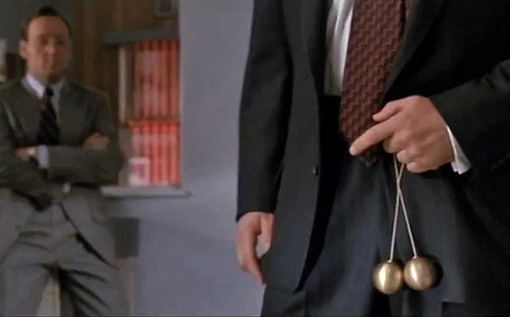
There’s another scene in Glengarry Glen Ross, where a salesman (played in the movie by Al Pacino) yells at the sale manager (played by Kevin Spacey), never to open your mouth until you know the shot. If you don’t know the angle being played, anything you say might ruin the plan (you can watch the scene here).
This is a great rule to follow before you raise objections or offer big ideas. No matter how right you are, if you care about effecting change, you should never open your mouth without some sense of who will agree with you and who won’t. If you can anticipate the angles and responses, and judge, even by guessing, if there is a 80%, 20% or 0% percent chance anyone in good standing will follow your lead in support of what you say, you know whether it’s worth opening your mouth. It’s a world of difference of perception when someone respected says, after you speak, “he might be right” and when there’s only silence. And of course, in most cases your percentages go up if you raise your objections in private, rather than in a large meeting where egos are at stake.
These days, as an independent, I’m invited to visit and speak to different groups every week, in different cities and countries around the world. I depend on my ability to evaluate the culture I’m in each and every time.
Of course there are times when the BS has piled up too high and you have to speak the truth no matter the consequences. Forcing an issue can be the only way to get it the attention it deserves. But pick your battles. If a year goes by and you haven’t taken a single stand, I’d likely call you a coward (Nothing in 12 months was worth making a stink over? You have to draw your sword now and then to remind people you have one). But if you’re taking a stand every day, you’re either a glutton for punishment, an egomaniac, or too stupid to realize you’re working for the wrong people.
How to say things well, including the tough stuff, is another matter entirely and one I’ll save for another post.
Meanwhile, to help with my own recovery: how do you decide when to open your mouth, and when to keep it shut? At work or at home?