There’s something captivating about movies where you don’t know all the rules, but care to stick around to find out. This is why I like some foreign films, the ones that aren’t too weird, in that they grab your attention and mind in ways American films rarely do. They are actual artifacts of drama, instead of exercises in “guess which cliché will happen next”.
Winter’s bone is about a young woman in Missouri who, to save her family, has to take on many hardships and risks. And at its core as a quest driven narrative it works well. But what makes the movie so engaging is how it captures the sense of a place, and a people. All of the characters feel like a part of the world being filmed (and it turns out, many of them are locals), and there’s a patience to the dialog and the plotting that lets the fears of this world, and the questionable nature of the characters, stand in relief.
It’s not an easy film to watch – but it is a fantastic and heroic film.
Last week I finished reading Founding Faith, by Steven Waldman. The book explores the history of religion in America, focusing on what the founding fathers believed personally and expressed in their role in government. It was an excellent read and balanced in coverage – the author frequently explains how both modern liberals and conservatives get the history wrong.
Here’s some of what I learned:
When someone says “the founding fathers believed X” they’re probably wrong. Each founder had different views – they were rarely unanimous. They had bitter rivalries (Adams/Jefferson), different opinions on the constitution, the war, states rights, you name it. And more confounding, their opinions, like yours and mine, changed over time (Adams became less religious as he aged, Franklin possibly more).
Americans wanted freedom from the British church. The Puritans, and others that followed, wanted freedom to practice their own version of Christianity, but were not allowed to under British law. One (but not all of the) motivation for the first amendment was to prevent the U.S. government from establishing a state religion, having seen what it did in Britain. Religious freedom, specifically from the British Church, was a contributing cause for the Revolutionary war. It was one major reason people came to America, and one reason they resisted British rule.
Many of the issues the founders cared about were immediate. We often say “what the founders intended” but they had little conception of some of the issue we face today. They struggled just to make the constitution, the revolutionary war and the bill of rights succeed at all, in their present time, given the complex politics of a new nation. They hoped to put a system in place that would interpret the law and explore its many corners and applications, which is what the Senate and the Supreme Court have done, and hopefully will continue to do. The first or any amendment wasn’t fully understood or defined until it was tested and explored in the years after its ratification.
George Washington was motivated for religious tolerance to fight the war. He may have had philosophical motivations, but practically speaking he needed soldiers. If he discriminated based on religious factions, he’d had fewer soldiers and he needed every last one. He defended Catholics and other groups for these reasons – the only hope for winning the war hinged on cross-denominational support, which demanded cross-denominational tolerance.
Jefferson was the least religious of the founders. He questioned the divinity of Chirst, yet found Christ’s message and teachings essential and brilliant (he worked on a version of the gospels stripped of its miracles). Adams was probably the most religious, often quoting scripture or including references to divine support in his acts.
The founding fathers beliefs were tempered by politics of the day. The book documents the debates among the continental congress (and, I believe, the senate) that surrounded the founders. Trades were made, positions were taken and then pulled back, in the same messy, ugly way it happens to day. We forget how many other people besides the founders were involved in every piece of legislation.
I read the book in just a few days (motivated by the religious issues in NYC). Oddly enough, the book had little impact on my opinions. But it did ground them better in the history of religion and politics in America.
I strongly recommend the book – not just for religious history, but for general understanding of the workings of the U.S. Government during such a pivotal time. I suspect there are other interpretations of the facts other than his, but simply for better framing the process and key decisions, it’s a worthy read.
Here’s the link to amazon: Founding Faith, by Steven Waldman
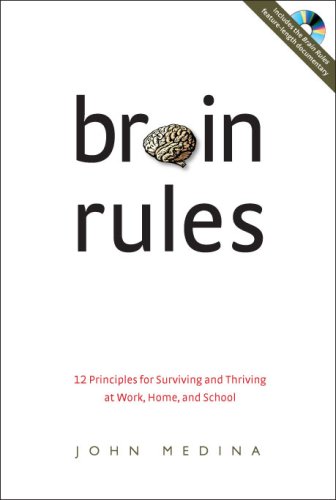
Brain rules is easily the best book I’ve read this year. I don’t say this lightly as I read many books, skim many more, and read lots of things I enjoy.
This book hits the non-fiction trifecta:
It’s about a universal subject – how we think and how our minds work.
It’s well-written, funny, entertaining and concise.
It’s based on research with support for nearly every claim made in the book.
Bonus: the author admits lots of things he and the field do not know (Huge credibility points – I love this)
Unlike Pink’s A Whole New Mind, a book whose premise I’m fond of but whose arguments were often weak and in some cases absurd, the book Brain rules never strays. He follows most of his own rules in how the book is structured, one main point per chapter, one set of basic advice derived from his interpretation of research.
As a teaser here’s some of what I learned:
Sleep makes your smarter – your brain processes information you need in your sleep
Exercise makes you smarter – our brains and bodies work best when moving
There is no scientific basis for how schools or courses are structured
The left vs. right brain thing is waaaay overblown (Pink needs to read this)
True multitasking is biologically impossible
I’m recommending the book to just about everyone – other writers, teachers, parents, friends, friends with kids, kids with friends.
If you’re not sure, check out the excellent supporting site for the book: Brain Rules website.
My favorite books on start-ups and entrepreneurship is Founders at Work by Jessica Livingston. It’s simply a collection of good interviews with the right people asking the right questions. No phony big theories. No made-up jargony words in the title. Just good conversations with people who have experience I want to learn from. Love it.
In that vein, I’m happy to recommend Blog Blazzers: 40 top bloggers share their secrets. Stephane Grenier, the author sent me the book a few weeks ago and I read through it in a few hours. Seth Godin, Jeff Atwood, Eric Sink, Dan Lyons (Diary of Steve Jobs), and 35 other successful bloggers explain how they do what they do, what they’ve learned, and how they make money or get other rewards from their work.
For $16 and a couple of hours (books of interviews are fast reads) I learned some new tricks, had more confidence in the old ones, and definitely got my money and times worth. At first I was annoyed by some repetitive questions – but in some ways it was interesting to see how different bloggers answers compared with each other. I read a lot of blogs, including some blogs on blogging (but gratefully no blogs on blogs on blogs) but there’s still nothing as good as sitting down with a book.
The book is good. Three of Five stars. If you’ve never gone out of your way to pick up a book filled with non-fiction essays, this is a decent place to start. I’m a bigger fan of the Best American Essays series, which has never failed me. I enjoy being able to abandon authors or essays I don’t like, and try another in the next chapter. It’s like a writing sample pack: great way to discover new voices and different kinds of writing.
In Glass’s compilation you have Michael Lewis (Moneyball, Liar’s Poker) reporting on a teenage day trader arrested by the SEC, A Malcolm Gladwell essay that appears in The tipping point, and other essays by Dan Savage, Michael Pollan and more.
But by far my two favorite essays were from two writers I’d never heard of before. Losing The War (full essay online), by Lee Sandlin and Toxic Dreams: A California Town Finds Meaning In An Acid Pit, by Jack Hitt. The $10 you’ll pay for this book is worth it for these two superior pieces of funny, clever, tightly written, truly thought provoking works. “Losing the War” explores a truer history of heroes and WWII than most of us know, while “Toxic Dreams” is the story of one of the first toxic waste dumps, and how the imact on the town nearby slowly unraveled over more than a decade.
I’m nuts about books. I finish a book a week, and abandon many more. Looking back on the year, picking a favorite, #1 book to recommend is easy – that’s how much I enjoyed this book. It’s Over the edge of the world, by Laurence Bergreen.
The book tells the wild, nearly unbelievably difficult tale of Magellan’s expedition to circumnavigate the world. In short, everything goes wrong. Mutiny, starvation, politics, bad project management, and on it goes. There’s also what has to be one of the greatest idea pitches ever (“Yes, I will go all the way around the world, requiring several routes no one has discovered yet, and you will pay for it”). And it’s all told with the perfect balance of tight, thrilling storytelling and historic detail.
I love books like this for their power to humble: they put all of the challenges and complaints people have today in relief. Nothing any entrepreneur or middle manager faces today even approximates the risks, suffering, and significance of what these historic figures did. Finishing this book I felt inspired by the realities of what Magellan and his crew did, rather than the false, simple tale I’d learned as a kid.
It’s a great gift choice for anyone interested in innovation, how progress happens, how myths compare to realities, project management, people management of all kinds, and well told true adventure tales.
I’ve been attending or contributing to GEL (Good experience live) for several years now , but I have to say, it’s my favorite conference. The early registration deadline is tomorrow, so if you have the budget to attend a conference next year, I want to make my pitch to you to make it GEL.
It’s a NYC conference run by new yorkers. All of the day one experiences, where you get to experience design first hand, are run by local designers, curators and other experience creators. No other conference I know of pays so much attention to locale and teaching experience through places and activities, instead of presentations. Many conferences move every year, like nomads, never taking full advantage of their locale – not GEL.
It’s single track. Ok, like, no big deal. But when was the last time you went to a design conference that said “our speakers are so good, and so fun, you can stay in your seats, and we’ll bring the good stuff to you?”. Like a good UI design, a single track shows a high commitment to quality and faith in the program.
Until Dec. 12th, It’s $1000 to attend. Hey, why pay less for forgettable generic conferences, when you can pay a little more for a true experience you’ll remember? More info and registration here.
Sometimes good books sneak up on you – you enjoy reading them, but their full value doesn’t surface until afterwards, when in the days and weeks that follow you find yourself thinking back on how the book changed your mind. Engines of ingenuity by Historian and NPR host John Lienhard, fits this profile.
The book is comprised of short essays on the history of technology and invention, largely from his NPR show by the same title (transcripts onlne). These essays read well, cover many famous bits of technology history and offer insights and fresh perspectives on some stories I thought I knew well. Highly recommended.
Lienhard’s new book, How invention begins picks up where EOI leaves off. This time he looks deeper into how inventions develop, exploring how often desire, and not true necessity, led to many of the major technoligical innovations of our past.
It’s written in a more challenging style than EOI: longer pieces, more rigorous history, and covers less well known territory. For that reason I recommend EOI or Leinhard’s short NPR pieces first, and if you enjoy those, they’re excellent introductions for How invention begins.
The folks at 37 signals have well earned their reputation for making great web applications. They’ve established a strong identity for with a line of web tools for project management (Basecamp), To-do lists (Backpack) and simple collaboration (Whiteboard).
They recently published a short book called “Getting real” about how to build web apps – and here’s my review.
The book is short – 170 pages with lots of whitespace and heavy quoting. If you’ve used any of their apps you’ll feel right at home as they do a fine job maintaining the same voice and style.
The highlight is their passion for making good things. They are most effective when they boldly express their ideals, using them to slash through common assumptions about features, big planning, organization and customers. It’s a brisk and optomistic read. At turns clever and confident, but ocassionally nieve, this book will generate strong opinions and can spark healthy debate even if you don’t like or agree with what they say.
The lowlights are the how – While I’m philosophically aligned with these guys, this book is more mantra than guidance or instruction. I imagine it working as a boost for people who believed some of these things prior to reading the book who, now reaffirmed, can point others to it as an external and respected source. There are obvious counter examples to some mantras, but they’re beyond the point, as the questions raised are worthwhile.
But for those in old-school organizations or with dysfunctional teams, this book doesn’t give the tools needed to turn things around nor provide individual readers with “Real” practices they can employ on their own. Most of “Getting real” is about approach and attitude, and it requires your co-workers to share it with you to work.
The book’s strength and weakness is the experience of the authors: they started 37 signals on their own, and advise largely from that context. While they don’t try to direct readers for how to convert older, larger, slower, less talented teams of people into “Real” teams, there is the vibe througout the book that the world would be a better place if everyone did.
Summary: I recommend this book – it’s a fast and opinionated read. It’s most valuable to small self directed teams, as a reference for how one small, talented, self directed team has successfully built quality software or as a hand grenade for teams that have been doing things the same way for too long. However it doesn’t quite justify the $19 price: there are tragically no references and no links to other sources, something I hope they’ll remidy in a 1.1 book update. (For reference: McConnell’s Rapid Development, with a 5 star average over 100 reviews at amazon, covers similiar ground with near opposite highlights/lowlights, for $22, with thorough links to other sources to go deeper than the text. These two books make a fine pairing).
The early registration deadline for GEL 2006 ends next week, so it’s a good time to make a pitch for why you should go.
Good Experience live is the only conference I’ve been to that is self-reflective: many of the principles of design and good user experience espoused during the day can be found in the way the conference itself is run. Day one of the conference is out in the field, spending time with experts in their domain: an inside tour of the experience design of NYC landmarks like Natural history museum, MoMa and the Hall of Science. Participate in an improv experiment on the midtown streets or a learn how to apply tmusic techniques to your work. There’s also a food experience tour of my home burrough of Queens, NYC.
Day 2 are talks from Craig Newmark (Craigslist), Jason Fried (37 Signals), Seth Godin, Douglas Rushkoff, Photographers, Urban pranksters, Game designers and other interesting perspectives on making great things for people. There’s no formalized boundries here – instead you get great cross-discipline stimulation that will stay with you long after you leave.
The conference rates are still discounted Before April 5th, it’$1200 for both days, and $1500 afterwards. (Price was $900 before December 1st, but that’s behind us now).
I’ll be running a Day one tour on NYC’s sacred places. We’ll be walking around the city and exploring magical and special places, discussing how they were designed to have the effects they have. You can sign up for this or other Day 1 tours when you register.


 Brain rules
 The New kings of Nonfiction


 The early registration deadline for