I believe in first impressions, especially if you’re asking someone else for something. When you make a connection to another person, even on the interwebs, please take 60 seconds to say something personal about why you’re making the connection.
If you’re not willing to take 60 seconds to write something personal, and explain why you want to connect, why would you expect them to say yes? If they’re important enough to you to ask for something, match that with putting in a moment of effort. Otherwise you’re the equivalent of a stranger running up to someone on the street and asking to shake their hands, screaming “You’re someone I trust!” as you do it.
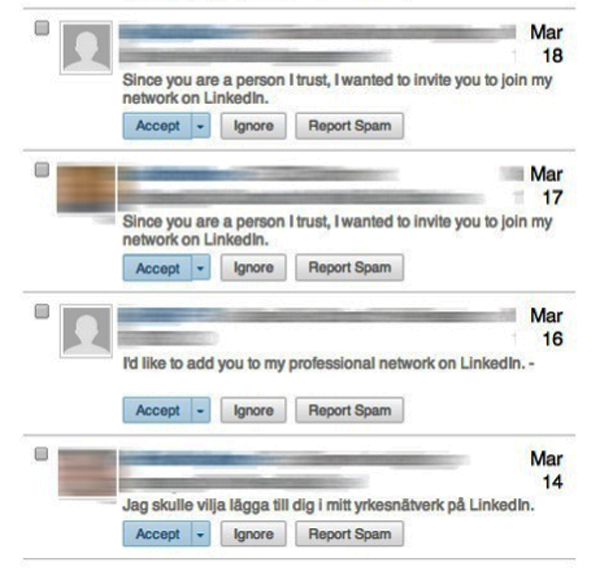
Here is what my LinkedIn inbox always looks like (see below). It’s often filled with generic requests from people whose names I don’t recognize, where the request tells me nothing about who they are, how they know of me or why we should connect. It’s a wasteland.
That last guy didn’t even get the language right as I only speak English.
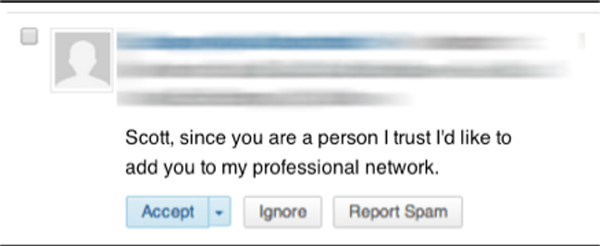
The generic messages LinkedIn offers should be avoided. How could I be a person you trust if we’ve never met? And even if you trust me, that’s not the important part on my end: why should I trust you or find you worthy to connect with? It’d be far better to explain how you met the other person, why you’re a fan of their work, or how on earth you even know who the hell they are.
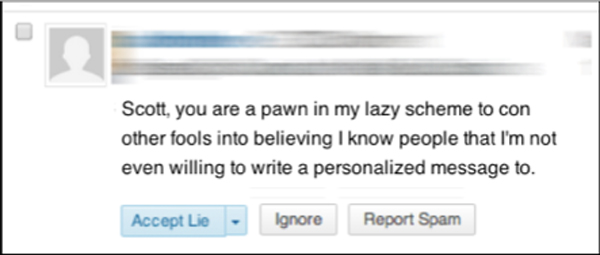
When I see these generic requests (above), I translate it to mean the following (below):
Advice:
Take 60 seconds to say something personal and meaningful
If you can’t, don’t bother sending the request
Unless you’re sure the person knows your name name well enough that it’s meaningful to them
I’m a fan of Melville house, a young, savvy publishing company founded in 2001 in Brooklyn, NYC. They have a lively twitter feed, they publish interesting books, and generally seem wise about what books and book publishing mean in this technological age.
But a recent article of theirs titled Publishing and Poverty by Zeljka Marosevic, their director of UK Marketing, reflects a flawed romanticism about writers: there was never a good time to be one.
The writing life has always been hard, especially for writers of fiction. Even Hemingway and Fitzgerald had a hard go of it at times. Dickens saw most of his profits lost to piracy and, like Twain, earned more from speaking engagements than his books themselves. Even when the novel was at the center of European or American entertainment, it was still the rare novelist that survived by their writing alone, and those that did achieved it at great risk and with consequences to their health, their families and their wealth. Many famous writers, from Mellville to Kafka, became famous after they died. They never experienced the full attention their works generated, a fate common for many artists (e.g. Van Gogh). Da Vinci is far more famous today than he was during the Renaissance. Being an artist has always been a hard road.
Marosevic mentions a story of British author Rupert Thompson:
Rupert Thomson, who is being forced to abandon the office he hires in exchange for converting his attic into a “garret” to save money. Due to falling advances and physical book sales, combined with publishing’s move to digital, Thomson feels fearful about his future as a writer: “I don’t buy anything. No clothes, no luxuries, nothing. I have no private income, no rich wife, no inheritance, no pension. I have nothing to look forward to. There’s no safety net at all.”
He had an office? What a luxury. What percentage of writers throughout history had them? And what is this talk of safety nets? If an adult wanted a safety net, why on earth would they choose to be a writer? Now mind you I’m all in favor of good writers who need support getting it if they can. I’m a member of the Author’s Guild and I support programs that support writers. However to choose to be an artist is to deliberately reject the security that comes with nearly any other profession. It’s to be expected that to structure a life around writing will be a challenge.
She comments on the recent London Author’s fair:
Their education seemed more to be about learning to market themselves than becoming better writers. Unless that’s what it means to be a good writer today. No vision seems satisfactory, and with the decline of the old and the dawn of the wobbly new, a writer’s place seems highly insecure.
Throughout history there have always been more authors looking for a break than publishers can afford to give. Even Mellvile House itself does not accept unsolicited fiction submissions. It should be no surprise that when writers convene, much of their conversation is about marketing: publishers demand writers market themselves to the publishers! That’s what agents, book proposals and synopses are for. The entire machine of the publishing industry depends on writers marketing to publishers. And until the technology of the last decade they’ve had the keys to the only gates (now we all have gates on our phones).
Publishers today, and probably always, desire writers who are excellent self-promoters. Walt Whitman went too far in writing fake reviews of his books in newspapers, but the spirit was always desirable. Authors are chosen in part for their platform, jargon for how famous they are. That fame is assumed to translate directly into marketing, and it’s common now for publishers to ask how many twitter followers or blog readers a would-be author has. This is not a shock, it’s logic. Publishing is a business. To choose an author already known minimizes risks and publishers, more often then not, play it safe, especially when deciding between two equally good manuscripts.
Beyond my critique, I believe without question this is the best time ever in history to be a writer. It is still hard, but today we have more tools in our possession to publish, to collaborate, to market, than any writer in history ever had. And most of these tools are free! There is simply no one to blame. Can’t find a publisher? Publish yourself. It’s cheap. You can’t blame ‘the system’ anymore. Don’t know an editor? Hire one. Don’t have money for it? Save. If you are so passionate and talented you will find patience. Don’t have any followers or fans? Start a blog – a blog is free and instant publishing to the planet. If as a writer you can’t get excited about publishing anything you like to the entire planet for free I question your sanity. This is as good as it will ever get.
Most of what’s published is trash, it’s true, but this means if you are talented and dedicated your work will shine. It’s unlikely to shine brightly enough to be the way you make a living, but as I’m telling you there was never a time this was likely anyway. Do it because you want to do it, not because of some reward you expect from the species. Your talent might have been granted to you, but it must be proven, through hard work, to the rest of the planet.
Publishers can be great partners to writers. They can help craft the book and find it an audience. But all they’ve ever done throughout history is help. Only the writer gets their name of the cover and for that privilege comes the lion’s share of the work. While publishers are allies, a prolific writer finishes a book a year while a publisher will publish dozens of them in the same period of time. The math is simple, in that the most committed publisher will never invest as much in a particular book as the author. All authors should be prepared for this since it has been true since the history of publishing. The author is always at the center of marketing and publicity even when a publisher is fully behind them. But today with Kickstarter, Facebook, twitter and blogs every single person you know can help contribute to, or spread word of, whatever you make and have as much or more influence than publishers had in the glory days (whenever you think those were) for finding an audience for what you make.
The web has rekindled the old complaints of giving work away for free, or competing with people who work for free. It’s hubris. Bakers, brewmasters and cheesemongers give free samples, why not writers? You end up doing work for free in any profession where supply outweighs demand. Actors, musicians, poets, painters and writers struggle because thousands of people want to do these things. If you don’t want to compete with people who will work for free, you must choose a kind of work that few people can do. Learn to fix cars or air conditioners and you’ll never work for free. But to chose to write, or paint, or sing, and then bemoan a golden era than never existed shows a lack of understanding of the profession of your passion. Many actors, musicians, painters and writers get paid very well for what they do, but they had to earn it. There are careers available, but you’ll have to scrap and hustle and then get lucky to get them.
I have the ambition to be a novelist. I want to write plays and stories too. But thus far in my writing career I’ve written business and philosophy books. Why? Because these markets are simpler and easier to market to. Magritte worked in advertising for years before becoming famous enough for his paintings to focus on his own work. Director David Fincher filmed TV commercials. Hemmingway wrote for newspapers. You don’t have to do much research to discover how many great talents hustled to develop the skills, the connections and the confidence to become who they became, without any security other than what they scraped together themselves.
I wish the best for writers, and publishers, everywhere, including Melville house. We’re all in this together. The world needs great works and people with the ideas, craft and dedication required to entertain, challenge and inspire us. But lets not kid ourselves about what writing is or how it has always been, and always will be, done. Good luck to you and I hope you’ll wish some to me in return.
Ranting about opinion pieces isn’t generally worthwhile, but some pieces are deeply flawed and popular enough that they demand critiquing. I’ve taken Susan Cain and Jonah Lehrer to task in the past, and I’ve come across another post worthy of examination.
The article is a New York Times opinion piece titled “Secret Ingredient For Success” and the title itself is hyperbole: what they describe is no secret and it’s not necessarily an ingredient for success.
Even it’s opening story is problematic on several counts:
WHAT does self-awareness have to do with a restaurant empire? A tennis championship? Or a rock star’s dream? David Chang’s experience is instructive…
He recalls a low moment when he went with his staff on a night off to eat burgers at a restaurant that was everything his wasn’t — packed, critically acclaimed and financially successful. He could cook better than they did, he thought, so why was his restaurant failing? “I couldn’t figure out what the hell we were doing wrong,” he told us.
Mr. Chang could have blamed someone else for his troubles, or worked harder (though available evidence suggests that might not have been possible) or he could have made minor tweaks to the menu. Instead he looked inward and subjected himself to brutal self-assessment. Was the humble noodle bar of his dreams economically viable? Sure, a traditional noodle dish had its charm but wouldn’t work as the mainstay of a restaurant if he hoped to pay his bills.
Mr. Chang changed course. Rather than worry about what a noodle bar should serve, he and his cooks stalked the produce at the greenmarket for inspiration. Then they went back to the kitchen and cooked as if it was their last meal, crowding the menu with wild combinations of dishes they’d want to eat — tripe and sweetbreads, headcheese and flavor-packed culinary mashups like a Korean-style burrito.
Here’s the rundown on poor logic in this opening story:
This story suffers from survivorship bias. How many restauranteurs make the same type of choice Chang did and still fail? Many.
It doesn’t show Chang as particularly self-aware. There’s no mention in the story that he’s aware of his tendencies, his thinking process or his biases (or even thinks of himself as particularly self-aware). The story merely says he chose to continue the same career, and same restaurant, by taking a new risk in the face of failure. He might be very self-aware but nothing in the article suggests it.
He was working 18 hour days. Was he aware of his workaholism? Aware of the impact on his health?
And worst of all, nothing in this story, or the entire article, is a secret. The notion of pivoting a business is an old idea, far older than the term itself.
The article falls further into overwrought and unnecessary theory:
During the 1970s, Chris Argyris, a business theorist at Harvard Business School (and now, at 89, a professor emeritus) began to research what happens to organizations and people, like Mr. Chang, when they find obstacles in their paths.
Professor Argyris called the most common response single loop learning — an insular mental process in which we consider possible external or technical reasons for obstacles.
LESS common but vastly more effective is the cognitive approach that Professor Argyris called double-loop learning.
A better and simpler term for this is metacognition, or the ability to think about how you think. It’s an ancient idea that was also popularized and given this name in the 1970s. Metacognition is a term often used for learning, and learning how to learn, but it’s applicable to skill development too.
More importantly, there are always multiple obstacles in front of us. The question is when will we deal with them and how? There’s a good argument you can’t deal with every obstacle at the same time and you have to choose carefully which challenge you take on, and how you decide to move on to the next one.
Arguably Chang was desperate. Is desperation a valuable forcing function? How is desperation different from courage? These are good questions raised by Chang’s story, but not raised in the article.
The successful people we spoke with — in business, entertainment, sports and the arts — all had similar responses when faced with obstacles: they subjected themselves to fairly merciless self-examination that prompted reinvention of their goals and the methods by which they endeavored to achieve them.
They have this story backwards: these people didn’t set out to be self-aware. They set out to ACHIEVE. They were already highly competitive and high functioning individuals who had failed. With their level of commitment they would have tried just about anything to achieve their goals and in the case of already successful athletes (Martina Navratilova is mentioned) they had coaches and trainers who were experts at analyzing their weaknesses and training them to use new approaches.
Another observation: high achievers are sometimes assholes. They can be narcissistic, self-centered and frustrating to live or work with. Are high achievers self aware in this way? I’d love to know but it’s not a question suggested (e.g. what are the downsides of being a “high achiever”?).
The indie rock band OK Go described how it once operated under the business model of the 20th-century rock band. But when industry record sales collapsed and the band members found themselves creatively hamstrung by their recording company, they questioned their tactics. Rather than depend on their label, they made wildly unconventional music videos, which went viral, and collaborative art projects with companies like Google, State Farm and Range Rover, which financed future creative endeavors. The band now releases albums on its own label.
This example has nothing to do with self-awareness or metacognition. The band was frustrated with their music label! Is there any band that isn’t? Do you know how many bands have made unconventional music videos to get attention (most of them)? Do you know how few get offered projects by Google and State Farm (almost none)? This is an even more egregious example of survivorship bias than the Chang story (although the famous treadmill video for the song “Here It Goes Again” is fun to watch). Most bands that followed similar thinking as Ok Go did not see the same results.
But what we learned from conversation with high achievers is that challenging our assumptions, objectives, at times even our goals, may sometimes push us further than we thought possible. Ask David Chang, who never imagined that sweetbreads and duck sausage rice cakes with kohlrabi and mint would find their way beside his humble noodle dishes — and make him a star.
That last sentence is a complete mistruth and contradiction: Chang did imagine that sweetbreads and duck sausage would find their way next to noodle dishes. It was his idea, at least according to the opening story.
What I think they meant to say is his imagination was fueled by:
his commitment to his craft
his persistence in the face of failure
his willingness to take risks and try new approaches
These are admirable traits, but none are new, none are secrets and sadly none are at the center of this poorly constructed article.
I’ve published six successful books and in the years it took to write each one I’ve heard every range of opinion on what makes a good book title and how important it is or isn’t. Here’s what I’ve learned, and it applies to fiction, non-fiction and even other kinds of creative works.
#1: Advice is cheap, decisions are hard
Everyone is very happy to tell you how to pick a title, and in particular, that you are doing it wrong.
A special joy comes from people telling you that your title ideas stink, yet who can’t offer a single better alternative. “Gee, thanks” you’ll say, to which they will offer “Hey, you’re the writer.” Both complaints are valid of course, but neither solves the problem.
There is plenty of good advice, but it’s rarely based on good data. Even a skim of the history of popular books or the current top 100 shows dozens of violations of any expert’s advice. Worse, often good sounding advice contradicts other good sounding advice. For example:
#2: This is all very subjective, even among experts
If we rounded up the wisest book editors and the smartest title creators and gave them a list of book titles for soon to be published books, they’d passionately disagree about which ones worked and why. And most of them would be wrong about the results (See #4).
We all suffer tremendous taste bias on titles. We assume our instincts and likes are matched by everyone. There are many kinds of taste, good and bad, which means there is an unbelievable amount of contradictory advice about titles, almost as much as there is about writing books themselves.
Insiders love to point to previously published books as examples of good titles, but that’s cheating. What would validate their expertise is a record of what they thought of the title before it was released. If you want an honest opinion from an expert ask them to tell you about books with “great” titles that failed, or books with “bad” titles that did well. There are many of both.
#3: Many titles are cliches
Most advice chases past successes. And the popular advice leads towards books that sound the same. Since this advice is well known many books aim for the same crowded bullseye. The paradox is they will say: “Your idea is a cliche, so take this advice (which will lead to a different cliche)”
Most genres have crowded namespaces with familiar patterns. Aiming here defeats some of the purpose of the title: to uniquely identify the book. If you follow too much of the advice you hear, soon you’ll be in questionable territory:
The Art of Blah
Transforming Foo
Breathing for Dummies
How to Blah and Blah
Noun + Number of Noun
Somebody’s something
The Joy of <thing not generally thought of as joyful>
The End of <Something people are afraid of ending>
Extreme Coughing
The <something important> playbook/guidebook/handbook
<Invented word you pray will become a meme>
Breakthrough Cheese
How to <verb> <adjective> (“How to” is so common it’s abbreviated h/t)
Outrageous Claim: How something or other will do something or other
The <insert number> of Sins/Secrets of Something
Remember that for every cliche there is an original idea for a book title that started it. And you can bet when that author pitched that title, they were told mostly why it wouldn’t work.
But know that cliches can be good if you time them right. They fade in and out year to year, being abused, abandoned and then suddenly rise as cool again. Depending on how many book titles you look at a day, your place, and your reader’s place in that timeline is different. What seems played out to you might be on the rise for your audience.
It can sometimes be effective to use a cliche if you’re going after an audience that hasn’t seen a book aimed that way (e.g. Confessions of a Public Speaker), since it won’t seem cliche to them, as the cliche is a shortcut to expressing the style of the book (e.g. 101 Things I learned in Architecture School).
#4: The title serves many functions
The non-book writing majority of our species has no idea how many different functions the title serves in the machinery of selling books. It will be used for any of:
To convince someone to be interested in the book <— this is the one people think about
The cover
The Amazon listing
Advertising, marketing and branding
Any t-shirts, flyers or other promotional material
In presentation slides
The domain name
In book reviews (and in the title of book review blog posts)
The thing the author will say 5000 times in interviews, lectures, radio and TV appearances (should they be so lucky)
As a one line bio on TV or for magazine articles
As the brand name for other ventures (courses, conferences)
The thing readers (hopefully) will say to their friends 5000 times
Each of these has slightly different requirements and you can’t nail them all at the same time. Most are improved with brevity.
#5: Titles aren’t predictive of sales
Two facts about books:
There are many great books with dubious titles, and awful books with fantastic titles
Many popular books suck, and many awesome books are unpopular
Book publishing is not a meritocracy. Even if it were, dozens of decisions influence the outcome. There are many reasons books become popular, or not. Some books become popular in spite of their author’s choices. Other books do everything most things right, and never do very well.
One factor in the overstating of title importance is insecurity and ego. At the time an author and a publisher are deciding on the title they are both at their greatest emotional insecurity: the book is not finished and not released. Their fears only puts more pressure on the decision, not less. Another reason is people other than the writer want to make their mark on the project and the title is the single most prized sentence in the entire book writing enterprise, and it’s easy to express opinions about it (whereas opinions on the text of the book itself requires hours of investment). Many books are chosen by editorial committee and you can guess which ones they are.
Titles of course have an impact on a book’s success. Often its all a potential buyer ever gets to see, and if they can draw interest the book crosses its first of many hurdles in the improbable struggle of getting noticed. But titles only help so much. Most people hear about books the same way they hear about new bands. Or new people to meet. A friend or trusted source tells them it was good and it was called <NAME HERE>. The title at that point serves as a moniker.It’s the thing you need to remember to get the thing you want to get and little more.
#6. We feel differently after we read the books
Many titles are meaningless until after you read them. Consider the day any of these were first published: The Mythical Man Month, Catcher in The Rye, Catch-22, To Kill A Mockingbird, Moby Dick, Eats, Shoots, and Leaves, Eat Pray Love. After these books were successful of course the titles seem great. But you wouldn’t have said that before the book came out. Or go further and ask about REM or Led Zeppelin or RUN DMC. What? Names for things sometimes are just names for things. They let us refer to a thing, and that’s it. If we love the thing we eventually love the name. You didn’t marry your spouse purely because of their name, right? Or what city you live in? Or what company you work for?
It’s entertaining to consider the names of many publishers: HarperCollins, Simon and Schuster, MacMillan. These names mean nothing as names since they are the actual names of their founders. What rule of naming was followed here? Sure, companies are different from books, and these companies have done very well. But consider Random House, which was named because the founders wanted to publish “a few books on the side at random“? None of them exemplify a strategy based on the importance of a name choice in the success of a venture.
#7: What really matters
Of all the advice I’ve read, been given, had thrown at me, or pulled out of of more experienced authors, here’s the core of what matters:
Memorable. The more specific, original and short the title, the easier it is to remember. Or write down. Or type into amazon. A title can be both cryptic and easy to recall: Life of Pi means almost nothing to someone who hasn’t read the book. But it’s just 3 one syllable words.
Provocative. One way to be memorable is to be provocative. To achieve this likely means dividing your audience: provided half of that division is very interested, it’s a win. It’s better to split a crowd than to bore everyone. Many books make a provocative promise that’s impossible to deliver on. You need to decide how close to an infomercial you’re willing to be.
Easy and fast to say. At parties, on TV, on Radio, the name should be easy to say and enunciate. The fewer the syllables the better.
Author wont get sick of saying it 1000 times. Anyone selling the book, including the author, will say the book title thousands of times. Consider what you will think of the title the 5000th time or five years from now. You want something you’ll be excited about each and every time you say it.
Matches the soul of the book. Only people who have read the book can help here. Many novels make the title pay off after you’ve read it and in some ways make the title more potent than other kinds of titles. Organic titles, meaning titles pulled from something in the book itself (a story, a term, a name, such as The Perfect Storm), can work well.
#8: What to do: Make a big list
The best solution to subjective creative challenges with cheap materials (e.g. words) is to make a big list of candidates. As big as possible. Include anything you like, including cliches. Take your time, over days and weeks. Show the list to lots of people with the goal of making the list bigger. Often there are hybrids and variants that you’ll discover only by growing your list.
When you have a small list of titles you like, get some data. Tim Ferris, Eric Reis and others have graciously popularized the methods they used for applying A/B testing methods (Like Pick-Fu) for picking book titles. From experiments with their websites, to using sample google ads for book title candidates to compare how people respond. This is excellent. Data should inform opinions. It can’t answer every question but it can verify or disprove assumptions in ways no amount of debate can.
However, A/B testing can never generate the candidates for you. It also never tells you how to break ties. And it can’t tell you anything about how well the title matches the book. You might find a title that gets a fantastic response, but isn’t a good match for the book you wrote.
#10: Remember A title is just a sentence
If you’re a writer you will write hundreds of thousands of sentences in your career. Only your name is going on the book: put some confidence in your own judgement.
Dear college graduates:
I will share what no one told me when I graduated: live for yourself. Do not make life choices based on what parents, girlfriends, boyfriends or buddies will judge you for doing or not doing. Be wary of people who tell you about regrets – they are projecting theirs onto you. At 21 it is far harder to figure out how to live for yourself than you think. You probably haven’t yet discovered that you don’t know who you are.
Eventually you may find living for yourself hinges on living with and for others, but you’ll need to live for yourself first to find that out. Spend an hour a day believing nothing – it will be good for you. Some of the best things about college are what you unlearn.
Make bets. For every day since you entered kindergarten there have been safe choices waiting for you. Go to elementary school. Go to high school. Go to college. You’ve done all the safe choices already. Don’t die with a headstone that merely says “was safe”. Make some bets. Expect to lose some, and be open to surprise about which ones. Your profit in all outcomes will be to figure out who you are. If you were good at playing it safe, your mistakes and failures will be the first things in your life that are truly your own.
Move. Escape your house / town / state / country for a time. Every year that goes by in a career makes it harder to ever wander again. Work as hard as you have to, doing shit jobs, if it lets you get out of your hometown. See something else. Don’t complain about your old stomping ground as if it were the world. You’re still a kid – go see something before you decide anything. If you go somewhere you hate, you can always move somewhere else. That’s the upside of learning how to move.
Stay in touch. The surprise of my degree was the people I met – my education could have been obtained elsewhere, but the collection of insane and wonderful people I met would be hard to replicate, many of whom I’m friends with today. Had I been less of a fool, I’d have stayed connected to more of them. Don’t be shallow – don’t use people. But do stay connected with the people you have bonds with. You’ll lose most, but you can help pick which ones you’ll keep.
Accept the Paradox. The confusion you feel about what to do or where to go may never leave you, and that’s OK. Don’t wait around expecting it to resolve itself. Graduation does not guarantee clarity. Most people twice your age don’t know what to do with their lives either – why believe you should have it all figured out now? Certainly try, but know the odds. Make commitments and work for goals, but never believe their utility is persistent or guaranteed.
Believe in work. All things equal, those who put more in, get more out. If you can’t find the job you want, make it. Do it for free, and do it better, and you’ll find someone who will hire you. It may not be easy to get what you want, but if you swallow your pride and put in more passion than the slackers, you’ll be rewarded. Not by the universe, but by your self-respect.
Best wishes.
Experience is not what happens to you: it’s what you do with what happens to you. – Aldous Huxley
Experience is only a chance to learn. It does not guarantee any lessons or skills. You can have many experiences where you learn nothing, or the wrong things. Only when someone studies their past honestly, and periodically throughout their lives, is there a better chance their experience will have value in the future.
In the working world, a resume for someone who worked at a company for ten years, even a fancy one, ensures only that they learned how not to get fired. Maybe they slept with the boss, or were the low performer others kept around so they’d look good. The quantity of their experience alone promises little. The experience of a proud parent with 5 adult children many mean little about their parenting skills if they’re all in prison and hate their Mom and Dad. A VP at a Fortune 500 corporation whose division succeeded in spite of their incompetence, has a deceptive track record that does not tell you the important parts of the story.
We make decisions about people based on our positive assumptions about the quantity of their experience, denying our knowledge of experienced people in our lives who are bad at what they do for work. We also look down on people who have moved between fields, assuming this gives them less experience. Yet it’s the ability to compare and contrast different experiences that makes each one more powerful. Often for this reason people who have worked in more than one field have more reliable wisdom than people who have only worked in one.
Many on this planet go through life being mediocre at most things they do – it’s not a shortage of experience that’s the problem. Sometimes someone who is smart, honest and motivated but has no experience at all, will perform better than someone with a superficially impressive career we can only judge from the most biased source possible: their own opinion.
People say they get stuck when they try to write, but being stuck really means you’re forced to think. What is writing but thinking put down on paper? If you’re not willing to sit and think you probably won’t write well. Writing, therefore, can be thought of as a long series of thinking sessions. You string enough of those sessions together and you have an essay, a chapter or a book. If you don’t, you don’t.
More than anything, writing is a kind of work. Even if you love it, even if you are brilliant, even if you have amazing ideas, it will require many hours of effort to finish writing an essay or a book. You will be giving up other activities to create that time. This trade may simply not be worth it to you. This is fine, as you might be happier and more useful to the world as a person who does not write. If you know yourself well, you might realize the problem is simply you like the idea of writing far more than the reality of how much time and effort is required.
But many people are not self-aware. A common question I get asked is this (from an actual email I received):
I really really want to write a book. I know I have it in me. But when I start I get stuck and want to do something else. How do you get around this?
Some things can not be done. Writing without writing is one of them.
If you don’t like writing a sentence, odds are good you won’t like paragraphs, and if you don’t like paragraphs you’ll be really pissed off when you learn about these things called pages (chapters will blow your mind). Writing is hard. It’s work. That’s part of why people are impressed by others who have written books, or essays, or anything at all.
There is a big difference between wanting to say you wrote a book, and actually writing one. Many people think they want to write, even though they find crafting sentences and paragraphs unpleasant. They hope there is a way to write without writing. I can tell you with certainty there isn’t one.
“A writer who isn’t writing is asking for trouble.” – Walter Kirn
Many books are written by ghostwriters. Why? Many people want to say they have written a book, without writing a book. They pay someone to do the writing part, and then get to put their name on it. That is not writing. It’s delegating. Same goes for books that say “By <very famous person>, with <very not-famous person who writes>”. They are offloading the writing part. They might be thinking, or sharing, to make the book possible, which are good things, but that’s not writing.
Thousands of people start books and then stop. This is the second law of thermodynamics applied to creative works. The natural state of a book idea is for it not to be written. We have to expend extra energy to manifest an idea in the world, and that’s why making things can be so magical. But someone can think about writing, and have ideas for grand movies and thrilling novels, ideas they love and tell their friends about, and never write a single word. Thinking about writing is not the same as writing. No amount of thinking about a paragraph puts your ass in a chair in proximity to a keyboard, and gets those fingers moving.
Another reason people fail at writing is simply they don’t know how to read well. To read as a writer means your paying attention to why writer’s made the choices they did on every page. Asking questions about craft as you read is important because when you write pages of your own, you will have to reread them many times. If you can’t read other writer’s work well, you probably can’t critique your own. It seems counterintuitive, but a way to be a better writer is to become a better reader first.
There are definitely techniques for learning to get past fear, how to love blank pages, what to do when your motivation fades – these techniques are easy to find. Writing is old. Writing about writing is almost as old. I’m happy to share the ones I know.
But many people who fail at writing really didn’t want to write in the first place. They only thought they did. Perhaps they want to be famous, or to think of themselves as the kind of person who writes books, both of which have little to do with writing.
But if you really want to write – here’s more practical advice:
Every few months there’s another article on the evils of PowerPoint, but it’s a poor craftsman that blames their tools. If you can’t think of a decent sentence to write, would you blame your pen? If you seem to habitually crash cars, would you blame the shape of the steering wheel? Regardless of how good or bad your pens and cars are, the burden of writing and driving is placed squarely between your ears. Speaking is no different. What kind of person insists on claiming otherwise?
Presentation tools are a distraction from the real issue: fools get lost with great tools all the time. PowerPoint is fine for what it does, which is put images on a screen. It’s better than the slide and overhead projectors it was designed to replace. But that’s just the point: slides are rarely the hard part of communicating anything. Slides are props. They support the ideas and points the speaker is making. For thousands of years great leaders and orators did their thing without a single slide. If the speaker is an idiot, or renders themselves virtually idiotic by their own hubris, forgetting why the audience is there, or gets distracted by animations and fonts, the fault is theirs, regardless of the tool. I prefer Keynote, but most criticisms of Powerpoint apply to it as well. All speakers have the option of speaking without any slides. which is how its been done for most of human history.
In every organization that’s ridiculed for “PowerPoint stupidity” (Such as the U.S. government in this NYT article), I blame the leaders of the culture, not the tool. In these articles there is rarely any evidence the use of Keynote, Prezi, or any other presentation tool in the same culture wouldn’t result in the same intellectual misery. In fact it doesn’t even appear the image so ridiculed by the NYTimes was made in PowerPoint. It was likely made in Illustrator or some other graphic design tool. If your boss demands you have 100 slides, with 50 arrows, and 30 different fonts, the problem is not the software.
The better question is:Why do some cultures reward poor communication skills? Why do they confuse charts, spreadsheets and animations with clear thinking? (perhaps its a data death spiral). Environments like these ruin the power of any tool, and eventually any mind. Any leader who confuses volume with clarity, and density with wisdom, has set up the entire organization to fail, independent of what tools they do or do not use. And when a culture is in trouble, look to the leaders as the leader’s behavior defines the culture.
The next time you find yourself victimized by a bad presentation, don’t just blame the presenter or their software. Instead blame whoever is in charge. Ask the following:
Who invited this speaker and chose to give them the floor?
Does the majority of the audience find the speaker effective?
If not, what is the leader doing to improve this?
What communication example did the leader set? Is this speaker simply emulating him/her?
What constructively critical feedback will the leader give the speaker so the speaker is better next time?
Blaming tools can be a copout for people who should be held responsible, from conference organizers, to department heads, to the speaker themselves. Event organizers often do nothing to train, coach or reward good speakers they invite. Same for bosses and their staff. The feedback loops are broken and poor communication skills are, by default, reinforced. Training people to use PowerPoint isn’t speaker training, just as teaching someone how to use a hammer isn’t architecture.
Edward Tufte is fond of criticizing PowerPoint (See PowerPoint is evil, Wired). And I agree with his critique, but not his target. If you see him present his famous workshop, he shows images on a big screen behind him. He seems proud not to be using a tool as crude as PowerPoint, but the functional distinction is trivial. Regardless of how, he shows images on a big projection screen. While he is wise in not centering his lectures on his slides (often turning the screen behind him to black) he could very well use PowerPoint to do all these things and no one would know the difference. The key distinction is not the tools, but his choices as a speaker for how he uses the tools. Hit B any time in PowerPoint, and you get a black screen.
Word Processors, email programs, and now blogging software have all been criticized for lowering various bars of quality and distorting people’s focus away from good thinking. But this is what popular tools tend to do and always will do. When you democratize a kind of power, you enable people to use that power in new ways. This enables the creation of great, as well as awful, things, as people without training or discipline now have great power without earning it. With fresh blood innovations can be made, but also trash.
In the end, most “X is evil” type rants contain a logical fallacy, which is this: you can do stupid things with any tool. Most tools are indifferent. A chainsaw works just as well on your foot as on a log. The more powerful the tool, the larger the problem or solution you can create.
As someone who understands design, I recognize ways to make PowerPoint better. A good chainsaw could have a foot proximity detector, and try to minimize the odds you’ll do stupid things. And in turn, PowerPoint should help you think about what you want to say before you make any slides at all. But thinking takes time, and in many cultures thinking is made to seem like a waste of time. Since all slide tools inherently worship slides, and all tool lovers inherently worship the tools, many people tend to jump in to making slides well before they know what they want to say. Apple’s Keynote will never tell you when you’d be better off using fewer slides, or demand you practice your talk, two things most experts agree are big and easy wins for better presentations. But both require acts of thoughtful patience, something no tool yet designed can grant us.
As a final example, Carolyn wrote about why lazy professors who abuse PowerPoint suck. And I agree, but I think the professors carry the balance of the burden. A lazy professor would be nearly as lazy with other tools. Years ago, in the age before computers in the classroom, I had courses where professors copied their own crusty, aging notes onto huge chalkboards for an hour, so I could copy the same fucking notes down in my own book. This was complete mass-scale idiocy masquerading as learning. Did anyone say chalk-boards were evil? slide-transparencies were evil? The reuse of lecture notes? Do we really expect a piece of software to redefine human nature? The professor gets paid a salary to be accountable for how they use whatever tools they choose. And same for any speaker.
In summary, of course there are ways to make PowerPoint better, but that’s not the real problem to solve.
When someone finds a gun that fires anti-lazy/anti-stupidity rays at people in power, I’ll be the first to buy. But until then, lets for once put some blame on the users of tools, not just their creators. When you step up to the microphone, you are responsible for everything you present. If you put up a slide and stand in front of it, it is your show: you have no one to blame but yourself. If you are a leader, part of what you are responsible for, like it or not, is how well the people who work for you communicate with each other. If you don’t like what you see, do something about it.
Owners of thoroughbreds never stop their horses mid-race, every ten seconds, to remind the horse and jockey how to run, where the finish line is, or that it’d be good to finish first. Why? It would slow them down. Only an fool would do this.
If you’re a manager, you must assume you have thoroughbreds working for you. Your job is to give them what they need to win their respective races, agreeing with them on goals and rewards, but then getting the hell out of the way. Until they start jumping fences or attacking other horses, you must let them run their race.
Even if you are 30% better at a task than someone who works for you, the time it takes for you to check on them every few hours, and demand approvals over trivial decisions, costs more in lost morale, passion for work, and destruction of self-respect among your staff than the 30% you think you’re adding. No one works well if they feel they are being treated like a confused child. Having two people involved in work that should only require one wastes everyone’s time.
Perhaps you don’t think you are managing thoroughbreds and that your horses need lots of help.
This is possible.
But if you are in fact a micromanager, you started over-managing the first day others worked for you. You have no idea what they are capable of. You’re probably treating at least one potential Seabiscuit as if he were a toy pony at the county fair.
A healthy, confident, well-adjusted manager knows their job is to do three things:
Hire thoroughbreds, point them at the finish line, and get out of their way unless they truly need help, or ask for it
Coach, teach, encourage and position ordinary horses to maximize their potential and approximate thoroughbreds in some of their work.
Fire those who can never do the work needed without your constant involvement to make room for those who can.
If you don’t do these things, the responsibility is yours alone. Good managers achieve all three. Mediocre managers at least are working towards good ends. But bad managers are too distracted by their own egos, paychecks or insecurities to recognize how self-destructive they are.
An easy test of micromanagement is to let your team know you are confident in their ability to do their job, set clear goals and then tell them you are available if ever they need help. Give them more room to perform. Tell them you are available if they need you, but otherwise you will put your attention elsewhere other than timely check ins. See what happens. Hold your tongue. Don’t demand to review that email. Don’t insist on regulating who can meet with who. Take one small step backward and see what happens.
Odds are good the world will not end. Your best employees will be happier and more productive, giving you new energy to invest in the rest of your work or more afternoons where you can head home early. Some of your team might surprise you, and thrive with more autonomy. And for those who fail to improve or make mistakes, you’ve lost nothing, as you can step back in where it’s actually needed and now know where to focus.
If you are terrified of trying this and have a list of excuses why this is a bad idea, the only thing you are managing is your ego. Perhaps you’re afraid to admit your people can function quite well without your approval or input on every little thing. Or it could be you are proof of the Peter Principle, and would be happier and more useful if you stopped managing and worked solo. A bigger paycheck is not a healthy trade for making yourself and your staff miserable.
Good managers are brave, and generous with trust in their people. They want them to mature in their judgment and grow in their skills, preferring to err on the side of trusting too much than trusting too little. They take pleasure in letting go and giving power away to their staff, accepting that when someone who works for them shines, they shine too.
But if you do not enjoy these things, and struggle to trust your staff, or can’t bear to see a decision made or reward earned without your name all over it, you should stop managing people. You and everyone who works for you will be happier if you did.
While I like and use Facebook and Twitter, there’s enough hype and abuse of words like innovation, transformation and revolution around all things social media that a critique is warranted. I hope this post is used whenever someone feels they’re being sold something phony or that makes little sense and wants a skeptical opinion to calibrate where the truth is.
For starters: social media is a shallow term. Is there any anti-social media out there? Of course not. All media, by definition, is social in some way. The term interactive media, a more accurate term for what’s going on, lived out its own rise / hype / boom cycle years ago and was smartly ignored this time around – first rule of PR is never re-use a dead buzzword, even if all that you have left are stupid ones. I’ve participated in stupid terms, from push-technology to parental-controls, so I should know when I see one.
That said, here’s some points not made often enough:
We have always had social networks. Call them families, tribes, clubs, cliques or even towns, cities and nations. You could call throwing a party or telling stories by a fire “social media tools”. If anything has happened recently it’s not the birth of social networks, it’s the popularity of digital tools for social networks, which is something different. These tools may improve how we relate to each other, but at best it will improve upon something we as a species have always done. Never forget social networks are old. The best tools will come from people who recognize, and learn from, the rich 10,000+ year history of social networks. (Read the Excellent Writing On The Wall: The First 2000 Years of Social Media).
There has always been word of mouth, back-channel, “authentic” mediatools. In Gladatorial Rome, in Shakespearean England and in Revolutionary America, motivated individuals had ways to express their ideas and share them. Call it gossip, poems, paintings or pamphlets, there is a long history of individuals taking action to express opinions through non-official channels. The ease of using these channels changes over time, but they always exist because #1 always exists. Of note, IRC predates some, but certainly not all, of the features twitter is heralded for introducing to the world.
The new media does not necessarily destroy the old. TV was supposed to kill radio – this was wrong. TV forced radio to change and in some ways improve. The web forced TV, newspapers and magazines to change, and they will likely survive forever in some form, focusing on things the web can not do well. Its unusual for new thing to completely replace the old ones and when they do it takes years. Anyone who claims social media will eliminate standard PR or mass media is engaging in hype, as odds are better those things will change and learn, but never die. It’s wise to ask what each kind of media / marketing is good and bad for and work from there.
Social media consultants writing about social media have inherent biases. It’s difficult to take posts like this about social media seriously, as it’s written by someone from a social media consulting firm without an ounce of humility or perspective. It’s hard to come across as authentic if you promote a revolution that you personally stand to benefit the most from. Much writing about social media is PR people writing about the importance of PR – see a problem of authenticity here? When did PR, like advertisers, become a reliable source for what is authentic? How is SEO optimization, or similiar techniques for twitter, authentic? When a system becomes popular the greedy will game it and social media is no different. We should be worried when people with PR and advertising backgrounds or consulting firms are leading us in the ways of authenticity or integrity. The Twitter Book, from my publisher O’Reilly, takes a surprisingly reasonable, authentic and low-hype approach to social media I wish was more popular.
Signal to Noise is always the problem. I’m someone who would rather read 5 or 10 really good things every day, than skim through 50 or 100 mediocre ones. I find much of social media activity consists of people re-forwarding things they were forwarded that almost none of them appear to have read, as they believe they are rewarded for publishing frequently above all else. Using twitter, facebook or nearly any social media service I often feel I’m in the minority since what’s popular is rarely what’s good. If you are interested in quality, and not volume, then the size of your network matters less than the value of what or who is in it. I’m more fascinated by how kottke.org and metafilter.org have kept such high signal to noise ratios for years than I am about most media tools I see.
All technologies cut both ways and social media will be no different. For all the upsides of any invention there are downsides and it takes time to sort out what they all are. Blogs and Twitter have made self promotion, and self-aggrandizement, acceptable in ways I’ve never seen before, and I’m guilty myself. Is it possible to write or publish without self promotion? I don’t know anymore. I suspect digital tools for social media may have the negative effect of making authentic communication harder, not easier to find, as more people, and corporations, hover right on the gray dividing line between authentic and corporate, or selfish and generous.
Be suspicious of technologies claimed to change the world. The problem with the world is rarely the lack of technologies, the problem is us. Look, we have trouble following brain dead simple concepts like The Golden Rule. Millions starve to death not because we lack the food, but because of greed and lack of political will. We will largely behave like idiots on blogs and on twitter because we behave that way in real life. Every technological revolution must contend with the fact that we bring our stupidity, selfishness and arrogance along for the ride with our generosity, wisdom and love (12for12k.org being a great positive example). This is true for any new technology we use, and invariably it’s this fact that plays itself out and ruins the current technological wave, setting up the frustrated landscape for the next one. Democracy, steam power, electricity, telegraphs, telephones, televisions, the Internet, and the web have all been heralded as the arrival of Utopia, and although there has been progress in each wave, it seems there are things we want that technological change can not bring to us.
Always ask “What problem am I trying to solve?” The smartest thing to do with something new is to ask what is it you need it to do for you. Recognize good marketing will not make up for bad products or incompetent services. If your company is marketing itself well to customers, or your social life is fine, perhaps you don’t need a revolution and need something much simpler and more realistic from social media. Spend time figuring out what you need. If you want to experiment and see for yourself, that’s awesome, but know that’s what you’re doing. But above all use whatever media/communication tools or methods work for you, whether they are old or new, no matter what anyone says, including me.
I was out and about today, and got home to find email from a friend telling me my site was down (Thx Livia). Hmmm. Ok. Checked it out, and they’re right.
So I check the dreamhost status site, and there’s nothing for today. Ok, so I contact dreamhost directly. I hear back quickly.
I’m told they suspect there is a script running on my site that used too much memory, shutting down the entire site. I’m sent a reference for how to investigate this myself to figure out what might be the cause.
Meanwhile. My site is still down.
I say WTF. I can’t fix this if I can’t get to my site. And moreso, why not charge me $50 or whatever you want for going over my memory limit, a fee I’d gladly pay, instead of HAVING MY SITE DOWN AN ENTIRE DAY.
I ask them to temporarily bump my memory to get the site up, which they thankfully do, and fix the likely cause of the problem (a plugin I didn’t update when I upgraded to WordPress 2.7).
Lessons:
Always inform customers if you are turning their service off, regardless of the reason. I should not need a friend to let me know, or be surprised on my own, even if I’m to blame for the reason the site is down. Always notify me when, and if possible before, you turn off what I’m paying for.
It’s better customer service to charge extra for doing the right thing, and keeping *my customers* out of it by loaning me more memory. It’s done for bandwidth, for overdraft charges at the bank, why not for memory usage? Charge me whatever you want – just don’t ever let my site go down.
Anyway, end of story is I’m sorry the site was down. And end of the line I’m to blame. Dreamhost has always been a mixed bag of good and bad. They suggested their PS service, which does allow for variable memory use at a price, which I’ll check out.
Some of you know I worked at Microsoft years ago (’94-’03) as what they call a program manager. In any other company the job would be known as team lead or project manager, and it was an awesome job.
When I was hired 1994 there was a cult around the role. Program Managers had a reputation for being people worthy of being afraid of for one reason: they knew how to get things done. If you got in their way, they would smile. And then eat you. They drove, led, ran, persuaded, hunted, fought and stuck their necks out for their teams with an intensity most people couldn’t match. The sort of people who eliminated all bullshit within a 10 foot radius of their presence. How to be this way, and do it without being an asshole, was one of the things I tried to capture in my book, Making things happen. All teams need at least one leader who has this kind of passion and talent regardless of where you work or what you’re working on.
But that cult has faded. I have many friends and a few clients at Microsoft, and talk with more through email and on the pmclinic discussion list, and I’m convinced true PMs are a dying breed. I suspect they were a dying breed before I started at the company and I was just lucky to be hired into a pocket still running strong. Group managers like Joe Belfiore, Hadi Partovi, Hillel Cooperman, and Chris Jones all created a landscape for PMs like me to drive and lead their teams, and made it possible for us to do a lot of good for our teams that no other role could do.
One change is the enormous growth of Microsoft since I was hired. I started in ’94 as employee #14,000 something, and now there are nearly 90,000. Bureaucracy, overhead and dead weight collect in big successful companies and Microsoft is no different. This makes it much harder to consolidate the kind of power a PM needs to behave the way I described above. The PM role has been stretched so thin there are PMs for everything, and if ever a position needs to be created that isn’t quite a marketing, programmer or tester position, but isn’t a leadership or management role, the PM label gets used anyway. Somehow it’s a crime for there to be more than 10 job titles at a company. I’m not sure why.
In many cases teams have so many PMs, and authority is so loosely distributed, than would should be simple decisions require a meeting of 8 or 10 or 15 people. Cycles of meetings on the theme of “are you ok with this? How about you? And you?” As if everyone deserves a vote on every decision. This kills momentum and wastes the value of what PMs can do. And as this goes on for years, with larger and larger staffs, no one knows what it’s like to have a clear, fast process for making basic decisions. Few remember what it feels like to be on team that has synergy, clarity, trust and focus, eliminating the need for hand-holding, triple level reconfirmations, and spending hours every week un-reversing decisions that should never have been reversed in the first place.
I hear from PMs who I suspect no longer recognize 3 hour meetings that are 100% guaranteed to be a complete waste of time, because many of their meetings are complete wastes of time. By the same token, I know PMs who work on teams that are entirely out of control, and failing in the marketplace, who think it’s normal for a team to be entirely out of control and failing in the marketplace. They’ve never seen anything else. And sadly in some cases, neither have their bosses, or (gulp) their VPs. They believe a PM is supposed to feel, much of the time, useless, ignored, and in the way. Instead of realizing that those feelings come from their failure, and the group managers failure to enable them, to do what the role was designed for.
I gave a lecture at Microsoft before I left in ’03 titled The problem with program managers that outlined many of these problems and what can be done to avoid them. All management roles run the risk of being wastes of space, and project management roles are no different. And if there’s interest I’ll pull some of those nuggets out into future blog posts.
But are there still surviving pockets of old school PMs? If so, I’d love to hear from you, at Microsoft or elsewhere.
The longer I’m alive the more often I realize the cause of problems is someone’s failure to get the basics of their job right. We all love to believe our problems are advanced: it’s rare that any of us admit, or even consider, that the reason for something going wrong could be something basic we overlooked.
For starters, it takes confidence for anyone to take responsibility and even say something like, “This project did not go well and it’s my fault.” It’s far more common to point fingers, use passive language like “the project went badly” or hide in false complexity such as “our innovation infrastructure needed to be redistributed to support the unexpected variable dynamics.” Even if, all the while, the simplest and best answer is “this went poorly because I overlooked <fundamental thing/concept/question>.”
We habitually hide the core problem under layers of noise and complexity because it makes us feel safer, and feel more competent than if we openly looked for, much less confessed to, the simple truth. It can also be less awkward for others too as there can be safety in emotional ambiguity. To cut to the core requires everyone to be able and honest. Yet we know many professions where there is nowhere to hide. The best baseball players hit the ball safely only 30% of their attempts and strike out hundreds of times a year. Yet they don’t explain it away or invent jargon for it in the way people in the professional world do for failures of a simple nature (although some do complain to the referees far too often).
Perhaps worse is how once we have been doing something for 5 or 10 years, we convince ourselves we must be experts. And to admit we got a basic wrong hurts our egos and, we fear, our reputations. Yet in reality to call something what it is would likely enhance someone’s reputation more than hurt it, but many are not brave enough to find out. A true expert is valuable not only when they get it right, but in their speed, accuracy and remediation when they get it wrong.
Example #1: What percentage of people in every profession do you think are bad at what they do? 10%? 20%? 50%? There has to be a number. What do you think it is? I say, based on exactly zero data and pure conjecture, it must be at least 25%. People whose peers would never hire them to do what they are currently paid to do. To be fair they may be poorly treated or underpaid, but even if we limit this rant to the well treated and paid a sizable number remain.
Example #2: I’d guess half of all professional managers have not earned the trust of their team. Now if you don’t have the trust of your team, no budget, no brilliant plan, no clever organizational model, is going to save you. Your team will always under perform if they do no trust their leader. End of story.
So regarding the working world: want to fix 50% of the projects out there? Forget the advanced theories and complex explanations. Convince these managers to find the integrity to trust their own people, and then in reciprocation, the team will grow to trust the manager. And have leaders model the behavior of taking responsibility for basic things that go wrong without obscuring them away.
I seem to be in the minority, but perhaps many challenges managers believe are intractable, impenetrable, situations so complex they believe a PhD in 10 disciplines is required just to understand it, can be framed as one or two fundamental problems currently ignored that if called out could be solved and transform the situation.
What do you think? Do we need a reality check at the basics of our crafts? Or am I just being cranky?
[light edits: 4-1-2021]
The irony of my writings about innovation is how little interest I have in the latest trends. Sure, I keep up enough to have meaningful commentary: it’s my job. But at the same time everyone I meet in the context of “innovation expert” is surprised I don’t own an i-phone, mostly use a 2003 model laptop, and often prefer writing on legal pads to word processors. I am a total throwback.
Despite my knowledge of how things work, I’m mostly useless in talk about the latest gadgets. Unless you show it to me so I can play with it, odds are I haven’t used it before. I’m a Luddite sympathizer. A technological skeptic. My passions lie in the timeless, things so deeply good they connect and re-connect with us for years, decades and lifetimes. I’m ridiculously happy about the pursuit of timeless things, and many of my favorite timeless things do not have on or off switches.
I’m not an old man, but I’m not young either. I’ve been fortunate to figure out what makes me happy and a good percentage are not electronic. I find my most memorable days involved less time spent in front of computers, rather than more.
The trap is much of the world, the world of my generation, spirals around the web and its various technologies – there is no choice but to spend daily hours in it. I love its conveniences but its burdens are almost as numerous. If I could swing it I’m convinced I’d be a happier man in a lifestyle where the majority of my interactions with people were in person, rather than online.
If I could conjure up my fantasy world, a world comprised of amusement parks, water parks, huge untouched forests, Greenwich village, joyous, funny, opinionated, passionate people, all on a safe tropical beach island, with basketball courts with great runs everywhere, all things digital would be a cute treat I’d taste every few days. The real world, when done right, kicks the virtual worlds ass. I mean, it’s not even close. Great websites and video games, as much as I enjoy them, don’t hold a candle to great meals with close friends and fantastic sex with passionate lovers.
Technology can enhance the real world. But little adds something good, without taking something good away. I score most gadgetry as a net loss.
I take pride in my willingness to turn things off. When on vacation I don’t long for the web or for checking e-mail. But as of late I’ve found myself victimized by my own choices: working alone, traveling often, as writers often do, makes in person interactions with close friends less frequent than I’d like. I meet many good people, which is an privilege, but spreading myself across many relationships can’t help but make those connections thinner than we admit. And as fond as I am of using online interactions to fill gaps, the gaps remains. I know no combination of IM, twitter, e-mail, blogs, or whatever the next communication thing we proclaim as our savior can fill it.
I can’t close this missive with a confident prescription – I know only who I am and not who you are. And I confess that often at parties, when I’ve been drinking, I comically ramble on about the above (I’m an entirely passionate, and philosophically comic, drunk) – and I know people think I’m nuts. Cute, charming maybe, but nuts. I don’t expect my advice to mean much, but it’s worth a shot.
Right now, turn at least one thing off. If you can, turn all your gadgets and beeping things off, and listen to the sound of the world without them. Then stop reading this, or whatever the web teases you with next and do something crazy like… go outside. Grab your favorite person within 500 feet of you (by definition, there is always one person you like the most of those available within 500 feet), and go for walk. Lie in the grass under the sun and split clouds with your mind. Spend more time and money than you should at lunch. Food becomes you, literally, so be mindful of it while you eat it. And talk to someone as your food becomes you, or at least watch and observe the waiters while they work, they do more than you usually notice. A long break from digital things does wonders for the mind. And I bet when you return to whatever digital thing you felt you could not leave, you wont feel so dependent on it as you did before. And that’s a good feeling to have.
There is not a child who dreams of being a project manager. Maybe a firefighter, a rock star or an astronaut, but a manager of projects? There’s something inherently dull about the words “project” and “manager” together. They’re not terms that come to mind when people dream about their future. And it follows that in the professional world saying you are a project manager won’t get you much respect either. To many being a PM means you fit this unfortunate stereotype: you were not good enough in your field to be an engineer or ambitious enough to start a company, and through politics and self-inflation, you find ways to take credit for the hard work done by others. It stings, but that’s the sometimes well earned stereotype.
Many PMs unintentionally reinforce this view by trying to get everyone to pay attention to the work they do produce: the meta work of spreadsheets, specifications, presentations and status reports, failing to realize that to most in any organization, these are the least interesting and most bureaucratic things produced in the building. This mismatch of value sends the PM and his/her team into a downward spiral: the PM asking for more and more respect in ways guaranteed to push people further away.
The core problem is perspective. Our culture does not think of movie directors, executive chefs, astronauts, brain surgeons, or rock stars as project managers, despite the fact that much of what these respected professions do is manage projects. Everything is a project. The difference is these individuals would never describe themselves primarily as project managers. They’d describe themselves as directors, architects or rock stars first, and as a projects manager or team leaders second. They are committed first to the output, not the process. And the perspective many PMs have is the opposite: they are committed first to the process, and their status in the process, not the results.
The result is that most of the world thinks of project management as BORING. Not sure how it happened, but instead of thinking of the great moments in PM history, say the NASA space race, The construction of the pyramids, the Empire State building, the production of every great movie, or any of a thousand great things made possible only by someone’s effective management of the project, people think of overdesigned presentations, epic status reports, and people who spend too much time creating meetings. If you are not going out of your way to separate yourself from the stereotype, odds are good that when you say “I’m a project manager” the person you are talking to puts you into a Dilbert cartoon in their mind, and you are the punchline.
People with job titles like “Program Manager”, “Product Manager”, “Information Architect” or “Quality Assurance manager” have similar problems. These titles all makes it hard to relate to what it really is that the person gets paid to make happen: a sure sign of title inflation, confusion via over-specialization, or abstraction from the real work. I suspect all of these folks have similar problems with getting respect from people when they introduce themselves with their literal job title (process), instead of what it is they help make (better results).
The news isn’t all bad. This lack of respect creates a huge opportunity for people with open minds. First, their expectations of you are low. Second, most projects are a mess in one or more ways. If you can provide clarity and sanity it will be noticed and you will earn more trust and authority. If put your focus on your teammates, asking how you can help reduce their frustrations and making that happen, they’ll return the favor. You’ll get more respect than you expect. And you may find that people start referring to you as a different kind of PM – one who has changed their opinion of what a good PM can do.
See Making Things Happen, my bestselling book on how to be a great project manager.
Over the last month I’ve spent more time than usual with consultants and it is making me miserable. Is there a support group I can join? A ten step program? A nearby happy-hour? There are some great consultants out there, but damn, I wish there were more of them.
My passion for trying to get to the heart of things, to be clear and direct, makes it impossible for me to talk with most consultants for more than 5 minutes without wanting to punch them in the face. This might not be their fault – my spine shudders in revulsion when I’m faced with people who go out of their way to make things sound as complicated as possible. Consultants aren’t alone here – some academics, politicians and doctors are just as guilty, but I haven’t been dealing with those folks recently, and today, they get a free pass.
The inherent problem is this: I look at the English language as a good thing. Shakespeare did some good with it, didn’t he? Although he did invent some words here and there, I don’t think most of us need to create new words to get our points across – 200,000 is plenty to work with. In fact unless your new word enhances my understanding of what you’re trying to say instead of diminishing it, it’s hard not to see you as either a fool or a blowhard. You’re not making a new word or using obscure language to help me, you’re doing it to help you. If you look at how most consultant talk, you’d think they hated English, had a personal vendetta against it, as they seem to take such pride in burying clear thinking under layers of vacuous, disingenuous jargon.
My recent experiences have convinced me many consultants see jargon is an advantage – how, I’m not sure. Perhaps like the bait on a hook, it distracts potential clients into error, just long enough for them to open their wallets and bite on the hook. But for whatever reason I personally don’t know how to take the bait. And the result is many of my conversations with consultants (note I say many – there are exceptions) leave me feeling one of three things:
They are trying to deceive me. If they know what they are selling is advice on managing creative people, but they insist on calling it ‘ideation flow’, an ‘idea capitalization market’, or some corny trademarked term like ‘Ideaness(tm)’, I can’t help but feel deceived. If your advice is good, why all the camouflage? Why give me a chance to believe you have something to hide? Especially if this first conversation is one you hope will lead me to hire you.
They believe their own bullshit. Consultants do have to differentiate themselves and make claims – I get it. But some consultants have lost all ties to reality – they pathologically believe in their own hype and will die before confessing a simpler story of their work exists. If after a ten minute conversation I can’t get someone to stop using trademarked phrases, made up words with too many hyphens, or concede some of their clients get less value out of their efforts than they claim, I can only conclude they’re nuts.
They have no idea what they are talking about. Some consultants have never done the things they consult on. In innovation circles this means they’ve never managed a team of people making something, never prototyped an idea, never filled a patent, never taken creative risks, so instead of banking on their experience, or even their knowledge of the experience of others, they make stuff up. Often it’s a magic process or system they claim will transform your organization, described in frighteningly similar terms to the latest diet craze.
Certainly (bad) consultants aren’t entirely to blame for what they do – some clients want the made up stuff, they want to believe in things they don’t understand, or they want to rely on a outsider simply so they can blame the outsider later on.
So how do you separate the useful, well-meaning consultants from the less savory ones? What are your biggest gripes from past experiences working with consultants? I’d like to know.
George Orwell wrote about what happens when we misuse words. A core theme in the novel 1984 is how abuse of language enables other evils. Well the time has come: I’m stepping up to defend the word Zen.
Zen is in a sorry state of abuse. Much like the word innovation, the word Zen is now a placeholder for thought, used for its connotation of something positive rather than any specific meaning. People often use the word in complete ignorance. Here’s what the word means:
To practice Zen is to use meditation and other techniques to develop an understanding of oneself, and seek spiritual enlightenment
That’s heavy, no? Can you think of a concept more worthy of respect than someone dedicating time to seeking spiritual enlightenment? To understand their true selves? If more people spent time figuring out how to be cool with themselves spiritually (in whatever flavor they choose), instead of accumulating more stuff they don’t need, or taking things that aren’t theirs, we’d be happier all around on this planet. The word Zen, and it’s meaning, gets a top shelf spot on the list of words worthy of reverence and respect.
Worse perhaps is CSS Zen Garden, which uses not only the word Zen, but the Japanese rock garden, which are used by some in meditation practices. To their credit, at least they’re giving stuff away, but still. That’s charity garden, not zen. (Why wouldn’t simply CSS Garden have been good enough?)
Presentation Zen, which is a blog, and book, on professional presentation design. It gives very good advice, but what does this have to do with Zen? Not much. The spirit of the advice is minimalism, an element of many eastern philosophies, but minimalism is not spiritual by itself. I know Garr Reynolds and I like him and his presentation advice, but the question remains. Most presentations are capitalistic and not spiritual acts.
Some of these things are good and people like them, but they have nothing to do with Zen. The word is decoration. It’s a marketing hook, used to suggest but not provide. Many use visual imagery that vaguely suggests eastern philosophy, but it’s purely visual. The superficial without the substance.
I’m no saint of titles. I took criticism from friends for titling my first book The art of project management, as “The art of…” is perhaps the most cliche title in the world (Perhaps I’m redeemed by the name change, perhaps not). But unlike the sites above, a cliche title can accurately describe what is being offered, without the material itself being cliche.
These sites use this amazing word, Zen, fun to say, beautifully compact, high in noble purpose, and use it for decoration. Orwell would claim these folks are both benefiting from the dilution of language, and promoting the further gutting of an enlightenment-path into a for profit choice of branding style. Ok. Forget Orwell, he’s dead and can’t speak for himself: So I make that claim. This is bad for everyone. How bad? I have no idea as we’ve been doing this to words and ideas for a long time.
From my skimmings of these sites, these folks are smart. I’m sure they all knew synonyms for good, great, cool, or whatever it was they were looking for could be found in any thesaurus. They could have been industrious enough to make up their own name or hire someone to do it for them. They could even have stooped, like I did, to reuse a naming cliche (Secrets of, Art of, etc.). But instead they chose to drag a word like Zen into the laziest kind of intellectual mud.
Certainly, these folks have company. Many point the finger at Robert Pirsig’s Zen and the art of motorcycle maintenance for starting the trend. It’s an excellent book on one man’s explorations into philosophy and life, but Zen is a sideline. Of course Pirsig was probably riffing off of Herrigel’s Zen in the art of archery. That book actually is about Zen, and the attempt by a Westerner to practice it. It should be required reading (despite its flaws) for anyone who even thinks about taking command of the Z-word for their own profit.
If you’re curious about Zen, I’m no expert. Here’s a good experience to start with. I bet you’ll be surprised. (flash site, but worth the ride).
The single best book introducing meditation (and by-proxy Zen & Buddhism), is Turning the Mind into an ally. Highly recommended (it’s the best of many I’ve read).