This one day experience will boost your confidence in speaking to groups of all sizes and in many different situations, from speaking at events. to work meetings to pitching ideas to coworkers and friends.
Expert critique from Berkun, with personalized advice for each student
Mini-lessons on managing fear, reading a room, storytelling, handling Q&A, preparing a presentation and more
A morning and afternoon performance of your talk to a live audience
Mid-day speed rounds of practice and feedback
Time for Q&A to get your biggest concerns and questions answered
Who should attend?
Beginner to intermediate speakers (all speakers can benefit from critique and are welcome at any level, but most attendees typically have low to medium speaking experience/confidence)
People who like small workshops (20-25 people)
Anyone who is a fan of Scott Berkun and his honest, direct and entertaining style
If you want a private workshop for your organization, get in touch
Please share and spread the word – if there’s demand I’ll offer this to the public more often.
Thanks.
For any skill, the only way to improve is through practice. This is not the same as reading or watching, even if you feel you are learning. Reading and watching only help if you apply what you learn while you practice. Most people do not practice, which is why most people are bad at most things, including public speaking.
Speaking is actually several skills combined: writing, storytelling and performing. A good presentation combines them into one experience. To be a good speaker requires studying and practicing all three.
People worry the most about performing. The best possible way to improve performance is to (surprise!) practice. Here’s a simple way:
Take a few minutes of your material, even if just a rough outline, before you make any slides, and do a practice run.
Record it on video (you don’t have to, but it helps).
Take notes on places where you get lost, where your points can be clearer and any distracting habits you might have. Watch the video to help identify them.
Think through some adjustments, write them down if you like.
Repeat
And when each segment feels good, move on to the next few minutes. Then do it all together. Practice is the only way to improve habits, improve your thoughts and get comfortable with your own material.
One important part of practice is thinking. Think about these questions:
Why is your audience there? What problem are they trying to solve?
What 5 questions do they want you to answer on the topic?
What work do you need to do to give great, practical answers?
What can you remove to get to the answers faster?
What’s a simple outline of topics that gives a sense of progression?
Who will you do a practice version of your talk with to get their feedback?
Many speakers don’t spend enough time crafting the central message of their talk. Instead, most get lost in surfaces: trying to look and sound good. But the reason people show up to a conference or presentation is rarely for superficials – it’s to get answers and encouragement. The experience is not about the speaker, it’s about the audience.
At any event, the one lecture that solves the most problems for the most people will be the best remembered. If you give the audience ways to solve their problems, they’ll overlook many superficial mistakes. This requires hard work. Good public speaking is always based on good private thinking.
When you see a presentation that is smart, polished and looks natural, never forget how much effort was required to make it seem so effortless. There is no magic trick or secret despite what some books promise – there’s only thoughtful effort.
People laugh when I tell them I’m a professional speaker. They assume at first that I’m some kind of self-help guru or infomercial star. But when I explain that the average American says 15,000 words a day, mostly at work, and frequently to convince others of their ideas, they stop laughing. I explain I’m primarily a writer, but that to make a living as a writer I must often speak about my work.
Just about anyone in the professional world is, in effect, a professional speaker. Every single idea in the history of the business world had to be explained to at least one other person before it got approved, funded or purchased by anyone else. Call it what you like–sales, marketing, pitching or presenting–but I know the history. Despite dreams of a world in which the best ideas win simply because they should, we live in a world where the fate of ideas hinges on how well you talk about what you’ve made, or what you want to make.
People are surprised to learn that for centuries many of the great writers in history, from Emerson to Mark Twain to Peter Drucker, made much of their incomes not from their ideas alone, but from the interest people had in hearing them talk about those ideas in person. A different level of understanding comes from seeing someone explain her ideas to you, before your own eyes, in real time. You can’t shake hands or share some beers with an idea, but you can with its creator.
From my studies of innovation history (see The Myths of Innovation), I know that the difference between relatively uncommon names like Tesla, Grey and Englebart, and household ones like Edison, Bell and Jobs, has more to do with their ability to persuade, convince and inspire than their ability to invent, create or innovate. One potent thread in the fabric of reasons why some ideas take off and others don’t is the ability entrepreneurs have to explain to others why they should care. The bigger the idea, the more explaining the world demands. Yet these skills are constantly trivialized in many organizations, leading to dozens of great ideas being rejected, and their creators wondering why lesser rivals with weaker concepts are able to capture people’s imaginations and pocketbooks.
Dale Carnegie is often quoted as saying, “Tell the audience what you’re going to say, tell them, then tell them what you told them.” His intentions were less cynical than people take this quote to mean. The goal isn’t to treat people as if they were stupid. Instead it’s to get them to pay close attention to what you’re saying. Speaking is not trivial. The attention of people who have what you need is precious and special. It must be treated with the deepest respect. To learn how to tell a good story, one that connects your ideas to their needs, or your products to their dreams, without succumbing to the hawkish tricks of the latest gadget infomercial, requires effort and careful thought. How do you choose what to say? What angle to take? There are an infinite number of ways to introduce an idea. How can you be confident you’re choosing wisely? The only way to know is to pay attention to the craft of words, and the performance of presenting them. I see too many inventors and executives who see speaking about their work as the least important thing they do. And it shows. To the detriment of the quality of their ideas, their presentations are the spotty lens through which those ideas will be seen. Without dedicated effort, those lenses distort and betray what it is they truly have to offer.
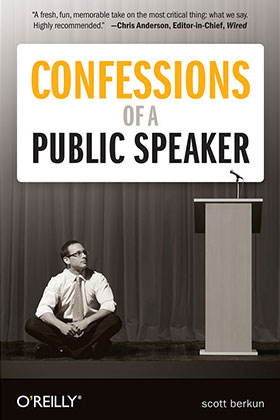
The simplest step in the world is curiously the one few use. Anything you expect to do well must be practiced. Any kind of pitching or presenting is a skill, and no amount of thinking about doing it can compare with what’s learned from the experience of doing it. It’s taken me 15 years of pitching, presenting and teaching, giving hundreds of lectures around the world, to accumulate the knowledge represented in my book, Confessions of a Public Speaker. I explain for posterity the many mistakes I’ve made over those years, and the important lessons that could only come from those mistakes. It’s those mistakes, born from the effort of trying to convince others of the value of my ideas, that have led to whatever talents I now possess. And while books like mine can, through fun stories and insights, show a way, at the end of the day the choice is always up to you. How important to you is what you say?
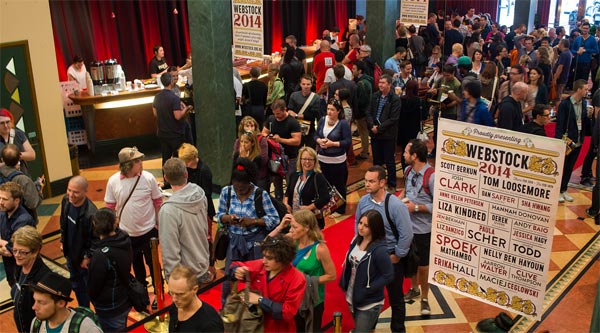
Last week I had the pleasure of speaking for a second time at Webstock in Wellington, New Zealand. Natasha Lampard, Mike Brown and all the organizers exemplify many great things organizers hope to achieve. They run an amazing event and I was inspired to share what I thought they did so well.
Like great design, a great event is notable in large part for what you don’t notice. It takes far more work to make things seamless and natural, making it seem like its all just magic.
1. Single track events force quality
By only having a single track of speakers Webstock places big bets on who they invite. Any event with multiple tracks is choosing quantity over quality, as no organizer can spend much time selecting and supporting dozens (or hundreds) of speakers. Therefore the best events are almost always single track events and afford the deepest experiences for attendees. It means the organizers are investing heavily in a singular, crafted, shared experience, making it easier for attendees to talk to strangers and make new friends. The speaker list for 2014 was excellent and I was honored to be on the roster.
2. Great venues create energy
This year Webstock was at the St. James Theater in Wellington, a grand theater with two balconies. I can tell you as a speaker I do my best work in rooms built for speaking, which is what theaters are. No matter how fancy a hotel event space pretends to be, since the rooms are designed for multiple purposes, the acoustics, the lighting, and the energy always suffers. But in a theater, especially one with as much design detail as this one, wow.
The addition of a DJ spinning tracks (and not too loud so conversations are still easy to have) during registration and before talks began helped set the vibe before the event officially started.
3. Speakers Are The Stars
It’s shocking how many conferences forget that speakers are the stars. The marketing for most events is centered on who is speaking: shouldn’t choosing speakers and helping them prepare to do a great job be the most important thing organizers do? You’d think so. But often speakers are forgotten in the logistical shuffle of running a major event.
Webstock does an exemplary job of making sure speakers are taken care of. From the invitations, to detailed emails about what to expect and how to prepare, they thoughtfully help speakers give their best performances. Demographics on attendees and videos of past lectures are provided to help speakers prepare. There were no slide templates or other absurdities.
All speakers were invited to a special pre-event evening to socialize. This is a great speaker perk. It also helps build camaraderie between speakers that caries over into the event itself. Speakers need help to make connections and friendships and they might meet a fan or someone they’re fans of. The organizers took us to the amazing Boomrock, a stunning ranch on the side of a mountain, where we shot rifles, threw knives and fired arrows (not at each other of course), building our appetite for an amazing meal overlooking the ocean. They made sure we all had a great experience together doing something memorable and unique to where we were in the world.
Webstock ’14 had diverse and well curated topics. For a web/tech event 25-30% of the talks were not strictly about the usual topics of design, engineering or technology. I spoke about the future of work, Derek Sivers spoke about the meaning of life, Anne Helen Petersen talked about media and gossip. The event brought in a wide lens of stories and perspectives that because of their careful choosing, fit together brilliantly (afforded by having a single, curated track).
4. They put love and style into the details
From the first email I got from Natasha, it was clear these organizers are smart, funny, passionate and inclusive. This is a passion project for them and they want as much of their energy and excitement to rub off on everyone involved, and it works. Natasha is a fantastic and entertaining writer, even in the many typically dry procedural emails that come with event organizing, and unlike any event I’ve ever been to I smiled and felt energized every time I had contact with her. It’s a little thing in the grand scheme, but little things matter. I wanted to do a great job for them simply because of how much they seemed to care.
Little things they did right:
Great signage everywhere, well branded and on theme (note the visual references to the St. James theater)
Attendee badges are easy to read (and double sided, since they often flip over – more badge advice)
Talk lengths 30 minutes or less (most speakers also offered pre-event workshops)
High quality and healthy food
Choosing volunteers who are excited to be there and genuinely interested in helping peopple
An opening high energy 5 minute video, with a rocking soundtrack, highlighting all the speakers (each getting natural applause), the venue, the organizers and the audience (the closing text in the video said, simply, ‘we love you’). What a simple way to get the crowd’s energy up before any of the speakers take the stage. I was the opening speaker and their brief, but energetic, opening, helped me do a good job in the lead off slot.
One way to think about conferences is that they’re really a form of a party, where what people most want is to join a fun, exciting, informative and inspiring community for a few days. Webstock gets it right in so many ways. Most events can learn much what Webstock does so well.
Q: How one can handle differently experienced crowds? Like half expect detailed technical explanations and the others just want an intro into the topic.
This should be solved by your title and description. If you don’t want novices, the title should be “Extreme ultimate advanced cake baking.” If you only want novices, title it “How to make a cake for the first time.” The organizer should be trying to help you avoid this situation too.
The first item on the checklist is to ask about demographics for your audience before you work on your presentation.
If you do somehow end up in a room with a mixed audience, find out how mixed it is. Poll them: “How many of you have never done X? Done it 5 times? More than 5 times?” And then at least you know who you’re talking to and can adjust the points you make accordingly.
The best stories and insight cut across expertise. Listen to This American Life, The Moth or RadioLab and pay attention how they tell stories about seemingly basic topics but make them interesting to almost anyone.
Q: Any tips for presenting to youths? E.g., regarding careers in computer science for a career day? This is a particularly tough audience for me.
It’s harder to speak to people who didn’t choose to come. Always think hard about why they might be interested and start there. In your case, start by telling them how much money they can make or the amazing things they didn’t know were made by computer scientists (video games, the apps on the phones in their pockets, etc.). There is always a way to focus on the audiences perspective – it’s just a question of working to find it. You could also talk one on one with a student and get a personal perspective on what they would advise, or what feedback they have for you for the next time you give the talk.
Q: What if the people staring at their smartphones are the members of the Board of Directors, meanwhile your are presenting a project for their approval?
If you think there is a zero % chance you’ll get the approval if they stare at their phones, ask them not to. Every organization has a different culture and different rules for etiquette. But if my job was to get an approval and I was failing I’d take the risk breaking of etiquette.
Q: How do you skip several slides gracefully?
You can’t. Some people complain when I skip slides but it’s far better than the alternative (wasting their time covering something I no longer feel I need). I skip slides for their benefit, not mine. Either I already told a story or a point seems less relevant given what I’ve learned about the audience. Maybe I’m running out of time so I’m reprioritizing. Often I’ll just say “I already covered this” or “we don’t need this now so I’m moving ahead”
However if you’re doing a lot of slide shuffling you didn’t practice enough or didn’t practice with a timer.
Q. What if you get to Q&A sooner, but there aren’t any questions?
Everyone goes to get a beer! Seriously, if there are no questions it means all questions were answered or the audience isn’t interested. In both cases it’s time to go.
Some cultures, Asia and Northern Europe in particular, are more conservative about engaging with speakers and it can take more effort from the host or the speaker to get someone to break the ice. Some cultures rarely clap or respond to performers at all. It’s always good to ask a host what the audiences are usually like.
I like questions so I usually have a stack of books to give away and offer them to people who ask questions. I’ll at least have one copy to give to the first asker since that’s the hardest one to get.
Q. Two questions: I attended a Q & A with an author who has a very devoted following. One of the attendees asked her “Will you be my mentor?” What followed was an awkward conversation that threw the rest of the Q & A off. How would you have handled it?
I’d have been polite and made some kind of joke and then moved on to the next question. There is no obligation for a speaker to answer or respond to everything.
There’s never harm in moving along. You can always choose to return to a question later if you decide, later on, it’s worth more time.
Q: How can you manage switching media (e.g. slides and some live demo or a video file) – I tend to prepare “backup” slides in case demo failure. Any other tips for such a situation?
Keynote handles media better than most other tools I’ve seen, but it’s always risky. Projectors are finicky beasts. Backup in slides is a great idea. I also never trust wifi or any network for anything: if I don’t have a local copy of something I won’t depend on it working.
Q. Do you have good reading tips or similar on preparing the presentation itself. It’s a creative process that I struggle with sometimes. How to tell the right story, what should i keep in the presentation and what should be removed and so on.
Chapter 5 in Confessions of A Public Speaker the simplest and strongest process I know for developing material. Most people simply fail to practice. You can’t know how all of the stories and facts will fit together until you try it. If you were doing a play you’d rehearse dozens of times. For a presentation you should do a dry run early in the process so you don’t get distracted by slides and other props.
Q: How do you handle hecklers?
Hecklers are incredibly rare. I’ve given hundreds of lectures and have only been heckled a few times. Unless you are a standup comedian, very few people feel comfortable, or drunk enough, to challenge you. Always know that you are the person with the microphone and therefore all of the power as you can talk over anyone in the room if you choose to. Also realize that everyone came there to see you, not the heckler. The best thing to do is to keep your cool, politely dismiss the heckler (“please hold questions until the end. Thank you”) and continue. If they persist, remind them again and continue. If they refuse, look to your host to help control the room.
Q: What if you have no microphone and/or the heckler is a VIP?
They are not a VIP for the talk if they are not on stage. The rules are the same. If they interrupt me the audience expects me to stay in charge of the room. Heckling is very rare. If the VIP were my boss or something like that I’d still ask them, politely, to hold questions and comments to the end. They’d have to break that request in front of dozens of other people which even the most arrogant executive is unlikely to have the nerve to do.
Q: What if you laptop explodes? Or more generally, how do you prepare for an “impromptu” talk (ie, a talk you are asked to do 30 minutes from now).
My advice is basically the same as how to present without slides but with a simpler structure. I’d consider my audience and the 5 or 6 questions I think they want me to answer, or the major points I want to make. If I’m knowledgable on the subject I should be able to talk on each of those without any planning for a few minutes each. If you’re not a brain surgeon and you’re being asked to talk about brain surgery 30 minutes from now, you should question the sanity of the person asking you to speak.
Q: Would you recommend to follow training like improvisation theatre classes?
Improv classes are great fun and teach you many useful lessons. Here’s Why I Recommend Taking Improv. I found it particularly useful for dealing with many of the situations discussed in the talk. Through playing games you learn how to pay attention, how to listen better and how to, well, improvise. I became dramatically better at Q&A after taking a series of improv classes.
Q: What do you think of PechaKucha format? Any tips for doing this properly?
Q: How do you make a presentation about Project Management without sounding like you’re telling people how to do their jobs? (i.e. you want some improvement in the company but don’t want to offend etc).
Presentations aren’t the best way to make change happen. No one is obligated to listen or to do anything even if they agree.
I’d work the other way. Who is doing great work in project management, inside the company or outside? What examples will inspire people to consider working differently? A talk is a great way to expose people to different ways of thinking about their work and get them interested in learning more.
I’d also much rather give a presentation highlighting a team or project that is doing some of the “right” things and use them as an example, rather than simply tell an entire company they’re doing something wrong.
Q: I talk fast, like Jesse Eisenberg fast. Is it best to prepare more material so the talk doesn’t go by too fast or try to really slow down, which feels a little unnatural?
First rule of speaking: don’t make people’s brain hurt.
Speaking fast is a simple problem to solve. It’s not fun, but it’s straightforward. Grab a favorite speech or a talk of your own and set a timer. Practice doing the talk in 10 minutes. Then practice, with the same talk and same number of words, doing it in 12 minutes. Then 15 minutes. Pace is a habit and it’s easy to learn to change. You’ll learn it’s ok to pause and breathe between sentences (and words!).
Q: what techniques do you recommend to prevent “filler sounds” (ah, um, etc…) when speaking?
Similar to the above. Grab a favorite speech or a presentation of your own. Get a timer. Start timing. Whenever you use a filler sound, start over. At first you’ll only get a minute or two in, but as the repetition drives you crazy you’ll slowly learn to control it and eventually turn it off completely.
Q: Tips for feeling comfortable away from a podium?
You stand behind a lectern, and on top of a podium.
The way to feel comfortable with anything is to practice it. Go into an empty conference room and give your talk. Try moving around. Try standing to the side of the lectern. Try try try. You can’t be comfortable with something physical just by thinking about it. You have to do it.
Q: Any suggestions for preparing to speak on a Webcast? Hard to speak without audience feedback.
It’s the P word again. PRACTICE. When you practice you are giving your talk at full voice and volume to an empty room. As weird as this is it helps make the weirdness of a webcast familiar. Good webcast tools give you a chatroom and the ability to poll an audience. Use them. Take a break every ten minutes to jump into the chat room for 5 minutes and answer questions.
Q: As an instructional designer who is required to prepare material to be delivered by others, can you offer tips for the best way to get them to engage with this material?
No one can feel engaged presenting someone else’s material. If you want them engaged involve them in the process of making the material. Or provide options for them about which stories to tell or exercises to use. Then at least they have some decisions and control over how the material is delivered.
Q: What are the important differences between delivering lectures versus giving speeches?
Speeches are rare these days unless you’re a politician. A speech typically means you’re formally addressing a large crowd without slides or other materials (e.g. commencement speech). A lecture typically means the goal is to teach something, but it’s far less formally defined.
The best way to think about all of this stuff is the audience. They don’t care about forms or whether you’re doing a lecture, or a talk, or a presentation. They care about getting what the came for. Information? Inspiration? A story? A lesson? If they get what they came for they won’t complain about whether you used slides or didn’t, or whether it was 10 minutes long or an hour.
Q: Do you prepare multiple versions of a presentation to tailor the talk to the audience on the fly?
Depends. If I’m asked to give a basic talk about one of my books I’ll often change specific stories or facts to best match the audience but keep the core structure of the talk the same. There is no shame in reusing a talk. If you’ve done a talk many times it’s probably far more polished than any new talk you could make. As long as it addresses and engages the audience how old the talk is is irrelevant.
Q. How much do you move around when you are presenting? Importance of body language?
Your voice matters more than your body or your slides. Body language isn’t anywhere near as important as people think (except the body language consultants). The single best piece of advice I give people is to be loud. To be loud you have to stand up straight and make eye contact. Those two things alone change your body language and your attitude.
Everyone is different. Some people are comfortable moving, others aren’t. What matters is that what you do helps you and helps the audience. If you pace quickly you’ll make everyone nervous. If you hide behind the lectern, you’ll be harder to hear. The only way to get comfortable moving is to practice and to speak enough that you can try different things.
In Confessions of A Public Speaker I explained how to deal with 17 difficult speaking situations. In the webcast I’ll coach you through some of them, or the ones you ask for in comments:
You’re being heckled
Everyone is staring at their laptops / phones
Your time slot gets cut from 45 to 10 minutes
Everyone in the room hates you
One guy won’t stop asking questions
There is a rambling question that makes no sense
You are asked an impossible question
The microphone breaks
Your laptop explodes
There is a typo on your slide (nooooooo!)
You’re late for you’re own talk
You feel sick
You’re running out of time
You left your slides at home
Your hosts are control freaks
You have a wardrobe malfunction
There are only 5 people in the audience
Would you like me to cover any of these in the webcast? Or are there other situations you want to learn to handle better?
Leave a comment and I’ll consider covering it in the webcast. Thanks.
It’s rare to get heckled when giving a lecture, yet it’s a top fear for many people. My own advice on dealing with hecklers is in the what to do when things go wrong chapter of Confessions of a Public Speaker.
In short:
Acknowledge them briefly and politely. They want you to step down to their level. Don’t. But do recognize their existence. Everyone in the room knows what just happened and is waiting for you to frame what it means.
Ask them to hold their comments to the end. You are under no obligation to respond to them now, if at all.
Remember you have the microphone. You can always talk over them and they know this. You have more power over the room than anyone.
The audience is on your side. They came to see you, not the heckler.
I’ve given hundreds of lectures and only been heckled a handful of times. It’s very rare. Unless you are speaking to a drunk crowd, the odds are incredibly slim that people will directly challenge you on stage. Comedians however deal with them more often. Jerry Seinfeld has similar advice to mine but goes much further. Here’s an excerpt from his AMA interview:
Very early on in my career, I hit upon this idea of being the Heckle Therapist. So that when people would say something nasty, I would immediately become very sympathetic to them and try to help them with their problem and try to work out what was upsetting them, and try to be very understanding with their anger.
It opened up this whole fun avenue for me as a comedian, and no one had ever seen that before. Some of my comedian friends used to call me – what did they say? – that I would counsel the heckler instead of fighting them.
Instead of fighting them, I would say “You seem so upset, and I know that’s not what you wanted to have happen tonight. Let’s talk about your problem” and the audience would find it funny and it would really discombobulate the heckler too, because I wouldn’t go against them, I would take their side.
In all cases always remember it’s your show. The audience is with you. If you handle an outburst calmly and in stride, they will too.
This month I’m posting every day, picking the top voted reader question and answering it. With 37 votes, submitted by Andrew Holloway, is:
When do you know that you have something worth saying or teaching?
I often find myself caught between two competing thoughts: that I don’t know enough to help anyone, and that I should help anyone I can by speaking/writing to others about my experiences or how to do something. As a speaker and writer, was there a point where you felt you were “qualified” to speak or write? Did it evolve over time, or arrive at a moment?
The French Coin Drop is the easiest magic trick in the world to learn yet I never run out of people who don’t know how to do it. Even the most basic unit of knowledge will be new to many. In that case look around: if you’re the only one at the dinner table who knows the trick, guess who the best possible teacher is? It’s you. Worth is relative. If David Blane shows up yield the floor, but otherwise everyone is looking to you. Put simply something is worth teaching if the person learning it thinks it’s worthwhile.
The fear inexperienced writers have is that everything has been said already. Even if this is true, no one has read it all. You may be the first person that offers to teach them a specific skill, or tells a story in a way that they connect with. It’s Ok To Be Obvious since the person reading your work probably does not know everything you or your peers do. Oddly enough, there is always the largest market for people who can teach the basics in any skill, or tell stories that strike at the universal themes of heroes, love and loss. Experts and snobs complain about books that are too basic, but they’re in the minority on this planet. You don’t need to write for everyone, you need to write for your audience and you can’t find your audience until you start writing.
Personally I know I might have something worth saying when an idea resonates with me and stays in my mind. It could be a critique of something I heard, a powerful story, or even an interesting quote. I keep a notebook with me at all times and write these small observations down. The ones that stay in mind end up as drafts and it’s in the process of trying to write a draft that I learn if I really do have something worth sharing or not. I throw away many drafts and have many half written ones that maybe I’ll return to, but maybe I won’t. Creation is messy and accepting the mess is the biggest challenge for many people who want to make things.
I’m interested in writing and speaking about important things that go unsaid. I like to demystify, debunk and critique sloppy thinking and I try to be brave in taking on subjects that many people think are wrong but are afraid to speak up about. Even something as straightforward as How To Write A Good Bio is a radical simplification of the stupid things I constantly see people do. I try not to be a cynic, and even my critical posts like How to Call BS On a Guru are intended to elevate the reader’s thinking and not just tear down someone else’s thoughts. Even when I rant I work hard to offer an alternative.
My advice is to write and speak anyway even if you have doubts. It’s only through writing and speaking that you’ll improve your thinking and invite feedback from other people. That’s the only way to improve your judgement and craft. I’ve been doing this for years and if you like what I do it’s explained more by commitment than talent. The worst that can happen in writing is no one will read what you have to say. So what? Most writers aren’t widely read, including successful ones. But it’s through publishing and calling something finished that you invite the most useful feedback and that’s the only way to learn better judgement about both what’s worth writing about, and how to write about those things well.
If you were having an important conversation with a friend at a restaurant, would you pull out a projector and put your slides on the wall? They’d think you were crazy as would the people at other tables. Rather that look into your eyes or give full attention to your words, your friend would have their minds divided between you and the images you were showing simultaneously.
Which raises the question: why use presentation slides at all? Most important conversations you will have in your lifetime happen without slides. And ask anyone who works in media: if the power went out and they could only show your slides or broadcast your voice, they’d go with your voice. Your voice, what you say and how you say it, is the most important thing. If you listen to This American Life or The Moth, it’s clear how powerful a speaker can be with their voice alone.
Look at any list of the best speeches of all time and you won’t find a single use of slides or other props. Of course slides and presentation software hadn’t been invented then so it’s unfair to make a direct comparison (For fun see The Gettysburg Address as a bad Powerpoint deck). Yet the question is easy to ask: would these speeches have been better if they were narrated over slides?
In many cases, no. You’d have to listen carefully to figure out when ideas would be better presented visually rather than with words alone, which is the secret for thinking about your own presentations: when do you truly need a visual image to express an idea? And when would it be better simply letting your voices tell the story?
Speaking without slides seems more challenging because:
You feel naked without the familiar crutch of slides behind you
It may require a different way to prepare
It demands more thinking and refinement of your ideas
Speaking without slides is often better because:
Audiences grant you more attention and authority over the room
You have no fear of slide or A/V malfunctions
You can never become a slave to your slides
It forces you to clarify and improve your ideas, making you a better speaker
If I’m asked to speak for 20 minutes or less I often go without slides. More than 20 minutes and the dynamics of attention are more complex and I typically use slides, though less than many speakers do. I give the same advice to others: the shorter the talk, the simpler your presentation should be.
How to prepare a slide-free presentation
In Chapter 5 of Confessions of a Public Speaker (“Do Not Eat The Microphone”) I provide a simple, well-tested method for preparing talks of any kind. In short it looks like this:
Take a strong position in the title
Think carefully about your specific audience (why are they here? what do they already know?)
Make your 4 or 5 major points concisely (from a draft outline of 10 or 12 points)
Practice making your points without a single slide.
Revise #3 and repeat #4 until done.
This approach works with or without slides, but in all cases it forces you to develop your ideas into a solid outline and practice delivering it before you’d even consider making a slide. If you want to go entirely without slides, you’re already prepared for that. And if you decide as you revise that you need slides to best make your points, then add them, but only after you’ve proven their necessity by trying to present without them.
If you want your ideas to take center stage, the slides should come late in the process so that they are used only to support what you’re saying, rather than the other way around. Even if you are a visual thinker and need something to look at to develop your ideas, develop your ideas and rehearse assuming the slide deck is scaffolding you will remove. Don’t fall into the trap of polishing your slides and tweaking fonts when you should be revising your thoughts and practicing how you’re going to express them.
Given a choice between a great talk with lousy slides, and a lousy talk with great slides, what do you think most audiences would choose? Prepare accordingly.
What do you put on the screen if presenting at a slide-dominant event?
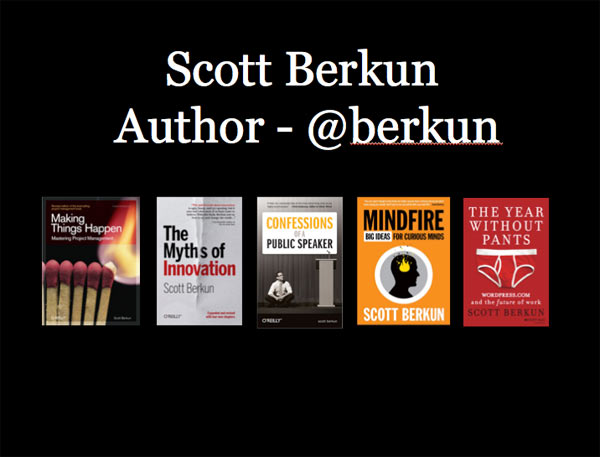
I simply put together a slide with my name, the title of the talk and the basic contact information I want to provide. There’s an argument that only having a single slide does far more to make you accessible to an audience interested in your work as the way to contact you is visible the entire time you’re speaking, instead of just at the end. Here are two examples from two different events:
How do you get over the fear of forgetting something?
Many speakers use slides to mitigate fear. Slides used for this reason often come at the audience’s expense. It’s common to see speakers reading their own slides, or facing their slides as they present, clear signs they made their slides first, rather than constructing the presentation first and using slides to support their thoughts. Slides should be for the audience, not for you.
If you work hard to have clear points, and you practice it’s unlikely you’ll forget anything important. Even if you did forget something, only you will know. Since there are no slides, as the speaker only you know what you planned to say. You could skip an entire point or express it in a completely different way than you intended and no one will know but you. Slides can lock you in and if you are a true expert on the subject you’re speaking about you may find advantages in flexibility.
The notecard
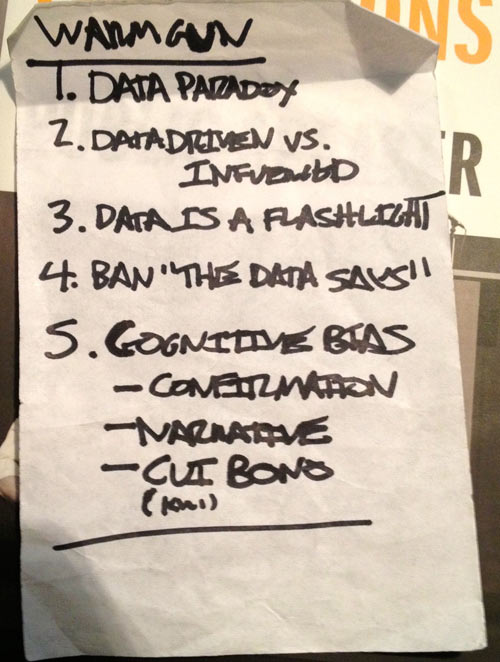
When I speak without slides I usually have one small piece of paper listing my 5 main points. For my recent keynote at Warm Gun 2013 on The Dangers of Faith in Data, here’s what I brought with me on stage:
This notecard is short and simple. Since I’ve thought hard about this topic and have practiced the talk, all that I need the notecard to do is remind me of the next point, and the overall structure. I cheated on #5 as it has sub-bullets, but I simply found while practicing I couldn’t recall all three, so I wrote them down. Churchill and some other famous speakers used similar lightweight systems for their speeches.
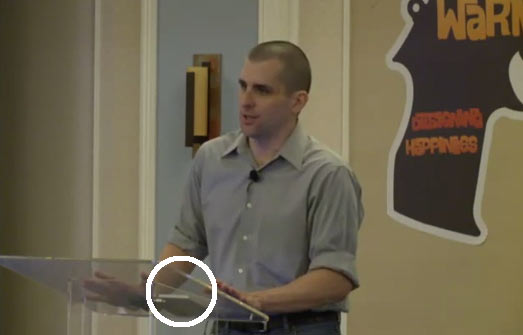
You can see the notecard on the conveniently transparent lectern:
What about the handout problem?
If I prepare my talk as described above, it’s easy to write up a blog post with the same structure.
Here’s the blog post, titled The Dangers of Faith In Data, which I wrote in less than an hour while the ideas were still fresh in my mind.
Watch the actual talk based on the above
Now that you know how I prepared and practiced, you can watch the actual talk and judge for yourself. You’ll see me look down at the notecard, but it’s typically while I’m silent and trying to let the audience digest what I just said, while I collect myself to lead into the next thought.
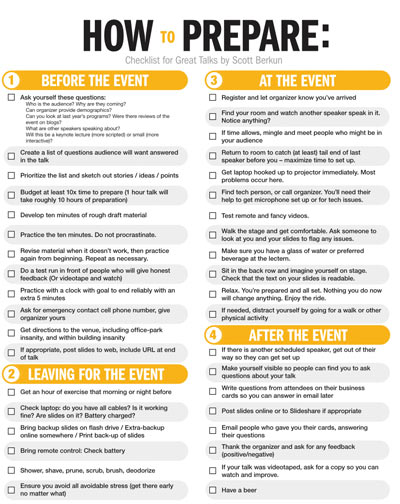
Here’s the best checklist for ensuring sure your presentation is as great as it can be. There’s a lot to remember so use this to make sure to you don’t forget a thing.
Or you can download the checklist here (1.2 MB PDF). It’s a great handout for event organizers to give to their speakers. Pass it on.
I spoke at TEDXDepaul last month and it was a fantastic event. The organizers Daniel Gurevich and Matt Helbig did a fine job from a speaker’s perspective. They chose a great venue, sold every ticket, paid for good A/V, the stage was well lit, and they had a great roster of other speakers (you can read my notes on all of the talks from the day here).
But there’s only so much organizers can do: speakers have to do the heavy lifting of good material and delivery.
Tactical mistakes are annoyances. If the material and delivery are good, people will overlook these problems. But a good speaker wants as few distractions from their ideas as possible. There were two tactical mistakes speaker’s made at TedXDepaul worth reporting.
If you hold a device, it creates glare that moves.
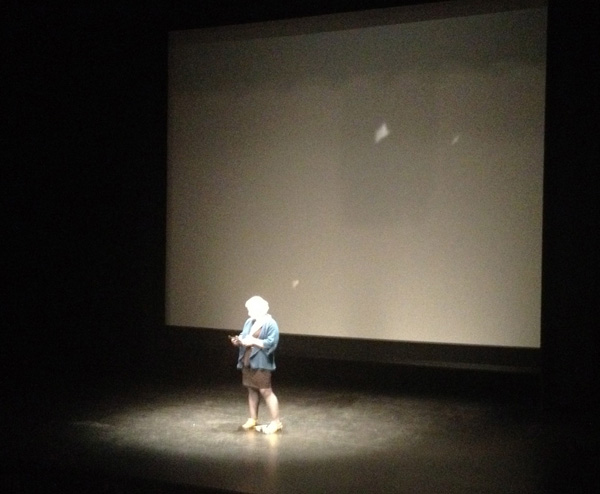
Marcy Capron of Polymathic chose to use an iPad for her notes. There’s nothing wrong with notes themselves, or iPads, but in this case the stage lights reflected off her iPad onto the screen and walls behind her. And every time she adjusted the iPad, those glare spots moved around. It’s hard not to be distracted by bright things that move on a large screen.
If you plan to have a device on stage, ask for a run through with the stage lights on to check for anything unusual. If there are glare issues, most venues can provide a lectern to place your device on, eliminating this problem.
Don’t wear a hat.
Doug Zell of Intelligensia Coffee arrived late, and joked about it, which bothered me all on its own. The primary commitment every attendee and speaker have made is their time, and it’s a sign of great disrespect to be late, much less to joke about it (Apparently he was in a bike race earlier in the day, and would have entirely missed his speaking slot if the event wasn’t running late). He had a cavalier attitude about the whole thing which rubbed me the wrong way. His talk on branding was good (notes here), but he crossed the line for me on professionalism. You must show your hosts, fellow speakers and audience respect. He was the closing speaker and hadn’t seen a single talk for the entire event.
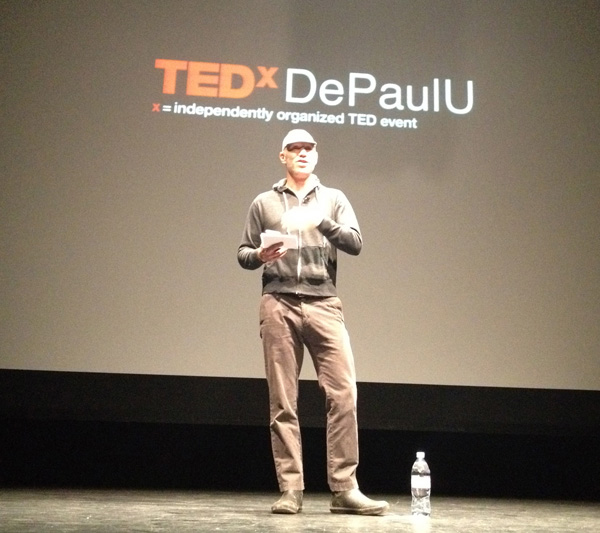
The specific tactical mistake he made was keeping his biking hat on. As you can see here, wearing a hat on stage puts a speaker’s eyes into shadow. Eyes are the most important part of the face to connect with, and a hat hides them. Good lighting amplifies the problem, as it casts the rest of a person’s body into good primary light.
Clay Hebert recently posted on the The Best Conference Hack, which is simply sitting in the front.
As a frequent speaker I like Clay’s advice. For speakers the empty front row is mysterious and frustrating. Speakers make a huge commitment, yet audiences who have little at stake show their lack of faith by staying back. Unlike a rock concert, somehow the 5th row is more desirable than the 1st.
I think better advice than Clay’s is to participate and speak about something. Many conferences offer Ignite or lightning talks, allowing many attendees to share their voice. This is by far the best conference hack: participate. It puts you in the middle of things. Volunteering has similar benefits without the stress.
But the surprise is, when I’m an attendee I don’t listen to all the speakers.
Sometimes I barely go in the session rooms.
Everyone has different learning preferences, and I know mine: I find it hard to listen to lectures, but I’m a tremendous reader. Unless the speaker is very good, which is rare, I’m better off reading their book or their blog which I can do at my own pace. As I wrote about in Confessions of a Public Speaker, lectures were never a good way to learn skills. They’re passive, non-interactive and rarely performed by people good at lecturing. I know it’s ironic that I have a low tolerance for lectures as I make a living giving them.
Conferences are a compromise: you get access to popular experts, but it’s broadcast access. This is a good deal if it’s your only option or your learning style matches what you get at the conference. But for me it’s conversations, which are two way, that I learn the most from. Conferences use speakers as MacGuffins, drawing attendees to come, but often the “side stuff” has the highest payoff.
Typically at events I do the following:
For talks I’m excited about, I’ll sit in the front as Clay suggests. But this is rare. It’s not a judgement of them, it’s a judgement of how I learn.
Frequently I sit in a back aisle, especially at a multitrack event. I’ll take aisle near the front if I can. In 7 minutes I can tell if the speaker has prepared well enough to warrant me staying. If I’m not convinced, I’ll move to another session – this is hard to do if you’re in front (unless you’re fortunate to have the aisle and brave enough to leave it).
Often I’ll listen for 5 or 10 minutes to evaluate their credibility: then I’ll buy their book, or subscribe to their blog, and move on. Or stay if I think I’m getting something special I can’t get any other way.
I regularly wander the halls and talk to others who are bored by lectures. They’re like me: better at doing than sitting and listening. I’ve learned great lessons from the conversations during sessions. The halls are not packed during sessions and it’s easier in some ways to start conversations.
If I commit to blogging the event, my attention improves. At Failcon 2012 I reported on the talks and I found this helped me focus. But it changes how you listen: it’s a shallower experience in some ways as you’re rushing to get things down. And to do it properly required far less interacting with other attendees. LukeW is the master of this: see his notes from 200+ talks.
But this is merely what I do. Unless your learning preferences match mine, don’t do these things.
If you don’t know how you learn best, experiment. Go to different kinds of events that offer different experiences. Better events invest in different kinds of learning, with things in the hall for people like me, and well prepared speakers worthy of all the attention the front row can give them.
The other day, I heard the CEO of a large corporation drone on for twenty minutes. He was pitching a large group of strangers, reading them a long, prepared speech that was largely irrelevant to their needs. They weren’t there to hear him and in fact, weren’t even able to hear him over the buzz in their heads… this was classic interruption, no permission granted.
If you’d interviewed the 150 people in the room an hour later, no one could have told you a single thing about what he had said. If your tactic is to have a one-shot, the equivalent of a pickup line in a singles’ bar, it’s pretty hopeless. You can’t sell anything complex or risky in this way.
Many speakers are bad, it’s true.
Organizers have to balance 3 improbable criteria of: find experts, who are good speakers and are available. Many CEOs have lawyers vet their talks, reuse the same material and are boring speakers anyway. But a CEO of a company can be a draw for an event, helping fill the seats, an objective that has only some relationship to the quality of speakers.
He mentions three classic mistakes:
Long speech
Poorly prepared (you can spend 10 hours preparing poorly)
Irrelevant to the audience
But he offers a curious suggestion:
On the other hand, what if he had taken three minutes (just three) to say, “Let’s talk.” Give out his personal contact info or an easy way (and a good reason!) to engage with his staff. And then give up the podium and let the event go forward.
But the problem isn’t the speaker alone, it’s the organizer too. The organizer asked for what he saw. The organizer could have asked for something else, but didn’t. The organizer chose that speaker out of 6 billion people on the planet and gave them that particular slot. The speaker could have suggested something else, but they’d need the organizer’s permission to do it. And besides, speaking is an ego-centric activity: to ask for less time is nearly unheard of.
TED and other events have 3 or 5 minute slots to mix up the pace, which is a good. But this needs to be planned. To surprise organizers and the audience with a 17 minute gap makes their work harder. It’s good manners to use less time than offered to help the day catch up, but more can cause problems.
More broadly, people want to see speakers speak, that’s why they paid money to come to an an event comprised of a series of speakers. Organizers want speakers to speak too, and carefully plan how much time they need each speaker to have the stage for. Both audiences and organizers are optimists. They assume the speakers will do well and will feel insulted if someone slotted for 20 minutes left the stage with 17 minutes to spare.
Doing what Godin suggests might be preferable to a bad twenty minute talk, but not as good as a well done 10 minute talk.
The simplest answer is in the middle ground of basic advice Godin skips over:
Make your talk shorter – if given 20 minutes, use 15
plan the talk around questions the audience wants answered
practice the speech, but don’t memorize it
In summary, when I see a bad talk I blame everyone:
A basic rule offered in Confessions of a Public Speaker is to pick material you care deeply about, since you can’t blame an audience for being bored if you are. But what I didn’t cover is what to do when you have to present the same material 300 times: how do you stay excited about it then?
Steven Estes asked:
As academic advisors at a large university, we have a unique presentation dilemma during summer orientation. We have to present the same material every day for six weeks. We do use Power Point, but are entertaining the idea of breaking away from it. We tried having each advisor present a different part of the short (15 minute) presentation, but it gets pretty stale by week three–and we still have three weeks to go.
There are many ways to keep material interesting, but they all involve some work, or at least paying more attention. Consider that many stand-up comedians do the same 45-60 minutes of material night after night. Broadway actors have to say the same lines again and again for weeks on end. What keeps them interested?
Primarily it’s the energy they get from their audience. If the performer is paying attention the energy in the room, from the audience and from their co-performers, it’s different each time and that’s what makes it interesting to do the same thing again and again. Although the script is the same, each day and performance is new to everyone there and as a performer you have to use that energy from the audience to help you.
Here’s a short list of things to consider if you’re bored with your material:
Improvisation. If you can base part of each segment on something from the audience: a story, a question, a unique element of the particular demographic you are speaking to on that day, change will be introduced naturally as part of your material. Think of your material as a kind of Mad Lib, with segments that depend on the injection of something from the audience (or from your co-presenter). If you choose the right slot, it will be different every time.
Have audiences make choices. Design the material so the audience has to make choices. Let’s say you have a story you tell 5 minutes in to drive a point home. Learn 3 different stories/examples and let the audience vote to pick which one you tell (Or randomly choose one yourself each time if the audience keeps picking the same one).
Examine the room to see what options are available. Perhaps you can stand in a different place when you’re speaking. Or use a hand microphone instead of the one on the lectern. One time try walking around Phil Donahue style. Maybe use a higher pitched voice, or a lower one. If you study the room there are many variables you can add that the audience will never notice since they only see the talk once, but that will make each instance interesting for you, and you’ll learn something new about public speaking or your material each time you change something.
Play secret games with your co-presenters. Each day pick an uncommon word from the dictionary at random. Every presenter has to find a way to work that word into their section. There are many games like this you can play.
Improve the slides. How boring are your slides? Simpler, cleaner slides will garner more energy from your audience which will help keep you interested.
Tell personal stories, not lists of instructions. Don’t you have stories from your childhood you love telling again and again? If you make the presentation a series of stories, perhaps about stupid (or amazing) things that have happened at previous summers, instead of lists of instructions, your energy will be different. They don’t even have to be your personal stories: you can tell the stories of other college students.
Change something in the material every few days. Presentations are a series of linked stories. If you change even one story it forces you to also change the segue you use to get into the new story and the segue you have to use to get out of it. One seemingly small change can ripple through how you give the entire presentation, at least the first time you make the change.
Make it theater. Don’t simply do tag-team speaking where one person speaks at a time. Instead of slides, use the other two speakers to act out or demonstrate every point the speaker makes. This requires the effort to write the presentation more like a play and less like a business presentation, but it will give everyone something to do all the time and likely engage the audience better too.
Start over. It’s probably time to move on. Louis C.K., inspired by the great George Carlin, drops all his old material each year and starts over. You’ve learned so much since the last time you started from scratch. Give yourself and your audience a chance to have fun again with something fresh for everyone.
I’m always changing my material, even in specific talks I’m asked to give again and again. I’m a different person each time I give a talk, with new stories or opinions to share. By making changes I get excited to see what happens, and it brings life to topics I’ve talked about dozens or even hundreds of times before.
Workshops are hopeful things. They’re sold on so much promise, but that promise is often dashed as students discover their expert instructor is far from an expert at teaching them how to learn anything.
For years I was a workshop guy: I taught them, I studied them, I even hired people to do them for other companies. I watched many instructors run them and I know the common mistakes. Here’s my best advice on how run a workshop people will love.
Rule #1: A 3 hour lecture is not a workshop
The word workshop implies that work will be done in a shop like atmosphere. This means the center of attention should be on the students doing work, not on the expert talking about their expertise. A cooking workshop means students cook things. A writing workshop means students write things. If most of your “workshop” is people not actually making anything, you should perhaps call it a class, a lecture, or a mistake.
Many experts are bad at teaching workshops because they are used to lecturing. A lecture has the spotlight on the speaker, but a workshop has the spotlight on each of the students.
The skills involved in designing workshops are very different for this reason. Instead of crafting a message for people to listen to, a good workshop is crafted to give students the opportunity for guided instruction in doing things. Many workshops are born from lectures, which explains why those workshops are so boring.
Rule #2: The more students you have, the less of a workshop it is
Better workshop instructors make larger groups feel more interactive, but beyond 20 or 25 people the instructor is spread thin. The common approach for large groups is to have people work in teams, as they at least get to be interactive with each other while the instructor is helping other students. In bad cases group work is a copout: the exercises aren’t interesting enough, or students struggle to work with annoying strangers who are too pushy or too passive. In better situations, when the students are motivated and the exercises well designed, it can work well (but likely not as potent as time spent being coached in a small group directly by the expert).
Designing exercises for groups of people to work together is hard. And also demands more testing to get right (see #5).
Rule #3: Work the triad: explain, exercise, debrief
The simplest way to construct a workshop is to think in units of 3.
Walkthrough: Show how to do something.
Exercise: Have everyone actually try to do that thing (while you wander around and help people one on one).
Debrief: lead a discussion of where people got stuck, what parts were fun/hard/frustrating, and what things people learned, or realized they want to learn. Show people’s individual work, rather than your own, to the class to help explain your insights and observations, and as way to invite them to share theirs. Lead a healthy critique session.
Repeat, with a more challenging thing.
These triads can be of different lengths 45 minutes (15/15/15 or 10/20/15) or longer. Its best to start with small things and build to a larger projects as the workshop goes on. It’s fine for the ratios to change. A more challenging exercise might be 1:3:1 (10 minutes, 30 minutes, 10 minutes).
Take breaks regularly. When people stand up and use their bodies for a minute or two their heart rate goes up, and they get energy back. It’s good for their bodies and minds to move around at least every hour or two. Gadget junkies can get their fix and people with biological needs can get that off their mind. Don’t see this as dead time: see it as taking a breather so everyone can bring more energy into the next exercise. Once every two hours is a good rule of thumb.
Rule #4: Stay out of the center
Workshop students come to learn and they can learn from other students often as much as they can from you. But they start as strangers to each other and you are the social link. Be friendly. Be conversational. Ask students who are good at something to help students who have questions on that thing. Do what you can to make everyone comfortable getting feedback from each other and not just from you (you can design exercises to make this happen naturally). The easy mistake is to center everything on you. This works for TV or lectures. This is a failure in a workshop.
Facilitation is the name of the game. It’s your job to create an environment where everyone is comfortable enough to take risks and learn some things. You should laugh, so they can laugh. You should be passionate so they can be passionate. At times you need to be a teacher, other times you’re game show host facilitating what’s going on, and other times you are quietly out of the way, helping people one on one.
Rule #5: Beta test your exercises
The top complaints workshop instructors hear is often “it was too easy” or “it was way too hard.” Using one exercise for 10 or 20 people guarantees a spectrum of experiences.
It takes a surprising amount of work to develop an idea for an exercise into something specific enough to be interesting, but flexible enough for different people. Since every student in a workshop will have different levels of skill, you want each exercise you use to have built in ways to make it harder or easier.
Great teachers let their students know it’s ok to raise their hand and say “Can you make this more/less challenging?” They’ve prepared wrinkles and twists to handle those cases.
It’s a great idea to beta test your exercises, if not the entire workshop. Do a dry run of half the workshop, for free, with the kind of people the workshop will be for. You’ll learn many little things to fix and adjust that will make a huge difference when you do it for the ‘first’ time.
There are tons of books with workshop exercises. If you poke around you can likely find a book for your discipline that will give you many ideas to start from. Many workshop exercises are horrifically lame, especially ice-breaker type games, but even those can inspire you to think of worthy ones.
Rule #6: Match promises to exercises
Each exercise should be about acquiring a skill, or at least having an experience that helps acquire a skill. List what you believe students will have learned, or experienced, by the time the workshop is over. Use that as your description for the workshop: it’s the promise you are making to students. If your workshop description has a promise than doesn’t map to a specific exercise, either change the description or change your exercises. You’ll find you need to limit your promises, which is good and realistic for everyone.
Rule #7: Always have a whiteboard or flipchart in the room
You never know when you, or a student, might need something big to write on to explain something. In corporate settings you’d be amazed how often the room you are supposed to teach in doesn’t have anything to write on. Digital whiteboards aren’t the same as they often break and take 5 minutes to figure out how to use. Flipcharts are cheap: always make sure there is one available.
Rule #8: The room should look like a workshop when you are done
If its been a true workshop there will be papers, drawings, diagrams, sketches, post-it notes and other made things all over the place. Tape the output of each exercise up on the walls so people can refer to them later. The room should look like a place where a real group of workers had been working on projects all day. Students should leave feeling like they’ve done work, and have some work they can take home with them if they choose.
Rule #9: Build a workshop checklist
There are many things to bring and remember. When you do your beta test of exercises, make notes on all of the equipment you need to bring (e.g. markers, pens, post-it notes, flip-charts, etc.), and what things students need to bring (of which you will have an extra set or two for forgetful students). You never want to have to waste time in the workshop searching or waiting for things. Build a checklist of all the things you need to bring, and put it all in briefcase or box so its ready to go.
Rule #10: Give students the next thing to do after they leave
Students didn’t come for the day: they came to keep learning. Have the next logical exercise or project available on your website, or in whatever materials you give them. Also include a small list of the best books or other resources they’re likely to need.
Many good people write bad bios for themselves. Anyone asking you for a bio, or reading it, wants you to sound awesome, but what they need and what your ego wants to say are often different things. With these five simple rules you can write a good bio for yourself in less time, with less effort and everyone wins.
1. Impressive people have short bios
Compare this:
Bob Smith won the Nobel Prize for Chemistry, twice. He invented air. He’s currently the head of Amazingness at Wonderment University.
With this:
Bob Smith spent 2001-2004 staring blankly at piles of yard waste in Atlantic City, NJ. During the better part of the 90’s he read several mediocre comic books. He studied in 2002-2008 licensing regulations for circus clowns in West Palm Beach, FL. and garnered a second place industry award while merchandising mouse yogurt in Las Vegas, NV. He consulted in near-UFO experiences with random tourists on the street in Ocean City, NJ. and spent two years unsuccessfully licensing cannibalism for farmers, while maintaing his Pez dispenser collection.*
Everyone wants your bio to be shorter. The shorter your bio, the more people will read it. No one is impressed by a long series of unimpressive things. If you have a great one sentence bio, people will be curious enough to find out more. On the other hand, if you have a bad and long bio they are certain never to want to learn anything about you. When you are famous enough to appear on TV or write an article for The New York Times, your by-line will be a few words long: Author. Senator. Musician. Keep this in mind. The goal is to make your bio shorter, not longer.
2. Write for the real audience
If you are asked for a bio because you are speaking somewhere, perhaps Ignite Seattle, shape your bio to best fit what you are speaking about. Your bio will be read by people at that event to help them understand why you’re credible on your topic.
For example, if you are speaking on fly fishing, don’t do this:
Sally Shmeckes is a software developer and designer who has written code in every language known to mankind. She works mostly as a hired gun for startups in trouble, who need a superhero to help turn trainwreck projects around. She studied 3-D Film Theory and Anti-Nuclear Architecture at the University of Ridiculousness, and has 3 children if you count her husband.
Do something like this instead:
Sally Shmeckes is a veteran software developer and designer. Her Dad taught her to fly fish before she could walk and she has fished every day since he died. She’s on twitter at @sallyschemkes56.
3. Invert your pyramid
Put the important facts first. The fancy term for this is the inverted pyramid. Assume with each word in your bio that fewer and fewer people will keep reading. It’s a great assumption because it’s true.
This is good:
Bono is the lead singer for the rock band U2. He is an advocate for many important political and social causes. His real name is Paul Hewson. He owns many interesting pairs of glasses.
Not this:
Bono likes the color red, especially on Tuesdays. He loves to drink whiskey (on all days). He learned to drink whisky from his childhood friend Zippo, when they went to school together at Mount Temple Comprehensive School. His real name is Paul Hewson, He is best known as the lead singer for the band U2.
Have two versions of your bio, one two sentences long and a longer full paragraph version. When asked for a bio, provide both. For most marketing materials a short and long version are needed.
4. Be clever only if you’re certain it’s actually clever
From the Department of Made up Facts:
Percent of people who think they are clever: 64%
Percent of people who are actually clever: 7%
If you think you are clever: write your clever bio and get feedback on it from someone else you know who you’re certain is clever. If they approve, you’re in, but don’t try to be clever all on your own. One good joke in a bio is more than enough.
5. Watch the slashes, Jack
A sad trend born of Twitter are bios where people self describe themselves by a dozen different traits. This makes you look like someone who sucks at everything. It’s fine to be a Jack of All Trades, but to insist on telling everyone you’re a Jack of All Trades mostly makes you Jack of Many Annoyances. Our species has small brains: we need you to tell us the one or two of your trades that will be most relevant to us, or to what you will be talking about.
Instead of this, which seems written like SEO metadata:
Nina Nana is a designer / juggler / smuggler / hellraiser / accountant / anti-ninja / metallurgist / snake charmer
Try this:
Nina Nana is a designer who has mastered juggling, smuggling and many glorious pursuits of diverse ingenuity.
That’s all. Happy bio writing!
[*Note: The second example from #1 is a revised creation of the auto bio generator.]
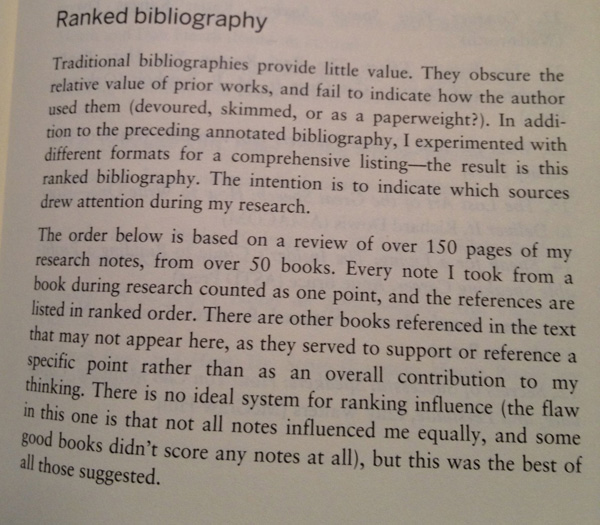
A feature of some of my books is a ranked bibliography. I rank books that I read while doing research in the order of their usefulness. Below is the ranked bibliography from Confessions of a Public Speaker, which suggests which books are the most valuable to read.
Warning: trying to learn a skill by reading about it is never as valuable as doing the thing itself. Putting in the time to speak in front of people and getting good feedback is far more efficient and valuable than reading alone. Even posting a 5 minute web video of you practicing giving a talk and asking friends for feedback is a great investment of time.
Popular recent books like Reynold’s Presentation Zen and Duarte’s Slideology didn’t rank high on this list even though I recommend those books often. The reason is both books emphasize slide design which in my experience isn’t the primary place to help speakers improve (which explains why I only spend a few pages in Confessions with advice on slides. Also see: How To Present Well Without Slides). I needed to cover a range of subjects including history, anxiety, business, performance, neuroscience and teaching – and books on my list scored better when I learned the most.
The best books on public speaking, ranked in order of number of notes I made while reading them:
(The list goes on for another 25 books – but the value of a ranked bibliography is you’ve now seen the highest ranked ones!)
One reason I rarely get excited about TED talks, although I do enjoy many of them, is I’m drawn towards the personal. For years I’ve been a bigger fan of the MOTH podcast, which is an evening of stories told without notes in from of live audiences. Although these talks are generally well presented, the agenda is different. They’re not as shinny. They have rough edges. They’re human and humble and honest in a way people pitching ideas can’t quite match.
A recent gem of a talk in every way is this one by Janna Levin, theoretical physicist and author of How the Universe Got Its Spots.
The talk moves from astrophysics, to misguided love, and the consequences of taking big risks.
But then consider TV advertisements: they’re 30 seconds long. The good ones communicate many ideas well in a very short amount of time.
Years ago I ran an event at Microsoft called Design Day. Each year we’d experiment with different formats and one year we tried 99 second presentations. It went well and we did it the next year too. Unlike most speaking events it gives the audience a real chance to participate.
How it works:
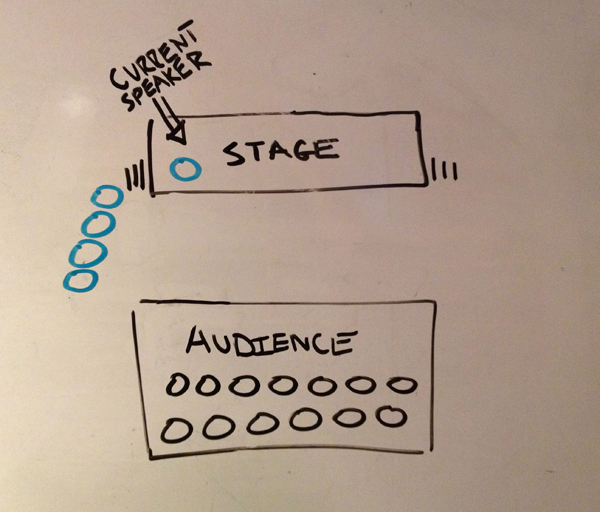
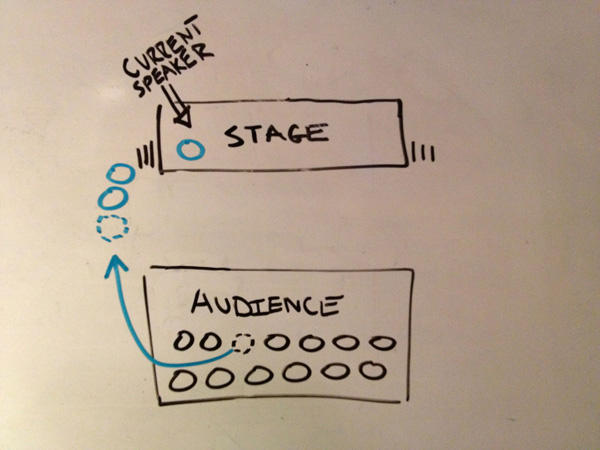
There’s a stage and a microphone
You hand pick 5 or 6 speakers to be in line by the wall
The first speaker gets 99 seconds to speak (they can have a single slide if they want)
When they’re done, they hand the microphone to the next speaker
Anyone in the audience can get in line: either to speak on a new topic, or to respond to something they heard.
Speakers can speak more than once
When you run out of time, or speakers, the session ends
What happens:
Before the session starts, explain how it works. Make sure the audience knows they can get in line and get a turn.
At first everyone is nervous, but paying attention. How does this work? they wonder. The format itself creates drama, which is good. If you choose good speakers to start the line, and invite them to speak about provocative or important topics, soon someone in the audience will stand up. When this happens, everyone starts listening differently, realizing they too can can get in line.
On finding and coaching speakers
It’s a small commitment to get someone to speak for less than 2 minutes. They can practice their material 10 times in half an hour. The surprise of short format speaking is it forces speakers to get to the good stuff. One year we let the hand picked speakers have a single slide if they wanted. This adds to your logistics, but if they want to give the audience a URL or twitter handle, having it on a slide makes this easier.
Speakers who volunteer can and will use less than 99 seconds, since they won’t have prepared. This is good. You’ll be impressed by the different, clever ways people choose to use their time.
Logistics
You need to have:
A hand held microphone
A gong or buzzer to cut people off when they hit 99 seconds (you have to be militant about this). A warning sound at 80 seconds is wise.
5 or 10 invited speakers to be the first to go and help set the tone you want. Choose good, provocative speakers that will inspire responses. If you want to play it safe, have a large number of people in the original line. If the session is going to be 30 minutes long, plan for 20 minutes of hand picked speakers. Then even if you fail to get volunteers, worst case you’ll just end 10 minutes early.
Plant a seed in the audience for someone you know will get in line after things start to break the ice.
A time limit for when the session ends.
Afterwards write up a blog post listing all the people who spoke and their contact info – helps people follow up and make connections.
Everyone has fears about regular public speaking, but what if you have to present someone else’s slides? And see them for the first time as the audience does? And only have 5 minutes? And the slides auto-advance?
I believe in the theory of trying something insanely hard to make normal work feel easier. As a public speaking expert, I had to try this at least to see what I could learn for you readers.
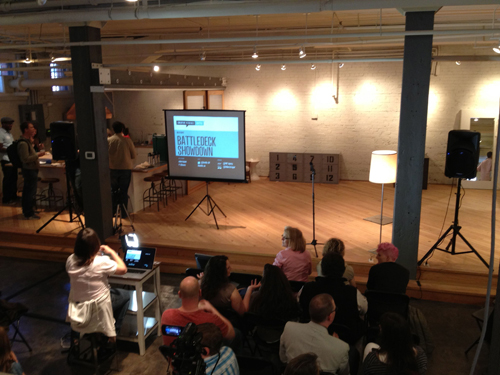
So what is Powerpoint Karaoke? Despite the name, there is no singing. Instead, a bunch of people are asked to present in front of a live audience but with (Powerpoint) slides they have never seen before.
There was no effective way to prepare. Surprise! Good advice for presentations hinges on having good material and practicing it. Neither is possible in this format. This was both terrifying and liberating.
I tried to prepare anyway. I found videos of others doing PowerPoint Karaoke. They were strange to watch since the presentations are unavoidably bad in any formal sense, but the live audiences have unusual responses. They expect it to be bad and have an unusual set of expectations for what they’re going to experience. Some of the best-received presenters disregarded the slides, which was effective but felt like cheating. Although there were no official rules, I decided if I did this I should buy into the spirit of it, at least the first time
It’s a crash course in improvisation. A decade ago I took a course in improvisational theater. I reviewed the lessons, including a refresher on “Yes, and…” which is shorthand for the mindset of faithfully committing to whatever happens.Powerpoint Karaoke is at its heart an exercise in improvisational theater.
Here’s what I learned after I presented:
You play for comedy. There is no way to take the slides seriously since by design they are ridiculous. I didn’t realize the full extent of this, as obvious as it seems now, until later. At best you are making the audience laugh, at worst they watch in silence as you struggle on stage. It’s purely stunt presenting. No one is there to learn or be inspired, at least not directly.
The audience wants spectacle. Mid-way through Hillel’s talk he abandoned his slides, and the format. In what was one of the most interesting experiences I’ve seen at an event like this he politely, but firmly, confronted the audience about why they were there. As awkward as it was he was entirely accurate – it is a weird kind of theater that wants to see speakers work against, and likely fail because of, the unfair challenges. There’s an element of wanting to watch cars crash in this event. It’s all in good fun, but also schadenfreudian.
The energy is weird. Good speakers (and comedians) build a rhythm with the audience through their material. The pacing of jokes, how certain facts are revealed, all build to something. But here since the speakers don’t know the slides the energy is weird – sometimes very funny things happen, but often there are complete misfires. Sometimes the audience laughs but the speakers don’t know why. Sometimes the speakers think the audience should be laughing, but doesn’t know why they aren’t.
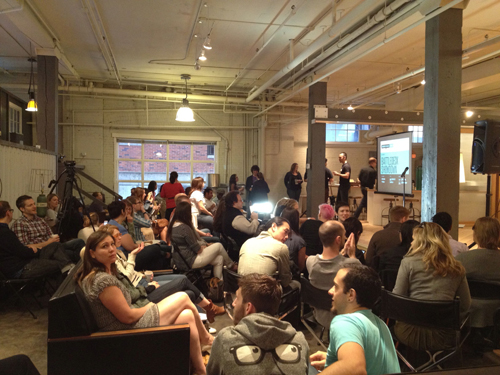
Michelle Mazur is brave. There were only 4 speakers on the agenda, with an extra battle deck for a volunteer from the audience. Michelle volunteered after seeing the four of us perform. I thought for sure no one would be brave enough, but she proved me wrong.
Advice:
There is no way to be good at this. This is liberating. It was very hard for me to say who of the five speakers did the best job. They were all weird, funny, awkward, and interesting in different ways. It really is more like experimental theater than anything like a public speech.
Make sure you trust the hosts. Luz Bratcher made the slides for this event and did a great job. If the person making the slides wants to screw all the speakers it’s easy to do, as if the slides are thoughtless speakers won’t have much to work with. You want the hosts to make it a challenge, but to give you well crafted slides that are funny all on their own and give the speakers plenty to work with (You can see the slides Luz made below).
I would have preferred to use an actual deck from a random event. By this I mean, give me a slide deck from a brain surgery conference, or a law accounting event. Then even though I have to make things up, there is a sane structure in there somewhere, and the audience can enjoy the attempt to follow an actual expert’s intention. By having a designer make original slides, it’s far too random and (I think) less interesting in several ways.
What I’d change about the format:
Let speakers control the slides. If you kept the 5 minute limit, but let the speakers control when a slide advanced, they’d have slightly more power over delivery. That adjustment would dramatically improve their ability to make the slides work. It would still be very hard, but the auto-advance works against everyone’s interests in this case.
Do it at night, after drinks. We did ours as part of Creative Mornings, which means IT’S THE MORNING. People are going to work right after. It’s not the right time for crazy and absurd. Crazy works better after work, or at night, or following a happy hour where everyone is midway through letting off steam after a long day. Mornings mean people are going to work afterwards, they’re charging up, not winding down.
Use real presentation slides. I’ve always wanted to get the slide deck from a medical conference, or a corporate retreat for a company I’ve never heard of, and make up a presentation in real time for that. Real slide decks have a continuity built in to them that fabricated battledecks never do.