On Tuesdays I write about the top voted question on Ask Berkun (see the lovely archive). This week’s question came from J.R. [via email]:
What is a favorite theory that you wish more people understood?
A favorite theory I wish was more well known is the Satir Change Model. It’s popular in some circles, but often when I mention it in talks at events few have seen it before. Virginia Satir was a family therapist who studied how families behave, and in particular, how they respond to change. Her ideas have been successfully applied to organizations and groups of people.
We like to believe change and progress are predictable, especially if we’re applying an idea we’ve used before or that is widely accepted. But according to her research (based on family behavior), and her model, even when we’re making the right change, at the right time, confusion and fear are likely.
Late Status Quo – this is the present, where things are stable, at least in the sense that they’ve been the same way for some time.
Foreign element – This is Satir’s term for any change that is introduced, which could be something deliberate (a new healthy diet) or something surprising (new neighbors move in next door). It could be a new idea, process, team member or anything. Often people resist foreign elements, even if they come with the promise of solving a problem. People often prefer to keep doing what they have been doing (status quo), even if there are things they don’t like about the status quo, especially if they don’t have much trust in their leader or their coworkers.
Chaos – (IMO this is the central idea of the model). Even if you are doing everything right, and the change is the right one, volatility will rise for a time. Average performance will drop as people experiment with adjustments to incorporate the new idea. Hidden assumptions, and emotions, will be revealed, which can be painful at first. A new idea may require new conversations, redistribution of responsibilities and more. What makes this phase challenging is it’s hard to predict how long it will take or if the path is the right one (e.g. “do we need to keep going, or is this direction a mistake?”)
Transforming Idea – The job of a leader is to help a team work through the chaos phase until they reach clarity. This is challenging as each person might require different coaching, advice, support or training to adopt the new idea. And the team as a whole may need to reform, with different roles and responsibilities. Someone with leadership skills might correctly identify a new direction, but it takes someone with people management skills to help them through the transitions that the new direction demands.
Practice and Integration – Once the new idea is understood and adopted, finally the expected gains can be seen and progress becomes predictable. And eventually stabilizes again as the new status quo.
The model isn’t predictive. It doesn’t tell you how much chaos a particular idea will generate, if any at all. It can’t tell you how long it will take before you find the “transforming idea”. It also can’t tell you whether the new idea you’re introducing is the right or wrong one (e.g. the chaos will never end, or performance will never recover). It’s simply a useful framework for thinking about the psychological patterns likely to arise when something changes.
Inexperienced people often confuse the chaos phase as a failure in their choice. And if they quit early, assuming “chaos” means they made a mistake, and revert back to the old ways of doing things, they likely will never have the confidence to try something that bold again. They now confuse the chaos phase with failure. This is a kind of self inflicted learned helplessness, where the necessary cost to improve and grow is now too psychologically expensive. People and organizations can become paralyzed here, as they’ve become extremely resistant to any threat of a “foreign element”, even though that’s exactly what’s needed to grow.
Some foolish people dismiss Satir’s work based on the question what do families have to do with workplaces or individual adult choices? But workplaces are based on relationships, and we learn our models for how to relate to other people from… our families! Your favorite, and least favorite, coworkers learned many of their patterns of behavior from their early relationship with their parents and siblings. How we define trust, love, collaboration, friendship and teamwork all come from our experience with the first and primary tribe in our lives.
Anuradha Gajanayaka compares the Satir model to Kanter’s Law, which states that “Everything looks like a failure in the middle.” She suggested that we “Recognize the struggle of middles, give it some time, and a successful end could be in sight.“
And that is a key takeaway from the Satir model. Even if you’re doing everything right in your life, or as a leader, when you try to change something be prepared for surprises. Plan time for “chaos” in response to the change, where it’s normal for performance to drop and for experimentation to happen until the new idea is understood, incorporated and refined.
One day at the mall while walking with his daughter he noticed how, because she was bored, she made up a game of not stepping on the cracks in the floor tiles. I took this story to suggest we have the power to make many ordinary experiences fun if we are motivated to frame them that way. I believe this is true. The key to his daughter’s success might be that she was motivated to create, which raises the question: if she was never bored, would she ever be motivated to try to learn how to make things fun for herself? There are many things in life we know we want, but finding the motivation to go get them is the challenge. It seems counter-intuitive to have to expend effort to have fun, but maybe there’s a truth here that we don’t want to admit?
He criticized the notion popularized by Mary Poppins that “a spoonful of sugar helps the medicine go down” as an empty promise, and that covering one large unpleasant thing with a thin layer of something pleasant is a ruse and rarely works. It also dodges the question why isn’t the core of the experience made well on it’s own? He offered chocolate covered broccoli as another example – we’re fond of coating unpleasant things with tasty ones as a “solution”, but rarely is it as satisfying as simply making the central ingredient excellent (why not buy fresh broccoli and cook it lovingly so it tastes delicious itself?) I liked this thought, until I reconsidered his daughter’s choice: didn’t she cover over the boredom of the mall with the sugary distraction of a private game?
He shared how he chose to use a push lawn-mower, which takes more time and is far more frustrating to use than powered ones. He didn’t complete the story (perhaps he does in his book) or how it connected to his daughter, or Mary Poppins, but it was enough to make me consider that fulfillment can be more powerful than fun. The pleasure we take in finishing a hard project might be greater than spending the same amount of time doing something that was ‘fun and easy’. Game designers know they must balance the level of difficulty in their creations, making it simple enough to enjoy but hard enough to challenge us and keep our interest. And this was where the idea of fun fractured for me: fun isn’t really the goal, it’s pleasure or satisfaction that we’re after which are deeper concepts.
In the end I’m left feeling there’s something shallow about the isolated quest for fun, which I admit I was on as I was attracted to the lecture. Looking back now, the very idea of going to a lecture about a book about fun seems like a very un-fun thing to do. The more time you spend thinking about fun, the less fun you’re probably having. It’s a common problem with philosophers, who in all of their thinking lose the very thread they’re trying to follow (e.g. great thinkers on life and love who failed to ever get a date). Inquiry is useful for a time, but soon there are diminishing returns in abstractions.
If I tried to explain all of this to a college student half my age they’d think I was crazy, as most twenty year olds are surrounded by people and situations heavily oriented towards having fun: it’s not something they’d think you need to go out and find. And in truth it wasn’t a particularly fun crowd or an especially entertaining experience, but who in their right mind would expect either of those things AT A LECTURE? Perhaps there is something to learn from the fact that this is not where people who are good at having fun go on a Friday night in Seattle (Yes, it was a Friday night. In my defense I DID have much fun at dinner with friends before we went to Town Hall, so there!)
One problem is the quest for fun assumes that we have binary states of fun or un-fun, which is about as true as always being either happy or unhappy. Our emotions are more sophisticated and that’s what makes us interesting. We can be happy and laugh in reminiscing about a tough day with a friend who was there, or, like Bogost’s daughter, use a very un-fun experience as the motivating force to create something more pleasing for ourselves. Fun is as multi-faceted as we are.
A great example of the limits of the term fun are the work experiences that are sold as entertainment. Learning how to be a chef, which is a job, is offered as a “fun and relaxing” experience for groups of friends. People love Crossfit, an exercise program that makes people as fit as marines, in part because of “the community that spontaneously arises when people do these workouts”. The dichotomy between work and play doesn’t hold up for long. Many people love their jobs because they find them fun, or at least enjoyable. When I watch a young band on stage at a concert, it certainly looks fun, even though I know they’ve worked hard at their craft and are technically working as I listen to them ‘play’.
It’s simply misguided to seek happiness, fun, or any singular emotional experience as if it were a product in a box. It’s just not a realistic understanding of how emotional experiences happen. As Victor Frankl wrote:
…happiness cannot be pursued; it must ensue. One must have a reason to “be happy.” Once the reason is found, however, one becomes happy automatically. As we see, a human being is not one in pursuit of happiness but rather in search of a reason to become happy, last but not least, through actualizing the potential meaning inherent and dormant in a given situation.
One related insight I learned from improv class is that fun things begin only when someone makes an offer. Someone has to make the first suggestion and give other people a chance to contribute in return. It can be as simple as inviting people out to lunch, to join you in a game, or even for a walk around the park. A wink, a nod, a smile, are all an offer of a kind. Someone has to initiate and create the possibility for an experience to happen. Like Bogost’s daughter we are always free to make offers to ourselves, to invent our own framework for the experiences we’re in, but some people find this much easier than others. Fun is easier to create when people we like, or are seeking fun as much as we are, are around us.
One approach is to think of the people in your life you find fun to be around: what is it that they do or say that makes you feel this way? I’d bet they simply make more offers, of the kind you like, when you are around them than other people do. They invite you into their stories, their jokes, or their hobbies, or find comfortable ways to invite themselves into yours. They share a sense of humor, or a sensibility, with you and offer ways to use that connection and grow it. If we want more fun in our lives then perhaps mostly we need to spend more time with these people or become more like them ourselves.
A tradition is simply a custom that has been passed down from one generation to another. Their longevity can have many reasons, some good and some bad. We can not assume that persistence alone provides moral justification. Instead we must ask better questions about traditions before we judge their value.
The problem is we instinctively defend our traditions. We learn them when we are young, and when we grow older we naturally want to protect what our elders taught us. Entire communities bond around traditions and rituals, and that is a powerful uniting force, but it simultaneously creates great social pressure not to challenge them. We develop the illusion that they always existed in the form that we practice them, making it easy to confuse questioning a tradition with questioning the identity (or existence) of the community itself.
The danger is that in resisting change both regress and progress are prevented. It keeps the status quo strongly in place. If one goal of a society is to help the next generation have better lives than the previous, that goal demands a periodic reexamining of what those traditions were meant to do, and to compare them with the effect they have now.
It’s the confident community, and leader, who recognize a strong idea can withstand being questioned. And that a truly strong community will prefer to recognize a problem, or that things have changed, and work to solve it, rather than hide behind the defense of longevity.
How did it change over time? (every tradition has changed over time)
Is the problem it was intended to solve still a problem?
What ideas are we using the tradition to honor, remember or pass on to future generations?
Can we carefully adjust this tradition to make it more effective to pass on those ideas?
Do we need to redefine this tradition given all we’ve learned since it started?
One of the most popular traditions in the world, and one that serves as a great example, is birthdays. Most of the world celebrates them today, but this wasn’t always the case. The Egyptians invented the practice in ancient times but it was limited to recognizing their gods. Then it was the Greeks who began the practice of lighting candles on the cakes they offered to the divine. Later it was the Romans who were the first to celebrate the birthdays of ordinary people (but only men). At that time Christians didn’t celebrate the birth of anyone, seeing birthdays as highly egotistical and pagan in nature. It was only in 336 that the first Christmas was celebrated. On and on through the centuries the birthday tradition has changed in meaning and significance, used in different ways, in different cultures, to honor or ignore, different people for different reasons.
The lesson is that what we do today will be someone else’s history. All traditions are living things, shifting and changing, sometimes for the better, sometimes for the worse, but they are all in motion, just at a pace we rarely notice. The more we can see traditions as just one of the many forces that tie us together, the better we can use them to help us protect and improve what’s best in our families, societies and civilizations.
“Every tradition we hold dear was once a new idea someone proposed, tried, and found valuable, often inspired by a previous tradition that had been outgrown. The responsibility of people in power is to continually eliminate useless traditions and introduce valuable ones. An organization where nothing ever changes is not a workplace but a living museum.” – From The Year Without Pants
How would you explain the events of this year to someone from the year 2050 who time traveled to visit us? Many adjectives come quickly to mind: turmoil, danger, violence, drama, unrest, uncertainty. But if you think deeper about trying to explain what it all means, you’d realize this challenge is impossible. We couldn’t accurately tell someone from the future about the meaning of the present because we can’t understand the present yet: we don’t know what happens next! We don’t have the context to make sense of these events. If we were alive in 1776, 1914, 1968 or 2001 we’d have a similiar problem. We can describe the significance of those years now only because we know what happens after.
It must be said that we are a stubborn and frustrating species. Too often we wait for terrible things to happen before we’re willing to change our minds, or change anything at all. It’s not a rule, as history doesn’t depend on rules, but unrest and disorder are sometimes necessary to wake us up and motivate us to grow. And to remind us we share our fates with each other. In the end, the best we could tell our friend from 2050 is “something is happening!” We truly are living in an interesting time.
Contrary to the title of this essay, I don’t think the world is insane. Instead it’s more that we’re designed to live at the scale of tribes, not cities and nations (See Freud’s Civilization and It’s Discontents, where he suggests we traded sanity away to get more security and stability). It’s not the world’s fault, in a sense, but our own.
When I get past my own emotions and rantings, I conclude three things about this year so far:
We’re addicted to news and news is shallow. Neil Postman said “information is a form of garbage” meaning that at a certain volume more information does not help you. The speed and quantity of news, which we presume to be an asset, does not help us gain perspective, understanding or meaning, three important things we all seek. The news business thrives on fear, more so that fact. Most forms of news are not helpful, but they are plentiful and addictive.
Our brains are poor at calibrating to a national or planetary scale. We’re easily misled by dramatic (but possibly unrepresentative) news. And we’re quick to use one narrow string of events to define our feeling of “how the world is”. Combined with cognitive bias, we’re prone to strong emotions based on irrational assumptions.
Big problems we’ve ignored are now un-ignorable. The violence, racism, classism, anger and fear that have fueled the worst events these past months did not suddenly appear. Instead, it’s the consequence of years, or decades, of problems we haven’t solved, or perhaps have largely ignored. Technology may have made these problems far more visible, but they were likely there all along.
You must focus on a problem you can impact. We are just individuals and worrying about all the problems of the world won’t help anyone. The rational choice is to pick an issue you care deeply about and focus your energy there. Even if you were a billionaire, you can’t solve every problem. By focusing, you can build relationships with other people interested in that cause, and celebrate even the smallest wins with them. That community will help you continue to invest and make a difference, a much larger one than you’d make than staying on the sidelines, waiting to find an optimal strategy that will never come.
The world, on average, is getting better. Many people refer to statistics that show that by many measures the world has been a steadily improving place. This is good and hopeful news: if you need a boost of positiveness, then look at these charts.
But the trap of that last point is the flaw of averages: simply because the total average, of say violent crime in America, has gone down for a decade, doesn’t mean there aren’t sizable pockets where crime is going up. Averages can be misleading. For example, on average the universe is a very dead and boring place, but that average makes it seem like Paris or Las Vegas don’t exist. But they do! Statistics tend to oversimplify – they’re useful but easily misused and rarely definitive without asking questions and thinking through for less biased answers.
My advice is simple. We are emotional creatures, so find a healthy way to vent the negative energy that you feel. Go to the gym, or for a hike, and let your feelings out through exercise, which we all know we need more of. Scream at the sky and challenge the wind. But don’t target your rage at people, certainly not at strangers: the golden rule is a good guide here.
Another safe place to express yourself is a private journal, where any idea on your mind can be expressed safely and without judgment (Social media isn’t quite the same, because you are expressing yourself with the knowledge that someone is observing you). Or talk to friends who care about how you feel (and if you don’t have friends who care about your feelings, your real problem might be you need to find better friends).
But then, once you’ve expressed those emotions… slow down. Be curious. Seek thoughtful points of view that differ from your own: it’s the only way to provoke your own thinking to improve (instead of just responding and sharpening your preconceptions). Talking to people who agree with you on everything will teach you nothing.
I’ve read so much these last few months seeking answers. I don’t look to the news for meaning, because that’s not what it’s good for: instead, I try to read deeper. Here are five essays, with varying views, that helped me to feel I understand what’s going on (or clarifying what I don’t understand). I don’t necessarily endorse their positions but to my point above, they help in the pursuit of understanding:
History tells us what’s next. A historian takes the opposite view about the world, and thinks we’re in big trouble (I agree more with the first one, but this one has its merits too. I’d like to see these two folks debate).
How Do People Change Their Minds? A good reminder that most expressions of opinions in social media have little effect. Venting is one thing, thoughtfully trying to influence a mind is another.
“The ultimate question of any advice, rules, or traditions is, What do you ignore and why? No one can ever follow all the good advice they hear. This is the advice paradox: no matter how much advice you have, you must still decide intuitively what to use and what to avoid.”
Books and experts often promise step by step ways to achieve a goal. The goal might be weight loss, becoming wealthy or living a happier life. But a promise is one thing: achieving the result is another. Looking at how most people who read these books and don’t achieve the results they desire reveals a problem. We often have more faith in advice from strangers than we do in ourselves.
Advice that sells the best makes the grandest promises, even if they’re false. We know, rationally, that there aren’t just 7 steps to true success and that even if there were, it would take more than 21 Days to Master it. We know growing rich requires more than following 13 steps.
Book titles never say what would be more honest: “This might work for you sometimes”, “You’ll have to take some risks to even try to get what you want” or “You’ll get just a handful of useful tips even if you read the whole book.” Honesty like this doesn’t benefit whoever is giving the advice, so the most popular advice givers rarely say these things.
Even if they did, our brains love the fantasy that there’s just a few easy tricks to learn to solve our biggest problems. We love it so much that when advice we pay for fails to deliver the impossible, we blame the advice, not the fantasy that magical advice exists elsewhere. Soon we’re on the hunt again for killer secrets and magic recipes.
The lure of advice is it’s a narrative: it feels good while you get it. But once the advice is over we return to the uncertainty of our lives, which feels, by comparison, confusing and scary. Advice is knowledge that we choose to use, or not. No one can make that choice for us, and it’s this that creates the paradox.
Simple advice can be hard to follow.
We can’t follow all the good advice we get.
Advice that feels good to hear can be bad advice.
Advice that feels painful to hear can be good advice.
It’s possible to follow good advice diligently and still fail.
Giving and receiving advice is far easier than making real life choices.
You’re in the paradox now – even this post is a kind of advice.
What now? I can’t advise you. But I wish you well.
Recently Mike Monteiro wrote about whether the AK-47 is worthy of study for a design student. I agree and disagree with him at the same time, which led me to write this response. He wrote:
If a thing is designed to kill you, it is, by definition, bad design.
This sounds powerful but it makes little sense because it pretends design and ethics are the same and they’re not. I know he wants them to be the same (and in a way I wish they were too), but he’s mixing design, which is a practice, with ethics, which is a system of beliefs. They overlap but they are different lenses.
For example, a house cat’s front claws have evolved into a wonderful design: sharp, compact, strong, lightweight and retractable. But by Monteiro’s definition if you’re a mouse or a bird, the claws are a bad design, since they are made to kill you. It might be unfortunate, or even evil (from the bird’s perspective), that such a design exists, but for the purpose it was designed for it’s an excellent design. If you’re a starving cat, those claws are designed well enough to save your life, even if through killing. (Also consider assisted suicide devices, things designed to kill you, but by your own hand. Is that bad design?).
This leads to the very idea of violence: when, if ever, is it ok to be violent and to kill a person? An animal? These are good ethical questions, but not design questions as you don’t need to question the ethics of a supermarket or a slaughterhouse to design one well (as defined by the client), even if you should (and I agree with Monteiro that you should). Most people most of the time don’t ask ethical questions about their daily work, or anything at all.
Regarding the AK-47, I don’t like guns. I don’t like most violence on TV or in movies. I wish the AK-47 did not need to exist, but I can’t deny the staggering amount of violence in human history. Much of that violence thousands of years ago was necessary to survive in Darwin’s world, but just 70 years ago the entire world was at war for a second time (because the first world war just wasn’t bloody enough).
I hope we grow out of our violence but moral progress is far slower than technological progress. In which case, when guns are pointed at you by evil people, and there is no alternative, a good designed defense may just include having one of your own. Albert Einstein, a pacifist, encouraged the United States develop the Atomic bomb, because the prospect of the Nazi’s having one before the rest of the world was far worse than the alternative.
No it isn’t. I wish it were, but it’s not. Who designed all the junk in our landfills? Who designs pop-up ads? Who designed TMZ? Who designed our culture of conspicuous consumption and the advertising that promises salvation if we just buy one more thing (that we don’t need)? Who designed newspapers that lie to us? Government technology that spies on us? It’s designers. Designers were paid to do all of those things. Some designers are ethical, but some are not. Some designers refuse projects because of their ethics, some do not. But both design things and both are designers.
Modern design is dominated by consumerism and while consumerism has been great for the U.S. economy it has also been bad for the planet and for the human psyche. If design were primarily a noble profession centered on the progress of humanity designers would worship Victor Papanek and Buckminster Fuller instead of Steve Jobs and Mark Zuckerberg. But we don’t. Most design students today don’t know either of that first pair, which makes me very sad. Most designers today, especially in the tech world, aren’t making the world any better at all. They are paid very well to make shiny things that attempt to solve largely superficial first world problems of extreme convenience.
And to design is to take purpose into account — as my friend Jared Spool says: design is the rendering of intent. You can’t separate an object’s function from its intent.
I’m friends with Jared too, and Monteiro and I have hung out together with him, but I disagree with both of them. I can use a hammer to build a chair, or a torture device, or to knock you unconscious. What the designer intended is mostly irrelevant once it’s in my hands. And even if the designer showed up and chose to tell me “Hey! You’re not using my object with the designed intent!” I could use the very object they’re talking about and bash them over the head with it.
All tools can be weaponized or used for evil, even a spreadsheet (“track the monthly wilding budget”), even an email application (“fire the missiles now!”) , even a calendar (“reminder: blow up building today”). Of course most tools are not designed to be weapons, and some designs are clever in minimizing their uses for evil, but so what. User intent trumps designer intent (See MacGyver, and then imagine him not as a hero but as a terrorist). Designers are arrogant and often forget they have the most influence only over the most trivial of their user’s decisions.
Monteiro wrote: Your role as a designer is to leave the world in a better state than you found it. You have a responsibility to design work that helps move humanity forward and helps us, as a species, to not only enjoy our time on Earth, but to evolve.
I do love this idea. The problem is almost no one who hires a designer sees this as what they are paying for, and as a result, most designers don’t see it either. It’s likely this ambition requires designers to make sacrifices, to do pro-bono work or to start their own companies that uphold a higher moral standard than their past clients. They have to redesign design which is far scarier than simply designing more things consumer companies hire them to do. If anything studying an AK-47 and its impressive and horrible history connects young designers with a world far larger, bigger and more inspiring towards truly noble works than the latest gadgets can. For designers to change the world for the better they first need to understand how the world works at all.
To answer the question about what questions never leave me I skimmed through my journal. Few people keep them anymore and I don’t understand why: it’s a secret weapon for sell discovery. A diary is a time travel device anyone can make. It lets you jump back in time and see what you truly thought in the past, which is very different than what you believe you thought. Human memory is terrible and reading a journal you discover hidden patterns in your thoughts and feelings you might never discover any other way. Writing in a diary today is a gift to the future version of ourselves.
I didn’t find many questions in my journal. There were certainly some, on average one per entry, but is that a lot? Since I have no basis for comparison I don’t know if the number I found was low, high or average. And of course most of my thoughts stay in my head, never making it into my journal which means at best my list below is a guess. I considered the questions I believe I ask myself often, but since I wrote it knowing it would be published it might be biased towards ones that sound impressive, rather than ones I truly ask myself often.
Death is a powerful motivator and is often on my mind. It’s no surprise many of my questions center on time and how I use it, as do the rules I live by. Since I ask these questions often I have answers to them that rarely change, which suggests I need to ask myself why they haven’t changed in a long time.
Is there any point to existence, or the universe, at all?
What is the best way to live given what I know, what I don’t know and what I can’t know?
What are the meanings of my life that I have chosen?
Is my time aligned with my goals?
Am I giving time to the people I care about most?
Am I giving time to the ideas and beliefs I care about most?
Are my actions aligned with my beliefs?
Am I taking my life seriously enough?
Am I enjoying life and not taking life too seriously?
How am I not myself?
What am I hiding from?
Am I pushing myself and loving myself?
What assumptions am I making that I don’t realize?
What blind spots do I have that are hurting me or others?
What questions have I forgot to ask myself?
Should my answers to these questions change?
What questions do you find yourself asking often over your life?
Americans are preoccupied by the size of things: big houses, big sandwiches, and big salaries. At leadership retreats, and in the bestselling books we buy, we seek grand thoughts. The basic logic we use is the bigger the idea, the bigger the value, but often that’s not true. There’s a myth at work here: the assumption that big results only come from radical changes. There’s good evidence for a counter-argument.
The problems that plague organizations, or hold them back from greatness, are often small things that happen to be consistently overlooked. The lack of progress or greatness isn’t because there’s a grand idea missing. Instead the cause is a simple idea prevented by bureaucracy, killed out of ignorance, or buried under incompetence. If those simpler, smaller, ideas were set free, the effect would be as potent as any grand theory. Somehow we discount simple ideas for being playthings, for being too small to be worthy, not recognizing the surprising power hidden in what seem to be our smallest decisions.
The McDonalds brothers had a very simple idea. They made hamburgers at a few stands in San Bernardino, California. And as any reasonable owners would do, they wanted to run those stands efficiently. How did they do that? They tried to make the process for making food repeatable, an assembly line for food construction. Any homemaker or line cook of the 1950s made the same discovery, as making school lunches, or eggs over easy, again and again motivates this kind of thinking.
Had you shown the McDonalds’ business plan to any of the great business minds of the day, they’d have thought you were insane: they’d have said the idea wasn’t big enough to warrant interest of any kind. Fifty years later, McDonalds has 30,000 locations and $22 billion in revenue. Certainly not all of that value can be attributed to the simple notion of creative efficiency, but dedication to the notion did enable their early domination of competitors. The point is simple: a small idea, applied consistently well, can have disproportionately large effects. Ray Kroc’s insight was not finding a big idea, but in seeing how a little idea, done right, could become big.
Put another way, what I’m describing is leverage. Rather than worrying about the size of an idea, which most people do, it’s more productive to think about the possible leverage an idea has. To do this requires thinking not only about the idea itself, but how it will be used. An idea can have a different amount of leverage depending on where, when and how carefully it is applied. One old idea from one team in your company, reused in the right way on another team unfamiliar with it, might just have transformative effects.
In Atul Gawande’s book The Checklist Manifesto, he explains how the simple idea of a task list, something used by aircraft pilots for decades, has improved patient safety in surgery by 30% or more. Hospitals didn’t need a breakthrough technology. There wasn’t a new theory or grand vision. A simple act, with a simple, old tool, had incredible, and surprising, leverage.
There are many dubious stories in the history of innovation, and some, despite their improbability, make valid points about the nature of ideas. Charles Steinmetz (or Edison, or Tesla, depending on the version of the legend you hear), holder of over 200 patents, retired from General Electric. A complex system had broken, and no one could fix it so they hired him back to consult. Steinmetz found the malfunctioning part and marked it with a piece of chalk. He submitted a bill for $10,000. The GE managers were stunned and asked for an itemized invoice. He sent back the following: Making the chalk mark $1, Knowing where to place the chalk mark $9,999. Ideas are like chalk marks: as simple as they seem, knowing where, when, and why to use even the smallest ones can make all the difference in the world.
Maybe the challenge of modern life isn’t external distractions, but our lack of practice with concentration?
I learned to concentrate when I was 15, as part of my dream of playing in the NBA. I read a book by Larry Bird to help me. I didn’t make the NBA (no surprise) and don’t remember much about the book (the cover was green, like the Celtic’s uniforms!), except for this advice on concentration:
You can sit or lay down. Once you are in position, close your eyes and relax. Just sit there for a minute and think about anything you want. After about a minute, start thinking about the neighborhood or subdivision in which your home is located. In your mind see your neighbors houses, the roads, the streets, the trees. After you can see your neighborhood clearly, move down the road your house is on and see the houses along the way…
When you begin, you will only be able to concentrate for a few seconds or minutes. If you work at it every day, though, you can build your concentration just as you can build the strength in your arms.
When I hear someone say “I get easily distracted” I always think of Larry Bird’s advice. Maybe they haven’t practiced concentrating enough to earn the ability to control where their attention goes?
I heard recently about Hemmingwrite, a distraction free writing device, as if it’s the devices we currently have that hold people back from writing the novels of their dreams. I don’t think so.
You can also buy software that claims to free you from distractions, but if Bird is right the distractions are in your mind, not in the world. No matter how advanced the software, a mind that’s bored will always find a way to do something else. Writing often and well requires dedication, just like doing anything often and well does. Every device with an off switch is “distraction free” if you choose to flip that switch. Every app has a close button. Take some responsibility. Sure, gadgets and software may help you, but at some point the problem is you, your commitment and your habits. Larry Bird bet on his own mind, the one thing you have upgrade yourself.
Artists don’t get down to work until the pain of working is exceeded by the pain of not working. — Stephen DeStaebler
I don’t always want to write. Writing is hard work. But I know the rewards are worth the effort and I work up the motivation to stick to my commitments to myself and put time to write ahead of other things. It’s only by practicing with your mind, the most important software you will ever have, that you can control what distracts you and what doesn’t. Some of the most important things we want in life can not be bought or sold as a product: control over our own attention is one of them.
We share a mass confusion about creativity – why are ideas are so fun in our minds but so frustrating when we work on them? Through my own stories, and tales from Picasso, Michelangelo and Yoko Ono, I explain how to close that gap. Recorded live in front of a great crowd of 2500 attendees of the World Domination Summit 2014.
This version of the talk contains the largest live game about cognitive bias that has ever been played (as far as I know). Jump to 18:31 if you want to start there.
Over the course of life you make experiences, learn from them and have certain key “nuggets” of wisdom that you hold on to. These are rules that you found that make you more successful and happy, make you avoid stupid things and make better choices. What are those?
I have rules about rules:
Rules are magnets for cognitive dissonance. More than any generation in history we’re awash in lists of rules: the 7 secrets of this, the 12 killer tips for that. These lists have the pretense of providing insider advice for living better lives. But I can’t say the abundance of rules has made much of a difference for our quality of life. Are we better people than we were 50, 100 or 500 years ago because of these lists? Take the Ten Commandments: it’s the most well known list of rules in the world, and the most frequently ignored, even by those most faithful to them. I’m afraid of rules for that reason. It’s easy to find rules that are satisfying to mention, even when we delude ourselves that knowing a rule equates to following it.
I’m doubtful that rules for one person are useful to others. When I played for my high school basketball team, I used to write “Play Smart” on the top of my sneakers. I was prone to turnovers and it was my little way of reminding myself to calm down. Had I copied Michael Jordan’s rules for himself or Magic Johnson’s, it couldn’t possibly be aimed at what my real problems were at the time. It’s useful to learn from masters, but the copying and pasting of one amazingly talented person’s system for their work to a novice or beginner is just silly. Rules and advice are a place to start, but anyone who does the work of trying to apply any sets of rules to their daily lives soon customize them, and it’s the work and self awareness that’s the hard part, not the rules themselves.
Instead there are pairs of contradicting rules I think about often. Each side of each pair are true, but never to the exclusion of the other. The uncertainty generated by these “rules” keeps them alive and pushes me to revise and review the rules themselves.
The Golden Rule vs. Capitalism. One of the greatest contradictions in America is our hypocritical notions of biblical and economic ethics. We believe in the golden rule, and treating others as we believe they want to be treated, but this is in direct contradiction to competition, a central element of capitalism. In effect every NFL or NBA game consists of thousands of people intentionally not practicing the golden rule (“I want you to lose and will rub it in when you do”). Life itself is based on both cooperation and competition, not one at the exclusion of the other (see Dark Nature: a natural history of evil for an excellent primer on the moral duality of life). I try to treat everyone as I think they want to be treated, but I know that to run a business or to treat myself with self-respect, I sometimes have to put myself first (which can be done with varying degrees of grace). I often think about the idea of selling out as a writer, and what integrity means for someone who sells ideas for a living (See How To Call BS on A Guru).
Live for the future / Live for the moment. The philosophy joke at work here is “everything in moderation, including moderation.” Living a balanced life means sometimes going too far, and sometimes not going far enough. It’s only when you hit an extreme that you rediscover where the middle ground for your life should be. I love being disciplined, and I love being a hedonist and I know there is a place and time for each attitude. I believe in taking big risks, but I don’t see any reason not to think them through. I know I become more ambitious if I know what my safety net is, not less. When I decided to quit to become a writer, I planned it carefully. I know some people lose their nerve when they consider all of the ways they might fail, but I don’t. I gain confidence from it. Generally I want to be wiser in the future which demands working on the edge of my comfort zone, sacrificing “the now” to get more data, which improves my judgment in whatever I’ll be doing a decade from now.
Make meaning, but accept meaninglessness. I believe the universe is unknowable and most likely has little to do with the human race. I don’t believe in god, gods or the supernatural. I think the most likely outcome is the human race dies with the sun in a few billion years. This sounds horribly depressing, but I find it liberating. I know how special conscious life is and I LOVE being alive. It’s all the more amazing when I consider the infinite wonder around me might never happen again: this could be a once in a universe experience. This also means it’s up to me to decide to care about the Golden Rule, or not, or about my dog Griz, or not, or my friends and family, or not. I alone have to chose to put my limited energy into making those relationship meaningful (or not). It’s up to me to make the feelings and ideas I care about important in my life and no one else can do this for me (e.g. existentialism). I have to decide what matters and how much of my life energy I’m willing to dedicate to that decision. The very nature of the universe is a cry to anyone paying attention that we must decide what matters and aim the full force of our lifespans at that meaning while we are here. Or concede we don’t care as much as we pretend we do, when there’s so much good TV to watch. If there is meaning, it’s up to us.
Everything is funny / Everything is serious. Every time you hear a joke that makes you laugh you have to know there’s someone out there who was offended or hurt by the joke. But we forget this when a joke hits too close to our lives, and that’s part of the rub of human nature. We’re emotional creatures who love to pretend we’re rational. My wife Jill is my best friend and central to our marriage is our deep, dark, twisted sense of humor. We eventually find a way to laugh at everything, even ourselves in our worst and saddest moments. I can’t take anything too seriously for too long and it’s a sign of my closest friends that they help me laugh at myself, at the universe or at the idea of life at all. Voltaire wrote “God is a comedian playing to an audience too afraid to laugh” and if I believed in God this is the kind I’d agree with. Things in life can be sad and funny at the same time, one does not preclude the other. I do take work seriously. I work very hard at everything I do. I’m extremely serious about the things I make. But I can’t let myself lose sight of how funny it all is, even my belief that my hard work, in the end, matters, which it probably doesn’t. Far greater writers and artists than me have long been forgotten to history. But if I believe in the kind of meaning I’ve chosen, I’m committed to doing the work anyway, almost inspired by the fact I can’t know what meaning it will have in the future, if any at all.
Feelings and Reasons. There is no such thing as a purely rational moment. The oldest parts of our brains control our emotions and drive our immediate responses to life (Read about your friend the amygdala). I used to pride myself on being logical, but as I studied the human mind, and myself, I discovered logic is a great disguise for emotions. We hide meanness and judgement behind “logic”. We often confuse debating skills and charisma with the hard work of truly thinking through both sides of an argument. Sometimes I have to let my emotions lead, and stop to ask myself: “What am I feeling right now? Why am I so angry about this Facebook comment? What feelings am I carrying around that are surfacing now?” And sort those feelings out before engaging with the world. Other times I have to let my logic lead, and focus on finishing the workout despite the pain, or writing the draft with complete disregard for my fear or self-loathing. Many of us live in denial of our emotions, pretending throughout our lives that we don’t feel the way we do, never understanding ourselves, and therefore never understanding anyone else. But we need a balance of logic and emotion to be the best version of ourselves.
What are your rules to live by? How did you decide on them? Leave a comment.
[Of the 247 kickstarter backers of The Ghost of My Father, there was one gold sponsor, contributing $1000 in return for a blog post on the topic of their choice. This fine gentleman is named Keith Klain, who is the CEO for Doran Jones. One of the projects he works on is the UDC, which teaches underemployed adults in the South Bronx how to become software testers (see story in WIRED). Keith asked me to write about reinvention and I was thrilled to oblige as it’s a theme close to my heart]
There is a list of sayings on a whiteboard near my desk that I can’t help but notice several times a day. It contains ideas I try to remember, things I forget are true and important about the life I want to have. Near the top of the list is this one: you could be dead. It makes me laugh every time I see it, for reasons I can’t entirely explain.
The part I know will make the most sense to you is this: when we’ve been alive for decades, we forget what being alive means. We slide into a paper cage of our own habits and forget that with a little effort we can slide our way into new habits too. I can stand up whenever I want. Or sit down. Or put on some music, or close my eyes and lose myself in silence. I could dance, scream, stand on my desk, or anything I choose to do. Anyone can do an infinite number of different things, small and large, in this or in any moment as long as they are still alive. But I forget. We all forget. We live many of our waking moments asleep in a lazy dream of our own invention, a dream of boredom and regret that we don’t even enjoy. We become familiar with our favorite memories and allow ourselves to believe the feeling of familiarity is an acceptable replacement for investing in the life we have today.
There are hundreds of cliches about how to live life and it’s easy to dismay cliches. Sayings like “Carpe Diem”, “Memento mori“, or even “Sing like no one is listening” are reminders we often see, inspiring us to nod our heads affirmatively, “Yes! I should be more in the moment!” but then our attention moves on and we return to our waking slumber. We fool ourselves into the confusion that thinking about doing something, thinking about writing a book, thinking about changing a career, is practice for actually doing it.
But merely thinking about playing guitar does not make you a better guitar player. How many people do we know who continually talk about the movie they want to make, the company they want to start, or the trip they want to take, yet never take even the smallest act towards that goal? Complacency is a disease of affluence: if our lives were worse perhaps we’d be desperate enough to take chances, since we’d be less afraid of what we have to lose.
Children are masters of reinvention. Every day for them is another dream, another game, another world of kings and queens, or dragons and unicorns. Why as adults does it become so scary to try something new? We know our proudest memories involve moments of fear, risk, and doubt that we overcame. All adults remember dozens of firsts, their first time riding a bicycle, their first good grade, their first kiss or midnight tryst, yet along the way into middle age we forget the fear we felt before we did those things. It doesn’t make sense: why do we become more afraid of fear as we age, when we should have more experience with it and how to use it to our advantage? A masterful life would have an increasing number of risks and chances, perhaps carefully considered but risks no less, taken in it, not fewer. Why not try a new philosophy? A new kind of music? A new relationship? The older we are the less there is to lose.
Every winter the trees shed their leaves. They bravely drop their finely crafted foliage into the dirt, literally leaving parts of themselves and their past behind, to make room for what’s going to come next. Life itself is a cycle of ending things to start new ones. It’s only the dead rocks and cold stones that move only when pushed. The very cells in your body don’t live forever, they fade away every few weeks to be regenerated and renewed. On each day you are lucky enough to wake up, your body has changed, reinventing itself as a natural course of your biology. It’s stasis that’s unnatural. Staying in the same place, with the same thoughts, the same sadness, takes more energy than moving on.
Half or more of my life is behind me. As the darker cliches go I should be stuck in the loops of my memories, telling the same old safe stories of past adventures, pretending it feels as good and as real as doing something interesting or new today. But I’m not. I’m on my second career now, not out of any particular courage but simply because I decided I wanted to live in the present, and not let myself hide in my memories or be a slave to my doubts. Even if I fail to live up to my ambitions, I wake up each day giving myself a chance to discover a new dream, a new possibility, a new chance that, however small, I’d never find if I believed all of my imagined limitations. I’m here! I’m alive! I’m doing this right now! These are things I can say to myself during my days, even if they are the only reward for my efforts. I’m not dead yet and I will treat every day as the precious mystery that it is. Life is to be lived. To try, to reach, to stretch, to dance, and sure, yes, to cry and fail at times, but the avoidance of uncertainty is a denial of life itself.
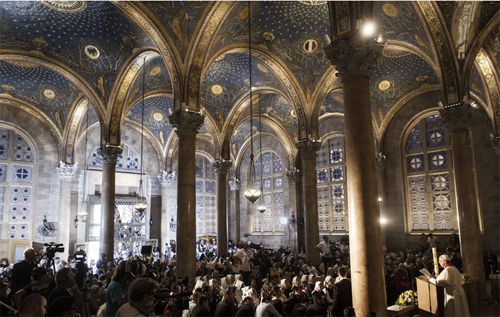
In 2012 I visited Jerusalem for the first time and had an amazing experience. I’ve long been a student of religious history, as it’s a subject that combines so many fascinating threads about human nature (psychology, culture, philosophy and more). During my visit I was struck by how little information the important sites in Christianity (as well as Judaism and Islam) provided to visitors about what they were seeing, and an idea for a book was born.
The premise: There’s so much arguing between religions, and perhaps even more within them. Wouldn’t it be great if there was some kind of religious referee, a person without any particular faith but knowledge of them, who could help sort things out? Or make interesting observations as an informed, and mostly respectful, outsider? That will be me (or that’s who I will be attempting to be). The book will combine my first person experiences visiting these amazing places, with insights from history, theology and comparative religion. It will be primarily a travel book about these important places, but focused on exploring deep questions about history, humanity, belief, and the past and the future.
The details: I’ll be in Israel in December spending a week in Jerusalem, observing and studying some of the most famous religious sites in the world. Chapters of the book will be subjects such as “Walking The Via Dolorosa“, “Watching at the Church of the Holy Sepulchre” and “Meditating at the Temple of The Mount“. This will be preliminary research and I’m not certain the book will come together, or if this rough outline will hold, but there’s only one way to find out!
Photographer: I’ve hired photographer Itay Cohen to work with me on the project, and we’ll be visiting the sites together. You can see more of his amazing work in his portfolio.
Researchers: The historic and theologic depths involved are enormous and to help me prepare for my visit, and develop the book, I’ve hired Nina Skafte (M.A. Religious History, Oxford) and Margaret Harris (working on PhD in Cultural History). More research volunteers are welcome, and if you have expertise and interest let me know.
Publication: I have no specific plans for how or when the book will be published. I may discover the concept of the book doesn’t hold together at all, who knows? I’ll make decisions about this after the research trip.
If you’re interested in this project, please leave a comment or contact me. It’s another big risk for me as an author and I hope you’ll at least support my willingness to take risks. I may set up a separate blog for the project and leaving a comment is the best way to get invited to follow along.
I’ve written many posts about religion in the past, and you can read some of the best ones here:
[THIS POSITION WAS FILLED. THANKS FOR YOUR INTEREST]
My latest book, The Ghost of My Father, is barely two weeks old but I’m starting research on another book. This time the topic is religion, architecture and place. The tentative title is The Atheist of Jerusalem. It’s a project I’ve thought about since my first visit to Israel in 2012, and I have a window of opportunity to work on it now.
The pitch: Jerusalem has important sites for three major world religions, and each religion has different claims about which buildings and locations represent the presence of the divine. Who would be best to arbitrate their claims? It would be an atheist, someone with no stake in any particular religion who could visit these places, make observations and ask questions the faithful wouldn’t think to ask. The ambition is to write a book that asks and answers important questions for both the faithful and the faithless.
The book: I will visit the major religious sites in Jerusalem, and write about the experience. What do I see? What questions do I have? What are the answers? What does it feel like to be a curious, well-read and mostly respectful atheist to visit some of the most religiously significant places in the world?
Chapters might include:
Walking the Via Dolorosa
“Praying” at The Western Wall (I’m of Jewish heritage, thus the quotes)
Watching at the Church of the Holy Sepulchre
Thinking at the Temple of The Mount
The book’s primary goal will not be a manifesto on religion or to debate theology, but instead to use the physical experience of visiting these places, and both their history and the experience of visiting them today, to explore the questions and answers they raise.
Help Wanted: Researcher(s)
I need one or two people who are experts at doing research to help me study the history of each site I’m planning to visit. Before I go (Dec 1st) I need to know how each site has changed over time, how the meaning has changed within the particular religion, and be prepared with specific questions and ideas before I arrive. The research goal is to provide me with a dossier for each location.
Ideally you’d have a background in religious history, religious studies, architecture or live near Jerusalem. The position would be paid with a stipend for the project and a major acknowledgement in the book.
Time commitment: a few hours a week through November and early December.
Help Wanted: Photographer
I need to partner with a local (e.g. Jerusalem) photographer who can come with me as we visit each site. The photographs would be central to the book, documenting what I saw, what the experience was like, how I tried to answer the questions I had, etc. As a local you’d possibly help co-ordinate the project logistics and intangibles I’m overlooking.
The position would be paid with a stipend for the project, I’d cover at least some of your meals, and you’d get a major acknowledgment in the book.
Time commitment: you’d need to spend a few hours a day with me while I’m visiting Jerusalem (first week in December).
How To Apply
To apply for either position, do the following:
Take a deep breath, they’re good for you. Follow this list carefully.
If you’re interested in research, explain how the Via Dolorosa’s location has changed (or has it?), with references. One page is sufficient.
If you’re a photographer, send me to your portfolio and list any relevant professional/documentary shooting experience. (Note: ideally you live in Israel. If you don’t live in Israel you’d have to be willing to go there first week in December.)
Tell me either the superpower you’d like to have, or your favorite meal (and why you love it).
Sometimes I have an idea for something I want to make. When I mention it to friends, I eventually hear “interesting, but odds of it working are slim to none” And I’ll think, yes, I agree. But the idea stays on my mind. Slowly I realize I want to do it anyway. I don’t care what the odds are. I want to see how close I can get to matching the idea in my head to something real in the world. I don’t need the project to succeed, in total, for it to be interesting. And if it fails it will be far more interesting, with many lessons to learn from, than a dozen boring successes. If I only did things that had high odds of success, I wouldn’t be successful.
This is why I have trouble with the question: “What would you do if you could not fail?” It’s a fun question for poking at the specter of fear, revealing how we limit ourselves before we event consider many ideas, but it’s limiting too. If I couldn’t fail perhaps I wouldn’t do much of anything at all. It’s often overcoming a challenge that motivates me. Being superman might be a bore. When people tell me the odds for an idea working are low, I consider that ideas with great odds are boring. I agree that going to school to study widget making to be a junior widget maker at WidgetCorp has high odds, but odds of what exactly? High odds of security perhaps, but if you don’t like widgets it’s also high odds of depression. Another popular saying is nothing ventured, nothing gained. A safe venture yields only safe gains, meaning a safe venture isn’t really an adventure at all. They say most businesses fail in the two years. That most books don’t sell many copies. Why is this surprising? The interesting things in life are hard. Do you want an interesting life? Then you have to accept different odds.
Of course we are lousy at predicting odds too. We assume all people are the same and have equal chances at the same challenges. We love to throw numbers around, pretending they grant us certainty of the future when we know they do not. Variables change. What seemed the safest choice one day might become the riskiest a year later. Evaluating risk is wise, but so is evaluating the risk of overvaluing that evaluation. Now and then you have to decide to do it anyway. That despite all the logic and rationalizing there is something in your intuition and emotion that needs to take this risk in the face of what all the numbers say.
For interesting ideas bad odds are far better than zero odds. A 5% chance at a dream might be as good as it ever gets. A lifetime of strictly 90% probable choices is a sad life for many people. Sometimes in life you have to take a 10% or 20% chance now and then just to know what a 90% choice really feels like, a sense you lose if that’s all you ever take. You learn something about yourself no one else can give you by taking a chance purely because you want to do it. And you keep the discoveries you make about yourself regardless of the outcome. You learn more about what failure means, and how to avoid it and recover from it, things you will need in life no matter how safe you play it. Taking a chance is also the best way to meet other people willing to take chances, who, I can tell you, are full of life in ways bored, safely successful people never are. The odds of your very existence were extremely bad – you’re already a fluke – why live all of your life pretending otherwise?
There is plenty of advice today about habits and how to change them. I’m no expert, and you can find plenty of well regarded books on the subject. While the topic hasn’t reached mainstream knowledge yet, I hope it does. Our habits define who we are more than our dreams do. All schooling is an attempt to change students habits, but we are never taught how to change them on our own. The fancy word to know is metacognition, which means thinking about how you think. This is a key element in changing habits and many other things about yourself, as thinking about how you make decisions is exactly what you need to change your own habits.
A better question is: how to get into a good habit. Framed this way you have positive psychology on your side, increasing your odds. A goal like “I want to lose 50 pounds!” is far too vague and negative, compared to “I want to eat a healthy salad for lunch 5 days a week.” That second goal is specific, positive and thoughtful, and easier to achieve. Start by defining the goal in something you can do on a daily basis and that is positive.
We like dramatic goals since it’s easier to get initially excited by them, but they’re too abstract. Because of their grandiosity we feel worse when we’re not making progress, not better. It’s easier to quit a goal that feels impossible than one that’s merely about a small decision we have to make today.
1. Get your own data
If you have a bad habit you probably don’t realize how often you do it. Start by simply accounting for your habits. Exactly how many Oreos do you eat per hour? How many times per day do you check Facebook? Have a place, on a whiteboard or on your phone, where you mark down every time you do the thing you’re trying to do less, or more, of. You don’t have to change your habits yet: that comes later. But for now build in awareness of exactly what your current habits are.
You might be surprised by the patterns you find. And the simple act of recording it might motivate you to do it less. Maybe there’s a habit you don’t even realize you have that sets off the habit you want to change. Perhaps it’s the time of day when you have the most stress that the habit is most pronounced? Or when you’re with certain people? This is data about you that no book or expert can provide: you need self-awareness if you want to change yourself.
And by writing down every time you do something you’re teaching yourself an important skill: how to form a new habit. Without even changing the old habit, you’ve put a new, healthier pattern in place. Give yourself credit for how many days in a row you document what you’re doing. Writing things down every day is an easy habit to learn: we all had it in elementary school. There are plenty of mobile phone apps that help with this.
2. Find A Partner
We are social creatures and many bad habits involve other people to share them with. Find a friend who has something they want to change, and partner with them. Websites like stickk and 43 things make setting and sharing goals with friends into a game. This uses the forces of peer pressure to push you in a direction you want. Many of our most common bad habits are done socially (drinking, smoking, overeating), but so are many of the habits we want (exercising, volunteering, connecting). Think through who in your life most contributes to your bad and good habits and shift how you spend your time accordingly, or even invite friends that you share bad habits with to join you or your goal for a better habit.
Simply being around people who are engaged in habits you want to adopt will change your perception of the habit and of yourself. Many of our deepest habits are learned from the most intimate relationships we’ve had: our families. You will feel differently about the daily walk around the block you are proud of if the people you like spending time with take a daily 2 mile hike. You’ll naturally want to participate, and it will be a nudge towards a habit you want that will feel good, not bad.
3. Pick smart rewards, not just old ones
Many people use bad habits as rewards: an extra cupcake, a third beer, or a four hour TV binge. Think about things you enjoy that are entirely positive, where the reward doesn’t work against the very goal that earned the reward in the first place. Experiences, like going to the movies or a play, make for great rewards since they’re about an experience you don’t often have but probably enjoy and can look forward to. The concept of a cheat day makes sense in it sets up a controlled escape valve for natural desires to experience old habits, .
4. Choose alternative behaviors
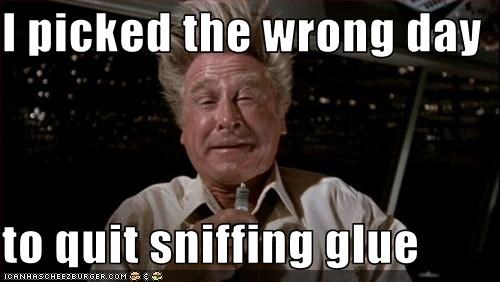
After you’ve made recording data a habit, you have to find alternatives. The joke of course is, like the Lloyd Bridges character from the movie Airplane!, it never seems like a good day to make a change. When under pressure we compulsively want comfort and that means our old habits.The mistake Bridge’s character made though wasn’t about the day he chose. It was about what his lack of forethought for feeling pressure to return to the old habit. He had no alternative, had no partner, and wasn’t recording data about what he was doing.
This is where the practice from #1 and #2 above come into play. If you have a partner, odds are they’re not experiencing a craving for old habits at the same time that you are. If you reach out to them they can help talk you through the feelings you’re having and sort them out without using the old behavior. If you’ve been tracking your habits, looking at the last few days or weeks of data will remind you how much you’ve achieved so far, and inspire you to stick with it another day. You’ll be reminded it’s not just about the moment you’re in – it’s about the long term, and it’s the long term view that made you want to try changing your habit in the first place.
It’s best not to depend on willpower. No one really has very much of it. The basic notion of a habit is to be able to do something without much conscious effort. Use the willpower you do have each day to do the simple things that will influence your behavior in the long run. It’s what you do each day that allows the natural pull of habituation to move you towards the behaviors and goals you desire.
We love to blame the world because the world can’t blame us back. I recently read Sarah Gooding’s article titled Drowning in Data: When News is Noise. She feels information overload makes it hard to cultivate creativity. It’s a sweet article and you should read it, even if I disagree. She writes:
It’s never been easier to be productive, but it’s also never been harder. With technology and a flood of information at my fingertips every time I turn on an Internet-connected device, my resolve crumbles.
There is a difference between how something feels and how something is. Of course life feels overwhelming at times. We all struggle to concentrate on what we want to now and then. But that doesn’t mean the world, or the technology in it, is accountable for our problems. Throughout history some people have struggled to be creative and to concentrate, while others haven’t found it to be much of a struggle at all. What explains the difference? I don’t think technology has much to do with it.
My theory is it’s best to think of information overload as a myth. As long as the things that distract you have an off switch, the problem isn’t the world, the problem is you. The world has always had far more information than we can consume, much less comprehend. The only thing that’s changed is our self-righteous stress in response to it. Consider these situations:
When you go to a concert with friends are you distracted by the crowds around you?
When you go to a bookstore, are you overwhelmed by the books you see?
When you walk in nature, do the thousands of plants & insects stress you out?
When you breathe, does the abundance of air in the atmosphere around the planet worry you?
There are floods of information at our fingertips all the time, even when you go camping in the wilderness or when the power goes out in your apartment. The same arguments about how mobile devices or social networks are overwhelming could be made about anything on the list above. But we don’t make those arguments about anything other than technology and media. Why? Technology is an easy target. It’s easy to blame. It reflects our product centric culture that it is products, and not ourselves, that are the problem. We imbue technology with god-like powers which gives us the psychological crutch of blaming it first. But we forget only we turn the devices on and only we can turn them off. Gooding briefly mention The Slow Web, but even this puts technology in the center ring. Your mind should come first, always your mind. Our minds excel at tuning things out. We tune out an infinity of information all the time.
Much of our talk about information overload echoes the excuses of addiction. We complain that the web is trash, yet we complain about how hard it is to turn it off. We crave, we habituate, we justify, and we get nervous and uncomfortable when we don’t get our fix. And when we fail and feel bad we blame the technologies, and the world, for our problems. We wonder “why is there so much information? Who did this to us?” when the answer is always the person asking the question. We’ve been well trained to consume far more than we need. Our apartments and garages are filled with things we never use, yet we feel guilt in getting rid of them. Instead we want even more things. And we feel guilt there too, but not enough to change our behavior. It’s wise to ask who benefits from all this negative energy around consumption. It’s probably not you.
We consume information the same way: our inboxes and reading lists are several lifetimes long, yet every day we go out and chase more for no good reason at all. It’s a paradox: we fear missing out so much that we miss out. We are compelled to be information fiends, hoarding it, feeling shame over it, feeling dopamine rushes when we capture new batches, conquests that only repeat the same pattern. There’s really no reason to worry about reading all the books you own but haven’t read, yet we do. Speed reading is shallow reading, and we know, as Gooding points out, that we want depth over volume. The problem is very little of our behavior is in line with that goal. But if you can’t make your behavior align with your goals, whose problem is it? Nothing stops you from reading The Power of Habit, except, of course, your habits. Maybe useful books of self-awareness like it sit sadly in your queue, as you’ve forgotten it’s only reading books that helps your mind, not the buying.
Gooding writes:
The Internet is a black hole of information, sucking me in with its digital distractions.
Socrates never said “I’d do great work if I didn’t have philosophy overload from hanging out at the agora.” Emily Dickinson didn’t complain of vocabulary overload in the English language. Picasso, Da Vinci, Tesla and Marie Curie all possessed amazing curiosities and could have easily been distracted away from their work by the abundance of sex, food, conversation, money, news, books, and paintings in their lives. Yet they worked. They produced. Van Gogh was mad and starving and produced. Every generation has had its grand distractions. We forget ancestors painted on cave walls, as the struggle for survival didn’t stop their creativity. Bukowski was a drunk and a bum in nearly every sense of the word, yet wrote and wrote and wrote even more. With as little as he had, he sacrificed his time, and arguably his life, in the service of his ideas. What are you willing to sacrifice to create? If you don’t sacrifice something, it’s the creating that will be sacrificed for you. For our grandparents it was radio. For our parents it was TV. For us it’s the web. For our children it will be something else. There is always a justifiable distraction but history does not give you a pass for the ideas you let yourself get distracted away from.
As a writer I have days where no matter how much I want to work, I’m unproductive. I know it comes with the territory. I know my daily habits are a shield and my passion and love for ideas must fuel that shield and make it both stronger and more flexible. But I’m human and sometimes my habits fail me or I them. But I will never blame Netflix, or Twitter, or a phone, for the same reasons I would never blame the wind or the sky. It’s up to me to gain control over my mind. It’s my job as professional to take responsibility for both the inputs and outputs of my brain. It’s the willingness to work, over months and years, to make my mind an ally in my pursuits and not an adversary. But the first step is to stop blaming the information or the world. The world and the technology in it has never been the problem and as long as every device we use has an off switch, it never will be.
If you feel like you are drowning in data, stand up. Stand up for yourself and own your consumption. You’ll discover when you stand that you’ve been “drowning” in a kiddie pool all along.
The resurfacing of Woody Allen’s past is sad from many perspectives, amplified by how a daughter and a family are still struggling, very publicly, to deal with events that took place decades ago. I’ll leave the conclusions for you to draw, as my question in this post is a practical one. Should you ban an artist’s work based on their personality or unethical behavior? Assume for the moment that the worst, however you define it in The Allen/Farrow case, is true – what does that mean about Allen’s work?
If you ban art because of the artist, it follows you’d ban engineering because of the engineer. So turn that electricity off. Stop driving that BMW or Volkswagen you love. Drop that iPhone. Ban the use of genetics in science. Oh, and if you’re a designer, stop using Gill Sans, as Eric Gill, the font’s designer, admitted to sexually abusing his own children (and a dog).
Banning the work of someone you despise is far easier to do while in ignorance of the hundreds of created works you used every day with no knowledge about their origin. Scratch the surface and you’ll find multitudes of dubious characters behind the things you love and depend on.
Banning things is a negative act. It’s intended to hurt someone, or prevent something, but it does little to help other people who may have been, or will become, victims of the actions you despise. Banning things often gives ideas and their creators more power, not less, than simply ignoring them or, more progressively, taking actions for positive change against the thing you think is wrong. Banning Chick-A-Flick because the owner is a jerk does far less to help equal rights than volunteering your time or money to help one of the many groups actively working for positive change.
Instead of banning Woody Allen, or whatever creator you have issues with, do something to support organizations working for progress on the issue you care so much about. In the case of Dylan Farrow, you should support groups like RAINN, a charity that helps children and families victimized by abuse. This will do far more good for the world, and for you, than banning hundreds of works ever could. The act of banning is stuck in the past, instead take actions that help the future.
When was the last time you changed your mind about something important?
As children we changed our minds frequently since we were continually exposed to new experiences and were encouraged to learn new things and consider different ideas. The very goal of education for children is to accelerate the reconsidering of assumptions, providing tools for asking questions and finding good answers.
But somewhere in adulthood we find a career, or a circle of friends, and the rate at which we change our minds slows. We settle in to past positions and spend more time defending our old beliefs rather than exploring for better, more refined or more informed ones. There is infinite knowledge out there, but we give up on the habit of growing and choose comfort and familiarity first.
William James said “A great many people think they are thinking when they are merely rearranging their prejudices.” It’s easy to fake due diligence in our own minds that we’ve vetted new ideas. We allow confirmation bias to mask the difference between shallow inquiry and a serious reexamination of ideas we’ve held on to for longer than we can remember.
As social creatures there is great pressure for us not to change our minds and not to keep learning. The older we get the more we and our peers value tradition, and tradition of any kind resists change. We learn to take pride in being loyal and consistent which is at odds with progress, growth and learning. We get better and better at ignoring the many wise people who believe something different than we do, dismissing them for no good reason at all.
Emerson wrote “A foolish consistency is the hobgoblin of little minds” and he meant that he saw little reason to stay consistent with his past self. He believed if he was continuing to learn and experience, his opinion on some matters should continue to change and he should be worried if they stayed the same for too long. Being inconsistent with who he used to be was necessary if he wanted to be wiser this year than the last.
Age 8: Superman, Santa Claus, Tooth Fairy, Easter Bunny
Age 11: God, Angels. Miracles. Money isn’t important for happiness
20s: Reincarnation, Ghosts, People are mostly rational, Unquestioned patriotism is a good thing
….
Regardless of what you think of the specific items on his list, it seems a great exercise to make a list like this of our own.
When was the last time you changed your mind? What do you do to keep foolish consistency at bay?
Examples – 2 lanes of checkout on a busy day. Automated parking systems that break down with no backup. Sitting in traffic for over an hour each way to get to work. It’s madness yet we accept it as the way things are.
The easy answer is we’re lazy. It takes energy to reject a system, especially if it’s a complex system you do not control. Sitting in traffic is not an active choice, it’s a passive decision that comes with the choices for where to live and work. Like waiting in a long line, it’s far simpler psychologically to plod along with your head down, than to challenge the dozens of people in front of you who may have no objections to lines at all, or worse, diverging ideas for what the alternatives might be. It takes courage to challenge a system and wisdom to improve it, a rare combination.
The depressing answer is some systems are difficult, or impossible, to change. Even if you were sufficiently motivated, problems like traffic operate on a large enough scale, with multiple conflicting objectives, that it might not be solvable. Certainly not without the cooperation of many other people, some of whom benefit from the inefficiencies you find frustrating (e.g. the land developers who profited by overpopulating an area).
For all frustrating systems ask: Who benefits (Cui Bono)? That is the first step to understanding how a system truly works. There are always people who benefit more from a system staying the way it is, and as long as they are in power nothing will change. Any hope of improving a system starts with understanding the reasons forces are actively protecting the status quo.
The stoic answer is that all systems are designed, and all designs are tradeoffs. They are good for some things and bad for others. There is no perfect system, and even if there were, as soon as the world changed in a significant way the same elements that made the system seem perfect would suddenly become a frustration. Gas powered cars seemed a wonderful idea in 1925, before anyone could imagine global warming, rush hour traffic, or fatalities from drivers distracted by text messages on their phones.
The relative answer is: bad compared to what? We naturally take good things for granted since there are evolutionary advantages to constantly seeking to improve one’s situation. But for any bad system, go back in time. What was that system like 10, 20, 50, 100, 500 years ago? In some ways things will seem better, but in many ways that older system will seem worse. It’s better to wait a few minutes in poorly managed checkout lines at the grocery store, than to hunt and gather all day long with little guarantee of having enough to eat.
The positive answer is that many people do reject bad systems. They make sacrifices to give themselves the power to avoid systems they find distasteful. With sufficient motivation and the willingness to make tradeoffs, many modern frustrations can be avoided or minimized. For deeper systems, they protest in public to draw attention to how a system is failing. They complain to representatives in the system and try to influence them to prioritize change.
What “bad” system bothers you the most? Leave a comment.