Thanks to everyone who left a comment or sent me email in response to the previous burnout post. I’m grateful. I felt I owed you an update and here it is.
The unexpected entertainment of expressing an emotional experience is how surprising people’s responses are. Some are too concerned. Others not enough. Some don’t know what to say, so they grasp at what’s familiar and share that. Some don’t know what to say and stay silent. Others admit they don’t know enough and simply ask what they can do to help. It’s fascinating how when you’re real, the best people are real right back. And when you haven’t been real for awhile with someone it takes time for both people to calibrate where exactly the other person is coming from.
I’ve rediscovered how easy it is to shake myself and others out of a worn out routine: just be completely honest. Honesty is the easiest way to make life interesting. It’s the basis in part for why improv often works so well and regular life does not.
In short I’m doing fine. I’m not in a rut exactly. I’m not even really burnt out, and wasn’t beyond the first few days (which was now several weeks ago). Part of what I didn’t convey well in the first post is paramount: I now have a lack of conviction that I have to continue to be productive to be a good or happy person. There is a faith we share in society, an unquestioned ideal, that we must work hard and be successful to be good people. I don’t believe this anymore or at least not as much. Many people have told me “don’t worry you’ll get out of it soon” but what they don’t understand is I’m not sure getting out of “this”, whatever it is, is progress. There’s something here I can learn or need to figure out first.
George Carlin has a joke about motivation and the American self-help industry. He didn’t understand how you could buy a book to get motivation. If you’re motivated to buy the book, why not just use that motivation to do the thing itself? He goes on to point out that some of the worst people in history were highly motivated: Genghis Khan, Stalin, Hitler, Pol Pot. Books about motivation and productivity never mention them. Maybe there are more important questions to ask ourselves than how productive or successful we are or are not?
Maybe it’s not so bad to be unmotivated if you’re not hurting anyone else. The slacker who spends all day on the beach, or the bum in the park, does less damage to the world and the people in it than many CEOs and heads of state. Maybe it’s more important to do things that don’t earn as much money or prestige but that matter far more to the people you do them for? Or simply cause no harm? These are big questions, I know, and it’s much easier to only ask the little ones.
So many of us drive ourselves and our families into the ground chasing the modern version of a rat race. It’s a largely technological race now, but the results for all contestants is the same. We chase a made up idea of what success looks like, an idea shaped by corporations, religions and television, that’s defined by what’s easily measured, not what matters most. We’re so invested in the game we never stop to notice how miserable the personal lives of many of these “successful” people we’re chasing actually are. How much emptiness they feel and how productivity and what’s easily measured is the only way they know how to fill, even if temporarily, that void inside. Many legendary people were assholes, even to themselves, and I’m not sure it’s a worthy trade.
I still plan to work. If I’ve promised you something I will get it done and do a good job. I won’t disappear. But perhaps what I’ve achieved is I don’t mind taking it slow. I hope you don’t mind either. I think I’m learning something. But I’m still sorting myself out and I’ll share more when I have it together. Thanks for reading.
I’m ten days into the worst burnout of my life. I’ve discovered, in times like these, it’s a challenge to answer the seemingly simple question: “how are you?” The polite lie is what most people want, and that’s fine, but when you say enough polite lies you soon lie to yourself too. Out of my own frustration I’ve started surprising people with honest answers. Perhaps I’m just bored with the lie, or maybe I’m hoping honest conversations with people I don’t know that well can help free something stuck inside me. I know that burnout, like its older and more dangerous cousin depression, is a serious thing. And most people, most of the time, are terrified of talking about serious things. I want to talk about mine. I’m not afraid and I don’t want you to be afraid either.
Eleven years ago I wrote How To Survive Creative Burnout, back before my first book was published. I reread the post this week and there’s valuable advice there. If I think of my creative motivation as a horse, it must be rested in a fair ratio to how hard I work it, especially if I expect the horse to work well for many years. But somehow we imagine our minds as transcendent, free from the natural balance of work and rest. We know crops must be rotated and seeds take time to grow. But in our work centric culture to admit to anyone, much less ourselves, that we’re past our limit comes with shame. It’s part of the cult of busy we live in. And as with all emotions it’s the feelings we have about our feelings that do more harm that the initial feelings themselves.
My past burnouts have lasted just days. Two or three times a year I’ll fall out of rhythm with myself. I’ve been there enough times that I even have a routine. I stop all work, and reschedule meetings, so I can have a day or two where I’m doing as little work as possible, possibly none at all. Free to do anything, or nothing, as I choose. My chosen career requires some significant sacrifices, but a major benefit is on most days I answer to no one. When I need time for myself it’s there for me to take it. Sometimes I’ll spend more time with friends and try to recharge from their energy. Often I go see a matinee film or two, or perhaps a long walk or a marathon of video games. My wife knows I’m in one of these phases when she comes home from work and finds me on the couch, a place I almost never visit during the day, in a position so deeply nested into the cushions it looks like I was absorbed into the furniture.
But as I write this I’m more than a few days in and my standard routine has only had limited effects. I’ve thought about it hard and there was no acute trigger. Nothing specifically bad has happened to me recently. And this is where talking about burnout, or depression, with people becomes frustrating for everyone. We want a singular reason, a primary cause. Most people want to help you find the thorn in your side and take it out, and when you express there is no singular thorn, the script they know is useless. Instead of a bad day or a major rejection I simply feel a slow grinding away of something important has taken place. Something big and heavy that I need has moved and there’s no quick way to move it back.
But I am successfully past the judgements of myself: I stopped feeling bad about feeling bad. It’s OK for a time to be very far from my imagined potential and to be far away on purpose. It’s OK to grant myself patience. It’s OK to vacate. I don’t have to like it completely, but I do need to do it. Reading through my journals I realize I’ve been on my own as a writer for a long time now, without the morale benefits of working on a team, or the security of a steady paycheck. Maybe I need a new circle of creative friends. Or I need to do collaborative projects where I have a partner or two to share everything with. Perhaps there’s a five year or ten year habit that I need, something like what Sagmiester calls a creative sabbatical. I don’t know yet. I doubt there’s one thing alone I need to do. Perhaps this new challenge will just work itself out or I’ll have to find some new habits, short and long term, to keep on working towards my life goal.
Over this week I’ve thought much about who I am and what I’m trying to do. It’s a pleasant surprise that when I shut things down and take more deliberate time to play, rest, wander and ponder, that I slowly make realizations I’d be unlikely to make any other way. I hate the phrase “things happen for a reason”, but I do believe when something happens I can put effort in to make meaning from it.
I know that for most of my my life I’ve found it natural to care about ideas enough to chase them. I’m often described as intense or passionate and I take those words as compliments. My motivation is not accidental. I believe certain things should be done before I die and that belief sustains me. This belief has been my preferred fuel for the hard work of writing a book, preparing for a lecture or doing anything interesting at all.
But that fuel hasn’t been consistent lately. It fades easily. I’m more prone to false starts. Apathy is friendlier now and familiar. It’s a frequent struggle to stay motivated. And unlike the burnouts I’ve experienced before I find myself asking the question: “so what?” Why is working so hard important? Many people who are continually productive are miserable, or worse, produce little of value. Maybe it’s better to live a life where you work only as much as you need to, so that there’s more time left for living? I love to work hard but that’s not all that I love. And given I have a fulfilling, fun and comfortable life, I must decide if what’s going on for me is a problem, a blessing, or some of both. I don’t know yet what it means or what I’m going to do about it, but wanted to share it with you anyway. Knowing how many of you read my work for the honesty I offer it seemed only fair that I share this with you while I’m in it.
Thanks for reading. Words of encouragement are welcome. Better would be to share a story of your own burnout experience. We all, legends included, have our times with too much fire and not enough. And maybe if we share those stories openly we can help each other along.
My next book is a departure and a risk. If you want to understand why, read the goal of my life explained.
I’ve been asking questions about fathers and sons my entire life, which makes it no surprise I’ve had a difficult relationship with my father. He is not an easy man to know, but as a child I didn’t know this. And as it is with all families, you can only see your family for what it is once you leave it and look back. It wasn’t until my twenties, when I moved away and started my own life, that I began to understand both myself and my father and began the work of unpacking our relationship, as broken as it was. So many of the feelings I had about myself weren’t really mine, but feelings I learned to have to try and fit into his world.
My next book, titled The Ghost of My Father, is about this relationship. Particularly the events of the last two years where he, at the age of 70, has chosen to abandon his family. It seems he was never quite happy with his life, or with us, observations he never shared until this last chapter where he tried to move away and start a new life. He had an affair once before while I was a child, with disastrous consequences for the family. And now I find waves of memories, feelings and thoughts from that time have been brought back to the present, memories and feelings that demand being reckoned with.
We think memory is stable, but all my memories of my childhood have shifted dramatically. Different stories from my past now seem far more important, and ones I thought were important now don’t seem to matter at all. I’ve returned to my journals, sifting through to look for more insight into why these memories are with me now, and others are not.
“Memory seems to be an independent creature inspired by event, not faithful to it. Maybe memory is what the mind does with it’s free time, decorating itself. Maybe it’s like cave paintings. The thing is, I’m old enough now to know that the past is every bit as unpredictable as the future, and that memory, mine anyway, is not a faithful recording of anything, and truth is not an absolute.” – Abigail Thomas, Thinking About Memoir
Last night I watched the film The Return, about a father who returns to his two young boys from a mysterious ten year disappearance. There was something epic about the tones of the film and how fathers factor in many children’s minds as a powerful, ambiguous, possibly unknowable creatures. Certainly not all fathers are like this, but many are. And few of us have the courage to dig into the hard ground of our childhoods, despite our disappointments with our parents, to sort out who we are and who we want to be now that we’re not children anymore.
This 6th book will be my most personal one so far.
If you want to be notified when the book is out, signup here.
If you’re interested in this book, leave a brief comment (“I’m interested – go Scott!” works fine). I’ll be in touch as the book develops and is published. This blog won’t be shifting to be primarily about this project, so leaving a comment makes it easy to stay in touch with you.
And of course films, books, and other stories you recommend I read are welcome too.
If you have a related story to share about your relationship with your father, good or bad, I’d be grateful if you left a comment or sent me an email.
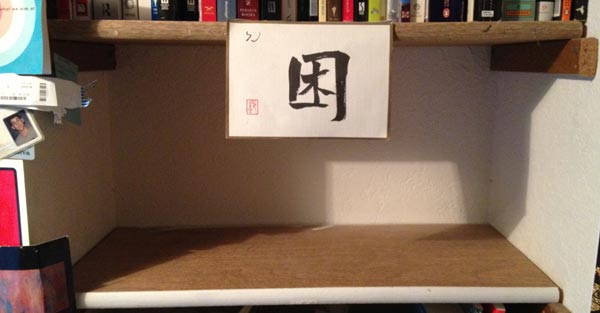
The photo below explains my ambition: I’m working to fill this shelf with books I’ve written. I want an interesting life which requires doing unusual things and having unusual goals. This is mine. Will I achieve this? I really don’t know, but in having this goal I believe I’ll live the kind of life that I want. What’s your big goal? How do you remind yourself of what it is? I find both these questions fascinating and I thought I’d share my answers as it might be helpful to help you figure out yours.
When I quit my first career as a tech manager in 2003, I primarily wanted to try another way to earn a living. I was afraid if I didn’t try I’d have the same career forever and that scared me. What else is out there? I felt I owed it to myself to try and see what I could possibly do and who I could I might become. I was lucky that I had a window of opportunity to try (no kids yet, little debt) and thought those that don’t would probably tell me I was foolish not to take a shot.
Books had changed my life many times and I wanted, hopefully, to write books that helped other people in a similar ways. Since I saw the shelf many times a day (it’s to my right as I type this) I decided it was the perfect spot to have some kind of reminder. Even when I finished a new book, the reminder would always be there. When my first book was published in 2005 I put this simple photo above on the author bio page.
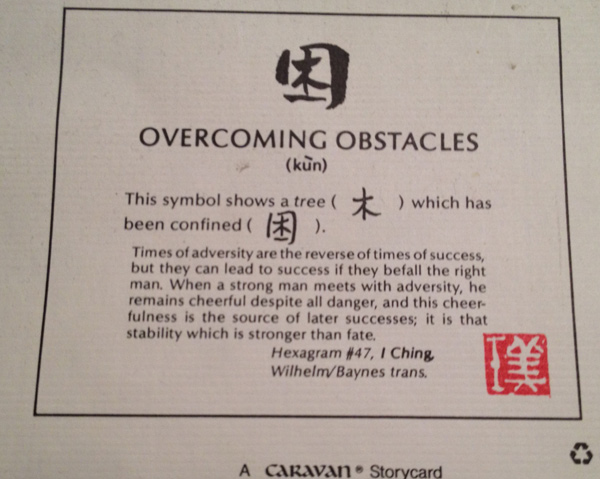
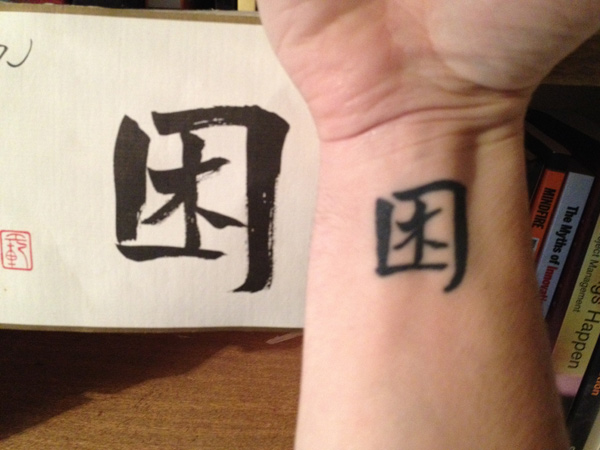
It’s a cliche for Americans to swoon over Chinese symbols, misunderstanding what they mean and not bothering to study their meaning or context. As my Chinese speaking friend Jeff likes to joke, “Uh, that symbol tattooed on your arm doesn’t mean Great Love, it means soup dumplings.” I did my homework and understand its legitimate meaning (often used to mean sleepy, or something that’s kept hidden or locked away), but it also has a specific meaning to me.
Around the time I decided to quit, which took me over a year to work up the courage to do, I found this card at Uwajamaya in Seattle around the time I quit my job. I liked what it claimed the symbol meant (see below). I love the quiet strength of trees and it matched how I needed to be to reach my goal. The I Ching references the symbol as Hexagram #47, which has various meanings, including the one on the card. I’ve learned in common Chinese the symbol/word is often used to means confinement (one of the other meanings suggested by the I Ching), trouble or sleepy more than overcoming, but that’s OK. The symbol has adorned my shelf for so long it means something specific to me regardless of its common meaning.
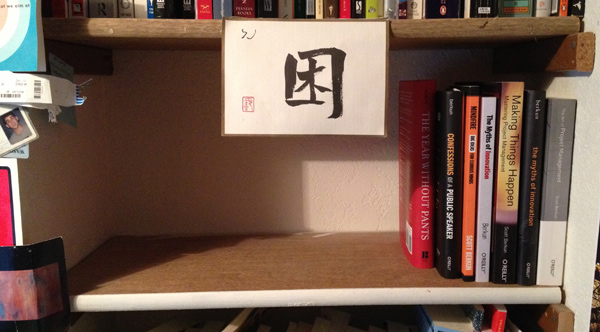
Years later I’ve written 5 books, [8 as of 2020], and the shelf looks like this (see below). I have a long way to go. Translated editions don’t count, as that’d be cheating, right? I’ll need to write about 25 books to fill the shelf which will likely demand most of my working life. That’s fine. I have nowhere else to go and no goal as meaningful as this one.
Although it’s a volume goal, I have no interest in writing bad books. I also have no interest in writing unnecessarily long ones. My essay collection Mindfire is comprised of revised essays from this blog, but I’d feel it was cheating if most of the shelf was recycled material. One book in five seems a fine pace for compilations and such.
Occasionally I’m very fortunate to have people interested in hiring me for very nice conventional jobs where I’d have more security and income, but then I look at the shelf. More security and income are desirable, but they have limited bearing on my ability to fill the shelf. So as tempted as I might be, I say no (The Year Without Pants was a notable exception). Writing and speaking are my only means of income.
Another reason I like this goal is writing books demands many things:
Polymathic thinking
Study
Curiosity
Passion
Connecting with friends and colleagues
Making new friends and relationships
Commitment to an idea
In the process of writing a book I’m forced to do many things in line with the kind of life that I want: An interesting one. As long as I focus on the shelf, many other good choices are forced naturally.
Most authors repeat themselves, writing the same kind of book repeatedly. The marketplace rewards familiarity and a writing life is hard enough, so I understand why it’s common. Many of our most popular authors publish in narrow ranges. This is wise and lucrative, but also limiting (the most curious perhaps are authors who exclusively write about creativity, which in a way is not very creative). I’m taking the opposite approach for as long as I can. I’ve never written a sequel, because we all know how underwhelming sequels often are. I have no shortage of ideas for books and I’ll keep moving forward until I’m forced to be more conservative, if that’s even possible.
I want to be a writer in the largest sense. I want to be an artist. I want to take big risks with my skills, which will help me discover exactly what abilities I have or don’t have and what good they can do in this world.
Last year I got my first and only tattoo. It serves as an additional reminder to me about why I’m here and what my goal is. I’m a writer which means I work with my hands. I wanted to keep the symbol with me, near my hands, all the time.
That’s my story. If you see me speak and notice the tattoo, now you know why it’s there and what it means.
Follow As I Chase The Goal
Any encouragement is encouraged. Praise the crazy writer man! And thanks for supporting my work. Best wishes to you on your own goals.
I’m 41 years old today and I never expected to live this long. Although I’ve spent more time in hospitals than I’d have liked, my lifespan expectations were not born from a specific reason. I simply recall as a teenager imagining the totality of my life and somehow those imaginations never got far past 30. There just didn’t seem anything beyond that point as far as I could tell. My horizon ended there and now to reach beyond it is a pleasant surprise.
I don’t know why but as I’ve entered middle age I’m filled with giddiness. This all seems like a bonus round. I have my health and some of my sanity left. I say some, as I find most of adult life comically absurd. Voltaire wrote that “God is a comedian playing to an audience afraid to laugh” and I don’t seem to have much fear in that regard. Here in the first world we are so lost in distraction and pretense that taking most of what goes on at face value is something I’ve long shed from my experience of life.
7 months ago I tore my achilles tendon, but yesterday, after months of physical therapy, I was able to play basketball again for the first time. It’s a miracle of modern medicine I can walk without a cane, but to play is magical. And it’s magic purely for me. No one on the court knew my story. Kids half my age just saw me smiling and had no idea why. And I find myself seeking others who have similar smiles, a smile they don’t need to explain, a smile unhinged from the weather, or a job, or other trivia, a smile from somewhere deep inside that reflects their appreciation for the amazingness of ordinary things. Being alive, compared to the alternative, makes everything extraordinary.
And having lived beneath my means, provided I don’t do anything impressively stupid, I should be able to spend the better part of my remaining years doing what I’ve been doing for the last ten: living the life of a writer. I’ve made many sacrifices to get here, but it has held the deepest meaning for me to try and fill that shelf. I’m doing everything I can to make this dream last as long as I do. And I hope you’ll continue to help that dream simply by reading and following along.
Many people my age or older half-joke about wishing to be younger. Wishing to be young is a coward’s wish. People who wish to be younger would squander that miracle. They’re wasting the time they have now pretending they’d make better use of a different now. My soul fades in these conversations, as the souls of these people are already dead. They’ve buried their dreams under so many copouts they can’t tell the difference. I used to make the arguments, but I’ve learned they don’t want to hear them. They prefer the certainty of a fantasy, to the uncertainty of living fully in the present. The same cowardice that failed them the first time around would only fail them again if they had a second chance. And as I age I wonder: how am I still a coward? What would I do if I had the courage? Getting older makes me more courageous as I have far less to lose. Courage is far scarcer and more important than youth, and the upside is you can always grow more courageous, at any time, at any age.
America has a youth obsessed culture, but I’m slowly taking arms against it. The longer I’m alive the further I’ll be on creakier end of the bell curve of age, and I better get used to it. I’ve learned to be comfortable as the oldest person at the table now. I can learn as much from younger people as they can from someone older. I’m fascinated by young adults, old enough to be on their own but young enough to passionately chase their sky high ambitions.
I don’t envy their age, as they have so much to learn about what they want from life, but I’m drawn to their openness to the present. They make big bets on life, bets people my age are terrified of making, and maybe always were. But I have many big bets I still want to make. We are social creatures and behave like those we choose to be around, and I’m thinking I don’t want to act my age. I don’t want to hang out with my ‘peer’ group. The peers of my soul are not the peers of my generation. I find my mentality, despite my age, is far younger than my body and I hope it stays that way forever.
Three weeks ago I tore my Achilles tendon playing basketball. Just like a well worn rope that snaps from being pulled too hard one too many times, it tore completely during my regular basketball game at the gym.
Everyone asks “what happened?” assuming there must be a grand story, like I reverse dunked over three people but misjudged the landing, or hit a game winning shot from half court, but someone fouled me hard, causing the injury. There wasn’t. It was entirely boring. No one touched me. For those who saw it happen, they saw me push down on my right foot to cut to the basket and I simply fell over as if a ghost had swept my leg from behind. It looked funny and harmless, as if I had forgotten where the floor was and tripped over it, surprised it was there. NBA star Chauncey Billip’s tore his Achilles the same way during a game last year, as you can see in this video.
I’ve played competitive basketball my entire life and know my body well. Sitting there on the court in mild shock, holding my ankle, I knew something very bad had happened. Since that day I haven’t been able use my right leg for anything, which has been surprisingly traumatic.
Of the many serious injuries a body can suffer, the repair for this one is simple, if slow. The loss of use of my leg is temporary: 4-8 weeks. They surgically reconnected the tendon last week (see photo), and with rehab and care I can likely play basketball again in 5-7 months. Despite the impermanent nature of my injury, it has had some permanent effects on how I look at things.
Here’s what I’ve learned. These may be obvious to you but these were new, or humbling reminders, to me:
Disability is isolation. I can’t drive. If I can’t drive, I can’t go to the gym each day. If I don’t go to the gym each day, I can’t stop for coffee or at the bookstore, or meet a friend for lunch, or a dozen other little daily habits that keep me sane. I don’t live in a convenient place designed for this kind of thing. I’m self employed and write from home. I’ve had to find new support systems to make my life work.
Everything demands minute planning. I generally cook for myself and love to do it, but now my kitchen is a logistics nightmare. When on crutches, you lose use of your hands. Without hands you can’t carry anything. Normally, to make a meal requires dozens of thoughtless trips from the refrigerator to the pantry to the stove and back. Each one of those trips is an exercise in logistics now. Going to the bathroom, taking a shower are all long sequences of thoughtful acts that must be planned.
I see everything in small terms. We all forget all the little things our bodies do when we run down the street, or throw a frisbee. When something breaks, those seemingly simple tasks become complex. Every action has to be planned, considered, tested and carefully executed. Rehab is relearning. It takes me forever to get around the house, or to get from a parking lot to a store. I’m attentive, for better and for worse, to the small. My ankle will have to relearn all the basic things we expect our ankles to do for us.
100 years ago I’d be crippled.While the surgery is simple by today’s standards, 100 years ago I’d be walking with a cane the rest of my life, if I could walk at all. Grateful to the universe for being born at this time.
I’m connected to wheelchairs, handicapped parking spots and people who need help. I notice all these things because at the pace I’m able to travel, my companions are other people with issues the world isn’t designed for.
My mind follows my body. I’m a productive writer because I have a healthy body. I go to the gym nearly every day to clear my mind and let my subconscious work on problems for me. I haven’t been to the gym in almost a month. I’m still struggling to find a new way to balance stress and find physical relaxation.
I’m sad about the prospects of losing basketball from my life. It will be a long road to recovery and there are no guarantees at what level I’ll be able to play. Basketball is the place I’ve learned most of what has made me successful. But sorting out what’s possible and dealing with my feelings about it are so far in the future, and I’m dealing with so much in the present, that I have no choice but to postpone worrying about it until I’m there.
I’m always grateful for people and things that get me to think and this experience definitely qualifies. I’ll be looking at the world from a different perspective for awhile. If nothing else, I’ve always been a fan of mythology – I now have a permanent scar connecting me with the legend of Achilles!
Some things I miss:
Having a diner a block away that serves breakfast until 4am
A nearby playground where there’s always a good game of basketball
Meeting my friends early at school to play Salugi in the park
Running to the pizza place near my elementary school, for lunch, where you’d get a slice and a soda for $1
The undeniable sense life is unimaginably long
The freak show of White Castle on Northern Blvd and Bell, at 2am on a Friday
The convenience store that sold us 15 year olds all the beer we wanted
Talking to close friends for hours without an excuse for why
Playing football in the streets
Crusing Franny Lew, just to make fun of other people who cruised Franny Lew
The ethereal sense of abundant undivided time
Watching summer thunderstorms at dusk, raging on the horizon, above the street on my parents porch
Many of my friends make fun of me when I complain. They tell me I’m living the dream. And in ways I am. I do what I love, writing and speaking, and make a living from it all on my own (thanks to the help of readers like you).
But as an expert for hire type guy, one natural concern is how few experts actually do the things they write and talk about. Many famous gurus in many fields haven’t done the thing they write or speak about in years, if they ever did it at all (see how to call bs on a guru). I’ve always thought it’d be smart at some point to get back in the middle of something for awhile – do a sanity check on how much of the advice I give to other people I practice myself. Plus learn new things, face new challenges, to boldly go where… and most important perhaps, work as part of a team of people where I have something deeper at stake in the outcome. Wisdom accrues when you have the guts to dive into the thing you keep wondering about and see what happens.
As of this week, I’m an employee at Automattic – the company that hosts and maintains a popular instance of WordPress, among other things. I’ll be working as a team lead on wordpress.com (one of the top 20 websites in the U.S.). I’ve had sweet offers for jobs here and there over the years, but nothing came close to these folks, which is why I said yes. If I’m going to jump back in for awhile, these are the best people in the world, and one of the most important projects, I can imagine doing it with. It’s a distributed company so my dogs won’t even notice the change.
This news won’t change your experience here or, hopefully, what you think of me. I’m still a writer, and I’ll still be writing and speaking, and new books are in progress (I still have a shelf to fill). Of course everything I write here is entirely my independent opinion. But transparency is good practice and I wanted to make sure I shared all this with you.
Hope you’ll wish me well.
My friend and artist Teresa Brazen ran an interesting project, called “What moves you?” She asked various people what gets them going. Here’s what I wrote:
I know this sounds morbidly strange but when I’m bored or frustrated or out of sorts, thinking about dying has a surprisingly positive effect on me. When I realize I will die someday, and try to visualize it, imagining the notion this will all be over, my senses vibrate in a way I can’t explain. It’s a crapshoot to be alive at all, and here I am, born at a time and place where I have a million choices, I can read any book, see any movie, visit any art, make, do and feel more things than 99% of all humans that have ever lived, it’s all there waiting for me, right NOW. Confronting the notion of the end of my own life, as far away as I’d like that to be, is one of my most reliable ways to feel moved in the present. To sit and watch TV or wallow in my own hubristic complaints seems unbelievably dumb. And I don’t like to feel dumb.
Kafka wrote “The meaning of life is that it ends”. Every one of my choices matter because I won’t have them forever. Jim Morrision said “I want to get my kicks in before the whole shithouse goes up in flames” and Horace wrote “Carpe Diem!” If I’m not getting what I want out of my life while I’m alive, or giving to those in need or who I care about before I kick the bucket, when the fuck do I expect to do it?
So there it is. I confess, I’m moved by the idea of my own death. I want to die regret free and the thought of confronting my last moments and having to justify being bored with my own life to myself as I die compels me to make, and passionately appreciate, the choices I make in the now.
What moves you? Leave a comment. If I’m moved by what moves you, I promise I’ll reply 🙂
Thank you for a great presentation. I noticed that your energy was explosive and there was absolutely no point in the presentation where I could detect a lull. I am interested in learning if you have any secrets or techniques in maintaining the focus of not just the audience, but also yourself as I often space out even when I am working on something that I am passionate about.
Explosive energy makes me think of being a drummer in Spinal Tap. Perhaps I should tone it down.
There are four things going on.
My life is at stake. I have bet I can make a living on my ideas and my ability to express them. I have no guarantees, no salary and no pension. Every time I write a blog post, a book or a give a talk I’m basically an entrepreneur. I’m not half invested. This isn’t a side project. THIS IS IT. I need people to buy my books, hire me to speak, and to tell others about me. When you’ve invested your heart in something, it’s much easier to appear passionate about it, because you are.
I believe what I say. I really hate phony people. I hate people who water things down, intentionally mislead, or pretend they care about things they don’t. How much of what is said at work do people truly believe or care about? I think very carefully, and long, about most of what I create, and so when the time comes to give a presentation, or write a book, my points are things I truly believe. And I’ve worked hard to make them concise. I’m not holding much back because I know it’s easier to get excited about things you deeply believe, especially if they’ve been boiled down to their essence. If you asked me to talk about my favorite tax software, or which 401k forms I liked the most, passion would be hard to find.
I’ve extended my range. If you can only play one note on your guitar, you can’t do very much. Musicians, especially singers, practice to extend their range. Most speakers have a narrow range. They only know how to get from volume level 4 to 5. If you practice, and listen to other great speakers carefully, you’ll notice how wide their range is. They can whisper (volume level 2) or almost holler (volume level 7). You also have a range of gestures, and postures, and facial expressions. The wider your range the more tools you have to express passion, or curiosity, or humor, or anything. You extend your range through practice and coaching. I never want to be too passionate, as it’s easy to sound like a preacher on cocaine or Billy Mays. Instead my goal is to be at high level of enthusiasm without crossing over into annoying.
I have great respect for anyone who voluntarily listens to me. Speaking and writing are very subjective, and I know that reasonable people might not like me, or what I have to say. But their sense of how much energy and effort I put in is something undeniable. I never want to be dismissed by people for not being sincere. They can hate me, prove me wrong, heckle me, whatever, but at the end of the day I don’t want anyone leaving the room, or finishing one of my books, feeling like I gave half an effort. Frankly any speaker is burning way more calories per second than any listener, but that’s often forgotten by most listeners, it’s a consumer’s market when it comes to things to consume.
In a desperate fit of end of year holiday boredom, as I’m self employed and don’t quite long for these weeks off as I used to, I decided it’s time to fix up my office.
If I’m actively writing a book, over time my research methods create piles of books all over the place. I did heavy research for Confessions, and there were papers, books, journals, and articles just about everywhere.
When a book is done, there are several weeks of promotion, and it’s only now, about 8 weeks in, that I finally get around to fixing up the disaster area that is my office.
In the photo below, I’m 30% of the way in to sorting things out, and things are complete chaos. Hopefully I’ll post another photo this week with everything nice and fixed up.
That’s my knee on the right, and my desk above it.
I dare you to post a picture of what your desk/office looks like right now.
‘I rarely follow it 100%, but I do believe what people want for Christmas, or as gifts in general, are not consumer objects, but experiences and acts that require the giving of our time, not our money.Here’s my post from last year about some rules I made up for gifts:
So this year I made two rules:
To buy only experiences. Tickets to plays, events, massages, meals, things that they’ll experience and own as a memory instead of as a thing. Perhaps I can baby or pet sit for friends, gifts that really could be useful to them. This also has the benefit of low environmental impact if you’re into that sort of thing.
To make things for people. If I make it with my own hands then it’s impossible to get at the GAP, or at their local mall and as ugly or fragile as it might be, it will be personal. It will will represent more of the the most precious thing i have, my time, than anything I could buy.
I’m actually thinking this year to write a letter – not an email, but a letter, to various folks I care about. Will be more personal than anything else I suspect they’ll get this year.
There is something important I don’t say very often. I need you.
Yes you. Not the guy in the cubicle behind you, but you.
What I rarely talk about is I’m on my own – I’m flying solo in most of my work – and the only thing that keeps all this going are the comments, links, tweets, recommendations all of you guys do on my behalf to spread the word about my work.
As I’m several light years away from being a household name, and no billionaire benefactor has come forth yet to bankroll what I do, whatever fame I have comes from people who like my work. And unless you wandered here looking for Shmott Shermkun or Fott Ferkun, that’s you.
Here’s how you can help me and my career:
Email / tweet / Facebook a blog post you liked to others
Leave a comments so I know I did well, or not
Buy one of my books if you’ve only read the blog (Myths / MTH / Confessions)
Recommend a book, or this blog, to coworkers & friends (they can subscribe via RSS)
If you know event organizers, suggest they bring me in as a speaker
I’m grateful to all of you who have done this stuff in the past. Every mention makes a difference.
Wanted to let you know I depend on you and appreciate the help, and if you’re not sure if it matters, I can tell you for sure that it does.
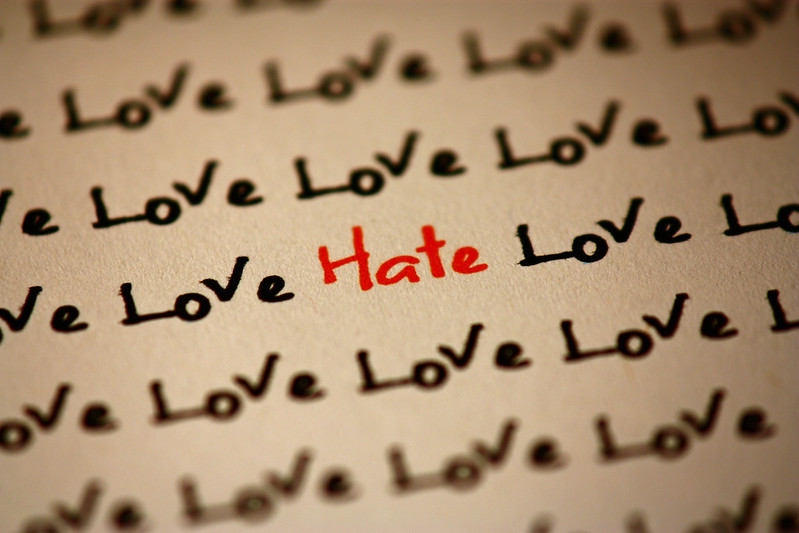
A book that changed my life in 2002 is Living, Loving and Learning, by Leo Buscaglia, which taught my hard-ass, repressed tough guy soul that I was doing things that made me, and those around me, unhappy. My big crime was being more comfortable hating than loving.
Any time you hate something there is a choice. You can focus on the hate, and outrage, and self-righteousness, or you can find the opposite of the thing you hate, and focus on loving that more.
If you betray me as a friend, I can fixate on my anger at you, or I can think about all the friends I have who have never betrayed me, and go thank and honor them. Why focus on how much you hate a book, when you can just as easily go back and remember and share other books that you love? If the friend or book disappointed you so much, why are aren’t using that as fuel to go back and appreciate the good you now realize you’re lucky to have? (An authorial gripe is it’s fine if you hate my books and write negative reviews, but please at least mention a better one so people can get what they were looking for?).
Hate is easy. Destroying things takes much less work than making them, always has and always will. Hate is also less fulfilling and isolating than love, since all it says is what someone or something is not, instead of what it is or could be. Boycotting and banning are attempts to stop something, and stopping bad things is good – but these activities always make me think why not use that energy to go support and promote something good that deserves move love?
In many cultures hate and judgement are safer to express than love (e.g. American men prove we’re close friends by finding funny/mean insults for each other, rarely ever saying out loud how much we care about each other). It’s common in repressed, dysfunctional families or organizations for anger and criticism to be confused with love when it’s the only thing that the parents or leaders provide – anger is still a kind of attention. Kids are genetically programmed to believe their parents love them, so if all they get is negative attention when young, they equate that with what should have been love (and often wander through life confused about what a healthy relationship is like). In some workplaces the dynamics are not that different. If all you know are negative kinds of expression, that’s all you’ll express even when you’re trying to love, and on it goes.
What I got from Buscaglia’s book, which I’d never believed before, was that people who can love more openly, especially in the face of those quick with sarcasm like myself, are the bravest and most positive forces our species probably has (I foolishly assumed they were weak, but yet why did I have so much fear about resistance do doing what they did?). You’ll always find many people happy to hate in the open, but you can’t negate hate with hate. But every now and then you can turn it around, or slow hate down, with the genuine positive expression of love. Only when hate is out of the way can progress start to happen.
I’m not saying not to express hate. I’m still angry now and then. It’s therapeutic, it’s fun and can be a way to bond with someone for the first time – but I’m careful not to let myself end with anger alone. If I hate something, once I’m done tearing tearing it to shreds even if just in my own mind, I force myself to look for something with the opposite traits of the thing I hated and show it some love. I can’t express how profoundly this has changed my life for the better.
I’ve had a lousy January. I hope yours has been better than mine.
Recently I’ve rediscovered, during a week of deathmatch cage battles with the next book, that working through this feeling is where the real work is. When a week of writing sessions have gone poorly and faith is low, that’s when my spine, if I still have one, is revealed. To choose to keep working anyway even when it’s not going well. If I pick projects that are always easy, I’m not learning anything. If I don’t hit some walls on a project, I’m not sure I want to be doing them at all. This is a platitude at the beginning, easy to say and believe that you believe. But then you hit a rough patch, and life is all question marks.
For years I’ve collected pithy quotes about how to handle moments like this. They take up half a whiteboard in my office. Little sayings, some mine, some borrowed, for how to get over the various bumps that come with a writing life. But those quotes just sit on their ass. There is always still a choice: do I sit down again and try one more time, believing I’ll get further than the day before, or go watch TV? Play with the dogs? A thousand things seem suddenly seem all so inviting.
When things are going well the choice is easier. Writing wins cause it’s fun, personal, often therapeutic and rewarding. There’s no magic in that choice on the easy days. But on bad days like this one, when you can hear the blank page laughing from the other room, when the memories of writing a chapter, much less a book, feel like they must belong to someone else, what will I choose?
For big goals the bad days matter more than the good. Anyone can work on the good, easy, fun days, but the bad? Well, that’s the question. To believe I’m committed to the work, I have to show up on all days. Every day. And feel my feelings but not let them stop me from showing up at the desk and taking my swings. I’d rather strike out than not show up at the plate. If I’m not willing to strike out, then it’s time to find something else to do.
Using one of my old tricks, this missive has let me cheat my demons by writing about them, and perhaps now I can get back to work. Wish me luck.
The irony of my writings about innovation is how little interest I have in the latest trends. Sure, I keep up enough to have meaningful commentary: it’s my job. But at the same time everyone I meet in the context of “innovation expert” is surprised I don’t own an i-phone, mostly use a 2003 model laptop, and often prefer writing on legal pads to word processors. I am a total throwback.
Despite my knowledge of how things work, I’m mostly useless in talk about the latest gadgets. Unless you show it to me so I can play with it, odds are I haven’t used it before. I’m a Luddite sympathizer. A technological skeptic. My passions lie in the timeless, things so deeply good they connect and re-connect with us for years, decades and lifetimes. I’m ridiculously happy about the pursuit of timeless things, and many of my favorite timeless things do not have on or off switches.
I’m not an old man, but I’m not young either. I’ve been fortunate to figure out what makes me happy and a good percentage are not electronic. I find my most memorable days involved less time spent in front of computers, rather than more.
The trap is much of the world, the world of my generation, spirals around the web and its various technologies – there is no choice but to spend daily hours in it. I love its conveniences but its burdens are almost as numerous. If I could swing it I’m convinced I’d be a happier man in a lifestyle where the majority of my interactions with people were in person, rather than online.
If I could conjure up my fantasy world, a world comprised of amusement parks, water parks, huge untouched forests, Greenwich village, joyous, funny, opinionated, passionate people, all on a safe tropical beach island, with basketball courts with great runs everywhere, all things digital would be a cute treat I’d taste every few days. The real world, when done right, kicks the virtual worlds ass. I mean, it’s not even close. Great websites and video games, as much as I enjoy them, don’t hold a candle to great meals with close friends and fantastic sex with passionate lovers.
Technology can enhance the real world. But little adds something good, without taking something good away. I score most gadgetry as a net loss.
I take pride in my willingness to turn things off. When on vacation I don’t long for the web or for checking e-mail. But as of late I’ve found myself victimized by my own choices: working alone, traveling often, as writers often do, makes in person interactions with close friends less frequent than I’d like. I meet many good people, which is an privilege, but spreading myself across many relationships can’t help but make those connections thinner than we admit. And as fond as I am of using online interactions to fill gaps, the gaps remains. I know no combination of IM, twitter, e-mail, blogs, or whatever the next communication thing we proclaim as our savior can fill it.
I can’t close this missive with a confident prescription – I know only who I am and not who you are. And I confess that often at parties, when I’ve been drinking, I comically ramble on about the above (I’m an entirely passionate, and philosophically comic, drunk) – and I know people think I’m nuts. Cute, charming maybe, but nuts. I don’t expect my advice to mean much, but it’s worth a shot.
Right now, turn at least one thing off. If you can, turn all your gadgets and beeping things off, and listen to the sound of the world without them. Then stop reading this, or whatever the web teases you with next and do something crazy like… go outside. Grab your favorite person within 500 feet of you (by definition, there is always one person you like the most of those available within 500 feet), and go for walk. Lie in the grass under the sun and split clouds with your mind. Spend more time and money than you should at lunch. Food becomes you, literally, so be mindful of it while you eat it. And talk to someone as your food becomes you, or at least watch and observe the waiters while they work, they do more than you usually notice. A long break from digital things does wonders for the mind. And I bet when you return to whatever digital thing you felt you could not leave, you wont feel so dependent on it as you did before. And that’s a good feeling to have.
Despite his reputation for focusing on obscenity, he was the smartest comedian I’ve ever heard. His ability to make cynicism funny, to communicate well and comically about tough things, going to dark, true places most comedians would be afraid to go changed the way I think about what’s possible. If he can make people laugh about that, what is it I can do? What can i use humor to do for me? How can I use clarity about a tough topic to make it easier to talk about?
Through his pitch black cynicism, he helped me figure out how to be an optimist – or at least, at times, optimistic. And I can’t think of higher praise to offer a creative person than to have helped people find better ways to deal with being alive. His work has become more than entertainment – lurking in the outlines of how he constructed his work is a strawman philosophy for living: life is here, it sucks sometimes, don’t pretend otherwise, find a way to deal with it (and making fun if of it is a damn good one).
I never went to see him perform, thinking there would always be time. I’m devastated to learn today I was wrong. Rest in Peace Mr. Carlin.
“You can’t be afraid of words that speak the truth. I don’t like words that hide the truth. I don’t like words that conceal reality. I don’t like euphemisms or euphemistic language. And American English is loaded with euphemisms. Because Americans have a lot of trouble dealing with reality. Americans have trouble facing the truth, so they invent a kind of a soft language to protect themselves from it. And it gets worse with every generation. For some reason it just keeps getting worse…
And we have no more old people in this country. No more old people. We shipped them all away and we brought in these senior citizens. Isn’t that a typically American twentieth century phrase? Bloodless. Lifeless. No pulse in one of them. A senior citizen. But I’ve accepted that one. I’ve come to terms with it. I know it’s here to stay. We’ll never get rid of it. But the one I do resist, the one I keep resisting, is when they look at an old guy and say, “Look at him Dan, he’s ninety years young.” Imagine the fear of aging that reveals. To not even be able to use the word old to describe someone. To have to use an antonym.
And fear of aging is natural. It’s universal, isn’t it? We all have that. No one wants to get old. No one wants to die. But we do. So we con ourselves. I started conning myself when I got in my forties. I’d look in the mirror and say, “Well…I guess I’m getting …older.” Older sounds a little better than old, doesn’t it? Sounds like it might even last a little longer. I’m getting old. And it’s okay. Because thanks to our fear of death in this country I won’t have to die. I’ll pass away. Or I’ll expire, like a magazine subscription. If it happens in the hospital they’ll call it a terminal episode. The insurance company will refer to it as negative patient care outcome. And if it’s the result of malpractice they’ll say it was a therapeutic misadventure.”
In 2003 I quit my management job at Microsoft to try to live by writing books, teaching and public speaking. It was the scariest decision I’d made in my life and here on the other side, about 4 years later, is what I’ve learned. If you believe life is to be explored, here are notes from a work adventure. There’s no amazing new theory – you may have heard all this before, but here it is, in first person.
Gift giving was never a strength in my family. Sure, we gave gifts, we just didn’t do it well, as in “Hey, here’s your annual CD/book/cake that’s mostly indistinguishable from what I got you last year.” Later, through friends and girlfriends, I learned what a good gift was: something personal and thoughtful that they’d enjoy or need, but probably wouldn’t think to buy for themselves.
But with the web, and the same 15 chain stores in every mall in every city, it’s harder to buy truly good gifts. There is an abundance of easily available impersonal goods people don’t want or need (and the idea of gift cards is just one step away from giving someone cash). I’m loathe to buy people more stuff anyway – I know few folks who complain about empty storage rooms, closets or kitchen cabinets, in need of more things they used once and never again.
So this year I made three four rules:
To buy only experiences. Tickets to plays, events, massages, meals, things that they’ll experience and own as a memory instead of as a thing. Perhaps I can baby or pet sit for friends, gifts that could make a difference. This also has the benefit of low environmental impact if you’re into that sort of thing.
To make things for people. If I make it with my own hands then it’s impossible to get at the GAP, or amazon, and as ugly or fragile as it might be, it will be personal. Writing a letter is more personal and requires more of my precious time (and therefore in a way is more likely to be a more meaningful gift) than any clever purchase ever could. It will will represent more of the the most precious thing I have, my time, than anything I could buy.
Art, film, books, plays, performances or even board games are special kinds of buying. Anything made by an artist or creator needs the support of buyers to continue to do their profession. Although these are still purchases, the effect they can have on the person you buy them for can be profound, personal and long lasting.
If my best or only choice is to buy, do it thoughtfully. Is this something this person will truly appreciate? Is it something they wouldn’t get themselves, even though they desire it? Is it something I want them to want, or something they will truly appreciate? Perhaps purchase from a local, independent artist or maker, or from a store that has sustainable practices for makers.
One problem for some people is they don’t know how to many anything. But there are always ways to offer gifts of your time, like coupons to babysit for a friend, to take them out for a fun night out or even to help them with housework, or a free lesson in a skill you have that you know they want to learn.
[Updated November 2017 – Thanks to Heather Bussing for suggesting #3]
With the end of year coming around, my highlights and lowlights for 2007 are coming to mind. One clear failure was my Scoliday project. In 2004 I set about creating my own holidays, to honor what I thought was important. I did them that year, fell off in 2005, and the started again in 2006 with a new list of days, some of which I celebrated.
Somehow in 2007 I didn’t even try.
I know a few folks did their own flavor of this idea, including antigeek, Konrad West, and more, and I hope they’ve faired better than I have.
I’m reading through my journals for 2007 and trying to see if I can figure it out.
Thoughts so far:
I didn’t have any partners in crime. As an author/speaker dude, I work solo most of the time and suffer from solo project fatigue. Having a holiday buddy or something would probably up my odds.
Perhaps I need a holiday every few months called called Celebrate all the holiday’s you’ve missed so far day. Build in a way to recover part way through the year.
Use this blog as a forcing function – post a note on the day, and if I didn’t celebrate it, hang my head in shame online or donate money to charity for each day I let fly by.
I’m still in love with the idea – but trying to learn from my mistakes, and improve my commitment level for 2008.

 Three weeks ago I tore my Achilles tendon playing basketball. Just like a well worn rope that snaps from being pulled too hard one too many times, it tore completely during my regular basketball game at the gym.