
Hi folks. It’s my birthday, and to celebrate I’m giving away one of my most popular books Mindfire: Big Ideas For Curious Minds.
Just go to the download page and you’ll be on your way.
Enjoy – Happy April!
Hi folks. It’s my birthday, and to celebrate I’m giving away one of my most popular books Mindfire: Big Ideas For Curious Minds.
Just go to the download page and you’ll be on your way.
Enjoy – Happy April!
Thanks to everyone who spread the word about the free download of my book Mindfire.
As of this moment the free download is up, but I’ll be shutting it down shortly.
In case you are curious here are the resulting numbers:
It was a great success, especially for a book that has been out for a year.
I’m grateful for your support and I’ll get back to work on the next book.
A few weeks ago I asked for photos of Mindfire out in the world. I promised to include their names in the 1.1 edition and I delivered. Here are the photos:



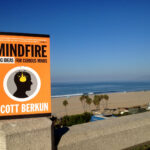
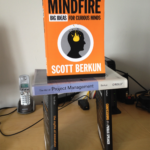


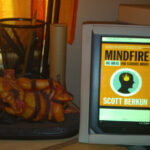






And their names appear in the acknowledgements of the 1.1 edition:
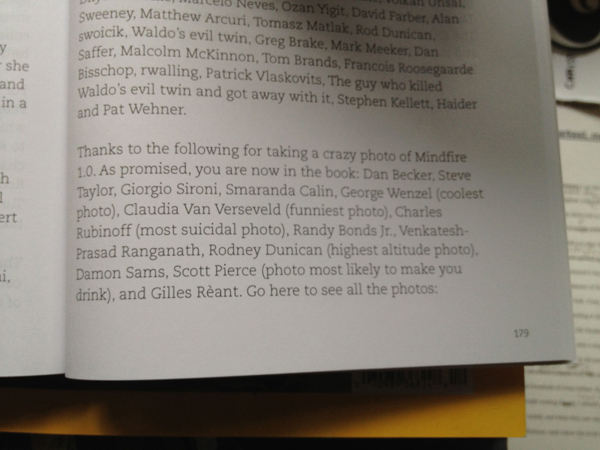
If you’re jealous, or think you can do better (these photos were tame I admit) – take a photo and leave a link to it in the comments.
I’ll at least highlight you on the blog, and if there’s a 1.2 edition you’ll get your name in too.
Have fun!
To help celebrate the launch of Mindfire 1.1 (free for 48 hours), here’s a round up of the many behind the scenes posts I wrote. One goal for the book was to learn about self-publishing, and I love to share things I’ve learned.
Mindfire: Big Ideas for Curious Minds is a collection of my best and most provocative essays. It’s short, fast, fun and inspiring. Its been revised, cleaned up, and polished for your enjoyment.
To celebrate and thank all of you readers, the book is available for FREE for 48 hours.
All you have to do is go here:
https://stage.scottberkun.com/book-download/
Please spread the word. Thanks for reading my work.
P.S. If you purchased the book recently, you likely already have 1.1. You can verify by looking at “Printing History” in the early pages. If it says 1.1, you’re golden.
The revised 1.1 edition of Mindfire: Big Ideas for Curious Minds is finally finished. More than 100 typos, fixes and little touches were added to make it the best version of the book ever.
It’s currently on sale at amazon.com, but the official launch will be tomorrow at 9AM (Wed March, 20th).
If you come back to the site then, you’ll be able to download any of the e-book editions for free.
Thanks for reading my work and I hope you’ll come by and grab it as a thank you for your support.
The 1.1 edition of Mindfire: Big Ideas for Curious Minds, a collection of my best essays, was officially released. Here’s a behind the scenes story on how the cover was designed.
After vetting more than 30 designers who applied, I hired Tim Kordik. And I’m glad I did. I wanted not just a graphic designer, but someone who was interested in helping define the book end to end, from the interior design, to the title, the content and of course, the cover.
I wrote up a short design brief that’s good for any book cover:
We brainstormed for an hour and Kordik went off and put some early sketches together. I made clear I was comfortable working low-fidelity so we could try things quickly and throw aways ideas without sunk cost feelings. He was all for it.
Here was the first round of concept sketches:
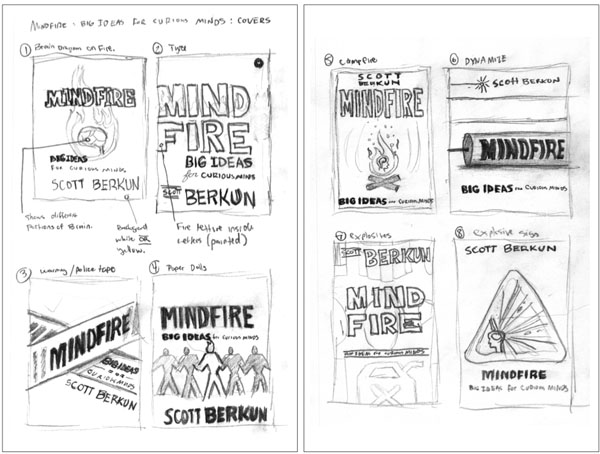
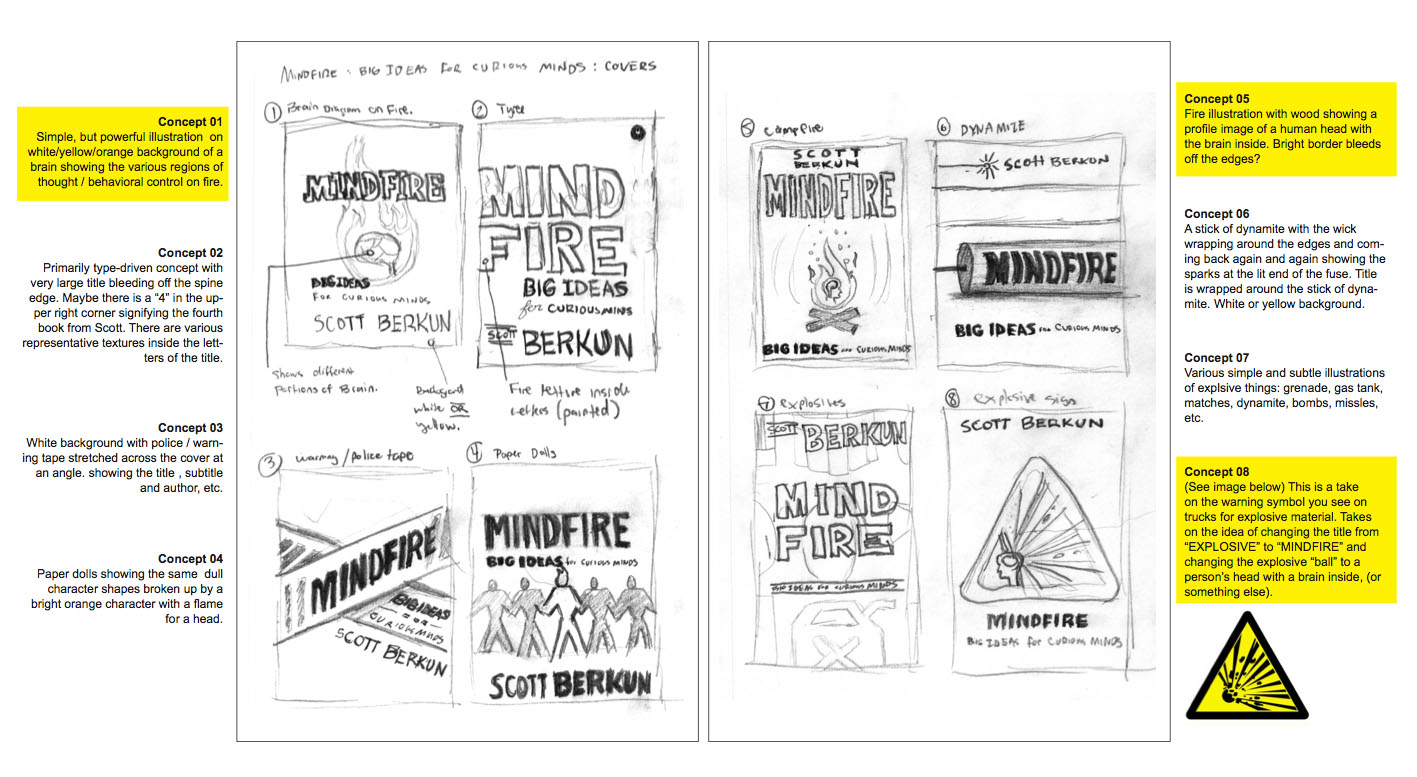
Tim paired each sketch with a brief description to help explain the idea, in case I missed it.
We discussed which directions we thought were strongest, and he did a second round. We killed some concepts and added a couple of new ones. The entire round was higher fidelity than last time:
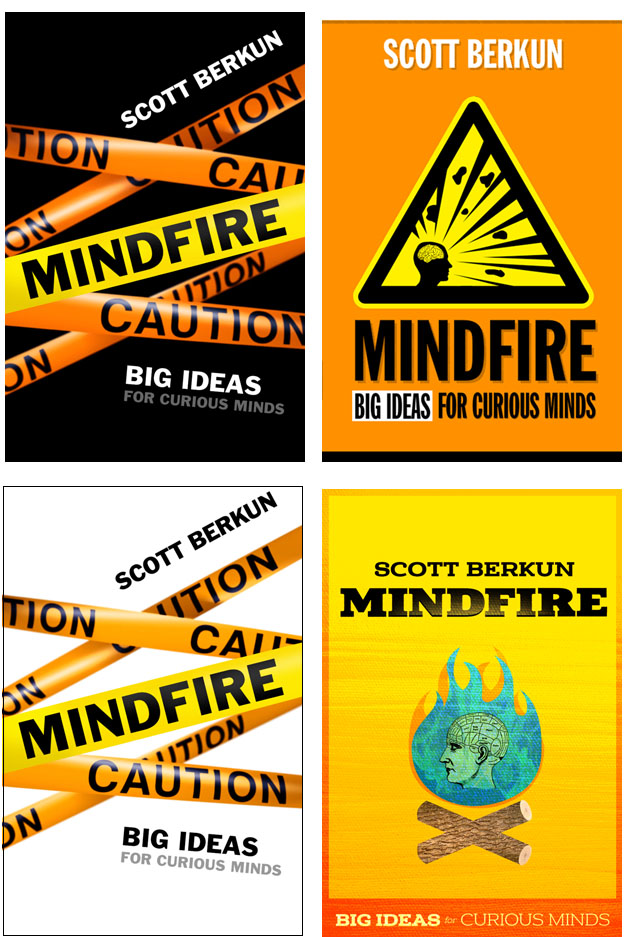
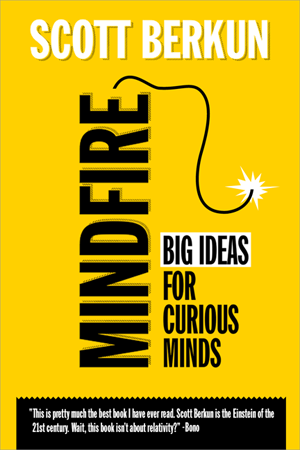
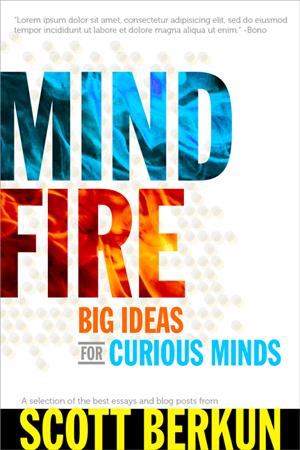
We picked three of these concepts and let blog readers vote: over 300 people participated.
The vote was used to inform our thinking, but not to drive it. Many of the comments people left were useful and Kordik and I discussed them. We didn’t agree with some of it, but it did help us step back and look and what we’d done differently.
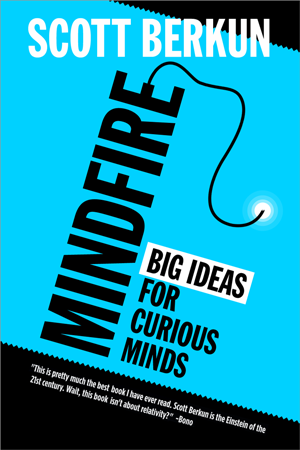
We narrowed the field to one concept. We did a couple of one-off last attempts at other concepts, but they didn’t pan out so we killed those paths.
I loved the idea of a book’s central image being a warning label of some kind. But round three revealed the challenges of the triangle for the central element. It left too much trapped whitespace, and the top angle of the triangle always felt strange.
But I loved how playful Kordik was in trying out different options. It let us look at alternatives instead of trying to imagine them.
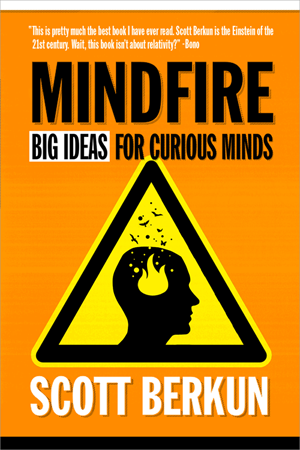
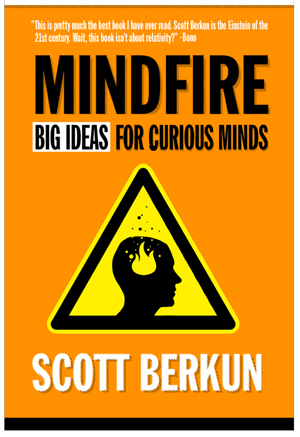
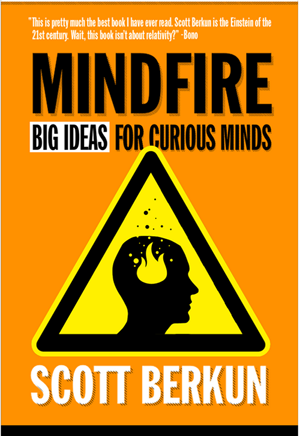
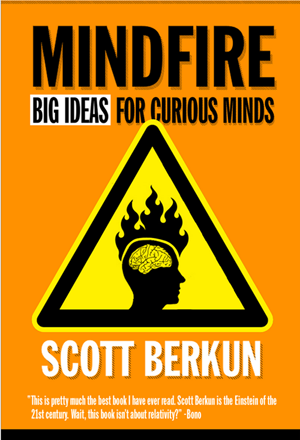
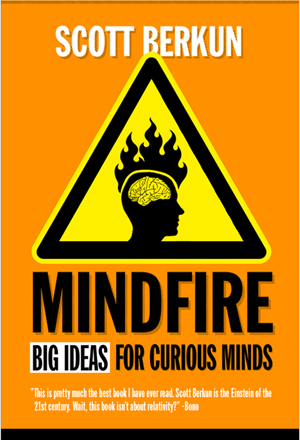
Moving to a circle, the simplest shape, made sense and we ran with it. Tim came up with the bullseye grey/white effect which is powerful and striking.
We moved on to the next level of detail down: the fire and the objects coming out of the fire. Kordik tried many different sets of images. We tried at first to pull images that matched the essays (life, death, time, inspiration, etc.), but it was hard to arrange them without it feeling cluttered. Kordik tried many variations and probably wanted to strangle me.
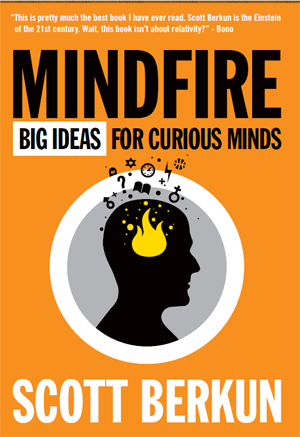
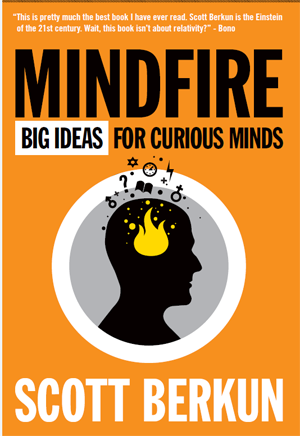
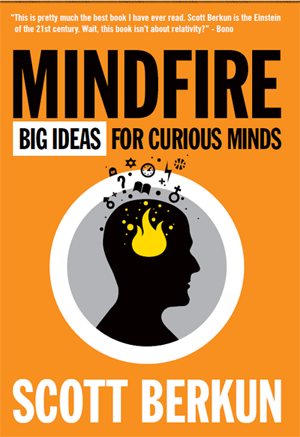
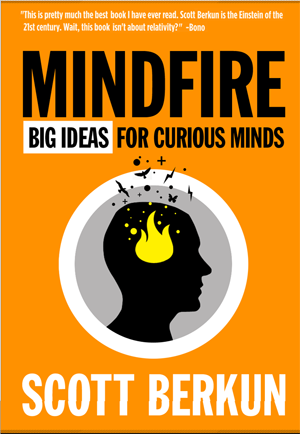
During one meeting, Kordik thought using my profile for the cover might work. I resisted at first: I hate books with pictures of authors in them. Why should readers care what the author looks like? But I figured I had nothing to lose by letting him take the photo.
Kordik did a great job, making it subtle enough that few would notice (I love books with secrets). It worked great and all future mockups had my profile as the silhouette. Here’s the picture the profile is from. He gratefully edited our the WordPress beard I had.

We did a final round of blog reader voting, and 300 people let their opinion be known. It came down to the details for the fire.
As much as I had pushed for all of the icons in the belief those little details mattered, the simple bubbles were cleaner, simpler and stronger, and gave more whitespace to the design.
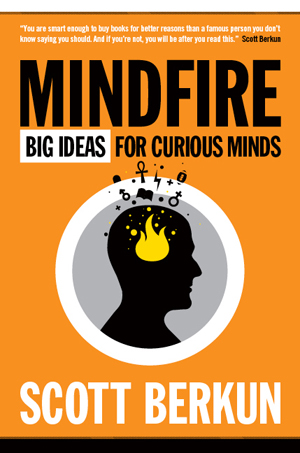
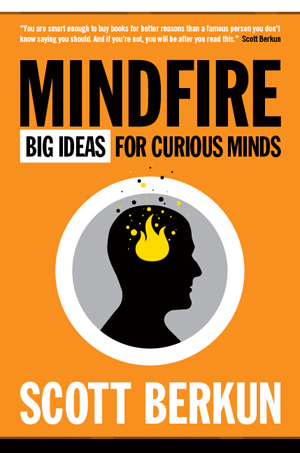
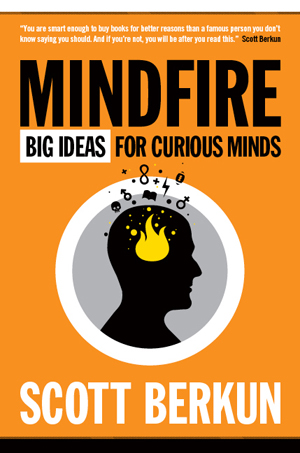
We were close enough that Kordik finished up the full jacket design.
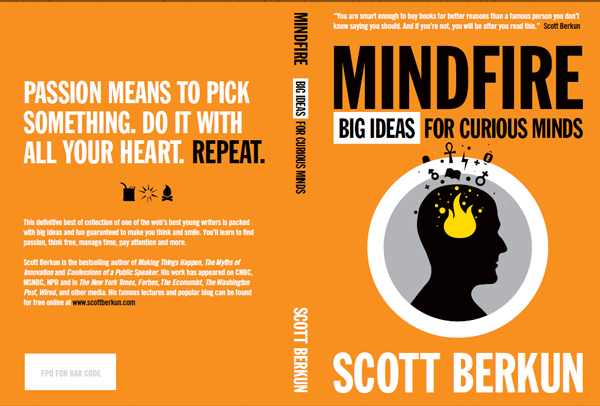
Blurbs are silly things (see the secret life of blurbs). Since I was self-publishing I decided to be honest and have some fun.

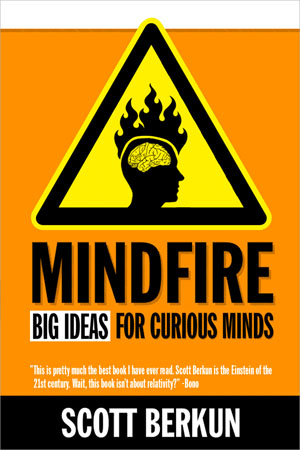
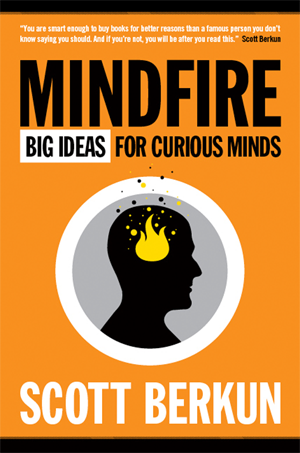
After months of work, and dozens of itterations, we arrived at the final cover design. I loved it. It’s the strongest cover design of all of my books, and I’m convinced it’s because of Kordik’s willingness to experiment and not fear exploring alternatives.
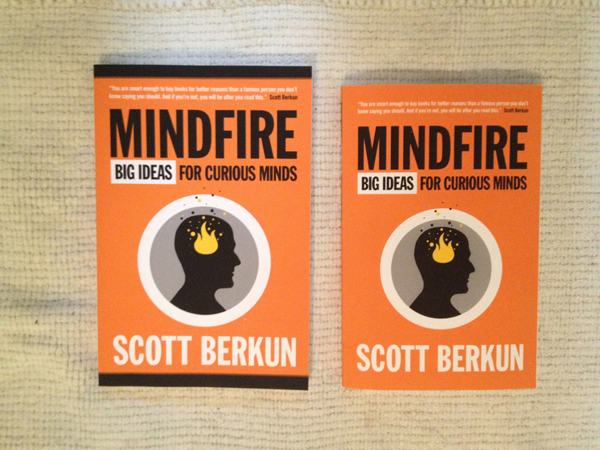
For the upcoming 1.1 edition we made the book size smaller, down from 9×6 to 8×5. We simplified the cover by dropping the black/white strips on top and bottom.
Hope you found this behind the scenes post interesting, buy the book!
Related Posts:
An updated edition of Mindfire: Big Ideas for Curious Minds, with more than 100 fixes, typo corrections and other minor improvements will be officially released next Wednesday. This collection of my best essays is finally cleaned up, polished and worthy of more readers.
9AM PST Wednesday March 20, I’ll make the book available for download here, for free, for 48 hours.
If you’re a fan, please put on it on your schedule. I’d be grateful for help spreading the word on the day.
I’ll be posting some fun making of materials from the book as we get closer.
Cheers.
I’m happy to announce that Mindfire 1.1 will be here shortly. Over 150 minor corrections have been made, making this the best possible edition of the best collection in existence of my best work from this blog (You can of course access my best posts of all time for free).
The print edition is currently listed as out print via amazon, but that will change shortly as the logistics of getting the 1.1 edition in the pipeline take place.
A curious side effect is the backlog of used copies for sale has been emptied, raising the lowest price to $309. And ‘new’ copies list at $711. If you have a copy you want to sell perhaps now is the time to do it? The used market on amazon is a mystery to me, and I never know what to make of the prices I see there.

There are about 12 awesome photos so far, and the photographers will all get their name in the upcoming 1.1 edition of Mindfire.
It’s not too late:
1) Pull out your copy
2) Take a photo
3) Post it here, as a comment.
And your name will be in the book. Offer ends EOD tomorrow.
Among other writing projects, I’ve been working on a revised and cleaned up version of Mindfire: Big Ideas for Curious Minds. The original printing had a long list of minor issues I’ve wanted to fix.
Here’s a partial list of what’s improved in 1.1:
To get your name in the book, do the following:
The people who take the 10 best photos will get their name in the acknowledgements, and a copy of the 1.1 digital edition. Have fun!
Dave Rodenbaugh, from How to buy a website, was one of my kickstarter supporters for my latest book Mindfire, a collection of my best essays. He had this request for a blog post: Where do I see outsourcing heading in the U.S. and the world for the next 5 years?
I avoid thinking about macro-trends. Even if on average all corporations are doing 10% more outsourcing, there can be many specific industries where the trend is exactly the opposite. The macro-trend matters less than what’s going on inside the particular industry, or company, you care about.
The short answer is outsourcing will continue to grow. And to shrink. I don’t see anything in the next 5 years that dramatically changes anything.
Outsourcing will grow because there are always businesses looking to reduce costs. By moving a job from inside to outside a company, the price paid for the work drops. Any large established company will eventually see slower growth, and will look for ways to make up the difference by saving money. There will always be companies looking to outsource and technology makes it easier every day.
Outsourcing will shrink because as soon as you outsource a job, you limit that worker’s ability to bring you new ideas. By making the job a commodity, the worker can no longer easily suggest ways to improve how the work is done. They will never, ever, offer a proposal that is better for the overall business but that eliminates the specific tasks they are being hired to do. For example, when you hire someone to mow your lawn, they are never going to suggest you get rid of your lawn. Whereas if you have a landscaper on staff, they will continually look for ways to improve your yard, including designs that have no grass at all. For companies or projects aimed at the equivalent of rethinking the yard, it’s natural to do as much work in-house as possible.
The rub is this: the more you outsource, the more compartmentalized and specialized your organization becomes. This can make you less flexible and less likely to develop new ways of working. Optimization demands inflexibility. A heavily outsourced company will have a hard time competing against a smaller, younger company that has found a new way to work. That younger company can afford to be inefficient since they are small, and inefficiencies can lead to discoveries. If they successfully take market share from the market leader, the market leader may never recover, as they’ve become less than the sum of their parts.
In larger organizations, the move to outsource or not swings on a pendulum. At times when competition wanes, or the economy stalls, there is a push to save costs and simplify, and more work moves outside. At other times when competition increases, or the market expands, more work moves inside to accelerate growth and take advantage of new opportunities. But as a rule, you never want to outsource work that is strategic. Your core business and core roles should always be done inside your company. Only a fool would outsource their heart or lungs by choice.
I’m working on a 2nd edition of Mindfire: Big Ideas for Curious Minds, to clean up some typos and to make other minor fixes. If you found a typo, I’d be grateful if you’d list it here.
This is the current list of known corrections:
Imran Farouk, one of my kickstarter supporters for Mindfire, had this request for a blog post:
Q: How has de-individualization impacted society in the recent years and will it grow or can it be stopped?
This is one of those fun but messy questions that is so loaded with assumptions there’s no way to answer it without taking it apart first.
Which societies are we talking about? There isn’t some annual meeting of nations where they all decide collectively whether this year they’re going to be more or less against individuals than last year. Each has its own trajectory and action. Some are more hostile than others, some less. Some are improving, some are getting worse. And some are getting better in some ways, and getting worse in others.
I’d say in general, around the world, freedom has progressed, but not in a straight line and not for everyone. According to wikipedia, in 1972 there were 40 democracies in the world, and 123 in 2007. The use of the word democracy has wide variance, but even so, this suggests the general trend is positive. If people can vote, and their votes influence the government, a certain kind of individualism is allowed.
The next distinction is between society and government. If we are talking government, the question becomes is the government a non-corrupt republic, where the citizens are represented effectively in the government. If everyone votes to elect representatives who limit individual rights, then that is, by proxy, the will of the people. They can choose next time to elect people who extend more rights to individuals or not.
I don’t know that a society can be against individuals, since a society is composed of individuals. If they collectively agree to restrict certain behaviors, than the individuals involved are making those choices: how can you be against yourself? All cultures allow and restrict behavior based on their shared values, and one shared value is tolerance (or not) for people who have different values. While I’m be free to a NY Yankee Fan in South Boston, the culture there would likely beat me to a pulp regularly for choosing to express allegiance to that sports tribe openly. Alternatively, if I chose to be a NY Yankee Fan in Jakarta, where few people might know what a Yankee is, I might be free to be as big a fan as I like.
If people aren’t free to move to a different society (say, a more or less conservative town in their country) then the question is less about individualism and more about mobility. They are related, as your ability to be an individual depends on your ability to find a town that accepts the you that you want to be, but mobility and individualism are not the same thing.
Freedom of expression is one way to think about individualism. The rights of free press and assembly are two good measures to look at. I couldn’t find an index value over time for this, but did find that Reporters without Borders does rank nations annually in their freedom of press (The U.S. ranks 47th this year, Finland #1). However, you could define individualism as property rights or other specific freedoms, which would change what data you’d look at answer the question.
What does individualism mean to you? And how would you measure whether a city or nation is making it easier or harder to be an individual?
Thanks to all your support and word spreading, Mindfire: Big Ideas for Curious Minds is the #33 book on philosophy on Kindle.
Cheers to everyone who has helped make this self-published effort such a success. And for you kickstarter folks, another update is coming soon.
If you haven’t checked out the book yet, now is a great time. How high can we help the book go? You can even gift it to a friend who has a kindle: all you need is their email address (Click the give as gift button on the right side of the page for Mindfire).

Free Book Giveaway: the first 20 people who leave a comment saying “My mind is cold, I NEED the Mindfire!” will get a free copy of the kindle edition (sent to the email address in your comment).
At the book launch party for Mindfire: Big Ideas for Curious Minds last month, Much fun took place.


(Photos by Shawn Murphy)
I set up a big wall upstairs in the back where people could write topics they wanted me to see me write about.
Wow.
It took up three huge sheets of paper, and some folks drew pictures, diagrams and other creative ways to express their suggestions.


Here’s the list. Some silly, some serious, some both:
You folks are awesome.
I know it’s annoying to keep getting asked to tweet, and post, and dance, in the name of some thing made by someone else. I know you have many other things to do. And I’m grateful to every single one of you who helped out today.
I promised a summary, and here it is.
The summary:
I promised prizes and I will gladly give them out – tomorrow 🙂
Of course its never too late – if you forgot, the book is still new and every bit of PR helps. All of the specific and easy to follow tasks listed here are always welcome and have value.
Thanks again. More soon.
Andrew Rosen of Jobacle, one of my kickstarter supporters for Mindfire, had this request for a blog post:
How do you know it is time to quit your job and put yourself into a project you believe in on a full-time basis (head and heart)?
I try to live life backwards. It’s a cliché, but many cliché’s are cliché’s because they have some truth in them. I do periodically imagine myself on my deathbed looking back. What do I want to see?
When I do that, answers to questions like this are easy. The time is now.
Many people spend their entire lives with a dream they keep in their back pocket, expecting there to be a day with no distractions or conflicting priorities. In that fantasy, there is a day that will come, on its own, when following a dream will be the easiest choice in the world to make, and everyone, and everything in the universe will point towards the dream. That day never happens. That day has probably never happened for anyone. You have to make that day happen for yourself, often in spite of some reasonable advice to the contrary.
Most people reading this post live comfortable lives. No matter what choice you make, you will live a reasonably comfortable life, historically speaking. Review Maslow’s hierarchy of needs – no matter what you do, you’ll likely be ok. You have the power to take a big risk or two over the course of a lifetime and survive, or possibly thrive. But never taking a chance? Never making sacrifices to find out what’s behind that dream or what’s on the other side of that fantasy? Over the long view of a lifetime, that approach makes little sense.
If you want specific plans for how to quit, see: Should I quit my job now.
Josh, one of my kickstarter supporters for my Mindfire: Big Ideas for Curious Minds, asked this question.
My place of employment is closing. The problem is the mood is very somber and depressing. How do you work within that environment and not let it bring you down?
If you stand back, way, way back, the entire solar system is a sinking ship. We know the sun has just a few billion years left, and if we’re still stuck on planet earth, we’ll go up in flames with the rest.
Meanwhile, can we thrive here? Of course we can.
Whenever I hear of a group in trouble, or a project not going well, I think of the earth and the sun. If you frame a problem right, you can thrive anywhere. Even Sisyphus himself, according to Camus, had moments of joy here and there. I admit you can’t always thrive in terms of productivity, but you can thrive in spirit.
First, its when times are tough that leaders earn their pay. It’s easy to lead when everything goes perfectly. In some cases, a leader might be doing nothing at all, and ride on the waves of producvtity driven by the people who work for them. But when things go wrong, or there’s bad news, or the sun starts exploding, that’s when a leader earns their pay.
What goals can be set that people find interesting? What skills can people learn before the project is over? What sources of pride can be cultivated and directed at the remaining work? There are always ways to make the boring interesting, and the dull fun. It just requires someone who has authority to choose to use that authority to motivate and inspire.
I’m not suggesting denial. Everyone will process the end of a project or a company in their own way, on their own time. But for those who can find ways to stay motivated and excited about what they’re doing, they should be supported and encouraged to find ways to involve others.
Lets say there are 100 people on a project that’s ending. Everyone will be somber when it’s announced. But the following week, what if there are 5 people, working together, having fun, and being productive. The other 95 will start to notice, and many of them will want to join the 5, in spirit, if not in work. Not everyone will be capable of coming along, but you’d be surprised. If a key leader or two take up with the minority group, it can soon become much larger than people think.
At the end of the day we all face situations we can’t win and can’t control. The question then becomes: how will choose to face those situations? Like Sisyphus, choosing how to respond to what we can’t control might just be the most important and defining decision we ever make.
To help spread word of the new book, I’m asking everyone I know to tweet, post or facebook about Mindfire.
The goal is to see how high we can get the amazon.com ranking to go. Its been hovering at around #11,000 since launch. Can we get it to 7000? 2000? Lets find out.
I’ll be tracking who helps (make sure to reference @berkun, www.scottberkun.com, or my name on Facebook), and giving away prizes like amazon.com gift certificates and signed copies of books.
To participate is easy. Do any of the following RIGHT NOW:
1. Tweet about Mindfire. Here’s a sample tweet you can use: “Great book – Mindfire: Big Ideas for Curious Minds – fast, fun & provocative read on big ideas by @berkun http://amzn.to/mindfires #mindfire”
2. Post on Facebook. “Great new book Mindfire: Big Ideas for Curious Minds, a fast, fun and provocative read on how you think, work and dream. A great gift for creatives, leaders and thinkers – http://amzn.to/mindfires”. (Tag me at Scott Berkun so I’ll see it).
3. Post on your blog. You can reuse the samples above, and also mention the free preview of the book, which can be found here: http://bit.ly/mindfirepreview. Make sure to have a link to www.scottberkun.com so I can track it.
4. Buy Mindfire as a gift, or for your team. Any sales today would help enormously. If you can think of friends or co-workers who need a good read, it’s a win-win: http://amzn.to/mindfires. (Also, you can gift the kindle edition of the book – it’s on the same page). You can simply tweet, FB or blog about the fact that you the bought the book.
5. See who else you can get to do any of the above.
Cheers for all the help!
In return, I have a stack of new posts I’ve been saving up, and you’ll see me posting and tweeting about them today.