I’ve been thinking about friendships and why some last and others fade away. It seems there is an unwritten set of rules people who stay friends are able to follow, even if they don’t even sit down and discuss them.
I’ve certainly never had a friendship where there was an official meeting, where a friendship charter was drawn up detailing what everyone expected of each other, or planting seeds for how to deal with difficult situations that might arise. Have you ever been a friendship where a compact for how the friendship should work was discussed?
It seems strange to me how sometimes the most important relationships in our lives are assumed to not require the same investment of consideration for how they function (or fail) as the relationships we have at work.
I’m looking for your thoughts on what the implicit, or explicit, agreements friendships that last have. And any stories you might be willing to share about how you arrived at those ‘rules.’ Or how the lack of them impacted you.
Looking forward to your thoughts.
On a whim I decided to spend all of yesterday offline. No email, no Facebook, nothing. I used to have a habit of doing food (and other) fasts, but it has been a long time since I’ve done a fast of any kind.
Here’s what I learned:
I was twitchy and cranky for the first 2 hours. I continually had the sense there was something I needed to check. But with everything off I was forced to ask “wait – why do I need to check that? And if I need to do it, why do I need to do it now?” I never had a good answer. NEVER. Email,Facebook, Twitter, looking up some obscure fact, could all wait until tomorrow, or whenever. There was no reason to be online, other than the habit of being online. It was fascinating to confront this same loop of logic again and again in my mind. Slowly my mind fell into a calmer loop of behavior.
By three hours I’d forgotten about the internet completely. I was more relaxed and noticeably better at concentrating on things. I went to the gym, to the supermarket, and not once felt at a loss for not having something in my palm to fiddle with. I did notice how rare anyone makes eye contact with anyone else anymore.
The Web didn’t notice I was gone. My ego might have silently believed I was missed (“Wait, I have to post/tweet/status about this! If I don’t the world will explode!”), but it was clear I wasn’t. There was no organized search party on twitter looking for me. No one even noticed.
I had more attention to spend which made things more interesting. While watching the NFL I just watched the game, instead of frequently fiddling with the web while watching, and it was better. I didn’t feel the compulsive need to have a second thing to do. I noticed more things and enjoyed it more (I wrote about this phenomenon in Attention and Sex).
My concentration improved. Without the availability of instant distraction my brain eventually settled down into a state of mind where I was more patient with my own thoughts. By the afternoon I had improved peace of mind and clarity.
I am a calmer person today. I don’t know how long it will last, but I’d say I am 35% calmer and more relaxed simply from this Internet fast.
How I did it:
As dumb as this sounds, I’ve been asked this already. Its as if we forget everything has an off switch:
The night before I turned the wi-fi off on my Mac.
The morning of I turned my phone’s web connection off.
The only cheating I did was to look up a recipe on an iPad.
I told my wife I was doing it, which helped keep me honest.
It’s easier to do if your family and friends do it with you. The idea of a sabbath makes much sense, as its good for people to separate from daily things, and having social rituals around those fasts increases the ease and value of doing them. Thanksgiving was a good day to try this as there were people around (social) and activities like cooking and cleaning that required my full attention (concentration).
What’s next:
I highly recommend doing an Internet fast sometime this holiday season. It will help you sort out what’s important and why. You’ll be surprised. Even if you continue your current habits you’ll do so with intention, not addiction.
I’m considering doing this regularly – possibly weekly, definitely monthly
We love and hate our families. We want to be with some of them, but after a few hours can’t stand others. Going home for the holidays means confronting an intense mix of pleasures and fears that we never figure out until its time to leave. Here’s some advice for surviving your family this holiday season:
How to avoid killing your family over the holidays:
Put a tack in your shoe: you’ll be distracted by a different kind of pain.
Pretend you’re visiting an insane asylum on another planet. Your mission is to survive and report back.
Invite your most abrasive friend/family member along to draw fire as a decoy (e.g. Home for the Holidays).
Play hide and seek with your entire family where you are the seeker. Once they’re hiding, take a nap.
Have a competition offering $10 to whoever can hold their breath the longest. This is a cheap way to buy silence.
Two words: gin & tonic (Two more words: often & early).
Make a list every family member’s deepest secret. Write each secret on a piece of paper with no names. Jumble in a hat. Give one to every family member and ask them to guess whose is whose. Stand back and watch.
Put a tack in your most annoying family member’s shoe.
Those were for fun. Here’s some real advice.
Here’s some practical advice:
Get exercise every day. Everyone abandons their routines, exercise and otherwise, when they travel, amplifying their stress and anxiety. A day of holiday travel puts everyone on edge before they even arrive. This makes you, and your family, like caged animals. Go for a walk every day or every evening. Even 20 minutes of light exercise will reduce your stress and restore your tolerance for annoyances. Get as many people up and outside for a game of touch football, tag, or just a walk around the block. Fresh air can do wonders.
Read how to discuss politics with friends. Some basic ground rules make it easier to stay civilized in the face of ideas you don’t want to hear.
Ask your partner for help. Who are your favorite family members? Enlist their help as an oasis of serenity (“Can you help me calm down when Dad’s driving me crazy?”). Offer to reciprocate with whoever it is that drives them crazy.
Participate. Helping in the kitchen, raking leaves, or doing chores are all ways for you to choose participation with people you get along with best (Volunteer yourself and them for a specific task). It’s a mild form of #1 and gives you a useful distraction and preferred company while you do it.
Read How to keep your mouth shut. Keep in mind your real goals and it will help you pick your battles, or get past the need to engage in any battle at all.
Look at old photos. The past can be a safe place to go to spend time with family you don’t see often. Bring old photos of good times to reminisce in ways palatable to you. Bring a memory for each family member that’s positive and mention it to them.
Play games. Board and card games are an age old tradition for sharing time with people you love but who also drive you crazy. Games have rules and the rules eliminate many frustrations of interacting with certain people. The better the game the more positive that experience is. If you bring a game you like, you get to take a lead role in teaching it to others (I highly recommend Apples to Apples, Carcasonne or Settlers of Catan).
Last resort: movies. It’s an odd American tradition, but movies do create a passive and non confrontational shared experience. Everyone is a nicer person after watching Finding Nemo. Bring a movie on your iPad with the proper cables, and if all else fails fire it up.
If you have a comical or serious suggestion, leave it in the comments.
There are only 4 steps:
Do it
Get feedback on how you suck
Study how to improve at where you suck
Repeat
People tell me this is obvious. But it’s ok to be obvious. Knowing and doing are different. Many people know many obvious things they fail to try or do, despite their knowledge.
I’m often asked for advice about writing. My first question is always “how much do you write now?” If they say, “I don’t really,” I say “Go write something. Anything. Then get feedback on it from someone who knows more than you.” There’s often a look of surprise or fear as if to say “I have to actually do the thing?” They’re afraid to even try. Their ego has made doing even a small task very expensive, when it should be very cheap. Their expectations for their own work should naturally be low and useful feedback is easy to find. It’s their ego that’s in the way more than anything else.
If they tell me they’ve written, I ask them how they think they need to improve. If they don’t know, I tell them to get feedback from someone who sucks less than they do. None of this is complicated. It’s not even expensive. The problem is everyone wants to skip steps 1 through 4. No one in history has ever become good at something by skipping these steps, yet everyone wants to try.
For most skills you can do #2 and #3 on your own. Read your own writing. Watch a video of yourself speaking or playing basketball or whatever it is you want to get good at. If you have read good writing, and watched good speakers, you can easily identify your bad habits. A coach or a teacher can help you move through these steps faster, but you can do them on your own, for free, with enough courage and persistence, two things everyone knows about, but few people have.
“A goal without a plan is just a wish.” -Antoine de Saint-Exupery
The Romans had new years resolutions, and I suspect they were just as bad at keeping them as we are (See The Meaning of New Years Day). The problem is we create them based on wishful thinking, the worst kind of thinking there is. While hope and optimism are great, they aren’t necessarily connected to reality. And for that reason it’s very easy to make grand resolutions, but much harder to keep them. We typically pick things for their emotional or ego potency, ignoring how unprepared we are to achieve them.
The desire is only one part of the challenge – even the definition of the word resolve expresses this:
re·solve:
to come to a earnest decision about; determined to do something
to separate into constituent or elementary parts
The solution is Divide and Conquer, another idea from the Romans:
Pick one single resolution. Your odds of staying focused improve.
Look at last years list and evaluate where you failed. Too ambitious? When did you give up? Use this self-knowledge to inform this year’s resolutions.
Find a friend who can sign up to the same goal. There are tools that even let you place bets on your goals. We are social creatures, and our goals should be social.
Write down the resolution and sign it. Seeing your commitment in writing has psychological power.
Put your written resolution somewhere useful (e.g. in front of the fridge)
Have a daily positive task – mark off a day on a calendar every day you’ve met your resolution. You get a positive visual reminder you’re on your way.
Divide further: simply make a resolution for January, and re-evaluate on Feb 1st.
And while nearly 60 percent of people will drop their resolutions by the six-month mark, perhaps due to the persistence of old habits as well as reversion to earlier stages of behavior change, Norcross notes that those who make resolutions are still 10 times more likely to successfully change their behavior than those who do not.
I’m often lazy with resolutions. Some years I give myself until the end of January to sort out exceptional goals for the new year. In studying what reseachers say works best, I stumbled across this list.
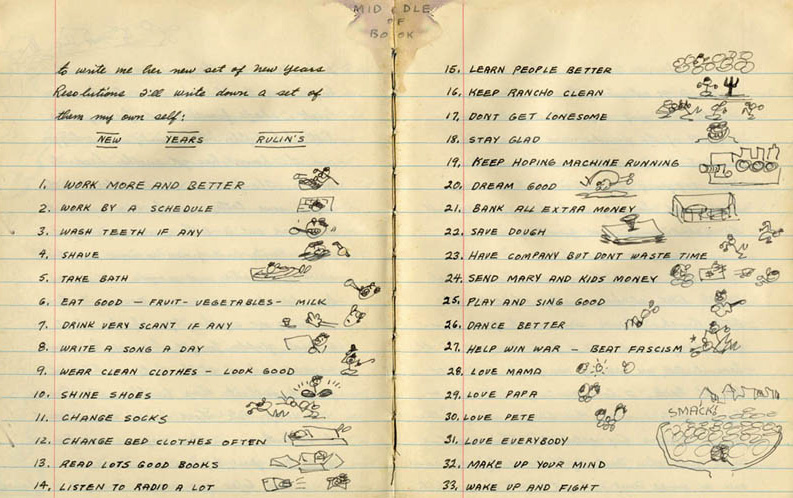
Apparently Woody Guthrie, one of my heroes, had a different problem. He didn’t seem to do too well with setting clear priorities. He lists 33 things for the year of 1942. Inspiring given the results, nevertheless.
For years now I’ve been self-employed and I depend on my own motivation, scheduling abilities, etc. to make a living. I’m not a user of any fancy system or method for getting things done, and 95% of the time when I see elaborate advice on lifehacker.com or other productivity sites I know it won’t work for me.
Well today I came across a great post that approximates the system I use that I didn’t even think of as a system: The writing on the wall. Vero, at thatcanadiangirl.co.uk, says “It turns out that the best organization tools are a single sheet of paper and a calm brain.” I totally agree. This might not work if you bill clients hourly, but for less structured businesses like mine, something simple and reliable is all I need.
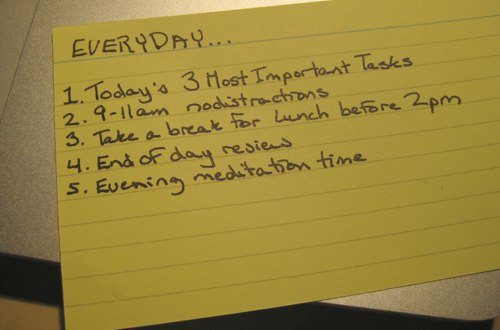
I don’t use her system exactly – but I do often start the day writing out my list of 5 or 6 things, and that list often includes 2 or 3 of the same things every day (Surprise: writing sessions is one of them). I write it on a post it, and stick it on my monitor, replacing the one from the day before. Whenever I feel lost or out of control, odds are I forgot to do this for the day. So I stop, make my list, and get back on track.
Sometimes I think we all have a worrying quota. An amount of worry we feel compelling to apply to the world. And if our lives get safe, and there isn’t much really worth worrying about, we fill up our quota by worrying about things that don’t really matter much at all. Experts call this chronic stress, an ongoing negative response to small negative events in life, not big ones like divorce or losing a job. And we develop habits that keep that chronic stress level high for no good reason.
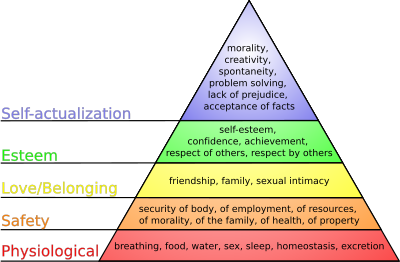
Case in point: I had a deep, worried conversation with my brother about the criteria for accepting Facebook invites from people who were jerks 25 years ago when we went to grade school with them. Boy – do we need other things to fill our quotas of worry. Like the Facebook example, I catch myself worrying about ridiculous, trivial things now and then, and the trick that helps, that shrinks my worrying quota is Maslows hierarchy of needs.
It’s an old trick: put whatever is on your mind in some kind of perspective (What’s worse? What’s better?) and it loses its venom. Most of the time, whatever I’m worrying about scores on the top half of the pyramid, and while it might belong in my quota of worry, it certainly doesn’t deserve the amount of energy from my life it’s absorbing.
Sometimes decisions are so insignificant that simply flipping a coin to decide and getting the decision out of the way is the best and healthiest thing all around: neither end of the decision matters. The only bad choice is taking too much time to make one. I find I can shrink my quota of worry by deciding a) some decisions matter less than I think b) worrying won’t help me make a better decision c) get someone else to sanity check if I’m worrying too much about something.
How do you find ways to worry less about things that aren’t worth worrying about?
(While I’m a fan of Maslow’s, anyone know of interesting alternative hierarchies of needs?)
[Updated with new link on stress 12/11/14]
With one of the biggest U.S. holidays, Thanksgiving, on Thursday, many people will be traveling to visit with families. If you’re working today, and most of this week, you’re smart – as I’ve talked about before, the best vacation strategy is to work when everyone is away, and spend your vacation days on days you’ll be escaping from actual work.
I don’t even work in an office, yet I’ve already had two out of office messages from people I work with at various companies – they’re already on vacation.
Of course often you don’t get to choose when to spend vacation days – if the family tradition is to meet back in your hometown at your folks place on the day before Thanksgiving, well, you’re stuck.
But if you have a choice, stay in the office on those extra days when everyone is away. You’ll be more productive than you will on a typical day, and you’ll save that vacation day for a time you really need a break.
The Story of the Office 2007 Ribbon UI. Lots of backstory, photos, prototypes, etc. straight from Jensen Harris, one of the main people on the project.
Interesting article in the NYT on the way willpower works (Found at kottke). I can’t say the article itself is good, but the questions it raises are. Check this out:
In one pioneering study, some people were asked to eat radishes while others received freshly baked chocolate chip cookies before trying to solve an impossible puzzle. The radish-eaters abandoned the puzzle in eight minutes on average, working less than half as long as people who got cookies or those who were excused from eating radishes. Similarly, people who were asked to circle every “e” on a page of text then showed less persistence in watching a video of an unchanging table and wall.
Ok. Stop laughing. Don’t we all test our willpower by staring at unchanging tables and walls? I know I do. And then, for fun, I break out the impossible puzzles, just for kicks!
The real problem here is that it’s hard to respect any article that mentions a study without providing references. I refuse to grant credibility to anyone using a study to support an argument without a reference. If the study was published I can read it myself and see what it actually says. Were the participants told the puzzle was impossible? How were they recruited? Were they paid? Did they accurately represent a typical urban population in age, education, etc?
As a baseline, anyone with above average willpower has a busy enough life not to have time to participate in psychological surveys. It’s a shallow, half-baked story that’s told here, and even at that, I’m not sure any conclusions can come from it. Speculation, yes. But a hypothesis, no.
I think I possess above average powers of will, but I would never test them against things I thought were pointless. Willpower works when I’m convinced of the value of the effort, or at a minimum, the value of the attempt. I can eat better or exercise more not because of some abstract force of will, but because my perception of the value grants me greater willpower.
And then the article obsesses about describing willpower in neurological terms, missing the point. For example:
No one knows why willpower can grow with practice but it must reflect some biological change in the brain. Perhaps neurons in the frontal cortex, which is responsible for planning behavior, or in the anterior cingulate cortex, which is associated with cognitive control, use blood sugar more efficiently after repeated challenges. Or maybe one of the chemical messengers that neurons use to communicate with one another is produced in larger quantities after it has been used up repeatedly, thereby improving the brain’s willpower capacity.
What would a kung-fu master or sports trainer say about willpower? There are tons of higher level masters of teaching willpower, but since they don’t have neuroscience degrees, this article neglects to give them a voice (Yes, it’s a short article, but the above paragraph is basically an extended guess. Why use 10% of the article on a guess, when a phone call could bring an expert with data).
If we are creatures of habit and increase our abilities at just about anything through repetition, why are the mechanisms for the habits of willpower any different?
My question to you is how do you cultivate your own willpower? When do you feel most in control, and most out of control? How do you use this knowledge to serve you?
The week between Christmas and New Years, is the worst time to use vacation. The reason is that’s when everyone else will be away. When an office is quiet even the most stressful workplace descends into a calm oasis of interruption-free time. Showing up at work on those days feels like vacation, even though you’ll be paid for it. Of course often family plans demand when you take time off, but if you have a choice you should make it wisely.
I remember when I first entered the full time working world, I was clueless about how to best use vacation, and I followed the herd. This is foolish, as here in the U.S. the annual average vacation time is a measly 13 days (Compared to Italy’s 42 and France’s 37): a pittance if you include time-off needed for weddings, complicated mid-week errands, parole violations and alien abductions. Yet somehow more than 1/3rd of Americans don’t use all their vacation each year. Yikes.
The ideal time to use vacation is when there is peak value, in your own psychology, for escape (say, when you feel creative burnout). This rarely coincides with what everyone else is doing (or in the above case, is the exact opposite of what everyone else is doing), as weekend trips with friends or sports team schedules put heavy emphasis on using Fridays and Mondays, regardless of when it is you need relief.
For awhile I found choosing periodic Wednesdays or Thursdays, every few months, was the best possible value for a spare vacation day: like a happy hour martini, they provided a dose of relief at the peak of a stress, and neatly divide up the working life into more manageable pieces. Catching a matinee, having a late breakfast and wandering my favorite bookstore, going for a short hike, or shopping in the calm of a mid-week crowd, were all low key, super mellow, high value vacation days.
Taken to an extreme, this strategy falls apart: it’d be a mistake to take vacation only at stressful events, or to dodge your responsibilities (“Hey boss, are you ready to present at tomorrow’s presentation for the CEO ?”, “Oh, didn’t I tell you? I’m off tomorrow: it’s all yours”). The goal isn’t to avoid hard work, it’s to maximize the value of time off so you’re of most use when you are actually there.
Consider these factors:
When do you need stress relief the most?
Are you, your friends, or your family, driving the use of your vacation days?
When are other people at work on vacation or away, calming the workplace?
Can you offset your own schedule, arriving at work before/after your coworkers, to make each morning a semi-vacation, free of interruptions or high stress?
Can you make part of your daily schedule include time at the gym, the bar, the coffeeshop, or with friends, breaking up every day with some kind of psychological reprieve?
If work is really so unpleasant that you don’t have enough vacation to survive, perhaps it’s not the vacation that’s the problem, but the job itself.
So what tips and tricks for maximizing vacation days do you know?