SB: Your book elegantly frames why we’re attracted to TV shows involving sociopathic behavior. Do you have a theory about when television shifted from more balanced dramas to a world where many of the popular shows involve sociopathy? The Sopranos is often referenced as the show that changed television and (re)introduced moral ambiguity to popular television drama: do you agree?
AK: The Sopranos was definitely a turning point, but I think the ground was actually prepared by reality television. By their very nature, those shows are about scheming and backstabbing — and as interesting and daring as Sopranos is in a lot of ways, it’s fundamentally about just that type of “office politics”-style conflict (although “voting someone off the island” obviously takes a very different form). In terms of a cultural turning point, though, it’s harder to pinpoint. American culture has always been very individualistic, utilitarian, or — to put it bluntly — greedy, but popular culture has most often tended to try to provide some kind of moral veneer or cushion. In many cases that was hypocritical sentimentality, but I’m not sure that the more recent trend toward openly embracing selfishness is to be preferred simply because it’s “more honest” or something.
If I were held at gunpoint and forced to choose a cultural moment that opened up this possibility, though, I’d say it was the end of the Cold War. Suddenly America no longer had a transcendent mission, and it no longer had to pretend that capitalism was some kind of moral force for good against the unmitigated evil of communism. And I think it’s really telling that once another transcendent mission presented itself — in the form of our farcical overreaction to terrorism — the moral sense was totally and radically absent. We perceived ourselves as entitled to openly violate all norms of law and human rights for the sake of facing this “existential threat.” It was as though the nation as a whole was echoing the archetypal reality show contestant who declares, “I’m not here to make friends!”
SB. What motivated you to write this book? There are many popular criticisms of television as both a medium and for its content, but your approach was both novel, approachable and specific. Did you have a personal stake in trying to call attention to this trend?
AK: I did Awkwardness as a kind of experiment with a more popular form of writing. I did Sociopaths because I wanted to go further in that direction — my explicit academic trappings are much more subdued in the second book — and simply because I felt as though I had hit on an interesting cultural trend that no one else was really talking about as such. On a more personal level, I basically didn’t want to let my idea go to waste — and more broadly, I was attracted to the idea that I could “redeem” my time spent watching all these shows by putting that to work in my writing.
SB: Clearly you watched many of these shows. Were, or are you, a fan of any of them? Do you see dangers in enjoying shows centered on individuals with major psychological issues? (or, more broadly, do you believe television has a desensitizing impact on American culture (e.g. Postman’s Amusing Ourselves to Death)?)
It’s probably clear from the book that I’m a big fan of the Wire, which I perhaps spent more time on than is warranted by its popularity. I still watch Mad Men avidly, and I’ve picked up on other shows in the sociopath style — Boardwalk Empire, Justified, etc. I’ve winnowed my TV watching over the years, compared to my more omnivorous habits during graduate school, and so I probably would not have devoted as much time to something like Dexter or stuck with House as long as I did if I were starting them now.
On the issue of how these shows are affecting people, I’m less concerned about that than I am about the culture and institutions that shape them into the kind of person that identifies with the sociopathic social climber. There’s always going to be a certain fascination in the outlaw figure, but the systematic glorification of the sociopath betrays a deeply sick society in my opinion.
Whatever effect TV shows are having on people, I think that the way their workplaces and schools function has a much bigger impact — and both of those institutions are structured increasingly as an ongoing competition where loyalty or morality seems like a liability. If people who live every day in that kind of environment need to let off some steam by identifying with Tony Soprano for a couple hours, I don’t begrudge them.
An evening spent drunk as a loon, looking up at stars, sitting by a bonfire, laughing with friends.
What is your greatest fear?
Waiting to die with a mind full of regrets.
On what occasion do you lie?
This is the first lie I’ve ever told.
What is your favorite journey?
Wherever I’m going next that I haven’t been to before.
Which living person do you most despise?
It’s a tie between Bill O’Reilly and Dick Cheney.
Which words or phrases do you most overuse?
My friends would say its mother*****r. But I don’t think this word can be overused.
Which talent would you most like to have?
Mind-reading is hard to beat, but I’d settle for time-travel.
If you could change one thing about yourself, what would it be?
The willingness to let myself make more mistakes.
If you could change one thing about your family, what would it be?
Open their eyes.
If you were to die and come back as a person or thing, what would it be?
If a thing, the most perfect object in NYC: The Chrysler Building. Or maybe Central Park (is it cheating to call that one thing? I like to cheat). If a person, I’d like to be me again.
What do your consider your greatest achievement?
Writing every day. Ok, that’s a lie. I don’t write every day. But just trying to write every day is hard enough.
What is your most treasured possession?
My mind. I dont care much for material things. Besides, you never have to worry about someone breaking into your mansion and stealing your mind, you know? It’s the only thing than will always be only yours.
What do you regard as the lowest depth of misery?
Watching someone innocent suffer for your own carelessness.
What is the quality you most like in a man?
Integrity.
What is the quality you most admire in a woman?
Curves.
What do you most value in your friends?
Brutal honesty, dark comedy, and trust under fire.
Who are your favorite writers?
George Orwell, Henry Miller, George Saunders, Raymond Carver, Bertrand Russell, Peter Drucker, Loren Eisley, John Gardner, Ray Bradbury, Hubert Selby Jr.
Who is your favorite hero of fiction?
How can you top Don Quixote? There’s no way.
Who are your heroes in real life?
Don Quixote isn’t real? Are you sure?
How would you like to die?
Drunk as a loon, looking up at stars, sitting by a bonfire, laughing with friends.
What is your motto?
Be amazed by everything.
When I failed out of college and was stuck in Queens for a year, it was a mix tape of Springsteen songs I’d listen to every day in the car as I drove to work that got me through. I didn’t prefer his more well known pop songs, but instead connected with his earnest storytelling of people in difficult situations, tales of facing life challenges in a sophisticated and elegant way I hadn’t heard before.
“I think it’s an honest record, and that’s basically what I was trying to make… A reckoning with the adult world. [It’s about] a life of limitations and compromises. But also a life of resilience and commitment to life, to the breath in your lungs.
Darkness is a meditation on where are you going to stand? With who? Not forsaking your own inner life force. How do you hold on to those things? How do you do justice and honor those things?
Whats the part of life you need to compromise? Whats the part of life where you can’t compromise, where you’ll lose yourself if you do? What is sin in a good life? How do you carry your sins?”
On Success and being great:
“The success brought me an audience, it also separated me from all the things I’ve been trying to make my connections to my whole life. And it frightened me because I understood that what I have of value [is] at my core and that core was rooted in the place I’d grown up, the people I’d known, the experiences I had. If I move away from those things… to go about your life as you desire, without connection… that’s where a lot of the people I admired drifted away from the essential things that made them great. More than rich, more than famous, more than happy, I wanted to be great”
On matching the ideas in his head with reality:
“I fantasized these huge sounds, but they were always bigger in my head… the thing I didn’t understand was the fundamental equation… there’s only so much sonic range. We just assumed everything could sound huge.”
On production:
“Bruce would write 5 songs to get 1 song” – Clarence Clemens
“There was a lot of multiversions of all kinds of things. We were always pulling things apart. I had a big junkyard of stuff as the year went by. If something wasn’t complete I just pulled out the parts I liked, like taking the parts you need from one car and you put it in the other car so that car runs.”
On the power of pop songs:
Part of what pop and rock promised was the never ending now. No, it’s about living now. Right now. You need to be alive right now. For those 3 minutes it was all on. All of a sudden you were lifted up to a higher place of living and experiencing and there was this beautiful and ever present now.
On learning how to write:
I go back to most of my writing before greetings and most of it seems terrible to me. Your writing lots of bad words and bad verses.. You’re artistic instinct is what you’re going on, your artistic intelligence hasn’t been developed yet. Hopefully that increases and develops.. At the time I’m going on instinct, and that’s a wide open game. I’m following all kinds of paths and all kinds of roads, and I’m going is “that doesn’t feel right” that doesn’t feel right, that’s how I’m judging.
On the magic of performing and making:
“You pull something that doesn’t exist out of the air. It doesn’t exist… on any given night when your standing there in front of you audience. Nothing exists in that space until you go 1,2,3,4 VOOM. You and the audience together manifest an entire world. An entire set of values. An entire way of thinking about your life and the world around you. An entire set of possibilities. That can never be taken away.”
“I wish I did [write every day]. I’ve gone for a long period of time without writing… because I didn’t have an idea. Or whatever is in there is sort of gestating. Its hard to believe, but I think that I’ve gone long periods of time w/o doing much writing. I’ve gone thru difficult periods of forcing myself to write. I think what happens is you move in and out of different veins.. you’re mining, and you hit a vein, and then you go with that, and then it dries up.
On where his song writing ability comes from:
“There were a lot of teachers. I didn’t think I had a great talent, I thought I’d be someone who had to work harder than the next guy. And when I was a kid I did work harder, I’d be in my room 8 hours, 6 hours [playing guitar]. At the dance I’d be the guy watching the guitar player all night long.
I felt like It was something I was going to have work at very hard to do well. And the rest is a certain amount of psychology that comes with what kind of person are you.
Are you a watcher? Are you somebody who jumps in and is active right away or do you watch? Do you stand back and observe? My nature was always to stand back and watch the way things interrelate. What was going on around me. I was too frightened to join, I didn’t know how to join in. Observation is a large part of my psychology.
And that has a lot to do with people who go on to write, or take their own thoughts and formulate them in to some thing. Result of a variety of dysfunctions that you’ve managed to channel into some positive and creative rather than destructive. It came out of that need to sort myself out… So part of it was natural, and part of it I worked really hard at.”
Last month I had the honor of being the opening speaker at an event at Crucell, an organization that finds new vaccines for diseases (with an impressive history). I’m no expert on such things, but I’ve learned much just by visiting their new office in San Diego. It’s thrilling to speak at different organizations – it reawakens my curiosity, and reminds me there’s always another perspective on how ideas work. Plus I get to meet smart people I’d never meet if I stayed in the same old circles.
My host at this event was Giuseppe Marzio, the Director of Innovation for Crucell. I asked him if he’d let me interview him, and he kindly obliged.
SB: Do you think creativity is a part of the scientific process? How are scientists trained to come up with ideas?
GM: A large dose of creativity is the key ingredient in every scientific project. Scientists love open issues, unanswered questions, problems awaiting a solution. You observe something you don’t understand, that does not fit in the theory, that you can’t explain. Why did we not observe this before, how can that be, what can we do to test our hypothesis. Ideas, anybody? Until you understand the mechanism, you know the answer, you solve the problem. Only to find out this leads to new questions.
There is no official training for scientific creativity. Scientists learn from other scientists, mentors, colleagues. We study how others solved similar problem in the past. And there is a very strong selection. Only the very best solutions to the most elusive problems get published in the top journals, thus attracting the attention of the international scientific community. We all like attention, don’t we. Publish or perish, as we say.
As director of innovation, what do you do to help create a safe environment for experimentation at Crucell?
Innovation is not an issue, is never an issue. We all are able to generate the most creative ideas. The question is, Do we dare? We don’t need more innovation, we need less resistance. Our own, internal resistance, that sometime blocks you, and prevents you from asking that crazy question at a meeting. Missed opportunity for you, for the company, for the world that might be desperately awaiting your idea. And external resistance, when your colleagues, your boss, the whole organization does not seem to understand the greatness of your idea.
My job is to help people overcome their resistance. I help create a work environment where people can meet, have coffee and discuss their latest ideas without feeling they should be doing “real work”. I introduce collaboration tools that facilitate the exchange of ideas. I connect people with other people who might understand their idea, fund their idea, make a project of their idea. I help them present their vision in a way that will inspire other people. It is all about people.
What techniques for idea generation and development are commonly used? Do you have brainstorming meetings? Whiteboards in every office, like many tech companies do?
Brainstorming sessions, whiteboards, idea generation meetings are all useful and fine, and we do all of it. But the best ideas materialize almost invariantly when we ask a bunch of people with very different backgrounds to look at the same problem. And we give them time and resources to find their own answers to the problem. That’s why we strive to have very mixed teams working together. Not always the fastest track, very often the most interesting.
Many corporations that invest in innovation refer to their creative groups as labs, which is clearly a reference to science laboratories. Since you actually work in a lab, what do you think of this comparison? What could most business executives learn from actually visiting a real science lab?
Lab or laboratory derives from the Latin word labor, which means 1. work, production but also 2. preoccupation, absorption of the mind. Both aspects of the word are very relevant, and there a two lessons two be learned here.
First, you need to work hard in science if you want to succeed. Very hard. Doing innovative research means trying many different approaches, changing experimental settings, writing papers, over and over again. And for one successful idea, experiment, paper, there are dozens that did not make it. Or did not make it first.
And second, you must be able to be totally focused on your idea. Scientists can do that, get completely absorbed by their new hot idea. And while we are at it, it is not just work; it is the way we think, act, and live. Finding the answer then is all that matters. You’ve got to get personal if you want to find important answers.
I had the chance to interview Michael Lopp, of RandsinRepose fame, about his new book, Being Geek. The book, like much of his writing, takes an honest approach to thinking about careers and life in the tech world, and he knows what’s talking about, having done stints at Apple, Netscape, and Symantec. Unlike many bloggers, he’s dedicated to the craft of writing and it shows in his work.
SB: Your latest book, Being Geek, is described as a career handbook, yet it’s way smarter and funnier than most books like this I’ve seen. What made you decide to write about career development, instead of a book about design or technology?
I think engineers have a weak spot when it comes to career development. I know I do. I’d much rather tinker with Python all morning that reverse engineer that cryptic off-the-cuff statement my boss made this morning about our project and how that statement might affect my work for the next three months.
There are endless strange situations we end up in on a daily basis that might affect our career and I wanted to sit down and document as many of those scenarios as I could in a way that is approachable to the engineer, to the geek.
You’ve mentioned you want people to feel they ‘own their own career’. Why do you think the majority of people don’t believe, or behave, in line with this sense of personal ownership?
You’ve spent a lot of life looking up to people who you believe are looking out for you. It was your parents and then it was your teachers and professors and finally it’s your boss. I think the idea of relying on your boss to move your career forward is a risky one. Sure, maybe he’s great and experienced, but his incentives are based on optimizing for this job and this job isn’t your career.
Does your boss know you want to be an architect? Do they know that all you ever wanted to do was found a start-up? That you want to write a bookshelf full of books? You probably talked about this at your annual performance review, but is he keeping that in mind as the myriad of decisions regarding you cross his desk? Maybe. Or perhaps he’s optimizing for the now… for his incentives rather than yours.
One of my favorite things about your work is the notion things are messier than we presume them to be. Do you think technologists are better or worse at dealing with the chaos of the real world than the rest of us?
We’re worse. A lot of the book is based on the idea that geeks are system thinkers which is a result of spending a lot of our careers surrounded by the blissful comfort of predictable machines. These tools have given us a profession and they define our success. Unfortunately, we project this sense of order outward. We believe the world is a rational place that is defined by inviolable rules… which it isn’t.
If you assume that much of this real world chaos is caused by people, technologists are in even worse shape because the solitary internal work of the mind does not traditionally expose us to random people in the wild. When one of these strange people show up at our desk with their odd corporate dialect and hidden agenda, we’re… a little slow.
I know you take writing seriously, as well as design. Do you find the process of writing well similar to the process of designing well? Is it rewarding for similar reasons?
There are two big intersections between designing well and writing well. First, before you start, you want to have just enough of a plan regarding what you’re going to build to give you a basic structure and a general direction, but not so much of a plan that you constrain yourself. You leave just enough room in your plan to improvise and to explore the unexpected because that is where I believe innovation comes from. One of my all time favorite pieces of writing was when I gave myself random permission to lose my shit researching gel pens and that leads me to the other intersection.
It’s cliché, but whether your designing or writing, you obsess over the details until your eyes bleed. I’m still staring at the my answer to your previous question and wondering if “solitary internal work of mind” says what I’m trying to say. It’s close, but it’s not perfect. I know I can keep staring at it until it’s perfect, but I also know that I can bring other people in to sweat the details with me. Design or writing, the rule is: all ideas improve with additional eyeballs.
What is rewarding about both approaches is I believe whoever is looking at your design or reading your writing can see and feel all of your consideration.
Ian is a long time public speaker who speaks frequently to very tough crowds: high school students. His talks are roughly described as motivational speaking, but if you didn’t know, you’d think it was solid stand up comedy than happens to have positive messages (without being cheezy). You can check a really funny bit of him making fun of superheroes here.
SB: Why do you think most people have fears about public speaking? Did you have them before you started? If so, how did you overcome? And if you still have those fears, how do you manage them?
People are afraid of failure. That fear holds so many people back on so many things in life, and public speaking is only one of them. Nobody wants to look “stupid”, “foolish”, “unprepared”, or any other (insert negative adjective here) thing that may be socially harmful in anyway. I think a lot of us worry about how we look or are perceived so much that it restricts our ability to enjoy an experience like speaking in front of a crowd.
Do I get nervous? Absolutely, I’ll be more scared the day I DON’T get the little butterflies in the stomach as I wait backstage. But as I have told many people in public speaking workshops I have facilitated, it is all about reading and redefining your body’s reaction. The body’s reaction to fear and excitement is the same; sweaty palms, “the stomach”, you name it. So if the reactions are the same it becomes a mental decision; “Am I afraid?” or “Am I Excited?” – there is a big difference. You are excited to see a movie you have waited for a long time, you are afraid walking through an empty parking garage at night.
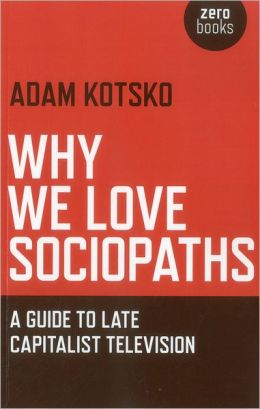 Last week I reviewed the book Why We Love Sociopaths: a guide to late capitalist television and I enjoyed it so much I asked the author, Adam Kotsko for an interview. To my delight he agreed.

 Ian is a