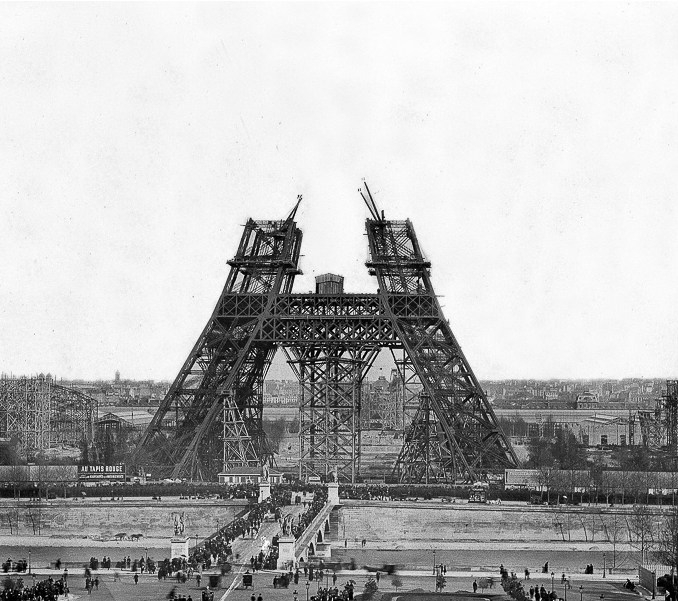
We take great works for granted. We forget, but the fate of even our most famous ideas and creations was far from certain at the time they were proposed. A powerful exercise anyone can do is to pick a famous creation and go back in history to the days before it was made. Only then can you see what the makers themselves truly experienced, and learn from the surprising challenges they faced and overcame. Here are some lessons we can all learn from the wonders of Eiffel’s Tower.
1. All Ideas Are Made From Other Ideas
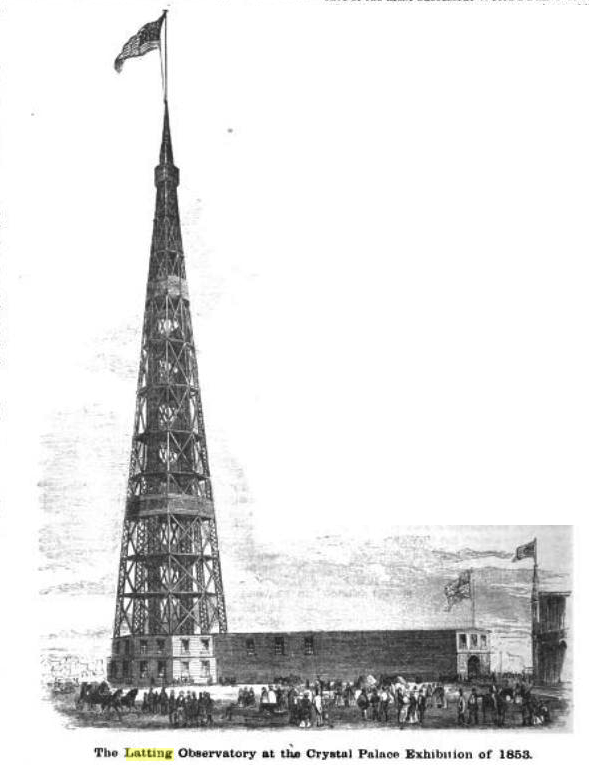
Eiffel was inspired by the Latting Observatory, among other works. This tower, built in 1853, was taller than any other building in NYC, that is, until it burned down in 1856 (wood was still the primary construction material at the time, a fact Eiffel wanted to change). Eiffel also used engineering techniques found in nature to reduce weight and retain strength, essential concepts for constructing the tallest building in the world at the time. If you’re struggling to come up with good ideas, dig deeper into the surprising history of the major ideas in your own field. You’ll learn how they borrowed, reused and found inspiration from existing ideas.
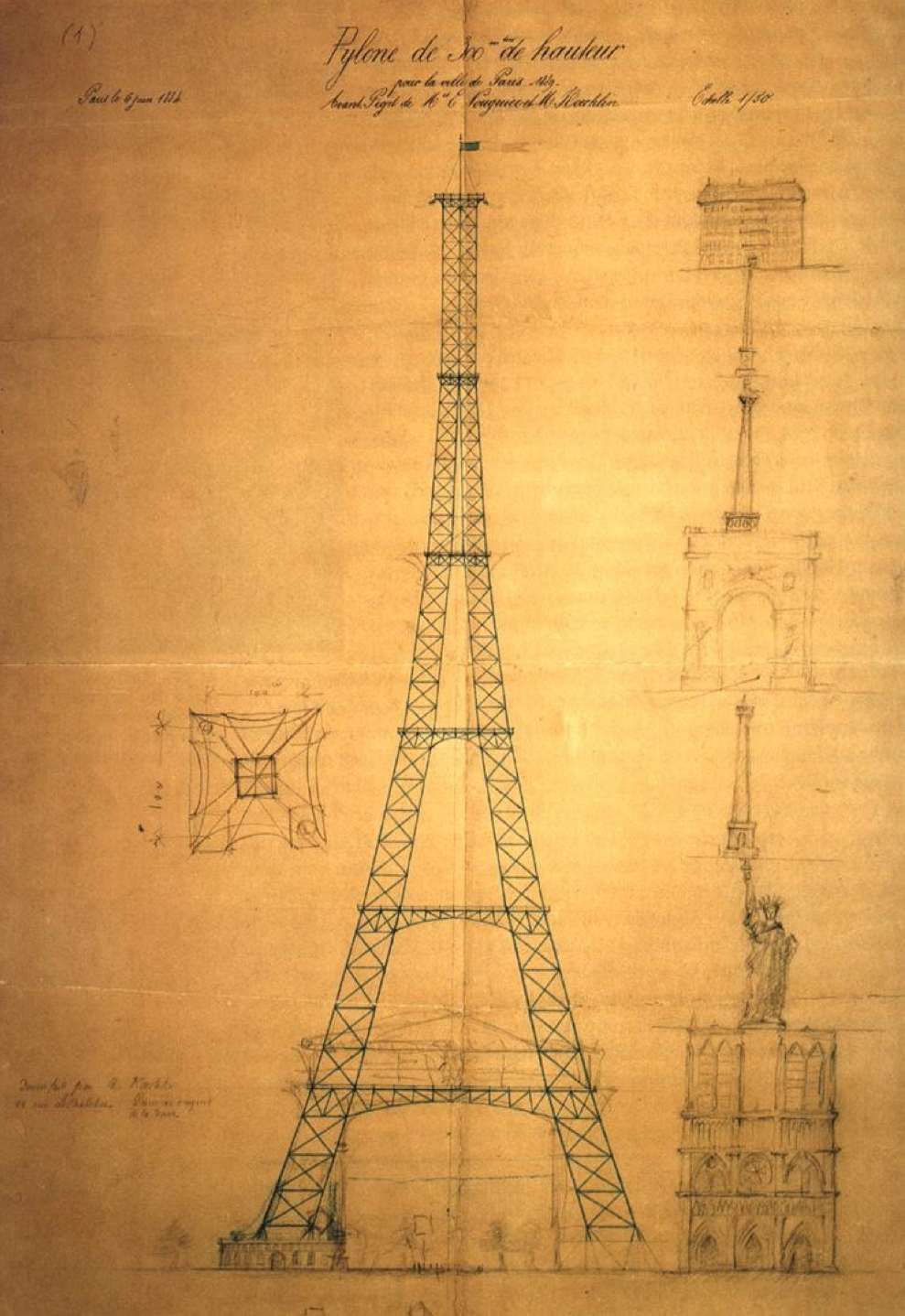
The design of the Eiffel tower was a wonderful combination of aesthetics and engineering (similar in this regard to the Brooklyn Bridge). But the plan for its style and construction evolved over time with contributions from at least four engineers. Maurice Koechlin and Émile Nouguier had the initial concept and drafted the first design (below), but it was rejected at first by Eiffel. They invited a third engineer, Stephen Sauvestre, who made several improvements, including the detailed latticework the tower would become famous for. Their revised design was finally accepted by Eiffel and proposed for the 1889 worlds fair (Exposition Universelle). Although the project bears his name, as only Eiffel had the reputation and finances to lead the project, the design of the tower had major contributions from others.
2. Conviction moves ideas forward
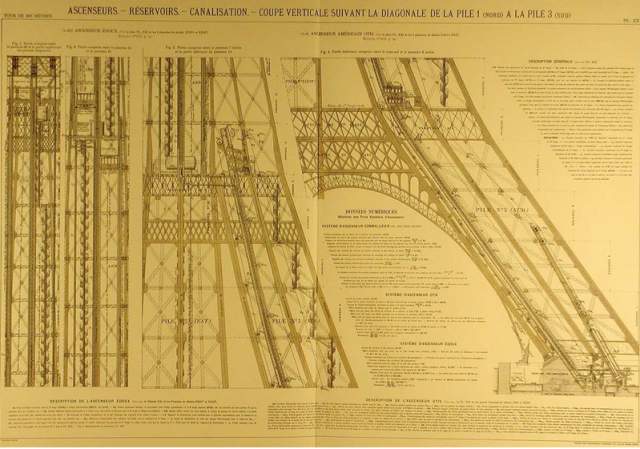
There were over 700 competing design submissions for the world’s fair tower (including this one from Bourdais, a major rival). Eiffel was fortunate to win, but the victory led to more challenges. The government surprised him by only offering $300k, a fraction of what his proposed budget required. Eiffel chose to put in the remaining $1.3 million (5 million francs) himself. In return, he asked for a 20-year lease and control over some of the pavilion area near the tower. This shrewd arrangement gave him the ability to advertise the other works his firm did, assuming of course that the tower itself was successful.
If your idea is turned down, what are you willing to put at stake as collateral (money or reputation) to make the project happen? If the person with the idea won’t stand behind it, why should they expect anyone else to?
Commitment to your own ideas is paramount. But also remember Franz Reichelt, as an example of conviction in an idea gone too far. He jumped from the Eiffel tower in 1912 to prove to the world that his parachute design worked, and fell to his death. You can even watch a film of his fatal attempt.
3. Even the best ideas meet resistance
Before the tower’s construction had begun, the French elite rejected its design. Soon 300 of the most well-known artists and poets of Paris joined together as “The Committee of Three Hundred” to write an open letter to Eiffel and the city, demanding the project be stopped:
We, writers, painters, sculptors, architects and passionate devotees of the hitherto untouched beauty of Paris, protest with all our strength, with all our indignation in the name of slighted French taste, against the erection […] of this useless and monstrous Eiffel Tower… imagine for a moment a giddy, ridiculous tower dominating Paris like a gigantic black smokestack, crushing under its barbaric bulk Notre Dame, the Tour Saint-Jacques, the Louvre, the Dome of les Invalides, the Arc de Triomphe, all of our humiliated monuments will disappear in this ghastly dream… we shall see stretching like a blot of ink the hateful shadow of the hateful column of bolted sheet metal.
Even our wisest and best people, by human nature, resist new ideas. We forget that some of the greatest ideas we’ve had as a species faced great doubt on their long road towards acceptance. This means anyone with big ideas needs to understand that the best ideas don’t always win. Merit is not enough. It’s wise to expect resistance, invest in skills of persuasion and try to learn from the feedback you hear before you dismiss it. The reason why Eiffel won is, in part, due to the relationships he built the society of civil engineers, and the investments he made in explaining to them why his design was superior to others.
4. Long-term commitments make history
The original agreement for the tower was that it would be torn down in 20 years. Part of the criteria for the design competition was that the tower must be engineered in a fashion that would make it easy to take apart. But Eiffel made careful investments in an attempt to prove the long-term value of the tower. He never wanted it simply to be a decorative delight. Instead, he imagined it as both a symbolic and practical embodiment of the future of science and technology.
He financed experiments in wireless telegraphy and radio, including the installation of one of the first antennas in France. This antenna proved sufficiently useful that it justified keeping the tower intact instead of destroying it, allowing it to remain the tallest building in the world for nearly 40 years. Eiffel even had a science laboratory installed not long after opening day, where experiments in meteorology, astronomy, and even aerodynamics were conducted. His commitment to the long-term vision of his idea is a major part of why the building still stands today and is loved by so many people for so many different reasons.
In 1946 Dr. Percy Spencer of Raytheon Corporation was working on radar experiments with a magnetron (a device used to produce radio waves). When he noticed the candy bar in his shirt pocket had melted, he had every reason to throw it away, except one: he felt no heat. Odds are good that other people in radar laboratories around the world experienced similar globs of chocolate and other foodstuffs in their various pockets, and did nothing about them, other than to clean up the mess and get back to work. And given that the rational, logical parts of most intelligent people’s brains would tell them to do the same, getting rid of the offending savory bits and forgetting about it as soon as possible, it’s entirely odd that Spencer chose something different. Remember, he essentially found a bit of warm trash in his pocket, and chose to spend the rest of the day playing with melted cocoa beans, ignoring the millions of dollars of super cool top secret defense equipment surrounding him in his lab.
Just imagine Spencer in that moment: standing alone in a lab, expensive lights blinking on and off all around him, his eyes staring down at two chocolaty fingers, his Hershey stained clothes and lab coat crying out for care. If you walked past him at that instant you’d think for certain he was insane: a chocolate fingered loon. But although he didn’t know it yet, this chance encounter, the moment that redlined his curiosity well past his logical mind’s ability to follow, would lead him to the invention of the microwave oven. Curious about the source of heat, he put some popcorn kernels, and then an egg, by the nearest radar tube. The pop-corn popped, and the egg exploded. He quickly found support for more experiments, and spent the next ten years developing this chance encounter into one of the most used appliances in the world.
How else will new knowledge appear to us, if not as strange, bizarre or incomprehensible experiences? We forget that the common sense we hold dear today was, years or centuries ago, discovered by a curious mind willing to ignore the common sense of their own time. Any sane person would throw away his mistakes without a second thought, but an open mind might just stop and ask “how can I explain this?” before throwing it in the trash.
In 1968 Spencer Silver, with a PhD in organic chemistry, worked for 3M as a senior chemist. Among 3M’s most popular products at the time were different kinds of adhesives, and Silver worked on a project to create a new kind of stronger glue. Unfortunately his prototype was a failure: the glue was weak, too weak to be useful for anything. It was more of a sticky substance than a bonding glue. (No one knew it yet, but this substance contained an important discovery called microspheres, which would lead to a patent years later).
For many years Silver tried to find uses for this substance, but despite many experiments couldn’t find any. Most people would have given up, but he kept trying. In 1973 he had a new boss, Geoff Nicholson, and Spencer pitched him on the idea of using his creation on bulletin boards and other surfaces to make them sticky (eliminating the need for pushpins). But the potential seemed limited.
Another 3M employee named Art Fry saw a lecture by Silver where he talked about this curious substance he’d created and his inability to find uses for it. Fry sang in his church choir and would make notes on little pieces of paper over his sheet music when he practiced, but they often fell off or got lost. Fry and Silver worked together to create new prototypes for a paper with the weak glue that could be put on almost any surface. Fry suggested that Spencer’s design had it backwards: instead of making a surface sticky, the glue should be on the paper itself.
“We have a saying at 3M,” Dr. Nicholson said. “Every great new product is killed at least three times by managers.” (source). It was because of the support of Nicholson, Fry’s boss Bob Molenda, and the persistence of Spencer and Fry themselves, that they had the time to develop improved prototypes. Two more scientists, Roger Merrill and Henry Courtney, worked on inventing a coating for the paper that would keep the glue attached to it, rather than it being left behind on objects after the note was removed. The yellow color was chosen for convenience, according to Nicholson: it was what the lab next door had available, so they used it.
Prototypes of their work were popular in the 3M office, enough so that in 1977 executives approved a test release of a “Press ‘n Peel” product, as it was first called. A test release was required, in part, because the manufacturing machines would have to be redesigned to make this new product in large quantities, which may have contributed to internal resistance to the product. It seemed a very expensive proposition to build new production machines for a product that didn’t have, in the opinion of company veterans, high odds of success.
The response to the test release wasn’t positive – few people were interested in the product. Nicholson and others felt that the product wasn’t marketed well in this release, and that free samples needed to be given away so people could understand the concept. Finally in 1978 a second product release took place in Boise, with free samples, and it was a success. Soon the product was launched to the world in 1980 and is now one of the most popular office supply products in history.
Lessons:
You can’t predict what uses an idea will have, even if the idea is yours (“We never throw an idea away because you never know when someone else may need it” – Art Fry)
Spencer had to pitch his idea many times, in lectures and to his bosses, to obtain the attention it deserved
It can take years to develop an idea or invention into a meaningful concept
An idea, even a great one, needs to overcome organizational resistance
Rarely is there a lone inventor – most often a multitude of contributors are involved
Timeline:
12 years from idea to successful product
1968 – Silver’s “failed” glue prototype
1973 – Silver pitched new boss Nicholson on spray/bulletin board concept
1977 – “Press ‘n Peel” memo pad product in limited release, mixed response
1978 – Rereleased in Boise, ID (called the “Boise Blitz”) with free samples – strong response
When the Wright brothers landed from their famous flight at Kitty Hawk on December 17, 1903 almost no one was there: just five people including a boy from the neighborhood. This is surprising to us in the present because in the nearly 114 years since that day airplanes have become central to modern life. But at the time airplanes were mostly a curiosity. Many other inventors over the centuries had attempted, and in some cases succeeded, at different variants of assisted and even powered flight. But the world shrugged at them all. “What problem does this solve?” was an excellent and largely unanswered question for these men and their machines.
Even the Wright brothers themselves weren’t entirely sure what powered flight could achieve. They passionately believed the invention would help end wars, as the power to see enemies from above would, in their thinking, eliminate the incentive to attack at all. Given the central role airplanes have played in modern warfare for decades this notion seems terribly naive, but inventors often are. The ability to create something doesn’t come with the ability to predict the future (although often often comes with enough hubris to make the inventor believe otherwise). Regardless, they faced a more pressing problem after their famous flight. Almost no one in the U.S. was interested in their creation for any purpose at all.
The Wright brothers had to go to Europe for a time to try and to sell their ideas, and it took many months before they found their first customers. They finally negotiated a contract with the U.S. government in 1907. It was the first military contract in aviation history. It took four years to get someone to pay for their airplane design.
What can we learn:
When you do something truly significant, the world may not understand or care (see Why The Best Idea Doesn’t Always Win). Selling an idea is often harder than coming up with one. (“Don’t worry about people stealing an idea. If it’s original, you will have to ram it down their throats.” – Howard Aiken)
It’s hard to predict how new ideas will be used, even for their inventors
Progress and change happens far slower than we think (and history helps remind us of this fact)
Asking “what problem does this solve?” is a powerful tool – but not having a clear answer does not mean the idea is useless (although it might be). It may just mean the use hasn’t been discovered yet. Working on new ideas is a dance with both the possible and the impossible.
Germany, as a democracy, was a world leader in the 1920s in media and mass communication technology. It had more newspapers (4700) than most nations in the world. It pioneered improvements to radio and television, the high-tech of the era. Its internationally acclaimed film industry ranked among the world’s largest. It was a technological and communication leader on the planet.
After the great depression (1929), German citizens were divided between left and right. Millions found the simple messages of Nazi propaganda appealing in times of economic hardship and instability. They left mainstream parties to support Adolf Hitler.
The Nazis’ platform did not initially scare many voters. While many voters weren’t necessarily at first attracted primarily to racist themes, they were willing to overlook them in hopes of economic promises. The Nazi’s carefully crafted different messages to different audiences, using nuance to signal to their deepest supporters without offending more moderate voters. This poster at right (“We’re for Adolf Hitler”) was aimed at unemployed coal miners, suggesting a vote for Hitler would bring their jobs back. At the same time explicitly racist posters were also being widely distributed.
The term propaganda was originally a neutral term for the dissemination of information in favor of a cause. In the 1900s the term took on a negative meaning “representing the intentional dissemination of often false, but certainly compelling claims to support or justify political actions or ideologies” (wikipedia).
Propaganda, by definition: plays on emotions over facts and mixes truths, half-truths and lies. Hitler, and his propaganda minister Goebbels, had a deep understanding of mass media. They masterfully offered an appealing message of national unity and a utopian future, while simultaneously targeting the brutal persecution of minorities and anyone who disagreed with, or competed against, their ambitions for power. Outsiders and minorities were an easy target to blame for national problems, or the failure to fix them.
In 1933 a fire at the parliament, assumed to be a terrorist act, was used as an excuse to suspend the German Constitution. The fire was claimed to be the beginning of a communist revolution, allowing Hitler, who was only chairman at the time, to convince the president to use article 48 to suspend many elements of democratic process, giving the president near dictatorial powers. These powers were never revoked.
Within months the Nazi regime destroyed the country’s free press. There were no longer alternatives to propaganda, making it harder to recognize. The regime closed opposition newspapers, forced Jewish-owned publishing companies to sell to non-Jews, and secretly took over established periodicals. By controlling the media there was no possibility of dissension. Questions could not be asked. Answers could not be heard. Citizens were not offered alternative views to consider nor the means to voice them. Power became unchecked. Challengers were increasingly easy to threaten, as news of their challenge, or imprisonment, would never be known.
In less than six months, Germany’s democracy was destroyed. The government became a single party dictatorship. Rights such as freedoms of expression, press, and assembly were revoked. Police established concentration camps to imprison those deemed to be “enemies of the state” which included intellectuals, teachers, writers and artists, among those chosen simply because of their race or ethnicity.
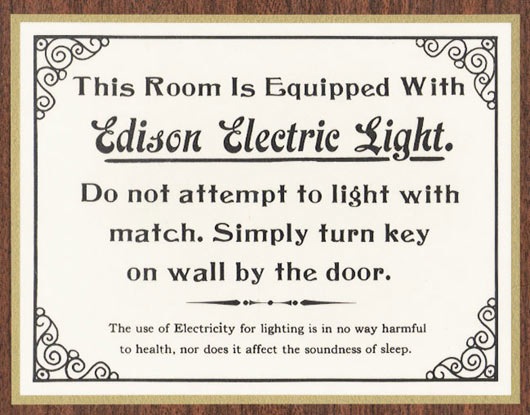
If you could only pick one, would you rather have power in your home or a working iPhone?
We tend to believe that the latest inventions are the most significant, but often the opposite is true. Running water, electricity, shelter, heat, safe sources of food, and good medical care are far more important for quality of life than nearly anything else. And as far as convenience, a reliable power source in our homes that we can activate with the flick of a switch (something 25% of the planet’s population still does not have) is more impressive than an invention than merely uses that power.
I admit comparing technologies across time is unfair in some ways, as domestic electricity was invented first. But in terms of how much we depend on particular inventions to live, comparisons are useful. The exercise exposes how much we take for granted. Or perhaps more importantly, improves our aim for new inventions that do more than attempt to add convenience, but that truly improve our lives.
Of 508 votes, 73% voted for electricity, and 27% for the cellphone (The poll didn’t let me explain, but my intention was the the cellphone could have unlimited power of its own and the internet worked fine on it. But if you chose electricity, you could not have a cellphone). Of course twitter polls have high bias (who are my followers? how do twitter audiences differ from the rest of the population) but it’s interesting nonetheless.
My belief is that for many among the 27%, if they actually experienced this choice for more than 24 hours, their answer would change. They underestimate how much they depend on electricity to do for them, from keeping their food cold, to heating their apartment, to washing their clothes and keeping the lights on (better go buy some Apple candles).
In a recent post comparing Tesla to Steve Jobs, writer Rajan suggests the light switch is at least as impressive an invention as the iPhone. And I agree. If for no other reason, the invention of domestic electricity had to be done without the benefit of electricity itself. In the 1880s, in the age of horse drawn buggies and hand (or steam) powered tools, they had to not only invent electric power generators, and neighborhood transformers, but also provide the installation of physical power lines across cities, streets and sidewalks. To upgrade a phone is easy, but how would you upgrade the entire power grid of a city? Far more challenging. The rate of technology change is faster today, but mostly with technologies that are far easier to upgrade.
The iPhone and the light switch are both tips of the innovation iceberg. They depend on a massive network of other technologies and inventions to function. With no internet or cell service, a cellphone has limited use, just as a light switch in a house that hasn’t paid its power bills, doesn’t do much at all. As consumers we only see the final interface, the last layer, but what makes an invention impressive or not might be best understood by studying the amazing things required to make that interface work, that in daily use we’d never even notice.
Electricity demanded the introduction of entirely new concepts to ordinary citizens. A transformation the iPhone did not have to force, as its very name reuses concepts well known by the average citizen when it was released in 2007 (its arguably an amazingly powerful wireless telephone). The technological and conceptual leap of in home electricity likely surpasses, in impact on daily (and night) life anything we’ve invented in the last two decades (facts supported by the excellent book, Empires of Light: Edison, Tesla, Westinghouse, and the Race to Electrify the World).
If you disagree, do this simple exercise: go for 48 hours without using electricity in your home (except the power required for your cellphone and internet access). Then report back and leave a comment.
The hotel where Martin Luther King, Jr. was assassinated on April 4th 1968, is now the primary site of the National Civil Rights Museum, and it is a powerful place. The sign to the hotel and its exterior is preserved for history, the interior thoughtfully converted into a modern museum space. I visited for the first time recently during a road trip through the South of the U.S.
Before the trip I knew the basics of the civil rights movement in America, but was surprised at how much I didn’t know. I’ve had this experience about history before, but it never prevents me from having it again. We always think the major events are enough to help us understand something, but then you dig in and discover how much went on before those major events.
A stop at the Birmingham Civil Rights Institute two days before broadened my knowledge. There were many more people who made sacrifices and took personal risks than I realized (Fred Shuttleworth’s story was particularly powerful), and the struggle lasted far longer. The effort not only to raise awareness, but to find support was slow, painful, and plagued by brutal setbacks.
I expected, given its location, that the National Civil Rights museum would center on the story of Martin Luther King, Jr. But it was clear in the first few minutes that there were several decades of important developments that led up to the rise of MLK visibility.
The many dimensions of racism and how proud some town leaders were of their outward defiance of any semblance of civility was disturbing. “Why burn a cross when you can foreclose a loan?” expresses such clear intelligence about what they were doing (economic intimidation). Even if you didn’t agree with these attitudes they were flaunted publicly and pervasively. Who could be brave enough to stand up against this kind of open harassment?
Segregated schools, given their own section in the museum, made clear how racism wasn’t just about the current generation, but also was applied to children, and therefore, the future. How do you divide children? I stood in that room and wondered how lost a people could be to so clearly take opportunities away from future generations. My 21st century eyes struggled to see this in a way that didn’t make me sad for humanity, as much as I didn’t want to see it that way. How do we do this to each other? How have we done this to each other for centuries? It’s impossible not to walk through the museum without feeling mystified about the human species. I’ve felt similar thoughts in Holocaust museums and at WWII sites (See What I Learned in Hiroshima). There is a brutality in our history and in us that we haven’t evolved past, if we ever will.
As I walked through the museum the big question I asked was: what would I do? In every story of awful behavior, vicious cruelty, and repression of ideas, I tried to imagine how I’d respond if I were a victim. What action would I take? Would I have done a sit-in at Woolworth’s? Would I have protested peacefully? Would I have gone on a Freedom ride? How civil would I be? Would I have been violent? Where? How? How brave would I be, and what would that word even mean? Or would I hide and ignore the whole thing?
And with each step I took from room to room I felt waves of respect for how many people were willing to make sacrifices to make arguments for rights that should have already been theirs (“”I’m tired of marching for something that should have been mine at birth” -MLK). I really don’t know what I would do. I can’t know. But I can try, today, to do something for the causes I believe in and injustices I see.
Out in the streets of Memphis are a series of murals, and had I not gone to the museum I wouldn’t have completely understood what they were about, and how they fit into the larger story.
The famous stories like Rosa Parks, a story I’d learned as a child, always seemed like a singular event in my memory. As did MLK’s I have a dream speech. But it was only during the second half of the experience at the museum before either one was mentioned.
It took years of work and sacrifice before Parks’ protest for there to be enough of a story for hers to get broad attention and have the wider effect it had. The story of Fred Shuttlesworth, a name I first learned in Birmingham, came up many times in the museum, and I was inspired again by his intelligence and courage.
Its only towards the end of the story that MLK comes into central focus. In the movement he was a major wave, not the ocean itself, and as obvious as this sounds now, until I’d walked through the museum I’d never had that perspective before, or had it so clear in my mind. The role of the FBI and other government organizations in harassing black leaders was sad too, another reminder of what the status quo was like in the 1960s and how if we believe in progress, there is always something worth improving in any status quo.
From outside on the street there’s a plaque just beneath room 306. I watched many people stop to take a photo of this most famous and tragic place, and then walk on. Like me, before I went inside, I knew this was a horrible and important moment in history, but I didn’t fully understand. I felt sad for the people who moved on without going into the museum. They were in a historic place, but didn’t understand the history that led to that day.
Standing in the room itself you can’t help but look across the street to where the rifle was fired that killed MLK. It seems so close and so quaint, and it was. There was an ordinary, neighborly grace of civility violated here. It’s an ordinary street, with ordinary buildings, made extraordinary for horrible reasons.
The museum continues across the street, and you can look the opposite way towards the hotel, out the apartment window where the shots that killed MLK were fired. It was not a hard shot to make. The cruelty of it is made worse but how peaceful this place is now and must have been then.
There is a marker in the street that quietly expresses where the shot traveled. It’s a silent, dark memorial, that some visitors might not notice.
Standing in the window was a morbid and disturbing place to stand. I felt obligated to look and to stop for a moment. I thought about what the world would be like if there was never a reason for a museum like this to exist at all, much less in this specific place. I’m still mystified by how anyone can want to hurt someone who is a leader of a non-violent movement. It’s only cowards, filled with hate they don’t understand, that can act this way.
The museum ends with questions and the idea of community. I like that word. I like the idea of people creating a shared place together where everyone has an approximation of equal opportunity, and everyone contributes to doing what they can to help their neighbors, in the broadest sense of the word.
I strongly recommend visiting the museum. It will put everything going on today in America in a wider, deeper context, which can only help you sort out your feelings and what you want to do or not do about them. There’s so much history we, collectively, have yet to learn from.
What would you have done then?
What will you do about injustice now?
On the end of a long road trip through the southeast, I spent yesterday at the WWII museum in New Orleans. I didn’t even know we had a museum for this war, and was surprised to discover it’s not in Washington D.C. The museum is located in New Orleans in part because the Higgins boat was invented there: it’s the amphibious vehicle used for the D-Day invasion at Normandy.
Higgins boat in use at Okinawa, April 1945
The museum itself, I’m sad to say, is one of the more confusing museums I’ve ever been to, with exhibits divided over several buildings, and not ordered in any obvious fashion (like say, chronological). There is an amazing and powerful story told here, but the overall experience is disorienting and it’s easy to get lost or go the wrong way through some exhibits. The Final Mission: USS Tang experience exhibit is the worst of the bunch, an under designed and barely interactive experience “simulating” the last mission of the U.S. submarine Tang, the most honored and successful submarine of the war.
I’m glad they chose to tell this story, as it’s a heroic and tragic tale, but it’s poorly told and a film would have been far more engaging than the underwhelming simulation they provided (I had to read about the last mission online to understand what the simulation was trying to explain. The Tang sank after being hit by it’s own stray torpedo).
The offering with top billing is the 4D experience Beyond All Boundaries, narrated by Tom Hanks with many famous actors in voice only roles, a 20 minute summation of the entire war. It’s well done and comprehensive, establishing how the fate of the world was at stake in this war, something that has not been true for any war since (despite the endless fearmongering of every war the U.S. has entered or caused since). The story told has an unsurprising focus on American’s role in the war, which is certainly important and worth in many ways, but there’s very little mention of the Soviet Union’s major, and possibly larger, contribution to victory. The U.S. lost 600,000 people in WWII, the Soviet Union lost nearly 20 million. I visited the WWII museum in Kiev, Ukraine in 2009 and was fascinated by the comparisons and contrasts to U.S. tellings of the same war it provoked.
My favorite exhibit, perhaps because I learned the most new insights from it, was Manufacturing Victory. The central argument it makes is the primary reason we won, and were even able to put up a fight, in WWII was the transformation from the U.S, with only the 18th largest army in the world in 1937, into a major military production power. Without guns, tanks, boats and planes to fight, the war would have been over before it began. One of the displays in the museum showed the relative size of the armed forces of Japan, Germany and the U.S. (shown below) early in the war. We were an isolationist and peaceful country with few ambitions for world power.
General George Marshall is the hero of the exhibit. He pushed his way into a conversation with FDR, convincing him the U.S. was woefully underprepared and needed to make radical changes to protect itself, much less win the war. His persistence led to the plans that made co-operation between government and business possible. Ford converted car plants to make warplanes, Motorola made the walkie-talkies used in WWII and dozens of other companies shifted their production from consumer goods to war goods. The exhibit details just how many people and organizations contributed. There are so many untold stories in just this one aspect of what was involved in winning the war.
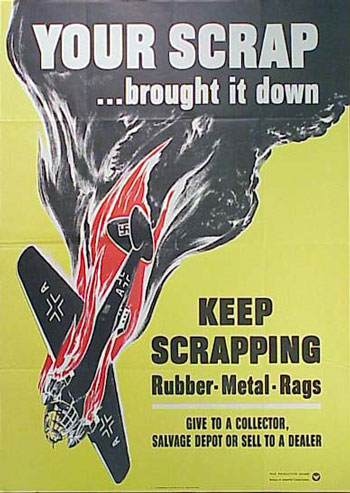
It was also made clear how every American was asked to help with the war effort. It wasn’t just the existence of the draft which gave most Americans a personal connection to the war (something we’ve lost in our wars since abolishing the draft). There was a kind of civic pride and patriotism that’s rare today about making sacrifices for the nation. Shortages of rubber and copper meant citizens were asked to donate the supplies they had, and many items, like food cans, were recycled for the war effort. Unlike being told our duty is to consume, it was made clear that every American should take pride in sacrifice for the greater good and helping with the national effort.
In a way the massive armada at D-Day, one of the largest every assembled in history, was the output of the collective effort of an entire nation. Britain and Canada made similar sacrifices and contributions (and of course it was England that had the strength to remain the last free country in Europe, fighting for years before America entered the war). Even during the revolutionary war American citizens were largely divided and there’s an argument to be made that WWII had more support from its citizens than any war fought before or since.
The D-Day armada
The carnage at D-Day, and during the war, is explained in graphic detailed at the museum. The prolonged end of the war was horrible on so many levels, and even more futile and pointless, than the heart of the war itself. It’s hard not to feel something deep and sad about how many people lost their lives during the war and how much pain and suffering the entire endeavor caused for everyone involved.
For Veterans day my thoughts are with everyone who has volunteered their time and service for a greater good. I just wish those sacrifices could be made in ways that weren’t in opposition to other nations. I hope for a day when the lessons form the past are so broadly and deeply understood, that few people ever have to die or suffer again for so little gain. I feel tremendous respect towards everyone who serves their communities, and only wish more of our sense of service was directed at civic, peaceful endeavors, a thought that weighed heavily on my mind as I left the museum.
I was a senior at CMU in ’93/’94 and for my computer science classes I spent many long hours in the computer labs, called clusters, working on programming projects or doing other schoolwork. Many of my friends hung out in clusters and it was common to see new software friends had found, or in some cases, made. I worked mostly in the Unix rooms, where all of the DEC and Sun workstations running X-Windows were, including their hockey puck shaped mice.
Late in ’93 or early in 1994 I remember being in Baker Hall, one of my favorite clusters, sitting in the back row (the photo above is from Ween Hall, a similar cluster, via CMU Archives, analysis). I wasn’t enjoying whatever I was doing so I looked around the room. Someone had a window open on their workstation with all sorts of images and text in it, and I asked him what it was. He told me it was Mosaic and he told me how to install it, which I did. I played with it for a few minutes, found it cute, and didn’t touch it again. There were only a few hundred websites and most of them were junk.
There were no search engines. There were no maps or guides. The joke was “There is nothing worthwhile on the web, and you will never find it anyway.”
What I can tell you is NO ONE thought much of the web at the time. I didn’t know a single person anywhere, in school, real life, or online, who thought this would ever become something mainstream, much less dominate the future, as the walled garden of AOL dominated how ordinary people interacted with each other online.
That year I read the first issues of Wired magazine, and even wrote for them, and they barely mentioned the web either. It just felt like yet another odd academic project, with few people using it. The Internet, meaning email, gopher, telnet and newsgroups, was something I’d been using in class for years (including The Andrew Project). I’d worked with Hypercard, Director, and studied different forms of hypertext tools in class. I knew about Project Xanadau. This “web” just seemed like yet another thing. And HTML, wasn’t even a proper “language” with barely any functionality other than crude text, links and images.
I was hired at Microsoft in 1994, and in early 1995 joined the Internet Explorer 1.0 team (where I’d work until version 5.0). Even then the web was far from mainstream. It was progressive for Windows to have a web browser at all, even though the first version shipped only in The Plus pack, along side screensavers and utility programs.
It wasn’t until the browser wars of 1996-1999 that the industry first shifted to focus on the web and the Internet, and only as society shifted from using dial-up modems to broadband, and eventually mobile devices, in the 2000s did it become central to most people’s lives. It wasn’t until 2001 that AOL saw it’s subscribers decline as direct access to the web became commonplace.
Lesson: The future often looks strange in the present. Any idea with the power to transform the world won’t make much sense at first. This is one of the best lessons from the history of innovation: if you want to be part of the future, keep weird stuff around.
When did you first see the web? Leave a comment, or write a blog post about it and I’ll link to it.
[Updated March 12, 2019]
Today is the 80th anniversary of the repeal of the American prohibition of alcohol, and it serves as an excellent example of unintended consequences. For 13 long years alcohol was illegal, but early in prohibition it was clear the law change didn’t have the intended effects. Alcohol became more powerful in many ways, and since the mechanisms by which people obtained it were illegal, some of the cultural problems prohibition was expected to solve got worse.
Most bans in free countries today regard media: books, films, music and ideas. In most cases the announcement of a ban is free-PR for all of the people who are probably interested in the thing being banned who might not have heard of it if the ban didn’t happen. Most media love telling the story of things being banned, since it earns intense interest from both the people who agree with the ban and the people who are upset by it. Every time a parents group bans an album, or a religious organization bans a film, the film itself becomes far more powerful. Rather than a ban being a bad thing for an artist, it can often be a catalyst for their ideas and you can often see artists deliberately trying to manipulate this cycle to their advantage.
The same principles holds true among parents and children, or managers and employees. The more something is withheld, the more power and meaning it gains. For the powerless in these situations the banned item becomes a symbol of their lack of control, and their interest in it can only grow. Banning something gives that thing a personal meaning beyond whatever attributes the thing inherently has. Forbidden fruit often only tastes better than regular fruit because of what’s in the mind of the person eating it, rather than what’s in the fruit itself.
A ban is lazy policy. It’s a failure to examine causes and effects of human behavior, including the history of the causes and effects of banning things. It’s entertaining to learn the earliest known prohibition of alcohol was by Yu The Great in China in 2100 BCE, and surprise: his son ended the prohibition when he took over. Had Yu been great enough to develop a more mature and reasoned policy, his son might have embraced it.
We think the world is tough right now. But compared to what? If you think things today are upsetting, this book is for you. And if you think things are great, this book is for you too. If you skim even a few chapters you’ll arrive at a profoundly better understanding of what it is to be a person in a “civilized” world.
This book is a tour de force of history, using warfare and atrocity as the thread to understand civilization itself. The author, White, weaves his way through every major conflict with insight, wit, and delicate humor. He takes complex events and explains the causes, however dumb and disappointing, and provides a better understanding of current events and what we should want in the future.
As the title suggests, the book explores warfare, fratricide, genocide, and other terrible collective actions. White provides ranked lists of the most horrible events and the worst leaders, but not for sport. Instead he shows us what people, powerful people, have done in the past out of hope we can do better in the future.
The book provides a list of the worst 100 atrocities of all time. The last 50 pages lists his sources and methods for the historians who want to follow his trail (the references are online too).
Here are some choice quotes:
“People have been killing each other ever since they came down from the trees, and I wouldn’t be surprised to find bodies stashed up in the branches as well.”
“War kills more civilians than soldiers. In fact, the army is usually the safest place to be during a war. Soldiers are protected by thousands of armed men, and they get the first choice of food and medical care. Meanwhile, even if civilians are not systematically massacred, they are usually robbed, evicted, or left to starve; however, their stories are usually left untold. Most military histories skim lightly over the massive suffering of the ordinary, unarmed civilians caught in the middle, even though theirs is the most common experience of war.”
“Civilization before the Enlightenment was rather flexible when it came to historic accuracy, and ancient historians never let the truth get in the way of a good story.”
“Why Did Rome Fall? The best way to understand the fall of Rome is to skip the first half of any book on the subject. Yes, background and long-term trends are important, but some historians go so far back looking for the cause that they make it sound like Rome was tumbling toward its inevitable fall right from the start.”
“If we categorize the entries in this list according to which religions came into conflict, we get this simplified breakdown: Christian vs. Christian: 9 Muslim vs. Christian: 3 Christian vs. Jewish: 3 Eastern vs. Christian: 3 Jewish vs. pagan: 2 Muslim vs. Chinese: 2 Muslim vs. Muslim: 2 Human sacrifice in India: 2 Human sacrifice in Mexico: 1 Ritual killing in Rome: 1 Muslim vs. Hindu: 1 Manichaean vs. Taoist: 1
We can probably go even farther and group them into four larger categories: indigenous human sacrifice (4), monotheistic religions fighting each other (17), heathens fighting monotheistic religions (8), and heathens stirring up trouble all by themselves (1). In early history, the majority of religious killings involved sacrificing people to bribe and placate the dangerous forces of the universe. Then, Judaism and its offshoots, Christianity and Islam, devised a worldview where a single all-powerful god required a strict, uncompromising belief rather than tangible offerings.”
Thanks to Rob Lefferts (of the Lefferts law) for the recommendation.
Note: Light revisions 1/17/2025.
Here is a good thought experiment:
Consider the last time you walked into a convenience store .
Perhaps you grabbed a snack, waited in line to pay, and left.
Did anything in the experience seem interesting? Probably not.
Now magically transport that same little convenience store to a poor shanty town in Ethiopia or India, where there’s extreme poverty.
Suddenly that same convenience store is an oasis of innovation.
It has many world changing breakthroughs: fresh water, electricity, working toilets, air conditioning, cold drinks and stockpiles of food. There are magazines to learn from and basic medicines to use. Their lives would be instantly transformed by access to such things.
The big question: How can the same technology be a breakthrough in one place, and meaningless in another?
The only answer is that the true deciding factor for whether something is innovative or not is not in the technology itself, but in the point of view of the person using it. Innovation is not a static quality, but a relative one. Innovation is a matter of perception relative to where you are and what you have.
William Gibson said “The future is already here — it’s just not very evenly distributed” but there’s more to it than that. The value of any idea or invention is variable, not static. And it varies not only through time but from person to person. It can also move backwards and forwards, as organic food is now seen as an innovation, but yet before 1950 that’s all there was in the world.
Eleven Fourteen years ago 2996 people died during the events of 9/11/2001. It was a tragic day for thousands of innocent people whose lives were taken. It’s impossible to understand the significance of the day for surviving family and friends.
From a colder, mathematical perspective, I’ve wondered what the total cost in lives has been since that morning. How connected these deaths are or are not to each other is up to you. With a few hours of research I compiled the math, with sources marked as follows:
WP = Wikipedia, CRS = Congressional Research Service, AP = Associated Press, DoD = U.S. Department of Defense
Deaths on 9/11/01: 2,996 (including 19 hijackers) Injured on 9/11/01: 6000 (WP, but source needed)
The Wars in Iraq and Afghanistan:
U.S. armed forces deaths in Iraq: 4422 (FAS, U.S. DoD)
U.S. armed forces injured in Iraq: 32,229 (FAS, U.S. DoD)
I don’t have any commentary. These numbers are staggering, no matter how you connect them or not.
Please check my math and my sources and note corrections in the comments. I’d be thrilled to see these stats vetted and improved. It was bewildering to go through all the reports and studies to compile even this list, as many reports show similar data in slightly different ways with different sources. I’m sure I’ve made mistakes, I’m just not sure where.
[references updated 9-11-15]
I ran a session at FOO camp on Why Great Ideas Fail. The goal was to leave the room with a list of reasons and here it is.
The crowd was tech/start-up folks and the list is shifted towards those pursuits. Fascinating how many of these are opposite pairs of each other (e.g. gave up too soon vs.stayed with same idea for too long).
Why Great Ideas Fail:
Killed idea too soon
Launched idea too early or too late
Death (of person with the idea)
Someone got their first and stayed in front
Not willing to experiment to find audience
Unwilling to change direction
Willful ignorance of economics
Not knowing target audience
Unable to overcoming organizational inertia
Not understanding the ecosystem the idea lives in
Inability to learn from microfailure
Fighting the last war
Stayed with idea for too long
Giving up
Chindogu – solution causes more problems than it solves
Factors beyond anyone’s control (market, wars, competitors, natural disasters, etc.)
Failed to pitch or communicate well
Underestimated marketing
Not taking the idea far enough
Taking the idea too far too early
Underestimating cultural limits
Underestimating dependencies
Failure to balance how world is vs. how world can be
Failure to balance wants vs needs
Thanks to Val Aurora, I also got a list from attendees of personal reasons great ideas failed. Wide range of levels of specificity, but still interesting,
Specific failures people listed as their own:
Forcing something on people they don’t want
Not controlling distribution (e.g. Tivo vs. Comcast DVR)
Not doing post-mortems
Not eating our own dogfood
Building something ‘powerful’ but too complicate for the average user
Force change earlier. It won’t happen on its own.
Launching a product before it’s ready – unreliable performance
Not killing a project/startup faster (i.e. spinning wheels for an extra year instead of getting it out the door)
Trusting before researching
Not trusting my gut
Not considering political capital within a large organization
Trusting my gut too much
Juggling between being your greatest supporter and your greatest critic
Voice version of twitter circa 2005
Built an Airbnb before Airbnb, but didn’t see it through
Thanks to @jessykate for the photo of the whiteboard, from which these notes were transcribed.
Can we finally admit we live in the future?…Thanks to a combination of 3G internet, a touch-screen interface, and Wikipedia, the smartphone in my front pocket is pretty much the Hitchhiker’s Guide to the Galaxy. I can communicate with anyone anywhere at anytime…and then use the same touch-screen device to take a picture, deposit a check, and navigate the subway system. We live in the future, ladies and gentleman.
Having studied the idea of the future, I had two responses:
1. The future is a safe place we never want to believe is now. Something in our psychology likes to long for things. This includes the afterlife, the faith that the next raise will make us happy, or that when we lose 10lbs we’ll feel good about ourselves. The better future is a form of projection we need. In the present we need to believe something better awaits. You don’t need an iPhone to recognize how amazing the present is. Study the history of civil rights, personal wealth, or opportunity in America, and you’ll find much to be amazed about. We take most progress for granted.
2. Technological progress is not social progress. Are there fewer assholes in the world? Is there less greed? Do more people follow the Golden Rule? Technologies focus on a narrow aspect of progress, one we are good at. It’s the other kinds of progress that are harder to develop. If the only elements of a better future are improved technologies, prepare to be disappointed. Many things do not change with technology.
There is a cynical slant to this piece, which the title gives away, but much of his logic and question are sound, it’s just the conclusions where he sometimes runs astray. I agree Marshall McLuhan was a lousy writer and a jumbled thinker, and technology revolutions tend to warp the idea of what a true revolution should bring. The Internet certainly has changed some things for the better, but it has had little effect on others (Are Americans happier or better educated on average than in 1994?).
Here are two choice quotes:
The Internet is not new anymore. It’s twenty years old. Commercial television was roughly two decades old in 1970; it was an established medium. No one then heralded TV as a revolutionary new technology. The Internet is not maturing. It is mature. TV’s programming and business models were rock solid in 1970; the new line up was always the old line up slightly modified. No one speculated seriously about any radical new broadcast TV format. Finally, the Internet has not “changed everything.” TV too was supposed to “change everything.” It didn’t. Rather, it altered what we did with our time. Before TV, the week had an extra twenty hours. TV took them away.
The suggestion being that the Internet mostly has taken those hours back from TV. We used to write letters, now its emails. We used to talk on the phone, now we use Facebook. There is more shifting than radicalizing or revolutionizing. Is the shift a revolution? depends on which part you care about: the means or the ends.
Think for a moment about what you do on the Internet. Not what you could do, but what you actually do. You email people you know. In an effort to broaden your horizons, you could send email to strangers in, say, China, but you don’t. You read the news. You could read newspapers from distant lands so as to broaden your horizons, but you usually don’t. You watch videos. There are a lot of high-minded educational videos available, but you probably prefer the ones featuring, say, snoring cats.
Why we don’t use the internet to the fullest is not a technological problem – it’s a cultural / personal problem each of us face that technology can’t solve for us. We had the same problem with typewriters and libraries. And we’ll always have it. Convenience is not always the problem that needs to be solved.
As Neil Postman suggested long ago, there are many kinds of problems technologies not only can’t solve, but have no effect on. If our view of life is tech-centric, we are blind to both the limited impact of technologies on those problems, and the problems themselves.
Most factory tours aren’t tours. They’re PR fabrications. For years I’d stop at the Hershey factory ‘tour’, on my regular end of semester trip between CMU and NYC. It was cute and silly, with bad animatronics and cheezy movies about how cocoa beans eventually become hershey’s kisses. Not much of a tour, but a fun break on a long trip.
The Rouge factory tour (Rouge is the name of the nearby river) is the real deal. After a few short PR-ish films (kudos for a mention of Ford’s early union battles), you walk on an observation catwalk above the Ford F-150 assembly line – it’s the real thing. And it’s self guided. No photography is allowed, and cell phones are prohibited, but I spent an easy hour watching in fascination as people and machines worked in tandem to build cars.
The observation area is a catwalk above the factory floor, and you can walk around the entire perimeter. Kiosks tell you about each of the major areas you can look down to see and how each section works.
Workers stand on moving skids, traveling with each car until their tasks are done. Then they step off, and move back up to the next car. The line moved perhaps a foot or two every second. Not that fast to my naive eyes, but given the number of tasks each worker had to perform, it was impressive none the less. And the longer I watched the more impressive this pace seemed.
Most fascinating was the design of the line itself. Hundreds of details must be sorted for each car, and communicated to dozens of workers. Huge scoreboards showed the line status, but other terminals and indicators helped each section discover and track what needed to be done for each car. Designing a system like this involves a huge set of skills: interaction design, workflow, process, economics… the amount of thinking that goes into a line like this is hard to fathom. And the work involved by each person on the line, despite the automation and technology, was intricate, careful and precise. In just a few minutes of watching anyone on the line, I was reminded of how much effort goes in to make a single car, much less 1000 or so a day. It really did make me want to go buy a Ford F-150.
All these thoughts are, I’m sure, well beyond the dreams Ford had when he considered that how butchers work with meat in automated lines, might just be useful for assembling cars.
If ever you’re in the area, I highly recommend the tour. It was the most interesting hour I have spent watching things indoors in some time. Somehow watching software and new technology being made can never approximate the wonders of the construction of physical things.
Last week I finished reading Founding Faith, by Steven Waldman. The book explores the history of religion in America, focusing on what the founding fathers believed personally and expressed in their role in government. It was an excellent read and balanced in coverage – the author frequently explains how both modern liberals and conservatives get the history wrong.
Here’s some of what I learned:
When someone says “the founding fathers believed X” they’re probably wrong. Each founder had different views – they were rarely unanimous. They had bitter rivalries (Adams/Jefferson), different opinions on the constitution, the war, states rights, you name it. And more confounding, their opinions, like yours and mine, changed over time (Adams became less religious as he aged, Franklin possibly more).
Americans wanted freedom from the British church. The Puritans, and others that followed, wanted freedom to practice their own version of Christianity, but were not allowed to under British law. One (but not all of the) motivation for the first amendment was to prevent the U.S. government from establishing a state religion, having seen what it did in Britain. Religious freedom, specifically from the British Church, was a contributing cause for the Revolutionary war. It was one major reason people came to America, and one reason they resisted British rule.
Many of the issues the founders cared about were immediate. We often say “what the founders intended” but they had little conception of some of the issue we face today. They struggled just to make the constitution, the revolutionary war and the bill of rights succeed at all, in their present time, given the complex politics of a new nation. They hoped to put a system in place that would interpret the law and explore its many corners and applications, which is what the Senate and the Supreme Court have done, and hopefully will continue to do. The first or any amendment wasn’t fully understood or defined until it was tested and explored in the years after its ratification.
George Washington was motivated for religious tolerance to fight the war. He may have had philosophical motivations, but practically speaking he needed soldiers. If he discriminated based on religious factions, he’d had fewer soldiers and he needed every last one. He defended Catholics and other groups for these reasons – the only hope for winning the war hinged on cross-denominational support, which demanded cross-denominational tolerance.
Jefferson was the least religious of the founders. He questioned the divinity of Chirst, yet found Christ’s message and teachings essential and brilliant (he worked on a version of the gospels stripped of its miracles). Adams was probably the most religious, often quoting scripture or including references to divine support in his acts.
The founding fathers beliefs were tempered by politics of the day. The book documents the debates among the continental congress (and, I believe, the senate) that surrounded the founders. Trades were made, positions were taken and then pulled back, in the same messy, ugly way it happens to day. We forget how many other people besides the founders were involved in every piece of legislation.
I read the book in just a few days (motivated by the religious issues in NYC). Oddly enough, the book had little impact on my opinions. But it did ground them better in the history of religion and politics in America.
I strongly recommend the book – not just for religious history, but for general understanding of the workings of the U.S. Government during such a pivotal time. I suspect there are other interpretations of the facts other than his, but simply for better framing the process and key decisions, it’s a worthy read.
Here’s the link to amazon: Founding Faith, by Steven Waldman
If you complain about your compiler being slow, or about web standards not being followed, take a humility pill. At least the stuff you hate actually exists. Try and imagine the conversations she must have had with her friends in 1843:
Friend: So Ada, what did you do yesterday? I went for a horse ride and picked some flowers. Ada: “Oh that sounds fun. Well, I translated a paper about a lecture, written about a new application of math to make a machine that can do complex computations on its own and just for fun and I wrote up the instruction set to compute Bernoulli numbers automatically on this machine. Which doesn’t exist yet.” Friend: <silence> That’s nice. Go for a horse ride?
It is desirable to guard against the possibility of exaggerated ideas that might arise as to the powers of the Analytical Engine. In considering any new subject, there is frequently a tendency, first, to overrate what we find to be already interesting or remarkable; and, secondly, by a sort of natural reaction, to undervalue the true state of the case, when we do discover that our notions have surpassed those that were really tenable. The Analytical Engine has no pretensions whatever to originate anything. It can do whatever we know how to order it to perform. It can follow analysis; but it has no power of anticipating any analytical relations or truths.
She was writing about Babbage’s machine, but boy does it seem relevant to all the technologies we make. Some folks celebrate October 14 (or 16th) as Ada Lovelace day. She was born on December 10th 1815, and died at the age of 37 on November 27th 1852.


 The Nazis’ platform did not initially scare many voters. While many voters weren’t necessarily at first attracted primarily to racist themes, they were willing to overlook them in hopes of economic promises. The Nazi’s carefully crafted different messages to different audiences, using nuance to signal to their deepest supporters without offending more moderate voters. This poster at right (“We’re for Adolf Hitler”) was aimed at unemployed coal miners, suggesting a vote for Hitler would bring their jobs back. At the same time







 Today is the
 I ran a session at