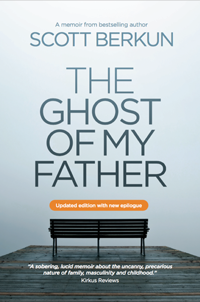
I’m proud to announce the new edition of The Ghost of My Father, with a new epilogue, is now on sale.
The book was first released October 2014, and a year later my father died. The new epilogue explains what happened between these two pivotal moments in my life. It shares what he thought of the book (he did read it and shared his opinion) and what happened between us before he passed away.
This new edition includes a list of resources and recommendations for readers who want to explore their own stories, advice on writing your own memoir, plus an annotated list of books on family dynamics and how to learn from our past.
Free on Kindle Wednesday 11/2 (tomorrow): for 24 hours the updated edition will be completely free. This is in part to give folks who already have the book a chance to grab the new edition without having to pay for the whole thing. Please help spread the word to friends and family you know would benefit from reading my story. Here’s a tweet/FB post you can copy:
“Bestselling author @berkun’s Ghost of My Father is free on #kindle tomorrow: bit.ly/ghostmf”
Thanks again to everyone who helped support the first edition of the book.
Reviews from the first edition:
“A sobering, lucid memoir about the uncanny, precarious nature of family, masculinity and childhood.” -Kirkus Reviews
“Not only captivating, but also insightful… digs deep into many themes; family dynamics, forgiveness, grace, legacy, hope…” – Jen Moff, Thejenmoff.com
“Ghost of My Father is a poignant example of the value of positive role models. ” – Amy Mack, CEO of Big Brothers Big Sisters of Puget Sound
“…A brutally honest memoir, well worth reading.” – David M. Allen M.D., Professor Emeritus of Psychiatry, University of Tennessee
“compelling… ideally suited to an audience that’s similarly concerned with the challenges of adulthood and parenthood in the 21st century.” – Kirkus Reviews
“Thought-provoking read, and highly recommended” – Thomas Duff
“When I finished it, I felt more human and less alone.” – Heather Bussing
“Finished in one intense sitting. Intensely personal & gripping” – Michael van Lohuizen
I always had a tough relationship with my father, and the week of father’s day is a tricky time. While I’m happy to see friends celebrate, and appreciate what they have, the day reminds me of what’s missing from my own life. Many people have similiar stories to mine, or their fathers are no long alive, making the day a complicated one.
I wrote the book The Ghost Of My Father (free excerpt here) in part to redefine who I am, and how I related (or did not relate at all) to the father of my birth. Along the way I found a different way to feel about Father’s Day and redefined it into something positive.
Here are five ways to get through Father’s Day if it’s a difficult time for you:
Make it “men who helped you” day. Make a list of other men (or women if no men qualify for you) who helped you in your life. Give them a gift or write them a note that you’re grateful for what they did. Perhaps a high school teacher or coach? A boss who mentored you? Or even an older friend, or uncle, who has given you fatherly advice now and then. Let them know that they helped you.
Honor good fathers you know in your community. Do you have a friend who is a good father to their children? Father’s day gifts from children can feel obligatory, but a thoughtful note from a friend, someone who has no obligation, can mean a great deal to them (and to you). Tell them what you’ve noticed and why you appreciate the kind of father they are.
Consider fathers from movies and books that have inspired you (Candidates include: To Kill A Mockingbird, Contact, Boyz ‘n The Hood or even Life Is Beautiful. See: Ten Best Movie Dads). A fictional father can still provide guidance or even be a role model. You can choose to think about them on Father’s Day and write in your journal about why those characters have earned a place in your memory.
Think about becoming a mentor. Help a young person get some of the support and guidance you didn’t get (or that you did get and want to pay forward). Big Brothers Big Sisters is a great place to start, and the first edition of Ghost of My Father donated a portion of the proceeds to them. I was a Big Brother myself for many years and highly recommend participating. It can change how you feel about your past, and your future, in profound ways.
(Bonus) Work on your relationship. If your father is still alive, take a chance and reach out. My father died last year, and I’m out of chances to ever try and reconcile again, but perhaps there is hope for you. Instead of a cliche gift, buy a book about fathers and sons and give it as a gift, with a note asking him to have a conversation about it. The Great Santini and Big Fish are challenging places to start (and were made into excellent films). If you’ve done this and have book recommendations, leave a comment (particularly for books on father / daughter relationships, which seem harder to find)
[Update May, 18 2016: Yes I know, a year has passed. My father died October of last year, more than a year after the book’s release and I wrote a brief note to my mailing list about the news. When it happened I put this update on hold to give me a chance to sort myself and feel things through. Only now do I feel ready to finish the story.]
This week I’m working on an updated edition of The Ghost of My Father. It will have a new epilogue chapter about what’s happened since the book came out, answers to questions I get asked often and some recommendations for people with family issues like mine.
Did you read the book? If yes you can help by leaving a comment about a question you had you wish the book answered.
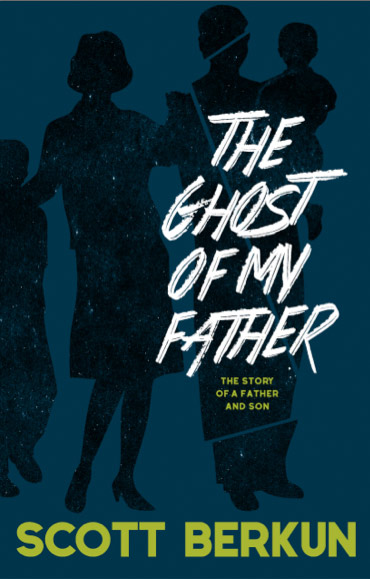
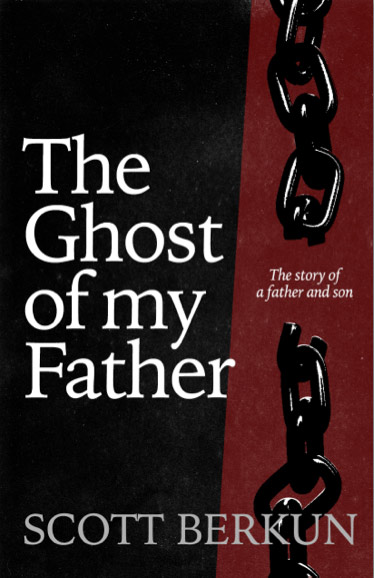
Meanwhile designer Tim Kordik updated the cover design. It now has lovely reviews from generous souls, a more thoughtful description and more.
Recently I did a live Q&A about How To Write A Memoir. It was a reward for the book’s backers. This post is a summary of the advice I shared. Thanks to everyone who tuned in and asked questions (and helped me keep the lights on).
1. The two truths of writing anything
There are only two things you need to write any kind of book.
Good habits. Books take time to write which means your success depends on regular habits. It’s a marathon. I know the way my psychology works I either need to write every day or I won’t write at all. It’s a muscle I have to use regularly to have it perform the way I want it to. How does your psychology work? You need to know. My advice is simple: have a set time every day, before you go to work, after dinner, before you go to bed, that is permanently reserved and protected by hungry Rottweilers, for writing. It needs to be something you do daily without debating each time.
Commitment. Your writing time will come from somewhere. You’ll need to give up one TV-show a night, spend less time with friends and family, or get up earlier each day. No writer in history has written anything without sacrificing time they could have spent on something else. And when you show up for each writing session turn everything else off that distracts you. You might only put a sentence or two down a day, but if you keep showing up that’s all you need to eventually finish a book. If I don’t feel like writing I’ll show up to my session anyway and commit myself to sitting and thinking about the project, or staring at the blank page. That’s commitment. Usually I’ll get so frustrated in a few minutes with how idiotic I feel having nothing to say that I’ll eventually start writing about that. And then, soon, I discover I do have something to say about the book I’m working on, and before I know it I’m writing. But I have to show up and put the time in. There is no other way.
When people fail with a writing project there are only two causes: bad habits or lack of commitment. If you are committed you will continue to experiment with your habits until you find one that works for you. And if you only manage a paragraph a day, as long as you are patient you will, eventually, have a finished draft. But there is no trick to avoid the work: every writer in history had to put in the hours and you will too.
2. What books or resources do you recommend for writing a memoir?
Read what you want to write. How many memoirs have you read? Go read some. You can’t write well in any genre unless you are well read in it. You’ll discover how many different ways there are to approach point of view, style, tone, pace, chronology and more. Here’s a list of memoirs I recommend.
Thinking About Memoir, by Abigail Thomas. A simple, short book that explores the basic concepts of what a memoir is and how they work. It includes writing exercises and encouragement. There are many basic books like this one, but I liked it’s concision and straightforward style.
The Art of Time in Memoir, Sven Birkerts. If you write a first draft and read it, you’ll discover the core challenge of memoir is how you, as the narrator, move through time. It’s the spine that makes a memoir work or not. Of all the books I read about memoir writing, it was this book that helped the most with the central challenge of time. The book referred to many memoirs I’d never read before, which I needed to read (at least partially) to fully understand his points, but that was time (ha ha) well spent. The only way to understand the different ways to handle time was to read another writer and experience the choices they’d made.
How To Write A Memoir. This short Reader’s Digest post by Joe Kita is surprisingly good and honest.
3. A memoir is not an autobiography.
A memoir is a true story about an aspect of your life. An autobiography is a comprehensive telling of you life story. This gets confusing because we often hear politicians or celebrities talk about writing “their memoirs“, as in plural, which really means autobiography. Autobiographies are much harder to do well, often span 600 pages and are far less interesting to most people.
A memoir has more creative freedom in the themes, narrative styles and storytelling techniques you can use. There are memoirs about childhood, travel, family, competitive sports, starting a company, almost anything. Rebecca Solnit bends the very idea of memoir by combining elements of history, personal stories and journalism together. The unifying factor is the the book is a true story told in the first person about events that primarily happened to the narrator on a singular theme (at least in the writer’s mind).
4. You have a secret reason for writing (a memoir). Figure out what it is.
My friend, and trained therapist, Vanessa Longracre was my expert guest during the Q&A. She pointed out that many people think they know why they want to write a memoir, but possess a secret, and more honest, reason. That honest reason might be:
This will solve my problems
My estranged father/mother will do X for the first time
Everyone will know the TRUTH about my brother and will shun/love/hate him
I’ll finally get the apology I deserve
Having written a book is unlikely to achieve any of these things. Certainly not by itself. A book can be cathartic and the process of writing it can help you think and feel more carefully helping you to understand yourself better. But the fundamental dynamics of a family relationship have very deep causes that are unlikely to be influenced by the existence of a book alone. Do some research and see if other memoir writers got their secret reason satisfied (See this story about a new memoir about a the troubled McCandless family)
People telling you “you have a great story you should write a book” is an insufficient reason. Unless they are gifting you 500 hours of time to do the work, it’s not help. You have to decide your own reasons, the primary one being that you believe it’s a good use of your time to write a book about yourself. I get emails often asking me “Is my book idea good?” and I tell them the same thing: only you can answer that question. My opinion is irrelevant since you will have to do the work.
It’s okay if you don’t know. And it’s ok if your answer changes as you’re writing. But realize you probably have a fantasy about your motivations. You’ll write a better memoir if you dig deep to sort out what it is you are truly after.
When this crisis happened in my family I talked to my mother and brother often. These were long, intimate conversations about our family and how we felt about what was happening. It’s a crazy story and we’d laugh at times about how absurd it was. I said to both of them “this should be a book” and they agreed. I don’t know at the time they knew how serious I was, but I’m a writer. This is what I do. A powerful, complicated true story landed on me and I committed myself to telling it.
I wrote it for many reasons. First, I was obsessing about my father and my family and I needed a constructive place to put that energy. Second, I’m a writer who wants to take risks and this was going to be a different kind of book. Third, all families have problems. What we don’t have are the skills and courage to talk about them. I felt if I told my story well it could help readers figure themselves out. This is what good art is supposed to do: help us understand the human condition.
6. There is power in writing without publishing.
I’ve kept a private journal since I was 19 years old. It started as a class assignment, and most of my early entries are embarrassingly shallow attempts to impress the professor. But after the class I kept writing in it. I found that trying to explain whatever I was thinking or feeling in words had a power, even if no one read it. It forced me to think and feel carefully, and when I wrote something down, even if it was expression of confusion or uncertainty, I always felt like a burden had been lifted. Seeing the words on the page made me feel more comfortable with myself. And then I discovered that going back to entries in the past and comparing my feelings in the present was transformative. Written words persist far better than our memories do, and writing your thoughts down is a gift to your future self.
You don’t need to publish writing for it to have meaning. You can also choose to share what you write with only with a friend, or family. You can decided after you’ve written a draft whether you want to publish it or not, or who you’ll publish it for.
7. How do you deal with the situations you don’t remember precisely? (e.g. names of places, people, what happened exactly, what people said, etc. )
Writing is never neutral, completely fair or perfectly accurate. There are long debates among writers about what poetic license is, and how far a (non-fiction) writer can go in shaping or crafting true events: it’s a complex subject I’ve written about here.
Human memory is highly unreliable and anyone writing a memoir must admit this. Keeping a journal helps as at least you have a written record of what you thought on the day certain things happened. Interviewing other people who were there when events happened can be critical as two or more sources dramatically improves the quality of the facts.
Most important is to disclose to readers what sources you had. Few memoirs do this and it’s a mistake. In most memoirs quoted passages (e.g.’and then Todd said “this is the worst Atari game I’ve ever played!”‘) are inventions based on one person’s recollection of a conversation. How accurate can this possibly be? Unless the author had a tape recorder playing 20 years ago how could they possibly remember the exact quote someone said? They can’t. But written storytelling works better when this kind of precision is provided, so many writers claim poetic license to fill in these gaps.
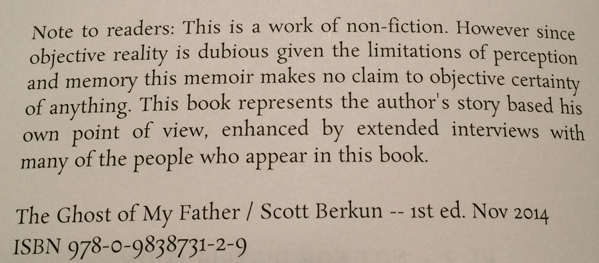
I think whatever you do is ok provided you explain to the reader somewhere what you did or didn’t do. Here’s what I included on the first page of The Ghost of My Father:
8. Were there periods of doubt while writing this book that were more severe or different than what you have experienced before? Were your habits always strong enough to alleviate these doubts? If not, what parts of your life helped you rebound?
Yes. All ambitious projects come with periods of doubt. If I work on something and never have doubts it means I wasn’t ambitious enough. This is my most personal book and everyone in my family who is in the book is still alive. But I’m a writer. This is what I do.
The habit that matters the most is having faith in the next draft. In each draft I had a chance to reconsider what stories I told and how I told them. I had 5 people read early drafts of the book, people who I know are honest with me about their feedback.
9. Did you have any fears or concerns about how being this vulnerable, personal and open would impact your perception and opportunities with your harder core business audience?
I’ve had some practice with sharing private thoughts publicly. I wrote a popular book in 2009 called Confessions of a Public Speaker, so I’ve confessed on some things already. My previous book, The Year Without Pants, is a first person story of my experiences leading a team. Of course The Ghost of My Father was far more personal, but the experience with being honest with readers is something I’ve been developing over time.
I want to take risks with talents. To do that means doing things I’m afraid of. I want to bet on fans. If I publish a book they’re not interested in I hope they’ll just wait for the next one.
10. What does a personal memoir need in order to be popular (have high sales) if it’s not about someone who is already in the public eye? Does it need a character arc? Or a realization of a profound truth? What makes it interesting to the reader?
Selling books is harder than writing them. There is no formula. In broad strokes memoirs are harder to sell than novels or non-fiction books. Being famous helps of course as people are interested primarily in the person, not the book. A big part of any book selling well has little to do with the writing of the book. You have to identify the audience, find ways early on to reach out to them, write a great book, and then work hard to let them know you’ve provided something they want. But the more you write a book to sell it, the less soul the book will have. Making true art demands goals with more depth than sales numbers.
11. Being such a creative mind and tackling so many topics in your blog, how do you decide on a topic & outline for a book? How do you handle “book being already written”, “same old topic”, etc? Really, how do you write great books on topics already addressed?
Every topic has already been addressed many times. So what? If you read the Greek tragedies you’ll discover Shakespeare stole their plot lines. And then if you watch the Lion King you see it’s Hamlet for kids. No one really cares how original it is in the abstract, they care about how good it is in the specific. See It’s Ok To Be Obvious for my take on this philosophy. If you have an opinion go read what someone else said about it. I bet you’ll find you disagree with them or have a better way to express a similar idea. Don’t hide from it, build on it.
11. Did you consider writing it as fiction even if it’s mostly true to avoid the issue of criticism of your decisions?
Telling my story as fiction felt like cheating. Many writers have done this and I’ve often wondered why. Even Charles Bukowski wrote Ham on Rye as a novel, despite it being the story of his childhood. In this case I asked myself: am I telling a true story or not? If I am, why call it a novel and introduce doubts? If I’m a good storyteller why do I need to invent things to make it work? Anyone in my family who read the book as a novel would easily identify who they were. So why the ruse?
My complaint about so many films and TV shows about family is how phony they are. And since these are the primary ways we learn about families other than our own they perpetuate the same fantasy mythology about what real families are like. Where does most of your knowledge about relationships come from? Much of it is from fiction and I think that’s part of the problem. Of course fiction can illustrate some things better than non-fiction, but in some cases the opposite is true.
I know many authors wait until their parents are dead to write about them. This feels like cheating too. Superficially it seems like respect to wait until after someone is dead to write about them. But think about that: it takes away their rights to respond. It’s actually a betrayal. It’s a permanent way to go behind their back. There is nothing in this book I haven’t said, or wouldn’t say, to everyone in my family. Does that make me brave or stupid? Probably some of both. To put it another way: how I can consider someone close to me if there are deep things central to who I am that I can’t share with them? Or share, as an illustrative example, as a writer, with strangers? We talk about transparency and honesty but do we practice it in families? in tribes? Cultures?
You can decide if you want to fictionalize your story later (and here’s advice on how to decide). Don’t get hung up on this. You’ll write many drafts and it’s a decision you can start worrying about once the first draft is done.
12. Did you come to have a different understanding of forgiveness? As a human ability or valuable choice?
I want to say yes, but it’s hard to be sure. The cliche of forgive but not forget is true to me. I don’t hate my father. He is a lost person and I feel sad for him, as he’s his own worst enemy. And I do understand, now, that his failings as a parent have more to do with him than with me. But forgiveness is not a panacea. Dysfunctional families are not fixed through forgiveness alone. Here’s a more important question: if you are in a relationship that is inherently destructive for you, what obligations do you have to stay in it? And how deeply? That’s not about forgiveness so much as it is about figuring out how to be a healthy person. How do you create healthy boundaries on territory you know is dangerous to you? That’s the hard question. There’s no platitude for solving that one. It’s the struggle most people have in their families: how can I be myself in here? I love these people and they love me, but then why does it hurt so much to get close? It takes hard work to learn healthy expressions of love.
———————————————————————-
You can buy The Ghost of My Father on Amazon. Kirkus Reviews called it “A sobering, lucid memoir about the uncanny, precarious nature of family, masculinity and childhood.” Profits from the first edition of the book are donated to Big Brothers Big Sisters.
If you have other questions about writing, or writing a memoir, leave a comment.
Interesting in writing a memoir? or did you read The Ghost of My Father? Or both?
Join me for a live Q&A about my book and how to write a memoir of your own.
When: Wednesday March 4th, 12:00pm PST Where: Anywhere! It’s online. How: RSVP here
I’ll answer any questions you have about the issues raised in The Ghost of My Father (FAQ, free excerpt here), or questions about how it was written and what advice I have for you if you’re interested in writing a memoir yourself. Trained clinical therapist, and friend, Vanessa Longacre will join to provide expert commentary.
If you can’t make it, leave a comment with your question below, and I’ll answer here or during the Q&A (which will be recorded).
What? Who is this Berkun guy and why should I care he wrote a book? Good questions indeed. Here are the answers.
Is there something about your childhood that lingers on your mind? My story is told in a way that can help you figure out yours. I’ve made mistakes but you can benefit from them. This book is about doing the work to sort our your memories and discover what really happened and who you want to be.
It will start conversations for you. Everyone who has enjoyed the book found it raised important questions for them about themselves. Give it to a friend or family and use my story to help explain yours, or them theirs.
Kirkus reviews said “…lucid memoir about the uncanny, precarious nature of family, masculinity and childhood.” Jen Moff wrote “…captivating, but also insightful… digs deep into many themes; family dynamics, forgiveness, grace, legacy, hope…” It’s the best reviewed of all my books.
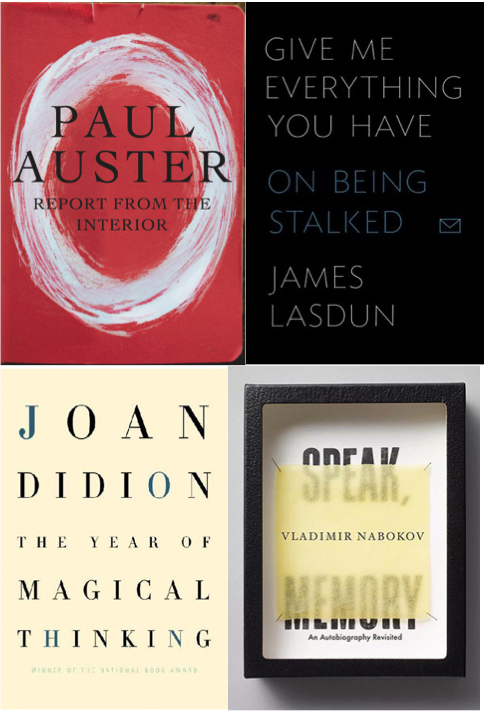
I always start with a one page design brief, explaining the goals for the cover. Since Ghost is a memoir, I spent much of the last year reading memoirs in preparing to write one. I picked some of the best memoir covers I found and shared them with Tim, and we talked about them over beers. We both liked the simple typography and the bold design choices (singular colors, simple imagery, etc).
Round 1
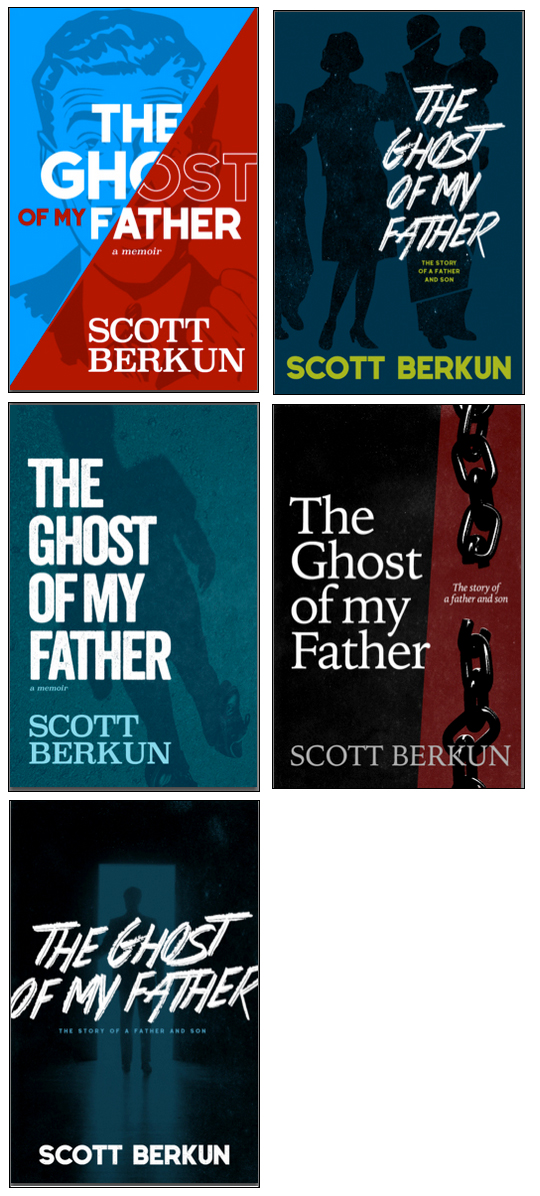
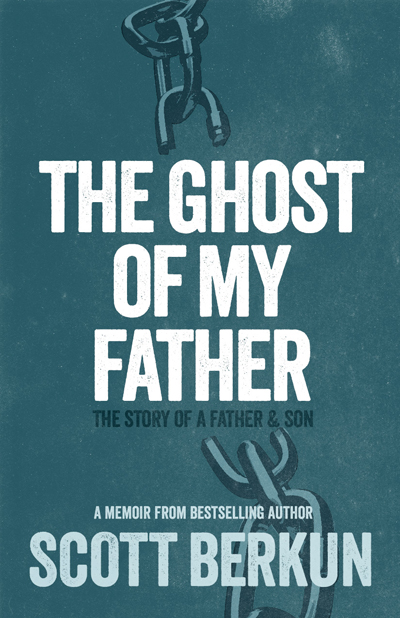
I like working with Tim because he understands the fun of the first round. Round one is the time to try widely different ideas and break rules. He put together more than a half-dozen initial concepts. Some were all out pop-art (upper left) and others felt more like thriller novels (bottom left) but I was pleasantly surprised by how different the concepts were: shadows and cut-outs were excellent metaphors for a book about a distant parent.
I asked readers to vote on the design, and 359 people kindly volunteered their choice. The 2nd option above, with the family in shadows, won with 33% of the vote. I never let votes make choices for me, but it generates discussion and helps me think about the design, even if I don’t necessarily agree with the winner.
Round 2
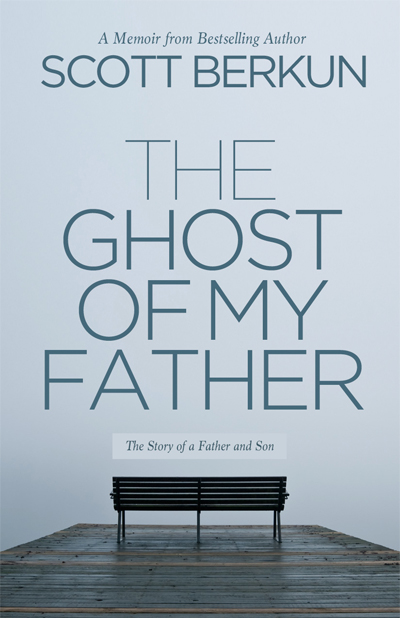
We talked about how strong the metaphor of the chain from the first round was, but not the style (too much like a literary novel from the 1970s) which led to one of my favorite concepts of round 2, with a vertical chain over a patchy blue background. It was my favorite design for round two and a front runner for the final design.
Round 3 – New Concept
By chance a friend, Teresa Brazen, posted a photo of a hike she took on Facebook. It seemed a perfect theme: a place for contemplation, and perhaps sharing time with someone close, but that was obscured and uncertain (in much the way a difficult, but important relationship can be). It seemed worthy as a concept and I sent the photo to Tim with some brief thoughts. He liked it and ran with the idea.
We kept my favorite design from round 2, as it was the strongest concept so far, but spent the round focusing on the new bench concept. Tim found stock photos that captured the spirit of Teresa’s photo (the rough, dense visuals of the landscape in Teresa’s photo made it hard to use for something like a book cover).
Round 4
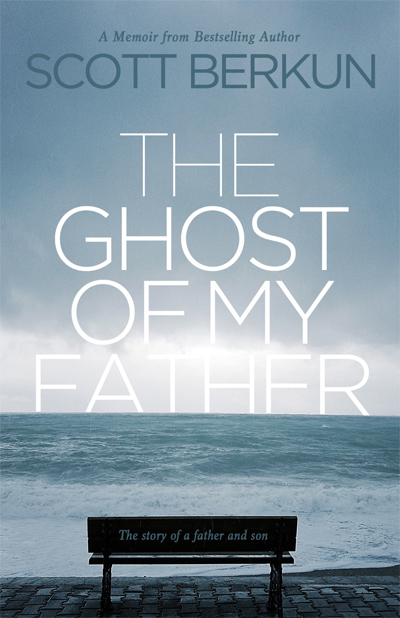
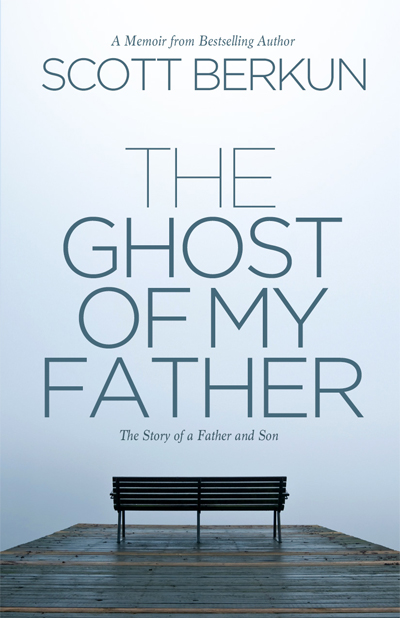
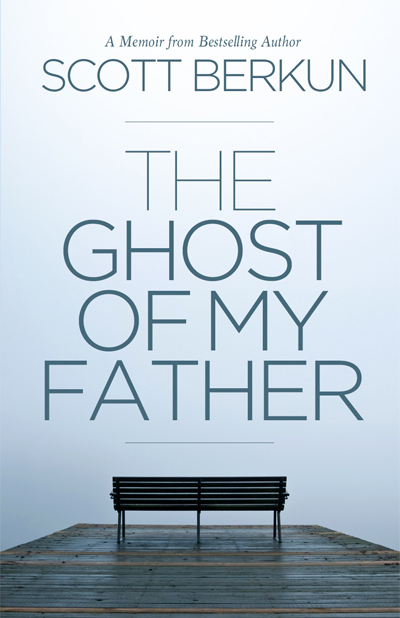
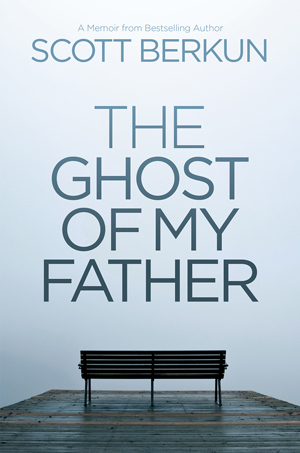
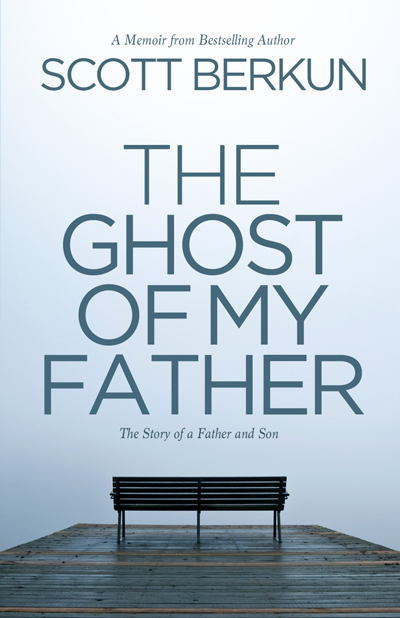
We finalized on the bench concept, and went with more abstract photo. Not being able to see where the ocean meets the sky suggested so many things about how, when you look closely, there is a surprising fuzziness to our memories and connections with some people we think are important in our lives, and the book is a head on exploration of this challenge. With most of the big decisions finalized, we got down to the graphic design details of spacing, font weight and composition. I still wasn’t sure if we’d have a subtitle or not, and after some advice from my kickstarter backers, I went dropped it. Simplicity wins.
Final Design
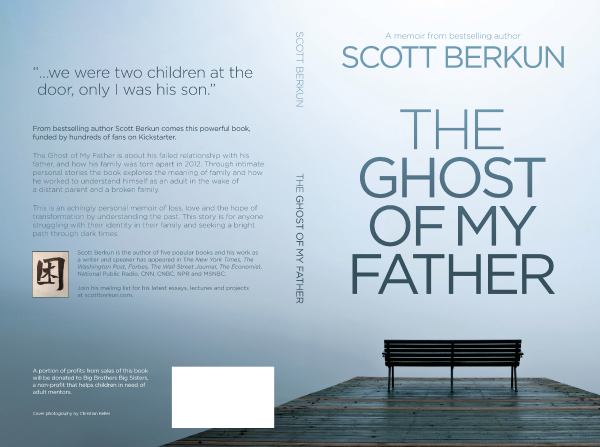
Here is the final design of The Ghost of My Father. Below you can see the full front, back and spine design.
Updated edition
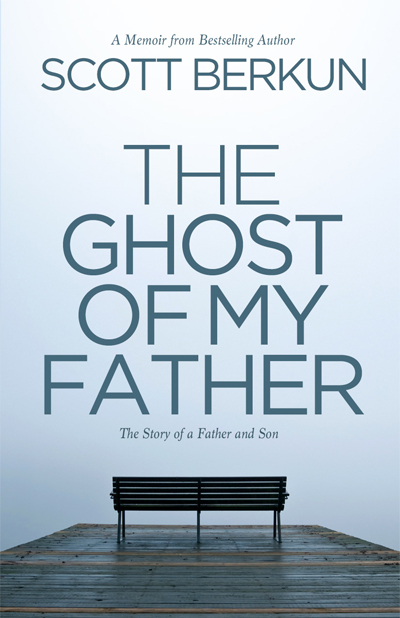
I wrote a new chapter for the book, after my father died, and we rereleased the book with an updated cover. We added a blurb to the bottom, and a visual highlight to make it easy to tell the difference between editions.
We settled on orange as the best contrasting color, and added a thin highlight strip to the spine as well, so anyone can spot the updated version even if it’s on a shelf.
You can buy the book on Kindle or Paperback, or read an excerpt (PDF). Kirkus reviews called it “A sobering, lucid memoir about the uncanny, precarious nature of family, masculinity and childhood.” It’s the best and most personal book I’ve written and if you like my other writing, you should really give this one a try. It changed my life to write it and may change yours to read it.
Along the way to writing The Ghost of My Father, I came across many stories of famous people who had difficult relationships with one or more of their parents. The samples are too random to assign any particular significance, as I learned in my own research, family estrangements are common. Are they more common among famous families or with children who become stars? Hard to say.
Here’s the rundown:
Jennifer Aniston: her mother, Nancy Aniston, wrote a memoir about their troubled history. They have recently reconciled.
I’m certainly not famous, but if you want to read a great book about understanding family and learning from the past, check out The Ghost of My Father. Read the free chapter here.
In my research for my book The Ghost of My Father, I was surprised at how little data there was about estrangement. I wanted stories and research from people in situations like mine, but I didn’t find much. One U.S. study I found reported that 7% are estranged (or detached) from their mother and 27% from their father.
To fill the gap I did an informal survey last week of 91 adults, primarily through twitter, to get some baseline data. Here are the results.
Disclaimer: since I recently published a memoir about my family and survey participants self-selected, it’s almost certainly biased towards higher reports of estrangement than average. This research is intended only to be a first step towards collecting more balanced data.
1. How old are you? Gender?
Nothing interesting here. Twitter and my following on it are unsurprisingly male and around middle age. 66% identified as men, 33% as women and 1% as other. 73% of respondents were from North America (U.S. & Canada) with 16 countries with at least one respondent.
2. Are you currently estranged from an immediate family member?
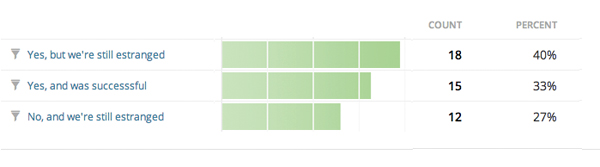
Nearly 50% of respondents are currently not speaking or relating to someone formerly close to them.
3. What is your relationship to them? And how did the estrangement start?
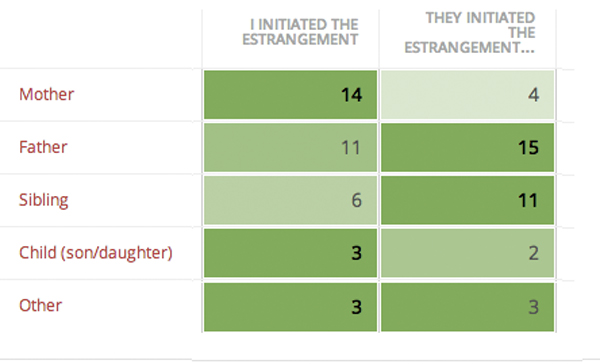
I wanted to know if particular kinds of familial estrangement happened more often. Fathers were most common, at 26. Mothers next at 18 and siblings third at 17. The second part of this question was unintentionally biased, as one of the respondents pointed out, in that there is no option for mutual initiation. Slightly more respondents initiated the estrangement (37) than did not (35).
Of course every family is complex and each relationship can influence the others. I did not ask for example if respondents were estranged from their entire family, parts of it, or just one person (they could choose more than one). Adoptions, divorces and other specific situations were not identified.
4. How long have you been estranged?
The majority of estrangements (45%) have lasted more than 5 years, 1 to 5 years were 34% and less than one year was 20%. This is likely indexed to age, as older people have been alive longer and the possibility for longer estrangements increases.
5. Have you tried to reconcile?
73% of respondents who are or were estranged from a family member have tried to reconcile. Less than half of them were successful.
Reconciliation can mean many different things and I left it to respondents to define the term. Specific situations liked adoption were not isolated from more common situations.
6. Comments
These situations are unsurprisingly tough and complex and many respondents left a comment with more of their story or details they though were relevant. Here are a few edited comments:
“It’s weird – I don’t know why it happened. There was no event. We both gave up on the relationship without communicating anything.”
“never estranged. Physically and financially family has always been together. But emotionally, in terms of open conversation, not so much.”
“I had enough of an unhealthy relationship with my mother after many years of trying, so I ended it. There have been life moments (sickness and deaths), with some contact, but that’s it. She hasn’t known my children for the past decade.”
“My father remarried and we haven’t talked much, if at all, since.”
“My family sucks”
“I’m sure my brother thinks it was me!”
7. What’s Next?
I’m trying to find psychologists doing research in this area who might be interested in doing more. If you know of anyone studying these questions professionally please send them my way or point them to this summary.
I’m pleased to announce the launch of book #6, The Ghost of My Father. It’s on sale now on kindle and in paperback.
Please buy the book today, as buying on launch day helps greatly in raising its rank and visibility on amazon in one big wave. 31 reviews so far (4.7 out of 5 average), dozens of mentions on twitter and Facebook. Its been a good day so far.
My 6th book, The Ghost of My Father is, as the title suggests, a departure from my other books. Many have asked why I wrote it and this page is the answer. The story itself addresses many questions people have, so I recommend reading the free chapter excerpt here (PDF).
The book has the highest avg. reviews of all of my books (4.7/5 avg, 70 reviews) and Kirkus Reviews called it “A sobering, lucid memoir about the uncanny, precarious nature of family, masculinity and childhood.”
There are questions inside every family that everyone thinks about but never asks. I asked my questions and wrote about the answers with the hope it can help other people. My unresolved questions had always been about my mysterious, distant father, whose absence played more of a role in my life than his presence.
Q: How hard was it to write this book?
It was the hardest book to write because the stakes were high. These are my most personal feelings about the most important people in my life. The craft of writing about emotions is hard to learn. It’s very easy to seem self-involved or trite, and miss the nuances that make a feeling relatable or even sensible to someone who wasn’t there.
Reading many memoirs (I read more than 15 of them) helped me sort out what I wanted to do with the book, and how to deal with some of the challenges memoirs have. The Art of Time In Memoir by Sven Birkerts was by far the most useful book about memoir writing I found and he calls out many of the traps, citing many good examples writers should read.
Q. Why did you decide to write a memoir?
How do we know what a good family is? Are there relationships that are beyond repair or is there always hope? We usually only have family one in our lives, perhaps two if we marry into another one, which is not much information to work with for the most important relationships we have. I wrote the book for anyone with questions about how their family works, or doesn’t work, and wants to read a well told story, from the inside, of a family that fell apart and what I did about it.
Q. A memoir? But you’re not famous.
We confuse autobiography with memoir. A good memoir is not comprehensive. Instead it takes one thread of a life and carefully explores it. Someone with a drinking problem, an interesting job or a specific question they’ve explored, can write a fantastic memoir even if the totality of their lives isn’t historic.
People assume only famous people have earned the right to write a memoir. I don’t think this is true. Most of us lead ordinary lives and well written books by ordinary people can be far more compelling and inspiring that books by people lost in their own fame.
In my case I’m a writer. My life presented me with a difficult story about my family and I felt someone needed to tell it. There are many people who have serious relationship issues with their fathers or mothers. I’ve wanted to write different kinds of books and this seemed an obvious time to take that risk. The primary goal in my life is to fill a shelf with books I’ve written and that demands I push hard to discover exactly how far my writing talents go.
Q. Do you think many families have stories like yours?
Many of us have unresolved issues with at least one parents. Most of us ignore those feelings, hoping to keep the past in the past. Yet we feel the pressure at every family visit, a bottled up tension fueled by something powerful we don’t know how to release. While I know not every family has the drama mine has, the goal was to use my story to ask universal questions about being an adult, and what to do about the monsters we’ve made for ourselves in our past. I want my story to help other people figure out theirs, which is why 50% of the profits of the first edition will be donated to Big Brothers Big Sisters.
Q. Did you family know you were writing about them?
Early on in I told my brother and mother I was thinking about writing a book about our family, and they agreed it was a good idea. I don’t know that they fully understood what this would mean (or that I did) but it was something we discussed. I interviewed my brother and mother many times, and my father once (which is captured in the book itself).
Q. How did you prepare?
I’ve always kept a journal and once this all happened and I thought about writing a book about it, I kept a separate journal of thoughts and correspondence related to my family. When I sat down to start writing the book in earnest I had a stockpile of archival material that helped me get started.
Q. Was writing the book cathartic?
Yes. I was surprised how in each draft parts of the story hit me hard, or didn’t make sense, even though I’ve known these stories all of my life. Life presents us with situations that don’t make sense, or are unfair, but happen anyway. We have to fight to live in the present and find ways to escape the past without pretending it never happened. Writing about yourself is difficult but I highly recommend it. It preserves your feelings and thoughts in a way memory never can.
DW: How long did the writing take? How many drafts did you do? What was your process? Did you use readers or editors for feedback as you went along??
I’ve always kept a journal and around 2012 kept a separate one for this project. I wrote, I believe, seven drafts. However, the last three drafts were primarily for copyediting and proofreading with few structural changes if any. I always have early readers. In this case four people read early drafts (they’re enthusiastically thanked in the Acknowledgements).
I hired two copyeditors to review the last drafts, a proofreader, and had many volunteer proofreaders too. Most of my books demanded fewer drafts, but otherwise this arrangement of editors/readers is standard for my book projects.
DW: What are your tips and lessons for writing about a painful topic, one that you are exploring as you write?
The best advice is to read many books in the form you want to write in. When you read as a writer you read differently. You’ll discover how many different ways there are to handle the core challenges (is the narrator reliable? believable? whiny? charming? annoying? How did the writer achieve or fail at this?) and inform yourself about what they are.
You’ll also discover many different styles of narrative and structure, which will also help you make those choices. Joan Didion is a very different kind of memoir writer than Mary Morris or Maya Angelou, and each of their books expresses painful stories in different ways.
It is useful to invite people who were there into the project early on. David Carr, in his memoir, The Night of The Gun, used his family to help him remember events, and even had them read drafts. For me, I interviewed both my parents, and my brother read nearly all of the drafts and gave feedback on them.
The challenge for memoir is that it is highly subjective and personal, even more so than novels. The reasons why someone likes a memoir – or not – are very personal. Only in reading many of them can you recognize there is no right answer, and that no matter what you do not everyone will be interested in your story, or like the way you tell it.
Have a question about the book? Leave a comment and I’ll add the answer here.
If any of my work has helped you in the past, here’s an easy way to return the favor. My 6th book, The Ghost of My Father, launches on Wednesday. Every single mention or purchase of the book on the day helps tremendously in helping this new book find its way in the world.
50% of profits of this first edition are going to Big Brothers Big Sisters, so you’ll be helping a great charity too.
How to help TODAY:
Set a schedule reminder for one or more of the following (iCal appt):
Buy the book on launch day 🙂 For now only on Kindle and paperback
Post on Facebook, Twitter, LinkedIn with the link
Email your friends and family about the book
Post an Amazon.com review when you finish reading (and Facebook / Tweet about it)
The hashtag is #ghostmf. Feel free to reuse, borrow, snip and edit these:
Twitter: “New book by @berkun, The Ghost of My Father, fantastic story of understanding the past, on sale today: http://bit.ly/ghostofmyfather #ghostmf”
Twitter: “New book by @berkun, The Ghost of My Father, read the powerful chapter excerpt and buy today: http://bit.ly/ghost-excerpt #ghostmf”
Facebook: “One of my favorite authors has a new book out today. If you have issues with your parents you’re still trying to work through, get this book. His story will help you understand yours: http://bit.ly/ghostofmyfather – 50% of profits donated to Big Brothers Big Sisters”
Early Reviews:
“Not only captivating, but also insightful… digs deep into many themes; family dynamics, forgiveness, grace, legacy, hope…” – Jen Moff
“Thought-provoking read, and highly recommended…” – Thomas Duff
“When I finished it, I felt more human and less alone.” – Heather Bussing
Want a Reminder?
If you’re following me in any medium you’ll be reminded on Wednesday 🙂 There’s a special Facebook Event page, but my twitter, Facebook fan page and mailing list will all be updated in the morning, and likely throughout the day with news.
If you leave a comment on this post I’ll make sure you get an email too.
When writing a new book I often start by making a reading list. It’s by reading books in the genre you’re writing in that you is the only way to understand the strengths and weaknesses of the form, and how to solve certain challenges.
With the release of The Ghost of My Father (read the free excerpt here – PDF), it was useful to review the best, or most important, memoirs I’ve read.
Down and Out In London and Paris, George Orwell. Technically this is a work of fiction, but it was clearly based on Orwell’s real experiences. His style was very influential for future journalists who chose to write in a first person style. Orwell’s ability to describe situations and environments is first rate, and he excels at concision. One of my favorite books, NewJack: Guarding Sing Sing By Conover, is in the same lineage (though more journalistic than strictly memoir form). These books heavily influenced The Year Without Pants and the new book too.
The Year of Magical Thinking, Joan Didion. For my purposes I needed to study the telling of tragic personal stories and this book has become the canonical reference. Didion’s husband and best friend died suddenly and the book documents the year that follows. Didion is cerebral, the camera angle of her narrative is strictly in her head, or over her shoulders, providing a more intellectual narrative than many memoirs do. It is a solid book, but I was underwhelmed by it for reasons I can’t explain. It felt repetitive to me, which to be fair is perhaps an accurate reflection of what she experienced (that’s the challenge with memoir – the most honest telling of real life stories often don’t fit into convenient narrative arcs or patterns).
Pilgrim at Tinker Creek, Annie Dillard. If you’re not captivated in the first few pages, give up, not just on this book but on reading in general. I’ve read this book several times and each time I’m surprised by how truly breathtaking her prose is, and I’m not a prose junky. I will never be the kind of writer she is is. She’s like Updike at his best, able to wind paragraphs of description and perspective around a single moment or image and leave you wanting more and more. The book demonstrates how a memoir can take one simple trip, act, decision, or idea, and develop it into an entire world.
Get In The Van, Henry Rollins. The raw, honest stories of life in a rising, but fledgling punk band in the 1980s is something to behold. There is no pretense here, in the writing or in the life he led. The simplicity of his approach, both in the structure of the book (it’s a journal) and the entries (a record of places they performed, and encounters on the road) reveals how little artifice a memoir needs to function. Many of Rollin’s books are disappointing, especially his poetry, but this book shines and stands up as a testament to how simple a good book can be.
Nothing to Declare, Mary Morris. I read this book 15 years ago ago, long before I decided to be a writer. I’d never read a book that was simply a person telling a story about what was happening to them, and for that to be interesting. I’ve read several of her books and enjoyed them all. This in part gave me the confidence to become a writer. The idea that a good book wasn’t about extreme situations or great drama. It was about being honest, being thoughtful, and applying the craft of storytelling. Bukowski and Henry Miller were also huge influences for me in the idea that simply being brave enough to be honest is exceedingly rare and can make for powerful writing all on its own.
This Boy’s Life, Tobias Wolfe. I read many of the classics memoirs and this was one of the few I enjoyed reading. It tells the story of Wolfe’s difficult childhood. The themes echoed the stories I wanted to tell in The Ghost of My Father, and Wolfe tells his story with a lack of pretense and judgement. I knew I wanted to be closer to Didion in perspective, with commentary on what happened in my life, both what I thought about it then and what I think about it now. But Wolfe avoids this. He writes as if it were a screenplay, making few overt judgements about anything, leaving it to the reader to decide for themselves what was good, bad, right or wrong.
Born Standing Up, Steve Martin. Famous people writing about their lives is often dreadfully predictable, but Martin is a fantastic writer. This book focuses on his early years performing for empty theaters, and how he found his way, through work and experimentation, to excellence. Its charm is how foolish he reveals himself to be, a naive kid working oh so hard to figure out show business. “Precision creates movement” is one of my favorite quotes.
Chronicles, Bob Dylan. This is an odd choice in a way, as he gets away with things here purely because of his fame. He jumps through time, abandons stories, repeats stories and generally seems to be teasing and playing with us readers. But there is a charm here. An unwillingness to follow convention and to play with the lines of storytelling and narrative. If you know his career it’s no surprise his book takes this approach, but it’s a worthy counterpoint to more literal memoirs that follow strict boundaries of form.
Broken Music, Sting. Like me Sting had a difficult relationship with his father, and the album The Soul Cages, is essentially dedicated to him (most notably, the wonderful sad Why Should I Cry For You). I put it on my list for that reason and wasn’t disappointed. Sting is smart and well read (he was an English teacher while playing in bands at night), and the book is empty of most the arrogance he’s earned a reputation for. It focuses on the early years of his professional career, before the Police, and the many mistakes and chance occurrences that led to his rise to fame.
The Night Country, Loren Eisley. Like Nothing to Declare, I read this long before I became a writer. Eisley has always been a big influence, particularly his ability to blend personal stories with professional observations, a theme that runs through all of my books. The Night Country in particular expresses a love of the mystery of life and how important mystery, and the curiosity to explore it in all it’s forms, is at the heart of an interesting life. If you have any interest in science and literature Eisley is a rewarding read.
Diary of A Young Girl, Anne Frank. I’ve read this book several times. There’s something so simple and clear about her writing, and the fact that you know the end all along changes the way you read it. Credit should go to her father as well for editing together her journal into such a simple, short, powerful book.
A Heartbreaking Work of Staggering Genius, Dave Eggers. I think of this book often for both it’s strengths and weaknesses. It’s a fantastic and tough story, told well and honestly. Where the book struggles is Egger’s insistence on being extra clever. There are footnotes, and footnotes, and self-references, and it’s just too much at times – a brilliant writer who is too self-conscious to just tell the story without commenting on how he’s telling the story. I haven’t read this book in years and I’d like to read it again to see how my opinion has changed.
Night of The Gun, David Carr. This book turns the form of memoir on it’s ear, as NYT reporter Carr uses his journalism skills to tell the story of his drug addiction and the impact it had on him and his family. I don’t know of any other memoir that was so dedicated to finding ‘the truth’ and telling it (Full review).
Famous memoirs I didn’t enjoy:
Stop Time, by Frank Conroy, which I abandoned after 20 pages for sheer lack of interest – it didn’t cohere for me at all. Memoirs are a most tricky form to write in. It could be everything that didn’t work for me here, worked for many of the people who loved the book.
Maus: A survivors tale, Art Spiegelman – perhaps my expectations were too high, but I struggled to stay interested. Mind you I’m of Jewish heritage, have a strong interest in WWII and like graphic novels. There was something about the plotting and the characterizations I struggled to get into. Perhaps I need to give it another try.
Me Talk Pretty One Day, David Sedaris. I’ve tried many times and I’m just not a Sedaris fan. I like the idea of him. I do respect the way he writes and constructs stories. But I don’t like this writing much. There’s something mildly cloying that turns me off in most of the stories I’ve tried to read, including Me Talk Pretty.
In working on my book, The Ghost of My Father I’ve read many books about fathers, both good and bad and some names come up often in the bad category. These stories rarely explain what life was like with them on a daily basis, but for the actions they’re known for alone they stand out in history. Here are the 5 worst I found:
Emperor Constantine. Reigned over the Roman empire around 300 A.D. He led the way for the endorsement of Christianity, as a supporter of the Edict of Milan. Where he got into trouble, as many Roman emperors did, was how he handled his family. He had his son, and likely heir, Crispus murdered. And of course, he also had Crispus’ mother Fausta murdered just two years later. The history of Rome and many empires is filled with fratricide, filicide (killing your child), patricide and more.
Peter The Great. Curiously similar to Constantine, Peter had his son Alexei executed. To be fair Alexei grew up with an allegiance to his mother, who despised Peter. Alexei put himself into exile, which generally pissed Peter off and he returned only with assurances that he wouldn’t be tortured or killed. Those assurances were ignored and Alexei was tortured to death.
Bible grab bag: Lot, Jephthah, Noah. There is plenty of bad fathering described in the bible (including perhaps by God himself), and although I believe the bible is best understood as fiction the importance of the book earns these fathers an entry. Between Lot’s incest with his daughters (and allowance of their raping), Jephthah killing his daughter, Caleb trading his daughter to whoever could conquer a city (it turned out to be Caleb’s brother), Noah cursing his grandson Canaan to a lifetime of slavery for his father seeing Noah naked, and on it goes.
Ivan the Terrible. He makes Constantine and Peter look meek, as rather than have officials take care of the deed, he committed filicide by hand, brutally striking his son’s head with a staff. The reason for this fight? Ivan physically attacked his daughter-in-law for wearing immodest clothing, and Ivan’s son tried to protect her. This scene is captured in a famous painting.
Marvin Gay Sr. Marvin Gay Jr. always had a difficult relationship with his father, and he was thrown out of the house on several occasions. Alberta Gay, Marvin Jr’s mother, said, “My husband never wanted Marvin, and he never liked him. He used to say that he didn’t think he was really his child. I told him that was nonsense. He knew Marvin was his. But for some reason he didn’t love Marvin and, what worse, he didn’t want me to love Marvin either. Marvin wasn’t very old before he understood that.” As he rose in fame and wealth Marvin Jr. added an ‘e’ to his last name to distance himself from his father. They were estranged for many years, but eventually Gaye tried to reconcile with his father, presenting gifts. In one last argument things got out of hand and Marvin Sr. shot Marvin Jr. twice, killing him.
These are extreme cases and it’s a relief in some ways to realize that as bad as your parents might have been, they weren’t anywhere near as bad as these ones were to their children, as you’re still alive to read this (and I’m still alive to write it).
References:
I started with other people’s lists but did my own research to confirm/deny facts and pick the 5 worst examples.
I’m looking for a sharp copyeditor who practices tough love, extreme sarcasm and enjoys long arguments over wine about the Oxford comma (or arguments about why arguments like this are silly). Previous book copyediting experience required (preferably of a memoir, although a heavy diet of reading memoirs works too).
To apply:
Briefly describe the worst memoir you’ve ever read
Give one reference for a writer you’ve worked with who loves and hates you for the right reasons
Tell me if you’re available and what your rates are
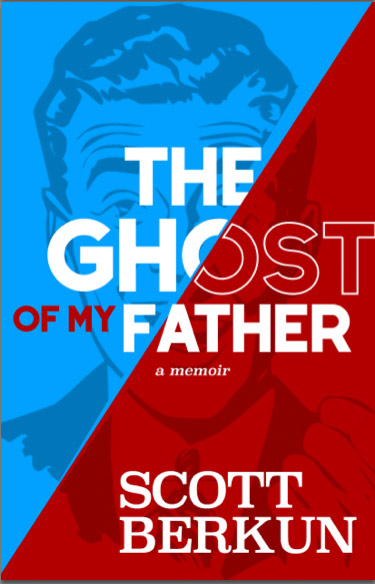
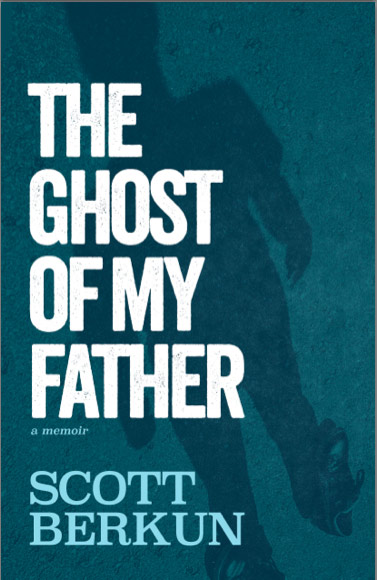
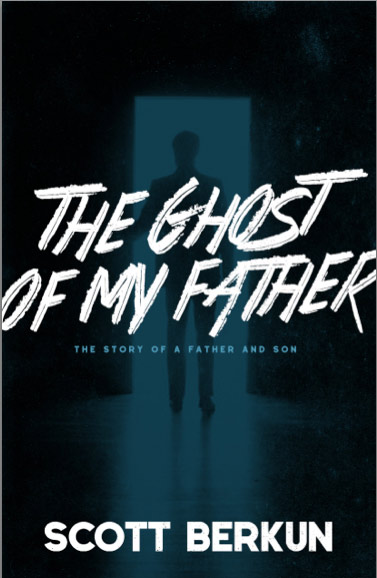
More than 350 of you voted for the previous round of cover designs. Thanks for your feedback dearest readers. A few weeks have passed since then and I’m back today with what are likely the final cover concepts: only two to choose from. How exciting!
Important: If you missed the kickstarter campaign, you can join this list to be first to be notified when the book is on sale, and receive early giveaways, free book excerpts and more.
The book itself is rolling along – still at work on draft #3 and it’s progressing nicely. Plan is for the book to be out this fall.
Regarding these designs: they’re not final, but we’re close. I’m still working on what the tagline will be (“The story of a father and son” isn’t quite right), or even if there will be a tagline at all.
There are plenty of great rewards – if you’re a fan of my other books I think you’ll dig them, but of course the coolest ones are in limited quantities. Take a look now and I hope you’ll help me with my next project. Thanks.
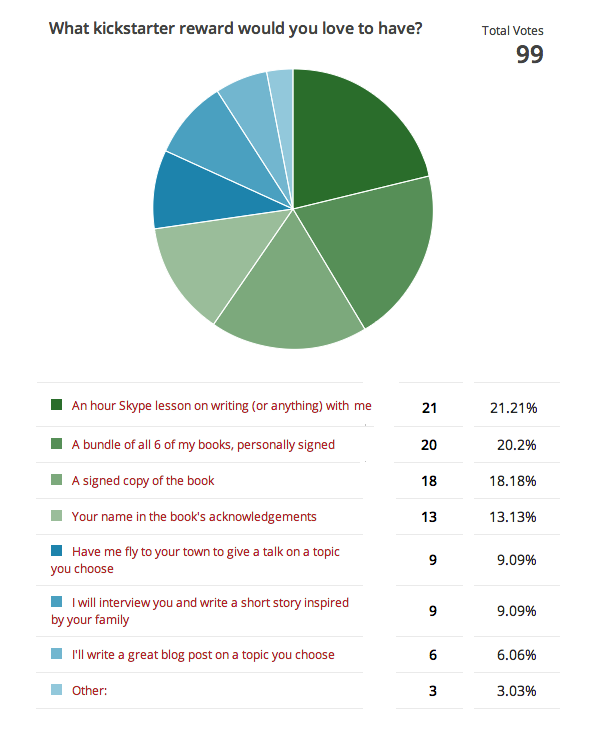
No surprises here. Of course with no associated price tags, an hour personally with the author (me in this case) came in first place. Curiously a signed copy of the book came ahead of items that are far more personal: writing something at the reader’s request.
About ten people emailed me to tell me they really just want the book. They don’t care about rewards and a reward is not going to make them decide to support a project they wouldn’t otherwise. I respect this opinion and often share it myself. However to run a successful kickstarter campaign requires appealing to different people who have different preferences. People who just want the book aren’t hurt by offering rewards to those who are willing to pledge more money, but want something special in return.
I’m sure different authors with different audiences will see different results than I did. But as I couldn’t find anyone who’d published survey data like this I though it useful to share.
The book in progress, The Ghost of My Father, is a memoir and it’s no surprise the process of writing it has been different than my other books. To help me sort out what I want to do and how to do it I’ve read dozens of memoirs and several books about memoir writing (recommendations post forthcoming). I thought I had a strong grasp of my own goals and the nature of writing these things. How wrong I was.
The funny thing is every book I’ve ever written has a moment where I realize how wrong I was. That’s part of the journey of writing. You have to possess a certain madness to believe you can take on something as big and unknown as 300 blank pages and shape it into something other people will want to read. For all of my books there has been a point like this, somewhere late in the middle of the work, where it hasn’t all fallen together yet in the way I want and I naturally wonder if it ever will.
The thing I’ve learned is when any creative work isn’t falling together yet it means something bold has to be done. Usually it’s concision: removing something big to give everything that remains the space it needs to blossom. Sometimes it’s shuffling: changing the order in which things are told. Other times it’s far more subtle, and I need to write a new beginning for the book that has better aim for carving through the rest of the material. For most of my books the first chapter that appears in the published version was written from scratch late in the process, to my dismay each and every time. The original first chapters, as hard as I’d worked on them, no longer fit the book they’d started. Maybe if I fill that shelf, I’ll have enough abandoned first chapters to make a book out of them.
This week I’ve been reading through the entire 2nd draft of Ghost. It’s the draft I’ve had 5 people read and give feedback on. I call these sessions where I read through the entire manuscript The Big Read. It’s a big deal psychologically and I force myself to do it. Rewriting and revising is far more fun than reading drafts. I’m convinced it’s worth it as reading the whole manuscript is the only way to put back into my brain what the book actually is at the moment. Books are big and my brain is small. Without rereading the whole thing I’m working with my imagined idea of what the 2nd draft is, which may be pretty far from what it really is like. Reading the entire draft also lets the feedback I’ve heard from others land properly, as while I’m reading I can see for myself where the feedback is accurate, or not, and make notes accordingly as I go. As strong as the urge is to jump to the computer and fix things, I resist. I want to wait until I’ve experienced the whole thing before I change anything.
As I’m reading the 2nd draft I’m noting the problems I find. Some problems are structural: why is this section before that one? Why is this story even in the book, but not this other one? How does X fit with Y, if at all? Other problems are craft: underwritten paragraphs, overwrought metaphors, experienced told but not shown. Craft is far easier to fix than structure. Craft is polish and you can revise a book, even a deeply flawed book, into polished writing. Some excellent books are structural disasters with craft so fantastic you barely notice (I’m looking in awe at you, Mr. Updike). But structure, pace and tone, things that have to line up throughout the entire narrative, are far harder to get right or to experiment with.
I have a novel I’ve worked on now and then for years. I once decided to switch the entire book from 3rd person to 1st, a task I decided could only be done by typing in the entire manuscript again, shifting the point of view as a I went. Some experiments and changes can only be tried at large scale. That’s the burden of long narratives like books, or films. The upside of books, and all writing, is you can always go back. Unlike a painting or a sculpture where a bad choice is irrevocable, in writing you can always go back. Writers should be brave in revision for this reason: there’s always a safety net, so be bold.
It took until I was halfway through this big read that I understood what I needed to do for Draft #3. And as much as I want to dig in right now and get busy, I won’t do it. I need to know if these plans I have now, at the halfway mark, will still hold together when I’ve read the whole thing. As soon as I hit publish on this post, I’m going back to the read. I’ll report back when I’m done. Have a good weekend.
The book is titled The Ghost of My Father. It’s a memoir about the most difficult relationship of my life. It’s a departure from previous books and I hope you’ll follow my lead. You can read previous posts about the project if you missed them. Please join the special email list for the book to be first to know when it will be available (and get early excerpts and other insider surprises). It will be a self-funded independent production and I can use all the support I can get.
Today I was thrilled to discover Kordik sent along his first round of concepts. While these are not final designs, I’m happy to let you have an early look and give your opinion. Just vote for the design direction you think is most promising (again, these are first rounds, not final designs). Leave a comment if you’re so inspired and I’ll read them all.
 proud to announce the new edition of The Ghost of My Father, with a new epilogue, is now on sale.