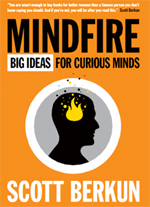
Last week I decided to give away my new book, Mindfire: Big Ideas for Curious Minds, for free from my website, for 48 hours. Some have asked me why I would do this, as I’ve been a popular author and my previous books have sold well.
Here’s a list of reasons why:
Platform. I could have sold some books, but by giving it away for a period of time I got extra PR and reach I would have had to pay for otherwise. I tripled the size of my mailing list in just two days.
Interest. It’s a way to generate interest in the book, and the wave of interest will outlast the 48 hour free period (at least I hope so 🙂 Sales are slow today, but I’m betting the free readers will like what they read, and create a second wave of interest.
The book is a collection of essays already online. I wanted to ensure my loyal readers didn’t pay for the book in digital form, since they’d read much of the book already. I wanted to avoid any fan saying “I didn’t realize and I paid for it – I feel like a sucker”. Instead I want them to feel enlisted to spread my work, and making a new book free empowers them to do that.
I’m a long-term author. I’m not worried about the sales of any particular book. I need to experiment and try different things to learn about how all this works so I’m smarter about how to create and market the work I do.
I’d like to broaden my reputation. Mindfire covers a wide range of challenging topics not in my other books, and it will expand people’s perceptions of my abilities. I’d gladly trade a pile of royalties (short-term) for an improved perception and wider fan base (long-term).
Giving it away generates interest from people who want to know why an established author would do this :). It’s another way to gain attention for positive reasons.
You can download a free preview of Mindfire: Big Ideas for Curious Minds (nearly 1/3rd of the content) right here.
Much of my recent ranting on social media is tied to this sort of philosophical questioning, as the making of good tools shouldn’t be confused with doing good in the world.
If you like my stuff, and are interested in tech, I think you’ll like this:
Are you free? I know I’m not. That’s why I write essays about being free, to freely show how un-free I am. Does this not make any sense? That’s ok. All is explained in the essay.
I enjoyed reading your article “#44 – How to learn from your mistakes”. One other category of mistake I would add to your list, really a continuation of the “Stupid” mistake, would be “Habitual”, or “Automatic”, whichever phrasing you like better. This is the case where you repeatedly make the same mistake(s) out of habit, it’s automatic. Take the person who wakes up every Saturday around 2pm and says “Gee, I wish I didn’t drink so much, why do I always do that?!”.
These are mistakes that we regret and always ask “Why do I keep on making the same mistake over and over again?”. From my personal study, I feel at the moment that the answer lies in making a new habit of pausing before we make a decision, and imagining the possible outcomes of the action and making a CONSCIOUS (rather than automatic) decision this time.
Absolutely – In fact Leo Buscaglia, in one of his books (I think it’s Living, Loving and Learning) talked about how being healthy depends on making more of our behavior choices. To grow as a person, in his estimation, hinges on seeing more and more of our own behavior, and even emotions, as choices and taking responsibility for them, instead of blaming others, or perhaps, the entire universe.
I’m at least at the point that when I wake up at 2pm on Saturday, I know full well why I made the choice 🙂
One question I hear often is “what can I do right now?”. Well, it turns out there are lots of things to do if you want to become an innovator, and in many cases it’s not very hard.
Genius is one of those tricky words that gets used often, without anyone knowing quite what it means. Well, I’m taking the word, and advice on how to be a genius, head on in this fun and entirely wild run through genius history.
At the last Seattle Ignite event, I did this talk, based on this essay, about the changing nature of human attention and how great creators have controlled their attention spans. Check it out.
Ignite seattle uses the following talk format: you get 5 minutes, but most have 20 slides and each slide can only be on screen for 15 seconds. I hacked the format, as you’ll see in an interesting way.
Anyone who does anything year after year has the same challenge: keeping up intensity when the energy, and novelty, fades. This essay is my primary list for staying in the game.
So I owe the universe or myself (whomever cares more), 9 essays. That’s right. Not to mention the 3 so far this year that haven’t materialized yet.
I have plenty of ideas, but I’m bored with my ideas. I want yours. That way I’m guaranteed at least one person other than myself will give a shit when I post the thing.
So here’s your chance: If you could rent my brain to write something, what would the title of the essay be? What topic do you think I’m chicken to write about? What mean scary question do you want me to answer?
Lets get it on!
To my delight, every now and then the fine folks at slashdot or lifehacker mention an essay of mine, and waves of people swing by, read something, and send feedback mail through the contact form.
I respond to as much of the interesting and thoughtful as I can – but it’s the internet, and some of it’s creepy, incomprehensible or just plain bizarre. I don’t fully know how to respond to many of these little notes I receive.
So for fun, here’s some highlights from the mailbag for the popular essay Why smart people defend bad ideas:
“You sir, are clearly a case of bad person defending a bad idea. You should practice what you preach before preaching to the choir.”
“THIS IS AMAZING. So MANY CLEVEr Things. SO NOW CAN YOU TELL ME HOW TO DECIDE WHAT TO DO WITH MY PARENTS?”
“I liked the essay but smart people are just better, right? So why shouldn’t they just defend whatever they think is best?”
“…loved this. Really loved it. Made me want to get a shotgun and shoot all the asshats.”
“Hey. If you’re so smart why don’t you know that spark plugs can’t cause fires? eh? Tell me that tough guy. You suck rat ass. I want the 5 minutes it took to read your turd back.”
“I printed this in big font and slid it under the doors of the executive floor. But it had no effect. What do I do now you think? Bigger fonts?”
“Perhaps you can help with this. I’m dating two girls at the same time, and keep thinking I want one, but then the other… well I don’t know how to LOGICALLY choose. Write an essay on this! yes!”
“How much can I pay you to stand in my boss’s office with a megaphone and read this essay every time he opens his mouth?”
The series of O’Reilly hacks books is tons of fun. Despite how you don’t want to hear about hacks for certain things (Brain surgery, Nuclear weapons, etc.) the idea of sharing the high leverage little tricks is awesome.
So here’s Part 1 of what will be a series on writing hacks: this first one is about getting started.
In part one, I hit on the topics new managers need to know before they shoot themselves, or others, in the foot. Here in part two we get into tactics, from getting acclimated, learning the team and setting the tone.
At e-tech 2006 the theme was the attention economy – but the conversation was mostly technocentric despite attention being a 100% human resource.
In this essay I discuss a view of attention that’s centered on people – attention is the most precious thing we have and I explore why we’ve lost control of it, how to get some control back and the role of desire and intimacy in how we spend our time.
Someone on the ask Berkun forum requested an essay for new managers. It’s a huge topic – there are entire books on this! – but I took a good swing and here’s what I came up with.
Part 2 will be more on tactics and specific things to do in the first few weeks.
Essay #50 will be published today – Its been 6 years of writing these things, first for MSDN, then at uiweb and now here. Thanks to everyone that’s been reading and writing in with questions and requests for essays – hope you’ll stick around. The next book is in progress and I’ll have details soon.
For fun I went back through all the traffic logs and looked at what’s been popular. So here is a traffic determined best of Berkun thru 2005:
 Last week I decided to give away my new book, Mindfire: Big Ideas for Curious Minds, for free from my website, for 48 hours. Some have asked me why I would do this, as I’ve been a popular author and my previous books have sold well.