Why Design Is Hard was published a year ago and since then I’ve given dozens of talks about the ideas from the book. I’m always grateful to be invited to speak and that there are folks who want to hear what I have to say.
The good folks at CanUX agreed to record my keynote talk about Why Design Is Hard and I’m happy to share it with you here. Hope you enjoy it. It’s also available to watch on Youtube here.
Note: the opening story about the Notre Dame cathedral fire is actually from the book How Design Makes The World.
Yesterday my feed had many references to a new Marc Andressen essay titled It’s Time to Build. I understand its popularity as it has an enthusiasm that’s in short supply in the tech world today.
But what he has to say floats about the fray in a disturbing way – thousands of people are dying from a problem we aren’t sure we know how to solve. Unemployment is rising towards 20%, which means basic needs for many is now a struggle. The government decisions happening now will determine how many more thousands of people die, especially front-line workers and the poor. And his essay doesn’t give consideration to them at all: having everyone build now will solve everything is his empty answer.
There’s much more. Let’s dig in:
Every Western institution was unprepared for the coronavirus pandemic, despite many prior warnings. This monumental failure of institutional effectiveness will reverberate for the rest of the decade, but it’s not too early to ask why, and what we need to do about it.
This sounds compelling at first as I hoped he’d explore what the rest of the world did right, so we can learn from them, but that is nowhere to be found in this essay, despite how well documented our lessons are. What did they do right? Is not a question he seems to have studied. A sign of things to come, or more precisely not to come.
Many of us would like to pin the cause on one political party or another, on one government or another. But the harsh reality is that it all failed — no Western country, or state, or city was prepared
Here he has made pandemic response binary, either you pass or you fail, which is not how things happen in the world. There’s always a spectrum for how to evaluate outcomes. If he wanted to write about the future he could have, but he starts in the present and makes everyone equal as a way out, which dodges learning anything from what’s happened.
Some U.S. States and European nations responded much better than others, as evidenced by the countless charts we all study daily. But that spectrum isn’t convenient for what Andreessen really wants to say, so he frames the world as pass or fail so he can confidently say that everyone (except for all of Asia which he won’t talk about) has failed.
And pinning the blame means you blame someone who was not involved (which he calls here pinning the cause). You can’t say this about someone whose job is precisely to prevent a thing that ends up happening.
For example, if a CEO calls the threat of a competitor a hoax and tells his staff to ignore it, despite their knowledge and interest in doing something pre-emptive, and then that competitor devastates them a few weeks later, and the stock price tanks, and 20% of staff are fired, it wouldn’t be pinning the blame. Instead it’d be holding the people in power accountable for the consequences of their actions.
Andreessen is avoiding politics by not mentioning Trump, or his staff, or any government agency, all of whom are accountable in degrees for what has happened. Andreesen wants to avoid alienating anyone but he’s doing it at the expense of credibility. Later on he writes:
“We need to demand more of our political leaders…”
But he does the opposite in this essay. We pay our leaders to plan for, respond to and be accountable for the outcomes of major events and he gives them a free pass, without even a mention of who has served their citizens well.
We see this today with the things we urgently need but don’t have. We don’t have enough coronavirus tests, or test materials — including, amazingly, cotton swabs and common reagents. We don’t have enough ventilators, negative pressure rooms, and ICU beds.
A cursory look at the successful pandemic responses showed that if you act early and shut social interaction down quickly, you never need vast quantities of ventilators or ICU beds. I’m not saying we should copy what they all did, as there were many tradeoffs, but we should start by learning from it, instead of leaving it out completely from essays on the subject.
Even if prevention wasn’t possible, we could have had the supplies we needed. They were for sale. But someone has to decide it is worth keeping massive expensive inventories that are rarely used. A hospital owned by a corporation that wants to stay lean to keep profits high, is unlikely to do this. What corporations call inefficiency, in the short term, is often very important in the long.
It’s governments that historically are well suited to insure societies against uncommon but devastating events, like wars, famines and natural disasters. Without shareholders and profit motive they can prioritize differently. America’s prized $748 billion military mostly stockpiles missiles, guns and aircraft that will never be used for their purpose, but we pay anyway. Why? In case we need it. That’s what a government can do. Why the same logic isn’t used when it’s about the health of citizens is a better line of inquiry than simply pointing out that we didn’t have enough of something. A small percent of that military budget might have been enough.
This was not a building problem. It was a priorities problem. A logistical problem. A leadership problem. You could call it many different kinds of problems but building isn’t high on the list.
Making masks and transferring money are not hard. We could have these things but we chose not to — specifically we chose not to have the mechanisms, the factories, the systems to make these things. We chose not to *build
Finally we really get to what he wanted to say all along: BUILD!
But he’s off the rails already. Sure, making masks that sit in a warehouse and transferring money to individual consumers are easy. But that was only part of the challenge. The other parts were:
How to pay for a stockpile of masks/resources that are unlikely to be used for decades
How to quickly distribute masks/resources across 50 states, or between dozens of counties within states, and through various agencies who may not have coordinated before (or pay for the training and exercises to make sure they are always ready)
How to build a public tech money transfer infrastructure within existing legacy (e.g. COBOL) systems that can service citizens during a national crisis
These are hard problems to solve, or in his language, hard solutions to build. He doesn’t frame the problem this way because… I don’t know why.
Maybe because it doesn’t support what he really wants to say? Or maybe he has little experience with massive government infrastructure problems with 30 year old COBOL codebases and didn’t talk to anyone who does, like the folks at 18F or USDS who are technologists who work in the U.S. government and can explain exactly why these challenges are far harder than they appear.
I agree with him that these should be solvable problems but part of the answer is having more of our best young technologists choose to work to help society in profoundly important ways instead of being recruited to join one of Andreessen’s startups that’s going to go try, but likely fail, to disrupt something or other that everyone involved admits isn’t really that important but happens to have a bigger “growth opportunity.”
You don’t just see this smug complacency, this satisfaction with the status quo and the unwillingness to build, in the pandemic, or in healthcare generally. You see it throughout Western life, and specifically throughout American life.
Who has smug complacency? I do not know who he is talking about.
If anything, most of America is angry, scared, lost or grieving, and feels let down in one way or another, which is neither smug nor complacent.
Is he including the people who work at his startups, or use their products? Or the millions of people who use the products his startups are busy competing with to convert into their own customers? Who is he rallying against here? I don’t know and he doesn’t say.
We have top-end universities, yes, but with the capacity to teach only a microscopic percentage of the 4 million new 18 year old’s in the U.S. each year, or the 120 million new 18 year olds in the world each year. Why not educate every 18 year old? Isn’t that the most important thing we can possibly do?
I actually agree that education in America is in a bad place but we’re in a crisis. And even if we weren’t this isn’t a problem of building. It’s a problem of systems, of leadership, policy and bureaucracy. I don’t think Andreessen has watched season 4 of the Wire. If he had, he’d understand how school quality is inextricably linked to city and state politics. It’s a really hard and long term problem that is rarely solved by budgets and technology alone.
You see it in transportation. Where are the supersonic aircraft? Where are the millions of delivery drones? Where are the high speed trains, the soaring monorails, the hyperloops, and yes, the flying cars?
We are now fully in bad example territory.
Supersonic aircraft? The Concorde was expensive. And noisy. And is convenience of faster air travel really important for the foreseeable future?
High speed trains? Much of the world has them, but America has not invested much in infrastructure in 50 years. Our highways are bridges are literally falling apart. And our culture has a huge preference for cars over public transportation. In a democracy that makes it pretty hard. Like masks, high speed trains exist, but someone has to decide to pay for them and we haven’t.
Soaring Monorails? I live in Seattle. I know about monorails. They are inefficient and expensive (They also don’t soar – birds do. Maybe he meant speeding monorails? But they don’t get very fast either.) There isn’t one non-imaginary city that uses them effectively (and DisneyWorld doesn’t count).
Hyperloop? Is he only going to mention technological ideas that most experts think are ridiculous for very clear reasons but the uninitiated love to romanticize?
Flying cars? Yes! He did it! Had he mentioned jetpacks too he would have had the full set.
Had he simply listed important problems that he feels we have underinvested in (education, infrastructure, emergency response, climate change) I’d be fully behind him. But that’s not what this is. It’s an underthought list of tech-lust thinking. He was trying to be inspiring here but these are terrible examples.
How about free internet for all? (A timely problem since underprivileged kids can’t do schoolwork from home right now). How about ensuring basic health care for everyone or even that every family has enough food to eat for the next few months? Those are building problems too, but they don’t sound as cool to the tech-centric as his list does. Historically the truly important things technology can do for us in the long term don’t seem cool, but maybe a silver lining of the pandemic is that will change.
Building isn’t easy, or we’d already be doing all this. We need to demand more of our political leaders, of our CEOs, our entrepreneurs, our investors. We need to demand more of our culture, of our society. And we need to demand more from one another. We’re all necessary, and we can all contribute, to building.
I’m doing my part my demanding more from his essay. And you can do the same by demanding more of mine.
I’d prefer you also go into the part of your community that is struggling right now and help them get the basics they need. If you go to them (virtually of course) and listen, and pay attention, and learn, I bet you’ll find plenty of easy things to build that will help them right now.
Even better, find people already building solutions, and have been working on these problems for years, who need more money or other support. Builders are often bad at helping if it doesn’t involve them building something themselves (e.g. the mostly pointless pandemic hackathons), even if they’re not the best person to do it.
There is only one way to honor their legacy and to create the future we want for our own children and grandchildren, and that’s to build.
I can agree with this. Provided we’re talking about building societies, safety nets, higher quality of life for communities and the tools they actually need to make that future, I’m in. Or building better tools and telling better stories for reminding us how interconnected our fates are.
But first we have a crisis to solve. And unless you’ve lived through a pandemic before, it’s time to learn before we act. We have to look to our experts who know the options and the tradeoffs and how they played out in the past. And more than anything, resist the temptation to jump ahead and likely repeat the mistakes that have been made before.
When Dr. Jan Mikulicz-Radecki designed the first surgical mask, he was questioned by his peers: they didn’t believe that by creating something so simple, millions of lives could be saved. And when chief nurse Caroline Hampton complained about her hands after assisting with surgery, William Halsted was inspired to design the first surgical gloves and asked her to be the first to test them. These stories are just two among thousands about how ideas became things we depend on. Most ideas go nowhere, it’s true, as it takes more than just having an idea to change the world. We need people who know how to make ideas real. And for this, designers are among the best we have.
Every challenge we’ve overcome in human history was led by a designer of one kind or another. Someone designed the first city, the first market, and the first hospital. It was a leader who designed regulations to keep people safe (or not) or crafted plans to help them recover after a crisis (or not). Design is everywhere we look and in everything we depend on. It explains what resources we can get or wish we had, fueling the fears that we find hard to shake. Mostly design is an act of hope. It’s the belief there is a better way and that creativity and persistence will find it.
We take good design for granted, as when it works we assume “it just happened that way.” When we flick a light switch or take a hot shower, it never enters our minds how many people with different design skills worked hard, over decades, just so we could live our lives free from thinking about their work. It’s only when things fail that we start to ask questions that perhaps we should have considered all along. Design questions. What were the goals? What tradeoffs were made? How could this fail (or have been designed to be more resilient?)
Often we dismiss design as a matter of luxury: designer handbags, designer jeans, designer living rooms. But we’ve been forced to see the limitations in the design of our systems, like schools, markets, and hospitals, which like a light switch, we assumed would always work without a thought. Design defines our social safety nets, our shared plans for emergencies, and our systems that either help us, or prevent us, from working towards the greater good, especially when lives are at stake.
Someone designed every chart, each curve and line, updating you about the state of the world, and the cities where your friends and family live. Another kind of designer designed the database that makes those charts work. Someone designed every sign or video you see about “flatten the curve”, “physical distancing” or “how to wash your hands”. Someone designed your sick leave policy, and the policy for the people who drive your bus or make your food, assuming you and they even have one. Someone is working right now to design a vaccine, or better logistics for your supermarket or even a society that works with fewer people working.
There are designers everywhere working hard right now and the work they do matters more than it ever has before. Websites, services, systems and laws are being designed, and redesigned, right now, and their quality will determine who struggles, who survives and who thrives. We all must learn and think more about good design: it profoundly impacts our lives and the sooner more people understand how good design is done, and demand it, the more likely we’ll see it where we need it most.
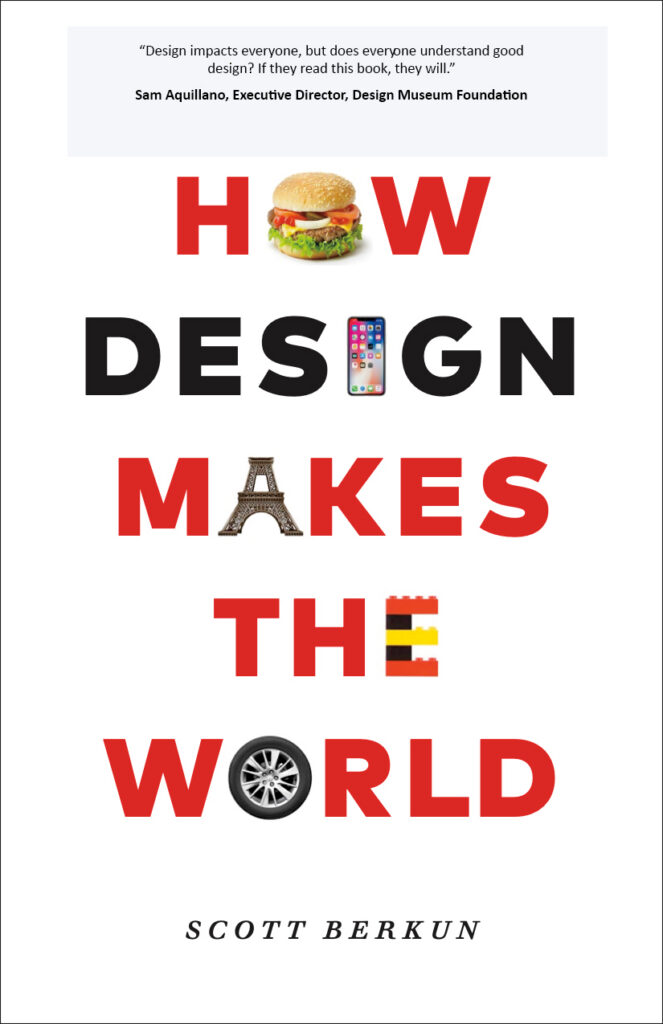
I wrote the book How Design Makes The World to teach everyone, from any walk of life, how to better understand good design and look at their world in a new way.
My next book, How Design Makes Out the World, comes out in a few months. I’m looking to hire a motion graphics / video producer to make a trailer video to help market the book and get the word out.
Interested? Or know someone you’d recommend? Provide a link to a portfolio in a comment below, or send it here.
Trailer Design Brief:
Vision: The book teaches everyone what good design is and why it’s so important. It uses everyday objects and real life situations as the basis for asking new questions about our daily lives and how design impacts our quality of life. One approach to the trailer could be as simple as stock footage of everyday experiences (driving in traffic, making dinner, dealing with meetings at work, etc.) overlayed with motion graphics and narration calling out things we don’t notice and hinting at how much we can learn from looking at them in a new way (that the book provides).