“This is not a presentation, a sermon” – a passage from the book of hackernews. “I don’t want to be a founder anymore – there’s a lot to lose from speaking how I feel. We’re profitable, growing, debt free and about to be acquired. The problem is I am supremely unhappy”
The founder who posted this had four choices:
Quit, killing company
Hate the next 2-5 years
Fix it
Keep running the company
It seems to be a common pattern that founders aren’t happy despite achieving all the things they set out to do (See Credit-Suisse research study).
You have to decide to face some ugly , emotional truths – no one will force you to since you have no boss. It’s easy to be a victim of your own denial.
Jason asked the room “who here has taken too long to fire someone?” and most people raised there hands. “Too soon” – on ly a few people. There’s the good reason, and then there’s the real reason we do (or don’t do) thing.
2×2: matrix, Things that don’t need to be done, needs to be done, want to do, don’t want to do
The fact that a thought won’t go away, and keeps you up at night, is a good indicator it’s something you need to deal with.The emotionally tough choice is usually the right choice.
How to do the tough thing:
Be swift: delay never helps, often hurts
Be decisive: flapping hurts
Be kind: to the person, to others, to yourself
Someone is always the smartest people in the room, but many people might believe that it’s them.
A players hire A. B’s hire Cs.. The presumption is that as an A, you are an A at everything, but when you take on a new role, like finance, even after a couple of months you are not really an A. And when you hire, you are calibrating against yourself, so you unintentionally hire a C and staff new roles or departments with C.
“We don’t hire smart people to tell them what to do. We hire smart people so they can tell us what to do.”
Be an editor, not a writer. Hold people to hire standards, but hire people who can do their own job/role better than you can.
Action oriented vs. results oriented – results are about outcomes and customer satisfaction, action is just a series of acts and choices
He told the story of selling his first company Smart bear. He got an offer and talked to his wife, who said “you have to sell.” And he asked why. And she said “Don’t you know how unhappy you are?” And even when he sold the business, he thought he’d feel better, but not at first. It took a long time to resort himself.
Has been marketing software for many decades, almost 40 years.
Just because its good software doesn’t mean it’s a good business.
B2B is different (if you type in B2B in google image search it’s all handshaking). Purchasers are spending other people’s money – different from selling to customers. They need to know “what will I tell my boss?” without something better, they will buy the cheapest one assuming they are all the same. Your job is to reduce fear.
The connection ratchet (or racket). Phone booths do not improve as more people try to use the same one. Metcalf’s law vs. Fight Club. Instead of thinking of funnels, think of megaphones. Purple cow is remarkable, which means something worth making a remark about. “make things in a way that they are worth talking about”. The marketing of ringtones is built in to ringtones themselves. People like us do things like this (e.g. instead of bilboards and TV ads,we need to think about the minimum viable audience of passionate people)
Packaging is obsolete. Infocom games and competitors invested in packaging and how things appeared on the shelf. Album and CD covers.
The art of promising. If we over-promise to get in the door, you are set up to disappoint.
Free (Price) is not related to cost. Three reasons to make software free: 1) engagement 2) to get people hooked (to upgrade) 3) spread the word. Customer traction means to get people using and talking about your software.
Make it Matter.
3. Natalie Nagele, Keeping the fun in your business life
Managers job is to create an environment – the business exists not strictly for the customer but also for the team (especially if sustainability is the goal – a future proof organization). A team is committed to each other, not just a product (it’s easier to replace a product that a team).
Culture sometimes happens to you. As the founders age the culture will tend to shift with them, but this isn’t the best way as the founder centric culture can leave other people behind (e.g. she had her first child and the company became more family friendly).
She tried to enforce culture through policy but at a retreat she learned from her team that they weren’t fond of this approach. They asked the question: what are our values (what do we expect from ourselves)? how do we support them? And clarify the values to new people who join? This was the first time they took culture seriously and clarified their intentions.
Why do people have a job? 1) Success of purpose in their professional life 2) Enable a life outside of work (we work for our hobbies). Work to live or live to work? The came up with these values for the company:
Wildbit is product agnostic. We exist to support our team.
As individuals, we are self-motivated and constantly improving our craft.
As a team, we support each other to do the work of our lives.
We expect great things from ourselves. You should expect the same from everyone else.
We are motivated and rewarded by our customer’s success.
Perks: Flexible working hours, profit sharing, competitive salaries, private offices + best benefits we can afford
There is nothing wrong with being a regular business. You don’t need to a lifestyle business, or a growth business, or a Unicorn magical business. Business are not built for martyrdom. There is no obligation to be a workaholic or not to have time for ordinary pleasures.
Growing to sell vs Growing to keep: if you are growing to sell you are making a huge bet that a final success (acquisition) will validate and pay for all of the sacrifice and debt along the way. But if you grow to keep, you have a sustainable and reasonable business (and founder salary) along the way, and likely have a better negotiating position. Take care of yourself so you have the incentive to keep going. Many founders exit because they are tired and broke.
Quit serving the business, serve the people. And by doing this, it serves the founders too.
When you are scaling big problems are scarier – there is more money and more people impacted. Communication as you scale gets hard.
Clarity and authenticity are important, but tone is part of the message too. And the medium you use changes it (an email vs. a text vs a post – different levels of formality).
He told a story about a major issue that the leadership team felt was best solved by raising prices. When they told the team, they revolted and said “it can’t be done.” They formed a new team to own the problem – they did something very different. Instead of going off to discuss in private (like the leadership team did) they worked on the problem openly. They reached a similiar conclusion, but because the problem was solved openly people’s responses were different.
Lesson: Solve big problems openly – instead of shielding people from uncertainty, it creates fear and a whiplash effect
As a company scales, finding time to think becomes a challenge. At the beginning it’s much easier. He showed his schedule one year after the company started and it was mostly empty.
Work life unbalance: his calendar and schedule made it seem like he was a balanced person, but he wasn’t present with his family and friends. He forgot that thinking is work. Running a company is a creative endeavor in a different way that starting a company.
Problems are rarely schedule problems, they are people problems. You need to delegate more or get better people. Being busy is a people problem, not a productivity problem.
Focus on Tone
Solve big problems openly
Don’t feel guilty having free time
I believe in first impressions, especially if you’re asking someone else for something. When you make a connection to another person, even on the interwebs, please take 60 seconds to say something personal about why you’re making the connection.
If you’re not willing to take 60 seconds to write something personal, and explain why you want to connect, why would you expect them to say yes? If they’re important enough to you to ask for something, match that with putting in a moment of effort. Otherwise you’re the equivalent of a stranger running up to someone on the street and asking to shake their hands, screaming “You’re someone I trust!” as you do it.
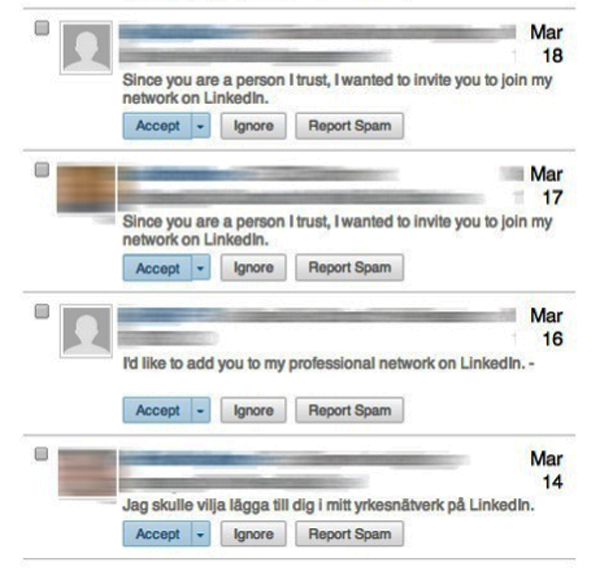
Here is what my LinkedIn inbox always looks like (see below). It’s often filled with generic requests from people whose names I don’t recognize, where the request tells me nothing about who they are, how they know of me or why we should connect. It’s a wasteland.
That last guy didn’t even get the language right as I only speak English.
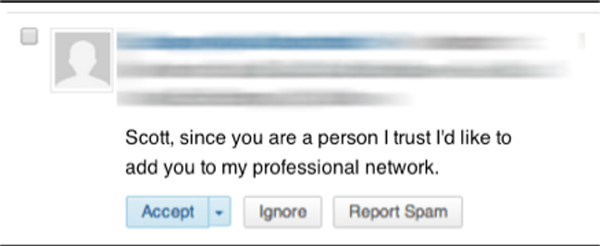
The generic messages LinkedIn offers should be avoided. How could I be a person you trust if we’ve never met? And even if you trust me, that’s not the important part on my end: why should I trust you or find you worthy to connect with? It’d be far better to explain how you met the other person, why you’re a fan of their work, or how on earth you even know who the hell they are.
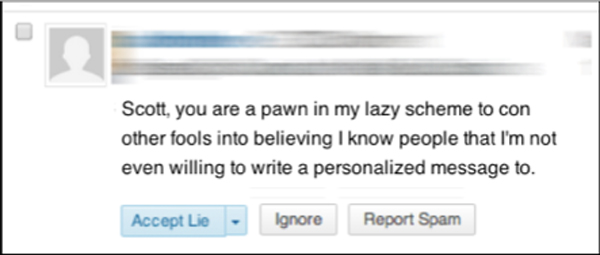
When I see these generic requests (above), I translate it to mean the following (below):
Advice:
Take 60 seconds to say something personal and meaningful
If you can’t, don’t bother sending the request
Unless you’re sure the person knows your name name well enough that it’s meaningful to them
Yesterday I gave the closing talk, How To Champion Ideas, at An Event Apart Seattle (If you saw me at AEA Boston, those slides are here) . It was a new talk, requested by organizers Marci Eversole, Jeffrey Zeldman & Toby Malina. From their observations and attendee feedback they knew one big challenge for all events is how to help attendees bring ideas with them back to work. As an experiment, they asked me to do a talk on this as part of the event itself. I thought it was great that both they were thinking about this issue and they were willing to do an experiment. I wish more organizers were as thoughtful and as brave.
One primary observation: events should end with a happy hour. Or perhaps, like Webstock, with an after party at the venue. Most events end as soon as the last speaker finishes speaking. It’s a cliff of an experience: all of sudden there’s nothing. Why not invite people out for an informal social gathering, where they get one last chance to connect, share stories, and talk about highlights from the event, now that it’s over? As an experiment I invited everyone out to a drink after my talk, and the result was great. About 45 people joined me, and we took over most of Black Bottle.
I discovered that most people want this, but are afraid to take the social risk of trying to organize. It’s exactly the kind of thing an event, or the last speaker, can facilitate. Pick a place, a time, and announce it. Boom. Instant extension of the energy of an event, giving everyone more value for coming to the event at all. Thanks to everyone who came along and validated this little experiment. It would have been sad if I ended up drinking there alone.
Of course at a big event you can’t just invite 500 people to go to a bar together (But I basically did this, guessing 5 to 10% would come, which was about right. You might not be as crazy as I am though). If you’re worried about the logistics, simply make it an unofficial but encouraged activity. Offer signup sheets during the day, and find 5 or 6 volunteers willing to lead small groups out for a beer. Maybe ask each volunteer to call ahead a local bars to see who wouldn’t mind a nice rush. Events are often on weekdays which are slow nights for bars: they’ll be happy to hear from you. The key thing the event needs to do is announce it and provide the structure (time, place, etc).
Here are the slides from my closing talk, which offers a range of advice on how to get the most out of an event (as it’s ending). Thanks to everyone who commented on my related post.
I’m finishing up work on a talk for An Event Apart Seattle about what happens after the conference is over [update: that presentation is here]. At first this might seem like an odd session to have, but it’s reflective of a fundamental problem of all events: events are intense short term experiences that people attended with the hope of long term effects.But from the moment the last session ends, attendees are basically abandoned, and on their own, left to their own devices for sorting out how to digest and apply what they just experienced.
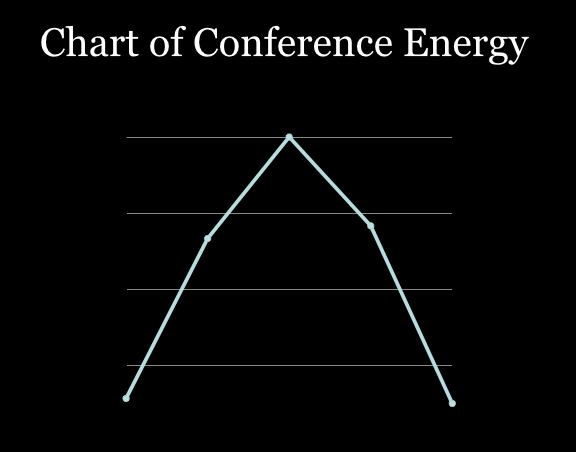
If you made a chart diagraming the positive energy effects of the event, it would look like this:
Somewhere in the middle of the event, usually at the sponsored reception, is the peak of the community that forms around that event. It’s the moment when:
The most people are in attendance
people have had half the event to meet and engage with people
It’s the easiest socializing,as there’s booze, food and everyone there is there to socialize
People can still look forward to the second half of the event
But as time progresses towards the last session, that energy falls. And when the event is officially over, there’s a user experience cliff where you are instantly returned to being on your own again, sadly divorced from the bonds you just formed, much like a child getting on the bus to take them home from the last day of summer camp.
What I’m wondering is, what can conferences do to make it so the chart looks more like this?
A list of obvious things events can do include:
Opt-in mailing list or Facebook group for people to continue the conversation
A follow up email the day the event ends, with links to slides and resources
A check-in email one month after the event, to see how folks have applied what they learned (there’s good feedback here for the event as well)
A happy hour a month after the event to reunite locals (or done in a google+ hangout)
Have you seen smart or well done ideas at events for getting closer to this goal? Or that help attendees get the most value, now that they’ve returned to work, from the event that just ended? Leave a comment.
Clay Hebert recently posted on the The Best Conference Hack, which is simply sitting in the front.
As a frequent speaker I like Clay’s advice. For speakers the empty front row is mysterious and frustrating. Speakers make a huge commitment, yet audiences who have little at stake show their lack of faith by staying back. Unlike a rock concert, somehow the 5th row is more desirable than the 1st.
I think better advice than Clay’s is to participate and speak about something. Many conferences offer Ignite or lightning talks, allowing many attendees to share their voice. This is by far the best conference hack: participate. It puts you in the middle of things. Volunteering has similar benefits without the stress.
But the surprise is, when I’m an attendee I don’t listen to all the speakers.
Sometimes I barely go in the session rooms.
Everyone has different learning preferences, and I know mine: I find it hard to listen to lectures, but I’m a tremendous reader. Unless the speaker is very good, which is rare, I’m better off reading their book or their blog which I can do at my own pace. As I wrote about in Confessions of a Public Speaker, lectures were never a good way to learn skills. They’re passive, non-interactive and rarely performed by people good at lecturing. I know it’s ironic that I have a low tolerance for lectures as I make a living giving them.
Conferences are a compromise: you get access to popular experts, but it’s broadcast access. This is a good deal if it’s your only option or your learning style matches what you get at the conference. But for me it’s conversations, which are two way, that I learn the most from. Conferences use speakers as MacGuffins, drawing attendees to come, but often the “side stuff” has the highest payoff.
Typically at events I do the following:
For talks I’m excited about, I’ll sit in the front as Clay suggests. But this is rare. It’s not a judgement of them, it’s a judgement of how I learn.
Frequently I sit in a back aisle, especially at a multitrack event. I’ll take aisle near the front if I can. In 7 minutes I can tell if the speaker has prepared well enough to warrant me staying. If I’m not convinced, I’ll move to another session – this is hard to do if you’re in front (unless you’re fortunate to have the aisle and brave enough to leave it).
Often I’ll listen for 5 or 10 minutes to evaluate their credibility: then I’ll buy their book, or subscribe to their blog, and move on. Or stay if I think I’m getting something special I can’t get any other way.
I regularly wander the halls and talk to others who are bored by lectures. They’re like me: better at doing than sitting and listening. I’ve learned great lessons from the conversations during sessions. The halls are not packed during sessions and it’s easier in some ways to start conversations.
If I commit to blogging the event, my attention improves. At Failcon 2012 I reported on the talks and I found this helped me focus. But it changes how you listen: it’s a shallower experience in some ways as you’re rushing to get things down. And to do it properly required far less interacting with other attendees. LukeW is the master of this: see his notes from 200+ talks.
But this is merely what I do. Unless your learning preferences match mine, don’t do these things.
If you don’t know how you learn best, experiment. Go to different kinds of events that offer different experiences. Better events invest in different kinds of learning, with things in the hall for people like me, and well prepared speakers worthy of all the attention the front row can give them.
I’ve run a few events myself and a challenge many attendees never think about is how to arrange the day. When are the breaks? What order should the speakers go in? What topics should get the morning vs. the afternoon? There is a curation-like design challenge in figuring out how to make a great day.
SB: Speakers are the core of most conferences, yet the lectures and lecturers have earned a reputation for being boring. Gel has consistently had very high quality speakers. How you think your approach is different than other events?
MH: Invite your heroes. I learned that from Richard Saul Wurman, founder of TED, who originated the phrase.
That means, invite people who you are personally, genuinely interested in. Forget any other consideration and focus on: would YOU want to hear from them, if you were an audience member?
I’m not sure how this compares with other conferences – I can’t speak for them – but I’ll leave it to you to imagine the other not-so-good reasons why events might have people speak… rather than inviting them because they’re good for the attendees.
SB. Is there any coaching or training you do for your speakers? Do you think this is a meaningful practice for conference organizers to consider?
I run speakers in a 20-minute time slot, so there’s often some coaching around getting the message across in that short timeframe. One thing I often say is to go light on, or skip over, all the normal introductory stuff, and just get right to the good stuff. In other words, start strong. And then try to tell a story, while still making the larger points. It’s a tricky balance.
Most conferences use 45,60 or even 90 minute sessions, yet yours are shorter, often 20 minutes. How do you decide the length, format and order of speakers for each Gel?
The length is easy – 20 minutes is the standard slot. Format is easy – the day is comprised of four groups of four, usually with a few shorter “special appearances” sprinkled inside.
The order of the speakers is the challenge – and that’s hard to describe, as it’s more of an art than a science. It’s a puzzle with lots of dimensions. You have to consider developing the theme of the day, and (possibly) a sub-theme for each individual session, and the blend and flow of the energy that each presentation is likely to transmit to the audience, and the timing of catering (coffee breaks and lunch), *and* occasionally there are constraints due to a speaker’s schedule. And it’s really tough to put the puzzle together unless you have the speaker list completely finalized… so I generally have to do this late in the process, not long before the event, and go through several revisions of speaker order, before I finalize it and send it to the printers.
How do you evaluate speakers, both before you choose them, but also how to you evaluate how well they did?
I listen to attendee comments at the event, and read all the emails that come in after the event, to get a sense of what people liked or not. I’m happy that Gel attendees are enthusiastic about sending feedback – positive and negative – about their experience, so I always have a pretty good idea of how the audience reacted to each speaker. (And it’s often a mix – occasionally a speaker polarizes the audience with an extreme reaction in both directions.)
As for how I *choose* speakers, see answer to #1 above. That’s another one that’s more art than science – but generally I’m just trying to find a good mix of speakers that, together, will create the best possible experience for the attendees.
Many conferences include what’s called a panel session. This is where 3 to 5 experts get up on stage and each one, in turn, bores the audience to death.
Why do panels still happen? One reason: they’re sooooo tempting. In theory a panel is great. It gets more people on stage, which should magically creates something real, engaging and spontaneous.
Why doesn’t it work? Here’s why:
Everyone is too polite. For a panel to work the panelists must be comfortable disagreeing with, or passionately supporting, each other in front of a crowd. Few professionals are willing to do this, especially if they just met the other panelist 5 minutes earlier. They know that to openly criticize someone else is likely to make them seem like a jerk. Why take that risk?
There are too many people. If you want a good dinner conversation, how many people can you have ? 3?4? Maybe if it’s a quiet restaurant, 6? The more people, the more fighting their will be for the floor, the harder it will be to make eye contact with each other, and the easier it is for people to hide. A debate, meaning two people, is way preferable to a 6 person Battle Royale. It forces people to take a stand and speak up. If you have more than 3 or 4 people and you get the opposite effect.
There aren’t enough microphones. If the goal is a lively conversation, everyone has to have their own microphone. Sitting in the audience, waiting for the microphone to be passed between people…. zzzzzz. It’s energy death.
The panelists are dull and unprepared. Sometimes they’re on the panel because they’re too dull, or low profile, to earn their own session in the eyes of the organizers, and the session isn’t tended to as much as other sessions. And even when you get rock stars, they will look to the moderator to set the tone, and if the tone is dull, they’ll follow. A panelist is a guest: what cues is the host giving them for how honest to be?
People waste time stating the obvious. Each speaker should have their background, bio, and even their two sentence position on the topic, available online. Get it out of the way. And the panel should have a sense of their audience (job titles, ages, etc.) so they don’t spent 10 minutes debating things the audience doesn’t care about.
The moderator is passive. It’s the moderator’s job to set up questions that will polarize, or spark strong opinions. Simply giving each panelist 5 minutes and opening the floor to the audience is rarely going to be interesting. There is no angle or structure for people to respond to and use as leverage to make their points. Often the moderator is the conference organizer, and they are afraid to challenge the panelists since the panelists are their guests.
How to run a great panel session:
Pick a strong moderator. You want a Phil Donahue. Someone who can facilitate, help people express their opinions, Cut off people who are hogging the floor (when was the last time you saw this done when it needed to be?) and challenging panelists on occasion. They need to be prepared with tough questions, the questions the audience wants asked, have done some research, and who will instigate when necessary to keep the debate lively, but get out of the way if the conversation is going well.
The moderator’s questions must center on what the audience wants to know. The audience is there for a reason: what do they expect to learn? What kinds of stories do they want to hear? When the session is over how will the audience have benefited from the session? It’s easy to try and please the panelists, but the panelists are not the customer, the audience is.
Limit position statements. 5 minutes is more than enough time for a speaker to introduce their opinions. Never ever use more than 1/3rd of the session time to prepared, canned round robin presentations by the panel. This is a cop out. The whole idea of opening remarks is to draw people into asking each other questions and create a lively conversation. The moderator should be skilled at audience Q&A and editing rambling, or poorly constructed, audience questions.
Frame the panel as a debate with a clear question. Avoid panels with the title “What is the future of cheese?” This rarely works. It’s too vague. Instead the moderator should work with the panelists to frame a more definitive, and polarizing structure. “Will blogging still be here in the year 2050?” Assign each panelist a yes or no end of that question. If they balk at this being artificial, ask them to propose a better question, or series of questions to frame the debate. Pick the right spine and many problems will take care of themselves.
Pick panelists with naturally opposing viewpoints and backgrounds. Get a police officer and a drug dealer on a panel together, and I promise the conversation will be interesting. What’s the equivalent in your field? Conference organizers are often highly constrained in who they can get on a panel – which might be the strongest explanation as to why they’re often so bad.
The moderator must prep and debrief the panelists. The moderator is really the orchestrator of the whole show and has to get everyone comfortable before the event. A short conference call weeks before so everyone at least had a chance to chat and hear the message and goals from the moderator at the same time is essential. To debate in public with someone requires knowing them well enough to know you won’t upset them, and this can’t happen if the first time they speak to each other is 5 minutes into the panel session.
At the end of the day, good panel sessions are work. If the organizer is also the moderator, the investment required to make the good will get dropped before other responsibilities. It’s a great assignment to give away to someone, perhaps for free admission to the event.
I happen to love moderating panel sessions. I bet other people do to. A wise conference organizer will find these people, given them free admission for their services, and get out of the way.