Do you wonder why we obsess about categories and labels for things? It goes back to Plato, Aristotle and the birth of Western philosophy. They pioneered ways to use language to understand the world, but there were some unintended consequences.
Richard Farson wrote:
“The great contribution that Eastern philosophies can make to our own thinking is that they have little difficulty embracing the co-existence of opposites. That’s because they were very little influenced by Aristotle. He had the idea that things should be categorized; that if something was true, then it couldn’t be not true. He left that mixed legacy, that unfortunate dichotomy, to us Westerners and we honor it to the present day.”
We’re aware of eastern philosophies like Yin and Yang, how dark and light forces can stay in balance, but we rarely internalize those ideas as deeply as other cultures do. Instead we think the goal is for one force to dominate the other (e.g. good vs. evil), rather that dualism where both forces are needed (day and night).
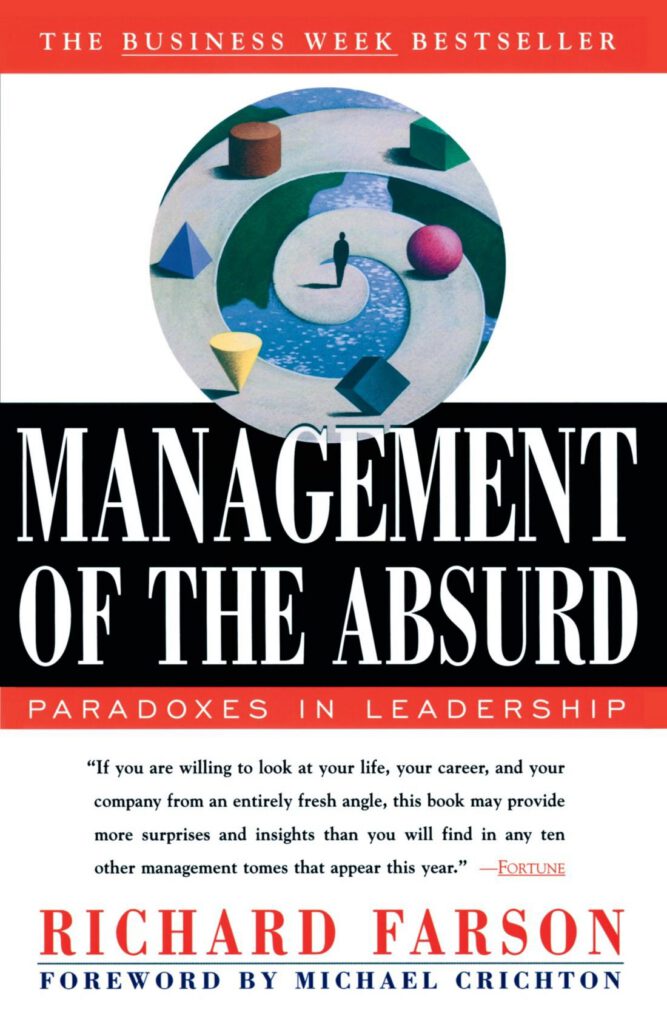
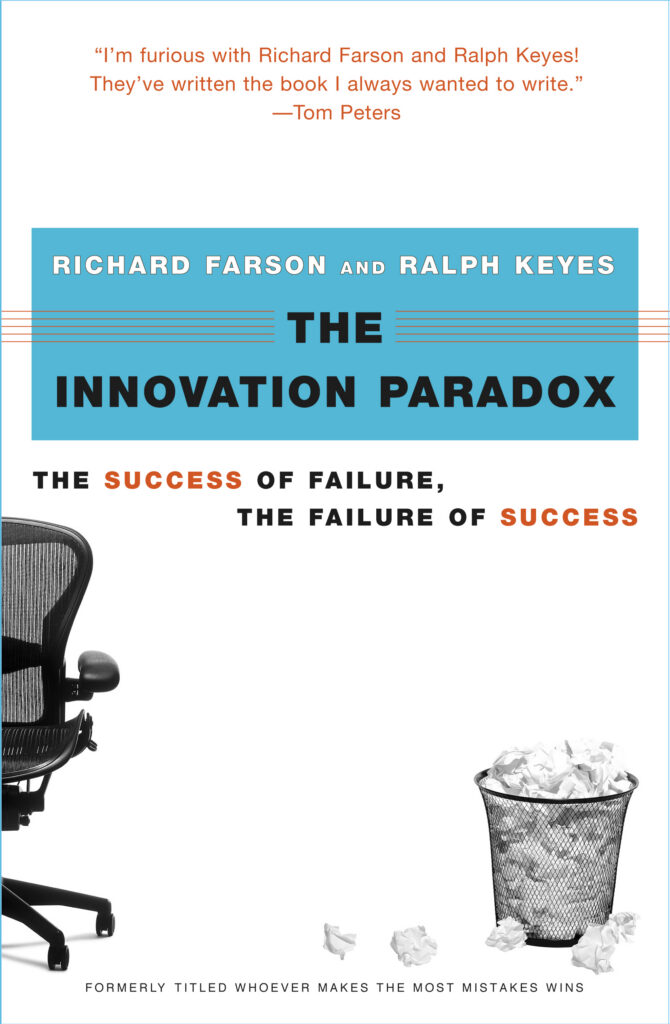
One of my favorite business authors is Richard Farson, who wrote two books that explore these ideas in the context of work, Management of the Absurd and The Innovation Paradox. As the titles suggest, there are fundamentally strange things about how work works, or doesn’t work, that we tend to to ignore. We struggle to process absurd realities about life and avoid even talking about them. Part of the popularity of Sun Tzu’s The Art of War in the West is it’s paradoxical premise that the best way to win is to never have to fight.
Generally books like these don’t tend to be popular in the U.S. They’re too weird to most people and do not promise easy answers for how to be productive or succeed. And yet it’s these kinds of books that are my favorites. Books that don’t quite fit in a category and don’t promise conventional satisfaction, like Shlain’s Art and Physics or Anne Dillard’s Pilgrim at Tinker Creek. They provide the deepest experiences by capturing what’s puzzling, weird or simply hard to explain, and helping us to hold on to thoughts and feelings over time. These ideas stay with us longer because of their mysteries, because of what’s left unresolved that keeps us curious for years or even a lifetime.
Here are some of my favorite quotes from Management of the Absurd.
‘There is a difference between absurdity and stupidity… Paradox and absurdity keep us off balance. In so doing, they produce the humility, vitality and creative surprise that make life so worth living. But they cannot be controlled. They will always defy the attempt.”
“Some senior managers who have been at the job 30 years don’t necessarily have 30 years of experience. They may have one year of experience thirty times.”
“Technology helps us in countless ways, but it always backfires. The term for this phenomenon in medicine is iatrogenic, meaning “physician induced.” Examples are complications from surgery, side effects of drugs, infections that result from hospital stays. There are more than a thousand different diseases that would not exist if not for the practice of medicine and the existence of hospitals. Half the time any hospital staff is spent treating iatrogenic disease.”
And from the Innovation Paradox:
The price of success too often is a loss of focus and daring. The tendency is to try to protect one’s accomplishments by shifting into cruise control. This syndrome gets played out repeatedly in the television industry. One network climbs to the top, begins to play it safe, repeats what worked in the past, slips behind, then gives may to a competitor on the bottom who’s taking creative chances because it has no reason not to.
According to an old military axiom, the weakest point always follows success. At those times it’s hard to resist the temptation to loosen up, take a breather, and abandon the intense concentration needed to fight your way up the next hill. Once a battle is won, soldiers are liable to ignore the sound of a twig snapping beneath the boot of an approaching scout, or overlook the glow of a distant campfire. Like soldiers, mountaineers say the most dangerous moment of their ascents is after they’ve reached the peak of a mountain. That’s when they’re most likely to fall into a crevasse or slip on a ledge. Surgeons, too, can find it difficult to stay focused once an operation has apparently succeeded. Until then, the demands of operating absorb their attention so completely that the scalpel seems almost to move itself.
Success is at least as hazardous as failure. It means redefining our sense of self around being a success rather than an unfinished portrait (This is a much tougher task that it sounds to those that never had to try.) We also no longer have failure to blame for feeling unhappy. If success can’t make us happy, we then must ask, what can? If we don’t feel successful and our life is problematic, it’s easy to see a connection. Obviously we surmise, the reason we have so many problems is our lack of success.
In the 1950s it was thought that the success of television would lead to radio’s demise. Instead, radio reinvented itself as a talk-show drive-time medium and roared back stronger than ever. Far from wiping out the market for fresh produce, as was feared, frozen vegetables whetted our appetite for fresh ones in countless new varieties. Convenience foods fueled a renaissance in gourmet cooking. Fast food inspired a passion for leisurely dining.
Powerful people often become conservative. Once they’re in charge, it’s easy to feel that the knowledge that helped them rise into power is all they will ever need. This means that despite the platitudes about wanting new ideas, many bosses are hard to convince to try new things. They have more to lose now, so their preference for the status quo increases.
We read books, take courses and go to events, often with the support of our bosses, under the pretense change is possible. But often they find ways to kill ideas, gently or passively, and not much happens. It often takes a different way of approaching the problem to get a powerful person to do something new.
Here’s a quick guide for how to convince your boss:
Have a great reputation. The best leverage you have with any boss is your performance. They’re more likely to consider suggestions from the highest performing person on the team than the lowest. Before you present the grand revolutions you want them to lead, make sure you’re in good standing. Be patient. Match the size of your suggestion to the quality of your reputation.
Consider what problems your boss needs to solve. Don’t start with your problems or what things you want to try. Instead think about the world from the perspective of your boss. What are their goals? What do they need to do to succeed? What achievements are they striving for? What will get them promoted? A good pitch is based on the catcher.
Match what you want to try to their goals. Frame anything you want to try in terms of how it might help your boss. Will it have a chance of helping reach their sales quota? Will it help them get better clients? Will it save them budget? At minimum, think about your own productivity and morale: why should your boss care about improving these things? Consider that and make it part of your pitch. You may discover that there are far better things to suggest than the idea you originally had.
Get support from respected coworkers. If your idea is good you should be able to get a coworker or two to also want to try it. Provided the boss respects their opinion, their interest helps support you. In some cases it might even be better if someone other than you makes the pitch. If you have a good relationship with the peers of your boss, especially peers they respect, consider trying to get them involved.
Look for books and respected organizations that support the thing you want to try. Find companies your boss respects that already use the practice you have in mind. There are often books and papers that can help support your case. Of course getting your boss to read them is another matter, but your consumption of them will better inform you of answers to questions your boss is likely to have, and most importantly, refine your own thinking about the realities of the thing you want to try. Maybe it’s not such a good idea. Or perhaps there is a different way of thinking about the problem that’s more useful.
Plan for a trial. Minimize their sense of risk by suggesting you try the new thing on a trial basis: a week or a month. Also propose a list of criteria for how to evaluate if the new thing was successful after the trial is over. If you’ve never pitched your boss on anything before, pick the smallest simplest version of the thing you want to try. Minimize the risks and earn some trust for the next time you have something you want them to try. Pick a safe and small project that has the fewest risks, or that is only of moderate importance.
Make the pitch. Remember that most people in power respond differently to pitches when they are in front of a group vs. when they are by themselves. Find a situation that provides the best opportunity, based on when your boss is most responsive to suggestions (email? in your performance discussions? at coffee?) Define the problem (in terms the boss relates to), offer the solution, define the (trial) terms, and reference what other companies already participate. Observe how other people pitch your boss and what tactics work best (See: How To Pitch An Idea).
Work very hard to make the trial work. Your future reputation is on the line in the trial. If the trial goes well, and they agree to the change, you’ll be in higher standing for the next recommendation you make and convincing them again will be far easier. If you fail, and fail badly, it will be harder to earn their trust next time. Do everything in your power to make sure that failing all else some useful lessons are learned, enabling the argument that doing trials, even if they fail, have minimal risk and provide new lessons for the organization. Including the discovery of new trials to do that might have better results.
In the end, it shouldn’t be all that hard to convince a smart, wise, progressive boss to try new things on a trial basis. If you realize that your boss is impossible to convince, the thing you might need to try is looking for a new boss to work for.
I was wondering how you think Automattic’s model would work for a more diverse workforce. The culture you describe in the book is very much centered on young, male, tech-savvy, western-socialised software developers. I was envisioning myself (female, a generation older, and while working in the tech world, not a technical person myself) in that specific culture and imagined I’d probably be rather miserable. 🙂
Do you think this kind of approach can still be effective with teams from many diverse backgrounds, different ages, cultures, languages, etc.? What would have to be tweaked?
One tradeoff of the book’s intimacy into the team I lead is you learn more about my team than others in the company. Automattic is in fact pretty diverse, at least for a tech company. Perhaps what you learned is you really don’t want to work with me? 🙂 Which is fine of course.
Putting Automattic aside for the moment, remote work has many benefits regarding diversity:
People see only your output. Most of what I knew of my coworkers was the designs they made, the code they wrote, the blog posts they drafted, and the things they typed or said in conversation. If I had a bias against someone’s age, gender or height, those elements were invisible to me most of the time. Or more powerfully, it was very hard to hold onto bias in the face of unignorable productivity.
No one hears your accent when you type.Remote work often hinges on written communication. No one can hear your accent when you are typing. While excellent communication skills become critically important in remote organizations, everyones typed words read the same.
You often discover people’s appearances only after you’ve worked with them. It’s common in remote organizations to spend weeks or months working with someone before you meet them in person. By the time you do, your opinion of them is based on their performance, unbiased by any biases you have.
Remote workers can be hired from anywhere. Since no relocation is required, anyone can be an employee. If people can work from home or a coffeeshop, they could also work in China or Portugal. Hiring employees from other countries doesn’t guarantee diversity, but it raises the odds significantly, certainly along geographic and cultural diversity lines.
Of course hiring remote workers doesn’t guarantee diversity unless the hiring process minimizes bias.
On gender diversity, When they were @ 180 employees, they had 39 female employees, ~21%. (They’re closer to 250 now).
On age: I was a generation older than most of my team and still not the oldest employee there
Because they hire by trial, a candidate’s performance is the primary criteria, minimizing the potential for discrimination
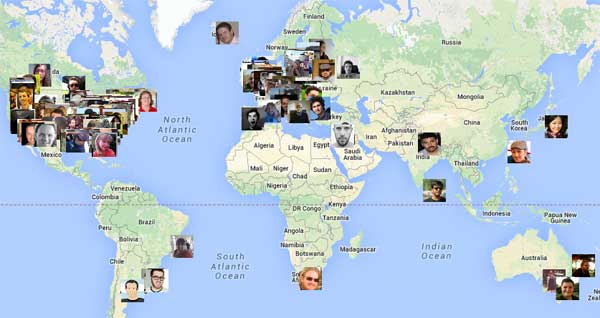
They have employees in over 120 cities, and 30 countries (you can see a map here)
In the section of The Year Without Pants on Results vs. Tradition I strongly make the case that superficials like how we dress, or who works late, are distractions, but I should have driven the point home harder that remote work helps reduce gender, age and other biases, since you see far more of a coworkers output than their outward appearances.
This essay in the NYTimes, Silicon Valley’s Youth Problem by Yiren Lu, is a kaleidoscopic essay on culture divide, and the angst of being smart, young and successful in Silicon Valley. It’s a well written but strange essay in that she seems unsure about where she lands on many of the issues she’s raising. It also suffers from her youth, which is fair given that that’s what the essay is about.
Why do these smart, quantitatively trained engineers, who could help cure cancer or fix healthcare.gov, want to work for a sexting app?
If Sean Parker, Mark Zuckerberg, and (young) Bill Gates are your heroes, your choices are obvious to you. But there are also plenty of social startups, ventures aimed at doing good as well as profiting, but Lu doesn’t mention them. And that’s her primary blindspot: she sees dichotomies on age and attitude, rather than spectrums.
He does answer her own question later – identity:
As an enterprise start-up, Meraki has been impeded by its distance from the web scene. It simply does not have the same recognition as a consumer company whose products users (and potential recruits) interact with every day. “You say, ‘I work at Pinterest,’ and people know what that is — they use Pinterest,” Biswas said. “You tell them you work at Meraki, and they’re a little more reserved. They’re like, ‘What’s that?’
The company you work for is an easy way to impress people and impress yourself. If you value this where you work hinges on how popular the company is, not what it does or what contribution you might be able to make there.
Before the web more bright engineers chose to stay in academia where they could work on problems that took a long time to solve, if they were solvable at all. The financial and cultural rewards today for leaving school and joining a startup has shifted that balance away from long term work (or for doing that work in academia, rather than a corporate research lab). Those pressures have always been there but they’ve intensified.
Scientists, including computer scientists, argue real innovations are fundamental developments like the laser, the satellite, the mouse, Ethernet, cellular networks, WiFi, even Object Oriented Programming. These are contributions that took years to develop and provided a breakthrough that enabled thousands of other inventions, including the web. And by developing these ideas in academia they become available to the world, not a corporation. What inventions does your average startup enable for the world? Usually none. Most startups die or are acquired and mothballed, their IP locked forever in a corporate cave.
Lu correctly mentions that the Web has made the barrier to entry for starting companies and releasing applications lower than ever in history. She writes:
“The sense that it is no longer necessary to have particularly deep domain knowledge before founding your own start-up is real.”
That alone explains the draw for anyone with ambition: for the first time in history you can launch a product to the entire planet in 6 months with the primary expense being your time. Many of these startups hope to become a fad, a viral trend, which means they are shallow by design. Many have the primary goal of simply learning what they are capable of and starting a company is a great way to do that.
But the typical startup is very high up on the tree of innovation, providing little for others to build on, and capitalizing on contributions from hundreds of forgotten people. There is little wrong with this, it’s just not interesting on the scale of the future if you are interested in more fundamental kinds of progress.
Dalrymple’s description makes sense, but its implied recommendation — that new and old need to embrace each other — is difficult to put into practice. Several of Cisco’s previous attempts to reach out to the new guard, like the Flip video camera and the Cius tablet, were busts. The phrase that’s constantly repeated in the valley is “innovate or die.” Innovation, everyone seems to agree, is the answer. The problem is that so many “innovations” — Intel’s “creative collaboration” with the rapper will.i.am, for instance — are just some stuffy vice president’s approximation of cool. That is to say, they’re hardly innovative at all.
Lu gets lost in the meaninglessness of the word innovation. The fact that a product was a bust doesn’t mean it necessarily failed at breaking new ground or developing new ideas, it merely means it failed in the marketplace. And celebrity collaboration is marketing, as it’s generally paid for by marketing and advertising budgets with the singular goal being attention.
These failures say nothing about the challenges of old and young. While the average age at Cisco, IBM and Microsoft are much higher than Google or Facebook, all of those older companies successfully hire thousands of top new graduates every year: they are simply graduates who have different ambitions and values. However I’d agree with Lu it’s less common to see older engineers join startups, but the reasons for this are multiple and she mentions some of them in her meandering way.
Many people crave opportunity. Many people crave stability. Some of this is linked to age, but not all of it.
The success of self-educated savants like Sean Parker, who founded Napster and became Facebook’s first president with no college education to speak of, set the template.
Lu desperately needs to read about survivorship bias and that a hero is not a template. A hero can be an inspiration but should never be used, without careful examination of others who did nearly everything the same as the hero did but failed, as part of a trend or a playbook.
In perhaps the most ignorant notion in the piece, Lu quotes a friend:
“Never before has the idea itself been powerful enough that one can get away with a lacking implementation,” she wrote. Her remark underscores a change wrought by the new guard that the old guard will have to adapt to. Tech is no longer primarily technology driven; it is idea driven.
This is hubris and youthful ignorance doing a blindfolded dance together. Lacking implementations is precisely what startups have shipped since the beginning of software startups (now approximated and acronymized as MVP). The web itself began with a shockingly limited feature set compared to desktop publishing tools at the time (or arguably, even now). The web had to reinvent table layout, only to abandon it years later in favor of an approximation of the kind of positioning system that had been around for years.
For the last 30 years everyone has bemoaned how Microsoft succeeded with third rate engineering. Or look at ShamWow or hundreds of other hyped ‘inventions’. The very notion of advertising can be cynically defined as ideas trumping implementation.
The lesson from innovation history is the best idea doesn’t necessarily win. Nor does the best implementation. You can do everything right and still fail, and do many things wrong and do very well. Marketplaces are chaotic and unfair. The personal lesson here is if you place meaning on success in the market, you will always be chasing meaning instead of making it for yourself.
Ranting about opinion pieces isn’t generally worthwhile, but some pieces are deeply flawed and popular enough that they demand critiquing. I’ve taken Susan Cain and Jonah Lehrer to task in the past, and I’ve come across another post worthy of examination.
The article is a New York Times opinion piece titled “Secret Ingredient For Success” and the title itself is hyperbole: what they describe is no secret and it’s not necessarily an ingredient for success.
Even it’s opening story is problematic on several counts:
WHAT does self-awareness have to do with a restaurant empire? A tennis championship? Or a rock star’s dream? David Chang’s experience is instructive…
He recalls a low moment when he went with his staff on a night off to eat burgers at a restaurant that was everything his wasn’t — packed, critically acclaimed and financially successful. He could cook better than they did, he thought, so why was his restaurant failing? “I couldn’t figure out what the hell we were doing wrong,” he told us.
Mr. Chang could have blamed someone else for his troubles, or worked harder (though available evidence suggests that might not have been possible) or he could have made minor tweaks to the menu. Instead he looked inward and subjected himself to brutal self-assessment. Was the humble noodle bar of his dreams economically viable? Sure, a traditional noodle dish had its charm but wouldn’t work as the mainstay of a restaurant if he hoped to pay his bills.
Mr. Chang changed course. Rather than worry about what a noodle bar should serve, he and his cooks stalked the produce at the greenmarket for inspiration. Then they went back to the kitchen and cooked as if it was their last meal, crowding the menu with wild combinations of dishes they’d want to eat — tripe and sweetbreads, headcheese and flavor-packed culinary mashups like a Korean-style burrito.
Here’s the rundown on poor logic in this opening story:
This story suffers from survivorship bias. How many restauranteurs make the same type of choice Chang did and still fail? Many.
It doesn’t show Chang as particularly self-aware. There’s no mention in the story that he’s aware of his tendencies, his thinking process or his biases (or even thinks of himself as particularly self-aware). The story merely says he chose to continue the same career, and same restaurant, by taking a new risk in the face of failure. He might be very self-aware but nothing in the article suggests it.
He was working 18 hour days. Was he aware of his workaholism? Aware of the impact on his health?
And worst of all, nothing in this story, or the entire article, is a secret. The notion of pivoting a business is an old idea, far older than the term itself.
The article falls further into overwrought and unnecessary theory:
During the 1970s, Chris Argyris, a business theorist at Harvard Business School (and now, at 89, a professor emeritus) began to research what happens to organizations and people, like Mr. Chang, when they find obstacles in their paths.
Professor Argyris called the most common response single loop learning — an insular mental process in which we consider possible external or technical reasons for obstacles.
LESS common but vastly more effective is the cognitive approach that Professor Argyris called double-loop learning.
A better and simpler term for this is metacognition, or the ability to think about how you think. It’s an ancient idea that was also popularized and given this name in the 1970s. Metacognition is a term often used for learning, and learning how to learn, but it’s applicable to skill development too.
More importantly, there are always multiple obstacles in front of us. The question is when will we deal with them and how? There’s a good argument you can’t deal with every obstacle at the same time and you have to choose carefully which challenge you take on, and how you decide to move on to the next one.
Arguably Chang was desperate. Is desperation a valuable forcing function? How is desperation different from courage? These are good questions raised by Chang’s story, but not raised in the article.
The successful people we spoke with — in business, entertainment, sports and the arts — all had similar responses when faced with obstacles: they subjected themselves to fairly merciless self-examination that prompted reinvention of their goals and the methods by which they endeavored to achieve them.
They have this story backwards: these people didn’t set out to be self-aware. They set out to ACHIEVE. They were already highly competitive and high functioning individuals who had failed. With their level of commitment they would have tried just about anything to achieve their goals and in the case of already successful athletes (Martina Navratilova is mentioned) they had coaches and trainers who were experts at analyzing their weaknesses and training them to use new approaches.
Another observation: high achievers are sometimes assholes. They can be narcissistic, self-centered and frustrating to live or work with. Are high achievers self aware in this way? I’d love to know but it’s not a question suggested (e.g. what are the downsides of being a “high achiever”?).
The indie rock band OK Go described how it once operated under the business model of the 20th-century rock band. But when industry record sales collapsed and the band members found themselves creatively hamstrung by their recording company, they questioned their tactics. Rather than depend on their label, they made wildly unconventional music videos, which went viral, and collaborative art projects with companies like Google, State Farm and Range Rover, which financed future creative endeavors. The band now releases albums on its own label.
This example has nothing to do with self-awareness or metacognition. The band was frustrated with their music label! Is there any band that isn’t? Do you know how many bands have made unconventional music videos to get attention (most of them)? Do you know how few get offered projects by Google and State Farm (almost none)? This is an even more egregious example of survivorship bias than the Chang story (although the famous treadmill video for the song “Here It Goes Again” is fun to watch). Most bands that followed similar thinking as Ok Go did not see the same results.
But what we learned from conversation with high achievers is that challenging our assumptions, objectives, at times even our goals, may sometimes push us further than we thought possible. Ask David Chang, who never imagined that sweetbreads and duck sausage rice cakes with kohlrabi and mint would find their way beside his humble noodle dishes — and make him a star.
That last sentence is a complete mistruth and contradiction: Chang did imagine that sweetbreads and duck sausage would find their way next to noodle dishes. It was his idea, at least according to the opening story.
What I think they meant to say is his imagination was fueled by:
his commitment to his craft
his persistence in the face of failure
his willingness to take risks and try new approaches
These are admirable traits, but none are new, none are secrets and sadly none are at the center of this poorly constructed article.
There are kinds of compensation other than cash. Exposure and experience are valuable forms of compensation. Sometimes these rewards are more valuable than cash. If you were a guitarist and could play a gig with U2, without pay, would you do it? Or, as an author, appear on a prime time news show (guests on TV shows, podcasts and magazine interviews are never paid)? I’m sure you would. No amount of money could equal the exposure you’d gain. How much exposure is worth working for free is up to you to decide, but any wise person recognizes opportunities worth the trade. There are many other examples of fields where working for free is expected until your reputation earns you pay, including athletes, musicians and other artists.
Any offer should be considered for its total value. If what’s offered is beneath your standard, then of course don’t do it. But like Krieder, I make my living as a writer (and a speaker) yet I get requests to work for free. I reject many of them but some I take. I base my decision on the total value of the offer (exposure? experience?) and I recommend everyone do the same. To reject all non-cash offers limits your opportunities.
There are many paid jobs that are unfair. Being paid does not guarantee fairness. You can be paid far too little, or even be paid fairly but asked to give up most of your rights to the work you made. Negotiations for writing, music and film contracts are largely about control over different kinds of rights, and not just revenue.
If I could work with someone I admired, on a fun and challenging project, I’d certainly consider doing it for free. Or if it was for a good cause, or the idea I’d get to work on was interesting to me and the opportunity was the only way I’d likely ever do the project.
Some people can’t afford to work for free. I understand that many people can’t afford not to be paid for their time. They have every reason to refuse work they can’t afford to do. But this doesn’t mean all unpaid work is unethical. Some of it certainly is, especially if it’s systemic abuse of free labor (unpaid extended internships are a tricky example), but that doesn’t mean a job without financial compensation can’t be a win for both parties.
As a clear example all of the posts on this blog are free. Most videos of my lectures are free to watch. My Twitter and Facebook accounts let fans read things I write for free. Every guest you hear or see on radio and TV shows are never paid anything and when I’ve appeared on these shows I was working for free. These are all creative works I am not paid for, but I believe the total tradeoffs of these actions are worthwhile, even if I’m not paid.
Would you ever work for free? Leave a comment.
[Updated 2-27-15. This post is a revised version of this post]
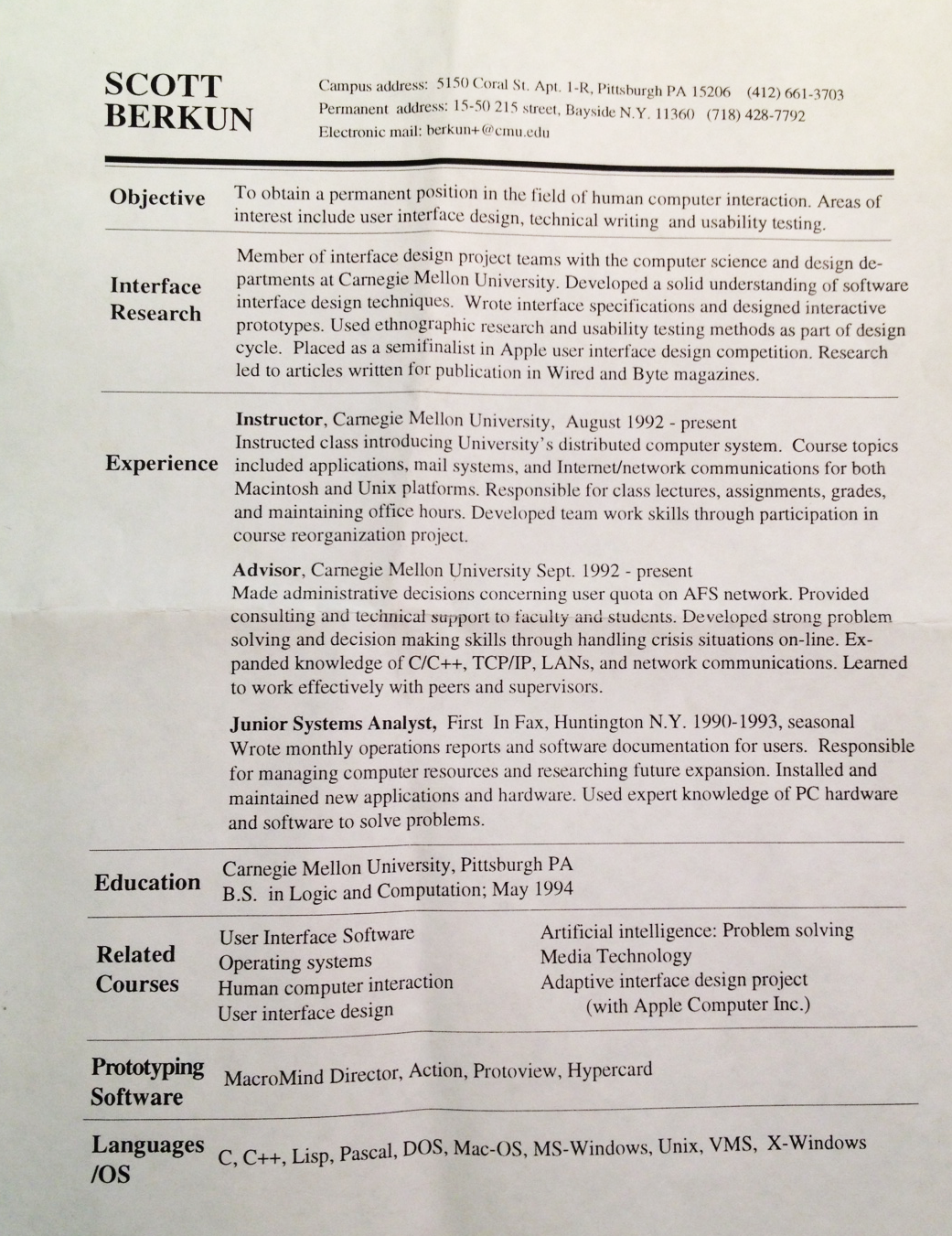
In going through old boxes I found this resume from 1994. And a wave of bad memories returned. I had a miserable time finding a job after graduation.
Most of my friends had offers months earlier, but I ended up stuck for a summer in the 2nd level of hell known as Pittsburgh in July, staying alone in my girlfriends apartment (while she was in Australia). I desperately did not want to return home to my parents. I had dozens of interviews, from at the career center, to on the phone, to fly outs to various companies. It was a benefit of graduating from a good school like CMU that I had so many, but there were no offers.
I didn’t want to be a programmer (and wasn’t strong enough anyway) and job openings for anything else entry level in the tech sector in 1994 was hard to find, as it was still climbing out of a recession. In 1994 there was no web and no startup community. No Facebook and no Twitter. Unlike today, there were no mobile platforms or web apps to try and make to prove my own worth by building something myself.
After months of struggling I lowered my expectations and made customized resumes for each job I applied for, bending my little pile of experience in whatever way best fit the job I was applying for. This one must have been one for a usability engineering position, which did in fact turn out to be the first job offer I got (from Microsoft, Sept 1994).
I’m posting for posterity and recent graduates having a hard time. Everyone starts somewhere. Applying for jobs is an absurd and unfair process, then and now.
A recent post called The Surest way to build a billion dollar company by James Slavet tries to look at data from the past to explain a plan for how to be a billion dollar company (And thankfully he never uses the i-word once). If you like his premise it’s a well written article with insights into how companies have achieved this in history:
The first observation in looking at billion-dollar consumer Internet companies is that there aren’t a lot of them. We’re approaching the twenty-year mark of the commercial Internet. Amazon and Yahoo were both founded in 1994. Yet from a recent scan of the public markets, there are currently only twenty-four publicly held U.S. based Internet companies that are worth $1 billion or more. That’s about one company per year for the past twenty years…
A full two-thirds of the 24 publicly traded U.S. Internet companies worth more than $1 billion are digital transaction firms. The billion-dollar club includes a heavy dose of travel, local and real estate businesses. The list includes Priceline, Expedia, TripAdvisor, HomeAway, Groupon, OpenTable, Yelp and Zillow. Other transaction-focused businesses that clear the threshold include Amazon, Ebay, Netflix, Vistaprint, Shutterfly, Ancestry, Bankrate and IAC/Match.com.
But there are fallacies lurking in the premise.
The surest way is not very sure. It’s very unlikely any company grows this large, even successful ones that are well run. Most new companies fail and even successful ones likely see normal levels of growth year to year. Even if Slavet’s advice is sound and followed, it doesn’t improve the likelihood much. It’s not as if we’re talking about the surest way to get a job, or the surest way to tie your shoes. Of course even a 1% improvement in odds is worthy if the stakes are high.
History is an unreliable predictor of the future. He accurately points out that most of the billion dollar companies of the last decade are transaction companies, suggesting that’s the domain with the best odds of becoming a billion dollar company. That may have been true in 1996, but it’s possible the abundance of these types of companies makes it a mature playing field, moving the domain of opportunity elsewhere, somewhere harder to predict. The next few billion dollar companies may look little like the last ones.
Most factors are beyond your control. The reasons why each of the companies mentioned (Google, Yahoo, Amazon) succeeded had much to do with forces those entrepreneurs didn’t control such as: how many competitors were there, how proficient were those competitors, how did their market change, which key people were available to join the company (or not), which technologies they depended on improved, etc. Entrepreneurs by nature discount forces they can’t control which helps them take on big risks, but those pivotal forces are also typically discounted in analysis of the past and the present.
Many billion dollar companies don’t start with the specific goal to be worth a billion dollars. I could use someone to check my history here, but I don’t think any of the companies he mentioned set out with an explicit goal to be a particular size or net value. They were all small companies started by people inexperienced with entrepreneurship who mostly wanted to create a viable business based on their ideas. They had projections of possible growth which their investors likely demanded, but when exactly were those projections made? Before they began or after they had a fledgling, but functioning service? Of course, given #2 and #3, the fact that they did or didn’t do something may have had little bearing on the outcome they experienced.
Bigger risk ventures have higher payoffs but lower success rates (maybe?). I don’t have data to support this claim, but a hypothesis is the factors you need to put in place to go after a billion dollar business, by design, increase the general risk of the venture. For example, buying a popular sandwich shop has very predictable returns, low risk, but modest growth potential. Starting a new web service in a new market has hard to predict returns, high risk, and high growth potential (if the market lasts). You can chart risk vs. reward for different ideas and look for sweet spots.
Potential for scale is the goal. A better framework for evaluating Amazon, Google, Expedia and others is they are businesses that had high potential for scale. They could create one product in one place and serve the entire planet, assuming the entire planet was interested. It’s very hard to predict exactly how big a market will grow, but you can build a business with plans for scale, and how to grow scale quickly to match a fast growing market. An interesting analysis of billion dollar companies is which ones simply out-scaled or outpaced their competitors, competitors who may have had other advantages over them.
If I could give every single business writer, guru or executive one thing to read every morning before work, it’d be this essay by George Orwell: Politics and the English Language.
Not only is this essay short, brilliant, thought-provoking and memorable, it calls bullshit on most of what passes today as speech and written language in management circles.
And if you are too lazy to read the article, all you need to remember is this: never use a fancy word when a simpler one will do. If your idea is good, no hype is necessary. Explain it clearly and people will get it, if there truly is something notable to get. If your idea is bad: keep working before you share it with others. And if you don’t have time for that, you might as well be honest. Because when you throw jargon around, most of us know you’re probably lying about something anyway.
The people who use the most jargon have the least confidence in their ideas. The people who use the least jargon have the most confidence.
In honor of Orwell here’s a list of jargon I often hear that should be banned rarely used. Flat out, these words are never used for good reason.
These are the lazy words of our time and whenever I see them used I feel justified in challenging the claims. To use these words with a straight face is to assume the listener is an idiot. They are intellectual insults. They are shortcuts away from good marketing and strong thinking since they try to sneak by with claims they know they cannot prove or do not make any sense.
Marketers and managers use jargon because it’s safe. No one stops them to ask: exactly what is it you are breaking through? What precisely are you transforming, and how are you certain the new thing will be better than the old (e.g. New Coke)? If no one, especially no one in power, challenges its use, jargon spreads, choking the life out of conversations and meetings forever.
Pay attention to who uses the most jargon: it’s never the brightest. It’s those who want to be perceived as the best and the brightest, something they know they are not. They use cheap language tricks to intimidate, distract, and confuse, hoping to sneak past those afraid to ask what they really mean.
I’m going to do my best for the rest of the year to question people who use these lazy, deceptive, and inflated terms. Maybe then they’ll use their real marketing talents and tell me a story so powerful that I believe, all on my own, will transform this, or revolutionize that.
What jargon do you hear these days that you’d like to add to the list above? Let me know.
A reader named Niko, who is working on a PhD in social network analysis, asked me for my favorite sources about how ideas spread:
I am doing a PhD in the field of social network analysis in which I try to determine mutual influence among people who are connected with cell phones. Many times individuals have good ideas but can’t bring them to life due to limited resources or social capital. If we would be able to find the right spot to plant the seed I believe there would be much more flowers on our planet. know you read a lot and have broad horizon, I wanted to ask about any good source to learn more about the spread of ideas, social contagion and social network analysis in general, may it be from philosophical or scientific perspective.
I’ve read much about the subject, but the strongest sources come from a wide range of fields, as there is no one universal theory for how and why ideas spread. It’s also interesting that most of these predate social media, as I believe taking a long view is often the most powerful one. Here’s my list:
The canonical pop business books about the spread of ideas are Made to Stick and The Tipping Point. These books have a strong marketing focus, and emphasize ideas that are bound to products. They’re both well written and easy to read. Made to Stick is more practical, focusing on a list of attributes to aim for. The Tipping Point is most notable for its identification of the roles certain types of people play in connecting people to ideas (e.g. Mavens).
Influence: The Psychology of Persuasion, by Cialdini. Influence takes a wider view of marketing and propaganda, exploring the wider history of how people in power use their power to tilt the playing field to their advantage. Most applicable to politics of the books in this list. Includes exploration of concepts like Reciprocity and Social Proof.
Connections, by James Burke. Most books on how ideas spread make it seem as if it’s something people control. Luck and factors outside of anyone’s control play a tremendous role. Connections entertainingly shows how random the spread of ideas can be, and the book joyously makes connections between inventions and breakthroughs that you’d never expect.
The Dr. Fox effect. This decades old study demonstrated that even experts are heavily swayed by the charisma of whoever is speaking to them. We are biased towards people we find charismatic, and towards ideas we want to hear (e.g. politicians, salespeople). In the study, an actor played an expert, speaking entirely in jargon and obfuscated language, but who managed to score higher marks in every category than a legitimate expert. You can see an excerpt of the video here. I wrote about this effect at length in Confessions of a Public Speaker, Chapter 8.
The Diffusion of Innovations, Everett. This is the book that defined much of marketing theory for the last 50 years. S curves, early adopters, it’s all here. Ironically many modern books on marketing use these concepts, but don’t acknowledge or seem aware of the source. While the book’s research focused more of the spread of technologies, most of the theory applies well to any idea.
Amusing Ourselves to Death, Postman. This critique of modern media demystifies how television thrives, and how it has changed our view of the world. It is a harsh critique (as you might guess from the title) and clearly takes the side that television has done more bad than good (or at best, it’s a draw). Postman’s goal was to disarm the negative influences television has for influencing which ideas spread and he succeeds: you won’t watch television the same way again.
Jerusalem: One city, Three faiths, Armstrong. What could be more instructive in the history of how ideas spread than a concise review of how religious ideas have developed and spread in the major religions of the West? This fascinating book, centered on the history of a city, walks through the early development of Jewish monotheism, to the birth of Christianity, to the development of Islam. You can see how each religion borrowed from the past (e.g. The Old Testament is really just the Jewish bible), factionalized in many directions, rejected ideas inherited from the past (often violently), had times of peaceful acceptance of other ideas/religions, condemned things in their own faction that were once accepted, and on it goes. If nothing else it offers how malleable ideas, even ideas born of scripture, are by the forces of culture. (For a more academic and wider take on how religious ideas spread, see History of Religious Ideas, Vol 1, Eliade, or Masks of God: Vol 1, Campbell).
How to write headlines that work, Copyblogger. The major medium of today is the web, and the one sentence descriptions that appear on Facebook, twitter, and email, are the first decision points in what ideas we consume or avoid. Headlines an titles are a microcosm of the entire question of how and why ideas spread: how much will you lie or misrepresent an idea to get a click? What emotions do you play on? What tone or joke can you cleverly compress into just a few words? This article by Copyblogger is one of many, but it expresses how little of the quality of ideas themselves determine the fate of the idea.
More broadly, we love to assume the best idea win, especially ideas in our national, cultural or religious history. There’s questionable evidence for this assumption. In The Myths of Innovation an entire chapter explores this myth. In short, self-interest is a huge driver of choice, and what is best for people with influence may not be what’s best for everyone else.
Additionally, the skills for a) having the best ideas and b) being persuasive, are not related to each other. A charismatic senator might have much worse ideas than his brilliant, but awkward, rival. Given how heavily influenced we are by superficials (see Dr. Fox, above) when it comes to evaluating ideas, the effects of this bias can not be overstated. Or in business terms, a product no one needs that is marketed well, can overcome a healthier, cheaper alternative that fails to excite or compel customers to buy. This should be troubling to everyone interested in progress.
Throughout history, ideas are often chosen for speed and convenience relative to an immediate issue, as their’s little expectation the choice will matter later. But when an idea takes off, they’re hard to change no matter how bad they turn about to be, in part because we love to protect the ideas from our past.
What books or articles should be on this list? Please leave a comment.
I wrote a popular post awhile ago with an analysis on the Google’s 20% time concept. Howard Baldwin from Computerworld interviewed me about this. Sadly, none of my comments made it into his article. The good news is here are the questions he asked with my answers.
HB: Please characterize the importance of creativity and innovation in the context of the working environment?
SB: All work is problem solving. Creativity is simply another word for the process of solving problems. If you give me a tough problem and I solve it for you, you may tell me “wow you are so creative” but really what I did was solve a set of problems. I may have used some old ideas, or some new ones, but to you it’s all the same since your problem was solved. Obsessing about how innovative you are is a mistake because it distracts from the real goal of solving important problems. The more ambitious the goals of a team, the more problem solving skills they will need to be successful and they better they need to be at identifying the real problems to solve.
Assuming you have a great idea you still need a good project team to execute it. Success for that hinges on 3 factors:
Is there a small creative team driving the project? IT groups are often dominated by committees, and suffer from too many cooks. It’s harder for good ideas to thrive if there are dozens of people who have the power to veto them while they are still young. You need a small (3-5) team of people who have power over the creative process.
Trust. Most teams are dysfunctional. They are competing for promotion and resources. If the VP of the group isn’t successful at creating a culture of trust, the most brilliant ideas in the world will be destroyed by infighting.
Leaders willing to make change happen. All good ideas demand change. The bigger the idea, the more change that’s required. Change makes people who like the status-quo very uncomfortable. If the leader isn’t willing to take on the risk of change, no progress can happen no matter how brilliant the team or the ideas they produce are.
HB: How many of these innovation/creativity programs are you aware of?
Many. It’s very trendy now for executives to create innovation programs. Most of them fail. They fail because new ideas are the easy part. What happens when the VP gets 10 good new ideas – is he willing to fund them? Bet the division on them? Cut an old project loved by another VP to make room for one single new idea? The real challenge is on the leader’s willingness to change and take on the risks of change. No method can do that for them – they have to do that for themselves as leaders.
HB: Is there something that keeps these programs from being more popular?
Shallowness and hubris. The most common practice is taking a small slice of a culture from a successful company (Apple, Google, etc.) without studying the larger context, and trying to jam it into their own culture. It’s organ transplantation surgery done with a butter knife. There is great hubris in assuming that making a poor copy of something that is not well understood will have instant positive effects. Typically the thing being poorly copied is then blamed as ‘not working’ and the cycle continues with the next fad.
It takes a long time to change a culture and IT departments are generally very conservative, risk-averse and focused on the short term. Often it’s not their fault as those characteristics are defined for them by the CEO. But the end result is the same regardless of who is the cause.
HB: What’s the coolest program you’ve seen?
The coolest programs I’ve seen are IT groups that are led by people who have experience making new products, rather than only working in IT departments. They’re more willing to embrace change, they understand how to sequester risk on new ideas, and they are better at learning new lessons.
HB: What advice would you give a CIO considering implementing such a program?
Start small. Pick one project team. Pick a good leader who is good at new projects. Let them work with a different set of rules (e.g. 20% time). Agree on the goals (small) for the project but then mostly stay out of their way and focus on protecting them from annoying people and roadblocks. When they finish, ask them to evaluate the results. Did those new rules afford better results? Ask why or why not? Ask the team ‘what did we learn? what should we do differently next time?” then share those results with the rest of the company, and repeat. If the ‘new rules’ result in progress, the VP should encourage other teams to use them. If they didn’t, the CIO should repeat the experiment with a similar team, but with new rules, fueled by the team’s own opinion for what to change.
I avoid thinking about macro-trends. Even if on average all corporations are doing 10% more outsourcing, there can be many specific industries where the trend is exactly the opposite. The macro-trend matters less than what’s going on inside the particular industry, or company, you care about.
The short answer is outsourcing will continue to grow. And to shrink. I don’t see anything in the next 5 years that dramatically changes anything.
Outsourcing will grow because there are always businesses looking to reduce costs. By moving a job from inside to outside a company, the price paid for the work drops. Any large established company will eventually see slower growth, and will look for ways to make up the difference by saving money. There will always be companies looking to outsource and technology makes it easier every day.
Outsourcing will shrink because as soon as you outsource a job, you limit that worker’s ability to bring you new ideas. By making the job a commodity, the worker can no longer easily suggest ways to improve how the work is done. They will never, ever, offer a proposal that is better for the overall business but that eliminates the specific tasks they are being hired to do. For example, when you hire someone to mow your lawn, they are never going to suggest you get rid of your lawn. Whereas if you have a landscaper on staff, they will continually look for ways to improve your yard, including designs that have no grass at all. For companies or projects aimed at the equivalent of rethinking the yard, it’s natural to do as much work in-house as possible.
The rub is this: the more you outsource, the more compartmentalized and specialized your organization becomes. This can make you less flexible and less likely to develop new ways of working. Optimization demands inflexibility. A heavily outsourced company will have a hard time competing against a smaller, younger company that has found a new way to work. That younger company can afford to be inefficient since they are small, and inefficiencies can lead to discoveries. If they successfully take market share from the market leader, the market leader may never recover, as they’ve become less than the sum of their parts.
In larger organizations, the move to outsource or not swings on a pendulum. At times when competition wanes, or the economy stalls, there is a push to save costs and simplify, and more work moves outside. At other times when competition increases, or the market expands, more work moves inside to accelerate growth and take advantage of new opportunities. But as a rule, you never want to outsource work that is strategic. Your core business and core roles should always be done inside your company. Only a fool would outsource their heart or lungs by choice.
A “bubble” is when you don’t own, or no longer own, what kept going up in price. -Nassim Nichol Taleb (#)
When I hear debates about whether there is a tech-bubble, or a real-estate bubble, I think “everything is a bubble” in some way. I don’t mean this as an investment strategy. I’m expressing doubt about the utility of calling out the existence of bubbles. Unless you can predict when the bubble starts or ends awareness of a bubble isn’t interesting. Markets and free-will ensure bubbles are common and unavoidable. Depending on what level you look at, you can find bubbles anywhere.
Since predictions for the future include our assessments of other people’s predictions of the future, any market is a network of speculations built on top of other speculations. This is fragile and prone to feedback loops. Feedback loops generate dramatic rises and falls. Widespread optimism about something can fuel years of investing in something that never pans out, and markets are dominated by optimists about markets.
Many investors love bubbles provided they get in on them early, and get out before they burst. They care nothing about “real” value. They are investing to profit, and don’t need “real” value to profit, but only the stock price to go up.
Here are some examples:
The sun is going to explode in a few billion years. This makes the earth, and our civilization, a bubble. We will not be here forever. Our certainty about the human world is unfounded. We know we take for granted many things that are not certain or are guaranteed to change for the worse for us. The human species is likely a bubble in the history of the universe.
The world economy is based on faith in banks and this faith creates a kind of bubble. If everyone asked to withdraw all of their money at the same time the banks would collapse. For economies to work there must be a balance of faith and doubt.
Some believe our consumption economy is not sustainable. It’s possible we won’t have the resources to cheaply produce, or buy, the kinds of goods that make up much of the world economy. If this is true, the entire economy is a bubble. Which means a bubble in any domain is is really a bubble (domain) on a bubble (entire economy) on a bubble (human race).
We are all going to die. We behave mostly as if we will live forever. Our lives are bubbles. We live in denial of the great uncertainties of when and how we will die. On the day people die, their families are surprised to learn how much unfounded security they placed in something that disappeared instantly, and possibly without warning.
People are strange and place value emotionally. Is a rare baseball card or pair of high fashion shoes worth $5000? Not in any practical sense. But civilized humans are not bound by historic practicalities. We are free to confuse perceived value with real utility whenever we like (or more precisely, can, afford to). When the apocalypse comes the survivors will be talking about how electricity, highways and running water were central to the “civilization bubble”.
Relationships are bubbles. Most of them end. Two people are good friends for a time, then lose interest in each other. If you created a stock price for each friendship, you’d seem them rise and fall. If you moved or took up a new and annoying religion that alienated your friends, you’d see a ‘friendship bubble’ burst, and your stocks drop.
The challenge isn’t identification, its timing:
If bubbles are easy to find, the challenge isn’t identifying them: it’s predicting when other factors will force those bubbles to burst. Bubbles can last for years, decades, or in the case of dinosaurs, millennia. So what if you see a bubble: that doesn’t necessarily mean anything.
Awareness of a growing bubble means little, unless you know when the bubble will end.
Macro-economics do not define micro-economics: A bubble can burst in an industry, but the strongest players may still do well. A bubble can rise in another, and the weakest players may still struggle.
This is why articles making an argument for the existence of a bubble are empty to me. What do you think?
There’s a good article detailing the death of Microsoft Courier, a tablet device project from 2009/10 led by J. Allard, of XBOX fame. The core story rests on this observation:
Within a few weeks, Courier was cancelled because the product didn’t clearly align with the company’s Windows and Office franchises, according to sources. A few months after that, both Allard and Bach announced plans to leave Microsoft, though both executives have said their decisions to move on were unrelated to the Courier cancellation.
Most interesting products for today’s world can not easily align with business models created in 1995. I know many smart people who had great prototypes for new products while at Microsoft, who were saddened to learn the escape velocity of a project is, at minimum, greater than the gravity of its two largest businesses (Office & Windows). They’d watch with sad eyes as their well conceived plans were smashed to pieces against the massively successful, but ultimately boring, twin leviathans of Microsoft. The details of the Courier story, a well designed product, fully staffed with 100+ creative employees, is sad indeed. A very different future for Microsoft was ready to born, but never saw the light of day (photos and demos).
During the browser wars, a similar, but rarely told, story explains why IE4 was the pinnacle of browser innovation in 1997, and then took a right turn into stagnation.
Brad Silverberg, VP of internet things circa 1997, intended for the web to replace Windows. He wanted Microsoft to make the web a platform, and launched versions of IE on Mac and IE on Unix (to the dismay of the industry. It’s the only UNIX application Microsoft has released). The idea was to leave OS’es behind, and focus on the web as the core way people will interact with computers. A prophetically Googlean strategy.
But when it came time for Gates to make the call, Jim Alchin, the VP of Windows, won. Windows was more important. As a result, after IE4 (and the implosion of Netscape), plans for making the web the future platform for the company were shut down, in favor of protecting the Windows franchise.
Many lament these choices. It seems boring to continually protect the status quo. But when your status quo generates $60 billion annually, a rate of income only a handful of companies in history have achieved, few complainers would have the courage to act differently if they were in charge.
There is a moment in bad product demos when everyone knows the speaker is in trouble. We watch them move their mouse, and click a button, and see the uncertainty in their eyes. Will it work? And when it fails, they fall into the downward spiral of live troubleshooting in front of a crowd. How sad. These are often smart people, representing decent websites or products. There is a better way.
Most demos fail for the same reasons. While it’s true demos are a public speaking challenge, with a few pointers anyone can do it well. Here’s a list of the most common mistakes – if you work to avoid them a solid demo experience awaits:
Don’t trust wifi. When you practice you are likely in your nice office, with great bandwith. Most demos are done in unfamiliar places, where you are sharing web access with dozens or hundreds of people. Plan for slow or no-bandwith. Have a contingency demo that requires no web access at all.
Really, don’t trust wifi. Even in a great venue, 100 iPhone users will slow all web connections to a crawl. Some venues provide a seperate router for speakers, or a Ethernet cable at the lectern, but most don’t. Ask for it. If they don’t provide it, consider bringing your own (Its worth $200 to your company to ensure your demo does not suck).
Have a video of you doing your demo. Your default contingency plan for any demo is to have a screencapture of it on video, on your laptop. This means that no matter what goes wrong, you can show the video of the demo. You’ll lose points for it not being live, but people will get to see the demo work properly, which is what they want to see. Your primary goal is to guarantee they get to see something, even if it’s canned.
Keep it short (Don’t confuse the steps with the payoff). If it takes 10 steps to add a widget to your web app, do you really need to show them all? All the audience wants to see is a couple of steps, and then the payoff. You can skip many of the individual steps. Write a script. Get a developer to make you a custom version that preloads some data. Avoid the dead air of filling out long forms, or waiting for things to load. Keep the demo short and use time to answer questions, or do extra impromptu demos based on questions people have. The key parts should be live code, but not every single step has to be.
Have a clear, and real, problem to solve. There is a big difference between demoing what a product can do, and showing a working solution to a problem the audience cares about. Know who you are speaking to and pick an example problem they care about it to use in the demo. Don’t resort to just showing off a list of features, that’s an inventory, not a demo. Watch an infomercial (e.g. Shamwow) – behind all the shtick, good infomericals define clear problems and demo how their product solves them.
Don’t make them watch you type. Typing takes time. Typing is boring. No one wants to watch you type. Find ways to avoid typing and to either fake or skip steps that are simply you typing in a password, a URL, or anything (If you must have things that are typed, have them in copy/paste, or on a sheet of paper so you don’t need to remember them). It’s very hard to type and talk at the same time, and you should be providing commentary as you go through the demo.
Practice in the venue. Ask the organizer to find you 10 minutes during the day, or the day before, to do a test run. Odds are good you’ll find a few small problems you can work around, but that you’d be blindsided by if discovered for the first time during the actual demo.
Have a backup machine. For high profile demos, have an entire backup laptop or cellphone ready to go. This level of redundency will protect you from internal problems (conflicting code, bugs, etc.) but not external problems (wifi, power outage, etc.)
Never troubleshoot in real time. It is cringe enduing to watch somewhere debug their demo live in front of a crowd. Don’t do it. 45 seconds is the most I’d spend. With everyone watching, your debugging skills will be severely compromised. If you can’t fix it in that time, drop it. Never ask anyone for help unless you are certain of what the fix is. Instead, just fall back to your video (#3).
What other common mistakes do people doing demos make? What other advice should they hear?
If you inherit a struggling team, or wake up one day to realize your team is in trouble, here’s the simplest playbook:
Build a theory of what’s wrong. The superficial reasons a project is struggling are rarely the important ones. We notice symptoms first, low quality work or bad morale, not the causes. Racing to fix symptoms often just creates other symptoms (and cultures that stay in panic mode are prone to have dysfunctional teams). Instead, go into detective mode, which means you are an investigator, not a judge. for an afternoon or a day talk to individuals about how they’re feeling and what they think is going on. Take notes. Ask clarifying questions. Talk to in private, offer confidentiality, and listen. What are the common frustrations you hear? (If none of them involve you, you haven’t heard the whole truth yet).
There are four major reasons: lack of trust, old wounds, conflicting priorities, or poorly defined goals. I’ve yet to encounter a struggling team that didn’t suffer from two or more of these issues. As you talk to people one on one, let them help you translate their complaints into those reasons. If they don’t fit ask them to offer another bucket. Be patient. Pay attention to their language. Ask questions. Listen and look.
The team leader may be the entire problem. The habits of a leader can create friction or help people thrive. Many in leadership roles don’t understand how their habits impact others. If the team doesn’t trust it’s leader it’s hard to trust anyone else. if you’re the leader you may have an existential crisis to examine: the problem may be you. Trust is grown slowly over time and if you are seen as incompetent, annoying or unreliable your teammates will hold back, weakening how the team works.
Identify people interested in change, enlist their help (Assets). In talking to your team, you’ll learn who is most interested in helping change happen. They might be the angriest, most critical people at first – but once they’ve vented, are they most passionate and willing to invest energy in working differently? Among them, who has the most respect of their peers? These are the people you need to involve in reviewing your assessment of the situation. Make a list of the issues you’ve heard, and work with them to rank the issues in terms of severity.
Identify people least likely to follow, and treat them with respect (Liabilities). Some people will resist change, even if they are miserable. This includes powerful people. Despite their resistance they can be just as useful as the positive folks. Explain what you see as the problems, offer your strawman for fixing them, and ask for their feedback. See if there’s a way, even if the plan has to change, to get them on board. If you can’t get their support, make sure to get their acknowledgment. “Ok Fred. I realize you don’t like this plan. And I understand your reservations. But I’m going forward, starting with those interested in change. But I want to make sure we continue talking about this as I go.” Don’t fall into the trap of ignoring people who don’t agree with you: a great person, sufficiently upset, over enough miserable months, will be indistinguishable from a bad seed. They may come back around if the climate improves.
Pick a small, easy thing to fix. Morale and trust operate on momentum. If the team has been struggling for some time, it’s very hard to turn it around all at once. You need to identify one single point of pain that is small, but real and fixable. The first tiny shinny star, undeniable in it’s contrast to the dark night sky, can change people’s minds about what’s possible. Let everyone know what you are going to solve first. Then ask them for their help in doing it. Once it has been fixed, report back. Ask for feedback? Is this better? If yes, you’ve now earned a small piece of trust that you can mortgage to solve the next problem. Go back and re-evaluate your assets and liabilities. Who is on board now? What feedback do they have?
Sometimes the right move is to take big action: reorganizing the team, stopping the project, or dramatically change the goals. It’s true some problems can only be solved with big moves, but most aren’t this way. If you believe in the long term health of a team, you have to be willing to grow and build it over time, and resist the temptation for the mythical complete and easy fix.
Some organizations make big changes regularly (e.g. your standard bi-annual big company re-org), but they’re so confused as to what the problem was, or how it could be fixed, they never fix anything. They just keep making big changes, masking their ignorance of what’s wrong and why.
There are dozens of factors that might lead me to work outside this playbook. But all things equal, this is where I’d start.
One favorite part of the article is an old story Tim told. Years ago, O’Reilly Media was looking to find partners for an early Internet venture. Bob Broadwater, an investment banker, gave them the following advice.
“You don’t fish with strawberries. Even if that’s what you like, fish like worms, so that’s what you use.”
That’s really good advice for any sales situation: understand the customer and his or her needs, and make sure that you’re answering those needs. No one could argue with such sound, commonsense advice.
At the same time, a small voice within me said with a mixture of dismay, wonder and dawning delight: “But that’s just what we’ve always done: gone fishing with strawberries. We’ve made a business by offering our customers what we ourselves want. And it’s worked!”
And in my own career I’ve thought much about these things, and I’m convinced they’re not mutually exclusive. Often in writing I’m aiming for Strawberries. This is the driving motivation in many of my essays: I simply wish someone else had written these things so I could read them. I feel there is a question or answer that should be out there, but isn’t, so I go and make it, and feel satisfaction when I do. Even if no one else cares, I feel like I solved a problem and filled a microscopic void in the universe.
But the ones I tend to publish are those that I sense, based on experience, there are many people who would want to read them. And to run the above metaphor into gross oblivion, this would be fishing with strawberry flavored worms, or worm flavored strawberries, which sounds awful and disgusting, but demonstrates there can be creative ways to satisfy yourself and others at the same time. There can be 80% worm and 20% strawberry, or 50% or 50%, or a hundred different breakdowns of how much you are thinking about you and how much you’re thinking about your customer, or reader.
If I know you, or have a sense of you, I can find the sweet spot between what you like and what I like and spend time there.
To only make strawberries makes you an artist. And to only make worms makes you a capitalist. To make both at the same time, or some of one now and then some of the other later, perhaps makes a successful artist. Or an artistic capitalist. Or in Tim’s case, it means you’re having a successful life that has helped people like me make successful lives, and perhaps that’s the best kind of fishing of all: fishing that helps other people learn to fish.
At The Economist Ideas Economy event Matt Mullenweg, founder of WordPress, in an excellent talk about open source software, proclaimed the end of the killer feature. He asked the packed audience of high profile influentials how many people use Firefox, and how many of them have a plugin installed – and a good percentage of them raised their hands.
He has a point. For many kinds of products, it’s the end of the killer feature. Not everywhere, not for all kinds of products. But the trend is definitely the other way. And the trend has been happening for some time.
There was a day and time when software product launches hinged on features (or killer applications) and how the new features compared to the old features competitors had. The browser wars were perhaps a peak of this kind of guns blazing feature rich marketing warfare between two competitors. Back then it was expensive to launch products and press millions of CDs, and ship them in boxes. It took time and money and you needed expensive waves of promotion to propel each release forward.
But today, with websites, iPhone apps, and web browser plugins. new feature additions are cheap(er) and can roll in at any time: the feature set matters, but it matters less. What matters more are the overall user experience and the quality and depth of the plugins/apps available for people to use.
Curiously enough, Apple’s app store is leading the way in 2010, which is an inversion of what happened in the 90s with Microsoft and Apple. The success of Windows 95, in part, was based on the huge platform of applications it had compared to the Macintosh. It didn’t matter than the Macintosh had a better experience, the availability of apps drove the decisions for many people. With the iPhone, perhaps for the first time I can remember, a product has both superior design and a superior 3rd party platform.
But the new plague we have is the annoyance of syncing upgrades and compatibility. To stay secure, we’re compelled to keep everything up to date. But my Firefox install has a half-dozen plugins, and every time Firefox itself updates, it causes a wave of incompatibility across those plugins. I’ve had the same problem with WordPress too. I never know now when I upgrade one thing, how it will impact the others, and the more plugins and apps I have, the more of a problem this becomes. It has happened before that a plugin, or app, is abandoned: , it can’t make the upgrade with me, and suddenly I’m surprised to be without something I’d grown to depend on. I’m dependent on a wider and wider set of people to get the features and things I want, which has its advantages, but its disadvantages too.
Here’s a good one from the mailbag:
I am seriously considering quitting the (day) job and dedicate myself to my consulting activities but, it’s scary decision. On one hand I feel it’s the right time. I have no family nor other important obligations and in a few years it’ll be too late. But on the other hand the cost of living where i live and the financial crisis make me hesitate.
Do you think that today’s crisis should affect this type of decision? Any insights you can provide me on your decision would be very appreciated.
Big decisions are always scary no matter what’s going on in the world. You’d be nearly as scared in boom times to quit as you probably are now. Keep this in mind. Much of the fear is yours. I know mine was. It’s easy to say “oh, it’s not the right time” as if there could ever be a perfect time. No angel is ever going to drop down from the sky and say “Quit now! It’s time! The universe has your back”, yet people seem to expect it will feel like this. It will always feel scary, weird and uncomfortable because it is new. And after the stability of a proper career, something you likely worked hard to get, it goes against the grain of our cultural attitudes to abandon that for the unknown.
Now I’m not saying everyone should quit today – far from it – but I am saying there is this fantasy about what it should feel like that can never possibly happen.
In short, going out on your own you only need one thing: enough clients to earn a living. That’s it.
Depending on what you intend to do this could be one single client. Or three. Getting one or three clients might be very easy for you. Or very hard. But either way you can start figuring out how hard or easy it will be before you quit your regular job. The quality of your business idea and talents are things you can measure no matter what the state of the world is. If you see a way to make money, can verify it, can get good businesses to sign contracts to pay you, then why wouldn’t you do it? Recessions or depressions are macro trends: there are always countervailing micro trends and that’s all you need to find.
The major advantage of being an independent is your low overhead and agility. You only need to pay one salary and that’s yours. You don’t need to build a factory or find investors – your constraints are much simpler. Even in down times if you see an opportunity to provide a service people need, and can pay for, you can do very well. Strong businesses are relatively stronger now given all the troubles weaker companies are in. Even during global downwards trends there are always pockets of opportunity and sometimes the people who strike out on their own during tough times, and survive, are best positioned to do well in boom times too.
Here’s a basic and time tested approach to all this:
What are you lowest possible expenses for the next 12 months. Do the math on how much you need to survive. Note all the frills you can cut, like cable TV, nights out on the town, skiing trips, moving to a cheaper apartment, etc. Put together your lean expenses for a year. If you have new business expenses you expect to spend before you can make income, consider those too.
Examine your savings. Based on #1, you know how much you need, assuming ZERO income, to last for a year. Look at your savings and do the math. If you find zero clients, how long can you last? A good guess is you need 6 to 12 months to build a base of clients. If you don’t have 6 months of savings, start saving now. Without a cushion you will have little margin for error, which you’ll need because you are doing something new and will make some mistakes along the way. Account for this before you start.
Be clear on what you want. Is it more autonomy? Is it more free time? Is it to have so much money you can wear clothes made from $100 bills? Think carefully about what you are trying to achieve. Simply ‘not working for the man’ anymore isn’t much of a target to aim for. I quit for more autonomy – I was sick of needing approvals for things. I also wanted to see if I’d like writing books and if I did, could I make a living around them. I decided if I could do that and live acceptably well, I’d be happy. So I quit.
Find your support team. Ask your friends, your spouse, your colleagues, and find a small group of people who will support you and help you out as you start this new thing. You will need to know who can help when need it, who will encourage you and who will give you tough feedback you need to hear. Line up your support team before you make the leap. It might surprise you how people react to your decision, so sort it out early. Groups like biznik.org or even more general networks like linkedin can connect you with like-minded people who can give you advice, support or who are a little ahead of you in the process. Blogging is an easy way to make connections and draw attention to your work, provided you like to write, or more importantly, write well.
Start looking for clients. Ask around. Of your network, who are the five people most likely to need your services. Talk to them. Ask them if you were a freelancer if they’d be interested. Talk to other freelancers in your field – buy them lunch and ask for advice. Do they like being on their own? Why? Why not? Before making the leap become a student of freelancers in your field and sort out if your fantasies about it approximate the reality. Start working your network and building it now. Start a blog about your expertise: it creates a home for your knowledge and if you go on your own, your business.
Get your first client fast: work for free. A good referral is worth much more than payment for a new independent. Be willing to work for free, on the basis it’s a limited time only arrangement, in exchange for a good referral or use of a client’s network (If you can’t find someone willing to let you work for free, be worried: your network or reputation are weak). You can do this on weekends or when off from your current job. Get projects under your belt now, while you have almost no risk. If after two weekend projects you hate it, you’ve learned, before quitting, freelancing isn’t for you. Get a taste for free before you mortgage your house for the meal.
Leave your job on good terms. Give plenty of notice, more than the minimum (Wouldn’t you be pissed if someone gave you only two weeks notice?). Finish all your work. Make sure you do everything you can to leave on excellent terms so worst case the door is open for your return, or to possibly use your former employer as a client.
Value life experience. When I quit it helped me to accept that even if I fail I’d have learned a great deal about myself, my industry and life in general. I was convinced there were lessons I’d learn I couldn’t buy any other way, and I got strength from this (It turned out I was right, but I didn’t know this when I quit). I was convinced on a personal level I could not lose, and if I planned #1 and #2 the financial risks were small. Worst case I’d take those experiences and return to the kind of career I’d had before, but much wiser and appreciative of what I have.
I’d also check out books like Million Dollar Consulting, which outline many of the considerations needed to run a successful consulting or freelance business. And Guy Kawasaki’s Art of the Start is a good starting point if you’re thinking along the lines of a business rather than consulting.