Last week I held a presentation to my company (around 60-70 people). My strategy for the post-lunch session was to keep the audience involved by asking questions. This was to prevent people from falling asleep from the food coma.
What I did was have a slide with a question, ask the audience, see what came up, and then reveal the answer I had in mind. I got a few interesting answers and it felt like it was partially keeping people from falling to food coma. Afterwards I got some appreciative comments from programmers who attended both about the contents and about the style of the presentation.
One problem: Our CTO thought that the way I’d asked questions when I already had the answers prepared was demeaning. He felt strongly about this in terms of “that’s something you just don’t do”. To me, I wouldn’t be standing there holding a presentation if I didn’t think I had answers that not everyone in the room did. Asking people to think about things rather than spoon-feeding them “truth”, to me, is a way to help the process of learning.
What do you think?
There are few things “you just don’t do” as every audience is different and the rules change depending on what they’re expecting, and how good you are at using a technique. So it’d be rare I’d ever say “you can never ever do X”.
It’s also important to realize there are many ways to reveal those answers, some which might be demeaning (“you guys were too stupid to say things like this”) but others that are entertaining, interesting and enlightening (“Here’s what I had, but your answers were better for these 2 reasons, except that you missed…”). So how you do it is as important as what you do.
The main problem I see is whether the questions you were asking were what the audience wanted to learn. I’d rather do one of these:
Ask 5 or 6 people who were going to be in the audience ahead of time what their actual questions were and use them instead of guessing.
Only ask them questions that reflect something I’d taught them in the lecture. So after demonstrating how to do long division, I’d give them an easy long division problem. Then the questions tests my ability to teach as much as it tests what they know. Any wrong answers means I failed, not the audience.
In the end the CTO is entitled to his opinion, but it’d be wise to have the opinions of the audience recorded in some simple way so his perspective is informed by what the majority felt. Having a better way to judge the value of a session is probably the best problem to solve here.
At the Business to Buttons conference this month, I noticed an interesting way to collect feedback on speakers at every session.
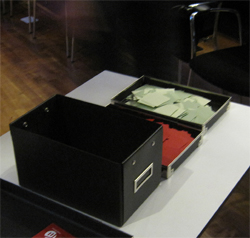
Instead of bothering with a complex survey, which has to be sent out, complied and edited, they simply place two voting boxes at the door, with two piles of small cards. One pile green, one pile red.
As you leave you grab a colored card and drop it in the voting box. And by counting the cards it’s quickly clear how well received the session was.
The upsides to this system:
It’s fast
It’s simple: either the session had value or it didn’t.
There is no extra work
However there are problems too:
It’s not secret. People see which pile you grab a card from, including possibly the speaker or his/her friends, which may change people’s votes.
If you get lots of reds it might not be clear why.
But I do love the idea as it quickly gives the speaker a sense of how well they did, and forces audiences to choose one way or the other.
The problems can be solved by finding a way to make it secret, even just by moving the box to outside the room, covering it, or finding a clever way to protect the anonimity of people voting.
Back in 2009 while working on Confessions of A Public Speaker, I wrote this post asking for speaking disaster stories. Nearly 60 people replied, and some emailed them to me privately. The best ten, including some from famous people, appeared in the book. Until recently this post was buried on another blog, but I’ve reposted it here.
If you have a good story to share, please leave a comment.
To get things started, I’m a veteran speaker and here are some of my own public speaking disasters:
I suck at math (The Hague, Netherlands, @CHI 2000). At the CHI conference I and some friends ran a live design competition called Interactionary. 4 teams of designers (from IBM, Razorfish, Sapient and U of Malmö) competed live on stage in front of a crowd of 800 people and were scored by famous judges in real time. At the end we announced the winners and took questions. Someone yelled out that our scores were wrong, which prompted the audience to start yelling and booing us – things got out of control and I had to end the session early. They were right – we announced the correct scores later that day.
Audience teaches me a lesson in front of 400 people ( San Francisco, 2007, @Etech). I made the mistake of claiming that the word architect is derived from the word arch, as in the people who make arches. Not sure where I read it (I did read it somewhere), but it turns out to be bogus. As soon as I finished my talk, Tom Coates stood up gleefully and called me on it as the first question. Blam. That sucked. (We joked about it later over drinks – he apologized, even though he was right).
“Lets start 20 minutes late with gear that doesn’t work” (San Francisco 2008, @Adobe Software). On book tour in SF, I spoke at an Adobe office with the worst tech guy I’ve ever met. I arrived 30 minutes early, but 20 minutes after I was supposed to start they were still sorting out their sound system, with various shrugs at my questions on why their system sucked so much. I spoke with a 2 second echo delay in my headset (required so 5 people could listen in remotely) the entire time, to an audience of maybe 15 people that blamed me for starting so late.
I piss off a hostile and drunk audience (Cambridge 2008, @Ignite). This first Boston Ignite was at a bar worth studying for the worst place to do public speaking (Tommy Doyle’s). The small stage is dwarfed by the much larger bar area, meaning as the speaker I could hear the roar of the bar much better than myself or the audience. And since the crowd had been drinking for 2 hours before I arrived, an inevitable heckler yelled out, with an esoteric complaint about my mention of Crick & Watson without mentioning Rosalind. I made a joke about having discovered the feminist section of the audience, and it all went downhill from there. Mike and Marlowe, the organizers (and my friends!) asked me to speak again to close the night, despite my protests based on how much I’d drunk to get over the opening session, I eventually said yes. I believe I rambled something about Michelangelo and creativity but it’d be best to ask someone who was there. Actually spare me more embarrassment and don’t ask.
The problems of being uni-lingual (Kiev, Ukraine 2008). Being translated is cool if it’s done simultaneously like at the U.N. But silly me, I didn’t think to ask. And in Ukraine I was surprised to learn they were doing live translation, but with the translator on stage. On the fly I had to divide my material in half, as it takes twice as long to do anything if you have to wait for every word you say to be translated. Most exhausting full day seminar ever.
“Please ignore the 120 decibel fire alarm” (Port of Spain, Trinidad). Halfway through my talk the fire alarm goes off. I can see the hotel staff and firemen running in a panic in the hallway behind the audience, but they can’t see it. Do I tell them what I see? Or play it cool and ignore the fact and try to speak over the alarm? I did the later. Talk about a distracted audience – at least no one slept through my talk.
If you take a minute to share a story, you can win:
Best story wins $100 gift amazon.com gift certificate
Two runner ups get gets $50 each
Any story can win inclusion in the book (you’ll get an acknowledgment & a free copy)
Instant therapy – you’ll feel better after you share, I swear! I do!
Comments are still open if you have a good story to share.
One of the goals of the book is to talk about things going wrong in public speaking. Few books ever mention how often things go wrong, even for experienced speakers, and I want to make sure these stories get told.
Leave your story of a public speaking disaster! It can be something that happened to you or something you saw or heard happen to someone else. You can win from a pool of $200 in prizes.
To help get things started, here’s some of my own public speaking disasters:
I suck at math (The Hague, Netherlands, @CHI 2000). At the CHI conference I and some friends ran a live design competition called Interactionary. 4 teams of designers (from IBM, Razorfish, Sapient and U of Malmö) competed live on stage in front of a crowd of 800 people and were scored by famous judges in real time. At the end we announced the winners and took questions. Someone yelled out that our scores were wrong, which prompted the audience to start yelling and booing us – things got out of control and I had to end the session early. They were right – we announced the correct scores later that day.
Audience teaches me a lesson in front of 400 people ( San Francisco, 2007, @Etech). I made the mistake of claiming that the word architect is derived from the word arch, as in the people who make arches. Not sure where I read it (I did read it somewhere), but it turns out to be bogus. As soon as I finished my talk, Tom Coates stood up gleefully and called me on it as the first question. Blam. That sucked. (We joked about it later over drinks – he apologized, even though he was right).
“Lets start 20 minutes late with gear that doesn’t work” (San Francisco 2008, @Adobe Software). On book tour in SF, I spoke at an Adobe office with the worst tech guy I’ve ever met. I arrived 30 minutes early, but 20 minutes after I was supposed to start they were still sorting out their sound system, with various shrugs at my questions on why their system sucked so much. I spoke with a 2 second echo delay in my headset (required so 5 people could listen in remotely) the entire time, to an audience of maybe 15 people that blamed me for starting so late.
I piss off a hostile and drunk audience (Cambridge 2008, @Ignite). This first Boston Ignite was at a bar worth studying for the worst place to do public speaking (Tommy Doyle’s). The small stage is dwarfed by the much larger bar area, meaning as the speaker I could hear the roar of the bar much better than myself or the audience. And since the crowd had been drinking for 2 hours before I arrived, an inevitable heckler yelled out, with an esoteric complaint about my mention of Crick & Watson without mentioning Rosalind. I made a joke about having discovered the feminist section of the audience, and it all went downhill from there. Mike and Marlowe, the organizers (and my friends!) asked me to speak again to close the night, despite my protests based on how much I’d drunk to get over the opening session, I eventually said yes. I believe I rambled something about Michelangelo and creativity but it’d be best to ask someone who was there. Actually spare me more embarrassment and don’t ask.
The problems of being uni-lingual (Kiev, Ukraine 2008). Being translated is cool if it’s done simultaneously like at the U.N. But silly me, I didn’t think to ask. And in Ukraine I was surprised to learn they were doing live translation, but with the translator on stage. On the fly I had to divide my material in half, as it takes twice as long to do anything if you have to wait for every word you say to be translated. Most exhausting full day seminar ever.
“Please ignore the 120 decibel fire alarm” (Port of Spain, Trinidad). Half way through my talk the fire alarm goes off. I can see the hotel staff and firemen running in a panic in the hallway behind the audience, but they can’t see it. Do I tell them what I see? Or play it cool and ignore the fact and try to speak over the alarm? I did the later. Talk about a distracted audience – at least no one slept through my talk.
If you take a minute to share a story, you can win:
Best story wins $100 gift amazon.com gift certificate
Two runner ups get gets $50 each
Any story can win inclusion in the book (you’ll get an acknowledgment & a free copy)
Instant therapy – you’ll feel better after you share, I swear! I do!
Lets see what you’ve got – it’s an easy way to help me with this project. Please do.
Much like clapping and applause, standing ovations are curious things. The idea, in theory, is that when a performance is so exceptional that clapping isn’t enough, people in the audience should stand to show an additional level of appreciation.
I think this is cool and great and the more kudos great performers and speakers get, the better.
The problem is there has been a kind of standing ovation inflation.
You can see it in politics, where it’s expected certain leaders get standing ovations by default. In these environments standing ovations are mandatory and expected. They convert what is supposed to be a spontaneous and responsive act into something quite official and often meaningless. And in some cases it can be seen as an insult not to stand and give an ovation, much in the same way not clapping can be seen as rude.
Rock bands are notorious for milking the equivalent of standing ovations by leaving the stage without saying they’ll be back for an encore. Then they wait for the chanting of the bands name, and come out as if the whole charade isn’t done in every venue in every city.
I’ve also found it in the arts. When I moved to Seattle, I found the number of standing ovations very high, particularly at dance or theater performances. My friends and I would look at each other in surprise as if we’d missed something – the shows were good, yes, but exceptional? No.
Our pet theories on ovation inflation are as follows:
The audience wants to believe they’re part of something special so they stand up to help make it seem special. (“It was amazing! They got a standing ovation!”)
They don’t get out much and can’t put what they saw in perspective.
They want to be polite, as is often the case in Seattle, and take being polite too far.
I believe in conservative use of ovations. It’s the last gift for an audience – you can’t do any more. Once you do it, you’ve told the performer it’s the best thing you’ve seen in some time. If you give many speakers ovations, as I’ve heard happens often at TED, you’re diluting the ovation. Unless you’re willing to invent something to top ovations, keep them in reserve.
In my 15 years of public speaking, I’ve only received one standing ovation I can remember. It was my last lecture at Microsoft before I quit, where I finished by playing a song about writing specs, solo on guitar. I can’t play well or sing well, and I suspect the ovation was mostly for having the balls to do it at all.
Two questions for you:
How do you decide when to give an ovation?
If you’ve ever received one, do you think you deserved it?
If aliens landed at a lecture they’d be very confused about what’s going on at the end. Why is it we strike our hands together violently to indicate we’re appreciative of what someone did? It’s an odd thing, an arbitrary cultural act that could have been just about anything. Slapping knees, howling, singing a song, all could have been the tradition just as easily as clapping.
In an article in Esquire, Elwyn Simons, head of Duke University’s Division of Fossil Primates, says “We don’t know know how far back it goes… but you don’t find primates doing it unless they’ve been taught to do it. They do not clap hands in the wild. It’s not to applaud something. It’s because they’re frightened or want to call attention to food”.
Jay Fisher, a professor at Yale University, dates the custom to the 3rd century BC, where (Greek?) plays ended with a request, plaudite, for the audience to clap. Wikipedia offers some tidbits from ancient Rome, likely one of the first places where clapping as a cultural phenomenon was recorded.
Various cultures throughout history have had alternatives to clapping. The Romans, and hipsters in the 60s, snapped their fingers. I know, first hand, that Bruce Springsteen fans yell “Bruuuuuce” at his concerts, which to the uninitiated, sounds exactly like people booing.
I also find it interesting, when I’m in the audience, to try and be the first person to clap. Often there’s silence when performances, or lectures, end, and whoever claps first can always start a good number of people clapping. It’s a strange phenomenon. Almost as strange as standing ovations.