On Tuesdays I write about the top voted question on Ask Berkun (see the lovely archive). This week’s question came via email from J.B.:
How can I learn to ask better questions?
If you’re asking this question you’re already doing well, as you’re asking questions about questions.
There’s the saying “there are no bad questions” which is especially true if you’re allowed to ask more than one. A question creates a space to be filled and in seeing how someone tries to do it the possibility of another, better question is created. The shape of the space a question creates is what makes it more or less interesting. “How did this happen?” creates one shape, but “Why did this happen?” creates another. Which one is better? It depends on what you are curious to explore. Better questions either satisfy your curiosity, or lead to other questions you are curious about.
This means there’s something about persistence in asking good questions. Whether you do it in your own mind or you do it with another person, it’s best to think of questions as a sequence. You don’t need to ask brilliant questions if you ask and answer many of them. A question can’t ask itself. You need gumption, or the courage to ask questions. Many people have good questions, but never find the courage to speak up or to explore them on their own.
Part of the fear around questions is the worry that we will expose a truth that someone, perhaps even ourselves, doesn’t want to be brought to light. Or we’ll be told we’re stupid or wrong for asking. We are social creatures who need each other to survive and the instinct of fear about being ostracized, which thousands of years ago would reduce your chances of survival, is powerful. This is part of why meaningful conversations are uncommon.
Most conversations in life are a kind of social grooming, a way to feel safe and included. Since the most powerful questions (What is Good? Why do you believe what you believe? What assumptions about life have you never questioned?) don’t have easy answers, we tend to play it safe and avoid asking them. Questions often lead to new perspectives which often leads to change and many people are afraid of change, even if it’s progress. Finding someone you enjoy exploring “dangerous” questions with is rare and if you find one, cherish them.
The surprise is it shouldn’t be hard to accept that there are many different answers to our biggest questions. There are 6 billion people, in 196 nations, practicing 4200 different religions on planet earth. Most of them can’t possibly agree with each other on many important subjects. Logically, rationally, diversity is everywhere and we shouldn’t be afraid of exploring different ways to be and live. But the problem is our brains are designed for life in small tribes. We’re biased towards behavior that works well in small uniform communities, even if logically we know how much diversity is in the world.
If ignorance means simply being uninformed, then curiosity means you are interested in your own ignorance and to want to do something about it. Even asking 5 whys, which depends on gumption more than brilliance, uses persistent curiosity to force deeper thinking. Once you see questions as tools for exploration, you’re likely to ask more of them of more people, increasing your skill at crafting good ones.
But my favorite way to think about better questions is.. a list of questions! At any moment in life when you want to question something, pull up this list and you’re guaranteed to find inspiration for better thinking. This list is adapted from the work of Richard Paul and the Foundation for Critical Thinking.
On Tuesdays, I write about the top voted question on Ask Berkun (see the lovely archive). This week’s question came via email from Pavel Pavia [43 votes]:
Are engineers more creative than designers?
Both answers (“Yes they are!” and “No they are not!”) are naive. It’s foolish to compare massive groups of people against each other especially around a sloppy word like creativity. Assuming you work in the making of products of some kind, we all likely know some engineers who are very creative and some who are not. We also know some designers who are very creative and some who are not. I can’t even imagine trying to average them out into two neat little piles and have the resulting comparison be of much use. But what then? Why can’t we have some fun? ok – FINE. Here we go.
Let’s start by ditching the word creative. It’s a romantic word and the wrong one. When someone hires an engineer or a designer they want a problem to be solved. The creative ability we’re talking about is to develop ideas that solve problems into working solutions. Do good engineers and designers both do this? YES. They might be different kinds of problems, and they may use different tools, but both show up at work with the intent to problem solve, not “problem create’ or “problem multiply” (although such people do seem to exist, unfortunately).
The first argument is usually an anecdote about how “all the designers/engineers I’ve worked with suck” and to that I say you might be right. You’ve probably never worked in a healthy, successful organization that respected both roles and hired talented people to play them. But they’ve always existed – look at the teams that made the best products you admire and I bet there was a team of both excellent engineers and designers working together. Until recently it was only in elite companies that these investments were made, but that’s changing.
The next argument is often someone pointing out that designers are really just planners, since they can’t actually build their plans themselves. They need an engineer to go and built them. But so what? Why is the ability to build something necessarily superior to the ability to conceive the plan? It might be superior, but it might be inferior. I don’t think Beethoven could play the trombone, but he could write the plan for what they (and dozens of other instruments) should do, and that’s why we know his name and not his trombone player.
But I’m not taking sides here. Not really. To succeed at solving problems you need both the plan and the ability to build it. The hard part is that depending on what the problem is, it can be either conceiving the plan or the ability to build it that is more difficult. And people are bad at recognizing when the most important challenge is in a domain that isn’t theirs (“If you have a hammer, everything looks like a nail”). Engineers are notorious for dismissing designers because of their own ignorance of what the customer’s true situation is (and the related potency of the designer’s plans), and designers are notorious for dismissing engineers because of their own ignorance of what the engineering constraints truly are.
The running sardonic joke in all this is designers and engineers tend to share more personality traits than not. Which include:
Passion for aesthetics (debates on visual style mirror debates on code style)
Preference for control (engineers love their control over bits similarly to how designers love control over pixels)
Reverence/Arrogance for idea purity (that there is a right way to do certain things)
A desire to make great things that help people
Which means many of the conflicts between designers and engineers are about bad management, the lack of a leader providing shared goals that unify these traits towards a common cause. Both trades are about problem-solving and when motivated can help each other with their individual tasks. Framed properly, and properly motivated, designers can have insights that help solve engineering problems and vice versa. All that’s required is some respect, shared goals and a curiosity to discover other ways to approach solving problems.
It’s useful to go back to a time when the distinction between designing something and engineering something didn’t exist. For most of the history of invention, people did it all themselves. When Archimedes or Archytas invented the screw (which is a mind-boggling act of genius), was he designing or engineering? Would anyone at the time have cared in the slightest what label was given? John Roebling, the architect of the Brooklyn Bridge, knew that to make something great required both great engineering and great design. He couldn’t build a beautiful, functional, enduring bridge without them both. He and his team would switch between thinking more like designers and more like engineers whenever necessary, as they were unconstrained by the strict delineations we’ve created for ourselves in modern times, and we should all consider doing the same.
[Note: Pavel’s actual question was “What is the reason for which we believe that the people who dedicate to the arts are more creative than the engineers?” but as I wrote an answer it morphed into a simpler question.]
I have a new boss who I don’t trust yet. How can I make sure they’re looking out for me?
The term set up to succeed means a person has been given most of what they need to do their job well. A good boss does more than just set goals and give assignments: they see themselves as responsible for ensuring good work happens (See: Lefferts’ Law of Management).
First, they think through the steps that need to happen for someone to do a project and where the challenges are going to be and discuss them with you. Second, they invest their own time, in coordination with you, clearing a path for those tasks to go more easily, or to become possible at all. A good boss builds a runway for you so that you can smoothly take off and checks in while you’re in the air, making adjustments behind the scenes, so you and your projects will land safely too. But taken too far this becomes micromanagement, which is the inverse way to set up someone to fail because the manager is far too involved. A good manager finds the sweet spot for each person and situation.
You know you’re being set up to fail if you’re assigned a project that:
No one seems to know about
Other people believe is their project or decision
Everyone treats as low priority
When there are major hidden obstacles on the runway, people telling you the runway is theirs and you’re not allowed, or there’s no runway at all, your manager is setting you up to fail. You are being managed poorly.
One exception is that they have clearly warned you about these conditions before you agreed to take them on (perhaps you’re a secret agent), or made clear they themselves have little knowledge of the landscape and part of your task is to map it and report back, they are either incompetent, indifferent or see more benefits in your failure than your success.
The checklist for assessing your situation
Here’s a simple list of questions to discuss with your boss (or at least with yourself) to assess if you are being set up to succeed or not. They can be used to structure a conversation with your boss about what you need and why.
Do I have the right skills? If you’re told to pilot a Boeing 747 but you have never even flown a paper airplane, whose fault is it if you fail? What training and mentoring is provided to help close skill gaps? Does your boss understand what you can and can not do and how that stacks up against what the project requires?
Do I have the right allies? Who has the power you need to do your job and are they on your side? Will they prioritize your requests? Invite you in to decisions early enough to be effective? A good boss will talk to other important people in the organization about your goals and create an agreement for how you all will work together. Or at least call out the roadblocks they can’t resolve so at least you know they are there.
Do I have the right resources (power, budget, staff, time)? You may have the right skills and allies, but if you don’t have enough power, time or money to do the work, you’ll likely fail anyway. The goals of the project might need to change if the available resources can’t.
Are there clear goals (and non-goals)? Clarity on desired outcomes is one of the most important things a leader provides. Does everyone understand and agree on how you’ll know when the work is done and that it was done right? Listing non-goals, things easily assumed to be goals, but are really distractions, can be just as important to discuss.
Are senior management’s goals aligned with the ones you have been given? If not your success will depend on you working against the grain of the organization and you are likely to fail. A good boss has made sure the right senior staff know about your projects and that all the goals line up.
What roadblocks are in your way that you do not have the power or skills to resolve? Who has been made aware of them? Who has the power you need to resolve them? Has your boss worked with you on a plan? Have you warned the right people of what may happen if the roadblock is not cleared? Have they at least agreed you are on a high risk mission and even a small amount of success will be an acceptable win?
Incompetent managers often unintentionally set up their employees to fail. They don’t realize they are giving conflicting goals, poorly allocating resources or that they’re asking people to take on work that is politically sensitive and possibly damaging to their reputation. This means you have to advocate for yourself, first by thinking through the challenges you’re going to face and second by involving your boss in helping you clear them out of your way. If you are continually set up to fail and don’t feel you are getting the proper amount of support, you have a bad manager. You should find a new one if you can.
Of course, depending on the job you have, and how senior your role is, you may be expected to identify and solve many hard problems on your own. It may be possible for you to create your own runway through influence, persuasion, relationship building and negotiation. These are valuable skills and are often necessary even if you have a good manager, but become critical if you are working for a bad one.
Some organizations call this “Dealing with Ambiguity” or “Organizational Agility.” While it’s true more senior staff should be able to handle more challenges on their own, there are limits. The expectation of all good managers is that as the boss they have more responsibility and power for making good work happen and if they fail to use it to help everyone on their team they are simply not doing their job.
What else can someone do to help in these situations? Leave a comment.
On Tuesdays I write about the top voted question on Ask Berkun (see the lovely archive). This week’s question came via email from Dennis S.:
What makes a book a good read?
Great question, but there’s no easy answer! Which is true for most great questions.
The simplest answer is “are they engaged enough to want to know what happens next instead of doing one of the 100 other interesting things in their lives they don’t have enough time for?” which sounds nice, but what engages one person can turn off another. Which is why there are so many genres, styles and types of books. For fun, go read the 1 star Amazon reviews for your favorite popular book. Many people hated it and couldn’t finish it! Does this mean the book is actually terrible? Maybe, it depends on your preferences and opinions. Art is highly subjective.
This fact is both wonderful and horrible. Wonderful because it means if you can find an audience for your particular approach to writing, you can be successful even if the rest of the world doesn’t like it. It’s horrible because success and what is good are entirely subjective which makes it easy to lose confidence, give up, or get distracted by looking for some mythical magic formula for “writing good books” which doesn’t exist. There are certainly good books on writing and story structure which are helpful, especially for new authors, but they’re more rough guides than step-by-step-magical-spells. Since books have no hidden parts, all the words are there on the page, it’s of great value to study books you and others think are good reads and ask “Why does this work the way that it does?”
It’s also useful to think what makes for a bad read. A bad read probably means:
The writer is very confused about what is interesting about their subject for the reader
The way sentences and paragraphs are constructed is confusing and hard to comprehend without reading them more than once
The book is organized poorly and it’s hard to understand why one story or chapter follows another
There is no momentum, emotional interest or curiosity created for the reader
Most serious writers have early readers who read drafts, give feedback, and help the writer understand what’s working in their current draft, and what it isn’t. They’re learning from actual readers which parts aren’t as strong as they think. All first drafts are bad. Many second drafts are too. The process of writing is rewriting and shaping material over many drafts into something good. A good read is usually the result of many revisions of a bad one.
Most serious writers also work with editors, particularly developmental editors who can guide and give advice broadly about what is working, or not, about each draft. The challenge is it’s hard to find people who give thorough and useful feedback beyond “I like it” or “I hate it”. You have to invest in finding good feedback givers, not to mention, being receptive to hearing things you don’t want to hear (which are probably true) and also being willing to make significant changes to a draft based on what you learned, rather than being stubborn or egotistical about it.
My favorite one link to give people about writing seriously is Jane Friedman’s website, filled with resources, references and recommendations.
Which is more dangerous: people who write badly, or people who read poorly?
Polls like this are mostly just fun for me. Even so, I try to word them carefully and think through how to make the question less leading towards one answer. And then before I post it, I stop to think up a guess at what the results will be.
In this case I predicted it would be nearly even. I thought the poll was clever, but not particularly interesting as binary choices often create false dichotomies. I admit I was quite surprised to see the result (21% write badly, 79% read poorly):
Yes, it’s true that binary polls are often unfair as in any real-life decision there are layers of nuance, clarifications and details that change both how you might define the problem and how you’d try to solve it. But the brutality of the forced choice has a power too, at least as a thought experiment: if you could only solve one of the two problems, which would you solve?
I see now that I agree with the answer. Here’s why:
A bad reader can squander the work of a great writer. If the reader is only skimming headlines or reading primarily for speed rather than comprehension, it’s easy for them to misunderstand or overlook the value of what they read. Reading is always the last step and it takes place entirely in the reader’s mind, not the writer’s. And of course there are far more readers than writers as it only takes one writer to produce something, but hundreds or thousands of readers can read that one work.
Misinformation and fake news are popularized by readers. Our decision to share something on social media hinges on our (mis)comprehension of its accuracy, meaning or truthfulness, or our disregard for those things. What becomes a trend, goes viral or becomes popular is based entirely on readers opinions no matter how (un)informed they are, or how many great works from great writers they have entirely ignored.
Learning to read better helps you to write better. The most common and worthy advice from writing teachers is to become a better reader and to read better works. It’s by improving the questions you ask as a reader, and developing the patience to pause and think, to reconsider, to glance between the lines, that the capacity to write well begins to grow. If we want better writers, we need better readers first.
Now that you are finished reading what I have written, what comments will you write for me to read? I look forward to reading your thoughts with extreme generosity, thoughtfulness, and patience 🙂
(I tried to find a picture of dangerous reading, and this was the best rights-free image I could find. I mean, she could trip in the sand, or maybe a big rogue wave could come up a knock her over, right?)
On Tuesdays, I write about the top voted question on Ask Berkun (see the lovely archive). This week’s question came from Ms. Unknown:
What ideas must we reject to save our future?
It’s wonderfully romantic to view the world from the point of view of a checklist of things we can either choose to accept or reject. I don’t mean this in a judgmental way. It really would be nice if we could vote each year as a planet on which ideas to promote or reduce, and then all collectively work hard towards that goal. But the tangible reality of how human society works regarding ideas is a terrible mess. Or at least, more positively speaking, it’s a complex web of interactions of needs, wants, scopes, fears, cultures, timings and coincidences. We’re all fighting our local crusades for more happiness or security and rarely have much reason to think in a unified way about what kinds of ideas are best or worst for all of us.
Ms. Unknown offered four ideas to reject: competition, scarcity, individualism, and the endless pursuit of more. Which in their way, in a simple list, seem lovely. She is describing the utopian world of Star Trek, where all core needs for all people (or at least human earthlings) are met. Star Trek of course conveniently skips over how they got from our primitive world to theirs. Even assuming Ms. Unknown is right, how do we get there? It’s hard to see it happening without a science fiction cliche like a terrible world war or alien invasion, something to force our myopic species to recognize our survival depends on our partnership in sharing spaceship earth and not petty self-interests, but I hope to see neither of those scenarios play out in my lifetime.
I’m prone to dualism, so I see most ideas on this list as having good and bad elements. Competition can be good if it’s done in a healthy way. Many people only do their best work if there is some element of competition, like artists, musicians or athletes who see others doing interesting work that challenges them to keep improving and growing, perhaps collaborating and building on each other’s work. But you can’t have a football league, or a literary society, with only one team or one author. Bad competition is when the combined choices by some competitors work against the greater good (Say, when two businesses collude to fix prices in a market so that no new entrants can even try to compete). This means it depends. The ideas aren’t necessarily good are bad, it’s how they are applied, with what goal and what result.
By scarcity, I assume she meant of fundamental needs like food, shelter and water. It’s hard to argue against the improvement of the standard of living for all. What’s there to lose for the rest of us? Probably not much. But taken to the other end of the spectrum, a question about the Star Trek Utopia is without scarcity of some kind, how are people motivated to strive? The history of America is driven by people from other nations who wanted a better life, who felt a scarcity of opportunity where they were, and where therefore motivated to take risks. Without some kinds of scarcity, or perhaps at least ambition, what drives progress? (Although the Western obsession with progress is an idea worth unpacking on its own).
It’s only the last idea from her list, the endless pursuit of more, that I’m more easily swayed to her position. The endless pursuit of anything makes me think, at first, of mental illness. The endless pursuit of cleanliness. The endless pursuit of stuff hoarded in your apartment. The endless pursuit of pictures of kittens in hats. The endless pursuit of status and conspicuous wealth. The endless pursuit of endless pursuits.
Of course, some pursuits are noble: the endless pursuit of reducing stupidity or the endless pursuit of helping people be better to each other. Yet somehow the world culture I see often rewards certain endless pursuits far more than others. The developing world is chasing the American dream of the 1950s and 60s, without learning from the mistakes (cars, pollution, suburban sprawl) that came with them. Our economies depend on the endless pursuit of growth which depends heavily on the endless pursuit of selling us things we don’t really need.
We are still struggling with the basic notions of maintaining a long-lasting civilization, but have the hubris to spend most of our time and resources in denial of the biggest challenges to our future. Perhaps the idea we need to consider rejecting most strongly is that we’re good at learning from the past or collectively learning anything at all. There is wisdom here on planet earth, it’s just not yet distributed to the places and people who need it most.
What ideas do you think we most need to reject? I’d like to know. Leave a comment.
On Tuesdays I write about the top voted question on Ask Berkun (see the lovely archive). This week’s question came from Daniel H. [23 votes]:
Does the attention economy lead to creative burnout? (And make life harder?)
Trying to make a living doing creative work has always been hard for two reasons:
The work is more emotionally challenging than other kinds of work
There is more competition for income for the kinds of work more people want to do
For these reasons alone it’s no surprise that many writers, designers or even programmers experience burnout in their careers. There’s only so long even the most disciplined and tough personality can persist in making things of their own invention without wearing themselves out. And as is the way with burnout, it’s only once you are past your limits that you discover where you limits are (or how long it will take to recover from crossing them).
It’s true that in today’s short attention span information overloaded age there are new challenges for makers. It’s easy to blame these cultural shifts, and to see how software uses our brains against us, as a problem (and for the future of civilization it’s scary indeed). For creators, the news and information cycle is so fast that to earn attention for your work suggests you have to keep up with it all. But the other side of that technological coin is that it’s easier than ever to make things and distribute them. Most people today have in their pocket everything they need to write a novel, or make a film, and at the click of a button, put it online and make it instantly available to the entire planet. They can even use wonderful tools like Kickstarter, as I have several times, to get their friends, family and fans to help make it happen (something artists have often had to do in the past, from Vincent Van Gogh to Richard Linklater).
Of course the entire planet does not care when yet more media is added to the world (4oo hours of video are posted to youtube every minute, so even if the world cared, they’d still have to prioritize). But even 50 years ago, before the internet, there were more films made each year than anyone could possibly see and more books published annually than anyone could read. For a very long time we’ve been living in a world where there is a surplus of creative works, which therefore means they compete for attention (Herbert Simon wrote about the attention economy as early as 1971). The attention economy has certainly intensified, but it’s part of an old story of how as civilization progresses, the means of creation enter more people’s hands.
One major positive difference that comes along with this change is the number of gatekeepers is lower than ever. Thanks to the web no one can tell me, or you, or anyone, NO, which was true until these last few decades. Before the web there was often no way to get your work distributed unless you had permission. Given the choice of a) depending on the approval of others to finish projects and share them with the world, but having fewer competitors vs. b) being able to put anything into the world, but I have to compete with everyone else for attention, I definitely choose b. At least I have a chance. At least I can compete, and use my skills at creation as an advantage.
Getting back to the attention economy and burnout, the wise answer is that if creativity is a primary resource in your work, you have to manage your emotional health carefully. This means understanding 4 things.
What is a sustainable pace of work for you (that can last for a long career)? This is more about self-awareness than what’s happening on Facebook (or whatever eventually replaces it). How many blog posts or tweets can you write in a week? Or short films? What if you have to average that over a month or a year? Or a lifetime? How much downtime do you need to sustain that level of production? These are questions anyone serious about being a professional maker of things has to consider. You can’t live on all-nighters (and the recovery time from those bold efforts is often longer than people realize).
What is a sustainable amount of income/attention? Much of my income comes from speaking at events. Speaking pays very well and is a short commitment, a combination that gives me the time and funding to support writing projects (including this blog, which is free). Most creative people in history realized they needed multiple paths of income, and attention, to make their life work (or do their life’s work). Only when you sit down and do the math can you understand how best to prioritize your limited time and what kinds of attention to seek (See Should I Quit My Job?).
Attention from fans matters more than the rest of the world. The most famous people in any media get most of the attention. But the fallacy is that you need to be in that top 1% or 5% to make a living. That’s not true. You simply need enough fans and attention to earn you enough money to make a living (an approach services like Patreon have validated). By most measures I am not a famous person, nor a particularly famous author. I’ve made it work over these 15 years because enough people have seen my work and liked it sufficiently to pay for it, recommend it to others and come back for more (and I’m very grateful to them). Maybe you only need attention from a handful of the right people (Patrons of the arts, a specific professional group, venture capitalists, who knows) to earn the balance of the income you need. Michelangelo and Da Vinci were likely unknown names more than a few hundred miles from where they lived. Once you start targeting the attention that helps you most, what the rest of the world is obsessing about doesn’t matter anymore.
A creative life is not the safe and secure path. I wish that it was, but I know it isn’t. The more creative the life you choose, the more risk that will come with it. If you want a secure, predictable career, consider an office job where you work for someone else. You will likely get a salary, health benefits and predictable days of working just from 9am to 5pm, all things I do not get as I am self-employed, just like many writers, bloggers, Youtubers, musicians and filmmakers are. It’s a mistake to enter creative life, including starting your own business, while presuming the outcome is clear. It can be wonderfully rewarding, but as I’ve pointed out in this post, you are choosing to compete to earn a living, and even if you do everything right odds are high you can still fail. I recommend doing it anyway, you will learn more about life and yourself by taking the challenging path, but you should do it with your eyes open.
Did you find this post useful? You can help me write more good works by sharing this post. Thanks.
On Tuesdays I write about the top voted question on Ask Berkun (see the archive). This week’s question is from Mike: How can you tell a wise person when you meet one?
“It is by no means uncommon to find men whose knowledge is wide but whose feelings are narrow. Such men lack what I am calling wisdom.” – Bertrand Russell
If you can’t judge a book by its cover, how can you judge a person on their first impression? I’ve never liked the cliche about “you never get a second chance…” because it’s rarely true. Sure, if you spill a large coffee on someone’s lap, or set an entire dining room on fire, that would be hard to recover from on a first date, but most first interactions with people are terribly bland, no matter how wise either of you are. There just is no secret wise-person handshake nor a wise-person detection app for your phone.
Instead it takes an actual conversation with someone to learn who they are and how wise they might be. Starting conversations isn’t that hard, but there is a stupor that comes over most of us when we meet new people. Mostly, it goes like this: “Hi, how are you?” “I’m fine, you?” “I’m fine, thanks” <silence>. There’s not much chance to notice a wise person here. Our questionable social skills with strangers means there are hundreds of wise people we have met at parties, or stood next to at the bus stop, and never knew it.
I understand social anxiety and fear of embarrassment, but yet it’s still mystifying that after 10,000 years of civilized life our species still hasn’t recognized how little there is to lose in talking to strangers (in safe situations). Why not just assume they are wise or interesting? What is there really to lose if you’re wrong? It’s easy to end conversations with strangers and they likely didn’t even expect you to start one. Therefore, why not make an offer to get outside of the boring conventions of daily life we so often complain about? More to my point, it takes a bit of wisdom about wisdom to find wise people.
Wisdom means not only experience, but an understanding of how to apply life experience to the present. This means the most likely way to identify a wise person is to have a conversation about life, which likely means to talk about a shared, or personal, event that has already taken place. It’s in their own observations that their wisdom or insight will be revealed (or not). This could take the shape of lessons learned, of attitudes about relationships or work, or thoughts about regrets and future dreams.
Now it’d be weird to go up to a stranger, introduce yourself, and demand “tell me a personal story that reveals how wise you are.” Don’t do that. But in most social situations there is a fast path towards sharing stories. For example, at a party you can always ask anyone you don’t know: “how do you know <name of host of party>” which almost always has some kind of story as an answer (and you can show your curiosity by asking interesting questions about their story). And then you can reply with your own answer, but add some leading context that hints at a story, or question, of your own. Perhaps “We went to college together a decade ago, but I have to admit I’m not sure I belong here. There’s just too many people I don’t know.” Or even ask for advice about how to meet new people at events like this, a fun meta-trick (as by asking this to a new person you are using the question itself to solve them problem).
Perhaps my party socializing advice seems bound to fail, and you might be right. Maybe it’s easier to start with people we already know, like friends, coworkers and family. But even then there must be some kind of ignition event to wake another person up out of their daily routines and pay attention to the fact you are offering a more interesting kind of conversation. There is no guarantee they’ll be interested, or even understand that this is what you are offering. Yet if you don’t try, you’ll never know if you just overlooked a wise person. Someone has to (kindly) spark the chance for insight. To find wise people, you have to be wise enough, or perhaps just sufficiently bold, to reach out for them.
Part of the challenge in finding wise people is what we perceive as wisdom is filtered by the chemistry created by our personality meeting the personality of another. Someone can be very wise, but also irritating. For example I suspect Socrates, for all his wisdom, wasn’t particularly easy to get along with (yet the meetup group that bares his name can be a great way to meet wise people). Maybe you meet someone wise, but they offer their wisdom in a way that makes you feel belittled. Or they have bad breath, which you despise. Or maybe you don’t like their sense of humor, which diminishes your interest in their sage like thoughts. Just because they are wise doesn’t mean their wisdom will be palatable, or even comprehendible, to you.
If I had to list traits of someone wise, they’d include:
Experienced – they’ve had interesting life experiences, both successes and failures, and they’ve asked good questions about them
Humble confidence – they have clarity to share, or to challenge my thinking, but without a strong need to convince me of their view
Insightful opinions – their thoughts invite consideration or raise my curiosity (even if I don’t agree with their conclusions)
(I very much want to list a good sense of humor, but I’m convinced that reflects my own biases)
Which leads to the observation that wisdom isn’t a universal attribute. Some people are very wise about business, but are terribly ignorant about how healthy relationships work. Or they can give fantastic advice about life to others that they fail to practice in their own lives (a notorious failing of gurus, experts and authors too). The singular word wisdom doesn’t stretch to cover the complexities of how it, or it’s absence, plays out in a person’s life, or in the advice they give. People in their later years certainly have more life experience to work from, but that by no means guarantees they possess any more wisdom about life than someone much younger than they are: a person might accumulate ignorance, or bitterness, at the same, or a faster, rate than wisdom.
In the end, mostly what we want are interesting people who are interested in us. Who are friendly, perhaps charming, willing to share what they know and perhaps willing to listen for wisdom they don’t have in new people they meet. Framed this way the titular question of this essay is less daunting. Once you befriend one person with these attributes, it’s easier to find more. And who knows, maybe while we’re trying to find what we need, now and then we can be the “wise person” someone we meet (at a party) is looking to find.
Where have you met the wisest people you know? How did you recognize them? Leave a comment.
[On Tuesdays I write about the top voted question on Ask Berkun (see the archive). This week’s question is from Regina [330 votes]: What gaps in communication exist in global virtual teams? Which I have simplified for your reading pleasure to why remote workers fail.]
The best argument about the viability of remote work is that it’s about results: any boss should let their good employees work remotely on a trial basis and see how it goes. If they can perform just as well, and their coworkers have no complaints, what’s the problem? You lose nothing and have a happier employee. Sadly many managers are afraid to try new ideas of any kind, which suggests they’re not all that great at being the boss anyway, but that’s a topic for another post.
Even when a remote experiment is done, and it fails, often it’s the remote worker, or the very idea of remote work, that gets scapegoated. This is sad. It’s far wiser to start by blaming the manager instead. Why? Well the Leffert’s Law of Management states that the starting assumption for managers should be that whatever is going wrong is their fault, and this rule applies to remote work too. A good boss realizes it’s their job to create an environment their staff can perform well in and remote work is just another scenario they should be taking responsibility for.
This sets the stage for the five most common reasons why remote workers fail:
No ally in the main office. If there is a primary physical office, it’s hard for remote workers to know what they’re missing. Someone has to look out on their behalf in meetings, hallway discussions or post work happy-hour chats. No one likes having their time wasted, but without an ally decisions are often made that are not communicated to remote workers, even when those decisions directly impact them. It’s not hard to learn the habits of being an ally, but someone has to lead the way. Some workplaces adopt a remote-first culture, where as many discussions, meetings and processes are done online, and with tools that can be used from anywhere and at anytime (which often benefits “non-remote” workers too, as all conversations are archived and searchable, people can be more productive when traveling, etc.). The boss is the most obvious ally for a remote worker, making sure their perspective and needs are represented.
Cultural bias towards caution. Amazon and other companies talk about bias towards action as a key part of their culture. This means the default posture every employee is expected to have is to be aggressive in making decisions and taking action, rather than waiting to be told what to do or taking endless precautions before acting. Remote workers are more likely to do well in these cultures, as their autonomy becomes an advantage, rather than a source of frustration. Bias towards action also tends to create more resilient employees who are comfortable identifying and solving problems (including perhaps diagnosing co-ordination frustrations involving remote workers). The more overhead and coordination required by a culture, the more pressure that’s put on remote communication tools and the team’s ability to communicate well (see #4).
Poorly defined role. Remote workers benefit from clearly defined roles where they have more freedom to decide on their own how best to use their time and resources. Even if their role requires high collaboration with other people, explicitly stating what’s expected, what powers they have and how their performance will be measured is essential to their success. Of course poorly defined roles are a problem in any organization, but the negative impact is amplified with remote workers. A role likely needs to be reevaluated, and possibly modified, when it’s transitioned to a remote position.
Poor culture of communication. When you work remotely you depend heavily on written communication: email, chat rooms, and more. Organizations that have cultivated excellent communication skills make it much easier for people to work remotely, as it’s built into the culture to ask clarifying questions, to be helpful to coworkers and to document processes and decisions in a way that other people can easily comprehend. One of the great discoveries I made when I worked for WordPress.com (Automattic Inc. is 100% remote) was how thoughtfully everyone wrote and read, and at every level of the organization. It’s taken for granted that most organizations in the world consistently hire people with good communication skills, but in reality good/mature communication skills are uncommon, and the price paid for poor communicators is amplified for remote workers.
The wrong person was hired. Hiring good people is hard enough, but to hire someone for remote work demands extra care. Remote work isn’t for everyone. Some people depend on the energy they get from being physically near their coworkers, or the psychological value of going to a physical place to “do work” and leaving to go home. Remote workers often need above average organization skills and self-awareness of their working habits. Being proactive as a remote worker is a major asset, as even in an organization with allies and a bias towards action, remote workers by definition must take more responsibility for themselves than other employees do. Automattic wisely hires by remote trial, which makes a candidate’s remote working skills part of how they are evaluated.
Despite the suggestion of the image shown below, it’s uncommon for remote workers to fail because they abused their privileges. Many people who choose to work remotely greatly appreciate not having to commute in traffic, value the ability to easily take care of their family (if they work from home) and the superior control they have over their lifestyle when compared to more conventional employment. It’s for these reasons I advocate workplaces give it a try and for people to ask for it. There’s much to gain and little to lose.
Have you seen other reasons why remote workers fail? Have a theory? Leave a comment.
On Tuesdays I write about the top voted question on Ask Berkun (see the lovely archive). This week’s question came from J.R. [via email]:
What is a favorite theory that you wish more people understood?
A favorite theory I wish was more well known is the Satir Change Model. It’s popular in some circles, but often when I mention it in talks at events few have seen it before. Virginia Satir was a family therapist who studied how families behave, and in particular, how they respond to change. Her ideas have been successfully applied to organizations and groups of people.
We like to believe change and progress are predictable, especially if we’re applying an idea we’ve used before or that is widely accepted. But according to her research (based on family behavior), and her model, even when we’re making the right change, at the right time, confusion and fear are likely.
Late Status Quo – this is the present, where things are stable, at least in the sense that they’ve been the same way for some time.
Foreign element – This is Satir’s term for any change that is introduced, which could be something deliberate (a new healthy diet) or something surprising (new neighbors move in next door). It could be a new idea, process, team member or anything. Often people resist foreign elements, even if they come with the promise of solving a problem. People often prefer to keep doing what they have been doing (status quo), even if there are things they don’t like about the status quo, especially if they don’t have much trust in their leader or their coworkers.
Chaos – (IMO this is the central idea of the model). Even if you are doing everything right, and the change is the right one, volatility will rise for a time. Average performance will drop as people experiment with adjustments to incorporate the new idea. Hidden assumptions, and emotions, will be revealed, which can be painful at first. A new idea may require new conversations, redistribution of responsibilities and more. What makes this phase challenging is it’s hard to predict how long it will take or if the path is the right one (e.g. “do we need to keep going, or is this direction a mistake?”)
Transforming Idea – The job of a leader is to help a team work through the chaos phase until they reach clarity. This is challenging as each person might require different coaching, advice, support or training to adopt the new idea. And the team as a whole may need to reform, with different roles and responsibilities. Someone with leadership skills might correctly identify a new direction, but it takes someone with people management skills to help them through the transitions that the new direction demands.
Practice and Integration – Once the new idea is understood and adopted, finally the expected gains can be seen and progress becomes predictable. And eventually stabilizes again as the new status quo.
The model isn’t predictive. It doesn’t tell you how much chaos a particular idea will generate, if any at all. It can’t tell you how long it will take before you find the “transforming idea”. It also can’t tell you whether the new idea you’re introducing is the right or wrong one (e.g. the chaos will never end, or performance will never recover). It’s simply a useful framework for thinking about the psychological patterns likely to arise when something changes.
Inexperienced people often confuse the chaos phase as a failure in their choice. And if they quit early, assuming “chaos” means they made a mistake, and revert back to the old ways of doing things, they likely will never have the confidence to try something that bold again. They now confuse the chaos phase with failure. This is a kind of self inflicted learned helplessness, where the necessary cost to improve and grow is now too psychologically expensive. People and organizations can become paralyzed here, as they’ve become extremely resistant to any threat of a “foreign element”, even though that’s exactly what’s needed to grow.
Some foolish people dismiss Satir’s work based on the question what do families have to do with workplaces or individual adult choices? But workplaces are based on relationships, and we learn our models for how to relate to other people from… our families! Your favorite, and least favorite, coworkers learned many of their patterns of behavior from their early relationship with their parents and siblings. How we define trust, love, collaboration, friendship and teamwork all come from our experience with the first and primary tribe in our lives.
Anuradha Gajanayaka compares the Satir model to Kanter’s Law, which states that “Everything looks like a failure in the middle.” She suggested that we “Recognize the struggle of middles, give it some time, and a successful end could be in sight.“
And that is a key takeaway from the Satir model. Even if you’re doing everything right in your life, or as a leader, when you try to change something be prepared for surprises. Plan time for “chaos” in response to the change, where it’s normal for performance to drop and for experimentation to happen until the new idea is understood, incorporated and refined.
On Tuesdays I write about the top voted question on Ask Berkun (see the lovely archive). This week’s question came from Faisal [22 votes]:
Appearances can be deceptive. How can I, as someone who tends to accept things at face value, develop the habit of searching for true motives of others?
In a practical sense the answer is easy: stop accepting things at face value! You need to ask more questions and think critically about the people you encounter. There are three ways to do this, all listed below.
However at a philosophical level, people are complicated. We often have multiple motives, some of which we might not fully understand when we act. Often we’re conflicted about our desires, regardless of what actions we take. And the reasons that drive our choices in life change over time: we don’t live life with a single consistent unwavering motive for anything. The more intimate the relationship you have with a person, the more complex (and possibly rewarding) it can be to understand their intentions and how your choices impact each other.
That said, here are three ways to try to know why someone does what they do.
1. Ask them
Few people take the time to simply ask direct questions to people they encounter. Somehow it seems rude or confrontational, but if done in a friendly way it can enhance your mutual understanding of each other. To ask something like “thanks for helping me move my things, but I’m curious: why are you helping me?” raises the sophistication of your interaction. Instead of just being a transaction (e.g. buying you a cup of coffee), it now because a personal conversation about intentions and expectations (e.g. how do you relate to me or to people in general? Do you expect something in return? Is this about your own sense of identity?). What they say and how they say it will give you more data to consider about their motives than the actions they take alone.
2. Exercise your judgement
Any new experience can always be compared to past ones that are similiar. You simply need to ask yourself questions like:
What are the possible reasons, positive and negative, why this person is behaving in this way?
What reputation have they earned with me (or with others) in the past that I can put this recent act into context with?
In the past who else do I know that has behaved this way? What did their intentions turn out to be?
If you can make a list of similiar situations, and think through who else you’ve known in your life who you’ve been in them with, you’ll naturally engage your own deeper judgement.
3. Use the judgement of others
You can always ask someone you trust for their opinion. This can be particularly valuable if your trusted friend also knows the person you’re curious about. Simply ask them: “Hey Jane: Rupert keeps buying me coffee every morning. What do you think this means?” Maybe they’ve known Rupert for years as a friendly, generous person, and the gesture is nothing more than that. Or perhaps they share some insight into how Rupert is up for a possible promotion, and is trying to subtly raise people’s awareness of what he does around the office.
In the end we have to decide how much we trust other people and there is no perfectly foolproof way to do that. Sometimes we trust people too much and other times we don’t trust them enough. But if we’re honest with ourselves, we can learn from each oversight, and slowly approach a more accurate way to assess both why the people around us make the choices that they do, and who in our lives is worthy of our deepest trust.
On Tuesdays I write about the top voted question on Ask Berkun (see the archive). This week’s question is from Kate N. [via email]: How can I evaluate the true value of a job offer?
I have two job offers: one pays less, but the quality of life (flexible hours, healthy culture) is much better. The other pays far more, and if I can do it for a few years I can be in a much better financial situation. What should I do?
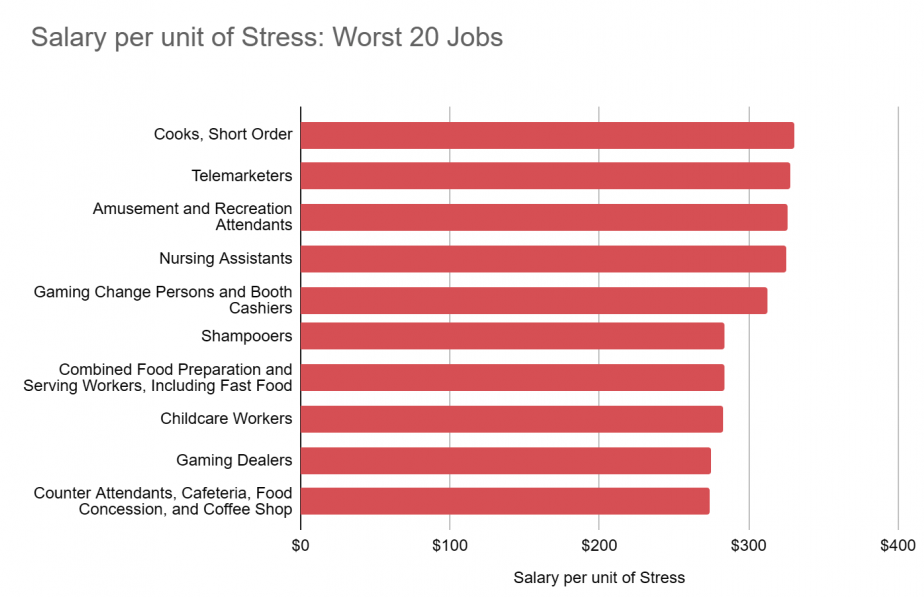
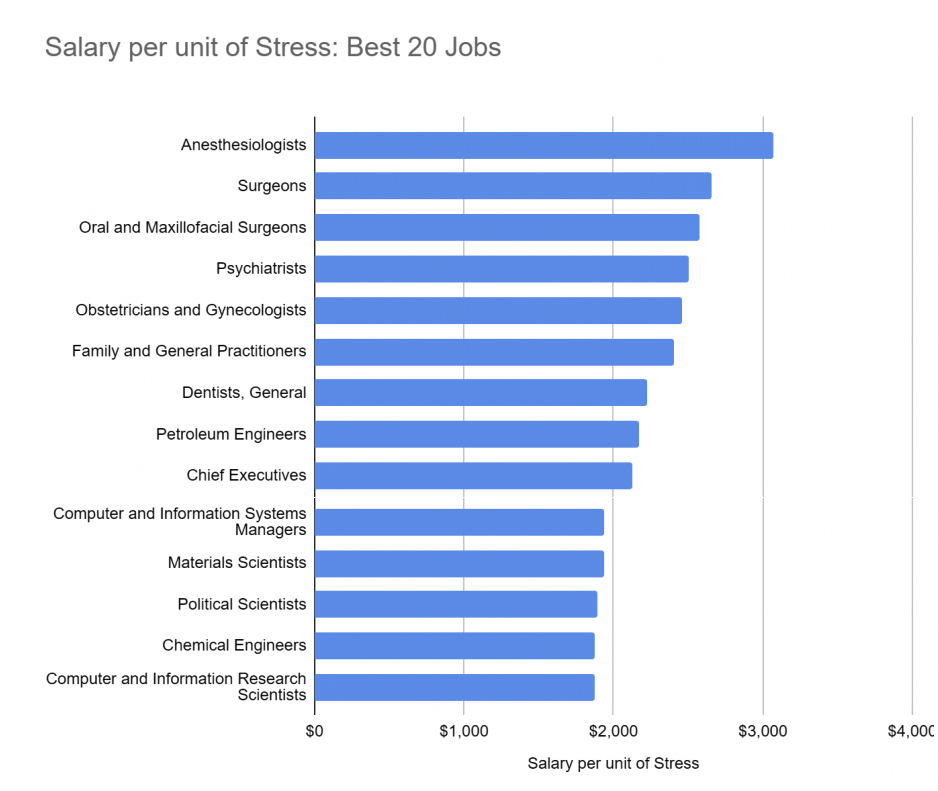
A friend of mine has a job that, on paper, seems great: he’s a high paid business consultant, working for a Fortune 500 company with excellent benefits. But he also has high blood pressure, is overweight, has little quality time with his family from his 12 hour days and exhausted weekends. Is he paid well? Most of us would say yes, but I’d say his pay to stress ratio is poor.
Pay to Stress is the ratio of the financial compensation compared against the true costs of life quality the job demands. The challenge in computing the ratio is the compensation packages an organization offers are well defined, lets say $100k salary, 20 vacation days and a gym membership. But to compute the stress, and negative impact, on our lives that job will demand requires homework and introspection most people don’t bother to do. The pay is well defined, but what is the true COST on a life for taking this job? It’s up to you to figure that out. For example: perhaps the gym membership is useless because you work too many hours to possibly use it.
In other words: If a job pays you $100k annually, but when you get home each night you are too tired, emotionally and physically, to spend quality time with your friends and family, are you really being paid well?
Pay, in professional circles, is often about status. It’s a symbol of the idea of success. It’s also easy to compare one job to another, or one person to another, in terms of salary, so so we use it as the singular measure of achievement. But this is foolish. The real yardstick of life is time. You can possibly earn more money, but you can not earn more time. What good is a yacht or a beautiful home if you rarely have the time to truly enjoy them? Many financially wealthy people are time poor, using their wealth to collect trophies they think signify a good life while never actually experiencing one.
Of course stress is subjective. Some people find challenging projects stressful while others enjoy them. In this context what I mean by stress is anything that you need to recover from before you can enjoy the rest of your life. The post work happy hour you need to have at the bar to decompress before heading home indicates a kind of stress took place during the day that you know you need to recover from. Another common symptom of stress are Saturday mornings (or afternoons) you spend sleeping late (trying to) catch up on the missed sleep during the week. Both imply your Pay to Stress ratio is high.
The wise choice is a job that rewards you well both financially but also in freedoms that help you use your time away from work for a high quality life. Those freedoms may include vacation time (which is terribly limited in the U.S. compared to other countries), the ability to work from home, flexible hours (so you can avoid the stupidity of commuting in rush hour) or a culture that measures/rewards your output instead of just your hours. The tech industry has long been a pioneer of many of these freedoms, but they are still rare in most of the working world.
In short, think through the total cost on your life of taking a job when you consider the offer. The potential employer can’t do that for you and likely will use that to their own advantage. If you knowingly take a high stress job that’s fine, especially if you see it as a short term choice to enable you to have better options in the future.
On Tuesdays I write about the top voted question on Ask Berkun (see the archive). This week’s question came from J. Mill via email [equivalent to 1 special vote]: Why are so many people charmed by narcissistic people? Which I recast as: Why do so many people fall into the trap of the narcissist?
You’re not sure why, but there’s something powerful and deeply familiar you feel from them. Something you’ve always wanted.
As you cross the doorway into their life, you see someone already inside on their way out. As they exit, sad and upset, they warn you not to trust the narcissist.
But you smile in disbelief at what they say.
How could it be true? You ask. The narcissist is so charming. They satisfy something you know you need. So you blame the person leaving for whatever went wrong.
You know you are special – because the narcissist tells you so.
They promise you something you want – something important. Something no one else can offer.
It feels good for a time. But then they forget their promise. You remind them, and they seem to remember.
But then they forget again. Or they lie.
Then you feel abused, but don’t want to believe it.
Maybe they apologize, but not very well. They promise again.
You wonder: have they earned your trust or are you just giving it away? But you think love is trust, so you offer it willingly.
Then you are used again. And again. Each denial makes the next one easier.
Another denial takes less courage than admitting to yourself who they really are and who you are for not seeing it sooner.
By the time you hit bottom and can’t deny anymore, you’re ashamed, wounded and exhausted.
Even when you summon the courage of confrontation, they ignore you. Or blame you for what happened.
So you decide to leave.
As you exit, you tell the next person coming in the door what you learned, but they smile in disbelief at what you say.
You can read The Ghost of My Father, my memoir about my family, for more thoughts on narcissists and how to overcome their influence on your life.
On Tuesdays I write about the top voted question on Ask Berkun (see the archive). This week’s question is from Bobby [with 305 votes] is Why do many managers have poor people skills?
Why do so many companies consistently and with depressing regularity keep promoting people to people manager positions when the clearly lack people skills? They are not supposed to do the job, rather get the job done. How can the if they can’t inspire and hold their teams together.
It’s healthy to start by asking how many people in any profession are good at their job? I’m not sure that management is an exception. Perhaps in general we’re not as good as the basic fundamentals in most professions and daily tasks as we assume. Trying to find a good car mechanic, landscaper or or a general contractor (to, say, remodel your kitchen) isn’t easy. Good people are hard to find.
Specific to management, “people skills” includes a wide range of things that are hard to find in one person: emotional intelligence, empathy, communication skills, decision making talents, role definition, honest/trustworthiness, conflict resolution, political acumen and more. It’s a hard job that’s often not rewarded well.
Here are five specific reasons why many managers you experience have poor skills:
It takes a good manager to hire one. If the head of the department doesn’t have good people and leadership skills, odds are low they’ll hire someone who does have them. Either they won’t be able to recognize those skills, or even if they do, they won’t prioritize hiring for them. This means good people skills are often an element of culture: some organizations truly value it and make sacrifices for it (e.g. paying for training to improve management/people skills), while others do not. If the executive is merely waiting to retire and is indifferent to the legacy they leave behind, many kinds of dysfunction and incompetence will go on until they finally walk out the door.
If good managers are scarce they go where they are rewarded. Better organizations, and better teams in any organization, will have a higher standard for many different aspects of work. It’s wise to scout for which teams are managed well and use your network to find your way into them. The best career move is often to find a better manager, even if it’s not the ideal project or role (they will help you in ways than more than compensate for those sacrifices).
If the only way to get a raise is to manage, people become managers for bad reasons. In most organizations the only promotion that comes with more financial rewards is to start managing people. They’re not doing it simply because they want and like to manage people, they’re doing it purely for mercenary reasons. Smarter organizations recognize this conflict of interest and have at least two promotion paths: one that is independent and centered on individual skill/influence growth, and the other more traditional path of management. The Peter Principle is real, which means if a person ends up in a role they’re not good at it’s often easier politically for their boss to leave them there than to deal with consequences of admitting to and correcting the mistake.
Some bad people managers “manage up” well. Managing up is the skill of influencing superiors. This is an important skill for anyone, but especially for managers. In some cases a bad people manager can succeed well enough in other ways and persuade their superiors that they are doing a wonderful job. Unless their superiors provide a channel for feedback from line level employees (e.g. skip level feedback), a manager is never evaluated in an objective way on what working for them is like. Another signal to senior managers of problems is retention: if employees flee working for a manager at a high rate, that should be a warning sign to any executive who cares about how well people are treated. But if executives don’t care to know, dysfunction can be rampant and stay well hidden behind superficial metrics and KPIs. Most cynically, if executives have a strategy where they don’t want employees to stay with the organization for long, why invest in managing them well?
Some people prefer to be managed differently. In some cases it’s not that managers are bad, it’s that they don’t match the needs of the people they are managing. Some employees want a stable easy-going workplace, while others are ambitious and want a fast pace and high adventure. Some people prefer a hands-off work style where they have high autonomy. Others need regular coaching and mentoring. Of course a truly great manager recognizes these different needs and strives to provide them (even if they require him/her to stretch beyond their own natural management style), but sometimes what is cast as “bad management” is really a mismatch of expectations.
On Tuesdays I write about the top voted question on Ask Berkun (see the archive). This week’s question is from TJ with 532 votes] is Why do we avoid what is good for us?
Some people don’t eat well, others avoid exercise, and yet others are sufficiently comfortable at work that they don’t have the initiative to take a leap forward. I, for example, have a wife that I adore and do virtually everything with. However, our comfort means that we don’t maintain or build our network of friends. This is despite knowing the value of close friends and the fact that we enjoy when we do get out with friends.
The short answer is many of the things we know are good for us require short term sacrifices to obtain long term rewards. Due to our evolutionary history the older, and in some ways most powerful, parts of our brains naturally tend to prefer things that have short term rewards. In the time before agriculture and civilization finding food and shelter were constant challenges. Our ancestors who did not seek immediate rewards often did not live long enough to reproduce. The result, after millions of successful years, is that we are a species that hasn’t adjusted yet to when there is an abundance of things that used to be scarce (e.g. high caloric food, access to news/media). Our short term bias often works against us in modern life.
And of course our higher brains, the part that can imagine and set goals, finds it easy to dream of behaving differently, as those dreams tend to be ignorant of the powers of the peanut sized amygdala in our brains, rooted in survival instincts developed from ancient times, that drive much of our behavior. We’re also often blind to the powers of corporations and advertisers to use media to influence our behavior in ways that heavily benefit them (another challenge our ancestors didn’t have to face).
Scientist Clayton R. Cook offers three reasons why we don’t do what’s good for us:
Lack of Awareness – we don’t really know what’s good (as there is much conflicting information about health, life and what is good)
Lack of Permission – we have limited time and often choose what we’re pressured to do over what is best for us
Obstacles & Roadblocks – prior commitments, self-control, peer pressure and lack of awareness of how habits work.
The good news is the popularity of the science of habits has soared in recent years (See How To Build A New Habit). We now understand much more about how to use the habits of our brains to help us rather than hurt us. In the situations you mention, it helps to break decisions down into smaller pieces that are easier to master. Another factor is making decisions once that last for a long time (reducing the short term pressure). A third is to have public/social commitments tied to them. For example always reserving Saturday evening on your calendar to meet friends at the (same) local bar (or your living room), and to have a recurring calendar invite with specific people to do it, greatly increases the odds it will happen regularly. Once it becomes familiar and the default behavior, and one reinforced by other people you care about (who may have more motivation for the habit on days when you don’t, and vice-versa), the short term vs. long term pressure fades: you’re not thinking about it in those terms anymore.
But of course all commitments require compromises (e.g. opportunity cost) – do we really, deep down want to behave in a different way, or do we just like thinking that we do? Sometimes our ego’s are in denial of our deeper feelings for what’s best for our lives. It takes experimentation to sort out the difference between what you want and what you think you want (or think you should want). Or how to decide when you need to push yourself to grow and get out of the comforts of complacency, or go easier on yourself. We have a fantasy that there are people with perfect habits, who live perfect lives, but I’m often surprised by how a mastery of external habits, especially those well endowed in the robotic allure of ‘productivity’, can have little bearing on a person’s true internal quality of life, or the quality of life they share with those closest to them.
OLYMPUS DIGITAL CAMERA
On Tuesdays I often write about the top voted question on Ask Berkun (see the archive). This week’s question is from C. with 101 votes] is Why Do Idiots Get Ahead?
I’m a diligent individual, but find it frustrating to continually clean up after the mess “idiots” create – but yet the “idiots” cannot be stopped. I have clout in my organization, yet individuals below me are supported by peers, while I’m ignored.
Your question is an interesting one, but not just for workplaces. As an experiment, lets turn your question around. Why Do Smart People Get Ahead?
I’m not sure they always do. The greatest single factor for how far ahead we get in life is simple: where and when we are born. If you were born in ancient Rome it was 50/50 you’d live past 10 years old no matter how smart you were. Then again, if your Dad was Louis XIV, King Of France in 1644, and you were the first son, you’d be far ahead before you said a single word. There were thousands of other smarter kids born that same day in France, but none were given the same advantages. Monarchy seems pretty limiting to us now, but even today who our parents were defined hundreds of advantages or disadvantages we didn’t pick, but often take credit for. Of course there are no guarantees: many children of the rich and famous often have a terrible time living up to the burdens of those legacies. But my point is there are many factors that define who succeeds in the universe, some we control but many we don’t. Some seems fair to us and some unfair.
Specific to the question of idiots, smarter people get ahead only when they are able to successfully apply their abilities to the situations and challenges they face. Some challenges in life depend more on social skills, passion, empathy, dedication and ambition than smarts. More so, words like smart, dumb, intelligent and idiot are used very loosely. Howard Gardner defined at least nine types of intelligence, including spatial and inter-personal smarts. Depending on what we’re talking about (life? work? sports?) different kinds of intelligence yield different advantages. Some titans of industry have terrible social lives. Many of our most prolific artists struggle with depression. Life is more complex than the simple scorecard we often use to judge others, and ourselves, with. “Getting ahead” seems a lousy measurement, since it demands the question: ahead of whom?
There are five different ideas hidden inside your question, as it relates to the working world:
Meritocracy depends on who defines merit. An idiot could easily get ahead in an organization that decided idiots are awesome. A crazy (or idiotic) CEO could say “we will give a 20% raise and rank promotion to the dumbest people we have.” With an incentive to be stupid, what would merit mean? We tend to think about meritocracy in simple, selfish terms, but it’s highly subjective and local to your culture. Some cultures value politeness, others directness. Banks reward consistency, but startups reward ambition. If you find yourself in a place where your definition of merit, or morality, doesn’t match those around you there are only 4 choices: influence their definition, change yours, accept your fate or move on.
When something goes wrong, look up. If ever you wonder why a team or group is a mess, look directly at their collective boss (or parent). It’s their job to make it not that way. If dysfunction and incompetence are common, hold those in charge responsible. Do you have a coworker who is truly incompetent? If yes, then ask: who has the power to fire, or reassign them, but hasn’t yet? (And who hired them in the first place?). Your problem might simply be your boss is terrible at her job (or her superiors are terrible, which constrains her abilities). A primary responsibility for a boss is to create a functional workplace where competence is rewarded. If the boss is failing to do that, not much else matters. They will spoil most attempts to right the ship, since they prefer it sinking (Perhaps because they are insecure and need to always feel smart, which is best achieved by having fools around them in an endless series of crises only the boss can resolve).
Intelligence is only one valuable attribute. An ambitious person with less talent can sometimes beat a lazy person with more talent. In workplaces, above a minimum level of intelligence, it’s often skills of listening, communicating, earning trust and being reliable that define a person’s reputation. Some abilities, like creativity, persuasiveness and work ethic, aren’t directly tied to intelligence. Someone of average intelligence but who excels at these other skills, and knows their own limitations, can succeed faster than a smarter person who is very difficult to work with or to trust. We’re also influenced by our biases: we like some people and don’t like others for superficial reasons. It’s hard for that bias not to slip into the decisions we make, or who we are willing to support (or not). And of course: if you’re smart enough to know your coworkers are idiots, but not smart enough to work around them or find a new job, how smart are you?
You might be confusing idiocy with disagreement. It’s possible the idiots see you as an idiot too (judgement reciprocity). We’re wired to divide the world into us vs. them distinctions, which often blinds us to the nuances we need to see to begin to understand a different point of view. To say They Don’t Get It might reflect as much about your own limitations as theirs. How do they see the world? How do they see their role or their contributions? Maybe they’re just as frustrated as you are, and recognizing you share this perspective might lead to other kinds of progress.
Cumulative Advantage. Any initial advantage, from luck, skill or inheritance, can tilt future odds of getting ahead into a person’s favor. Many people who don’t seem, in the present, to deserve the status they have, may be benefiting from past earned, or unearned, advantage.
People rise to their level of incompetence (The Peter Principle). The reasons people are promoted often have more to do with the work they’ve done than their ability to play the role they’re promoted into. An exceptional soldier might be a terrible manager or leader of other soldiers. It’s a common trap in organizations that the only way to earn more money is to take on a management role. This motivates people who have no real interest in leadership or management to take those positions. Once there, their mediocrity prevents them from further promotion, but their pride prevents them from seeking “demotion” to a role they are better suited for.
[Every Tuesday I write about the top voted question on Ask Berkun. This week’s question is from Gord, with 39 votes]
How can dreamers and young entrepreneurs ignore pessimistic family and friends? Many dreams get snuffed when friends and family are wildly unsupportive. The awkward dinner chats are anything but helpful when your life’s vision means not becoming a dutiful employee.
Negative voices don’t sound as loud if they are not the only ones you listen to. Of the people you know, one will be more supportive than the others and it’s your job to figure out who that is and reach out to them to get the support you need.
It’s important to remember that change is scary for most people. When your family hears you talk about making a change they subconsciously experience their own fears. And since they care about you they naturally project their fears in your direction. It’s partially out of love that they’re not being as supportive as you’d like. From Changing Your Life Is Not A Midlife Crisis:
To see a friend change is scary because it challenges the assumptions we have about ourselves. To watch a friend find a new career, partner or city forces us to question why we’re not doing the same, questions we spend most days trying not to ask.
You will need to do something to wake them up out of their default answers. It will take work for them to see that their own fears, and dreams, aren’t necessarily yours. And it will take work for you to see that despite your dreams, some of their concerns might be valid enough to consider. You likely have your own defensive habits that you fall back into when challenged, which helps your family see you as the person you were, not the person you’re trying to become.
To shake people out of their habitual thoughts, try communicating in a different medium. The family dinner table is a poor place to get people to understand your deepest feelings. Instead of being cornered during a meal, take the initiative. Make an appointment with your mother, father or friend to talk privately. Have the discussion on your terms: “Dad, I know you want the best for me. But I’ve thought hard about this. This is something I want to do with my life. I want your support but will do it without it if I have to.”
Change the conversation to be about what good support means to you and explicitly request it. You’ll be surprised how a change in how the conversation happens changes people’s responses. Often people respond to tough conversations better in other mediums. Trying writing a personal letter that explains how you feel. No one can interrupt a letter. You’ll also be forced to think more clearly about what you feel and what you want to say by writing it down. If you don’t like writing, make a video message. Unlike dinner conversation, you can practice making a video until you’re satisfied with how you express yourself.
Sometimes people need to see how fully committed you are before they’ll see you and your dreams differently. You might need to start working on your dream before anyone else will take your seriously. Talk is just talk, but if you start taking steps towards your dream, reducing your expenses, moving to a more affordable apartment, going back to school, or even quitting your job, it will be harder to dismiss you and your dream.
But don’t see your goal as simply learning to ignore your friends and family. Knowing who your Doubting Thomas is can be an asset. There will be good questions and critical feedback you will need to hear to be successful, but if everyone around you is pathologically supportive you won’t hear those things. You want to have a balance of support, some emotional, some logical, some supportive, some doubting, that combined helps you both emotionally and practically. A wise critic is an asset provided they are not your primary source of encouragement.
Don’t see friends and family as confining your life. If you are an adult you have the power to redefine any relationship you have. You can work to make any relationship healthier, deeper, narrower or wider. But it is work (Start with books like Difficult Conversations). You can also commit yourself to making new friends who have more respect for your ambitions. From Should I Quit My Job Now:
Find your support team. Ask your friends, your spouse, your colleagues, and find a small group of people who will support you and help you out as you start this new thing. You will need to know who can help when need it, who will encourage you and who will give you tough feedback you need to hear. Line up your support team before you make the leap. It might surprise you how people react to your decision, so sort it out early. You may be surprised by who commits to helping you and who only resists.
Redefining your relationships is a good first step towards an independent life: you will face many situations where your ability to relate to people will be tested. You will have to make decisions without enough information, money or time. You will need to decide who to trust, and when, and how to earn the trust of others. If you’re blocked on what your mother thinks of your decisions, how will you handle the relationship challenges of running a company? The sooner you learn how to make your own choices, and take responsibility for the consequences, the better your life will be.
[Every Tuesday I write about the top voted question on Ask Berkun. This week it’s a roundup of unanswered questions about writing]
Question #1. I have been writing a book for 12 years, it is a fantastic story of fiction that grabs you from the beginning and is relatable to almost everyone. I have the beginning the middle and the climax, i have characters, names, sub plots and actually very good characters that you care about and cant wait to turn the next page. My problem dialogue. I have the words but the grammar and punctuation is a problem. Is there a ghost writer who could polish the dialogue and punctuation for me? The total word count is about 66,000 to 70,000. 20 people have read the basic concept of the book and all are crazy about the story and the ideas in the book. I think I have a pot of gold waiting to be published I just need a little push in the right direction. I am not a professional writer but this idea is classic grab you and not let go excitment that could be the next blockbuster movie, I am not kidding it is that good and original. Please help me with any input that you may have. Thank you for your time.
I must make an uncomfortable point. Your question is mostly not a question, but sentences about how awesome your book is. Why do you think I would care? Every writer thinks their idea is amazing and even if yours actually is it’s irrelevant to the advice you seek. Your excitement here is useful to you, but not to me.
Put another way: You will only get one chance to pitch agents, editors or readerson your book. The place to start is not what you think of it as you are the most biased person in the universe to judge its merit. Whatever you say do it thoughtfully. Be concise. If you can’t be concise, at least be excellent (and have no typos or spelling errors to distract me from your excellence). But the misguided way you wrote this does not bode well for your 66,000 to 70,000 word manuscript (and how do you not know precisely how long it is?)
A few web searches will find answers to most of your questions. It’s smart when asking for free advice from an expert, to explain what other avenues you’ve tried. If you haven’t tried any don’t be surprised if they think you’re lazy. And no agent, editor or reader wants to read lazy writing.
A good copyeditor will review your manuscript for grammar and punctuation. Some copyeditors will revise your dialog for you, but you’ll pay more for that level of attention. You can find copyeditors looking for work on odesk or freelancer.com or through Writer’s Digest. Ghostwriters can be found in similar fashion, but what you seem to want is a ghostrewriter which might be harder to find. On the DIY front there are plenty of books that attempt to teach dialog to writers: start with Dialog: Technique and Exercises and The Emotional Thesaurus (though this one is not strictly about dialog, but about when dialog isn’t the best way to express a character’s emotions).
2. Should I use real names when writing a book about the physical, emotional, and sexual abuse I went through by my parents?
Don’t let this question slow you down. You can postpone this decision until after you’ve written a first draft. It’s an easy adjustment to make and you’re likely to have better judgement about it once you can sit down and read the whole thing. Real names means there is a higher standard of truth to satisfy as readers, and the people you mention, will read your book differently if you call it a memoir vs. fiction. See: Should Your Book Be a Memoir or Fiction?
3. How do i go about writing with a sencond language? I have this book idea I’ve started on and the main characters talk English, but some of the other characters dont. Is there a way to do this without creating a whole new language?
Snarkgarlal mergle bergle fimbar sniP? Icky Snickersta Reb nagga na. That’s a language I just invented to answer your question. Did you like it? I doubt it since I made it up and you can’t possibly know what it means. Why wouldn’t you use an existing language like Spanish or French that some of your readers might actually know? There are some books that invent new languages: A Clockwork Orange for example. You should study books like this and see if the effect it has for the reader is worth all the trouble. I’d think probably not. Unless part of your narrative is a puzzle and readers can figure out the meanings of words, or puzzles, as the book progresses this seems like an unnecessarily hard experience for you as the writer and your potential readers.
4a. What is your opinion of writing a book on my personal life and “rare” medical struggles? My childhood was rough, to put it lightly, I was diagnosed with a rare form of bone cancer in my early 20’s (which cost me my military career in the Army) but kept moving forward and created a mildly successful career for myself and now, in my mid 30’s, am permanently disabled with ongoing surgeries and uncertain future. BUT, I am not a quitter and refuse to lose “the fight”. What do you think?
4b. How do you write a book about hard times in your life? Writing down all the bad hurtful stuff I went through during my abusive divorce I want to write a book about it, is this the right way to start?
I’m sad that you have had hard struggles in your life and I commend you for being introspective enough to want to write about tough times. But I have no opinion of you writing a book. I don’t know anything about how well you write or how much effort you are willing to put in. The idea itself for a book doesn’t matter much nor does the interesting life of the potential writer. Interesting ideas for books are easy (even though your life may have been difficult) and interesting people are not hard to find. What matters is how much effort and talent they, or you, can put into finishing a 200 or 300 page book. Are you willing to do the hard work?
I think anyone who believes deeply about an idea for a book should write it. It’s good for the writer and possibly good for the world. But for nearly all authors the external rewards of writing a book will feel like a sacrifice. Most books don’t sell well and few authors become famous enough to make a living from it, or to compensate them above minimum wage for their time. This means external motivations alone are the wrong source. Only you can decide you care enough about the book to do all the hard work to write it. See: Is Your Book Idea Good? (Yes, I Promise).
There are many different ways to start writing and it doesn’t matter much which one you pick as long as you pick one. The goal is always to get to the next draft, as in each draft the work gets progressively easier. All ways of starting invariably feel like work because, surprise!, writing a book is a kind of work. See: How To Start Writing A Book.
5. How Do You Blog About A Book In Progress? I’m a somewhat experienced writer, but one without an established online “author platform.” (Dare I admit I don’t even have a basic portfolio website?) I now realize how crucial it is I start building my platform, and have read about the value of blogging about a book while writing it. My questions include: Do you blog under your name (even if it’s widely unknown), a working title for the book, or, absent that, a title that hints at the book’s content? Is it OK for your book blog to also market yourself as a freelance writer for topics that might be unrelated? Is there value in explaining the blog’s context — for example, “I am a writing a book on topic X and here I share what I find along the way?” Finally, what types of content should and should not be shared?
Why wouldn’t you blog under your own name? It’s not like a made up name will be any more well known than yours (unless the “made up” name you pick is Stephen King or John Updike). Stick with the name your parents gave you. Name the website something short, simple and that can be relevant no matter what topic your book ends up being about. Your comedic space opera might end up being a gluten free cookbook, and if that happens you won’t want to have to change the name of the website.
There is no singular way to blog about a book in progress and I wouldn’t wait to find a perfect method. Aim for a mix of short posts about articles or other people’s work related to your project, and sample drafts or ideas from your book. You will have to experiment and learn as you go. My advice is to grab a blog, commit to publishing something short once a week and see what happens. Go find other author sites and see how they blog about a book in progress (you can usually go into their archives to read their earliest posts, which you can compare to your early posts) Have a simple About page on your site that briefly explains who you are, what you’re doing and why. For advice on the challenges of working blog posts into an edited book, see How To Turn Your Blog Into A Book.
Since most authors, even some famous ones, make most of their living from means other than book royalties of course it’s ok to market yourself as a freelance writer. Some popular blogs like Brainpickings even ask for monthly donations to support the blog itself.
You’ll have to experiment to discover what kinds of content your readers want, since you don’t have any blog readers yet. If you’re writing a book about space aliens it makes sense that posts about NASA or science fiction films make sense, but ones about recipes for bran muffins do not.
6. Can I use first and third person in the same novel?
To answer the question about what questions never leave me I skimmed through my journal. Few people keep them anymore and I don’t understand why: it’s a secret weapon for sell discovery. A diary is a time travel device anyone can make. It lets you jump back in time and see what you truly thought in the past, which is very different than what you believe you thought. Human memory is terrible and reading a journal you discover hidden patterns in your thoughts and feelings you might never discover any other way. Writing in a diary today is a gift to the future version of ourselves.
I didn’t find many questions in my journal. There were certainly some, on average one per entry, but is that a lot? Since I have no basis for comparison I don’t know if the number I found was low, high or average. And of course most of my thoughts stay in my head, never making it into my journal which means at best my list below is a guess. I considered the questions I believe I ask myself often, but since I wrote it knowing it would be published it might be biased towards ones that sound impressive, rather than ones I truly ask myself often.
Death is a powerful motivator and is often on my mind. It’s no surprise many of my questions center on time and how I use it, as do the rules I live by. Since I ask these questions often I have answers to them that rarely change, which suggests I need to ask myself why they haven’t changed in a long time.
Is there any point to existence, or the universe, at all?
What is the best way to live given what I know, what I don’t know and what I can’t know?
What are the meanings of my life that I have chosen?
Is my time aligned with my goals?
Am I giving time to the people I care about most?
Am I giving time to the ideas and beliefs I care about most?
Are my actions aligned with my beliefs?
Am I taking my life seriously enough?
Am I enjoying life and not taking life too seriously?
How am I not myself?
What am I hiding from?
Am I pushing myself and loving myself?
What assumptions am I making that I don’t realize?
What blind spots do I have that are hurting me or others?
What questions have I forgot to ask myself?
Should my answers to these questions change?
What questions do you find yourself asking often over your life?
Recently I did a live Q&A about How To Write A Memoir. It was a reward for the book’s backers. This post is a summary of the advice I shared. Thanks to everyone who tuned in and asked questions (and helped me keep the lights on).
1. The two truths of writing anything
There are only two things you need to write any kind of book.
Good habits. Books take time to write which means your success depends on regular habits. It’s a marathon. I know the way my psychology works I either need to write every day or I won’t write at all. It’s a muscle I have to use regularly to have it perform the way I want it to. How does your psychology work? You need to know. My advice is simple: have a set time every day, before you go to work, after dinner, before you go to bed, that is permanently reserved and protected by hungry Rottweilers, for writing. It needs to be something you do daily without debating each time.
Commitment. Your writing time will come from somewhere. You’ll need to give up one TV-show a night, spend less time with friends and family, or get up earlier each day. No writer in history has written anything without sacrificing time they could have spent on something else. And when you show up for each writing session turn everything else off that distracts you. You might only put a sentence or two down a day, but if you keep showing up that’s all you need to eventually finish a book. If I don’t feel like writing I’ll show up to my session anyway and commit myself to sitting and thinking about the project, or staring at the blank page. That’s commitment. Usually I’ll get so frustrated in a few minutes with how idiotic I feel having nothing to say that I’ll eventually start writing about that. And then, soon, I discover I do have something to say about the book I’m working on, and before I know it I’m writing. But I have to show up and put the time in. There is no other way.
When people fail with a writing project there are only two causes: bad habits or lack of commitment. If you are committed you will continue to experiment with your habits until you find one that works for you. And if you only manage a paragraph a day, as long as you are patient you will, eventually, have a finished draft. But there is no trick to avoid the work: every writer in history had to put in the hours and you will too.
2. What books or resources do you recommend for writing a memoir?
Read what you want to write. How many memoirs have you read? Go read some. You can’t write well in any genre unless you are well read in it. You’ll discover how many different ways there are to approach point of view, style, tone, pace, chronology and more. Here’s a list of memoirs I recommend.
Thinking About Memoir, by Abigail Thomas. A simple, short book that explores the basic concepts of what a memoir is and how they work. It includes writing exercises and encouragement. There are many basic books like this one, but I liked it’s concision and straightforward style.
The Art of Time in Memoir, Sven Birkerts. If you write a first draft and read it, you’ll discover the core challenge of memoir is how you, as the narrator, move through time. It’s the spine that makes a memoir work or not. Of all the books I read about memoir writing, it was this book that helped the most with the central challenge of time. The book referred to many memoirs I’d never read before, which I needed to read (at least partially) to fully understand his points, but that was time (ha ha) well spent. The only way to understand the different ways to handle time was to read another writer and experience the choices they’d made.
How To Write A Memoir. This short Reader’s Digest post by Joe Kita is surprisingly good and honest.
3. A memoir is not an autobiography.
A memoir is a true story about an aspect of your life. An autobiography is a comprehensive telling of you life story. This gets confusing because we often hear politicians or celebrities talk about writing “their memoirs“, as in plural, which really means autobiography. Autobiographies are much harder to do well, often span 600 pages and are far less interesting to most people.
A memoir has more creative freedom in the themes, narrative styles and storytelling techniques you can use. There are memoirs about childhood, travel, family, competitive sports, starting a company, almost anything. Rebecca Solnit bends the very idea of memoir by combining elements of history, personal stories and journalism together. The unifying factor is the the book is a true story told in the first person about events that primarily happened to the narrator on a singular theme (at least in the writer’s mind).
4. You have a secret reason for writing (a memoir). Figure out what it is.
My friend, and trained therapist, Vanessa Longracre was my expert guest during the Q&A. She pointed out that many people think they know why they want to write a memoir, but possess a secret, and more honest, reason. That honest reason might be:
This will solve my problems
My estranged father/mother will do X for the first time
Everyone will know the TRUTH about my brother and will shun/love/hate him
I’ll finally get the apology I deserve
Having written a book is unlikely to achieve any of these things. Certainly not by itself. A book can be cathartic and the process of writing it can help you think and feel more carefully helping you to understand yourself better. But the fundamental dynamics of a family relationship have very deep causes that are unlikely to be influenced by the existence of a book alone. Do some research and see if other memoir writers got their secret reason satisfied (See this story about a new memoir about a the troubled McCandless family)
People telling you “you have a great story you should write a book” is an insufficient reason. Unless they are gifting you 500 hours of time to do the work, it’s not help. You have to decide your own reasons, the primary one being that you believe it’s a good use of your time to write a book about yourself. I get emails often asking me “Is my book idea good?” and I tell them the same thing: only you can answer that question. My opinion is irrelevant since you will have to do the work.
It’s okay if you don’t know. And it’s ok if your answer changes as you’re writing. But realize you probably have a fantasy about your motivations. You’ll write a better memoir if you dig deep to sort out what it is you are truly after.
When this crisis happened in my family I talked to my mother and brother often. These were long, intimate conversations about our family and how we felt about what was happening. It’s a crazy story and we’d laugh at times about how absurd it was. I said to both of them “this should be a book” and they agreed. I don’t know at the time they knew how serious I was, but I’m a writer. This is what I do. A powerful, complicated true story landed on me and I committed myself to telling it.
I wrote it for many reasons. First, I was obsessing about my father and my family and I needed a constructive place to put that energy. Second, I’m a writer who wants to take risks and this was going to be a different kind of book. Third, all families have problems. What we don’t have are the skills and courage to talk about them. I felt if I told my story well it could help readers figure themselves out. This is what good art is supposed to do: help us understand the human condition.
6. There is power in writing without publishing.
I’ve kept a private journal since I was 19 years old. It started as a class assignment, and most of my early entries are embarrassingly shallow attempts to impress the professor. But after the class I kept writing in it. I found that trying to explain whatever I was thinking or feeling in words had a power, even if no one read it. It forced me to think and feel carefully, and when I wrote something down, even if it was expression of confusion or uncertainty, I always felt like a burden had been lifted. Seeing the words on the page made me feel more comfortable with myself. And then I discovered that going back to entries in the past and comparing my feelings in the present was transformative. Written words persist far better than our memories do, and writing your thoughts down is a gift to your future self.
You don’t need to publish writing for it to have meaning. You can also choose to share what you write with only with a friend, or family. You can decided after you’ve written a draft whether you want to publish it or not, or who you’ll publish it for.
7. How do you deal with the situations you don’t remember precisely? (e.g. names of places, people, what happened exactly, what people said, etc. )
Writing is never neutral, completely fair or perfectly accurate. There are long debates among writers about what poetic license is, and how far a (non-fiction) writer can go in shaping or crafting true events: it’s a complex subject I’ve written about here.
Human memory is highly unreliable and anyone writing a memoir must admit this. Keeping a journal helps as at least you have a written record of what you thought on the day certain things happened. Interviewing other people who were there when events happened can be critical as two or more sources dramatically improves the quality of the facts.
Most important is to disclose to readers what sources you had. Few memoirs do this and it’s a mistake. In most memoirs quoted passages (e.g.’and then Todd said “this is the worst Atari game I’ve ever played!”‘) are inventions based on one person’s recollection of a conversation. How accurate can this possibly be? Unless the author had a tape recorder playing 20 years ago how could they possibly remember the exact quote someone said? They can’t. But written storytelling works better when this kind of precision is provided, so many writers claim poetic license to fill in these gaps.
I think whatever you do is ok provided you explain to the reader somewhere what you did or didn’t do. Here’s what I included on the first page of The Ghost of My Father:
8. Were there periods of doubt while writing this book that were more severe or different than what you have experienced before? Were your habits always strong enough to alleviate these doubts? If not, what parts of your life helped you rebound?
Yes. All ambitious projects come with periods of doubt. If I work on something and never have doubts it means I wasn’t ambitious enough. This is my most personal book and everyone in my family who is in the book is still alive. But I’m a writer. This is what I do.
The habit that matters the most is having faith in the next draft. In each draft I had a chance to reconsider what stories I told and how I told them. I had 5 people read early drafts of the book, people who I know are honest with me about their feedback.
9. Did you have any fears or concerns about how being this vulnerable, personal and open would impact your perception and opportunities with your harder core business audience?
I’ve had some practice with sharing private thoughts publicly. I wrote a popular book in 2009 called Confessions of a Public Speaker, so I’ve confessed on some things already. My previous book, The Year Without Pants, is a first person story of my experiences leading a team. Of course The Ghost of My Father was far more personal, but the experience with being honest with readers is something I’ve been developing over time.
I want to take risks with talents. To do that means doing things I’m afraid of. I want to bet on fans. If I publish a book they’re not interested in I hope they’ll just wait for the next one.
10. What does a personal memoir need in order to be popular (have high sales) if it’s not about someone who is already in the public eye? Does it need a character arc? Or a realization of a profound truth? What makes it interesting to the reader?
Selling books is harder than writing them. There is no formula. In broad strokes memoirs are harder to sell than novels or non-fiction books. Being famous helps of course as people are interested primarily in the person, not the book. A big part of any book selling well has little to do with the writing of the book. You have to identify the audience, find ways early on to reach out to them, write a great book, and then work hard to let them know you’ve provided something they want. But the more you write a book to sell it, the less soul the book will have. Making true art demands goals with more depth than sales numbers.
11. Being such a creative mind and tackling so many topics in your blog, how do you decide on a topic & outline for a book? How do you handle “book being already written”, “same old topic”, etc? Really, how do you write great books on topics already addressed?
Every topic has already been addressed many times. So what? If you read the Greek tragedies you’ll discover Shakespeare stole their plot lines. And then if you watch the Lion King you see it’s Hamlet for kids. No one really cares how original it is in the abstract, they care about how good it is in the specific. See It’s Ok To Be Obvious for my take on this philosophy. If you have an opinion go read what someone else said about it. I bet you’ll find you disagree with them or have a better way to express a similar idea. Don’t hide from it, build on it.
11. Did you consider writing it as fiction even if it’s mostly true to avoid the issue of criticism of your decisions?
Telling my story as fiction felt like cheating. Many writers have done this and I’ve often wondered why. Even Charles Bukowski wrote Ham on Rye as a novel, despite it being the story of his childhood. In this case I asked myself: am I telling a true story or not? If I am, why call it a novel and introduce doubts? If I’m a good storyteller why do I need to invent things to make it work? Anyone in my family who read the book as a novel would easily identify who they were. So why the ruse?
My complaint about so many films and TV shows about family is how phony they are. And since these are the primary ways we learn about families other than our own they perpetuate the same fantasy mythology about what real families are like. Where does most of your knowledge about relationships come from? Much of it is from fiction and I think that’s part of the problem. Of course fiction can illustrate some things better than non-fiction, but in some cases the opposite is true.
I know many authors wait until their parents are dead to write about them. This feels like cheating too. Superficially it seems like respect to wait until after someone is dead to write about them. But think about that: it takes away their rights to respond. It’s actually a betrayal. It’s a permanent way to go behind their back. There is nothing in this book I haven’t said, or wouldn’t say, to everyone in my family. Does that make me brave or stupid? Probably some of both. To put it another way: how I can consider someone close to me if there are deep things central to who I am that I can’t share with them? Or share, as an illustrative example, as a writer, with strangers? We talk about transparency and honesty but do we practice it in families? in tribes? Cultures?
You can decide if you want to fictionalize your story later (and here’s advice on how to decide). Don’t get hung up on this. You’ll write many drafts and it’s a decision you can start worrying about once the first draft is done.
12. Did you come to have a different understanding of forgiveness? As a human ability or valuable choice?
I want to say yes, but it’s hard to be sure. The cliche of forgive but not forget is true to me. I don’t hate my father. He is a lost person and I feel sad for him, as he’s his own worst enemy. And I do understand, now, that his failings as a parent have more to do with him than with me. But forgiveness is not a panacea. Dysfunctional families are not fixed through forgiveness alone. Here’s a more important question: if you are in a relationship that is inherently destructive for you, what obligations do you have to stay in it? And how deeply? That’s not about forgiveness so much as it is about figuring out how to be a healthy person. How do you create healthy boundaries on territory you know is dangerous to you? That’s the hard question. There’s no platitude for solving that one. It’s the struggle most people have in their families: how can I be myself in here? I love these people and they love me, but then why does it hurt so much to get close? It takes hard work to learn healthy expressions of love.
———————————————————————-
You can buy The Ghost of My Father on Amazon. Kirkus Reviews called it “A sobering, lucid memoir about the uncanny, precarious nature of family, masculinity and childhood.” Profits from the first edition of the book are donated to Big Brothers Big Sisters.
If you have other questions about writing, or writing a memoir, leave a comment.


.jpg)