The more creative the project, the more subjective the answer is for when it’s finished. If the project was to eat an apple for lunch, you’d know you were done when only the core remained (unless you were very hungry and ate the core too). But if the project was to create a powerful dramatic film about a troubled marriage or a believable science fiction novel about a civilization powered by core-less apples, success is not objective. In fact what makes a work loved by some people are exactly the reasons why other people will hate it. Accepting a project as finished means, in part, seeing its flaws but accepting them as necessary to achieve its graces. A perfect work of art, if there is such a thing, would be perfectly boring.
Many people complained, and still complain, about the long, silent sequences in Stanley Kubrik’s 2001 A Space Odyssey. Yet it’s one of the most influential science fiction films of all time. Gauguin, and most of the art world, thought Van Gogh’s paintings were underworked and unrefined. And Gauguin was right in a way. But given what Van Gogh wanted to do they were fantastic. Who is right? No one is really. The value of art is decided by two people: the artist and the viewer. Critics and experts have their say, but if you look at something and appreciate it no one can get in your way. And if you hate it, the fact that it’s famous or won awards only makes you hate it more.
We’ve all read books or seen movies we didn’t think were finished, or good, or worth our time. Some are simply overdone and over the top, and perhaps too done (What Dreams May Come isn’t so much a bad film as it is a saccharine one). We forget that even the films and products we hate took years of effort by people who probably did think they were done. One my favorite books is The Old Man And The Sea, a novel I think is perfect, yet many find it childish and overly simple. There is no one singular answer. And much of the criticism and feedback artists hear is really about the wish of the critic to describe a different work, not necessarily a better one.
I have goals for each book when I start, but the goals shift. I’m learning about my ideas as I try to make them real. Even on a successful book it feels like a spiral going around the same core notions, stretching and tightening with each draft (and loop of the spiral). There are false starts. There are wrong directions. Sometimes the best choice is to pivot: this isn’t a drama, it’s a comedy! And with that single change waves of new energy ripple through the entire work. It’s scary to make big changes, but there are no rewards without risks (and that’s what the undo button is for). But with each draft I expect the scale of the problems to get smaller. Eventually the problems I see are about polish, in sentences or paragraphs, rather than chapters and themes. I believe in testing drafts of work by consuming it the way readers will. If I’m in doubt about a book being finished I’ll sit down and read the entire draft from the first page to the last. I’ll ask honest friends to do the same and listen to their opinions. That’s the only way to refresh in my mind what the draft really is, or isn’t.
Questions to ask if you’re not sure if it’s done:
What were you trying to do when you started?
What were you trying to do last time you felt you knew what you were doing?
How does what it is now compare to what you were trying to do?
Have you gotten feedback from someone who will be honest with you? (and not merely give you a pep talk)
What do the other key people on the project, or who the project is for, think?
Is it finished, but you just don’t like it anymore?
Do you not want to do the grunt work required now that the ideas are set?
Do you see ways to simplify? You may have 300 pages of a great 200 page book.
Put it away for a week or more. Then look at it with fresh eyes. How do you feel now?
Always remember creation requires risk. If you knew for certain what you were making when you started and that you had all the skills required to do it, why bother? If you are ambitious, not all of your projects are going to work out. Every novelist and entrepreneur has abandoned projects over their career (Michelangelo and Da Vinci were notorious for not finishing works). Or released mediocre work into the world (e.g. Bob Dylan). You may decide a project isn’t done, but it needs to be put away for awhile, while you work on something else. That’s fine. Abandoning works isn’t a crime provided that’s not what you do on every project. But all ideas demand grunt work that has to be done. If you’re not committed enough to do the grunt work for your own ideas, who will?
The more works you release into the world and say “it’s done!” the better your judgement will become about when something feels finished to you, the maker. And the less afraid you’ll feel about handling the feedback from the world. Charles Dickens released most of his books a chapter at a time: maybe you need to work in smaller chunks of doneness. Every time you say “it’s finished” you’ll get better at sensing if a project just needs another round of polish, or that it really does need to go back into the shop for an overhaul. Your intuition as a creator needs mileage to get improve and you can’t get it if you never finish anything. You want to be a creator who can look back to past finished projects to compare with the unfinished one you’re working on now. There’s only one way to get there.
As a writer I think often about storytelling and different ways to tell stories. I recently watched Bitter Lake, a BBC documentary by filmmaker Adam Curtis (recommended to me by Ario) and I can’t recommend it strongly enough. The film is something everyone should watch for three reasons.
First is its ambition. Many Americans feel they are betrayed by media and that we are fed oversimplified stories that don’t serve our interests. Yet we do little to seek out alternative kinds of storytelling and storytellers. The opening narration to the film makes clear its ambition to offer something better:
Increasingly we live in a world where nothing makes any sense. Events come and go like waves of a fever leaving us confused and uncertain. Those in power tell stories to help us make sense of the complexity of reality, but those stories are increasingly unconvincing and hollow. This is a film about why those stories have stopped making sense… it is told through the prism of a country at the center of the world, Afghanistan.
Second is its form. Most documentaries use the same structure of voiceover and interviews with experts to tell a linear, dense story of an event. Curtis is known for more ambitious storytelling where the viewer has to put more of the pieces together themselves. This is the kind of intelligent storytelling we claim to want. It demands an investment from the viewer, but delivers on it. It reveals how the obsession with simple answers betrays the truth we claim to want.
Bitter Lake has much less narration and expert commentary than you’d expect. Instead Curtis sifted through hundreds of hours of rushes, the unused footage recorded by news and television crews, to share moments that are surprisingly real. I say surprising because in watching Bitter Lake you realize how stereotyped all of the footage you’ve ever seen of Afghanistan has been. Here you see children playing, soldiers dancing and people living their lives. And you also see moments of shock, violence and uncategorizable scenes too strange and real to label (vaguely reminiscent of clips from Koyaanisqatsi, but without slow-motion or endless Phillip Glass riffs) . It has as dream like effect and Curtis leaves it to you, the viewer, to decide for yourself what some of the shots he shares mean, or how they fit together if they do at all, just as you might have to do if you were traveling yourself to a foreign country and having a real experience.
Curtis himself offers:
These complicated, fragmentary and emotional images evoke the chaos of real experience. And out of them I have tried to build a different and more emotional way of depicting what really happened in Afghanistan.
Third is the story of America and Afghanistan, the subject of the film. Some of this story I knew, but there were many surprises here that sent me immediately to the web to research and explore. I didn’t know the U.S. in 1946 invested heavily in developing Afghanistan, (with unexpected and disastrous consequences) which means the massive reconstruction of recent years was a repeat of a failed project of the past, making many of the same mistakes. And I learned how the complex relationships of oil, weapons sales, America’s relationship with Saudi Arabia and its (perhaps unavoidable) hypocrisies fueled so many of the troubles in the middle east for the last 50 years, including 9/11, the rise of radical Islam, and the sad stories that have followed. I left the film understanding the larger stories in a profoundly better way (accepting its complexity), and with new, sharper questions too.
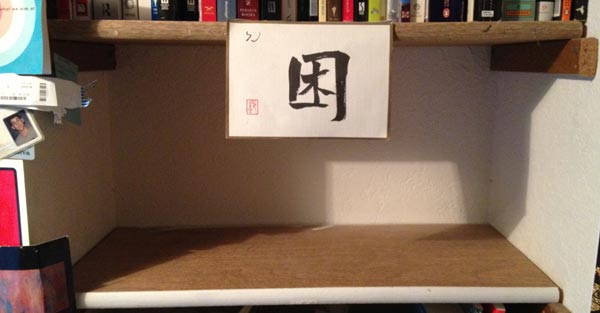
The photo below explains my ambition: I’m working to fill this shelf with books I’ve written. I want an interesting life which requires doing unusual things and having unusual goals. This is mine. Will I achieve this? I really don’t know, but in having this goal I believe I’ll live the kind of life that I want. What’s your big goal? How do you remind yourself of what it is? I find both these questions fascinating and I thought I’d share my answers as it might be helpful to help you figure out yours.
When I quit my first career as a tech manager in 2003, I primarily wanted to try another way to earn a living. I was afraid if I didn’t try I’d have the same career forever and that scared me. What else is out there? I felt I owed it to myself to try and see what I could possibly do and who I could I might become. I was lucky that I had a window of opportunity to try (no kids yet, little debt) and thought those that don’t would probably tell me I was foolish not to take a shot.
Books had changed my life many times and I wanted, hopefully, to write books that helped other people in a similar ways. Since I saw the shelf many times a day (it’s to my right as I type this) I decided it was the perfect spot to have some kind of reminder. Even when I finished a new book, the reminder would always be there. When my first book was published in 2005 I put this simple photo above on the author bio page.
It’s a cliche for Americans to swoon over Chinese symbols, misunderstanding what they mean and not bothering to study their meaning or context. As my Chinese speaking friend Jeff likes to joke, “Uh, that symbol tattooed on your arm doesn’t mean Great Love, it means soup dumplings.” I did my homework and understand its legitimate meaning (often used to mean sleepy, or something that’s kept hidden or locked away), but it also has a specific meaning to me.
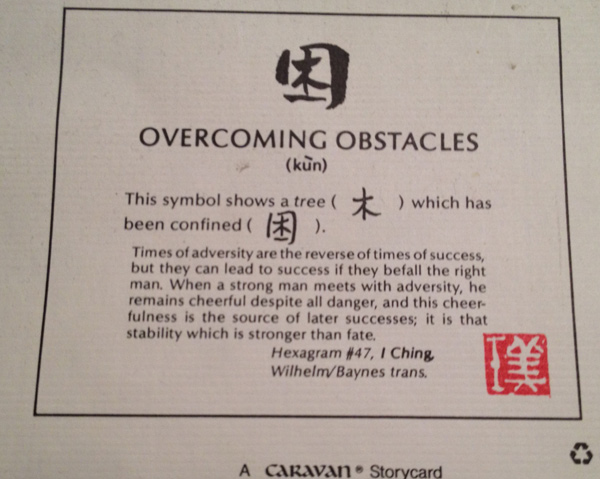
Around the time I decided to quit, which took me over a year to work up the courage to do, I found this card at Uwajamaya in Seattle around the time I quit my job. I liked what it claimed the symbol meant (see below). I love the quiet strength of trees and it matched how I needed to be to reach my goal. The I Ching references the symbol as Hexagram #47, which has various meanings, including the one on the card. I’ve learned in common Chinese the symbol/word is often used to means confinement (one of the other meanings suggested by the I Ching), trouble or sleepy more than overcoming, but that’s OK. The symbol has adorned my shelf for so long it means something specific to me regardless of its common meaning.
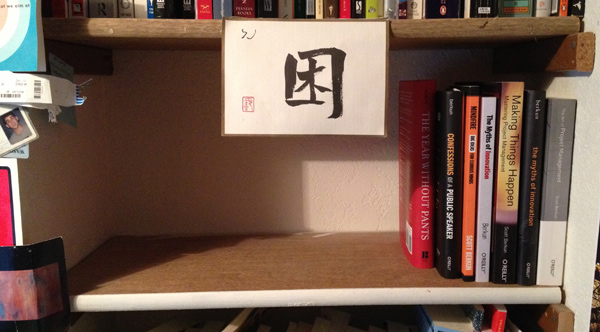
Years later I’ve written 5 books, [8 as of 2020], and the shelf looks like this (see below). I have a long way to go. Translated editions don’t count, as that’d be cheating, right? I’ll need to write about 25 books to fill the shelf which will likely demand most of my working life. That’s fine. I have nowhere else to go and no goal as meaningful as this one.
Although it’s a volume goal, I have no interest in writing bad books. I also have no interest in writing unnecessarily long ones. My essay collection Mindfire is comprised of revised essays from this blog, but I’d feel it was cheating if most of the shelf was recycled material. One book in five seems a fine pace for compilations and such.
Occasionally I’m very fortunate to have people interested in hiring me for very nice conventional jobs where I’d have more security and income, but then I look at the shelf. More security and income are desirable, but they have limited bearing on my ability to fill the shelf. So as tempted as I might be, I say no (The Year Without Pants was a notable exception). Writing and speaking are my only means of income.
Another reason I like this goal is writing books demands many things:
Polymathic thinking
Study
Curiosity
Passion
Connecting with friends and colleagues
Making new friends and relationships
Commitment to an idea
In the process of writing a book I’m forced to do many things in line with the kind of life that I want: An interesting one. As long as I focus on the shelf, many other good choices are forced naturally.
Most authors repeat themselves, writing the same kind of book repeatedly. The marketplace rewards familiarity and a writing life is hard enough, so I understand why it’s common. Many of our most popular authors publish in narrow ranges. This is wise and lucrative, but also limiting (the most curious perhaps are authors who exclusively write about creativity, which in a way is not very creative). I’m taking the opposite approach for as long as I can. I’ve never written a sequel, because we all know how underwhelming sequels often are. I have no shortage of ideas for books and I’ll keep moving forward until I’m forced to be more conservative, if that’s even possible.
I want to be a writer in the largest sense. I want to be an artist. I want to take big risks with my skills, which will help me discover exactly what abilities I have or don’t have and what good they can do in this world.
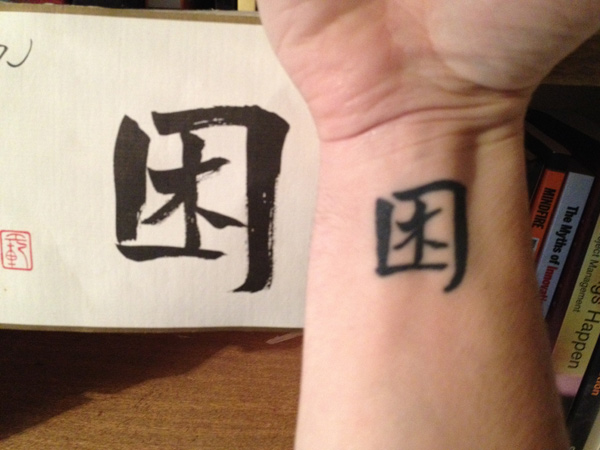
Last year I got my first and only tattoo. It serves as an additional reminder to me about why I’m here and what my goal is. I’m a writer which means I work with my hands. I wanted to keep the symbol with me, near my hands, all the time.
That’s my story. If you see me speak and notice the tattoo, now you know why it’s there and what it means.
Follow As I Chase The Goal
Any encouragement is encouraged. Praise the crazy writer man! And thanks for supporting my work. Best wishes to you on your own goals.
Each week I take the top voted question from readers and answer it (submit yours here). With 35 votes, this week’s winner was “Are Hospitals More Important Than Art?” submitted by awesome reader Sara Vermeylen.
Questions like this are fun, even if absurd. Like Street Smarts vs. Book Smarts, it’s a kind of false dichotomy. But like the game Zobmando where you must decide between two ridiculous choices, you can have great intellectual fun in crafting arguments for one side or the other (or both).
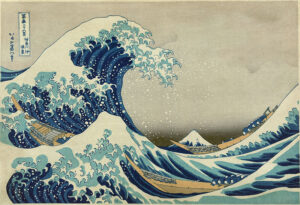
If survival is at stake, I’d choose hospitals. A hospital, assuming it comes with smart doctors and fancy equipment, keeps a popular healthy, lengthens lifespans, improves the survival odds of reproduction, and provides a core public service everyone needs. If everyone is sick and dying, art has limited value, and of course it’s harder for sick and dying artists to make art than healthy ones.
But art is a critical part of what it is to be human. As miserable as conditions were for our ancestors 30,000 years ago, they took time to make elaborate cave paintings. If art were meaningless, why did they bother way back then? The answer is we are both social creatures and tool makers. Central to our survival has been the ability to communicate ideas, and art is one tool for developing the ability to imagine, observe, record and communicate thoughts. Art is also a tool of expression, a way to capture ideas, feelings, memories and dreams for others to see. Art, in the form of tattoos, face-paint, and even flags, has helped us throughout history to define our identity and remind us of shared connections. Music, books, paintings and movies are forms of art we depend on to help us understand who we are and how we want to live. We are aspirational creatures and a primary way we define what is possible for ourselves is through the art our artists makes for us.
What do you think?
Growing up in NYC in the 1970s, with a mere 4 TV stations, any show in regular rotation on PBS was seen by millions. One show on PBS was called The Joy of Painting, staring Bob Ross, who was born 70 years ago today (and died in 1995 at 53).
I had no interest in painting or the arts, yet I’d seen his show many times. There was something about his goofy looks and quiet voice that made him easy to make fun of as a kid, and we did. But watching him now there was always an intensity about him. As silly as he seemed to me then, beneath the soft exterior he was deeply serious about the power of painting. He believed what he was doing had meaning and could be learned by others.
I see him now as an unexpected inspiration (Rick Steves is another one). Ross was the first person I’d ever seen paint. Few working artists let cameras watch them over their shoulder as they work. And although Ross’s work was often rote and predictable, he was open about his methods. He believed in what he did enough to share what he knew and to teach as many people as he could. I don’t know many people who do or have done that.
Today as someone who writes about creativity I spend time studying how creatives do their work – until now I didn’t realize I’d seen countless examples of it as a child, thanks to Bob Ross, well before I’d even started looking.
One of his most popular sayings was ‘Beat the devil’ and here you can see him gleefully, and with just a hint of joyful madness, prep to do some work:
http://youtu.be/Pen4SXm0B98
Later on I’d discover and be inspired by Picasso’s film, The Mystery of Picasso, where he lets the camera watch him work. Few artists have ever done anything like this:
Ira: In 1964 you moved to Paris and studied with [famed composer] Nadia Boulanger. Could I ask you to talk about what she was like?
Phillip: I always get into trouble when I talk about her because she wasn’t a very nice person. She was a wonderful teacher. She was the great master of music technique. Of counterpoint, of harmony. And she was extremely… demanding. From the first moment you walked in. For example if you arrived at her class and were a minute late it was better just to go home. Because if you came in late you got such an abuse, you were critcized on every level of your being and character and basically if the Metro were slow that day, you just went home”
I: Do you believe there is a pedagoical efficiency to terror?
P: It was at that moment that I understood what she was teaching me. I realized she was teaching the relationship between technique and style. Lets put the question another way. If you listen to a measure of Rachmonanov and measure of Bach you know which is which. You know immediately. The question is why do you know that? They both are following the same rules… but you have in the course of your listening you have recognized that Rachmononv will always solve a certain problem in specific way. You may not say that to yourself but your ear will tell you that… you’re hearing the prediciction of the composer to resolve certain problems in a highly personal way.
How hard is to define your personal way of resolving problems?
In order to arrive at a personal style, you have to have a technique to begin with. In other words, when I say that style is a special case of technique, you have to have the technique — you have to have a place to make the choices from. If you don’t have a basis on which to make the choice, then you don’t have a style at all. You have a series of accidents.
Looking at your career, one thing that’s striking is the # of colalborators you’ve worked with.
When you find yourself in a place of total ignorance, that’s where you can begin again. Learn again. The difficulty with anybody in any ordinary life is how you continue to learn. Everybody has this problem. We get what we call our training and education at a certain point and we spend the rest of our life changing our gears in the same way… The real issue isn’t finding your voice, it’s how to get rid of it. It’s getting rid of the damn thing. Because once you’ve got the voice you’re kind of stuck with it.
You said to Terry Gross, she asked do you ever try to compose to not sound like you…
I do it all the tme and I fail all the time. I learned that the only hope of shaking free of your own description of music was to place yourself in such an untenable situation that you had to figure out something new. That happened with Ravi Shankar in 1964. And I repeated that experience. I do it whenever I can. It means constantly finding new people to work with. The humbling thing is despite how often I’ve tried to do it, how rarely I’ve actually suceeded. It’s very humbling actually when you realize how hard it is to break out of your own training. It’s very very difficult.
How do you feel about that?
If I look at the body of work, over the last 30 years about 30 CDs… it takes about 10 years because the changes are so incremental.
One of the things that strikes me as a listener about the newer pieces is they seem much more romantic and melodic.
Exactly. It depends where you start. Had I stared with romantic music, I’d end up writing minimalist music. But I started writing romatinc music. Basically what point I started from, I left that point.
If you’ve wondered where I’ve been all this time I haven’t been posting, it’s safe to say I’ve wondered why I don’t make things like this instead of all the other things I do.
Purely mad, absurd and wonderful. Have the sound on.
All artists are psychologically and emotionally driven to tell their stories. I’m not so sure we choose the stories – they choose you. We don’t ever completely understand the things that drive us, but I do believe that a good deal of the thrust of the direction of the choices I made, when I had a choice I made, when I had a choice about where my life was going to go, was back in deep pursuit of the mysteries of the past in order to find out ‘who am I, who am I going to be, where’s my future?”

 If survival is at stake, I’d choose hospitals. A hospital, assuming it comes with smart doctors and fancy equipment, keeps a popular healthy, lengthens lifespans, improves the survival odds of reproduction, and provides a core public service everyone needs. If everyone is sick and dying, art has limited value, and of course it’s harder for sick and dying artists to make art than healthy ones.