I’m finally figuring out that small conferences are better in almost every respect than large ones. You can easily find people, get access to the speakers, single track makes it a shared experience, and everyone is chill and informal in a way impossible at 500 or 1500+ person events.
(Wait: was the conference itself an experiement in designing large datasets? hmmm).
Venue/Event synchronicity. It’s so rare that venues match their event. The Seattle library was the perfect place for this.
High intellectual space between sessions. The topics ranged so much that I felt my brain working to fill the gaps and make new connections. No one took the topic (large spaces) too literally, giving me lots of room to fill things in on my own.
Speaker diversity. It went from Park ranger, to librarian, to data mappers, to web entrepreneurs: awesome range of ways to attack the topics.
Big fat pile ‘O interesting ideas. Highlights were many, but deepest impact cam from the Local project folks, who make the most meaningful work out of design, and information, I’ve seen in some time. But the contrasts in hearing people talk about their approaches to designing data vs. design libraries, vs. designing parks, set off my thinking and left my mind buzzing.
One of the many great conversations I had at the Construx summit was about how games like Quake, CounterStrike and Warcraft teach people basic teamwork and communication concepts.
Well, wouldn’t you know: A report was published this month by the American Federation of Scientists making similiar claims.
My talk on teams and stars was fun: lots of follow up questions, side conversations and� ocassional debates about star egos, military fire teams, and team compensation. Great crowd and I had a great time.
A handful of managers that have worked together for years are good friends. One of them, the one with the least competent reputation, left over a year ago, and is now being hired back into the company as a perennial contractor (product manager).
Every time my team has interacted with him, across various contracts and on different projects, we’ve had some kind of performance problem. However given his connections, despite feedback to the contrary, he keeps getting rehired (generally with different teams each time).
What can I do, as a manager myself, to exorcise this ghost employee from my world?
– Signed, Haunted by a ghost employee
Rather than torture y’all with my first foray into liveblogging, I’m writing live comments, insights, and brlliant notes on each and every session.
The folks over at mapsofwar.com have put together an exception little visualization of the history of the middle-east, showing the reigns of every major empire in the last 2000 years.
Highly recommended. Great example of how effective a little animation can be.
There’s a great online exhibit at the Smithsonian Institute, exploring the history of various innovations – focused on the early sketches and half-assed doodles that eventually became great things.
If you like looking at design sketches and early drafts of ideas, you’ll love this.
I love Seattle and enjoy showing people why. When visitors interested in design or engineering come to town, they often ask me for cool places to check out. Here is my list (revised for Interaction ’19) aimed at those folks, followed by some basic advice useful to anyone coming to visit. It’s a mix of local must-sees, unique food, inspiring architecture and more.
1. Where to eat and drink, that’s good and close by
The main venue for Interaction ’19 is on the Amazon urban campus, on the edge of the downtown and SLU (south lake union) neighborhoods. This is an expensive and somewhat boring part of town (it’s dominated by Amazon employees), but easy walking distance to some good choices. All these recommendations are conveniently within a 10-minute walk from the main conference building.
Home Remedy – a funky mix of a local deli and grocery store. Open till 9pm.
Suite 410 – small, classy bar with fantastic service and cocktails.
Lola – Modern upscale Greek food (Part of the local Tom Douglas restaurant empire).
Cursed Oak – great bar and restaurant with small, tasty plates. Good for groups. (located on the edge of Belltown neighborhood, so walk north on 1st and 2nd afterwards for more nightlife fun).
Local Pho / Pho 25 – Pho is a fantastic Vietnamese soup, very popular here. Try it. Inexpensive. Hot. Fast. Delicious. A Seattle lunchtime staple.
Serious Pie – delightful pizza (vaguely Sicilian in style, but higher end with fancy ingredients). Seattle mostly has terrible pizza (yes, I’m a former NY’er), exceptions include Big Mario’s on Pike and Big Mamas.
Biscuit Bitch – Southern-inspired breakfast/lunch place with an attitude.
Rob Roy – one of the best cocktail bars in the area.
Shorty’s – dive bar with video games, pinball and lots of old Seattle charm. Located in Belltown with many other food and nightlife options nearby.
Portage Bay Cafe – great brunch place, in the heart of Amazon land. Excellent healthy options, lively staff, a good choice all around.
2. If you have more time or crave local adventure
Seattle Public Library (10-minute walk) – odd and underwhelming on the outside, inside is a design wonderland: are many great choices: neon yellow escalators, exposed girders, red blob like walls, spiral verticals. Easy to find on 4th avenue. Free. Ask at the information desk for the self-guiding tour pamphlet.
Pike Place Market (10-minute walk) – has a touristy reputation (the whole fish throwing thing) but it’s a huge complex with many places locals love. Including Daily Dozen Doughnuts It’s in a tiny, beat up stall in a busy part of the market, but well worth the $3 for a half dozen fresh little mixed delights, as you get to watch the wondrous Donut Robot Mark II make your doughnuts for you. Wander the market first for lunch, then stop here for dessert. Radiator Whiskey is a great whiskey bar nearby, and Matt’s in the Market is the best seafood place (upscale) in the area. Best cheap eats seafood, that’s super fresh is Jack’s Fish Spot (hard to find – it’s just a stall so be prepared to ask). Also, see the wall of gum wall for weird public art / social custom behavior.
Freeway Park (10 minutes) – this most unusual urban park should not be missed if you’re into urban design. It’s a funky, curious and inspiring combination of cement paths and walkways, greenspaces and stairs. It’s a short cut of a kind from downtown to First Hill / Capitol Hill.
Capitol Coffee Works (15-minute walk) – in the heart of the funky (but gentrifying) Capitol Hill neighborhood, this coffee shop has the right mix of good coffee, great people watching, wifi and the rest. Just a short stretch from lots of shops, restaurants and fun. Capitol Hill Cider is a great place (all food gluten-free if that’s how you roll) for drinking and eating, right in the heart of things. Optimism brewery is great for groups, lots of space, gorgeous industrial/wood building, and you can bring your own food (they always have a food truck too). A bit of a walk
Olympic Sculpture Park (15-minute walk) – On the north end of downtown Seattle is an outdoor park with various works of art. it’s a great walk or run on a nice day, with views of Puget Sound and the Olympic mountains and a little beach where you can sit and chill. The 5 point cafe is a 24-hour dive-y dinner nearby, good food and some attitude, with lots of Seattle history. Also, Green Leaf is excellent Vietnamese food that does take-out.
Take a ferry ride – this is a great way to see some of the nature around Seattle without working very hard. Seattle has the nation’s largest ferry system, taking people and their cars out to the islands and back. The shortest ferry ride is to Bainbridge island, just 30 minutes each way ($8 round trip if no car). I’ve had lunch meetings with friends where we bring food, take the ferry out and back, and then go back to work (or get a bite near the ferry terminal on the Bainbridge side). It’s relaxing, charming, and has many design and engineering things to be curious about.If you have more time make an afternoon of it.
Gasworks park (Lyft/Uber). Take an old construction plant, add love and some Seattle funk, and you get one of the most interesting urban parks in the country. Quietly tucked away a few blocks from the Fremont neighborhood, I’ve spent many a good afternoon watching kids fly kites and having a bite down by the water. (Don’t miss the human sundial on the top of the hill). Add-a-ball is a nearby video arcade and bar, and head to Brouwers for a gastro-pub with an amazing beer selection (and gloriously Belgian vibe).
Purple (downtown, 10-minute walk). This local wine-bar chain’s downtown location centers on a two-story bar sculpture that’s worth staring at for at least one good drink (Photo above). You can head down two blocks for dinner at Wild Ginger a touristy but reliable Asian-fusion experience, or better yet, catch a show at the glorious Triple Door theater, which serves dinner and drinks from Wild Ginger to your seat. (If you’re more budget minded, head over to Dragonfish, for a great atmosphere, many specials and a funky interior design).
Peter Miller books. This is the best design/architecture bookstore in the city (Although Elliot Bay books in Capitol Hill is a better general bookstore and in a more interesting location). Located just down from Pike Place Market on Post Alley.
Top Pot Doughnuts (5th avenue). The downtown location is right on the famed (but surprisingly short) monorail, giving views of what might have been for Seattle urban transit (great fodder for prolonged doughnut/coffee-fueled discussions). The doughnuts are sublime works of food design, but the crazy floor to ceiling bookshelves, free wi-fi and loungy upstairs seating makes this place worthy of some extended leisure time.
Rhein House beer hall and Bocchi ball – if you’re a big group, you can’t go wrong here. German-themed food and drinks in a big place with outdoor seating. Also a few blocks away is Seattle University, with one of the funkiest churches you’ll ever see. It’s almost next door to Canon, a nationally rated cocktail bar.
Museum of Pop Culture (formerly known as The Experience Music Project). Call it a Gehry on acid or Seattle’s 2nd most interesting building (SPL being #1), Also gives you a peek at the neighboring Space needle (not quite worth the price to go up IMO) and the aging science center nearby.
Amazon Spheres (aka Bezos balls) – it’s certainly striking to look at but you have to wonder if this really made a lot of sense (it’s not really open to the public, and it’s a very low building in what could be a high-density place).
3. Basic things you should know (travel guide)
Seattle is the #18th largest U.S. city by population (despite an infrastructure not scaling well to that size). Its location in the northwest corner of the U.S. (called PNW or Pacific Northwest) is surrounded by mountains and water, and has a great reputation for culture, arts, food and liberal political views! Vancouver is the nearest city to the north (Canada) and Portland to the South – all three share the same weather and are equidistant (about 2.5 hours drive or 3.5 hour train), which make for a good day trip or getaway.
4. Getting around (Walk / transit / Uber / Lyft)
The airport is 35 minutes by car, off-peak, from downtown, but the light-rail takes 45 minutes and is new, convenient and inexpensive (has several downtown stops). The Westlake stop is the closest to the IXDA venue.
Seattle is a city of little neighborhoods, but some are walkable and others are far apart. Buses are the main public transportation, plus a light-rail that runs north-south, all the way from the University of Washington to the north, through the core of the city, and down south to the airport. The buses, the light-rail and the street-cars all use the same payment system: The Orca card, which you can usually buy from any light-rail or street-car station. You load it up with cash and refill when needed. Lyft and Uber are very popular too. Traffic is terrible here during rush-hours so avoid them.
Quick Seattle neighborhood rundown:
Downtown: some major tourist sites are here and it’s where people work, but not where most of the fun/culture is.
Capitol Hill: the core arts/culture neighborhood (although it has gentrified in the last 15 years). Great food, nightlife, music, people watching, and late night activity. Cal Anderson park is great and central. Walking up Broadway (the main street, a block from Cal Anderson) will reveal lots of shops, cafes, restaurants, etc. Make sure to look for the sidewalk street art of dance steps. And the map of amazing murals in the neighborhood.
International District: (south of downtown) it’s Seattle’s equivalent of an Asian district and it’s where much of the best food from those regions and nightlife are. Jade Garden is famous for it’s Dim Sum (and they’re open late). Just south of downtown, near the sports stadiums.
Belltown: just north of downtown, 1st and 2 ave run to the north with a long stretch of nightlife/restaurants and shops – more upscale and uptight than Capitol hill, but you’re also near the waterfront (yay views).
Fremont: north of the city, it’s also a funky arts/nighlife/shopping area, but smaller than capital hill and more laid back.
Pioneer Square: the oldest part of the city. Ferry terminals are near here. Underground tour and other tourist attractions are here as well as some resteraunts and shops.
Ballard – northwest of the city and a bit far, but has its own wonderful vibe. Staple and Fancy is one of my favorite restaurants and it’s here.
South Lake Union (SLU): Amazon is headquartered here and the neighborhood is filled with new construction, high-end restaraunts, and bars.
5. Culture/Travel notes
Marijuana is legal (yay). Designated stores sell everything from joints (aka pre-roll) all the way on up. Technically it’s not legal to smoke it in public, but it’s generally tolerated and you’ll probably see (and smell) people using it outside. And just like the rest of America, you are not allowed to drink alcohol in public.
Tipping is often expected (15-20%) but many Seattle restaurants have switched to a built-in service fee, so check your checks before you pay or ask the waiter/waitress.
Seattle is generally pretty safe IMO but it’s all about knowing what neighborhoods/blocks to avoid/etc. especially late at night. If you’re not sure Lyft/Uber is reliable.
Generally, people dress casually here – lots of t-shirts, shorts, jeans and sandals, even out at night. Clubs and fancy places can be different.
6. Things to do and see (Touristy / Downtown)
Underground tour – sounds cheesy but it’s actually well done and quite fun. Walks you through the original city (currently underneath Pioneer square) and tells the story of the big fire, how they rebuilt the city, etc. Surprisingly fascinating. Takes about 2 hours (though I got bored after the first hour, I’d still recommend it).
Best view: you can get a spectacular view of Seattle from the rooftop bar at the Thompson Hotel (on 1st ave). It’s an expensive bar ($$$$) but worth getting a drink and looking at the skyline, the waterfront and the mountains.
The Space Needle is part of Seattle Center, where the world’s fair was in the 1970s (It’s still a lovely park). The needle itself is popular but a bit boring and VERY touristy (don’t eat at the restaurant there!) – there are some good museums near it, including the Museum of Pop Culture or the Pacific Science Center (a bit run down, but OK) I’d check to see what special exhibits they have.
Kayaking – Since the city is on the water ther are many places to rent kayaks from. Here’s one http://aguaverde.com/paddleclub/ – it’s also right next to the University of Washington (which has a beautiful campus to stroll through), and literally walking distance away from a Aqua Verde, good Mexican place with views of the water. Also, Portage Bay café isn’t far.
Hiking – There are a crazy number of options I won’t even bother to list them. All levels, all different kinds. A good searchable list of them can be found at the Washington Trail Association.
7. Other food/drink recommendations
Seattle has an excellent food scene – highlights include seafood, Thai, Vietnamese, weird fusion places and more. Capitol Hill and Belltown are two easy neighborhoods to explore for food and drink (Ballard is another excellent neighborhood, but it’s further away). In these neighborhoods, it’s easy to experience lots of Seattle’s best food and bar experiences.
A personal list of favorite places I recommend to visitors:
Momji – a great sushi place, but expensive (they have happy hour specials tho) – Capitol Hill
Excellent Indian/Nepalise food at http://annapurnacafe.com/ – I love this place, great food, not that expensive and good people watching. Capitol Hill, right by the light rail station. The (in)famous Dick’s burgers is just a block away.
Pinxto – small plates / Tapas, on the edge of Belltown.
Etta’s seafood – not as fancy as Matt’s but right by Pike Place and a classic Seattle joint.
5 point café – a dive bar/dinner that’s an experience. Open 24 hours. Cheap drinks. Good diner food. It’s the last bastion of an older Seattle, hanging on at the edge of Belltown.
There are many microbreweries/pubs here, but I’m not much of a beer drinker. I can say Optimism brewery, in cap hill, is a lovely place for communal beer drinking – it’s on Capitol Hill, you can bring food in (they often have a food truck too).
Six Arms / Mcmenamins – lovely simple pub with good food, good drinks, good vibe. On the edge of Capital Hill towards Downtown. I’m here a lot. (Mcmenamins is a local chain of pubs where they bought old properties and renovated them – very cool) – it’s also across the street from the largest/fanciest Starbucks in Seattle – worth walking in even if you don’t like coffee. Lots of tourists but it’s still impressive and they have good food.
Linda’s Tavern – this is one of the old school bars where Nirvana and Soundgarden used to hang out.
Grimm’s – fancy gastro-pub on Capital Hill.
Capital Cider – The single best bar in Seattle if you are into cider – really great. Good food too.
Canon – one of the top bars in the U.S. Very lovely, but tiny – get there early. They don’t take reservations and it gets busy Th/Fr/Sat.
Tavern Law – another top-rated cocktail bar – first rate, good but fancy small plates (there’s a speakeasy upstairs).
Comments are open. If you have a question or want to suggest a recommendation, the edit box awaits. Please report typos or corrections. Thanks.
As I’m on the home stretch of finishing the first draft of the book, I’ve read nearly 100 books on innovation, plus various studies, papers, magazines, and more than 100 interviews with innovators of various kinds. One trend I’ve found is the high number of innovation efforts within established companies, and how rarely they have any effect.
Have you seen these efforts in action? I’d love to hear why you think they worked, or didn’t. I’m cynical and here’s why:
Task forces and committees are seperate from the real teams. Unitl the teams doing actual work are rewarded for being progressive, innovation doesn’t reach products no matter what the task forces do. All the true barriers are still in place.
Suggestion boxes go to the same people who vetoed the last five good ideas (Imagine Darth vader with a suggestion box). The problem with innovation is rarely finding ideas: ideas are easy. Instead its finding someone in power with the convinction to take risks and empower creative teams.
Innovation and change must be core values, not layers or addendums. You can’t make a company innovative by sprinkling magic innovation dust in the hallways. Instead you have to grow a culture, and hire individuals, that are comfortable with risk, and reward managers willing to support the creatives who report to them.
Who has the power to stop innovation? Eliminating the real blocks can be more effective than trying to add some magic new mojo to the organization.
Can you name the innovation leader in any field that got there by committees and task forces? Most innovative companies don’t need any special innovation effort – they built a culture of exploration and risk taking, perhaps out of competitive necessity, as their way of getting good work done.
Innovation efforts that work:
There are a few things I’ve seen in my research that established organizations have done that work.
Pilot project. Organizations that form a new project team, give them big goals, and get out of their way. Once they succeed, they come back into the fold as a seed of innovative teamwork that other projects can copy, emulate, or build on. (See skunkworks)
Risks and Rewards. Innovation comes with the price of risk. In organizations led by risk takers, innovative cultures are natural as they feed off the leader’s willingness to try new ideas. If a leader is open to change and supportive of his most creative thinkers, innovation will come naturally.
Avoidance of innovation for innovation sake. Not everyone needs to innovate. Only certain projects at certain times need to reinvent, retry, or radically change. If everyone is asked to innovate all the time, no one is really innovating: it’s nonsense. It has to have a purpose and a reason, aligned with a strategy.
Culture and environment. Innovative organizations, even large ones like 3M, have a long history of supporting individuals in the pursuit of their ideas. 3M invented the “10% work on your own project idea” that Google has made famous. Big companies can be innovative just as small ones, provided the culture and environment support it. Big organizations need long cycles for any culture change, but it can be done by starting small and growing.
So what have you seen work, or fail? I’d love to hear some opinions.
Worldchanging is poised to be the Whole Earth Catalog for this millennium. Packed with the information, resources, reviews, and ideas that give readers the tools they need to make a difference. An intoduction by Al Gore, and a team of top-notch writers includes Cameron Sinclair, founder of Architecture for Humanity. Renowned designer Stefan Sagmeister brings his extraordinary talents to Worldchanging, resulting in a book that will challenge readers to personally redefine the conversation about the future.
I’m a single usability engineer serving over 100 programmers across a dozen ongoing projects. I focus on a couple projects at once, but have large amount of miscellaneous work that comes to me from the other projects.
My major challenge is that the project teams I work with generally have haphazard schedules themselves. So, its hard to plan my own time given that uncertainty. And to make this even more fun I have a new team member joining and will need to manage both our time.
Planning and organization are not my strengths, so I need techniques that are easy to use!
I’m a pm for a web development company – I have what we call a zombie: a project that lives on forever for no good reason. The client continually makes rounds of tiny changes, often to things where they can’t provide specific or actionable feedback so we can’t get it right the first time. The project scope (contract) of work, sadly, doesn’t have language that caps these things as they were unexpected. So, through either politics, influence, bands of garlic, or changing the process, how do you put a zombie
project to rest?
An old PM trick I learned years ago is that whenever you start something, it’s just as important to list the non-goals for the project, as it is to list the goals themselves. The reason is that non-goals, things that people might confuse with real goals, are where all the lost effort and wasted time that sinks projects grows from. Nip that in the bud, and things get easier.
The problem is it’s hard to know where people are confused with big ideas like visions – and its all too easy for people that write visions, sitting on their highest of horses, to assume people are taking the vision as gospel, when instead they’re mostly mocking it, or worse, not using it for anything at all.
The product vision test keeps your ego in check if you’re the dude who wrote the vision. Do people understand the project goals? Do they even remember them? Are they jazzed about what’s going on? Someone has to test the vision and validate its having the effect leaders want.
The product vision test
After you’ve published the project vision, do this:
Break the ideas down into 10 or less high level statements. Think ten commandments: short, tight messages that help people make decisions. If the vision is well written, this should not be hard.
Make this list visible – in the hallway, on the website, everywhere.
Perioidically ask people at random how many of the ten they know.
If people don’t know the ten, you’ve got problems. Either they haven’t read it, don’t care, or worse, don’t agree with the vision but haven’t said anything about it.
For this reason its important to vett draft visions. Starting with a small group, asking for feedback, revising, and pushing to wider and wider circles. people to reflect back to you what they think the essence is, or should be.
If you’ve built a good vision, and distilled it properly, most people, most of the time, should be able to recite from memory the key goals for the project.
Famous visions
The book Blockbusters, by Gary S. Linn documents several major products that used distilled versions of their visions to drive and communicate goals across the team. The book claims that these kind of rock solid, crystal clear, ultra-simple goals are what makes blockbuster products possible.
Palm
Fits in pocket
Sych seamlessly with PC
Fast and easy to use
No more than $299
Apple IIe
Simplify manufacturing
Modernize
Reduce cost
Look like the Apple II
IBM PC
Beat Apple.
Do it in one year.
Bonus test: Another way to test visions is to require the distilled list to be the first slide at every group or all-hands meeting. The rule is you put it up, read them, and ask anyone in the room if they have any way to improve the list.
This keeps the vision alive throughout the project – if someone has a way to refine a goal, or question it given recent events, they should have a mechanism to raise it for discussion. But if they don’t, they have to conceed they should be working passionately to satisfy the existing list.
History note:
My first exposure to this kind of practice was David Cole, the development manager on Windows 95, where he broke the complicated vision down in ten commandments that he would quiz and prod the team to remember. He could be an intimidating guy, which he used to his advantage at keeping the ten commandments on everyone’s mind.
More on visions:
My book Making Things Happen has a whole sweet chapter on visions and how to do ’em right.
After two years as a general manager, building a team of 25 from scratch, my VP is showing me the door. More precisely, I’m being asked to find a role elsewhere in the company. Yes I’m devistated, but that’s not the point.
My challenge: how do I message my leaving why I’m leaving? Most of them came to the org because of me: I recruited them on the basis of my commitment to them and the project. I don’t want to be ugly and badmouth the VP, but I don’t want to lie either. How do I message this honestly, but create the least damage for the team and whoever has to replace me?
I’ve been asked by the boss to do a usability review of all of websites, and to report the results directly to him. Happy as I was that he’s interested, as I’m working I get that “you’re going to bust us” look from all of the programmers and designers I’ve been working with, as I’m now a kind of UI enforcer. How do I do the job of reviewing the work for head honcho, without being someone people are afraid or resentful of?
– Signed, the rookie on the force
I restrain myself from writing often about writing – I’m too junior at the task to contend with the great writers who have written great books about how to do it well.
But as it’s 2:33am I will share a tale of this evening’s authorial madness: I’ve been sick all week, haven’t slept well since I don’t know when, and somehow find myself writing this now about what happened a few moments ago.
As I lie in bed, praying for rest, I sense a stir in a distant, forgotten corner of my disturbed little mind. There I find a dim, cloud like thought floating towards nowhere, tempting me with the faint shadow, a gray line against infinite gray, of something hiding inside. And as the puffy, soft marshmallow of a thought hovers mindlessly in my Tylenol infused semi-conscious brain, I see, wrapped in its shadows, the faint golden spiral of a truth, a tight phrase, a magic sentence that connects everything in the chapter that has tortured me all week.
And then the horror begins.
Do I get up to write this down? Or pray to the muse that the idea is strong and will stay until morning? I’ve killed more brain cells in the tail chasing circles of this debate than modesty allows me to reveal. (If you write it down, will it still work in the morning? Can I get part of it down while in bed? Where is the damn pen? Will she forgive me if I wake her up yet again?)
So there I lie, stars crossing the sky, mice and men snug in their beds, hearing only the rhythm of in my wife’s breaths, a secret chant from the gods of sleep, reminding me of my longing for softness of unconsciousness… and no. I realize what’s rising behind the thought is a dark circle of wolves, fangs at the ready, chasing their literary prey. I want to deny the wolves, holding fast against the absurd undisciplined notion of hunting anything of the brain this late, on a night like this, knowing as they charge that all I have to do is turn over to the pillow, slow my mind and it will all fade away.
One question I’m often asked is what is the ideal designer? – I get this from managers or VPs in tech companies, trying to figure out what’s wrong with the relationship their managers / leaders have with the design staff.
Working with ideals is an interesting exercise: it reveals assumptions and forces opinion as there’s no right answer, and even if there were, this universe rarely grants ideals (at least to me). So here’s my staple answer on ideal roles, followed by some thoughts on reality.
The Ideal PM
The best PMs partner with design in a similiar way to their partnership with programmers. They collaborate (not dictate) with the designers/programmers, perhaps starting with their own seeds, or ones from the business folks, and then delegate as much of the engineering thinking and design thinking as they can. The ideal PM focuses on creating the best environment for all roles to do well: marketers, analysts, designers, testers, everyone. They carefully shift the environment, the power balance, and their direct involvement depending on the project goals, the talents involved, and how far along things are.
Instead of designing, PMs should first use their unique powers to co-ordinate their team with (or protect their team from) management, other project teams, budgets, star-charts, etc. Any other time spent designing should only be: in partnership with designers looking for collaboration/feedback, where designers don’t have time or when quality is low (just like they’d help out test, documentation, or whatever). A good PM is a leader and a results machine: willing to do anything to empower people on their team, including keeping their hands out of the design cookie jar (slap).
The ideal designer
Someone with many design talents and who is a natural thought leader on the team. They not only make wireframes and prototypes, but drive the thinking and tradeoffs behind them, comfortably evangalizing good ideas and staying near the center of important discussions. They are drivers in resolving design issues, solving problems, and making things happen, and people happily come to them for help with decisions. They are communicators and collaborators as much as idea generators, leading design ideas through engineering, marketing and other parts of the process. They negotiate with PMs on when to handoff design leadership and who is best able to represent a decision, a design or a problem to the rest of the team.
Designers should be the tiebreaker in design issues and be granted signifigant authority when ease of use, style and other design traits are important goals. The designer’s opinion on design matters should trump others, just as an engineer or marketer’s opinion would in certain situations. A good product designer earns these powers through the respect of everyone they interact with, as an intelligent, thoughtful, reliable teammate.
The common dysfunctions
I offer these not as inditements of entire disciplines – that’d be stupid. Instead, I can tell you that when there are problems, these are the most common things I’ve seen for PMs & Designers. If what follows pisses you off, find your counterpart: maybe PMs & Designers can at least bond in their flaming hatred for me.
(Hint: Put your lead suits on now)
Common PM dysfunctions
Many PMs know little about design, or worse, believe they know everything – the result is any good designer will be quickly frustrated and turned off by them. Arrogant PMs, particularly from tech-backgrounds, often have limited exposure to designers, or only mediocre, limited role / contracted ones, creating a self-fulfilling loop for their low expectations for design staff. Even if they come across a superstar design talent, the PM will be blind to it, misuse it, or frustrate it to the point that they are rendered mediocre, insanely bitter, or both.
PMs can be tyrants and empire builders (“Here comes Napoleon” is often heard just before PMs enter rooms), comically insecure about their power, who see designers as threats to their fragile sense of power.
Common designer dysfunctions
(Hint: Don’t touch that suit unless you’re adding another layer).
Many designers claim to want leadership roles, but as soon as there is a design tradeoff debate, or a tough business decision, moments where there is an interdisciplinary leadership vacumn that they are primed to fill, they retreat. When their team leaders need to be taught core design principles, brand fundamentals, or any basic concept, some designers sit in gloomy silence, prefering endlessly clever protests in private to stepping forward in mixed company as a true design leader. This kind of passive aggression confirms the team’s perception of designers as (bitter) specialists, and simultaneously reinforces the designer’s frustration with their environment.
Designers often have auteur sized egos without the auteur quality track record of shipped work (At least in the eyes of their team, if not in truth). This gap between how designers percieve their talents vs. how their team values their talents must narrow for relationships to improve, and the designer, in the minority, often has to compromise first but is unwilling to do so.
So how do you fix PM / design relations?
PMs have more responsibility for these issues: so I start there. They are often granted more authority than designers, and have broader responsibility – meaning it’s up to them to delegate authority to design or do whatever it takes to make designers effective. A good PM should see a designer or programmer as both a person and a resource, and their job is to maximize the value of that resource towards the goals. If a PM is honestly trying to make a designer as valuable as possible, collaboration becomes natural and tension evaporates. And if the designer reciprocates (does whatever it takes to help towards the goals), same thing.
But designers have to take risks with their roles – if they want more power or influence that only comes with asking for bigger challenges and delivering: something they have to push for on their own (In old-school Microsoft parlance, you have to step up). These changes make designers feel vulnerable, but growth requires moving out of comfort zones.
In groups with no history (or a bloody one) of pm/design relations, it often takes a pilot effort: pick your most compatible pairing of a PM and a designer, define a new set of ground rules, and give them the cover-fire and resources (by their definition) to run with it. In a month when they can show kick-ass results, highlight them to the rest of the organization as the model to emulate. You need local examples of the new relationship working for people with intrenched opinions to change their minds. (Often you need to pick a trio of PM/dev/design for the pilot to work).
Reward models for Designers & PMs
The Pavlovian answer to all these problems is how the senior manager overseeing everyone rewards PM/designer behavior. If designers are rewarded for stepping up and being visible, they’ll do it more often. If you give kudos to the PM/designer pairings that collaborate best, more people will emulate them. So moving a team closer to ideals has more to do with what behavior is rewarded (promotions, raises, kudos, yachts, mansions, etc.) than what’s said or written down. Writing role definition documents is a waste of time if not tied to the core reward system.
One tricky pattern at many software companies (Microsoft included) is how people are rewarded for features: new features, big features, it’s features that drive how visible people are in their organization. (This is the true reason for bloat: people know it’s bad design, but the system rewards it, so someone always does it). To give designers more power in these environments demands shifting the PM reward structure away from feature design, and towards team building & team results, a difficult culture shift.
Notes and caveats
Since ideal people are rare, the best you can often do is approximate with a team. If you have 3 or 4 PMs who in conjuction play the roles, you have a virtually ideal situation. In reality this is a better way to use these idealizations that trying to hire perfect people.
Often it’s the lead position (lead designer / lead PM) that is closest to the ideal in the role that they play: using their own talents, and the talents of their reports, they are most accountable for using the resources in the best way possible.
It’s synergy at the manager levels that makes all the difference. If the overall project manager is sympatico with the most senior design manager, they’ll naturally pave the way for similiarly healthy relationships all the way down. But if they don’t, that gap will cause all of the organizations problems. Until they admit this and solve it, progress is uphill, on ice, in the dark, naked, while chased by rabid crampon wearing wolves.
There are many different kinds of design, which means many different relationships and roles. If I knew the details in a particular case (Feel free to offer one) I’d likely offer a modified set of ideals. The roles of visual, interaction, game, and web designers all create unique challenges.
Where is usability / user assitance / marketing / VP / me in all this? Hey, it’s just a blog post – can’t cover everybody. If you raise entertaining complaints in the comments, odds go up I’ll write about your favorite role pairing next time.
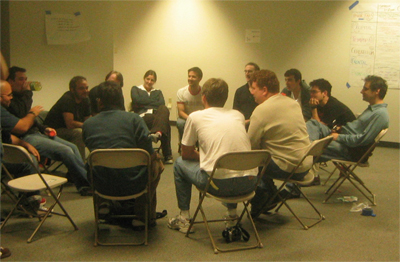
It’s easy to assume that unconferences, the popular trend in tech-sector events, require little thought on the part of session organizers. The myth is that by choosing to do an unconference, special magic will trickle down into all the sessions, blooming into dozens of beautiful flowers of enlightened communal experience.
It’s not true: All unconferences have good sessions and bad. Ask anyone who has attended one – they’ll tell you about dud topics, confused session organizers, and the guy who kept taking the floor to talk about his company in session after session. For all their benefits, unconferences have their bad moments too.
One trick with unconferences is not to bet the farm on self-organization: people running sessions have a job to do, and it’s up to them to make the sessions work. The event planners do carry the heavy burden of setting the tone, creating the environment and inviting the right people, but the session creators themselves are part of the the front lines for delivering value to attendies (and themselves).
Running a good session is easy – it just take some effort and awareness of what can go wrong.
Things to do
Create both a topic and an angle. It’s one thing to say “lets talk about AJAX”. It’s another to go with “AJAX war stories: the good and the ugly of real AJAX development”. It’s the same basic topic, but a theme calls people to action, or opinion. It lets everyone know what thoughts to stew over before the session begins, increasing the odds people will have interesting things to share.
Don’t be scared to pick tough topics. The only filter at an unconference is you. One trick is to pick topics you always wished they’d talk about at big fancy conferences, but never do. Now is your chance. Odds are high you’ll hit on surprisingly popular themes.
Emphasize interactivity. Make it easy for people to participate, ask questions, and use the group to add to your expertise on the topic. This is called facilitation and its a skill: pay attention the next time you see a meeting or brainstorming session run well. Use the whiteboards if there are any, writing down key points, suggestions or references you know people will want. (Or ask someone to volunteer to take notes at the begining of the session).
Be a good host. Like throwing a party, good hosts are friendy, introduce people, and set the tone. Be friendlier and more extroverted than usual, just like you would if throwing a party at your house. If you know a few people in the room, use them to your advantage (tasking them with seed questions or early participation). If you think you’re a lousy solo host, partner with someone to run the session.
Take advantage of the unique opportunity. There’s a special mix of experience and opinion in the room and that’s the unconference magic. Throw questions to the floor often, probing for expertise is in the room: “Who knows about X? Has anyone done Z with Y?”
Relax and have fun. If you have fun with the session idea, and show up smiling, everything will go easier. Remember: you set the tone. If you’re friendly and relaxed, people will tend to be friendlier and more relaxed. If you’re scared and quiet, people will be cautious and tentative.
Continue the conversation. Get people’s names and e-mails and follow up with any notes or photos to help continue the conversations. Often people are torn between two sessions and miss yours despite their interest: post to the conference wiki afterwards, leaving people who missed your session a way to catch up and still make connections (or contributions).
Things to avoid
Don’t disapear as the organizer. If you wrote the session on the board, you need to assert yourself if the conversation devolves into a shouting match, a soloiquoy, or dead silence. Be the shepherd – visible, as involved as necessary, a beacon of sanity (or insanity depening on the topic). Put your name on the session board so people can track you down later.
Don’t walk in without a position. Conversations need seeds: offer a position, or a set of questions, to get the ball rolling. Many start with a 5/7 minute presentation by the organizer on a topic, followed by completely open and free-flowing conversation and debate. Those 5/7 minutes, if interesting, give enough fuel and grounding for everyone to build a session around. A list of thought provoking questions can be a great, low cost bag of seeds.
Never assume people in the room know more / less than you. You never know who you’re going to get: ask for a show of hands on how long people have worked with, or studied, whatever the topic is. Then you’ll know where you stand (expert or idiot?) before you waste everyone’s time talking at the wrong level.
Never get bummed that only 2 people show up. If you meet 2 people at a conference who actually share your interest in something, that’s a win, isn’t it? The smaller the number of people that show, the less structure you need. It’s easier to chat and share stories with a handful of people than it is with 15 or 20.
Basic session patterns to copy
There are definite patterns you’ll find at tech-sector unconferences. Even though they’re self-organized, some basic shapes are easy to make and work ok.
The group discussion. Someone picks a topic they’re into, writes it on the board, and forms an interesting discussion around it.
The semi-talk. Mentioned briefly above, this is a 5/15 minute presentation by the organizer, used as fuel for the session.
The show and tell. The organizer has a cool project, demo, beta, or something to show and let people play with. It’s the springboard for all the conversation in the session. Alternatively, individuals are asked to bring their own thing to show and tell (perhaps with a theme), and the session works round-robin.
The interactive game or thing. Many sessions are based on social games, or the learning of how to play them. Mafia (aka werewolf) is currently all the rage, but anything goes. Some people do game shows or competitions (e.g. Halfbaked): these are awesome but require some preperation on your part (what are the rules? Who are the judges? Did you dry run it at all before inflicting it on a group of strangers?)
Learn how to do X. If you’re inclined to teach, this can be simple and awesome. Teach folks how to juggle, do basic yoga, magic tricks, you name it. Just make sure you bring whatever gear you need, and that you have some plan for teaching 5, 10 or 15 people how to do something all at the same time.
The lecture. This is tricky, as the basic format is low-interactive. But if you’re a rock star, or have a big, well developed idea (a book in progress, a manifesto) you can pull this off. If only 10 people show, you should switch gears to something more interactive.
Non-session interactive thing. Why be bound to the tyrany of the session? Set up a demo in the hallway. Put a machine you’ve made by the couches. Write up an essay and tape it on the doors to the restroom stalls. There’s no reason you have to run a session at all to contribute. Be creative. These are often the most memorable things at unconferences.
Something new. There are other ideas worth trying – but whatever you do, let people know the ground rules in the first 2 minutes. If they don’t like it or had different expectations, give them a chance to bail before they feel obligated to stay.
Basic session patterns to avoid
The poorly disguised product demo. Most unconferences I’ve been to are shy about demos – so follow the policy of your particular event. If you’re going to do a demo, make it obvious. “Fooby 2.0 demo” and don’t hide it behind some other topic, making people wonder why you keep steering the conversation back to a product you’re waaaay too excited about.
The introvert with a microphone. If you’re really not suited for facilitating a group of 15 people you don’t know, partner with someone that is. Or pick a format better suited to your comfort zone. (Hint: if you are a good facilitator, run a session teaching others how to get more comfortable presenting / facilitating / being in front of the room. Doublehint: If you know a good presenter, ask them to run this session).
The zealot with a microphone. If you can’t stand to listen to people who disagree with you, get a talk show, or start a podcast – but don’t run a session. Unless you set the ground rules, or describe the session in a way that makes your stance known, expect people to either challenge you, or leave the room in frustration. More fun: find a zealot with the opposing view, get a moderator, and have a debate.
The doing of things best done on e-mail or wikis. Having 20 people in a room making a long list of programming languages / cool websites / favorite bands is a waste of everyone’s time. Very little of that process benefits from being in a room together.
The bad rendition of a bad blog post. Rants are great if people volunteer to listen: so if you really just want to vent to an audience for an hour, imply that in the session name. But don’t let yourself dominate a room or force the conversation back over ground everyone else has hapilly left behind. Also, the unconference spirit tends to be more about “60 second rants” where everyone gets to chip in, than it is about geek soliloquy.
More on unconfernces:
Improving unconferences: at the event level – some notes on improving the structure of unconferences themselves (Highly recommended).
 Rather than torture y’all with my first foray into liveblogging, I’m writing live comments, insights, and brlliant notes on each and every session.

 There’s a

 As I’m on the home stretch of finishing the


 One question I’m often asked is what is the ideal designer? – I get this from managers or VPs in tech companies, trying to figure out what’s wrong with the relationship their managers / leaders have with the design staff.
 Many PMs know little about design, or worse, believe they know everything – the result is any good designer will be quickly frustrated and turned off by them. Arrogant PMs, particularly from tech-backgrounds, often have limited exposure to designers, or only mediocre, limited role / contracted ones, creating a self-fulfilling loop for their low expectations for design staff. Even if they come across a superstar design talent, the PM will be blind to it, misuse it, or frustrate it to the point that they are rendered mediocre, insanely bitter, or both.

 It’s easy to assume that