Hope to see you there. If you’re thinking of going, also check out Portland’s Start-up Weekend. Odds are good I’ll be there too.
Stumbled upon this excellent NYTimes article about major book publishers and their poor abilities to predict bestsellers. It’s refreshing how honest these editors are about the limits of their predictive powers. Much like the history of tech innovations discussed in The myths of Innovation, there are too many factors for anyone to claim high rates of success.
It’s guesswork says Bill Thomas, editor in chief of Doubleday Broadway. The whole thing is educated guesswork, but guesswork nonetheless. You just try to make sure your upside mistakes make up for your downside mistakes.
Hmmm. Is he calling an unexpected bestseller an upside mistake? It’s also interesting to hear them mention slow bestsellers, books that don’t have great sales on any one year, but over several years outsell other noted bestsellers:
There are two ways for a book to become a best seller. One is to make it on to a best-seller list by selling many copies in a week. Other books sell steadily over months and years, eventually outselling many official best sellers. Unanswered Cries, a true-crime book by Tom French, was acquired in 1989 by St. Martin’s for $30,000. It now has 400,000 copies in print in paperback and sold at least 31,000 copies last year alone.
Also notable is the acknowledgment that book publishers are in the dark ages when it comes to understanding readers.
The Newspaper Association of America has a staggering amount of data on people who read newspapers. The book business has, basically, nothing, said Professor Greco. They’re not going into the marketplace and doing mall intercepts and asking people, as they leave the bookstore, What did you buy? Did you find what you’re looking for? What motivated you to choose that book?
Interview with George Carlin. One can learn a great deal from this man about public speaking. He has a new HBO special.
Sidewalk Innovation. It’s funny: we can make supersonic jets and go to the moon, but making sidewalks that don’t crack from the growth of trees is just too much for us. Well not anymore. the answer? Rubber (video).
Record number of Americans in prison. Not sure how anyone can seriously argue there aren’t serious problems in America. Either we have too punitive a culture (e.g. drug possession ‘crimes’), our culture produces more criminals than other cultures, or we are miserable failures at designing prisons to minimize repeat offenses. (Check out the documentary Prisontown for one powerful slice of the American prison system).
Are CD’s the next 8-track tapes? Article claims almost half of all teenagers in the U.S. bought zero CDs in 2007. The death of the mix-tape was sad enough, but I doubt mix-flash drives and playlists will ever be Valentines day staples like mix-tapes used to be.
One highlight of webstock 08 was the fantastic design of their handouts, badges and bags. Most conferences, including design conferences, spend little effort on crafting the things they give attendees. The bags, swag, and badges are typically afterthoughts, rarely made with love, and infrequently reflecting any of the values espoused at the conference itself. Webstock kicked ass on all counts: an example for other conferences to follow. Here are some notes:
The badge
The schedule is upside down. Since the badge hangs on your neck, the schedule, one day per page, is printed upside down so you can read it. Nice (first saw this at GEL).
Not made of plastic . Is it just me, or is there too much laminated plastic at conferences? These badges are made of cardstock and heavy paper, with a natural hand-made feel. It has soft edges and fits comfortably in a shirt or back pocket.
Cord made of fabric for easy reuse. Most conference materials have limited reuse and don’t recycle well: those plastic lanyards aren’t good for much. But since the cord isn’t the standard plastic clip-on cable, but a nice length of fabric, I can use it for something else.
The only major design ding is the name is hard to read. I’ve yet to see a badge that was truly easy to read from conversation distance: they’re always crammed with affiliations and job titles making them not only ugly, but worthless (Here’s a good example for reference (scroll down to second picture)).
The bag
Looks like a high-end hipster bag. Nothing says inauthentic faster than a design conference that gives 500 people ugly, black, generic, ’50-zillion compartment but none that fit the things you actually need when traveling’ conference bag, replete with a garish logo carelessly glued (yet impossible to remove) on the front cover. Well the webstock bag doesn’t look like a conference bag: it looked so good I had to ask twice to make sure it was the conference bag, and not some special prize.
Is made of canvas! I’ve been to dozens of conferences, yet this is the first bag made of a sturdy, high-quality, non-synthetic material. It feels like a well made thing to hold and gives the vibe it’s meant to be used, not just a token gift to make you feel better about the fees you paid to get in.
The t-shirt
Looks like something from threadless. The front has, I believe, some of the public art from the city of Wellington, with the words Webstock underneath. It’s a nice yellow on grey, soft tones, and looks good with a pair of jeans. Unlike the dozens of conference t-shirts I’ve given away to goodwill over the years, I’m keeping this one.
Came in women’s and men’s versions. Why should I care as a man? Well, I confess: I like to look at women. Especially when they’re wearing clothes meant to fit their curvy figures. I always hear people complain about the low numbers of women at design and tech conferences. Well, maybe if they followed some of webstock’s ideas, more women would be interested in finding out about their conferences.
Other bits
Did not dig the food. I’m a foodie, I cook for myself all the time, and the food here was a problem. I admit it was awesome to see an entire vegetarian table and other special diets accounted for, but the food I grazed at at the regular tables didn’t have me coming back for more. I didn’t see anyone else complaining and everyone seemed to be eating tons, so perhaps it was me. That said, I gave up on the conference food part way through as F Inc, just across the street from the venue in Wellington, was great. I had some of my best meals of my two weeks in the country here.
An agenda that took risks. I missed most of the first day, but what I did at the conference included: powerpoint karaoke, where speakers had to talk for 5 minutes with someone else’s slides, and an 8×5 session, where 8 speakers had 5 minutes each. These things mix up the pace of a long conference, give people a different way to communicate, and make interesting mistakes possible. The social hours had awesome live music, craftstock was fun: it was clear, all over the place, that the organizers get what good experience design is all about.
I didn’t use the conference program. You can see it in the photo above of the bag, but I didn’t refer to it much. I’d read the basic agenda online and had the badge program. I can’t say much about its design, though it certainly looked great. My only gripe was that it had a page per speaker, making the book quite big, yet I struggled to find the specific speaker I was looking to track down (Mark from the 8×5 session). Do we need these big program guides anymore? This one sure looked good, but I don’t think I saw a soul with one at the actual conference.
If you get a chance to speak at or attend Webstock, don’t miss it. You’ll feel the love if you go.
The folks at IdeaConnection interviewed me about Innovation mythology, the rate of change, and how progress happens. The book’s been out for six months, but there were some fun questions here I hadn’t heard before. Here’s an excerpt:
VB: One myth you talk about is the one that says today’s technologies are a logical and foregone conclusion of our past. Do you think the potential existed in the past, for our present to be a very different place? If so, could you speculate in what ways and why?
Scott Berkun:
If we believe that we have free will, and that we have the power to make choices in the present, then we have to believe people 20 or 100 years ago had the same freedom to make choices. We could have had steam powered cars: the first trains and automobiles were in fact steam powered. Many U.S. cities regret pulling out their networks of downtown cable cars, as now it’s prohibitively expensive to retrofit cities with much needed public transportation. The rise of both Microsoft and Google depended heavily on the mistakes of their early competitors and predecessors. Had Xerox, Palo Alto Research Centre, Atari, IBM, or AltaVista made one or two different decisions; we’d have a very different world.
“All that is necessary [to promote critical thinking] is that at the beginning of each course, the teacher address students in the following way:
During this term, I will be doing a great deal of talking. I will be giving lectures, answering questions, and conducting discussions. Since I am an imperfect scholar and, even more certainly, a fallible human being, I will inevitably be making factual errors, drawing some unjustifiable conclusions, and perhaps passing along my opinions as facts. I should be very unhappy if you were unaware of these mistakes. To minimize that possibility, I am going to make you all honorary members of Accuracy in Academia. Your task is to make sure that none of my errors goes by unnoticed.
At the beginning of each class, I will, in fact, ask you to reveal whatever errors I made in the previous session. You must, of course, say why these are errors, indicate the source of your authority, and, if possible, suggest a truer or more useful or less biased way of formulating what I said. Your grade in this course will be based to some extent on the rigor with which you pursue my mistakes. And to ensure that you do not fall into the torpor that is so common among students, I will, from time to time, deliberately include some patently untrue statements and some outrageous opinions.
There is no need for you to do this alone. You should consult with your classmates, perhaps even form a study group that can collectively review the things I have said. Nothing would please me more than for one or several of you to ask for class time in which to present a corrected or alternative version of one of my lectures.”
I’m writing this from within my rented campervan, on the west coast of New Zealand. It’s a popular summer thing here and after 4 days we’re finally getting the hang of it. But 1000 kilometers back in Wellington, I spoke at Webstock, a most excellent little conference here in NZ.
Natasha Hall, Mike Brown, and the other organizers did a kick-ass job, lining up some great talent (Damian Conway was a highlight for me), a sweet venue, and a stellar job with the conference badges, materials and a gorgeous canvas bag (As Kathy Sierra said, ‘stroke the bag’). If you get a chance to speak or attend next year, don’t miss it. They’ll treat you so well you won’t want to leave.
The photo is from Moeraki beach, and the famous, mysterious boulders. We head out to the glaciers via helicopter in a few hours, and hopefully we’ll see more cool stuff to write about.
I watched a great episode of PBS’s Nova the other night about the design of the Parthenon. Heard lots of surprises of interest to designers and creators. It’s another example of how many innovations from history we take for granted without even understanding what they are.
What’s also amazing is how many different uses the building has had over 2500 years. It was a temple for Athena, a Christian church, a mosque, and an ammunition depot. It was bombed in several different wars, was stripped of marble and artwork by both the Turks and the British, and was seriously damaged by the first attempts to restore it in the 1890s.
They cheated on symmetry. Their understanding of aesthetics was so good they realized at the scale of the building several non-symetrical elements had to be added to make it look symmetrical. The middle section of the ground level is curved, and is six inches higher than the sides. Also the columns are tapered and few elements actually use the golden ratio.
We can’t replicate their quality of work. A $100 million renovation project is underway to repair 2000 years of damage, but they’re struggling to replicate the precision of craftsmanship. What took the Greeks ~9 years to build has already taken more than 30 years to repair, and is not finished yet. Without a computer or electric power, the Greeks had many clever innovations that were lost and are being rediscovered.
You can watch the video online and I highly recommend it if you’re into design history, architecture as technology, and the history of innovation.
Better than free. An interesting take on what happens to creative work when anything can be copied for free.
The undersea Internet. Good summary and analysis of the recent Internet cable crisis, which left 75 million people without Internet access.
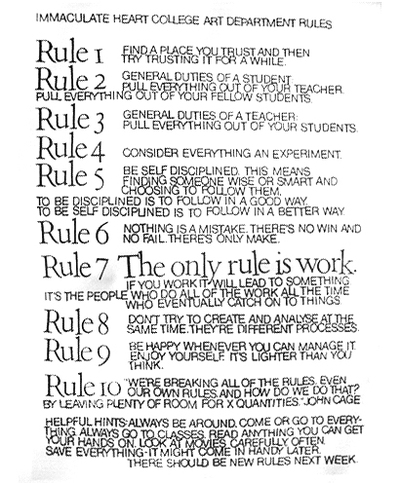
Find a place you trust and then try trusting it for a while.
General duties of a student: pull everything out of your teacher, pull everything out of your fellow students.
General duties of a teacher: pull everything out of your students.
Consider everything an experiment.
Be self-disciplined. This means finding someone wise or smart and choosing to follow them. To be disciplined is to follow in a good way. To be self-disciplined is to follow in a better way.
Nothing is a mistake. There is no win and no fail. There is only make.
THE ONLY RULE IS WORK. If you work it will lead to something. It’s the people who do all of the work all the time who eventually catch on to things.
Don’t try to create and analyze at the same time. They’re different processes.
Be happy whenever you can manage it. Enjoy yourself. It’s lighter than you think.
We’re breaking all of the rules. Even our own rules. And how do we do that? By leaving plenty of room for X quantities. – John Cage.
Helpful hints: Always be around. Come or go to everything always. Go to classes. Read anything you can get your hands on. Look at movies carefully often. Save everything, it might come in handy later.
The web is a funny place. I get requests to speak and write for people all the time, but sometimes the requests are from unexpected places, like, say, The U.S. State department. After a short chat with Alexandra M. Abboud, the coolest government employee I’ve ever known, I agreed to write an essay for their newly launched america.gov website, called How to innovate right now.
As a kicker, they run a monthly live webchat: anyone can sign in live and ask me questions.
Go to the Ask America website on Tuesday Feb 5th, 12pm EST. (The site currently says 9am EST, but it will be updated soon).
If you’ve got a question you’ve always wanted me to answer, now’s your chance.
And if you can’t make it, leave a question in the comments. That way when no one shows up in the live webchat, I’ll have something to do.
Steve Frank has a review of trees. Satire on the sad state of tech writing today. Loved this.
What advice would you give your younger self? Interesting question. The reverse is also good: what advice would the version of you ten years younger give to the older version of you today?
Found this list in an old notebook – I have no idea what exactly prompted the list. Guess I was feeling ignored at work 🙂 Instead of blaming others, I took a shot at self-criticism, and assumed the problem was mine. What could it be?
You pick too many battles and have never won any of them
You sound stupid to them
You are stupid (at least about the thing you’re being ignored about)
You waste time and never get straight to the point
You haven’t earned anyone’s trust
You don’t share your passion
You haven’t worked to find an ally
You smell funny
You always ignore everyone else
The people you work with are true fools
I’m sure you know someone who has potential, but always gets ignored – what else should be added to the list?
Can you be creative without constraints?
It’s a tricky question. Creative people everywhere complain that they don’t have enough resources to be creative at work. In the lingo, “blue sky” refers to a project where the sky is the limit, and it’s the creative holy grail. “If only I could get a week to think blue sky, I could do amazing things”.
But one definition of creativity is the ability to transcend constraints. Dr. Seuss did some of his best work with the hardest constraints. To find a clever way out of a difficult situation, or use a new idea to make lack of resources an advantage. I think about the Ramones or the Sex Pistols, bands whose lack of training became an asset. Or Spike Lee & Richard Rodriguez, filmmakers whose first films cost less than the price of a new car.
It’s interesting to notice how big corporations, with enormous resources, often fail at being creative despite their blue sky budgets. Is there something in the nature of constraints that brings out the best creativity?
Constraints as a special tool. We think of them as rigid, but they’re flexible things. Constraints can be:
interpreted differently
intensified
diminished
created on purpose
eliminated on purpose
Thinking like a manager, the goal is to have appropriate constraints that roughly match the goals. A team that is on life support needs to have constraints removed. But a team that is unfocused or out of control needs tighter constraints to function well.
Back in the 90s, Microsoft used to hire 3 people to do a project they knew required 5. Why? To create a set of constraints that self-motivated people would love. In trade for the extra work people received autonomy, and the net result was a creative, and productive, win.
Thinking like a individual, routines like writing an hour a day, or making a certain number of alternative designs, is a self imposed creative constraint to force my best work to surface, and in that sense I think everyone uses constraints in some way to help them be creative.
How do you use constraints in your creative work? Both at a personal level, but also at the project or team level?
(MacGyver is the patron saint of creative constraints).
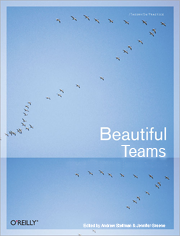
The goal for the book is to capture great stories about software development teams in a book, using a format similar to the bestseller Beautiful code. I think it’s a great idea and if all goes well I’ll be contributing a chapter.
If you think you can write about a true story from your experience in the tech-sector, that includes something about the team, and the relationships between people involved and how that helped or hurt the project, contact Stellman & Greene here.
One of my most popular blog posts ever, how to write a book, generates tons of comments and e-mail every week. Here’s an interesting one I couldn’t help but respond to:
Great article, gave me lots of inspiration and hope. I just submitted a proposal to O’Reilly, and it was rejected within 30 minutes. Very efficient, and very nicely worded, but devastating nonetheless. What do you do if you think you have a great idea, but the world disagrees?
The first rule of creative work: expect to be rejected. Ask anyone who reviews creative work of any kind, whether it’s screenplays, music demos, or book proposals, and they’ll tell you they reject a ratio of at least 20 or 30 to 1. Sometimes it’s 1000 to 1 in the case of movie actors or works of fiction. There is nothing wrong with you or your work simply because you have been rejected. Rejection means you are doing something many others want to do and it’s hard work.
Ask any writer, including the famous, how many rejection slips they’ve seen. They’ll laugh and tell you about how they papered their wall with them. Seriously, rejection is part of the game. I note many of these stories in The Myths of Innovation. The Star Wars screenplay was rejected by almost every major studio. Zen and the Art of Motorcycle maintenance was turned down over 100 times. Stephen King, J.K. Rawlings, John Grisham, you name it, they’ve been rejected. Do not give up hope: instead, use rejection as fuel. Prove them wrong. Get better at your craft. Work harder, and when you’re finished, send them a signed copy with your warmest regards.
Fear & doubt kill far more dreams than failure. -Jeet Banareet
In some ways how you handle rejection is self selection for creative work – if you cant handle a few rejections from publishers, how will you handle a few bad reviews of your finished book? No matter what you do, if you’re making something, many people won’t like it. In fact the more popular the thing is, the more people who will pick on it and for increasingly trivial reasons.
As I mentioned in the post, one major advantage of living in 2008 is how cheap it is to make things yourself. The only approval you need to create something is your own. You can self publish a book, make a video or a bunch of mp3s for just a few hundred bucks. If the world isn’t behind you, to hell with the world – do it anyway. The only thing stopping you is you. After you make the thing you imagined the world may respond very differently than it did to just the idea alone.
(Update): Of course you do need to consider now and then that the world might just be right, in some small way, about something you are missing. Perhaps you’re idea isn’t all that good, or you’re not explaining it very well, or it needs to be focused and directed in a different way. One of the best skills creatives need to learn is how to convert criticism into useful feedback.
The ever creative ze-frank is currently asking a great question about creative process.
When you make things with an audience in mind, do you have internal representations of that audience to help guide you in the process? Are you in dialogue with a cast of proto-audience members that somehow represent different facets of your perceived audience? Are there little homunculi that provide editorial voices different from your own?
My answer, which I posted, is that I don’t have formalized characters when I’m writing a book or preparing a talk. But there is an ongoing dialog in my head when revising that approximates three or four imaginary people:
The curious neophyte. If someone at random walked in off the street would any of this make sense? Would they keep reading/listening?
The expert asshole. What if the person who knew everything about this subject and loved to criticize read this paragraph or heard this lecture. What vitriol would I hear? What bullshit would they call me on?
The daily grinder. How about the guy who actually does whatever I’m talking about for a living and when I’m done will go straight back to work. Will anything I write or say impact what he does the rest of the day? week? month?
The fan. Will someone familiar with my work find this boring? repetitive? derivative? Can I make this more fun for them instead of less?
Awhile ago a wrote an essay on how to give and receive criticism. Writing about it is one thing, but doing is another. Recently I saw someone handle a tough situation in public quite well – here’s the story:.
Sun engineer Bryan Cantrill gave an offhand review, at a videotaped talk at google, of Rosenberg’s recent book, Dreaming in code (A book I reviewed last year). Rosenberg, instead of doing what many bloggers do, and either a) ignore the issue or b) escalate things into a juvenile flamewar, he looked carefully for the intent, instead of the sizzle, of Cantrill’s statements and offered a well reasoned response.
 I’ll be doing two sessions at this year’s Webivisions conference. One workshop called How to Innovate on time, and a talk on the Myths of Innovation.