With the recent post on the problem with consultants, I wanted to point out the impressive inventory of failed management methods that have grown in the comments section for last year’s post on asshole driven development.
Some are tech specific, but many apply to just about any kind of management. The comment count is over 250 – if you’re looking for a laugh or to give a name to what’s wrong in your world, check it out.
As I’ve grown older my tolerance for humorless people has declined – but does everyone feel this way? What about team leaders and project manager types?
Some folks at Bremen University in Germany are doing a study to find out.
So as a favor, anyone out there who reviewed the first edition of the book – could you take two minutes minute and re-enter the review for the new edition? The review count for books makes a big difference and I’d appreciate the help.
Over the last month I’ve spent more time than usual with consultants and it is making me miserable. Is there a support group I can join? A ten step program? A nearby happy-hour? There are some great consultants out there, but damn, I wish there were more of them.
My passion for trying to get to the heart of things, to be clear and direct, makes it impossible for me to talk with most consultants for more than 5 minutes without wanting to punch them in the face. This might not be their fault – my spine shudders in revulsion when I’m faced with people who go out of their way to make things sound as complicated as possible. Consultants aren’t alone here – some academics, politicians and doctors are just as guilty, but I haven’t been dealing with those folks recently, and today, they get a free pass.
The inherent problem is this: I look at the English language as a good thing. Shakespeare did some good with it, didn’t he? Although he did invent some words here and there, I don’t think most of us need to create new words to get our points across – 200,000 is plenty to work with. In fact unless your new word enhances my understanding of what you’re trying to say instead of diminishing it, it’s hard not to see you as either a fool or a blowhard. You’re not making a new word or using obscure language to help me, you’re doing it to help you. If you look at how most consultant talk, you’d think they hated English, had a personal vendetta against it, as they seem to take such pride in burying clear thinking under layers of vacuous, disingenuous jargon.
My recent experiences have convinced me many consultants see jargon is an advantage – how, I’m not sure. Perhaps like the bait on a hook, it distracts potential clients into error, just long enough for them to open their wallets and bite on the hook. But for whatever reason I personally don’t know how to take the bait. And the result is many of my conversations with consultants (note I say many – there are exceptions) leave me feeling one of three things:
They are trying to deceive me. If they know what they are selling is advice on managing creative people, but they insist on calling it ‘ideation flow’, an ‘idea capitalization market’, or some corny trademarked term like ‘Ideaness(tm)’, I can’t help but feel deceived. If your advice is good, why all the camouflage? Why give me a chance to believe you have something to hide? Especially if this first conversation is one you hope will lead me to hire you.
They believe their own bullshit. Consultants do have to differentiate themselves and make claims – I get it. But some consultants have lost all ties to reality – they pathologically believe in their own hype and will die before confessing a simpler story of their work exists. If after a ten minute conversation I can’t get someone to stop using trademarked phrases, made up words with too many hyphens, or concede some of their clients get less value out of their efforts than they claim, I can only conclude they’re nuts.
They have no idea what they are talking about. Some consultants have never done the things they consult on. In innovation circles this means they’ve never managed a team of people making something, never prototyped an idea, never filled a patent, never taken creative risks, so instead of banking on their experience, or even their knowledge of the experience of others, they make stuff up. Often it’s a magic process or system they claim will transform your organization, described in frighteningly similar terms to the latest diet craze.
Certainly (bad) consultants aren’t entirely to blame for what they do – some clients want the made up stuff, they want to believe in things they don’t understand, or they want to rely on a outsider simply so they can blame the outsider later on.
So how do you separate the useful, well-meaning consultants from the less savory ones? What are your biggest gripes from past experiences working with consultants? I’d like to know.
Man flies with jet powered wing. Straight from the sci-fi movies, this 48 year old man built a wing, that looks almost like a kind of jetpack and flies him around at almost 200mph.
A recent New Yorker had another excellent piece by Malcolm Gladwell, this time about simultaneous invention, the core topic of chapter 5 of The Myths of Innovation. Much of his coverage is spot on – we underestimate how many inventions and discoveries were achieved independently, despite how specific and isolated the credit we give often is.
It’s an excellent article and I recommend it. One highlight for me is this:
Stigler’s Law: No scientific discovery is named after its original discoverer.
A law which Gladwell points out also applies to Stigler’s law 🙂
My critique begins with his coverage of Nathan Myhrvold and his company, Intellectual ventures (IV). A firm dedicated to creating what they call “an invention economy”. He never asks any questions about the conflicts between a patent system designed centuries ago to protect individual inventors, and a well-funded company created, as best I can tell, to dominate entire domains of Intellectual property through massive patent fillings and then selling them. Who is best served by “an invention economy’?
It’s not his job to raise every question – that’s my job as the reader. But since the article focuses on Myhrvold & IV, it literally begins and ends with him, the fact that he never questions his company’s place in all this paints them as a positive evolution in how invention will be done. They are loosely portrayed as heroes, an idea which I couldn’t help but find personally depressing – Not entire sure why yet, but I did feel that way.
But more important is his overstatement of artistic creations. He writes:
A work of artistic genius is singular, and all the arguments over calculus, the accusations back and forth between the Bell and the Gray camps, and our persistent inability to come to terms with the existence of multiples are the result of our misplaced desire to impose the paradigm of artistic invention on a world where it doesn’t belong.
Shakespeare owned Hamlet because he created him, as none other before or since could. Alexander Graham Bell owned the telephone only because his patent application landed on the examiner’s desk a few hours before Gray’s. The first kind of creation was sui generis; the second could be re-created in a warehouse outside Seattle.
If you talk to most writers or artists they’ll tell you about specific influences for specific pieces. Picasso said “bad artists borrow, great artists steal”. We’re pretty sure Shakespeare based Hamlet, and many of his plays, on stories and plays he’d heard before. Reading Joseph Campell or Karen Armstrong on mythology reveals the incestuous nature of stories: they breed like rabbits and steal like thieves, and to claim any creative work as Sui generis (means, roughly, something uncategorizable) usually means there’s a kind of ignorance at work about that particular kind of art, or a lack of imagination about what a category is.
And as a kicker, what is one to say about amazing song covers, Like Johnny Cash’s cover of the Nine Inch nails song “hurt”? The fact that an idea can be both deriverative and creative means our definitions aren’t that good (For reference, Cash’s version – you really should see this).
Michelangelo’s David and Picasso’s Guernica are masterpieces, but an analysis of these works by people in the field can point out influences, progressions, and connections to other works the creator knew of or was deliberately trying to emulate. Sometimes, like simultaneous invention, artists pursue similar ideas at the same time: they’re called artistic movements. It’s not the same as simultaneous invention, but it’s close enough. I’ve studied art for years and I still have trouble telling Picassos from Braques, despite works by both being considered masterpieces.
I totally grant there are differences between artistic creation and engineering invention. And Gladwell’s piece had me thinking about them for the better part of a plane flight, a gift which I’m thankful for. But his cut at the differences isn’t quite right.
PBS miniseries: Carrier. Fascinating 10 hour show that explores what life is like on the U.S.S. Nimitz. A carrier off the Persian gulf in 2005. Hits on management, morale, morals, work, design, you name it.
List of 50 best cult books. Surprised Ender’s game didn’t make the list. That was the underground book only the hip geek kids (is that an oxymoron?) were reading in college in the early 90s.
The more I learn about creative thinking and about teaching, two subjects of great interest, the more depressing organized education in the U.S. becomes. I’m familiar with Montessori, Waldorf and various other well known private school brands, as well as public school programs here and there, but it’s all vaguely disappointing. I’m often left feeling there is no substitute for parents and extended family: they are the best hopes young minds have for learning what it means to think free. Perhaps that’s as it should be.
Two bright spots I’ve found are these two programs, aimed at giving kids exposure to creative problem solving in team environments. I’ve yet to see these things in action but I’d love to visit and maybe even help out with a local chapter.
Odyssey of the Mind – An international program that focuses on creative problem solving projects. It’s a world-wide competition with regional finals and programs.
If you know of other resources for parents who want to augment their kids exposure to creative thinking and problem solving skills, or have experience with either of the above programs, please leave a comment. I’d love to hear more.
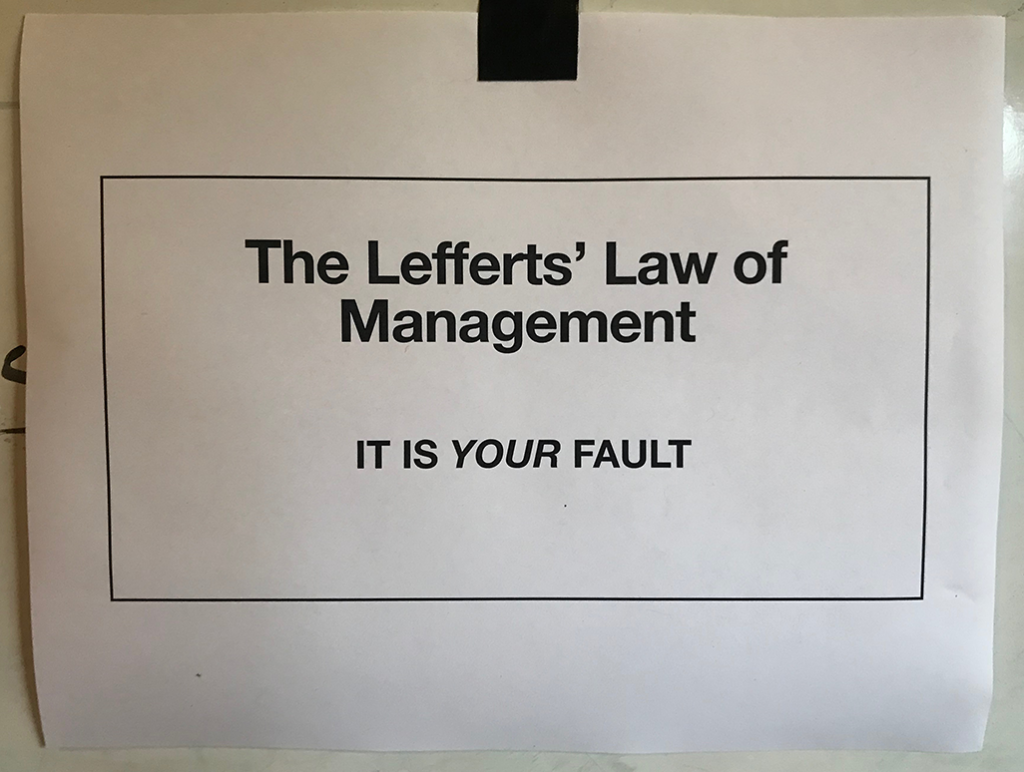
My friend Rob Lefferts, VP at Microsoft, offers this gem of advice:
It is your fault.
I call this the Lefferts’ law of management. The last thing you should ever do is blame your own team. You have more power, and are paid more, than anyone else. If something is wrong, it is probably because of you. There are dozens of excuses you can use instead that point the blame elsewhere but if you want to be a good manager don’t use them.
If someone is behind schedule, communicates poorly, or made a bad decision, who coached them, or failed to? You. If people are arguing and don’t trust each other, who shaped the culture or failed to create shared goals? You. If you feel you must micromanage to keep quality high, that’s on you too for not hiring better or coaching them into growth. Whatever the thing is that isn’t going well, you are the primary person that both caused it and can do something about it. Even if you inherited a problem, it is your job to manage it. If you’re not sure what to do, it’s your job to admit you are over your head and ask for advice or step away from being the boss.
This law should be the primary working assumption in trying to understand a situation. Certainly there will be cases where someone else is at fault, but start your diagnosis by assuming otherwise.
If you are the executive, the boss, the manager or in some cases the leader, you should tend to absorb blame for what’s going on, freeing people to actually solve problems instead of pointing fingers. Be the fall guy if needed for your own boss or partners. If people see you take bullets for them, soon they’ll be taking some for you, or prevent the need for anyone to at all.
Being passionately accountable creates a shield for others and makes it safer for them to invest more personal responsibility in their work. When they do, things can only get better.
When in doubt, good managers assume anything important that’s not going well is their fault and do something about it.
[edited lightly 9-23-2016, 9-24-2020]
An interesting little MBA project from UC Irvine provides a view of books and reviews based on the point of view of particular experts. There may be something like this out there already but i haven’t seen it.
Thanks to Brady Forrest and Jen Pahilka for giving me not one but two slots this week in a high caliber lineup. It was awesome to meet and talk to so many folks in just a few days (talking to people is always where the value is). (Photo credit: James Duncan Davidson).
Its been awhile since I’ve been to a big tech conference around a singular theme (web 2.0) during its rise. To see both the promise and the hype swirling around together made for a fun couple of days. Walking the expo floor, where vendors and companies demo and pitch for your pleasure, gave me flashbacks to Internet World in ’96 and ’97. Back then, there were a zillion “push technology” companies, services and products. Now it’s “social media” or “web 2.0”, with a zillion companies all throwing the same jargon around and mostly failing to distinguish themselves from one another.
There are certainly good ideas in the mix, and I think Tim O’Reilly and Clay Shirky‘s opening keynotes did more than any company I saw to speak for those ideas, or even attempt to describe what substance might surface from all the technology, energy and money bouncing around.
The problem for me is how infrequently people investing their lives making these things can describe how, at the end of the day, all of the potential described gets transfered into value. Or why the value provided is worth the risks and costs of using whatever they are selling (register for this, buy that, use this, etc.) It’s not a complex question, but it is the primary one I’m sure many attendees were asking: how much substance and takeaways can I fish out of the buzz?
I wasn’t surprised, but I didn’t hear anyone mention how many amazing things are made, in 2008, by organizations with little interest in web 2.0 concepts – namely Apple, Toyota, your favorite film director, or your favorite music band. Not to mention all of the great amazing things the world produced before 1994 (the year the web, even in 1.0 form, was born). That’s not to say this alone proves anything – my point is only this: it is possible to achieve amazing things, without -insert name of current trend here-. Thriving communities, tribes, and cultures have existed for ages. If its possible to do well without whatever the new secret sauce is, it suggests there’s an underlying element that’s not being talked about. I’m convinced there is a more refined explanation for what people might gain from buying what the expo vendors are selling, but very few people seemed capable of even suggestion one.
The unspoken nugget / explanation / marketing line that might get me jazzed is this:
We have always been collaborative. Always been social. It’s in our genes and it’s what we have evolved to do well. Good technologies enhance our natural abilities, give us useful artificial ones, and help us to get more of what we want from life. Web 2.0 and social media make the process of collaboration and developing relationships more fun, efficient, powerful and meaningful.
Ok. Now we’re talking. With a statement like this I can walk the halls of the expo, or converse with the greatest web 2.0 pundit, and have a straight conversation. Will this get me more of what I want from life? More of what my customers want from me, or vice-versa? I can make tangible arguments about what I want or my customers need and sort some decisions out. But note that the statement above is devoid of hyperbole like revolution, ground breaking, disruptive or transformative, things that are entirely subjective. If you identify a real problem well enough, you never need those words: the people who have those problems will naturally find what you do revolutionary if you really solve their problems.
Ok, enough industry talk. Here’s some shop talk for anyone that saw me speak: I’d give my performance at my innovation workshop a B and the keynote a C+. The keynote was mostly new material and, surprise, I never found my rhythm. I gave it my best but it wasn’t a great 10 minutes. The other funny thing is that the tech crew warned me the remote doesn’t go backwards – it’s kamikaze style – a warning I shrugged off as I couldn’t imagine in a ten minute talk needing to go backwards. Well, guess what, I did. I could have asked them to go back if I’d wanted but didn’t, it wouldn’t have saved my performance anyway 🙂
Liz Danzico kindly interviewed me about creativity and related things over at the AIGA website. Includes mentions of puppy torture, flashes of lightning, and ridicule for the book Who Moved my Cheese. Full interview here.
I can’t tell you how many times, even in notable magazines, I’ve read movie reviews that spoil the movie. It’s the most criminal, careless thing a critic can do: steal the narrative potency of someone else’s work. Even if it’s the worst movie in the world, a decent critic can tear it apart without spoiling the film.
So the other day on netflix I saw this – a spoiler warning:
On every review any user can flag reviews for spoilers.
Last week I upgraded to the latest version of WordPress. I’m a huge WordPress fan, I love what these guys do, and I was psyched to see what they’d done this time around.
Total time: 9 minutes. This was end to end, from downloading their software, to reading instructions, to the moment I was able to make my first post. And this included an extra 2 minutes where FileZilla imploded and I had to start over.
Summary: Thumbs up. Go get it. Most of the changes are for the positive, the UI is cleaner, my top gripes (text-editor and thumbnails) have been fixed, and there are some new minor features. Top complaints are UI fit and finish, there are some gotchas that should have been caught.
Kudos:
Text editor is much improved: less buggy, fewer perf issues, and better media support. People spend 80% of their time in WP here so happy to see investments to core use here.
Site wide search instead of just blog posts – obvious win.
The UI visuals shows some style love – in many places, like the comments view, the style choices make it easier to scan long lists. Other nice touches include a flag next to the comments tab when there are new unmoderated comments.
Many under the hood improvements that I don’t fully understand or expect to use but feel good about anyway.
Automatic plugin updates. Nice, though this broke for a few plugins I had. Expect the kinks will be fixed by plugin authors from here on out.
The install is just a few steps and takes minutes with no special skills required.
Complaints:
Leap of faith upgrade. Doing hand copying of files is very 1980s. I read the instructions ten times to make sure I had it right, and even then I had the willies while waiting for both the files to be copied, and to see the new dashboard working. The intermediary UI didn’t calm my fears at all. Say what you will about Windows or Mac software, but great relief comes from pushing an “install” button, and watching one little progress bar while the software does all the work. Instead in WP there’s a useless page offering no clue how long it will take, and given my hand-copying of files, no way of knowing if I’d screwed something up. To be fair it did take about 20 seconds, but they were the most stressful I’d had all day.
Admin redesign. This felt not quite finished. It’s definitely improved but has 1 step back for every three forward. It’s a space heavy design, with several levels of hierarchy floating in dreamy soft blues and whites. If it’s really a dashboard it should be more software app like than a webpage, but it feels more like the later. The core problem is 4 levels of UI, with varying left right dominance, creates a visual ping pong (left, right, left). Plus there are mismatches of prioritization: The Write a new post button, the most used button on the page, is off the right, while the text “Right now” gets prime real estate on the left.
Tab confusion. The UI rules for tab are simple, peers share the same tabs so people know what is on the same level as what. But there are three orphaned tabs all the way on the right that turn out to be peers to the stuff on the left. No idea why they’d do this. Similar problems on the top with a dashboard tab all the way left, and three orphans on the right (Help/Logout/Forums)
Settings confusion. Much of the UI in wordpress is config related, but is there really a need for three different hierarchies for Manage, Settings, and Plugins? Some of the UI in each can be compressed (e.g. Privacy has one option and doesn’t deserve it’s own page). Even after a week of use I find it hard to remember which top level category to go to for what.
My everyday tasks are still hard to optimize . This is my top gripe. I’m a very basic, vanilla user. I post 2 or 3 times a week, text and link heavy, with images and thumbnails in most posts. That’s it. No media streaming, no dashboard customization, no multi-users or anything whiz bang at all. Yet I still find it clunky to add images, check links, preview and review, and worse, despite having done it 5000 times there’s no efficiency path. No shortcut keys or tricks to make my routine faster.
Nitpicks:
The Comments listing should default to showing unmoderated comments. That’s the primary view people with moderation on need to see when going to the comments page.
On the home dashboard page, first page people see, the word dashboard appears 3 times, all on the leftmost column. The second one is highlighted to indicate it’s active, so the third one isn’t necessary. If people don’t notice the red highlight means it’s active then change the highlight, don’t add another instance of the word.
Moving the category field to the bottom of the post page is a huge pain. Most people use categories so they hit this set of checkboxes for every post. The current layout forces two scrolls: one to get down there, and a second to scroll the list of categories. This UI should be in the critical path of the UI design for the post page.
The add media UI is overkill. First, clicking on that tiny little image button takes over the whole screen. Blam – I thought I’d broken something. It’s a jarring, horrible transition. Going modal is ok, but don’t hit me over the head. There are other issues with the flow in this UI: not sure what use cases it is designed for, but everything seems to require lots of steps (And what does Crunching mean? Downloading seems more accurate).
.
Even with my complaints, I strongly recommend WordPress. If you want to give it a spin, you can use their free, hosted, blogging service at wordpress.org. If you’re thinking of upgrading or switching check out this handy guide: How to update wordpress with minimal downtime.
If you use this magic code websf08sbg you get $100 off the registration price.
This is exactly the kind of topic I avoid here, but since the deal hasn’t been shot dead (at least not yet) as I’d expected, it’s time to throw an opinion on the pile.
The first thing that comes to mind is the 1995 attempt by Microsoft to buy Intuit. It doesn’t seem important now but at the time it was a huge deal: it would have been the largest software acquisition in history. Inside Microsoft, where I worked at the time, the move was a surprise, much like the Yahoo deal probably was (Hot/Big companies are news leaks, so execs rarely bother with early internal memos). The DOJ said no, but regardless it represented the same type of inspired, ballsy, ‘go all in’ strategy that people forget Microsoft is known for (See Microsoft reverses course or Internet Tidal Wave Memo).
Forget whether it will work or not, this Yahoo move communicates how competitive and aggressive Microsoft still is. If Google kicks Microsoft’s ass all over the next decade, it will be a bloody war all the way. Unlike IBM, Microsoft is not going to walk quietly to the sidelines of public attention; they’re going to go out swinging. So say what you will about the strategy, but in terms of moving to take control over the battleground, Microsoft has scored a victory: they’re in the headlines, for the first time in ages, for being on the prowl, while news of Google has fallen beneath the fold. With the paint still wet on their recent acquisition of DoubleClick, it’s hard for Google to complain loudly right now.
Ok, here’s the cynicism. All mergers suck. They really do. They rarely go well and when they do it’s only after 12-16 months of hand wringing and confusion among everyone involved on both sides (not to mention the costs of defections on principle). No sane person would ever choose to merge with another company that has overlapping product lines. It’s a move that is only conceivable from the landscape view provided by executive ivory towers. VPs can say all they want about not losing jobs, but everyone knows no VP would ever say “Yes. This merger means you will be fired 3 weeks from now! Run for the hills!” It just doesn’t go that way, ever. Being employed isn’t much of a prize anyway if the job that remains barely resembles the one you loved. Of course if you hate your job, or your project, then this could be opportunity time.
But on the whole I suspect the entire Windows Live division held in a collective cry of despair the day the merger was announced, in the same way the Microsoft Money team did in 1995. It’s hard to recover from that feeling of betrayal that comes from working hard for months, loyally following your leader’s commands, only to learn, as an aside, over coffee, that someone 5 levels above you had been scheming to buy a competitor, one of the targets on your well worn dartboard, all along. In the old Microsoft days it was the stock options that carried you through. The hallway talk was “We do what’s right for the company first” but I don’t know if that line is still heard, much less believed, anymore. In some ways merger talk is a reality test: is what I’ve made better than what we’re buying? And will the newly appointed mystery date VP agree? That kind of uncertainty can’t help but tank morale.
And now, optimism. As an orchestrator, an architect, a creator, this would be one of the greatest shopping sprees for intellectual property of the last 20 years. It will be a once in a lifetime treat to be the VP who gets to pick and choose among projects and people from two vast pools of ideas grown from very different gardens. Hand that task over to a Ray Ozzie, Chris Jones or Joe Belfiore, and, if you get everyone else sufficiently far out of their way, wondrous things are possible. I’d bet any of them, or perhaps a management star from Yahoo’s ranks, could inspire the best people from both companies to stick around, at least long enough to watch the first offspring rise above the merger mess, or, perhaps, go up in flames.

 Thanks to


