Last week I held a presentation to my company (around 60-70 people). My strategy for the post-lunch session was to keep the audience involved by asking questions. This was to prevent people from falling asleep from the food coma.
What I did was have a slide with a question, ask the audience, see what came up, and then reveal the answer I had in mind. I got a few interesting answers and it felt like it was partially keeping people from falling to food coma. Afterwards I got some appreciative comments from programmers who attended both about the contents and about the style of the presentation.
One problem: Our CTO thought that the way I’d asked questions when I already had the answers prepared was demeaning. He felt strongly about this in terms of “that’s something you just don’t do”. To me, I wouldn’t be standing there holding a presentation if I didn’t think I had answers that not everyone in the room did. Asking people to think about things rather than spoon-feeding them “truth”, to me, is a way to help the process of learning.
What do you think?
There are few things “you just don’t do” as every audience is different and the rules change depending on what they’re expecting, and how good you are at using a technique. So it’d be rare I’d ever say “you can never ever do X”.
It’s also important to realize there are many ways to reveal those answers, some which might be demeaning (“you guys were too stupid to say things like this”) but others that are entertaining, interesting and enlightening (“Here’s what I had, but your answers were better for these 2 reasons, except that you missed…”). So how you do it is as important as what you do.
The main problem I see is whether the questions you were asking were what the audience wanted to learn. I’d rather do one of these:
Ask 5 or 6 people who were going to be in the audience ahead of time what their actual questions were and use them instead of guessing.
Only ask them questions that reflect something I’d taught them in the lecture. So after demonstrating how to do long division, I’d give them an easy long division problem. Then the questions tests my ability to teach as much as it tests what they know. Any wrong answers means I failed, not the audience.
In the end the CTO is entitled to his opinion, but it’d be wise to have the opinions of the audience recorded in some simple way so his perspective is informed by what the majority felt. Having a better way to judge the value of a session is probably the best problem to solve here.
Sorry its been awhile – on the homestretch for the new book, had a vacation, and also a total ISP meltdown. It’s been an interesting month 🙂
Iran’s Internet spying gear (built w/help from Nokia and Siemens). The story makes it hard to go to far, but “If you sell networks, you also, intrinsically, sell the capability to intercept any communication that runs over them,” said Mr. Roome, the spokesman for the project.
A brief history of Agile project management. The curious thing is how most of the criteria defined by MacCormack match what Microsoft was doing in the early 1990s. (See the book Microsoft Secrets, it’s all in there – daily builds, frequent releases, etc.).
Instant speaker feedback. I saw a clever method for collecting feedback on speakers at a conference this month.
At the Business to Buttons conference this month, I noticed an interesting way to collect feedback on speakers at every session.
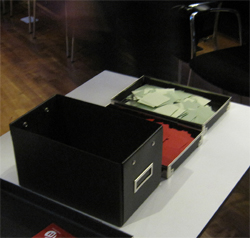
Instead of bothering with a complex survey, which has to be sent out, complied and edited, they simply place two voting boxes at the door, with two piles of small cards. One pile green, one pile red.
As you leave you grab a colored card and drop it in the voting box. And by counting the cards it’s quickly clear how well received the session was.
The upsides to this system:
It’s fast
It’s simple: either the session had value or it didn’t.
There is no extra work
However there are problems too:
It’s not secret. People see which pile you grab a card from, including possibly the speaker or his/her friends, which may change people’s votes.
If you get lots of reds it might not be clear why.
But I do love the idea as it quickly gives the speaker a sense of how well they did, and forces audiences to choose one way or the other.
The problems can be solved by finding a way to make it secret, even just by moving the box to outside the room, covering it, or finding a clever way to protect the anonimity of people voting.
I’m in believer in the philosophy of the small.
Part of why I quit was I wanted to work on things I could get my entire hands around (e.g. books), even if I made less money than I would for continuing to play a small role in the making of big things. I bet I’d get more pride and pleasure from making things I loved, even if they are only used by a few people, than I would for the thousands of compromises that come with making things used by millions of people.
One of my former bosses at Microsoft, Hillel Cooperman, has not only gone on his own with Jackson Fish, a company that makes hand crafted software (you read that right), but he’s started up a little event for people who share the small and special philosophy.
What: Small and Special – a tiny conference for entrepreneurs and hopefuls
If you’re a small business owner or have thought about starting one, this is a great way to meet many locals who are a few steps ahead of you. Check it out.
One of the goals of the book is to talk about things going wrong in public speaking. Few books ever mention how often things go wrong, even for experienced speakers, and I want to make sure these stories get told.
Leave your story of a public speaking disaster! It can be something that happened to you or something you saw or heard happen to someone else. You can win from a pool of $200 in prizes.
To help get things started, here’s some of my own public speaking disasters:
I suck at math (The Hague, Netherlands, @CHI 2000). At the CHI conference I and some friends ran a live design competition called Interactionary. 4 teams of designers (from IBM, Razorfish, Sapient and U of Malmö) competed live on stage in front of a crowd of 800 people and were scored by famous judges in real time. At the end we announced the winners and took questions. Someone yelled out that our scores were wrong, which prompted the audience to start yelling and booing us – things got out of control and I had to end the session early. They were right – we announced the correct scores later that day.
Audience teaches me a lesson in front of 400 people ( San Francisco, 2007, @Etech). I made the mistake of claiming that the word architect is derived from the word arch, as in the people who make arches. Not sure where I read it (I did read it somewhere), but it turns out to be bogus. As soon as I finished my talk, Tom Coates stood up gleefully and called me on it as the first question. Blam. That sucked. (We joked about it later over drinks – he apologized, even though he was right).
“Lets start 20 minutes late with gear that doesn’t work” (San Francisco 2008, @Adobe Software). On book tour in SF, I spoke at an Adobe office with the worst tech guy I’ve ever met. I arrived 30 minutes early, but 20 minutes after I was supposed to start they were still sorting out their sound system, with various shrugs at my questions on why their system sucked so much. I spoke with a 2 second echo delay in my headset (required so 5 people could listen in remotely) the entire time, to an audience of maybe 15 people that blamed me for starting so late.
I piss off a hostile and drunk audience (Cambridge 2008, @Ignite). This first Boston Ignite was at a bar worth studying for the worst place to do public speaking (Tommy Doyle’s). The small stage is dwarfed by the much larger bar area, meaning as the speaker I could hear the roar of the bar much better than myself or the audience. And since the crowd had been drinking for 2 hours before I arrived, an inevitable heckler yelled out, with an esoteric complaint about my mention of Crick & Watson without mentioning Rosalind. I made a joke about having discovered the feminist section of the audience, and it all went downhill from there. Mike and Marlowe, the organizers (and my friends!) asked me to speak again to close the night, despite my protests based on how much I’d drunk to get over the opening session, I eventually said yes. I believe I rambled something about Michelangelo and creativity but it’d be best to ask someone who was there. Actually spare me more embarrassment and don’t ask.
The problems of being uni-lingual (Kiev, Ukraine 2008). Being translated is cool if it’s done simultaneously like at the U.N. But silly me, I didn’t think to ask. And in Ukraine I was surprised to learn they were doing live translation, but with the translator on stage. On the fly I had to divide my material in half, as it takes twice as long to do anything if you have to wait for every word you say to be translated. Most exhausting full day seminar ever.
“Please ignore the 120 decibel fire alarm” (Port of Spain, Trinidad). Half way through my talk the fire alarm goes off. I can see the hotel staff and firemen running in a panic in the hallway behind the audience, but they can’t see it. Do I tell them what I see? Or play it cool and ignore the fact and try to speak over the alarm? I did the later. Talk about a distracted audience – at least no one slept through my talk.
If you take a minute to share a story, you can win:
Best story wins $100 gift amazon.com gift certificate
Two runner ups get gets $50 each
Any story can win inclusion in the book (you’ll get an acknowledgment & a free copy)
Instant therapy – you’ll feel better after you share, I swear! I do!
Lets see what you’ve got – it’s an easy way to help me with this project. Please do.
Back in 2009 while working on Confessions of A Public Speaker, I wrote this post asking for speaking disaster stories. Nearly 60 people replied, and some emailed them to me privately. The best ten, including some from famous people, appeared in the book. Until recently this post was buried on another blog, but I’ve reposted it here.
If you have a good story to share, please leave a comment.
To get things started, I’m a veteran speaker and here are some of my own public speaking disasters:
I suck at math (The Hague, Netherlands, @CHI 2000). At the CHI conference I and some friends ran a live design competition called Interactionary. 4 teams of designers (from IBM, Razorfish, Sapient and U of Malmö) competed live on stage in front of a crowd of 800 people and were scored by famous judges in real time. At the end we announced the winners and took questions. Someone yelled out that our scores were wrong, which prompted the audience to start yelling and booing us – things got out of control and I had to end the session early. They were right – we announced the correct scores later that day.
Audience teaches me a lesson in front of 400 people ( San Francisco, 2007, @Etech). I made the mistake of claiming that the word architect is derived from the word arch, as in the people who make arches. Not sure where I read it (I did read it somewhere), but it turns out to be bogus. As soon as I finished my talk, Tom Coates stood up gleefully and called me on it as the first question. Blam. That sucked. (We joked about it later over drinks – he apologized, even though he was right).
“Lets start 20 minutes late with gear that doesn’t work” (San Francisco 2008, @Adobe Software). On book tour in SF, I spoke at an Adobe office with the worst tech guy I’ve ever met. I arrived 30 minutes early, but 20 minutes after I was supposed to start they were still sorting out their sound system, with various shrugs at my questions on why their system sucked so much. I spoke with a 2 second echo delay in my headset (required so 5 people could listen in remotely) the entire time, to an audience of maybe 15 people that blamed me for starting so late.
I piss off a hostile and drunk audience (Cambridge 2008, @Ignite). This first Boston Ignite was at a bar worth studying for the worst place to do public speaking (Tommy Doyle’s). The small stage is dwarfed by the much larger bar area, meaning as the speaker I could hear the roar of the bar much better than myself or the audience. And since the crowd had been drinking for 2 hours before I arrived, an inevitable heckler yelled out, with an esoteric complaint about my mention of Crick & Watson without mentioning Rosalind. I made a joke about having discovered the feminist section of the audience, and it all went downhill from there. Mike and Marlowe, the organizers (and my friends!) asked me to speak again to close the night, despite my protests based on how much I’d drunk to get over the opening session, I eventually said yes. I believe I rambled something about Michelangelo and creativity but it’d be best to ask someone who was there. Actually spare me more embarrassment and don’t ask.
The problems of being uni-lingual (Kiev, Ukraine 2008). Being translated is cool if it’s done simultaneously like at the U.N. But silly me, I didn’t think to ask. And in Ukraine I was surprised to learn they were doing live translation, but with the translator on stage. On the fly I had to divide my material in half, as it takes twice as long to do anything if you have to wait for every word you say to be translated. Most exhausting full day seminar ever.
“Please ignore the 120 decibel fire alarm” (Port of Spain, Trinidad). Halfway through my talk the fire alarm goes off. I can see the hotel staff and firemen running in a panic in the hallway behind the audience, but they can’t see it. Do I tell them what I see? Or play it cool and ignore the fact and try to speak over the alarm? I did the later. Talk about a distracted audience – at least no one slept through my talk.
If you take a minute to share a story, you can win:
Best story wins $100 gift amazon.com gift certificate
Two runner ups get gets $50 each
Any story can win inclusion in the book (you’ll get an acknowledgment & a free copy)
Instant therapy – you’ll feel better after you share, I swear! I do!
Comments are still open if you have a good story to share.
Much like clapping and applause, standing ovations are curious things. The idea, in theory, is that when a performance is so exceptional that clapping isn’t enough, people in the audience should stand to show an additional level of appreciation.
I think this is cool and great and the more kudos great performers and speakers get, the better.
The problem is there has been a kind of standing ovation inflation.
You can see it in politics, where it’s expected certain leaders get standing ovations by default. In these environments standing ovations are mandatory and expected. They convert what is supposed to be a spontaneous and responsive act into something quite official and often meaningless. And in some cases it can be seen as an insult not to stand and give an ovation, much in the same way not clapping can be seen as rude.
Rock bands are notorious for milking the equivalent of standing ovations by leaving the stage without saying they’ll be back for an encore. Then they wait for the chanting of the bands name, and come out as if the whole charade isn’t done in every venue in every city.
I’ve also found it in the arts. When I moved to Seattle, I found the number of standing ovations very high, particularly at dance or theater performances. My friends and I would look at each other in surprise as if we’d missed something – the shows were good, yes, but exceptional? No.
Our pet theories on ovation inflation are as follows:
The audience wants to believe they’re part of something special so they stand up to help make it seem special. (“It was amazing! They got a standing ovation!”)
They don’t get out much and can’t put what they saw in perspective.
They want to be polite, as is often the case in Seattle, and take being polite too far.
I believe in conservative use of ovations. It’s the last gift for an audience – you can’t do any more. Once you do it, you’ve told the performer it’s the best thing you’ve seen in some time. If you give many speakers ovations, as I’ve heard happens often at TED, you’re diluting the ovation. Unless you’re willing to invent something to top ovations, keep them in reserve.
In my 15 years of public speaking, I’ve only received one standing ovation I can remember. It was my last lecture at Microsoft before I quit, where I finished by playing a song about writing specs, solo on guitar. I can’t play well or sing well, and I suspect the ovation was mostly for having the balls to do it at all.
Two questions for you:
How do you decide when to give an ovation?
If you’ve ever received one, do you think you deserved it?
If aliens landed at a lecture they’d be very confused about what’s going on at the end. Why is it we strike our hands together violently to indicate we’re appreciative of what someone did? It’s an odd thing, an arbitrary cultural act that could have been just about anything. Slapping knees, howling, singing a song, all could have been the tradition just as easily as clapping.
In an article in Esquire, Elwyn Simons, head of Duke University’s Division of Fossil Primates, says “We don’t know know how far back it goes… but you don’t find primates doing it unless they’ve been taught to do it. They do not clap hands in the wild. It’s not to applaud something. It’s because they’re frightened or want to call attention to food”.
Jay Fisher, a professor at Yale University, dates the custom to the 3rd century BC, where (Greek?) plays ended with a request, plaudite, for the audience to clap. Wikipedia offers some tidbits from ancient Rome, likely one of the first places where clapping as a cultural phenomenon was recorded.
Various cultures throughout history have had alternatives to clapping. The Romans, and hipsters in the 60s, snapped their fingers. I know, first hand, that Bruce Springsteen fans yell “Bruuuuuce” at his concerts, which to the uninitiated, sounds exactly like people booing.
I also find it interesting, when I’m in the audience, to try and be the first person to clap. Often there’s silence when performances, or lectures, end, and whoever claps first can always start a good number of people clapping. It’s a strange phenomenon. Almost as strange as standing ovations.
Most people don’t know it, but some speakers at events they attend are paid to be there. An entire business exists for speakers, conference organizers and what are called speaker’s bureaus, for matching speakers and events together.
I interviewed Shawn Ellis, the founder of The Speakers Group, to hear an insider’s view on the speaking world.
The Speaker’s Group represents many names you know, from basketball coach Pat Riley, to Dilbert’s Scott Adams, to Man vs. Wild’s Bear Grylls. They even have a search tool to help organizers find the right speaker for their event.
SB: Do you think public speaking is important in 2009? With YouTube, twitter, etc. giving people zillions of ways to connect from anywhere at anytime, why is it people still pay money to come listen to people give presentations?
Shawn: The one thing live events have that YouTube and Twitter cannot duplicate is the energy in the room. If you’ve ever seen a comedian live and then watched that same comedian on video, you’ll notice you don’t laugh as much. It’s not as engaging. Something is missing. It’s the same material, but you’re missing the energy from everyone else in the room. The same applies to speakers. Seeing a speaker in a room full of other people is more stimulating at the least, and at best, you connect with other people at the event which can lead to further discussion and maybe even accountability to help you apply the lessons taught by the speaker.
SB: Most people I know are surprised to learn there is a public speaking economy, an entire network of organizations that help match paid speakers to venues. How would you explain what a speaker’s bureau does to someone that had never heard of such a thing before?
The term “speakers bureau” is probably foreign to anyone outside the speaking or meetings industry. Calling a speakers bureau a “booking agency for speakers” might be more easily understood. Essentially, though, I would explain our business by saying, “Meeting and event planners – from corporations, associations, non-profits or other organizations – call us when they need a speaker for their event. We learn about their needs and objectives and then help them secure the speaker who is the best match.”
SB: In terms of payment per hour, public speaking is at the high end of wages in the world. Do people ever question you about whether speakers, or public speaking, is worth this much?
Speaker fees can be shocking to people who have not been exposed to them before. Even at the low end of the fee scale, you may be looking at a fee of $2,000, which sounds pretty good to most people. The fees of best-selling authors and celebrities, then which could be $75,000 or more, really sound outrageous! There are several things that you have to consider.
How many years did the person spend studying, researching, and making other preparations to be able to earn that appearance fee? Then how many hours did the speaker spend preparing for a presentation – researching the client organization, customizing the presentation, etc. – before that one hour on stage? And then you have to figure in travel time – it might take three days off the calendar for a single engagement. The “hourly rate” quickly starts to decline when you take this into consideration. (It’s still a good gig, of course!) But there’s something else to take into consideration: What is the value of a speaker’s presentation to an event? To an audience? To an organization?
A “celebrity” speaker may help an association draw more attendees, which increases registration revenue. A management guru may help a business’ leaders more effectively manage their teams, which could then boost corporate revenue and profits. If a company does $500 million in revenue and a speaker offers some nuggets of wisdom that spark a 1% boost in performance, that’s $5 million. How much, then, is that speaker’s time worth? So the point is, that while it’s easy to get caught up in just the dollars associated with speaker appearances, you really have to look a little closer if you want to start talking about whether or not the value is there.
It seems good public speakers are hard to find in any industry – why do you think good public speaking skills are so rare, despite how many events and conferences there are every year?
Some people just have the innate gift or talent to be a great speaker. Even someone without the gift may be able to learn the skill of public speaking. It’s a matter of aligning with some good coaches and practicing and investing the time, if you want to become a good or great public speaker. Becoming a great speaker is no different than becoming a great musician or great athlete or great actor. It takes work. It takes commitment.
What makes one speaker a better fit for a particular event than another? How do you help your clients decide which speakers will be best for which events?
Every client, every audience, every event, is unique. There are many factors to consider when selecting the “best” speaker. For instance: a speaker’s presentation style, level of content customization, availability of follow-up material (and whether or not such material is considered to be valuable), and experience or knowledge with a particular industry. Also, the time allotted for the speaker is important – because some speakers are great at 75 minutes, but will be off-balance when trying to fit into a 30-minute time slot. There is no universal “best” speaker. A speaker who is the absolute, all-time favorite of one group may fall completely flat with another group.
When we’re consulting with clients, we ask a series of questions to learn about their audience and their event objectives and their expectations to make sure we’re guiding them toward speakers who fit within their unique parameters.
I’ve given lectures in some strange places, but this venue is a new one.
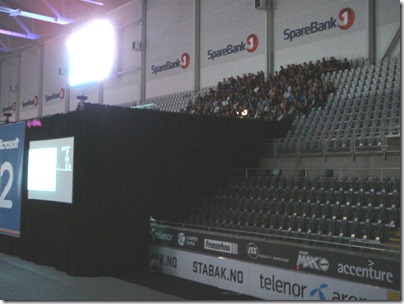
Scott Hanselman has this photo from a sports arena converted into a lecture hall.
Hanselman explains what you’re seeing here:
They’ve used curtains to build up a “room” on the bleachers of this part of the stadium. I’m inside that black box, and the people who are overflowing up the bleachers also go all the way down to the bottom. On the outside of the box is projected both a live video of me as well as my projected computer. That acts as an overflow room, and there’s people sitting out there also. It’s a very clever way to do it, and they’ve set up six different track rooms, all like this, around the stadium.
My main question is this: how can this not have awful acoustics? It’s certainly clever, and does add the potential for hot dog vendors to stroll up the aisles during a lecture.
What’s the strangest venue you’ve spoken at? Bonus points for pictures.
Hi there. I’m now back from my ramble through Scandinavia.
If you were at my seminar in Milwaukee (we had many questions on estimates and schedules), or struggle with bad estimates somewhere else in the world, you’re in luck.
Next week my friend Steve McConnell is doing a free webcast on the ten deadly sins of estimation. As if the regular sins weren’t bad enough, these are the ones that kill. Registration and details here. Tuesday June 23rd, 10am PST.
And here’s more stuff from Steve’s consulting firm, Construx, on estimation:
If you haven’t checked out speakerconfessions.com, you should. There’s some good material there and it gives a flavor for the questions I’m asking and answering in the book. Spread the word if you can.
I’ll be taking a break for a couple of weeks so don’t expect much to happen here until I’m back.
I’m speaking at BusinessToButtons in Malmo, Sweden next week and wrapping some R&R on both ends. And I’ll be posting again come mid June.
As research for the book, I’ve been collecting stories of things going wrong. From hecklers, to equipment failures, to tough crowds.
Today I’ve heard one of the best stories of things going wrong. It’s a great story of what he calls a hell gig.
Comedian Colin Quinn gets invited to speak at Robert De Niro’s birthday party, and nearly everything that can goes wrong, goes wrong, in front of dozens of major celebrities like Robin Williams, Harvey Kietel, Billy Crystal and others.
This is not a game. They held a competition of driving video gamers and the winner got to race in an actual driving race. Interesting story about the process.
From Speaker Confessions:
How to give a great Ignite talk. What I’ve learned from doing 4 different ignite talks, including an actual ignite talk on how to give an ignite talk!
Recently I’ve been playing tons of Gears Of War 2 for XBOX 360, because of it’s fantastic HORDE mode. I’m not a huge gamer. But find me:
A game/mode that has well designed UX
Is easy to learn, but hard to master, and fun to fail at
Has few annoyances (mandatory tutorials, non-skipable intros, etc.)
Has a team based, rather than purely competitive, mode
And I’m in. Great games, as rare as they are, are the perfect relief from long hours of writing. And if I can play with friends on the same team, all the better.
Like real life projects, where you can can only survive by working together, the HORDE mode is based on co-operation. You can’t get very far without working as a team.
However this doesn’t stop many players from trying to do it all on their own. It’s funny, gut also sad, in HORDE to see players make the same mistakes again and again and again, just like in the workplace, for not recognizing they need a team strategy to win, not just solo tactics.
Here’s lessons from HORDE that apply to many project teams:
team co-ordination > Individual talents . Early on you can get by with how good you are alone. But as soon as things get intense, or you fall behind, working solo is a liability. Programmers and Managers who insist on doing everything themselves are set up to fail when that approach reaches it’s inevitable limit.
Have a fallback position everyone knows. When everything is going to hell there is no time to make a plan. People are too stressed to think clearly anyway. This means you must have a fallback plan defined at the beginning. My friends and I call it the hiddy-hole – a spot where we will all fade back towards, that is defensible, easy to find, and likely to be where other teammates are.
Over Communicate. Talking matters. In Horde you have to share what you see, and take advantage of all the viewpoints. Teams that talk more last longer – it’s nearly a rule in Horde. If a minute into the game no one has spoken, it’s going to be a short game. Same goes for project management – teams that are good are sharing useful info with each other prevent things from going from.
Stay together. The temptation in HORDE, and in life, is to seek your own glory. To go out away from the pack. But as soon as the waves get hard enough you can’t do it alone and before you know it you’re dead because something snuck up behind you. If you stick together it’s surprise is less likely, and since you have two people dealing with it, survival odds are much higher.
Watch your buddy’s back. One of the most interesting elements of Horde is when you’re wounded another player must come and revive you. The teams that last longer are the ones who make reviving other players a priority. It’s a reciprocal trust thing – someone has to do it first and if you don’t reciprocate they might not do it again.
Develop a shorthand. The more you communicate the sooner you develop a shorthand. Novice players say things like “Lookout, it’s coming!” Without telling you where the bad guy is or what it is, which is useless. He may as well just say “aaaaaaaahh!” You want an efficient shorthand that makes frequent communication efficient. “Butcher at 2’oclock from fallback”. Shorthand makes it easy for many people to communicate without burying people in noise.
Recently I’ve started playing Left 4 Dead with the same circle of friends – It’s been great so far. Also excellent team based, co-operative game design. Easy to learn, fun to play.
Are there any other XBOX 360 games with excellent co-op modes? Let me know.
Ignite is a presentation format that’s simpler than Pecha Kucha but longer than lightning talks. In Ignite each speakers gets 5 minutes, and must use 20 slides with each slide advancing automatically after 15 seconds, forcing speakers to get the point, fast. Having slides that automate seems mad, and in a way it is, but the surprise is that for most speakers it forces them to be far more concise and thoughtful than they would in any other format.
Even without the automation, my advice holds well for any kind of short talk. Why should anyone get the stage for 20 or 50 minutes if they can’t keep people’s attention for just 300 seconds? In many ways it takes more craft to make a short talk work well than a long one.
Often Ignite events have a dozen or more speakers, creating a fun evening with a wide range of advice, stories and entertainments.
I’ve spoken at many Ignite events and here’s what I’ve learned:
Pick strong storiesand big themes. What do you love? What do you hate? What is the best advice anyone ever gave you? Pick stories with big themes, since they require less introduction. What are the 4 most important things to know about X that no one talks about? The stronger the topic & title the easier the material is to create. Consider what one thing you want people to have learned when you’re done and make sure to drive that home at the end.
Outline 4 or 5 main points. You need a simple structure to make your message clear, and make sure people can follow along. Don’t assume you can just ramble your way through: the short format means you need to be more careful about how you use your time, not less. Ask yourself: what are the major lessons or points you want people to remember when you finish? That’s the structure of your presentation.
Figure out your points before you make slides. Talking about something for five minutes is easy – really, give it a shot once or twice before you make a single slide (practice with a timer) it will help you sort out what you want to say. You’ll quickly discover how unlikely it is to run out of things to say during an ignite talk. Once you know the 4 major points you want to make, only then work on finding images and slides to support what you’re going to say.
300 seconds is easy to practice. You can practice 10 times in an hour. Do it (The average Ignite speaker practices 5 times). 300 seconds equals 10 television commercials – you can make great points in a short time if you refine your thoughts. The entire sermon on the mount can be read in about 5 minutes and The Gettysburg address takes about 2 and a half minutes.
It is good to breathe and have pauses. There is no law that says you must fill every second with talking. When you practice, practice breathing. Give your audience a moment to digest the last thing you said. Take a moment between points. Like whitespace in visual design it’s the pauses that make what you do say stand out clearly. Give yourself a slide or two that’s for just for catching up and taking a breath.
Don’t get hung up on slides. What you say matters most. Good slides support what you’re saying, not the other way around. The last thing you want is to end up chasing your slides, a common problem at Ignite as you’ll never catch up. Pick simple images and if you must use text, be sparse (and use large 50+pt fonts). No bullet lists, just one or two points. Make the slides flexible enough that if you fall behind it’s easy to skip something to catch up.
Make your talk fault tolerant. Unlike normal presentations, if something goes wrong there’s no going back. You should build your talk into 4 or 5 pieces, where each piece could stand alone. Then if you fall behind, or something goes wrong, when the first slide for the next part comes up, you can easily recover.
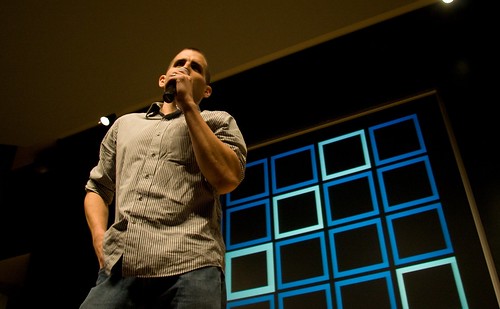
You can hack the format. The idea of a ‘slide’ is vestigial – they’re not slides anymore. Put the same slide twice if you want to have more time to make a point. Or don’t use slides at all if you don’t want them. I’ve hacked the format a few times, including using a special time counter deck to give me more flexibility (see photo above). You can see this in action in my ignite talk on Attention and Sex or grab the deck here if you want to use or hack it further.
Plan to lose your first and last slide. Time will get eaten by getting on and off stage, the audience laughing and by any ad-libs you do. When you practice allow for some extra seconds, especially in the second half of your talk, when you might need to catch up. Plan and practice for about 4:30 instead of the full 5:00.
Keep your fonts large. Assume people don’t see well. Even if they did, people will be trying to listen to you. The more you try to cram text on the screen at the same time, the less likely any of it will be understood. Same goes for complex diagrams – there just isn’t time. Simple images or photographs work best. And again, you are not required to use slide at all.
You can find royalty free images to use. Search Google’s Creative Commons, flickr using the advanced options to show you creative commons images. Or try freeimages.com or istockphoto. Please attribute any photos you use with either the URL in small font on the bottom, or a last slide that simply lists all the URLs for photos that you used.
If you’ve spoken at Ignite and have more advice leave a comment. I’d love to hear your thoughts on how preparing helped… or didn’t 🙂
I’m teaching a full day seminar on making things happen (project management fun) this Friday at the University of Wisconsin in Milwaukee. It’s $129 for the day, and i believe it includes lunch – a super bargain.
Bad reporting in action: NY Drivers worst in nation. The written test is almost irrelevant, don’t you think? At least it was when I took it way back when..
Why we say ummmmm. Some facts on one of the most annoying things about public speakers.
One of the most annoying bad habits some people have when they give a presentation is the use of “ummmm” to fill the space between words. Why do people do this?
There are four reasons:
It’s a habit in normal speech. People don’t just do it on stage, they do it in real conversations all the time. We just don’t notice it as much. In one study 40% of all verbal mistakes are umms, or filler noises, of some kind (From Errard’s book, below).
It’s a way to hold the floor. By making noise you indicate you’re not done and prevent other people from interrupting you. This is not necessary of course when on stage, unless it’s a really tough crowd.
It’s a nervous habit. Some people do it more when they are nervous. Generally the worst way to express nerves is through your mouth if you’re giving a presentation.
We are afraid of silence. There is the feeling among many people when they speak that if they are silent people will boo them off the stage. So they feel obligated never to stop making some kind of sound.
In Michael Errard’s excellent book Um: Verbal Blunders and What They Mean, he explains that we make many verbal mistakes every day, on the order of one every 10 or 15 words. We just overlook them. We stop, restart, change words, clip words, repeat phrases, all the time. He calls these slips disfluencies. Read a transcript of any conversation, even on TV talk shows, and you’ll see what a mess language is if you pay close attention.
However any repeated filler noise like “ummm” becomes distracting if you are the primary speaker. Other fillers include “So”, “Like”, and “Know what I mean” (Curiously different languages use different sounds). Anything repeated unnecessarily can become an annoyance.
As annoying as this habit can be it’s an easy habit to fix.
How to break the habit:
Admit you have a problem. This is always the first step and it’s the hard one. Many have this bad habit but don’t know, since they’ve never listened to themselves speak. Record your next talk and listen. If you umm more than once every 5 minutes, you may have a problem.
Practice with intent. In the privacy of your own home, practice one of your presentations, but stop and start over when you say ‘umm’ or other filler words. Set a goal of trying to go 5 minutes, then 10, then 30, without ‘umming’ once. This is a great way to work yourself out of many bad speaking habits.
Enjoy the Silence. Depeche Mode had it right. Pick your favorite speaker and pay attention to their pauses. Good speakers enjoy their silence. They take patience between points to let them sit. And when lost allow themselves a few moments of silence to sort things out in their own mind. If you notice when a speaker is silent they draw in more power from the room, like a wave going out before it comes back in.
Feel the pain! Some Toastmasters groups go so far as to have an Ummm-gong: someone who rings a little bell every time someone says “ummmm” in a practice presentation. It’s a bit militant but instant negative reinforcement may do the trick for you.
Have a story about presentation death from ummms? or know now a trick for getting rid of them? Leave a comment.
One of the most annoying and bad habits of public speakers is the constant use of “ummmm” to fill the space between words. Why do we do this?
There are four reasons:
It’s a habit in normal speech. People don’t just do it on stage, they do it in real conversations all the time. We just don’t notice it as much. In one study 40% of all verbal mistakes are umms of some kind (From Erard’s book, below).
It’s a way to hold the floor. By making noise you indicate you’re not done and prevent other people from interrupting you. This is not necessary of course when on stage, unless it’s a really tough crowd.
It’s a nervous habit. Some do it more when they are nervous. Generally the worst way to express nerves is through your mouth if you’re giving a presentation.
We are afraid of silence. There is the feeling among many people when they speak that if they are silent people will boo them off the stage. So they feel obligated never to stop, and never to stop making some kind of noise.
In Michael Errard’s excellent book Um: verbal blunders and what they mean, he explains that we make many verbal blunders all day every day, on the order of one every 10 or 15 words. We just overlook them. We stop, restart, change words, clip words, repeat phrases, all the time. He calls these slips disfluencies. Read a transcript of any conversation, even on TV talk shows, and you’ll see what a mess language is if you pay close attention.
However any repeated filler noise like “ummm” becomes distracting if you are the primary speaker. Other fillers include “So”, “Like”, and “Know what I mean”. Anything repeated unnecessarily can become an annoyance.
As annoying as this habit can be it’s an easy habit to fix.
How to break the habit:
Admit you have a problem. This is always the first step and it’s the hard one. You may do it an not know. Record the next talk you give and listen. If you umm more than once every 10 minutes, you may have a problem.
Practice. Most people can learn their way out of the habit if they practice talking and catch themselves every time they um.
Enjoy the Silence. Depeche Mode had it right. Pick your favorite speaker and pay attention to their pauses. Good speakers enjoy their silence. They take patience between points to let them sit. And when lost allow themselves a few moments of silence to sort things out in their own mind. If you notice when a speaker is silent they draw in more power from the room, like a wave going out before it comes back in.
Feel the pain! Some toastmasters groups go so far as to have an “ummmgong”, someone who rings a little bell every time someone says “ummmm” in a practice presentation. It’s a bit militant but it probably works.
Have a story about presentation death from ummms? or know now a trick for getting rid of them? Leave a comment.