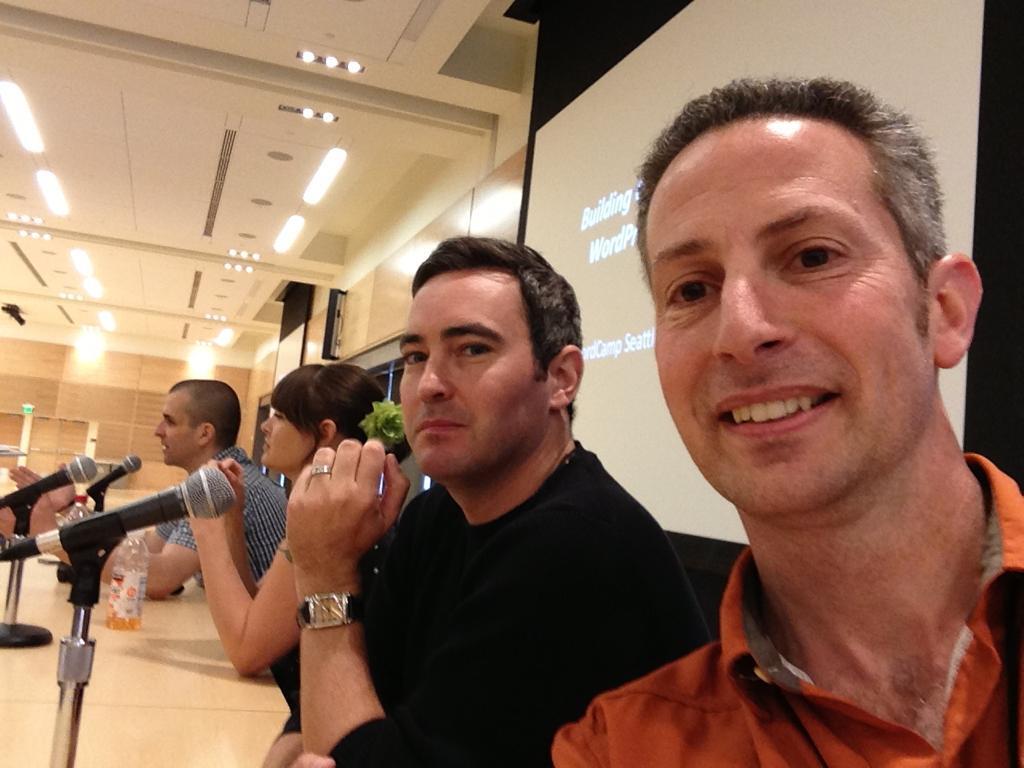
Michael Cyger, from isixsigma.com a B2B website that provides research and how-to knowledge for businesses (who took this photo)
It’s hard to capture the vibrancy of a discussion in a blog post, but this is a short summary of some the topics from my notes.
Some of the terms / facts I learned as moderator:
“cold start” – the challenge of getting your first comment, people are afraid to be first
“Cheers effect” – you need a small group of interesting regulars
Quality content first – you can’t get community until you have visitors. You won’t have visitors until you have (good) content.
“sockpuppeting” – the ethically questionable practice of posting comments as other people
10am is often the peak of commenting activity (Steve mentioned it: need source)
60% of time by readers is spent below the fold (ditto)
Questions to ask:
Why do you want a community? Do you have a larger ambition (say profit)? How does that fit or conflict with the goals the people who you hope will join your community? You need to personally reach out to people who might match your goals and invite their participation.
How do you reward people who comment? What natural, intrinsic rewards can you provide?
Brand and names matter: you want to pick a name for your site that is inviting and attractive, but not so bland as to be generic.
Here is a brief list of the links and references mentioned during the panel:
Megapost from Disqus with interesting data about how to measure community engagement
I’m going to a conference for the first time, in part to meet an author that inspired me who’s speaking there. Do you have any advice on what to do and, mainly, what NOT to do when I meet him?
I know that I’d love to talk with him about a lot of things, but I don’t wanna bother him. To be honest, I’m a little anxious. How can I help make this more natural, without killing the authenticity? Am I already killing it by thinking about it and asking for your guidance?
I don’t know that anyone has traveled and paid for an event just to meet me, but I have had the good fortune to meet people who are fans of my work. It always feels good to meet the people who like what I do and it’s easy to be nice to them, since their purchases make my career possible. Often they’re truly fun and friendly to hang around.
But I have had some awkward experiences too where people expect a little too much from me, forgetting that the dynamic isn’t symmetric: they’ve known my work intimately for months or years, but I’ve just met them for the first time and it’s impossible for me to catch up in just an hour, much less a few minutes.
Here’s what I advise:
Set your expectations low. People who make great books, movies or games are just people of course, but in our minds as fans we build up an image that is impossible to live up to (Some of the marketing artists and makers do fuels this of course). A book or song can be perfect, but people never are. It’s worth looking over the 12 reasons you should never meet your hero as many people tell disappointing tales of meeting their lifelong idol. I myself have met some of my heroes, and I’m convinced if you set your expectations right, it can be a thrill. The trap is many people expect far too much and end up unnecessarily disappointed.
Be patient and simple. Most speakers at events are accessible directly after they give their presentation. A crowd forms near the stage and fans take turns asking questions or getting autographs. Have one thing you want to ask or say, and plan for that to be the totality of the experience. A simple “I’m a big fan of your work and it has inspired me. Thanks for doing what you do” goes a long way. No one tires of hearing this. If you want a picture or an autograph, that’s great. Or if a burning question has been on your mind, ask away. Let that be your one request. But after that, let someone else have their moment. If your hero isn’t speaking but merely attending, politely introduce yourself when you see them in a hallway and then make your request (don’t wait for a perfect opportunity, since at a big event you might not even see them more than once).
In social situations, leave them a way out. At smaller events, or if you’re lucky to spend significant time with them, always make sure they have a way to escape and that you haven’t cornered them into spending an evening with you hovering over their shoulder like a gregarious hummingbird all night long. If you do want more time with them, collaborate with another fan or two so the offer comes from a friendly group and not a solo stranger. If your hero wants to spend all night talking to you or share a meal, or have you join his/her social circle that evening, that’s great, but be polite about not assuming you’re their new personal companion.
Contact them online, before the event, if you want a dialog. Email has the tremendous benefit that recipients can respond at the time they wish. There’s much less social pressure in email, whereas at an event, there is tremendous social and time pressure on famous people. Email them before the event with a very well thought out comment or question, and/or a strong thanks for their work and how it inspired you. Mention you’ll be at the event and hope to meet them. Odds are very good you’ll get a reply if your email is thoughtful, well written and not too long. Pick one clear question to ask if you have one, rather than a litany of little ones. I get a lot of email, but the odds of getting a reply rise dramatically for the ones that are well-written, thoughtful and ask clear questions (that they know I haven’t answered elsewhere). Many blog posts here on stage.scottberkun.com/ come from reader questions, which I love to get.
Bring a copy of their book, album or whatever they make. It’s impossible for me not to notice someone in the audience who is holding a copy of one of my books. I can’t help but want to talk to them, as they’re visually putting up a flag that they’re a fan and probably want an autograph. I might feel differently if everyone in the audience showed up one day with a copy of my books (that might be a little terrifying but I’d like to find out of course). I don’t know of any musician or writer who doesn’t respond with the same undeniable joy when they see a stranger with the book or CD that took years to make in their hands.
They say the devil is in the details, but the angels are in there too. That is, if you have a clue about what you’re doing. People who want to design things have large egos and presume that they’re skilled enough to work on large, grand ideas. But so rarely do designs in this world get the small things right, and if the small things, the little pieces that get used the most, are broken, what is the point of being large?
Dan Saffer’s book Microinteractions is the best book I’ve read about design in ages. I’ve been working in design for 20 years and often have younger designers ask me for advice, or how to achieve their grand design dreams. Most books about design are similarly grand and presume that everyone knows the basics well enough to do the little things well. The world proves this not to be true. Spend an afternoon strolling around town with a gaggle of caffeinated interaction designers and you’ll hear an endless commentary on the details the designers of the world have gotten wrong.
The book itself is a wonderfully self-consistent: it’s short, concise, well designed and brilliant. The fun and salient examples nail Saffer’s points, and his writing is sharp, incisive and with just enough comedic curmudgeonry to keep you smiling most of the way through. The book’s ambitions, like any good design project, are clear. Saffer’s focus is on the small sequences of interactions he calls, surprise, microinteractions. Ever been frustrated by entering your password? Leaving a comment on a blog? You’ve been let down by a microinteraction design. Perhaps the majority of design frustrations in the technological world are micro, not macro.
This is the book many designers will begrudgingly pick up, thinking it’s beneath them, but by the time they get to page 25 they’ll be thinking “oh, this is fun” and then by page 50 they’ll realize “oh dear, I make that mistake, or have peers that do” and when they’re finished they’ll know “I now have a language to describe these important problems that have bothered people for ages but were hard to describe, and I have the knowledge now to fix them properly”. What more can you ask for from a book about designing things?
We live in a world where the clueless have disturbing amounts of influence. There are no licenses required to use words like design, simplicity and quality, and it should be no surprise we’re often victimized by the engineered junk companies pass off as products. If we want that to change we have to start in the small. Until a designer, or an organization, can consistently get the details right, what hope is there to get the grand things right either?
Please buy this book. I say that selfishly as I want better design in the world. But I also say it generously: so many design books are fluffy affairs, lost in abstraction and ego. Saffer has hit the bullseye of problems the design world desperately needs to solve, and written a book every designer needs to read.
Every organization has a ratio of idiots to non-idiots. This is the idiot ratio.
This is a harsh, shallow, unfair way of looking at people, but everyone, no matter how offended they are by the premise, can come up with a number in their mind quickly. It’s an easy way to measure the talent pool in any organization. If for every 10 people you work with 3 are incompetent, your ratio is 3:10. Maybe you work somewhere that hires well, and it’s 9:10.
How to use it: when two people meet to compare their workplaces, both parties think through the people they have to work with regularly and assess how many are incompetent or ineffective. The resulting ratio, 1 in 5, or 1 in 20, is the idiot ratio. Or more optimistically, the talent ratio. With the ratio two people can quickly compare their assessments of their teams.
As mean as this ratio sounds, it might be more honest than when executives say “we have the smartest people in the world”, which is likely self-serving politeness. There is no executive that would ever openly say “our talent sucks” or “we are mostly idiots” even if they believed that.
Limitations:
Of course low performers aren’t necessarily idiots. Idiocy is about the person, incompetence is about the job. Calling it the Incompetence Ratio would be more accurate, as the person might be a bad fit for the job but possibly good fits for other jobs, but that’s a less fun phrase to say.
Intelligence doesn’t guarantee chemistry. A collaborative team of good people can run circles around a dysfunctional team of geniuses. (See Teams and Stars)
You might be the idiot. If you are, your ratio won’t be accurate unless you are humble enough to count yourself.
[This idea is from Rachelle Uberecken, a Senior Software Developer at a place with a pleasantly low idiot ratio]
Next This week I’m moderating a panel on building online communities as part of WordCamp Seattle, at 1pm Saturday June 8th. I have four experts, either with vibrant communities or with wisdom about how to grow and maintain them. I’m looking for questions and challenges for them during the session.
The panelists are:
Michael Cyger, from isixsigma.com a B2B website that provides research and how-to knowledge for businesses
Most blogs struggle to get comments on posts, much less build an active user base that lead their own discussions. What insights would you want to hear from people who have made it work?
Even if you’re not attending WordCamp Seattle, what would questions would you ask? What situations have you experienced as a blogger that you want an expert’s opinion on? Please leave a comment. I’ll make sure there’s a writeup afterwards so you can read the answers even if you couldn’t attend.
I’m speaking today at An Event Apart San Diego about Feedback Without Frustration. Here’s a summary of my best related blog posts:
I spoke at TEDXDepaul last month, on the invitation of Daniel Gurevich. He gave me free reign to decide what to talk about, a liberty I enjoy, so if you like this talk you can thank him too.
I spoke at TEDXDepaul last month and it was a fantastic event. The organizers Daniel Gurevich and Matt Helbig did a fine job from a speaker’s perspective. They chose a great venue, sold every ticket, paid for good A/V, the stage was well lit, and they had a great roster of other speakers (you can read my notes on all of the talks from the day here).
But there’s only so much organizers can do: speakers have to do the heavy lifting of good material and delivery.
Tactical mistakes are annoyances. If the material and delivery are good, people will overlook these problems. But a good speaker wants as few distractions from their ideas as possible. There were two tactical mistakes speaker’s made at TedXDepaul worth reporting.
If you hold a device, it creates glare that moves.
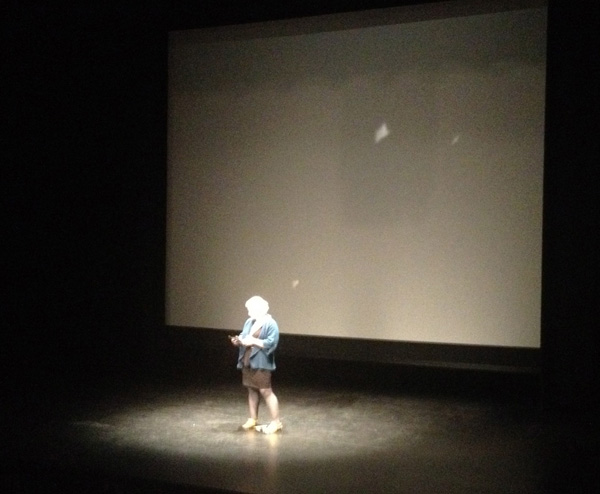
Marcy Capron of Polymathic chose to use an iPad for her notes. There’s nothing wrong with notes themselves, or iPads, but in this case the stage lights reflected off her iPad onto the screen and walls behind her. And every time she adjusted the iPad, those glare spots moved around. It’s hard not to be distracted by bright things that move on a large screen.
If you plan to have a device on stage, ask for a run through with the stage lights on to check for anything unusual. If there are glare issues, most venues can provide a lectern to place your device on, eliminating this problem.
Don’t wear a hat.
Doug Zell of Intelligensia Coffee arrived late, and joked about it, which bothered me all on its own. The primary commitment every attendee and speaker have made is their time, and it’s a sign of great disrespect to be late, much less to joke about it (Apparently he was in a bike race earlier in the day, and would have entirely missed his speaking slot if the event wasn’t running late). He had a cavalier attitude about the whole thing which rubbed me the wrong way. His talk on branding was good (notes here), but he crossed the line for me on professionalism. You must show your hosts, fellow speakers and audience respect. He was the closing speaker and hadn’t seen a single talk for the entire event.
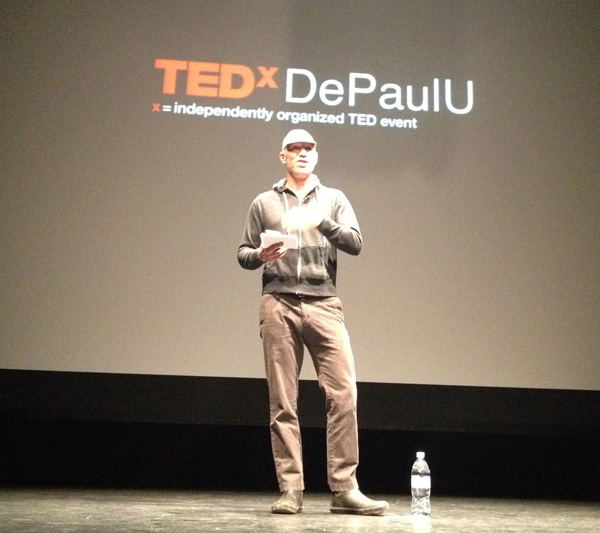
The specific tactical mistake he made was keeping his biking hat on. As you can see here, wearing a hat on stage puts a speaker’s eyes into shadow. Eyes are the most important part of the face to connect with, and a hat hides them. Good lighting amplifies the problem, as it casts the rest of a person’s body into good primary light.
I don’t root for sports teams for the same reason I’m not religious. The divisions between one group and another are too arbitrary to hold my attention.
If you ask a sports fan why they root for their particular team, it takes them some time to answer. Being a fan is not a logical choice, it’s emotional and tribal. It’s often an inherited decision, a choice not made but absorbed.
Most people are fans of the nearest team, the team of their home. It’s likely their parents, grandparents and childhood friends all rooted for the same team, and the bond they feel for that team is combined with the bonds they feel for their community. It’s the same cultural premise of rallying together as a tribe, and rooting for the warriors to go fight and defend the community, keeping everyone safe. This is a good premise if lives are at stake, as rallying together is what has helped us survive this long. This drive is deep in our biology, explaining why it feels good to stand in a stadium with thousands of people all cheering for the same thing. We are driven to feel connected, explaining the popularity of music concerts, rallies and events of all kinds.
But when you realize how many teams there are it’s harder to find a good answer for the question: why this team and not that team?
I used to be a fan. I grew up in NYC and had Yankees, Giants and Knicks posters on my wall, and wore the jerseys of my favorite players to school. I was a passionate sports kid, good at basketball and football, and I felt connected to local teams for that reason: I imagined myself playing professional sports one day. But as a teenager I stopped wearing player jerseys. It struck me as strange to want to be someone else, even someone I admired. I wanted to be me, and since I played basketball for my high school, I had my own jersey with my own number. I still loved my teams and loved cheering them on, but something had already changed.
Then I moved to Pittsburgh for college and was shocked to discover a new tribe rooting for a new set of teams. What was wrong with these people? I wondered. It seemed absurd to root for the Pirates and the Steelers, since they just happened to be nearby. It didn’t dawn on me until I returned to NYC, and saw the my own hometown fans, that I realized I’d done the same thing my entire life. Had I been born in Chicago, I’d have been a Bulls and Bears fan (teams my Knicks and Giants despised). Being a fan wasn’t a choice I’d made, so much as inherited. And I’d inherited hate too. I hated Chicago simply because they rivaled my Knicks and Giants. To root for a team means to root against the other ones.
Moving to Pittsburgh also reminded me of a childhood friend who moved to NYC from Toronto but still rooted for his hometown Blue-Jays. I remember the daily abuse he got from his “friends” about his choice. His Blue-Jays cap was seen as a betrayal of our tribe, but I realize now he was a much tougher fan than we were. He paid a price for that choice every day. It’s not brave in any way to show up to home games and root for the home team, even if you’re wearing face-paint and a wedge of cheese your head. Everyone loves you because, like the team mascot, you embody the tribe they are already rooting for.
The lyrics to “Take Me Out To The Ball Game”, a song sung at nearly every major league baseball game, are telling: Root, root root for the home team, if they don’t win it’s a shame. But why? What if the home team is a bunch of jerks? Or if they’re a lousy team? It’s only a shame if they lost unfairly. The fact that they were home or away should be irrelevant, shouldn’t it? At basketball games it’s now standard for the people sitting behind the hoop to wave objects and scream, hoping to distract players on the opposing team. At football games fans scream as loud as they can when they other team has the ball, hoping to prevent them from talking to each other about what play to run. Somewhere along the way rooting for ones own team has warped into to impacting the play of the game itself. The Seattle Seahawks even calls their fans the 12th man, an extra player helping the team. It’s great to see a team honor their supporters, but it’s also weird for fans to become part of the game.
Today I root mostly for close games. I don’t care much for any team. Mostly I want to see everyone play well. I want to watch the height of the sport. I want to see a game that will live on in all of the player’s memories for being the greatest game they played, something a blowout win never provides. I like certain players, and occasionally, find connections to certain teams, but it rarely runs deep or lasts long. To fans of teams this makes me a traitor, but I prefer to see my love of competition transcending my interest in any particular team.
Like fans of sports teams, most people adopt the religion of their village and their parents. It’s not a choice, in the same way it wasn’t a choice for me to root for the Knicks. Religions, like sports fans, are blind to how many equivalently well justified alternative views there are in the world. They often rally as much around crushing their rivals as they do honoring their own beliefs, despite there being no championship trophy to compete for. Being a fan of anything makes it easy to lose perspective on what you care about and why, which explains why I will never be a fan in the same way again.
A story with metaphorical truth even if not factually accurate
I spend time on this blog debunking factual myths like Newton’s Apple, even for things as boring as mythical numbers in schedule estimates, because I have expertise and believe people who read my blog want to know the truth. While complete ignorance is neutral, faith in a lie is dangerous. I don’t want the suspension bridge I drive across to be built on a pet theory. People with knowledge should be compelled to use what they know to question, poke and prod the darkness, especially the darkness snakes sell as light to fools.
But I do love the metaphorical truths found in mythological stories. The winged story of Icarus and Daedalus isn’t true in aerodynamic fact but contains powerful truths about ambition and trust. Few great works of literature are true in a factual sense, but their freedom from facts allows the expression of emotional or philosophical truths in ways factually based stories can’t. Picasso said “Art is the lie that tells the truth” and that’s what he meant. It’s not a justification for lying on your business plan.
Factual myths are very hard to kill. Simple lies are more popular than complex truths.And the most common factual myths have nuggets of truth in them, just enough to get past most people’s BS detection systems. Newton was never hit on the head by an apple. It’s one of the most popular stories in this history of science, yet it’s a fabrication. And science is a community of practice obsessed with factual certainty. How could this survive for so long?
The answer is the people most inspired by a story are the least interested in challenging it, and the most interested in spreading it. Apple Inc. chose its name after Newton’s apple, but never bothered to check the veracity of the tale. Why? Probably because they liked it and the popularity of the tale was part of the attraction. Popular lies grow into legends, and everyone wins in the spreading of a legend, everyone except the people who care about facts. I do like legends for their metaphorical truths, but it’s dangerous to confuse those with factual truths. Marketing and advertising live in the grey between what’s true and what’s a willful lie.
Does the true story of Newton, or anyone, matter? It depends. If you’re a fan and it you simply want to feel good about your fandom, then perhaps truth doesn’t matter. But if you are serious about achieving yourself, truth is essential. To achieve greatness the precise factual truth about what a hero did or didn’t do matters. I’m convinced these truths, if told well, always have more inspirational power than false legends. But not everyone agrees with me. I wrote The Myths of Innovation to sort out the history of ideas for people who want to stand on the true shoulders of giants, not the made up fantasy stories we’ve popularized. But as popular as the book has been, it will never be as popular as books that promise to teach you the magic secrets of geniuses in five minutes.
Falsehoods never go away completely. The ones that last are too fun, and too convenient, to kill. While Snopes.com will always be popular, it will never popular enough to eliminate the need for its existence. It’s too easy to bend legends to the needs of the teller and the listener. Few people are motivated to seek sources to verify what they see, hear or read. This is why legends grow in size with age: there are fewer and fewer people who witnessed the events around to question the tale. But I believe it’s progress to examine these stories anyway. It’s the duty of people with knowledge to use it to shine light on darkness. I know I will never eliminate the lies, but I must use what I know to help as many others find their way as I can.
History reveals itself to be a sloppy garden of truths, myths and lies, and it requires endless tending. Serious writers are the gardeners of ideas and must garden not just for the present, but for the future.
I used to feel guilty about books I own but haven’t read. They’d sit in piles making me feel unworthy as a writer, and reader. And no matter how many books I’d read in a year, I’d always find myself buying more. I couldn’t win. It was a destructive cycle and it drove me mad. It was yet another kind of information I seemed to be drowning in.
One day I realized there was another way to frame my behavior. The goal should not be efficiency because efficiency makes you conservative. As a writer I need an ambitious curiosity, not a safe one. It’s good to take bets on books at the limits of my comfort zone. That willingness to buy books signals to myself there are new worlds other creators make, and for the price of a meal I can purchase the opportunity to discover them. I can’t penalize myself for trying. If I never read any of the books that might be a problem, but merely not reading some of them is entirely sensible. The clothes we buy mostly sit unworn. Our couches are mostly not sat in. It’s rare for a thing to be used as much as it could be.
Buying books also has these larger effects:
Purchases signal the creator that I’m interested in what they made.
It’s a bestseller list – not a best read list – buying a book signals agents, editors and publishers.
It provisions future curiosity, since in 3 months or years I can easily read that book.
Seeing a good writer’s name and knowing I helped their career feels good (hint hint).
I feel no guilt now in abandoning books either. They’re not children, they’re invented things. If I don’t like it after 50 pages I owe the author nothing. In fact since I bought the book, I paid for the right to read as much or little as I please. Never finishing books is a different problem, and the solution for that is buying better books.
Not sold yet? How about this: on the day I was born there were already more books published that I could ever read. There was never the potential to read everything. I have to abandon the expectation of perfection in my book purchases, for the same reasons I need to abandon the expectation of perfection in everything. Books are cheap, my literary inefficiencies doesn’t cost much in the long run, especially if those bets and gambles help me find a book or two a year that changes my life.
Related:
Tsundoku (積ん読) is a Japanese word that means ‘stacked readings’ or books you’ve bought but haven’t read.
A decade ago, on a dare, I took a class in improvisation. I was surprised how much the class helped me experience daily life. It made me a better speaker and teacher too. Recently I decided to take improv class a second time, and again I was surprised. I’d forgotten how much I’d forgotten. My classmates had so much fun together that most of of us have continued on to the 200 & 300 level courses.
Here’s what I’ve learned and why I recommend people should take it.
Assumptions that are wrong:
It’s not about being funny. When I mention improv class most people are terrified. They assume students are thrown on a big dark stage where someone yells at them every few seconds to do something funny. The reality is far tamer: it’s mostly playing games. Simple ones, like saying sentences where you alternate words with someone else. The games get harder as the classes go on, but you’re often told to avoid trying to be funny. Instead the goal is to pay attention and to commit fully to whatever you’re doing. If everyone does a few simple things well the result is comedy, but it’s not a straight line.
You don’t have to be a natural performer. In the class you quickly learn improv (and most drama) depends on the commitment of actors to the scene they’re in. Being ‘good at improv’ is not talent in a conventional sense, but more of a capacity for being fully attentive. Enthusiasm and willingness matter most.
It’s not hard to learn. Both times I’ve taken the course I’ve been amazed at what happens when you get a bunch of ordinary strangers to faithfully follow the rules of the games. The rules are brilliant: they let magic emerge from a story people build together.
What I’ve learned:
I’d forgotten how to play. The games played in improv might bore a typical 8 year old. But for adults they’re wonderful. Someone says “Be an angry fish” and everyone says “I’m an angry fish!” and you have a room full of professional men and women instantly run around acting like a bunch of crazed, happy children. The rules for the game demand you jump in deep. And I’ve rediscovered what children know: when I jump in all the way I’m surprised by what I can do. So much of adult life is doing things by half, or pretending to care when we know we don’t. By rule, there is no half-assing in improv class. Whatever you are supposed to be right now, be it all the way.
Life is less stressful. Now when I’m in challenging situations in life I recall something ridiculous I was forced to do in improv, like miming my way through the world championship of dishwashing, and by comparison the life situation I’m in is easy. I’m more relaxed in general from taking improv class. Fewer things give me stress, as I’ve been in far crazier situations in class last week.
Questions and Nos are deadly. The improv rule of Yes and… is the most well known. The games make clear questioning slows things down and kills energy. It’s a bad habit many of us have in life, asking dozens of questions before we’ll try anything. The rule doesn’t mean you have to do what others tell you, but that you have to find creative ways to build on the energy of whatever they’ve offered, and offer it back to them to build on. It’s a simple principle, but we have many bad habits in how we handle things people offer us.
Improvisation is everywhere. Every conversation in life is an act of improvisation: no one gives you a script for the day when you wake up. Improv helps me pay attention, proper attention, to all the situations I didn’t realize I could influence, or that were available to me if only I noticed them. Or more precisely, going to improv class makes me comfortable in dealing with whatever happens in many situations with other people.
Metaphors for Life. The core rules work well as life philosophy: No half-assing. Make the other guy look good. Say Yes, And…, make big offers, it’s better to fail big then fail moderate. In tough decisions and situations I think about improv rules often and they help.
Doing > reading. I’ve been recommending improv class to people for years, but even I’d forgotten how much I’d gained from the experience. Life is experience and reading about other people’s experiences, as powerful as it can be if the writer’s good, is a shell of having the experience yourself. Merely reading about improvisation, creativity or anything else of importance robs you of what you’re seeking. Put yourself in the middle of things.
If you know of an improv comedy group near you, most teach introductory classes. Go take one. Grab a friend if you need to, but go sign up. In Seattle my class is with Unexpected Productions, but a decade ago I took it with Jet City Improv.
I’m 41 years old today and I never expected to live this long. Although I’ve spent more time in hospitals than I’d have liked, my lifespan expectations were not born from a specific reason. I simply recall as a teenager imagining the totality of my life and somehow those imaginations never got far past 30. There just didn’t seem anything beyond that point as far as I could tell. My horizon ended there and now to reach beyond it is a pleasant surprise.
I don’t know why but as I’ve entered middle age I’m filled with giddiness. This all seems like a bonus round. I have my health and some of my sanity left. I say some, as I find most of adult life comically absurd. Voltaire wrote that “God is a comedian playing to an audience afraid to laugh” and I don’t seem to have much fear in that regard. Here in the first world we are so lost in distraction and pretense that taking most of what goes on at face value is something I’ve long shed from my experience of life.
7 months ago I tore my achilles tendon, but yesterday, after months of physical therapy, I was able to play basketball again for the first time. It’s a miracle of modern medicine I can walk without a cane, but to play is magical. And it’s magic purely for me. No one on the court knew my story. Kids half my age just saw me smiling and had no idea why. And I find myself seeking others who have similar smiles, a smile they don’t need to explain, a smile unhinged from the weather, or a job, or other trivia, a smile from somewhere deep inside that reflects their appreciation for the amazingness of ordinary things. Being alive, compared to the alternative, makes everything extraordinary.
And having lived beneath my means, provided I don’t do anything impressively stupid, I should be able to spend the better part of my remaining years doing what I’ve been doing for the last ten: living the life of a writer. I’ve made many sacrifices to get here, but it has held the deepest meaning for me to try and fill that shelf. I’m doing everything I can to make this dream last as long as I do. And I hope you’ll continue to help that dream simply by reading and following along.
Many people my age or older half-joke about wishing to be younger. Wishing to be young is a coward’s wish. People who wish to be younger would squander that miracle. They’re wasting the time they have now pretending they’d make better use of a different now. My soul fades in these conversations, as the souls of these people are already dead. They’ve buried their dreams under so many copouts they can’t tell the difference. I used to make the arguments, but I’ve learned they don’t want to hear them. They prefer the certainty of a fantasy, to the uncertainty of living fully in the present. The same cowardice that failed them the first time around would only fail them again if they had a second chance. And as I age I wonder: how am I still a coward? What would I do if I had the courage? Getting older makes me more courageous as I have far less to lose. Courage is far scarcer and more important than youth, and the upside is you can always grow more courageous, at any time, at any age.
America has a youth obsessed culture, but I’m slowly taking arms against it. The longer I’m alive the further I’ll be on creakier end of the bell curve of age, and I better get used to it. I’ve learned to be comfortable as the oldest person at the table now. I can learn as much from younger people as they can from someone older. I’m fascinated by young adults, old enough to be on their own but young enough to passionately chase their sky high ambitions.
I don’t envy their age, as they have so much to learn about what they want from life, but I’m drawn to their openness to the present. They make big bets on life, bets people my age are terrified of making, and maybe always were. But I have many big bets I still want to make. We are social creatures and behave like those we choose to be around, and I’m thinking I don’t want to act my age. I don’t want to hang out with my ‘peer’ group. The peers of my soul are not the peers of my generation. I find my mentality, despite my age, is far younger than my body and I hope it stays that way forever.
From the title I expected either a manifesto or pragmatic guide to self learning, but that’s not the case. The book centers on interviews with successful individuals who achieved success without following traditional paths. Although I easily read the entire book and recommend it, it’s an oddly shaped reading experience, where the introduction read more to me like a closing summational chapter. Although the book closes with a chapter of tactics and resources, and some interviews provide tips, the book itself is more inspirational than pragmatic.
There are some excellent interviews (Norton, Doctorow, Taylor) but some wander too deeply into personal histories and career specific advice, away from the book’s ambition (Cory Doctorow‘s interview felt as if it were repurposed as he talks more about writing than anything else). Unlike Founders at Work, where the interviews stand alone, or even What Should I Do With My Life?, where the author weaved the stories together, Don’t Go Back to School sits in the middle in structure. It took until I reached the 4th or 5th interview that I settled in to the frame and tone of the book. I’d almost recommend reading the interviews first, and the introduction and closing references last.
And yet one of my favorite lines in the book comes from Stark’s introduction:
A gracefully executed quit is a beautiful thing, opening up more doors than it closes
She also clarifies common strategies her interviewees shared:
Portfolios to show their past projects and demonstrate competence
They show enthusiasm and chutzpah
They are adept at learning on the job
They are meticulous about doing good work
And Stark takes to task the often sited data about the value of a college degree:
…as a historical trend, people with college or graduate degrees have higher lifetime earnings… the problem is that this statistic is based on long-term data, gathere from a period of mderate loan debt. easy employability and annual increases in the value of a college degree.
Some highlights from the interviews include:
Quinn Norton (Journalist):
To this day, lectures are one of the best ways I can learn things, now on my iPod. To really get it, I listen to the same lecture back to back, twice…
I was a very odd teacher… I hated grading. I remember standing up in front of them and telling them grades don’t matter… One of them raised their hand and asked, “Well then Ms. Norton, what matters?” I told them what you learn matters. The skills that you get are useful. Not the grade you get. They were aghast.
Dorian Taylor (Programmer):
At my present age of 33, I suspect I could get into any institution that would take my money. But I couldn’t tell you why I’d go.
Molly Crabapple (Artist):
If you go to a rich people school, in any major, you will get a network of rich people. If you go to a poor people school, you won’t get a network of anyone. I totally understand why people go to Ivy League schools, so that they’ll meet the future power brokers of the world. I just never had the grades or the money for that, so it wasn’t an option for me. I made my own way. I network with people who are outside my field – journalists, writers, performers – and I look for every opportunity in the entire world where there is a blank wall and I can put my work on it.
Christopher Bathgate (Sculptor):
Getting stuck for me has been one of my best teachers. It has taught me the huge difference between just knowing the answer, and knowing how to find the answer
Pablos Holman (Hacker):
A lot of the people I think of as being most capable and accomplished are those that dropped out of college and learned what they do on the job. Learning that way gives you a sense of responsibility and a sense of ownership of your skills and knowledge in a way that a degree doesn’t. You get a degree and it’s an external authority saying you know what you’re doing. The degree abstracts responsibility for learning and the knowledge you have.
Zach Booth Simpson (Researcher):
Don’t bother getting an education: just hang with smart people and ask good questions.
The book is excellent for people who want to break free, and need to connect with stories of those who have done it. Most of the interviews are with independent, freelancer, entrepreneurial professionals and their stories will have the most appeal for those dreaming about similar paths (as opposed to those who dream about middle management and want to get there without going to college).
A recent post called The Surest way to build a billion dollar company by James Slavet tries to look at data from the past to explain a plan for how to be a billion dollar company (And thankfully he never uses the i-word once). If you like his premise it’s a well written article with insights into how companies have achieved this in history:
The first observation in looking at billion-dollar consumer Internet companies is that there aren’t a lot of them. We’re approaching the twenty-year mark of the commercial Internet. Amazon and Yahoo were both founded in 1994. Yet from a recent scan of the public markets, there are currently only twenty-four publicly held U.S. based Internet companies that are worth $1 billion or more. That’s about one company per year for the past twenty years…
A full two-thirds of the 24 publicly traded U.S. Internet companies worth more than $1 billion are digital transaction firms. The billion-dollar club includes a heavy dose of travel, local and real estate businesses. The list includes Priceline, Expedia, TripAdvisor, HomeAway, Groupon, OpenTable, Yelp and Zillow. Other transaction-focused businesses that clear the threshold include Amazon, Ebay, Netflix, Vistaprint, Shutterfly, Ancestry, Bankrate and IAC/Match.com.
But there are fallacies lurking in the premise.
The surest way is not very sure. It’s very unlikely any company grows this large, even successful ones that are well run. Most new companies fail and even successful ones likely see normal levels of growth year to year. Even if Slavet’s advice is sound and followed, it doesn’t improve the likelihood much. It’s not as if we’re talking about the surest way to get a job, or the surest way to tie your shoes. Of course even a 1% improvement in odds is worthy if the stakes are high.
History is an unreliable predictor of the future. He accurately points out that most of the billion dollar companies of the last decade are transaction companies, suggesting that’s the domain with the best odds of becoming a billion dollar company. That may have been true in 1996, but it’s possible the abundance of these types of companies makes it a mature playing field, moving the domain of opportunity elsewhere, somewhere harder to predict. The next few billion dollar companies may look little like the last ones.
Most factors are beyond your control. The reasons why each of the companies mentioned (Google, Yahoo, Amazon) succeeded had much to do with forces those entrepreneurs didn’t control such as: how many competitors were there, how proficient were those competitors, how did their market change, which key people were available to join the company (or not), which technologies they depended on improved, etc. Entrepreneurs by nature discount forces they can’t control which helps them take on big risks, but those pivotal forces are also typically discounted in analysis of the past and the present.
Many billion dollar companies don’t start with the specific goal to be worth a billion dollars. I could use someone to check my history here, but I don’t think any of the companies he mentioned set out with an explicit goal to be a particular size or net value. They were all small companies started by people inexperienced with entrepreneurship who mostly wanted to create a viable business based on their ideas. They had projections of possible growth which their investors likely demanded, but when exactly were those projections made? Before they began or after they had a fledgling, but functioning service? Of course, given #2 and #3, the fact that they did or didn’t do something may have had little bearing on the outcome they experienced.
Bigger risk ventures have higher payoffs but lower success rates (maybe?). I don’t have data to support this claim, but a hypothesis is the factors you need to put in place to go after a billion dollar business, by design, increase the general risk of the venture. For example, buying a popular sandwich shop has very predictable returns, low risk, but modest growth potential. Starting a new web service in a new market has hard to predict returns, high risk, and high growth potential (if the market lasts). You can chart risk vs. reward for different ideas and look for sweet spots.
Potential for scale is the goal. A better framework for evaluating Amazon, Google, Expedia and others is they are businesses that had high potential for scale. They could create one product in one place and serve the entire planet, assuming the entire planet was interested. It’s very hard to predict exactly how big a market will grow, but you can build a business with plans for scale, and how to grow scale quickly to match a fast growing market. An interesting analysis of billion dollar companies is which ones simply out-scaled or outpaced their competitors, competitors who may have had other advantages over them.
Why is it that when I ask for feedback, it’s never constructive. It’s always vague “good job, nice work.” What does it take to get thorough feedback?
Giving feedback is risky. Most people don’t want to hurt other people’s feelings. They’ve learned many people are just fishing for praise when they ask for feedback, so that’s what they provide.
Some people are more honest with feedback than others. Seek them out. And it’s up to you to cultivate trust with someone to get to the point where they feel safe enough to give you honest criticism. Consider the cliche “do I look good in this bathing suit?” who answers this with complete honesty? It’s typically people who know you well enough to know that you want to hear the truth and will appreciate it. It takes time for that kind of relationship to develop.
There are five ways to improve the quality of feedback you get:
Who you ask. What coworker do you have a strong enough relationship with that they’ll take the risk? Seek them out on something small, push them to be honest, and then genuinely reward them. Repeat, and over time you’ll can take on bigger feedback requests. And of course, ask someone with expertise on the subject at hand, not just your friend.
How you ask. If you ask vague questions, you get vague answers. Instead of “what do you think?” ask focused questions like “How can I make this better?”, “What did I miss?” or “does this design solve problems A, B & C?” This gives the other person something to aim for. You, as the feedback asker, have to frame what kind of feedback you desire, simplifying the work for the other person.
When you ask. If you want thoughtful feedback give people the time to do it. Set up a meeting where you forward your work, or questions, ahead of time. This shows you’re serious and that you’re willing to give them the chance to both look at your work and think over their feedback. If you catch a random person in the hallway and shove something in their face, you’re assuming they want to be interrupted from everything else they planned to do that day. You’ll get more thoughtful feedback if the timing of when you ask is thoughtful.
Where you ask. We are social creatures and behave differently depending on where we are. You get different feedback in a meeting with 10 people than you would over coffee or a beer after work. Different people have different comfort zones, but generally the more informal the situation the more open people are about their opinions.
How you respond. Everyone thinks they’re great at hearing feedback, but most people handle it poorly. They debate, they argue, and give off body language of offense. If you really want feedback you have to be prepared to shut up and listen. Ask qualifying questions “do you mean X, or Y?” and seek to understand their opinion more precisely, rather than to change their minds. And make sure to thank them sincerely (something that might only be possible after you’ve cooled down).
The day opened with brief comments from Daniel about how there are two kinds of people: creators and curators, which would be the two themes for the day. He spoke for just a minute, and then an unnamed warm up team from Second City Improv, Scott Goerhing and Kaitlyn Skully, came out. They were unexpected and excellent. Dan’s opening was by comparison short and cold, as commentary from hosts often is, but Goerhing and Skully charmed their way through introducing speakers, making safe jokes at the speakers expense (asking if I was behind the fashionable Birkin bag), warming up the crowd. An unexpectedly good choice of curation. They never outwore their welcome, and added warmth and humor to the entire day.
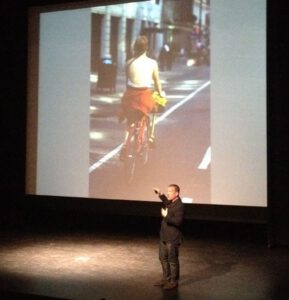
He briefly described his work and blog. He expressed that photography is a quiet act and its a surprise to go out and talk to large groups like this. He grew up by reading fashion magazines, which he thinks trained his eyes for how to see. At first I was concerned he was simply going to talk through his personal history, but listening to him explain why certain photographs were meaningful for him was fascinating. It’s hard to capture in notes here how much value there is in a generous expert honestly talking through work they admire.
When he moved to Brooklyn as a young man from Indiana, he didn’t know anyone. Walking on Atlantic avenue, he saw a postcard of a couple on a boat and it moved him. It had an emotional effect. The first real photographic images he bought. He talked through a series of images and what they meant to him. He likes to think his images start a story. Good photographs don’t tell you everything.
Photographs lose their initial meaning over time. They are taken in one context for one reason, but live on, and take on meanings, often superficial ones, by those who come later who do not know the context.
“The truth of a photograph is less interesting than the romance… allowing the romance is sometimes the most interesting part [as a photographer]”
He told a story of following a young woman on a bicycle, while on a bicycle, trying to time it right to take a good picture. And he worked hard to find the right angle and exposure, while moving. And later he realized a detail he’d missed: she had a metal right leg. A powerful detail that was entirely circumstance.
He wonders what photograph wil mean with digital photography and tumblrs, and the digital natives who don’t know what photography used to mean as an expensive, physical object, rather than cheap, easy, fast digital photography. Images on the internet are so easy to share that it makes the images themselves mean something else. He thinks it’s fascinating, unlike photographers of the past, that modern photographers can capture in the present, and 5 and 100 years from now, what people in any moment though of a particular photograph.
Aye gave the history of his work as designer working with the CTA (Chicago Transportation Authority) and other projects.
Transportation is the interaction of people’s choice and government. Includng tensions. The CTA has anxiety and a history of animosity between transportation users and employers “we’d have a great service if [it] weren’t for all those people”. In this sense The CTA’s main focus is to logistical expertise. They’re similar to FedEx – except these packages contain people. But as a designer, Aye was interested in the experience of being inside those packages.
After 11 months leadership changed at CTA, support for a designer (or for Aye) diminished, and he was fired. Now he’s a professor and wants to use what he learned to teach designers are everyone from the challenges he encountered. He created GGS to answer the question how can we help? And they realized what they needed was a ‘new model for public engagement.’ A new way for people to access the information and services CTA(?) already have.
Initially he resisted crowd sourcing, but realized there was a role for all kinds of research, including the messy, unfiltered elements of involving many people. He used his frameworks from being a teacher to consider the entire problem different: the city is a classroom. Which led to a new term: public design team. “Everyone of you in this room has a slightly different perspective on transit” and the spirt was to be open about finding ways to incorporate many of those views into the process.
Which led to…. a mobile app. To help people navigate the city. They launched a public kick starter campaign, which was terrifying. They set a goal of $125k, but only got $23k. Which was devastating.”After crying myself to sleep… he realized they were free from all of the expectations.. it didn’t matter if they screwed up again since they’d failed so largely before”
“Succcess hides learning” he realized. And what he’d learned was the project was much to complicated. They needed to simplify.
They developed three principles:
Give the team a role and a name. They came up with the title “Urban Agent” and people loved it. Volunteers could refer to themselves as “Agent #23”.
Ask questions that respect your team. There are no stupid questions but there are some that are deeply flawed. Assignments should be clear and real “observe your commute and look for transit tools – what could they do differently?”. Because they asked in a particular way they prevented people from whining. There were 300+ submissions.
Give the team tools so they can respond with solutions. “How can non designers help with design?” He believed the only prerequisite was to have motivation and an idea. 600 ideas were submitted, which were narrowed down to 70 app features. Then they went to wireframes. [but he didn’t explain what the final app is and how it did – if anyone has linkage leave a comment]
I had to prepare for my own talk and sadly didn’t take notes for Capron’s talk. If someone else took notes please leave a comment with a link.
Scott Berkun (me), Saving Your Creative Soul
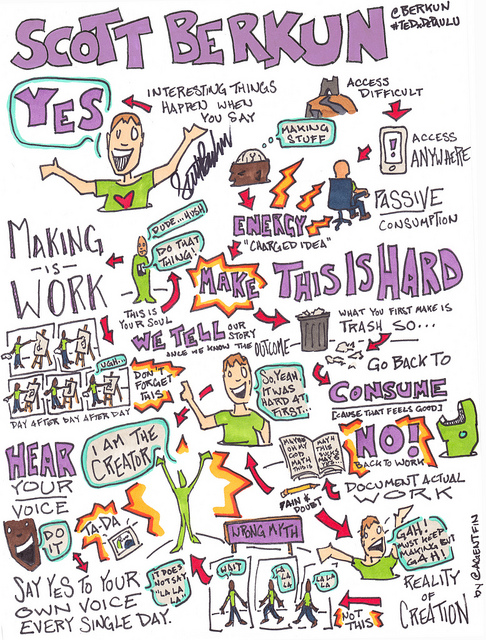
I talked about the wide gap between consuming information about creativity and actually making things yourself. To make good things demands connecting with yourself, your soul, and the voice inside you that you have to work to hear. I referred to the film The Mystery of Picasso.
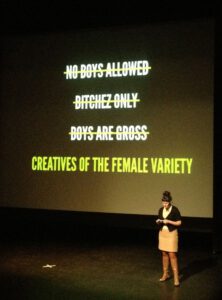
Elaine is an art director, involved with a group of female creatives called Quite Strong.
She opened by talking about advertising, and showed a short film by Gene Kilborn [killing us softly] about gender bias in ads:
Ads sell more than products – values, perceptions, morals
Cindy Crawford once said “I wish I looked like Cindy Crawford” – no one looks like they actually look
She studied women’s studies in school, and marketing and advertising and thought “what a bunch of assholes…[advertisers] ruining everything”. Apparently beer ads are known as being the most evil. But there is still room for good work: Budweiser did an add with the bottle cap as a crown. Compelling, simple and without any cultural issues.
She decided “I am going to change this industry from the inside”. On an early photo shoot she managed to hire a size 14 model, something unheard of – but they resized her in post production. She also worked on beer ads for Coors (w/Ice Cube).
She helped create Lustlist – a curated list of female talent they admire. Artists, directors, etc. to highlight their work and a place for advice for female creatives. In the beginning all they had was each other for confidence, but soon we were asked to speak at events. At the first of 2o speakers, 2.5 were women. Design conferences are better. But she noticed men speak differently and more egotistically, but that in some ways she admired that style: “hey what’s up, here’s my work, it’s cool, I get paid a lot of money for it… {mic drop}”. Women tend to focus too much on other people and the community rather than themselves.
6 out of 20 of top 20 are women on top ted talks. For the “Most Persuasive” top 20 list it was all men except one, where ironically the woman was speaking about women representing women in media. She joked it’s called TEDx, non TINAx or TabithaX.
With some colleagues she created the Moxie conference, with the tagline “Make that cheddar (money). Look good doing it.”
She was honest in saying “What merit did we have to throw a conference? We had no merit. But we wanted to practice what we preach” It was a success, and 40% of attendees were male, which they were proud of: their agenda wasn’t too big to include everyone willing to participate.
Question to ask when making work:
Is this coming from a conscious place
statement bigger than myself
You have the power to vote with your $$, vote with interests, likes & shares
“it’s either you [in the TED audience] or the people posting youtube comments, and they’re not stopping any time soon”
Kadavy is a designer and talked primarily about design literacy. He offered that when people across the web get angry about something it’s the sign of something big. He told the story of the origins of ComicSans font. It goes back to 1994 during planning for Microsoft’s Windows 95 launch. Microsoft Bob, a product in development at the time, had a talking dog as part of the UI. Vincent Connare, a type designer at Microsoft recognized the font the dog talked in, Times Roman, was out of context and a mistake. A cartoon dog should talk in a cartoon font. He went and created Comic Sans font. But it turned out to be too late to change Bob. Comic sans shipped in Windows 95 anyway and has been (ab)used ever since.
Connare never intended the font to be used as it has. For every 1000 people who say CS should never be used, there’s one guy who uses it anyway and says “I don’t care what you think” and anyway it’s just a font. Computers have granted everyone the power to be designers for better and worse. Connare was a craftsman. He’s emabarassed that his career is associated with this font, used in ways he never anticipated. Each of us is a craftsperson and can make things for others to see.
More people search for “comic sans hate” every year. [I wondered if more people do more searches every year]
Guttenberg, who made Europe’s first movable type printing press, made it possible to take an idea from one brain and give it to something else. In other words printing and publishing networked people’s brains.
Two big obstacles:
The more people there are making things, the harder it is [because of competition] to get it to people’s brain (A modern mobile phone is a network and a printing press)
When making for others what you like and what they like won’t be the same
He created an unnamed site that failed and then started redditgifts without co-ordinating with reddit. He was a reddit user and knew their inside jokes. He’d also been involved in one of the early kickstarter campaigns, based on the Jetblue travel challenge, in 2009 (Fly for 30 days, up to 15 cities, for $600). Two people did it and blogged about it. This led to an idea for something related to reddit – gifting to strangers (aka secret santa).
Their first rule for people who signed up was: Don’t be a dick. Since this involved strangers, the internet and sending things, they feared people who send gag or mean things. They built a very simple website that didn’t do much. That first Christmas in 2009 4380 participants in 52 countries participated. It was awesome for him, but super scary for many reasons. Now that it worked, they’d need to build out the site to cover:
proper signup
a profile of likes / dislikes
matching process (equivalent of pull names out of a hat, but smarter)
A way to report you got and how much you spent
if you get a gift – you post pictures
Reminders system
They wanted to make it easier to “friend stalk” participants so a stranger could learn enough about them to send a really good gift.
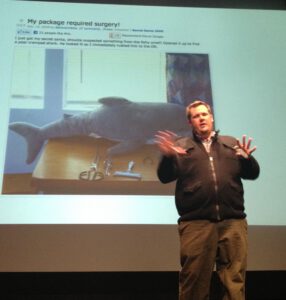
Beyond the tech challenge, wondered if people would abuse it and send garbage? it was scary and Exciting. The First gift sent was copy of the game Half Life 2. The next gift Dan mentioned was called Package required surgery (photo here)– they packed a set of gifts, based on research of that stranger, and stuffed them in a stuffed shark. “We put your present in the shark you are going to have to do surgery to get your gifts out”. The person who received it brought it full circle: and took photos as if it were real surgery. Other gifrst includes $1500 in cash. Hand paintings. Amazing – was famous on the web.
[He showed many great photos of gifts and the responses from the recipients. I’ll try to dig some up later online if I can]
They wondered Was it just Christmas? Or could we do this around a day of our own invention? They tried another day. Named: Arbitrary day.
2010 – signups quadrupled. Showed picture of crazy portraits (found their picture and painted them a portrait).
2011 – Jimmy Fallon participated as did Stephen Colbert. $1million in gifts to strangers were sent. Someone sent a case of live crabs to eat and the receiver posted as a joke “I got crabs from an internet stranger.” They did another version for U.S. troops and another that worked one-way (not reciprocated).
2012 – even bigger – $2 million, 127 countries
WHY? Is it working? Why does it grow? He saw a recent TED talk about using money to buy happiness, it can help but you have to spend it on strangers. That’s basically what redditgift is to him, this idea improved and amplified by the web.
He’s an artist in what is sometimes called Glitch art, where something that is commonly called ‘broken’, like a blinking street light, or a tv that only plays static, is recontextualized into another creation and used for another purpose. He believes glitches are powerful because they break us out of the context of being a consumer: What’s wrong? Is it my tv? my web connection? The software? We pay attention and the illusion the maker tried to create is broken. All systems are unstable and messy if you pay attention, just like we [as human beings] are.
Glitch safari: looking for glitches in different mediums and places. Referring to updating software: “My art sometimes breaks when things get fixed.” When stuff stops working the way I want [due to upgrades and such], it forces me to make new work.
His work is often called Brikolage, working with curating found objects. He looks at something like Word, the Microsoft application, is a collection of sounds, scripts, icons and code, and to him all of this is fair game. [And showed video of one of his works based on Word – I couldn’t find it but here’s a similar one called Windows Rainbows and Dinosaurs].
Satromizer – iPhone app for glitching he made with a collaborator.
Glitches are more than a stunt: but a philosophy of creation and awareness. Glitches offer us a chance to see things we depend on and forget about differently. He invites us to take a moment when we encounter them and consider what it means.
Betsy Hoover, Online organizing directory for Obama Campaign
She asked the audience to think about a social problem that requires a community to solve.
She studied at Xavier and was interested in community building. Went door to door in Cincinnati to ask about what they liked and disliked about their neighborhood. She heard 6 people tell her they wanted a speed bump, to protect their children. They were surprised many people had the same issue. She brought it through the right government channels, and made it happen. And this inspired her to do even more.
She worked on the campaign, and after they won South Carolina Primary the campaign was broader, and she was interested in using online tools. Rather than go door to doo she found MYBO which was pivotal in the campaign.
She continued doing online community and found the switch from offline to on was very similar She never imagined the internet would be central to her work, but it’s not surprising now. These were people who cared and the task was to help them relate to each other: organizing.
Discovered subject lines with the most casual subjects did best. They were treating the recipients as people (She joked “Sorry for all the emails (not really) but thanks for all the action”).
In 5 weeks someone who joined rose form being an unknown local volunteer rose to play a key role in the Ohio campaign. [I think her point was the online tool created local engagement that would have been unlikely without it].
Always have to meet people where they are. Not on obama.com, but on reddit. Many people don’t self select to join a community. But Reddit was a risky place to be (as a president). 30k people registered in one day, their highest spike in the campaign until near the end.
Modern Americans are hard to reach by phone. They move, they don’t answer cell calls to numbers they don’t know. But 85% of unreachable people can be reached online, through facebook, through their friends. Friends as messengers is the most powerful way.
If you are an organizer, you are not the best representative to get the people you don’t have already. Your friends or subordinates might be, but you definitely are not.
The internet is not a holy grail: it’s just a tool. Use it to build relationships.
[He arrived late and apologized for being dressed casually: he was in a bike race. He was slated for 5:30 and luckily didn’t need to go on until 6:00, which he joked about a bit. He carried all this well and got laughs but it was disrespectful on principle]
His company started as a small coffee roaster, now has coffee bars across the U.S. and 1000 wholesaler accounts, and buy from 20 counties, paying above fair trade values.
What’s required to build a great brand?
Conviction: you do what you say you’re going to do. Patagonia is a great example. That’s how you make brands that last.
Unimpeachable quality: if you build brand well it will last forever. Four Seasons started as a motor inn in Toronto. When it moved into London it had to change to compete. They decided on unimpeachable quality as their goal. Every detail smacks of quality (Also mention Krug champagne).
People see through lack of authenticity There are many inventa-companies (“we thought of this while out on a hike”). Levi’s embodies this. Gold rush history, 200 [it’s more like 130] years later the jeans have the same quality. Dockers however have lost their way. In coffee they see many other brands jump in and them jump out. They don’t commit completely, or aim to deceive customers about what they are.
Innovation and evolution. JCrew launched as preppie brand when he was in college, but now have reinvented themselves. Went from preppie and sleepy to leading edge. The tiring part is, just when you’re getting sick of your brand, the public is just starting to get it, they’re chasing you and are behind you. You need to be patient, but always working on what’s next. There are brands that just fell asleep for 3 or 4 years [and don’t survive].
Integrity. It took 18 years to have the success he has now, and deflects praise he gets from others (“Google started after we did”). If you are going to build a great company and brand you have to have the utmost integrity. It’s easy to do things that are cheap and low quality but it won’t last.
Be deliberate. Where do you want the brand to go? Even successful companies lose their confidence and way. Apple is a good example for their patience and dedication to quality.
He talked about how bike races don’t need to talk or make excuses. Great brands also stand on their own, with little artifice [which didn’t jive to me with him being cavalier about being late].
For years I’ve studied use and abuse of the word innovation. In the business world, it’s often used as a empty filler word, without meaningful intent. You can test this by simply asking someone using the word: what does innovation mean? Rarely will they have an answer, which is a good sign it has become a nonsense word. I’ve complained about this, which leads to people ask me to do more than complain, and to offer a definition.
I generally recommend people don’t use the word at all when working. Use more thoughtful words instead. Most importantly, simply dedicate yourself to solving problems. It’s solving problems that matters. Instead of saying “our goal is innovation”, which is vague, say “our goal is to solve THIS problem for THESE people”, or admit that your first aim is to decide which problems you’re going to solve and for whom.
If you must use the word, here is the best definition: Innovation is significant positive change. It’s a result. It’s an outcome. It’s something you work towards achieving on a project. If you are successful at solving important problems, peers you respect will call your work innovative and you an innovator. Let them choose the word.
This is a high bar, and it should be. To call every change you make in your work an innovation belittles the possible scale of progress. The act of creating something, even if it solves a problem, should perhaps still not be considered an innovation until it is adopted by other people (see Innovation vs. Invention). Until then, it’s just an invention with the potential to be an innovation. If you are an engineer, a designer or a start-up founder, inventing things is simply your job.
What does significant mean? I’d start with the invention of the light bulb, constitutional governments, wireless radio and the Internet. Perhaps you could say significant is a 30% or more improvement in something, like the speed of an engine or the power of a battery. If you know the history of your profession you know the big positive changes people made over the last 50 years, giving you perspective on the scale of brilliance you need to have to be worthy of that word.
But if you use word lightly, or frequently, you show hubris in the present and ignorance of the past. Sayings like “we innovate every day”, “chief innovator” or “innovation pipeline” are inflations. They’re popular, but misguided. Calling a thing an innovation doesn’t make it so. It’s just a word and words are free to be abused. If you think about it, it’s easy to separate mere improvements from something worthy of grander praise.
The best thing to ask anyone who uses the word innovation is: what do you mean when you say that?
Most of the time people have no idea what they mean (or realize they really just mean one of these). And once they admit this, that’s when you offer the definition above.
[Note: I can’t claim that I came up with this definition. I’ve read dozens of books on the history of invention and progress that influenced me before ever realizing an improved definition was necessary. Suggested sources are welcome.]
Clay Hebert recently posted on the The Best Conference Hack, which is simply sitting in the front.
As a frequent speaker I like Clay’s advice. For speakers the empty front row is mysterious and frustrating. Speakers make a huge commitment, yet audiences who have little at stake show their lack of faith by staying back. Unlike a rock concert, somehow the 5th row is more desirable than the 1st.
I think better advice than Clay’s is to participate and speak about something. Many conferences offer Ignite or lightning talks, allowing many attendees to share their voice. This is by far the best conference hack: participate. It puts you in the middle of things. Volunteering has similar benefits without the stress.
But the surprise is, when I’m an attendee I don’t listen to all the speakers.
Sometimes I barely go in the session rooms.
Everyone has different learning preferences, and I know mine: I find it hard to listen to lectures, but I’m a tremendous reader. Unless the speaker is very good, which is rare, I’m better off reading their book or their blog which I can do at my own pace. As I wrote about in Confessions of a Public Speaker, lectures were never a good way to learn skills. They’re passive, non-interactive and rarely performed by people good at lecturing. I know it’s ironic that I have a low tolerance for lectures as I make a living giving them.
Conferences are a compromise: you get access to popular experts, but it’s broadcast access. This is a good deal if it’s your only option or your learning style matches what you get at the conference. But for me it’s conversations, which are two way, that I learn the most from. Conferences use speakers as MacGuffins, drawing attendees to come, but often the “side stuff” has the highest payoff.
Typically at events I do the following:
For talks I’m excited about, I’ll sit in the front as Clay suggests. But this is rare. It’s not a judgement of them, it’s a judgement of how I learn.
Frequently I sit in a back aisle, especially at a multitrack event. I’ll take aisle near the front if I can. In 7 minutes I can tell if the speaker has prepared well enough to warrant me staying. If I’m not convinced, I’ll move to another session – this is hard to do if you’re in front (unless you’re fortunate to have the aisle and brave enough to leave it).
Often I’ll listen for 5 or 10 minutes to evaluate their credibility: then I’ll buy their book, or subscribe to their blog, and move on. Or stay if I think I’m getting something special I can’t get any other way.
I regularly wander the halls and talk to others who are bored by lectures. They’re like me: better at doing than sitting and listening. I’ve learned great lessons from the conversations during sessions. The halls are not packed during sessions and it’s easier in some ways to start conversations.
If I commit to blogging the event, my attention improves. At Failcon 2012 I reported on the talks and I found this helped me focus. But it changes how you listen: it’s a shallower experience in some ways as you’re rushing to get things down. And to do it properly required far less interacting with other attendees. LukeW is the master of this: see his notes from 200+ talks.
But this is merely what I do. Unless your learning preferences match mine, don’t do these things.
If you don’t know how you learn best, experiment. Go to different kinds of events that offer different experiences. Better events invest in different kinds of learning, with things in the hall for people like me, and well prepared speakers worthy of all the attention the front row can give them.






 This is now the edited version of my notes from
 Photographs lose their initial meaning over time. They are taken in one context for one reason, but live on, and take on meanings, often superficial ones, by those who come later who do not know the context.
 Elaine is an art director, involved with a group of female creatives called
 They wanted to make it easier to “friend stalk” participants so a stranger could learn enough about them to send a really good gift.
